
The breaker keeps tripping again, the HVAC sounds like it's straining, and the building manager is staring at another service call before lunch. In Palm Beach County, that kind of problem usually shows up when a property has outgrown its electrical service, but the equipment still has to keep running through heat, humidity, and long cooling cycles. Three phase electrical installation is often the practical answer because it gives larger loads a steadier path to run without asking one circuit to do all the heavy lifting.
Table of Contents
- Why Three Phase Electrical Installation Matters
- Understanding Key Concepts
- Benefits and Common Applications of Three Phase Power
- Components and System Layout
- Installation Steps and Safety Considerations
- Cost Factors and Return on Investment
- Troubleshooting and Maintenance Tips
- Why Choose Lighthouse Energy Services
Why Three Phase Electrical Installation Matters
A property manager in Palm Beach County usually notices the problem in the most frustrating way, a refrigeration rack stumbles, a rooftop unit cycles hard, or a production motor trips a breaker right when the building is busiest. When that keeps happening, the issue isn't just inconvenience. It's downtime, stressed equipment, and a service panel that's doing more than it was ever intended to do.
Three-phase power solved this class of problem long ago because it was built for heavier loads and more efficient distribution. By the early 20th century, it had become the standard for large-scale power distribution because it could run heavier motors and move more power efficiently than earlier single-phase systems, according to the history of AC power development. That matters in Palm Beach County, where commercial kitchens, offices, clinics, and mixed-use buildings often depend on air conditioning and motor-driven equipment for day-to-day operation.
There's also a local planning angle. In a coastal climate, electrical systems spend their lives under stress from heat, humidity, and constant cooling demand. When a site is already close to capacity, the better move is often to design the service correctly instead of repeatedly resetting breakers and hoping the load settles down.
For owners trying to understand where large utility systems fit into the bigger picture, the way OGE powers 900,000 customers offers a useful example of how large-scale power delivery depends on infrastructure planning, not just equipment.
Practical rule: if a facility depends on motors, HVAC, or mixed loads that can't afford a long outage, the service design has to be treated as a reliability decision, not just a wiring upgrade.
Understanding Key Concepts
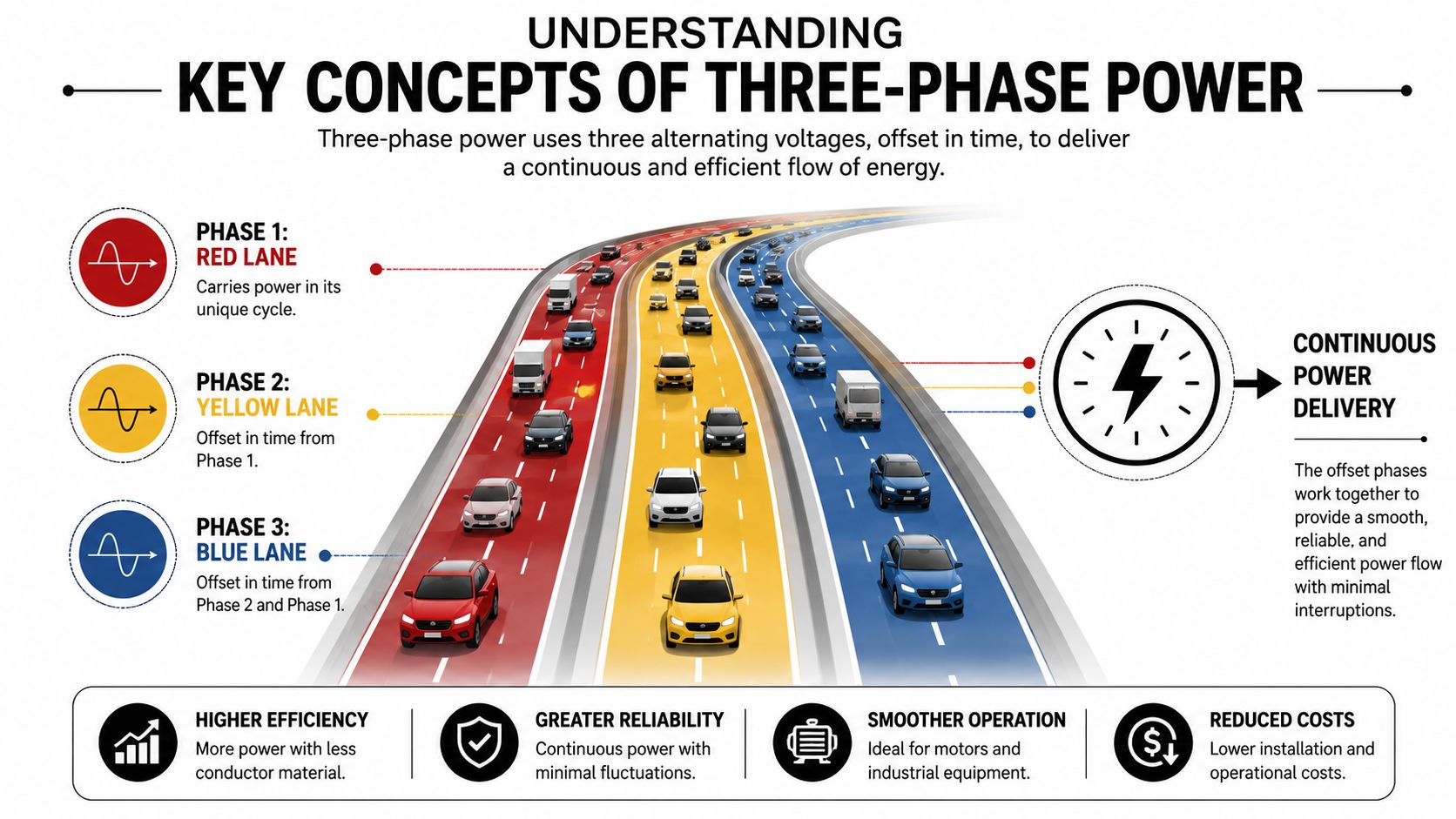
The easiest way to think about three-phase power is to picture a three-lane highway where traffic keeps moving even when one lane is momentarily lighter than the others. Each lane represents a phase, and the loads are spread across all three so the electrical flow stays smoother than a single alternating wave. That smoother delivery is why motors run more evenly and why larger facilities rely on it for steady performance.
The historical proof matters because this isn't a theory that sat on a whiteboard. In 1891, Mikhail Dolivo-Dobrovolsky demonstrated a three-phase, three-wire system sending electricity over 176 km with about 75% efficiency at the International Electrotechnical Exhibition in Frankfurt, showing that long-distance AC power could be delivered with relatively low losses, as recorded in the historical overview of three-phase electric power. That demonstration helped establish the technical foundation behind the systems used today in industrial facilities, commercial buildings, and utility transmission.
What phase rotation means in practice
Phase rotation is the order in which the three phases arrive. If the sequence is wrong on a motor-driven system, the equipment can run the wrong direction or behave unpredictably. Electricians check this before commissioning because a motor that turns backward can damage pumps, compressors, or conveyor equipment.
A useful mental model is this. Single-phase power is like pushing a cart from one side, then letting it coast. Three-phase power is like three people pushing in sequence so the cart keeps moving more smoothly. The result is less pulsation, less vibration, and a better match for equipment that wants constant torque.
“Continuous power delivery” is the key phrase to remember. The point isn't just more power, it's more even power.
Why the concept still shapes modern installs
Three-phase systems are still used because the original engineering solved a real problem, moving substantial power without excessive loss. That's why the idea shows up everywhere from utility service to building distribution. When you understand the phase relationship, the rest of the installation, from panel layout to load balancing, starts to make sense.
Benefits and Common Applications of Three Phase Power
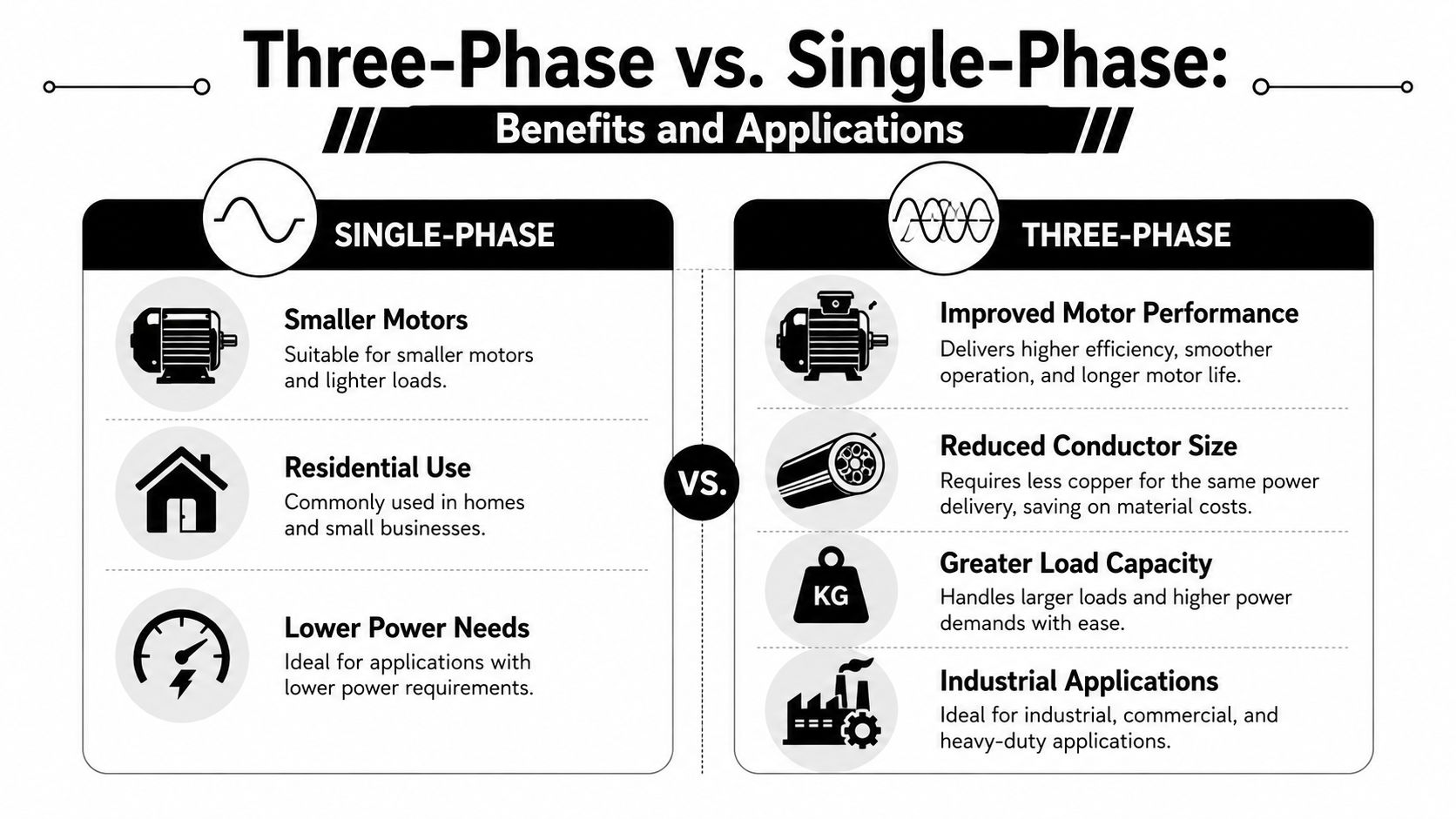
A property can outgrow single-phase service faster than many owners expect. Once motors, compressors, pumps, and larger HVAC equipment start asking for steadier delivery, three-phase power becomes the cleaner fit because it spreads the electrical work across multiple conductors instead of making one path do everything. The result is smoother operation and less strain on equipment that needs a constant supply.
The practical difference shows up in everyday operation. Single-phase service usually works well for light residential loads, small offices, and modest appliance use. Three-phase service makes more sense when the building has heavier machinery, longer runtimes, or equipment that reacts badly to uneven power, such as vibration, heat buildup, or repeated starts and stops. That is why contractors often recommend it for properties that need more stable performance, not just more capacity.
Where three-phase shows up most often
A retail site with refrigeration, a clinic with demanding mechanical systems, or a warehouse with powered equipment moving throughout the day can all benefit from three-phase service. Homeowners may also run into it when adding larger HVAC equipment or other high-demand loads that the existing service cannot support comfortably. In each case, the value is not only the size of the service. It is the way the load is shared, so no single circuit is pushed too hard.
The local angle matters in Palm Beach County because service upgrades are rarely just a wiring question. Permitting, inspection timing, service size, and equipment layout all affect how the job moves from plan to approval, so it helps to work with an industrial electrical contractor work in Palm Beach County that understands those steps before the installation starts.
Three-phase also gives property managers more flexibility when the building may change use later. A space that begins with a few motor loads can be arranged so the service supports future expansion without forcing a full redesign. That is useful in commercial properties where mechanical equipment, tenant needs, and operating schedules can change over time.
Delta and wye choices matter here, especially because the neutral conductor is not handled the same way in every setup. In a delta arrangement, the neutral may be omitted or used differently depending on the load mix. In a wye arrangement, the neutral is often part of the design so line-to-neutral loads can be served properly. That is where careful planning prevents confusion later, because the conductor count, grounding path, and panel layout all depend on the configuration. For an example of how varied service needs can be matched to site requirements, see the Abuja colocation facility details.
Modern installations also pay close attention to phase imbalance. When one phase carries far more load than the others, equipment can run hotter and less efficiently, and nuisance issues can show up at the panel or at the motor. Electricians handle that by distributing loads across phases more evenly, checking branch circuits during commissioning, and revisiting the arrangement as tenants add equipment. In practice, this is similar to balancing weight on a three-legged stool. If one leg carries too much, the whole setup feels unstable.
Field insight: three-phase power is not just about delivering more electricity. It gives the building a way to move that electricity in a steadier pattern, while keeping motors, HVAC equipment, and distributed loads from working harder than necessary.
Components and System Layout
A three-phase system makes more sense once you stop looking at it as a single piece of equipment and start following the power path. Electricity enters through the service equipment, moves through panels, and then splits into branch circuits so each load gets the supply it needs. The layout changes from property to property, but the aim stays the same, deliver power cleanly and keep the phases balanced.
The main pieces in the system
A typical installation may include transformers, switchgear, distribution panels, busbars, and conductors sized for the load. The transformer adjusts service characteristics where needed, switchgear provides switching and protection, and the panels divide power into usable circuits. Busbars carry current inside the enclosure, while conductors carry the service from one point to the next.
Property owners often expect every three-phase circuit to look alike, and that is where confusion starts. The system has to match the equipment on site. A building may have motor loads that use line-to-line power and smaller loads that need a neutral path for line-to-neutral circuits. The conductor count, grounding path, and panel arrangement all depend on that mix.
Delta and wye change the layout
In some setups, the system is delta, in others it is wye, and the neutral conductor may be omitted or handled differently depending on the load mix, as shown in this explanation of three-phase wiring arrangements. That choice affects panel design, what can be fed from the same distribution board, and how easily single-phase loads can share the system with three-phase equipment.
Practical rule: if a building needs both motor loads and line-to-neutral loads, the neutral question changes the panel layout and the circuits that can be connected safely.
A wye arrangement is often easier to plan when mixed loads are involved because it can support line-to-neutral circuits where needed. Delta can work well too, but it is a different design choice, not a shortcut. The right setup depends on the equipment list, the service plan, and the way the building will use power.
For property managers in Palm Beach County, the layout also has to fit local permitting expectations and the way the service will be inspected. That matters when the design includes phase imbalance management, because load sharing across phases needs to be considered early instead of corrected after the panel is already built.
UPS and PDU redundancy options become part of that planning in facilities that need backup power distribution. In those cases, the phase layout has to support the backup scheme without creating avoidable imbalance or leaving the neutral arrangement unclear.
Installation Steps and Safety Considerations
A three-phase installation starts long before anyone opens a panel. First comes a site assessment, because the electrician has to understand current loads, future expansion, service access, and where the equipment can physically fit. In Palm Beach County, that planning stage also needs to align with permitting, utility coordination, and local inspection requirements before work begins.
A practical project sequence
The workflow usually follows a clear order.
- Site assessment: Confirm the existing service, identify the loads, and decide whether the building needs a new service path or a rework of the existing one.
- Equipment selection: Choose the service gear, panels, and protective devices that match the load profile.
- Permit filing: Submit the package required by the local authority and coordinate any utility service agreement that applies to the upgrade.
- Rough-in and placement: Set equipment locations, plan conduits, and prepare the path for conductors so the install stays organized.
- Pulling and terminations: Run conductors, land them correctly, and verify that the system matches the approved design.
- Testing and inspection: Check phase rotation, voltage, grounding, and overall operation before the final approval.
For a local contractor workflow that fits this kind of project, the commercial electrical installation service page is a useful reference point for how large property jobs are typically handled in Palm Beach County.
Safety comes first, every time
Lockout/tagout should be standard practice before anyone touches live components. PPE matters too, because electrical work can expose a technician to shock, arc risk, and falling debris in older mechanical spaces. The exact gear depends on the task, but the habit never changes, verify the system is de-energized, test before contact, and keep the work area controlled.
Grounding and bonding deserve the same attention. A system can look fine on paper and still behave badly if connections are loose, corrosion is present, or the grounding path wasn't completed correctly. That's why final testing matters as much as the initial installation.
“A clean install is only half the job. The other half is proving the system is safe before anyone depends on it.”
In Palm Beach County, inspection timing can also affect the schedule, so the smartest approach is to build the permit and inspection milestones into the project from day one. That prevents the common mistake of finishing the electrical room and then waiting for paperwork to catch up.
Cost Factors and Return on Investment
Three-phase installation costs vary because the job is really a bundle of separate expenses, not one line item. You're paying for service equipment, conductors, conduit, labor, and the permitting process, and each of those changes depending on the building size and the existing infrastructure. A straightforward retrofit is one thing. A service upgrade that requires new routing and more coordination is another.
What drives the budget
Material costs usually hinge on how much new gear the project needs. Larger panels, switchgear, and conductors add cost quickly, especially when the existing infrastructure can't be reused. Labor also matters because careful terminations, testing, and coordination take time, and projects in occupied buildings often need more staging to keep operations running.
Permitting and inspection work are part of the budget too, especially where the utility and local authority both need to sign off on the service change. In Palm Beach County, that paperwork is not optional, and the project schedule should reflect it from the start.
The return on investment usually comes from three places: better equipment performance, fewer nuisance shutdowns, and less stress on motors and HVAC components. If a building has been fighting frequent trips or unstable operation, the upgrade can pay off in reduced disruption even before anyone tries to calculate power savings.
How to think about payback
A small clinic may value three-phase service because it protects refrigeration, air conditioning, and critical equipment from avoidable interruptions. A retail store may see the main benefit in keeping cooling and display equipment stable during busy hours. A light industrial site often cares most about the way balanced power supports machinery and future growth.
I'd frame the decision this way. If the property keeps running into load limits, the “cheap” option is often the one that keeps failing. A properly designed service upgrade can cost more at the start, but it can also reduce repeat service calls, equipment wear, and lost operating time.
For owners evaluating power quality as part of the budget conversation, power factor correction guidance can help explain why electrical efficiency and load behavior matter when planning larger systems.
Troubleshooting and Maintenance Tips
Once a three-phase system is running, the work is not finished. Even a well-designed installation needs periodic checks because building loads change, motors age, and terminations can loosen with heat and vibration. A property may operate normally for a while, then start showing trouble when one phase begins carrying more than its share.
A simple way to think about it is this. A three-phase service works best when the load is spread out evenly, like three legs supporting the same table. If one leg takes too much weight, the whole setup starts to strain. In Palm Beach County, that strain can show up as nuisance trips, warm panels, or equipment that runs harder than it should, especially when the original service choice did not account for later load growth or the neutral conductor needs of a delta or wye configuration.
What to check first
Start with the obvious signs. If motors sound different, breakers trip without a clear reason, or lights flicker when equipment starts, look for imbalance or a poor connection. Modern best practices focus on diagnosing and preventing phase imbalance through load redistribution, power-quality monitoring, and corrective equipment that helps reduce voltage fluctuations, according to engineering training on imbalance management.
The neutral conductor deserves attention in this same review. In a wye system, the neutral can carry the unbalanced return current, so its size and condition matter. In a delta setup, especially where a high-leg or corner-grounded arrangement is involved, the wiring choices are different, and a mistake there can hide a problem until the load changes. That is why a permit review and field inspection should both match the actual system design, not just the label on the panel.
Thermal imaging is useful because hot spots often reveal loose terminations or stressed components before a failure becomes obvious. A routine tightening audit matters for the same reason. If a connection has worked loose, heat usually shows up before the breaker does anything dramatic.
A simple maintenance checklist
- Phase load checks: Compare the load on each phase and shift circuits if one side is carrying too much.
- Voltage readings: Watch for changes that point to poor balance or supply issues.
- Thermal scans: Look for hot conductors, lugs, and panel areas that should not be warm.
- Tightness checks: Reinspect terminations so vibration and heat cycles do not turn into failures.
- Corrective equipment review: If the site uses sensitive or nonlinear loads, confirm that the corrective strategy still matches the building's needs.
The most useful habit is steady observation. Small drift often appears before a major fault, and that gives you time to correct the issue while the fix is still straightforward. If a building is adding HVAC equipment, motors, or other heavy loads, the phase balance should be reviewed again instead of assumed to be fine because the system passed inspection earlier.
If the issue keeps coming back, it is time to bring in a licensed electrician who can test the system under load, review the phase layout, and decide whether the panel needs rebalancing or a deeper correction. That is also where a local service partner can be useful for ongoing troubleshooting and service work in Palm Beach County, especially when the job has to move quickly and cleanly. For owners who want a clearer picture of load behavior, power factor correction guidance can also help explain how electrical efficiency ties into larger system planning.
Why Choose Lighthouse Energy Services
A three-phase project leaves little room for trial and error. In Palm Beach County, the contractor has to understand service design, mixed-load planning, permitting, and how to keep a building running while the electrical system is being upgraded. Lighthouse Energy Services brings local licensing, 24/7 availability, transparent upfront pricing, and phones answered by licensed electrical professionals.
That local knowledge matters most in the details. Delta and wye systems do not use the neutral conductor the same way, and the wrong choice can create either wasted material or a system that is harder to keep stable under real building loads. Wye services often rely on a neutral for line-to-neutral loads, while delta arrangements may call for a different approach, such as a high-leg or corner-grounded setup, depending on the service and the equipment on site. In Palm Beach County, that decision also has to fit permit review, inspection expectations, and the actual mix of motors, HVAC equipment, lighting, and electronic loads a property uses every day.
The practical value is simple. Property owners and managers need someone who can evaluate the load, handle the install, and stay available when a problem shows up after hours. Lighthouse Energy Services also brings experience across residential, commercial, and industrial work, which matters when a three-phase job has to coordinate motors, HVAC, panels, and inspection requirements without creating new headaches.
Modern phase imbalance management goes beyond shifting a few circuits around. It can include measuring each phase under real operating conditions, watching for repeated drift as equipment cycles on and off, and checking whether nonlinear loads are creating uneven current that a simple reallocation will not fix. It may also call for reviewing transformer and panel loading, separating sensitive circuits from heavier mechanical loads, and confirming that the neutral conductor is carrying what it should without overheating or becoming a hidden weak point. That kind of follow-through helps a system stay balanced after the first inspection, not just on the day the work is signed off.
For a site already dealing with breaker trips, uneven loads, or a planned expansion, that kind of field experience can save a lot of back-and-forth. It moves the job from a guess to a verified installation, with the service layout, neutral choice, and load balance all aligned to how the building operates.
If you're planning a three phase electrical installation in Palm Beach County, Lighthouse Energy Services can review the load, explain the service options, and handle the work with local permitting in mind. Visit Lighthouse Energy Services to ask about an upgrade, schedule an evaluation, or get help with a three-phase system that needs to be installed, balanced, or brought back under control.