
Most business owners in Palm Beach County don’t go looking for power factor correction. They run into it when a bill looks wrong, a panel runs hot, or a piece of equipment starts acting touchy for no obvious reason.
You open the utility statement, scan past the kWh line you recognize, and then see charges that feel harder to pin down. Maybe it’s a demand charge. Maybe it’s a penalty tied to reactive power. Maybe the bill just keeps climbing even though production, occupancy, or operating hours haven’t changed much. That’s usually when the question comes up: what is power factor correction, and why does it matter enough to show up on the balance sheet?
The short answer is simple. Power factor correction helps your electrical system use power more efficiently. The longer answer matters more, because poor power factor doesn’t just waste capacity inside your building. It can raise utility costs, stress equipment, and create problems that look like “maintenance issues” when electrical inefficiency is the cause.
The Hidden Costs on Your Commercial Electricity Bill
A lot of owners first hear about power factor from an accountant, property manager, or maintenance lead who says, “Can you explain this charge?”
That’s a common Palm Beach County situation. A warehouse adds more motor-driven equipment. A condo property upgrades common-area systems. A retail center keeps HVAC and lighting running hard through the long cooling season. Then the monthly bill starts carrying charges that don’t line up with what the owner thinks they’re buying.
Utilities often penalize facilities with low power factor through higher tariffs, sometimes adding 10% to 30% to electricity bills in affected situations, and projected demand for these fixes is one reason the global power factor correction market is expected to reach USD 3.32 billion by 2030 according to Mordor Intelligence’s power factor correction market analysis.
What the bill is really telling you
Your bill may not say “you wasted electricity” in plain language. It usually shows up through demand-related charges, reactive power charges, or a pattern of costs that looks too high for the work being done.
If you want a cleaner read on what each line item means before you talk to an electrician, this guide to understanding your utility bill helps decode the charges that owners and managers often gloss over.
Why this gets expensive fast
Poor power factor is one of those problems you can pay for twice.
- You pay through avoidable utility charges when the utility sees your site pulling power inefficiently.
- You pay through electrical strain because the same system has to carry more current than it should.
- You pay again through maintenance when heat, voltage issues, and wear start showing up elsewhere.
Practical rule: If the bill feels harder to explain every quarter, your electrical system may be telling you something your accounting software can’t.
Understanding Power Factor with the Beer Mug Analogy
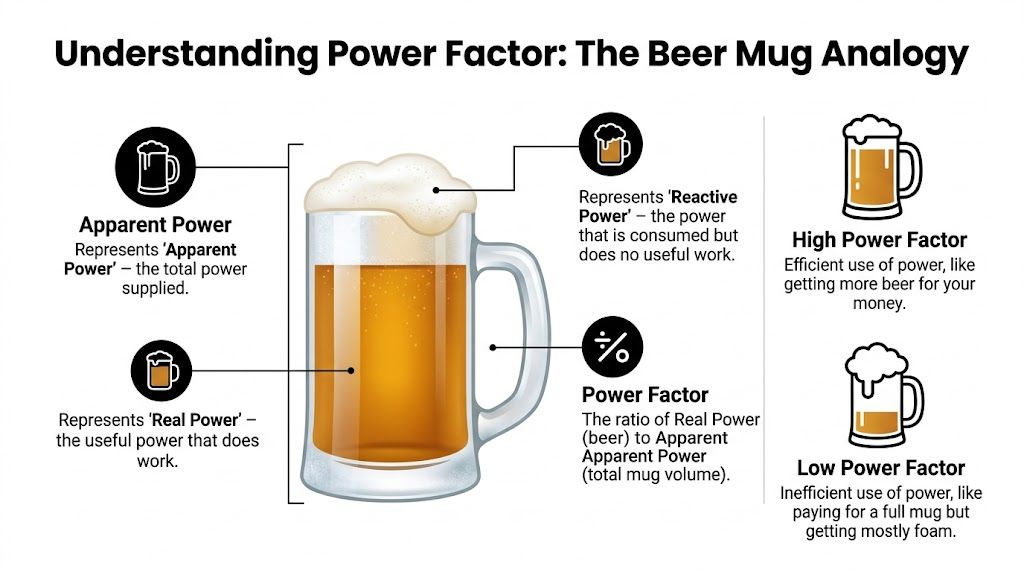
The cleanest way to understand power factor is the old electrician’s beer mug analogy. It sticks because it’s accurate.
The mug, the beer, and the foam
Think of the full mug as apparent power. That’s the total power your utility has to supply.
The actual liquid beer is real power. That’s the part doing useful work. It runs motors, drives compressors, powers lighting, and keeps your business operating.
The foam on top is reactive power. It takes up space in the mug, but you’re not drinking it. In electrical terms, it supports the magnetic fields that some equipment needs, but it doesn’t produce useful output on its own.
So the question behind power factor is simple: How much of the mug is beer, and how much is foam?
What a high or low power factor means
If your mug is mostly beer with just a little foam, that’s a high power factor. Your system is using electricity efficiently.
If your mug has too much foam, that’s a low power factor. Your site still needs the utility to deliver the full mug, but a bigger share of that delivery isn’t doing productive work.
That’s why low power factor costs money. You’re asking the electrical system to carry more than the useful work alone requires.
Where the foam comes from
In commercial and industrial buildings, the usual source is inductive load. Motors, transformers, and similar equipment don’t just consume working power. They also draw reactive power.
That’s why this issue shows up in places with:
- Large HVAC systems
- Pumps and lift stations
- Conveyors and process motors
- Compressors
- Transformer-heavy distribution setups
The technical ideas behind reactive power go back to Charles Steinmetz’s work in 1892, and by the 1950s North American utilities were already requiring many industrial users to maintain power factors above 0.90, as outlined in Eaton’s guide to power factor correction fundamentals.
Why owners get confused
People hear “reactive power” and assume it means useless power. That’s not quite right.
Some equipment needs it to operate properly. The problem starts when your facility draws more reactive power than it should, or when the system isn’t managed well enough to keep the balance under control.
A well-designed electrical distribution system doesn’t just deliver power. It delivers it in a way that supports equipment without wasting capacity on excess foam.
A low power factor doesn’t mean your building isn’t working. It means your building is working less efficiently than the utility and your equipment would prefer.
How a Low Power Factor Hurts Your Bottom Line
Poor power factor doesn’t stay trapped in an electrical textbook. It shows up in operating costs, equipment stress, and decisions you’re forced to make earlier than expected.

The first hit is on the bill
The most obvious problem is direct cost. Utilities don’t like serving inefficient loads because low power factor forces the grid and your local service equipment to carry extra burden. That’s why penalty charges and inflated demand costs show up.
A lot of owners focus on energy use alone. They watch consumption, but not how efficiently the site draws that power. That’s a mistake, especially in buildings with motors, chillers, pumps, and changing loads throughout the day.
The second hit is lost capacity
This is the part many businesses miss.
When power factor is poor, your conductors, transformers, and switchgear have to carry more current to deliver the same useful work. That means the system reaches its practical limits sooner. You may think you need a service upgrade because you’re “out of room,” when part of the problem is that the system is carrying too much foam.
Here’s the practical effect:
- Breakers and feeders have less headroom
- Transformers run under more strain
- New equipment becomes harder to add
- Expansion gets more expensive
That matters in Palm Beach County where facilities often layer new loads onto older infrastructure. Add refrigeration, EV charging, larger rooftop units, or production equipment, and hidden inefficiency starts costing real money.
The third hit is equipment stress
Low power factor often travels with symptoms maintenance teams already know well: voltage dips when large motors start, hot transformers, nuisance tripping, and equipment that seems to age faster than it should.
Those aren’t always caused by power factor alone, but poor power factor can make each of them worse. More current means more heat. More heat means more wear. More wear means more downtime and more calls for commercial electrical service.
The expensive part of bad power factor isn’t only the penalty line on the bill. It’s the way it quietly uses up capacity and equipment life at the same time.
Common Solutions for Power Factor Correction
Power factor correction isn’t one single device. It’s a group of approaches used to reduce excess reactive power and improve how your system behaves under load.
The main idea behind the fix
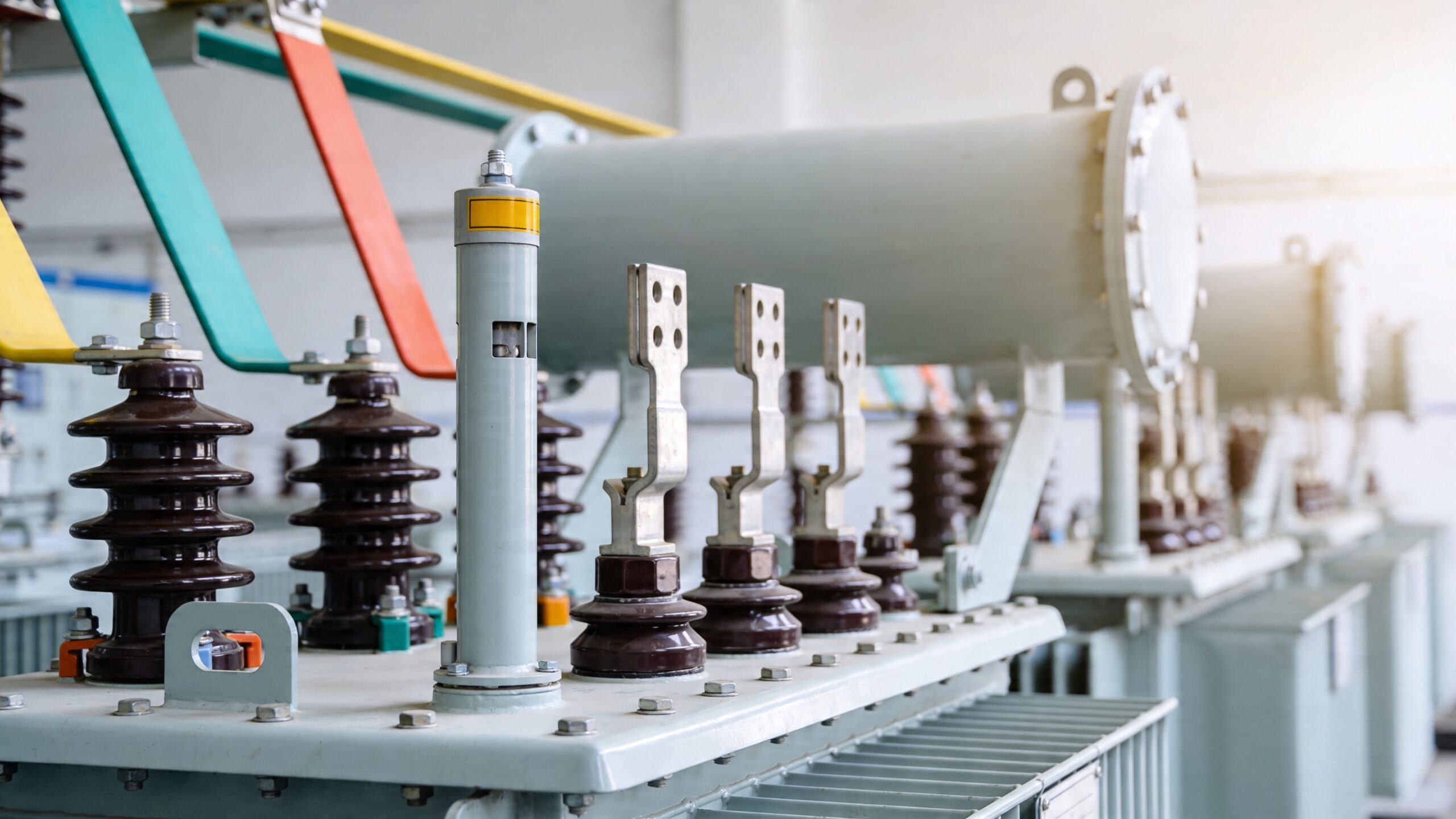
Most commercial and industrial correction uses equipment that supplies reactive power locally so the utility and your internal system don’t have to carry as much of it over the whole network.
Power factor correction works through displacement correction or distortion correction. Displacement correction uses capacitor banks to offset inductive loads, while distortion correction uses active filters to address harmonics from non-linear loads like VFDs. Capacitors are commonly sized to target a power factor of 0.95 to 0.98, as explained in Monolithic Power’s technical overview of power factor correction.
Fixed capacitor banks
A fixed capacitor bank is the simpler option. It’s usually best where the load profile stays fairly steady.
If a facility runs the same equipment at roughly the same level most of the day, fixed correction can make sense. It’s straightforward, but it doesn’t adapt much when the load changes. That can become a problem in buildings that cycle equipment on and off.
Automatic power factor correction systems
Automatic systems, often called APFC systems, switch capacitor stages in and out as conditions change.
That makes them a better fit for many real-world sites in Palm Beach County where the electrical profile shifts through the day. Think office buildings with varying HVAC demand, warehouses with changing motor loads, or mixed-use properties where occupancy patterns move around.
A contractor handling industrial electrical upgrades may recommend automatic capacitor banks when the load isn’t stable enough for a fixed setup. Lighthouse Energy Services also provides power factor correction solutions as part of broader electrical efficiency work for facilities that need demand-charge reduction and lower system losses.
Active solutions for harmonic-heavy sites
Some buildings don’t just have inductive loads. They also have non-linear loads such as VFDs, inverters, and electronic equipment that create harmonics.
In those situations, plain capacitors may not be enough on their own. Active power factor correction or filtering can help manage the distorted waveform, not just the phase angle problem.
That distinction matters because a site can have two separate issues at once:
| Issue | Typical cause | Typical response |
|---|---|---|
| Lagging power factor | Motors, transformers, inductive equipment | Capacitor-based correction |
| Harmonic distortion | VFDs, inverters, solid-state equipment | Active filtering or active PFC |
Synchronous condensers
For very large industrial or utility-scale applications, engineers may use synchronous condensers. These are rotating machines used to provide reactive power support.
Most small commercial properties won’t go this route. Still, it helps to know the option exists because power factor correction spans everything from a modest capacitor bank in a building service room to large-scale grid support equipment.
If your load changes all day, the correction system has to change with it. A static fix for a dynamic building usually creates a new problem.
Signs Your Facility Needs Power Factor Correction
You don’t need to be an electrician to spot warning signs. Most facilities show clues before anyone runs a full power quality study.
What owners and managers notice first
Sometimes it starts with the bill. Sometimes it starts with complaints from operations or maintenance. Sometimes it’s a panel that feels too warm or a transformer that always seems louder than it should.
Here are common red flags:
- Penalty or reactive charges on the utility bill that don’t make sense at first glance
- Voltage sags when large equipment starts
- Motors, transformers, or conductors running hot
- Unexpected breaker trips
- Limited capacity for new equipment even though the service looks adequate on paper
- Sensitive electronics behaving inconsistently in a building with heavy mechanical loads
What to check before calling for an assessment
Start with your last few utility bills and maintenance logs. If the problem appears during certain operating hours, note what equipment is running at that time.
If you want a basic outside reference for tracking demand and usage behavior, a power consumption monitor overview can help you understand what should be measured before a professional power analysis.
Why symptoms get misread
A lot of power factor problems get mistaken for “just old equipment.” That happens because the symptoms overlap with other electrical issues.
For example:
- A hot transformer might be blamed on age alone.
- Repeated trips may get pinned on one bad breaker.
- Low-voltage complaints may be treated like an isolated motor-start problem.
Sometimes those conclusions are right. Sometimes poor power factor is the condition making each one worse.
Don’t wait for a capacitor bank discussion before paying attention. The first clue is usually operational, not technical.
Calculating Your Costs and Real-World ROI
For most business owners, this is the deciding section. If the problem is real, what does the fix return?
A simple savings example
One verified benchmark gives a useful starting point. For a 100 kW industrial load, improving power factor from 0.80 to 0.95 can produce $2,500 to $5,000 in annual savings from reduced kVA demand charges, with a typical payback period of less than 18 months, according to this power factor correction cost analysis.
That doesn’t mean every building gets the same result. It means the economics can be strong when a site has the right load profile, especially heavy motor loads.
Another way to think about the math
Power factor correction improves the ratio between useful work and total supplied power. When that ratio improves, the system needs less apparent power to do the same job.
A practical example from the verified data shows that correcting power factor from 75% to 95% on a 450 kW load may require about 250 kVAR of capacitors costing around $2,800, while reducing apparent power demand from 142 kVA to 105 kVA, a 35% drop, based on the market overview cited earlier. That’s why owners often see savings through lower peak capacity charges and better overall electrical performance.
What affects your actual return
ROI depends on more than the equipment price. It depends on how your site operates.
A realistic review should look at:
- Load type. Motor-heavy sites usually show clearer value.
- Load variability. Buildings with shifting demand may need automatic correction instead of fixed capacitors.
- Harmonics. If the site has VFDs or other non-linear loads, the design may need filtering, not just capacitance.
- Billing structure. Some utilities make the cost problem obvious. Others bury it in demand-related charges.
Why Palm Beach facilities should look closely
Commercial properties here often run long cooling hours, frequent motor loads, pumps, elevators, and common-area electrical systems. Industrial and warehouse sites may add conveyors, compressors, or process equipment on top of that.
Those are exactly the kinds of environments where a power study can uncover savings that don’t show up in a basic “energy use” conversation. The key is not to chase a generic efficiency project. It’s to match the correction method to the way the building behaves.
Safe Installation and Compliance in Palm Beach County
Many articles oversimplify; power factor correction is not a box you bolt to the wall and forget.
The biggest technical risk
One of the main dangers is overcorrection. If a system is pushed too far, it can create a leading power factor, which may cause voltage instability and equipment damage.
That risk gets more serious when the building load changes during the day. A system that looks fine at one operating point can behave badly at another if it wasn’t designed around actual measurements.
The maintenance issue people skip
Capacitors don’t last forever, especially in tough environments.
Verified data shows that 20% to 30% of PFC capacitors fail within 5 to 7 years due to harmonics from modern loads, and the same source notes that humid climates like Florida can make professional installation and maintenance even more important, as described in this overview of power factor correction capacitor risks.
Why local handling matters
Palm Beach County facilities don’t operate in a lab. They deal with heat, humidity, aging distribution equipment, renovations, tenant turnover, changing HVAC demand, and newer electronic loads mixed into older infrastructure.
That’s why safe PFC work usually starts with a site-specific analysis, not a generic recommendation. A licensed contractor should review the service, load profile, harmonics, and switching behavior before equipment is selected or installed.
For owners, the practical takeaway is simple. If you suspect power factor is part of your cost or reliability problem, bring in a qualified electrical team that can test, size, install, and maintain the correction equipment properly.
If you want a professional assessment of whether power factor correction makes sense for your property, Lighthouse Energy Services can review your electrical system, identify utility and equipment issues tied to poor power factor, and recommend a safe path for commercial or industrial facilities in Palm Beach County.