
A production line is running, forklifts are moving, dock doors are cycling, and then a feeder trips. Half the building goes dark. Maintenance checks the obvious points first, but the issue isn't obvious. At that moment, the wrong contractor costs more than a service invoice. It costs output, schedule confidence, and sometimes a very long night for the operations team.
That's why hiring an Industrial electrical contractor Palm Beach County isn't a routine purchasing task. For warehouses, processing spaces, marine-adjacent facilities, mixed-use industrial properties, and buildings with rooftop warning systems, the contractor you choose becomes part of your risk control plan. If they can't diagnose fast, document clearly, and work cleanly under pressure, your facility carries the consequences.
Why Your Choice of Electrical Contractor is a Critical Business Decision
A facility manager usually doesn't think about electrical contracting when things are quiet. The decision gets urgent when a main panel overheats, a motor control issue stops a line, or exterior safety lighting fails before a weather event. In Palm Beach County, that urgency is amplified by heat, storm preparation, aging gear, and the fact that many sites run tight operating windows.

The national market is large enough that you'll find plenty of providers, but scale doesn't make selection easier. The US electrical contracting industry supports just under 220,000 employees nationwide, with over 70,000 establishments generating more than $170 billion in annual revenue, according to industry statistics summarized by Jonas Construction. In practical terms, Palm Beach County has access to a deep contractor pool. The challenge is separating industrial-capable firms from companies that mainly do lighter commercial or residential work.
What failure looks like on the client side
The bad hire usually shows up in familiar ways:
- Slow diagnosis: The tech arrives, but can't isolate whether the fault is in distribution, controls, equipment protection, or a failed component upstream.
- Messy shutdown planning: A simple repair turns into unplanned downtime because no one mapped the sequence for safe isolation and restart.
- Weak documentation: You get the system running again, but no one leaves a usable record of what failed, what was tested, and what still needs attention.
- Insurance gaps: The contractor can work on the gear, but you later find their coverage doesn't fit the exposure at your site.
Practical rule: If a contractor treats an industrial outage like a generic service call, they're already behind.
A strong contractor thinks differently. They ask what loads are critical, what can be bypassed, what can be shut down in stages, who must sign off, and what compliance issue could turn a repair into a larger operational problem.
Why this is more than a maintenance issue
Electrical work in an industrial setting touches production, tenant obligations, fire life safety, inspections, and insurance. It also affects your own vendor risk profile. Before you issue a purchase order, it helps to review the contractor's liability framework, not just their trade experience. A practical reference for that conversation is contractor coverage from Coverage Axis, which outlines the insurance categories electrical contractors typically carry and why they matter.
That kind of review changes the conversation from “Can they come today?” to “Can they protect the facility if something goes wrong?” That's the better question.
Verifying Credentials and Compliance in Palm Beach County
Before discussing schedule, pricing, or troubleshooting skill, verify whether the contractor is legally and operationally qualified to work on your site. This is the part many buyers rush through. It shouldn't be rushed.

In Florida, the license distinction matters. A Certified Electrical Contractor can work statewide. A Registered Electrical Contractor is limited to the jurisdictions where that registration applies. For a Palm Beach County operator with multiple sites, expanding work scopes, or properties near municipal boundaries, that difference affects flexibility. If the contractor presents themselves as an unlimited provider, confirm it directly and compare it against a current listing such as this page on government-approved electrical contractors.
The non-negotiable documents
Ask for these before the first field visit, not after an incident:
Electrical license information
Confirm the business name on the license matches the contracting entity on the proposal and insurance certificate.General liability certificate
Check effective dates, named insured, exclusions, and whether the certificate reflects the kind of work being proposed.Workers' compensation documentation
If a technician is injured on your property, this document matters immediately.Any site-specific compliance paperwork
Industrial sites often require additional onboarding items, safety acknowledgments, and access protocols.
What to review beyond the certificate
A certificate alone doesn't tell you enough. Read it as a risk document, not a formality.
| Item to verify | Why it matters |
|---|---|
| Business entity name | Prevents mismatch between proposal, invoice, and insured party |
| Policy dates | Avoids discovering expired coverage mid-project |
| Scope fit | Some policies look fine until industrial work exposes exclusions |
| Workers' comp status | Reduces disputes if a field injury occurs |
| Additional insured process | Important if your site requires contractual risk transfer |
The second layer is workmanship quality. One of the clearest indicators is the contractor's inspection passing rate. A benchmark of 98% or higher signals disciplined adherence to complex code and safety requirements, according to High Voltage Electric's industrial electrical services overview. That's not just a vanity number. On industrial jobs, failed inspections often mean delayed occupancy, rescheduled shutdowns, repeat labor, and unwanted attention from ownership or tenants.
A high pass rate usually reflects the habits you want before the inspector arrives. Better layout review, cleaner installation, tighter documentation, and fewer field improvisations.
Questions that expose weak compliance habits
Use these in the interview, and listen for direct answers:
Who pulls the permit and who closes it out?
If the answer is vague, expect confusion later.Who attends inspections?
A contractor that sends someone unfamiliar with the job creates avoidable friction.How do you handle redlines and field changes?
Industrial work changes in the field. The issue isn't whether changes happen. It's whether they're controlled.Can you provide recent industrial references with similar systems?
Similar means similar load type, building use, and operating constraints.
A qualified contractor won't resist this scrutiny. In fact, the better ones expect it.
Assessing Technical Capabilities for Industrial Systems
Plenty of licensed electricians can wire a tenant improvement. Far fewer can step into an active industrial facility and work confidently around distribution gear, motor loads, controls, rooftop systems, and continuity-sensitive operations. That's the separation you need to identify.
The broader market is moving toward larger infrastructure projects and smarter electrical environments. Electrical contractor revenue is projected to reach $283.74 billion by 2028, driven by infrastructure development and smart building integration, according to Attotime's electrical contractor industry analysis. For Palm Beach County operators, that means technical depth matters more than ever. Old-school troubleshooting still matters, but so does the ability to work on upgraded systems without causing compatibility or reliability problems.
Ask about systems, not services
Don't ask, “Do you do industrial work?” Ask what they've handled.
A capable industrial contractor should be able to discuss:
- Three-phase distribution issues such as phase imbalance, feeder problems, and nuisance tripping
- Motor and control work including starters, disconnects, and replacement coordination
- Shutdown sequencing for facilities that can't lose all loads at once
- Power upgrades where future capacity and current operations have to coexist
- Specialty exterior systems such as rooftop and tower electrical components tied to safety compliance
If your site has medium-voltage exposure or upstream distribution concerns, it helps to compare their capabilities against firms that specifically address medium-voltage electrical contractors. Even if your immediate issue is downstream, their answer will tell you whether they understand the full chain of risk.
Specialized work that generic contractors often miss
Palm Beach County has a mix of warehouses, logistics properties, retail-industrial hybrids, marine-related facilities, and taller structures with rooftop obligations. Not every contractor is set up for that mix.
One frequent blind spot is aircraft obstruction lighting. If your building or rooftop equipment requires warning lights, the contractor must understand the electrical side and the compliance side. This isn't decorative lighting. It's a safety-critical system, and failure can create consequences beyond a dark fixture.
Another sign of stronger technical range is whether the contractor can discuss efficiency improvements intelligently. The point isn't to buy every gadget offered. The point is whether they can evaluate load behavior, HVAC impact, controls, and operating cost in a way that fits the facility. Some Palm Beach County providers, including Lighthouse Energy Services, install the Smartcool ECO3 device, which is described as reducing electricity use by up to 25% in the provided company background. That kind of offer only has value when it's tied to actual site conditions and a clear operating rationale.
If a contractor jumps from “we can fix it” to “we can upgrade it” without first asking how the system is used, they're selling around the problem instead of diagnosing it.
A simple capability screen
Use this table during bidder interviews:
| Question | Strong answer sounds like | Weak answer sounds like |
|---|---|---|
| Have you worked on facilities with continuous operations? | Describes isolation planning, restart sequencing, and coordination with operations | “Yes, we do a little of everything” |
| Can you support specialty rooftop systems? | Talks through access, control gear, safety, and compliance implications | “Lighting is lighting” |
| How do you approach power upgrades? | Discusses load review, downtime windows, and future capacity | Focuses only on replacing parts |
| What documentation do you leave? | Identifies as-builts, panel updates, and service records | “We'll send an invoice” |
Technical capability isn't proven by a broad service list. It's proven by how the contractor thinks.
Evaluating True 24/7 Emergency Response
Every electrical company says it offers emergency service. In industrial work, that phrase needs to be unpacked. Real emergency response is not the same as an answering service that takes your message and starts calling techs.

For some industrial sectors, downtime can cost over $5,200 per minute, and a contractor with true 24/7 availability, answered by licensed professionals, can cut outage losses by up to 40%, according to Lightning Electric's emergency service discussion. That makes the response model itself a core selection issue, not an extra feature.
What 24 7 should actually mean
A credible emergency program usually includes these elements:
Licensed phone triage
The first person you reach should be able to begin narrowing the problem, not just collect contact details.Defined arrival expectations
Not a vague promise. You need a practical service area commitment for locations from Boca Raton to Jupiter.No surprise pricing structure
If the contractor won't explain after-hours billing in advance, assume the invoice will become a second problem.Field readiness
The responding tech needs more than a van and hand tools. Industrial diagnosis often requires preparation, coordination, and the ability to escalate correctly.
Questions worth asking before you need them
Vague marketing language fails in this context. Ask these questions directly:
When we call at night, who answers first, and what can that person do before a technician is dispatched?
Then ask the commercial question many buyers skip:
How do you handle after-hours, weekend, and holiday pricing, and where is that stated in your service agreement?
Finally, ask the operational question:
If the issue affects only part of the facility, can your team help us isolate critical loads so we don't shut down more than necessary?
A solid resource for comparing what real emergency support should include is this guide to an emergency electrician in Palm Beach. Even if you use another provider, that framework helps separate genuine readiness from generic availability claims.
The difference between dispatch and response
A contractor can answer the phone and still fail the emergency test. The weak version of 24/7 service looks like this: message intake, delayed callback, unclear technician status, and no useful instruction while the client waits. By the time someone arrives, the facility has already made hurried decisions without qualified input.
The stronger version starts with calm triage. What tripped. What still has power. What smells hot. What was just energized. Whether a generator, dock system, compressor, or rooftop equipment is involved. That first conversation often prevents a bad shutdown choice.
Here's a simple screen you can use during vendor selection:
| Emergency question | Why it matters |
|---|---|
| Who answers after normal hours? | Tells you whether triage starts immediately |
| What is your service area commitment? | Prevents geographic surprises |
| Are surcharges clearly defined? | Protects budget discipline during urgent events |
| Can you support partial restoration? | Reduces unnecessary downtime |
| What information should we have ready when we call? | Speeds diagnosis and dispatch |
Emergency service is where contractors reveal their real operating model. Marketing claims disappear fast at 3 AM.
Analyzing Pricing Transparency and Project Management
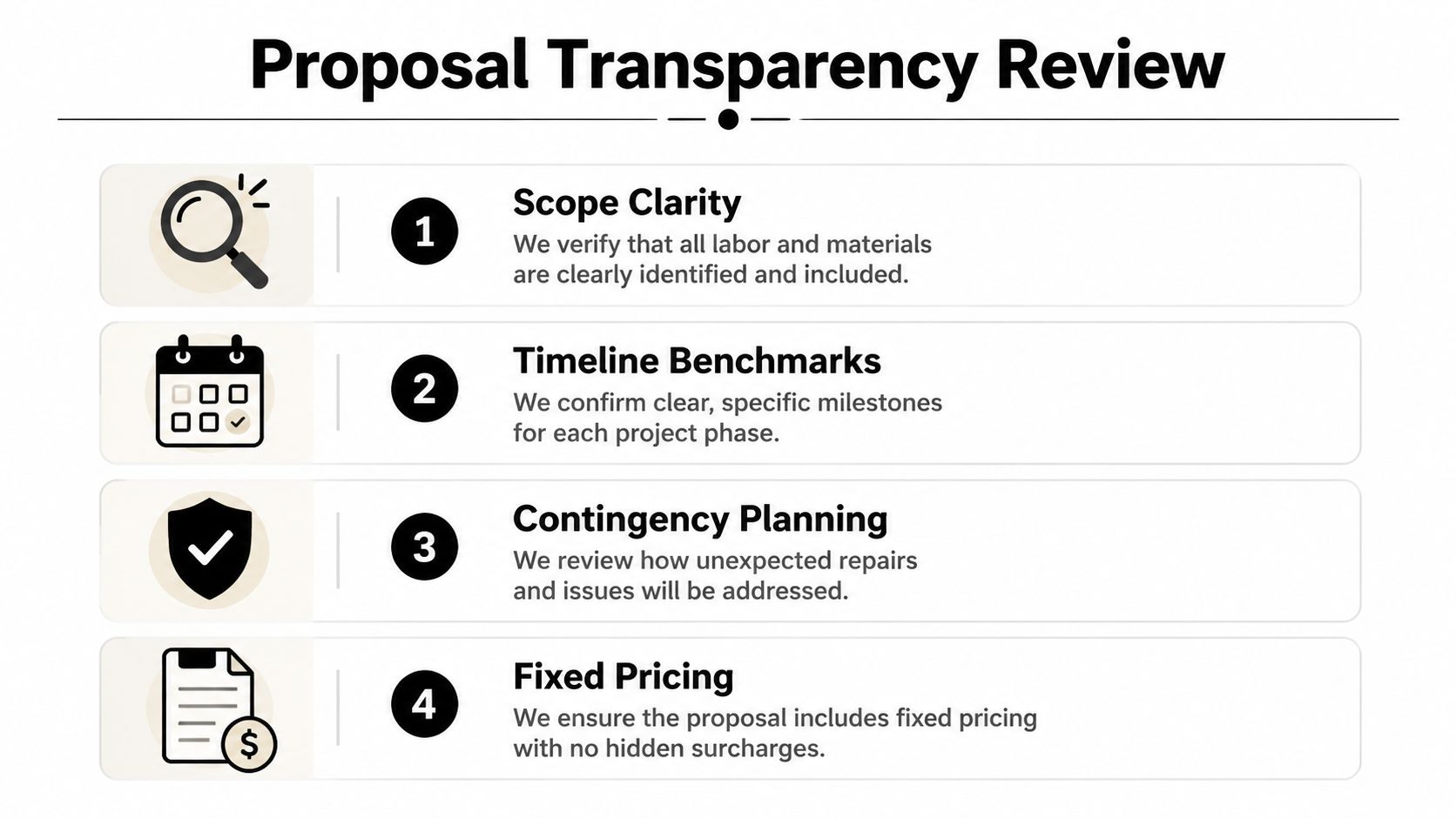
The low quote often wins the first meeting and loses the project later. In industrial electrical work, vague pricing usually leads to disputed scope, stacked change orders, and frustration between operations, finance, and maintenance. A clearer bid may look higher at the start but cost less over the life of the job.
Fixed bid versus time and materials
Neither model is automatically better. The right one depends on scope certainty.
Fixed bid works well when drawings are stable, access is known, shutdown windows are defined, and material requirements are reasonably clear. It gives ownership and accounting better predictability.
Time and materials fits troubleshooting, exploratory repair, and work where hidden conditions are likely. It can be the fairer model when no one can accurately define the full scope before opening equipment or tracing circuits.
What doesn't work is pretending a diagnostic-heavy project is fixed when everyone knows surprises are likely. That usually creates conflict instead of cost control.
What a usable proposal should show
A proposal should tell you what the contractor believes the job is. If it doesn't, you're not comparing bids. You're comparing assumptions.
Look for these details:
Labor definition
Are labor tasks broken down by activity, phase, or work area?Material scope
Does the quote identify major components, allowances, or exclusions clearly?Equipment access assumptions
Is the proposal based on normal access, escorted access, off-hours work, or shutdown support from your team?Change process
How are discoveries documented, approved, and priced?Scheduling logic
Are milestones tied to procurement, shutdown windows, and inspection timing?
A one-page number without scope detail is not a competitive advantage. It's a future argument.
For larger or repeat work, estimating discipline matters. Tools like Exayard electrical estimating software are useful to review because they show how structured estimating systems handle takeoffs, labor assumptions, and scope organization. You don't need your contractor to use one specific platform, but you do want evidence that they estimate systematically rather than improvising from memory.
Project management signals that matter
The project manager on the contractor side determines whether the work feels controlled or chaotic. Ask who your point of contact will be, how updates are delivered, and who has authority to approve field decisions.
A reliable project flow usually includes:
Pre-job review
Site walk, access conditions, hazards, and sequence confirmation.Execution tracking
Progress updates tied to actual milestones, not generic “we're on it” status messages.Field issue handling
Clear documentation when the discovered condition differs from the original scope.Closeout
Updated records, panel identification where applicable, and a clear summary of what was completed.
Red flags inside a cheap bid
| Red flag | Likely outcome |
|---|---|
| Scope described in broad generalities | Frequent disputes over what was included |
| Materials not identified | Substitutions and quality uncertainty |
| No mention of access or downtime constraints | Schedule slippage and operational conflict |
| After-hours pricing omitted | Invoice shock |
| No assigned project lead | Communication breakdown |
The best proposals reduce ambiguity before the first wrench turns. That's what protects both schedule and budget.
Onboarding Your New Electrical Partner for Long-Term Success
A contractor can be fully qualified and still struggle if the site handoff is poor. Long-term success starts with a disciplined onboarding process. The goal is to make your facility easier to support before the next outage, shutdown, or expansion request lands.
Begin with operating context. Provide the contractor with current drawings if available, but do not stop there. Walk the site and identify the equipment that matters to operations. Main distribution points, tenant-sensitive loads, refrigeration or HVAC dependencies, rooftop systems, dock power, generator interfaces, and any circuits that no one wants touched without management approval.
What to share on day one
Some information belongs in every contractor file:
- Site access rules including escort needs, gate procedures, and restricted areas
- Primary contacts for operations, maintenance, safety, and decision-making after hours
- Known problem history such as recurring trips, nuisance faults, water intrusion points, or overloaded areas
- Shutdown expectations covering who approves outages and what notice is required
- Documentation standards so service reports and proposals arrive in a format your team can use
Build a service relationship before the emergency
The strongest contractor relationships aren't built during a blackout. They're built during ordinary service calls, planned upgrades, and preventive reviews. That's when the contractor learns your building logic, your pain points, and the loads that can't go down.
Good onboarding shortens future outages because the contractor already knows the site, the people, and the equipment that carries the highest operational risk.
It also helps to define what “urgent” means at your facility. Some sites need immediate response for dock equipment, warning lights, or tenant distribution issues. Other items can wait for a scheduled window if the risk is controlled. When both sides agree on that framework early, emergency calls become more precise and less chaotic.
Treat the contractor like a continuity partner
If you only call when something fails, you're using the relationship at its weakest point. A better model is ongoing coordination. That might include periodic walk-throughs, review of recurring service items, recommendations for aging components, and a standing process for handling after-hours events.
That approach turns an Industrial electrical contractor Palm Beach County from a reactive vendor into part of your continuity plan. For most facility operators, that's the primary objective. Fewer surprises, faster decisions, cleaner documentation, and less avoidable downtime.
If you need an electrical partner for an industrial site, warehouse, commercial building, or specialty rooftop system in Palm Beach County, Lighthouse Energy Services provides industrial electrical support, emergency troubleshooting, upgrades, and aircraft obstruction lighting with true 24/7 availability. It's a practical option for operators who want licensed response, transparent pricing, and a contractor relationship built around uptime and risk control.