
When people talk about a commercial electrical installation, they're describing something far more complex than the wiring in your house. It's the engineered, high-capacity power system built specifically for a business, whether that’s a small storefront or a massive industrial facility. This isn't just about running wires; it's about creating a robust electrical backbone designed to handle heavy loads, ensure constant reliability, and meet a mountain of safety codes.
The Powerhouse Behind Your Business
The best way to think about it is to compare it to your home's electrical system. Your home’s wiring is like a quiet stream, easily managing the power for lights, a TV, and your kitchen appliances. A commercial system, on the other hand, is a major river. It’s engineered to safely handle a massive volume of electricity needed for everything a business throws at it.
That difference is everything. A commercial space has demands that a residential system could never handle. We're talking about high-intensity lighting, sprawling computer networks, walk-in coolers, and heavy-duty machinery. Meeting those demands requires a fundamentally different approach to the design, the parts you use, and the safety measures you put in place.
More Than Just Basic Wiring
A true commercial electrical installation is a complete, end-to-end process. It’s about making sure your business has the power it needs to run safely and efficiently, not just today but for years to come. Here’s what that really involves:
- High-Capacity Power Distribution: Most businesses run on three-phase power. This delivers a more consistent, higher-voltage current that’s perfect for large motors and the kind of equipment that would instantly overwhelm a home circuit.
- Specialized Components: We use industrial-grade equipment you’d never see in a house. This includes heavy-duty transformers, switchgear, and panelboards built to manage huge electrical loads and provide critical safety functions.
- Strict Code Compliance: Commercial properties are held to an incredibly high standard. Every installation must follow the National Electrical Code (NEC) as well as specific local rules, like those in Palm Beach County. Following these codes isn't just a good idea—it's what prevents fires, protects your team, and keeps you out of legal trouble.
One of the most common missteps we see is business owners underestimating their future power needs. A smart installation always plans for growth, so your electrical system can scale up without forcing you into a costly and disruptive overhaul later on.
Why It Matters for Your Business
At the end of the day, the quality of your electrical installation has a direct impact on your bottom line. A poorly designed system is a recipe for frequent power disruptions, fried equipment, and dangerous working conditions. In fact, industry data consistently shows that electrical failures are a top cause of expensive downtime for businesses.
On the flip side, a professional installation gives you a stable, reliable power source that protects your investments and keeps your team productive. It’s the foundation that ensures your business is ready to run at full speed from day one. Whether you're opening a new restaurant in Boca Raton, a shop in Jupiter, or an office in West Palm Beach, getting your electrical system right is the first step to building a successful operation.
The 5 Phases of a Commercial Electrical Project
Any successful commercial electrical project, whether it's a small retail shop or a massive warehouse, follows a predictable path. Getting it right isn't about luck; it's about following a methodical, five-phase process that takes you from an idea to a fully powered, certified facility. Think of it like a blueprint for a custom-built house—you wouldn’t let a builder just start throwing up walls without a detailed plan. The same exact discipline is needed for your building’s electrical system.
Each step logically flows into the next. This organized approach is the key to avoiding costly mistakes, frustrating delays, and ensuring the final product is safe and up to code. Let's walk through this journey, using the practical example of outfitting a new restaurant right here in Palm Beach County.
This diagram helps visualize the massive difference in power demands between a home and a business. It’s like comparing a garden hose to a fire hydrant.
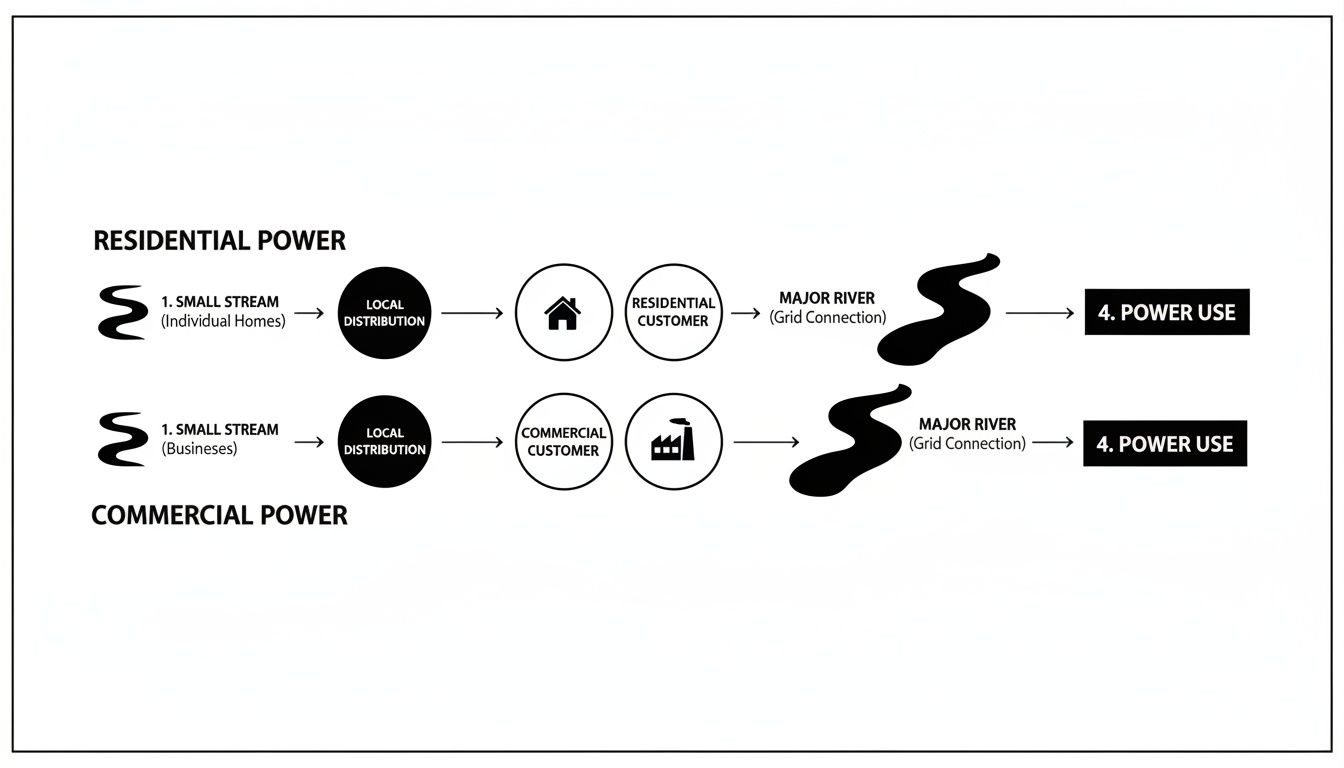
A commercial electrical installation is built to handle a much heavier and more complex flow of electricity, which is exactly why it requires this specialized, phased approach.
To give you a bird's-eye view of the process, here’s a quick summary of what happens in each phase of a typical project.
Commercial Electrical Installation Project Phases
| Project Phase | Key Activities | Primary Goal |
|---|---|---|
| 1. Assessment | Documenting all equipment, calculating total power needs (load), and assessing site conditions. | To determine the exact electrical capacity the facility requires. |
| 2. Design | Creating detailed electrical blueprints, specifying panel types, wiring routes, and circuit layouts. | To engineer a safe, efficient, and code-compliant electrical system plan. |
| 3. Permitting | Submitting engineered plans to local authorities (e.g., Palm Beach County) for review and approval. | To gain legal permission to begin construction, ensuring the design meets all safety codes. |
| 4. Installation | Running conduit, pulling wires, installing panels, switchgear, outlets, and fixtures. | To physically build the electrical system according to the approved design. |
| 5. Testing | Verifying circuit integrity, testing safety devices, and undergoing a final government inspection. | To confirm the system is 100% safe, functional, and ready for official sign-off. |
Each of these stages is crucial for a smooth and successful outcome. Now, let's dive into the details of what each one really involves.
Phase 1: Initial Assessment and Load Calculation
It all starts with a simple question: How much power do you actually need? This first step is all about calculating your electrical load—the total amount of juice your entire operation will pull from the grid. For our restaurant example, this is a meticulous accounting of every single piece of equipment that plugs into a wall or is hardwired.
We’re talking about a detailed inventory that includes:
- The heavy hitters: Industrial convection ovens, massive walk-in coolers, high-temp dishwashers, and a bank of deep fryers.
- Customer-facing tech: The point-of-sale (POS) system, intricate mood lighting, A/V equipment, and digital menu boards.
- Building essentials: The big HVAC unit on the roof, powerful kitchen exhaust hoods, security systems, and that glowing sign out front.
Getting this number right is absolutely critical. If you underestimate your load, you’re setting yourself up for constantly tripped breakers or, far worse, a dangerous overload. If you overestimate, you’ll waste thousands on oversized transformers and panels you don't need. This phase ensures your system is sized perfectly from day one.
Phase 2: System Design and Engineering
Once we know the what, we can figure out the how. This is the blueprint stage, where licensed electrical engineers translate that load calculation into a complete, detailed design for your system. This isn't just a rough sketch; it's a technical schematic showing the precise location of every single wire, panel, and outlet.
For the restaurant, the design would map out dedicated, high-amperage circuits for the kitchen equipment, completely separate from the lower-voltage lighting in the dining room. It would specify the exact size of the main electrical panel, the gauge of every wire, and the strategic placement of emergency shut-offs. This is where professional expertise really makes a difference, as the engineers plan for things like voltage drop over long wire runs and ensure there's enough physical space for all the conduit.
A rock-solid engineering design is the most important part of a reliable electrical system. It's the strategic thinking that solves problems before a single tool is picked up.
Phase 3: Permitting and Code Compliance
With a finished design in hand, you can’t just start work. Before any electrician steps on-site, those plans have to be formally submitted to the local building department—in our case, the authority in Palm Beach County—for a full review and approval. This entire phase is dedicated to meeting the strict standards of the National Electrical Code (NEC) and any specific local rules.
Getting the permit is a non-negotiable checkpoint. It’s the city’s way of verifying that a professional has designed a safe system. Trying to work without one is a recipe for disaster, leading to stop-work orders, hefty fines, and potentially voiding your insurance. It's a mandatory step in any legitimate commercial electrical installation.
Phase 4: Installation and Wiring
Permit in hand, it’s time to make it real. This is when the electricians get to work and the design on the page becomes a physical reality. It's often the busiest and most visible part of the project, as crews begin running conduit, pulling miles of wire, and installing all the major hardware.
In our restaurant, this is when the main switchgear is delivered and set in place, breaker panels are mounted on the walls, and dedicated circuits are carefully routed to each piece of kitchen equipment. It’s a phase defined by skilled, hands-on labor where every connection has to be perfect. The quality of the work done here determines how safe and dependable your system will be for years to come.
Phase 5: Testing and Final Inspection
Just because the last outlet is installed doesn't mean the job is done. The final phase is all about verification. First, our own electricians perform a series of rigorous tests on the entire system. Using specialized meters, they check every single circuit to confirm correct voltage, grounding, and polarity. They intentionally trip breakers to make sure the safety mechanisms are working flawlessly.
After our internal checks are complete, we schedule the final inspection with the city's electrical inspector. This official comes to the site to personally review the installation, comparing our work against the approved plans and triple-checking for code compliance. Only when the inspector is satisfied and officially "signs off" on the permit is the system legally cleared for operation. That final approval is your green light to open for business, giving you total peace of mind that your electrical infrastructure is safe, sound, and ready to perform.
Navigating Palm Beach County Electrical Codes and Permits
When it comes to a commercial electrical project, a lot of people see codes and permits as just red tape—more hoops to jump through. But from an expert's point of view, they're the single most important part of the job. They are the rulebook that prevents disasters, ensuring every wire and every circuit is installed to protect your business, your team, and your customers from the very real dangers of fire and electrical shock.
For anyone running a business in South Florida, this means getting familiar with a few layers of regulations. The rules start on a national level but get much more specific once you get down to Palm Beach County.
The Foundation of Electrical Safety
The starting point for every electrical project in the country is the National Electrical Code (NEC). This guide is updated every three years and sets the minimum safety standards for all electrical design and installation. But here in Florida, the NEC is just that—a starting point.
State and local authorities, including Palm Beach County, take the NEC and build on it with their own amendments. These local rules are written to handle our specific regional challenges, like the corrosive effects of our humid, salty air on electrical gear or the need for robust systems that can withstand a hurricane.
A common mistake is assuming that just meeting the NEC standards is enough. The truth is, local jurisdictions like the City of Boca Raton or West Palm Beach have the final say. You have to follow their specific rules to the letter if you want to pass inspection.
Getting this wrong can bring your entire project to a grinding halt. A local inspector can issue a stop-work order on the spot, leaving you with expensive delays and potential fines until every violation is fixed.
Local Rules in Palm Beach County
Even within the county, the rules aren't always the same. An experienced electrician who works here every day will know the subtle differences in code from Jupiter down to Boynton Beach.
This local knowledge is priceless. For instance, one city might demand stricter standards for exterior conduit to fight off rust from the salt air. Another might have unique requirements for surge protection because of how often we get hit with lightning. You can find out more about why this on-the-ground experience matters in our guide to hiring a licensed commercial electrician in West Palm Beach.
Specialized Compliance Requirements
And it doesn't stop with standard building codes. Depending on your building's height or what it's used for, other regulatory agencies might get involved.
- Federal Aviation Administration (FAA) Lighting: Any structure tall enough to be a concern for aircraft—think high-rises, cell towers, or even water tanks—needs special aircraft obstruction lighting. The FAA has strict rules for the type, brightness, and flashing pattern of these lights.
- Healthcare Facility Regulations: Hospitals, clinics, and surgical centers are on another level. They have to follow incredibly strict codes for their emergency power systems, backup generators, and isolated power in critical areas like operating rooms to ensure patient safety is never compromised.
- Data Center and IT Infrastructure: These facilities are power-hungry. Their electrical design is all about redundancy, with complex uninterruptible power supplies (UPS) and cooling systems built to prevent a single point of failure from causing catastrophic data loss.
The Real Cost of Non-Compliance
Trying to cut corners on permits and code is one of the riskiest gambles a business owner can take. The fallout goes way beyond just failing an inspection.
- Project Shutdowns: An inspector can shut your job site down, costing you dearly in both time and money.
- Hefty Fines: Unpermitted work can lead to significant financial penalties from the city or county.
- Liability and Insurance Issues: If a fire or injury is traced back to non-compliant electrical work, your insurance company could deny the claim, leaving you personally responsible for all the damages.
- Difficulty Selling the Property: When it's time to sell, unpermitted work is a massive red flag for buyers and can kill a deal or force you into expensive, complicated repairs.
Ultimately, working through the maze of electrical codes and permits is non-negotiable. The smartest move you can make is to partner with a licensed, experienced contractor who lives and breathes Palm Beach County's rules. It’s the best way to ensure your project is done safely, legally, and correctly the first time.
The Core Components of Your Electrical System
A commercial electrical system might look intimidating, but it’s really just a handful of key components working in concert to power your business safely and reliably. Getting familiar with what these parts do is the first step toward having a productive conversation with your electrical contractor. When you can speak the language, you can better explain your needs and make sure your commercial electrical installation is built for the long haul.
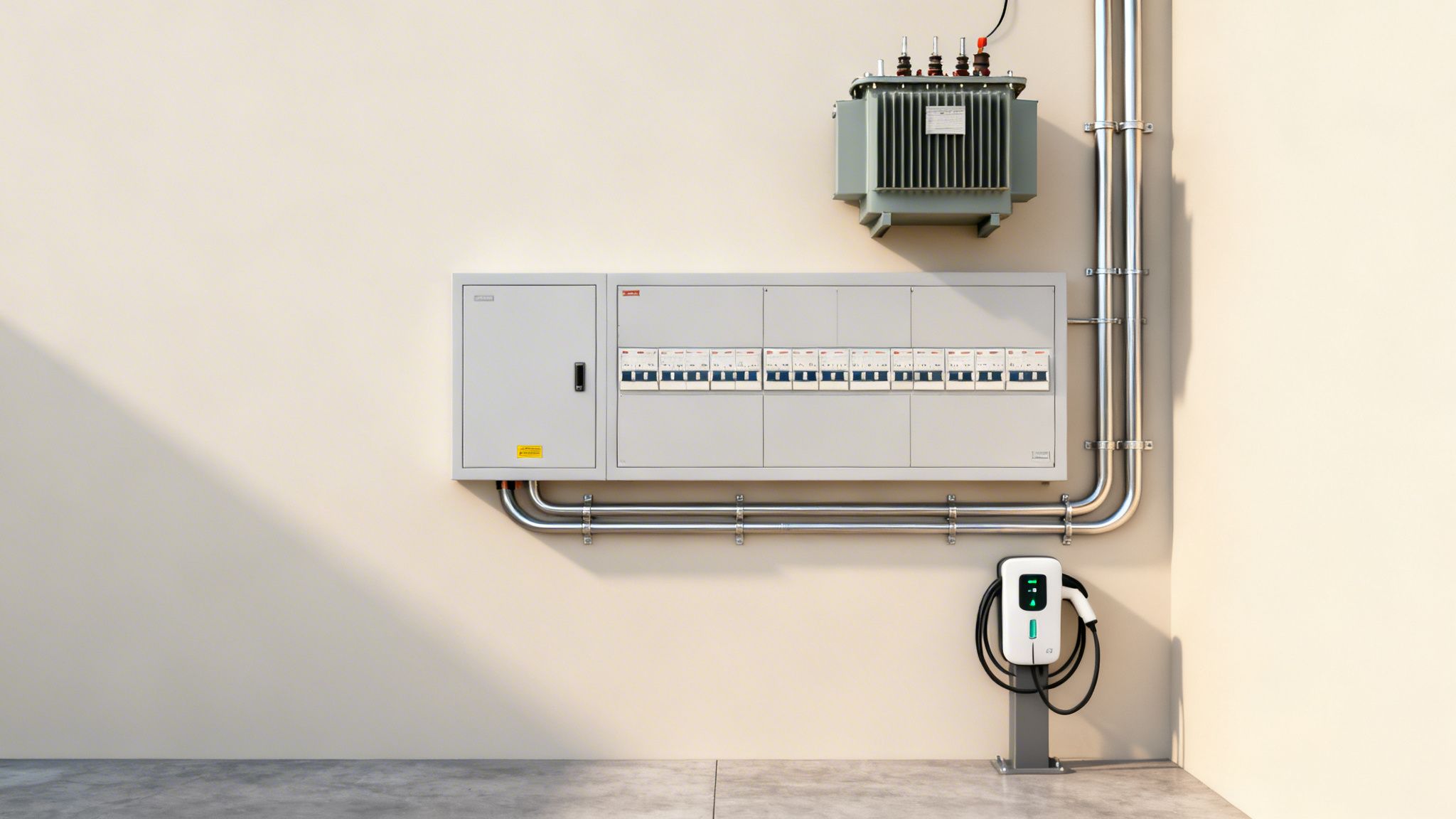
Think of it like the infrastructure of a small city. Your business is the city, and the electrical system is the entire power grid keeping the lights on. Each component has a distinct role, from managing the main power supply to routing electricity to the most remote corner of your building.
The Transformer: Your Power Gateway
The journey of power into your building begins at the transformer. The high-voltage electricity supplied by the utility grid is way too powerful to be used directly. The transformer's job is to act as a gateway, "stepping down" that intense voltage to a safer, usable level for all your equipment.
In our city analogy, the transformer is like the main pressure-reducing valve for the water supply. It takes the high-pressure flow from the aqueduct and lowers it to a level the city’s pipes can handle without bursting. A poorly sized transformer would be catastrophic, instantly frying sensitive electronics and heavy machinery.
Panelboards and Switchgear: Your Central Command
Once the voltage is safely stepped down, the power moves to the panelboards and switchgear. This is the absolute nerve center of your entire system—it's where all the power is managed, routed, and protected.
- Switchgear: This is the heavy-hitter, the main distribution hub for your facility. It's the first stop for power inside the building and contains large switches and circuit breakers to control the flow to major areas or power-hungry equipment.
- Panelboards (Breaker Panels): These are the smaller, local hubs. They take the main feed from the switchgear and split it into individual circuits for things like lighting, wall outlets, and specific machines. Each circuit is guarded by its own breaker, which will automatically trip to cut power if it senses a dangerous overload.
If the transformer is the main water valve, the switchgear and panels are the network of junctions and secondary valves that direct water to every neighborhood and every single building. You can dive deeper into how these critical components function in our guide on electrical distribution systems.
Wiring and Conduit: Your System's Veins and Arteries
Finally, that electricity needs a safe pathway to travel. That’s where wiring and conduit come in. The wires are what actually carry the electrical current, while the conduit—typically metal or plastic tubing—acts as a protective armor around them.
This is the circulatory system for your building, just like the underground pipes that carry water from the local junctions to every faucet. In a commercial environment, this network is vast. The conduit is essential for protecting the wires from physical damage, moisture, and even fire, making it a non-negotiable safety requirement under the National Electrical Code (NEC).
The Evolving Demands on Modern Electrical Systems
The list of "standard" components is always growing. Today's commercial electrical systems often include hardware that was considered a specialty item just a decade ago.
The explosive growth of data centers and artificial intelligence is reshaping the entire electrical contracting industry. What was once a large, 50-megawatt project is now dwarfed by "giga-campuses" that require over 1,000 megawatts—enough to power a small city.
This trend is driving an incredible demand for bigger, more complex electrical installations. As contractors, we're seeing a massive spike in projects that require this higher capacity, which is fundamentally changing how these systems are designed and built.
This evolution has made several specialized components much more common:
- Commercial EV Charging Stations: Businesses are now routinely adding dedicated, high-capacity circuits and chargers for their electric fleet vehicles or as an amenity for customers.
- Solar Power Infrastructure: Many new installations are being designed from the ground up to integrate with on-site solar. This involves adding components like inverters and transfer switches to manage power from both the panels and the grid.
- Backup Power Systems: For any facility where downtime is not an option—from data centers to medical clinics—an automatic transfer switch (ATS) paired with a generator has become standard equipment.
Having a good grasp of these parts empowers you to collaborate with your contractor, ensuring you get a system that not only meets today's needs but is also ready for whatever comes next.
How to Choose Your Palm Beach County Electrical Contractor
Finding the right commercial electrical contractor is arguably the most important decision you'll make for your project. This isn't just about the budget or the timeline; it's about the long-term safety, reliability, and compliance of your entire business. A great partner is a trusted advisor, but the wrong one can leave you with dangerous work, failed inspections, and a mountain of costly rework.

The U.S. electrical services market is huge, hitting $158.5 billion in 2023, according to an IBISWorld industry report. With roughly 262,000 businesses out there, sorting through the options can feel overwhelming. Having a clear vetting process is your best tool for finding a true professional in a crowded field.
Verify Credentials and Experience
First things first: cover the basics. Never even consider a contractor who can't show you proper, up-to-date licensing and insurance for work in Palm Beach County. This is a non-negotiable step that protects you from serious liability.
Once the paperwork checks out, dig into their experience. You're looking for deep, relevant experience. Ask to see a portfolio of projects similar to yours. If you're building a restaurant, you need someone who understands the intense demands of a commercial kitchen, not a team that mostly wires new houses.
Prioritize 24/7 Emergency Availability
Electrical emergencies couldn't care less about business hours. A critical failure can grind your operations to a halt, costing you thousands in lost revenue with every passing hour. This is where a contractor's emergency service proves its real worth.
But here's the thing: not all "24/7 service" is created equal. Many companies just route you to a third-party answering service that takes a message. The gold standard is a company where a licensed electrical professional answers your call directly, day or night. That immediate access to an expert can be the difference between a quick fix and waiting hours for a callback while your business is dark.
A contractor who provides direct access to a licensed professional for emergencies isn't just offering a service—they're demonstrating a deep commitment to being a true partner in your business's continuity.
Look for a Long-Term Maintenance Partner
A top-tier contractor doesn't just disappear after the initial commercial electrical installation is done. They see the project as the beginning of a relationship, offering ongoing maintenance plans to keep your system safe and efficient. This proactive mindset shows they're invested in your facility's health, not just cashing a check.
A good maintenance plan is more than just a vague promise. It should include:
- Regular Inspections: Catching potential problems like worn-out parts or loose connections before they cause a full-blown failure.
- System Testing: Making sure your breakers, emergency lights, and backup power systems will actually work when you need them most.
- Code Compliance Checks: Keeping your facility current with any changes to the National Electrical Code or local Palm Beach County rules.
Choosing a contractor is really about finding a long-term partner who will protect your investment. By focusing on credentials, proven work, true 24/7 support, and a commitment to maintenance, you can find a pro who helps your business thrive. For more tips on this, check out our complete guide to hiring a licensed commercial electrician.
Answering Your Top Questions About Commercial Electrical Work
When you're looking at a major electrical project, you’re bound to have questions. It’s a big investment, and you need clear answers to feel confident about the path forward. We get it. Here are some of the most common questions we hear from business owners and facility managers right here in Palm Beach County.
How Often Should I Get My System Inspected?
Think of it like a regular health check-up for your building. For most commercial properties, we strongly recommend a full electrical inspection by a licensed pro every 1 to 3 years. This is all about being proactive—catching small issues before they become big, expensive headaches that could shut your business down.
Of course, not all businesses are the same. Facilities that put their systems under more stress need more frequent attention.
- Annual Inspections: If you run a restaurant, a busy industrial plant, or a healthcare facility, your electrical system is working hard around the clock. An annual check is essential.
- Bi-Annual Inspections: Standard office buildings and retail shops with more predictable electrical loads are generally fine with an inspection every couple of years.
The smartest move any property manager can make is to get on a formal electrical maintenance plan. It shifts safety from a reactive scramble to a scheduled, managed process. You’re always ahead of the game, not just responding to emergencies.
Can a New Electrical System Lower My FPL Bill?
Absolutely, and often by a surprising amount. An older electrical system is full of inefficiencies that quietly drain your bank account. A modern installation is designed from the ground up to stop that waste.
When we upgrade a system, we're swapping out old, power-hungry components for new, high-efficiency ones. Think modern LED lighting, better transformers, and properly sized wiring that doesn’t lose energy as heat. We can also set up smart controls for your HVAC system—which is usually the biggest energy hog in a commercial building. A well-designed system doesn't just power your business; it actively works to improve your bottom line.
What Is the Difference Between Commercial and Industrial Electrical Systems?
While they're both built for business, not homes, the real difference comes down to the environment and the sheer scale of power involved.
A commercial system is what you’d find in an office, a restaurant, or a retail store. It typically runs on standard three-phase power and is designed for a clean, predictable environment. An industrial installation, on the other hand, is built for the big leagues—powering manufacturing plants, processing facilities, and other sites with heavy-duty machinery. These systems often require high-voltage power and use specialized, rugged equipment that can withstand things like intense heat, corrosive materials, and constant vibration.
Ready to ensure your project is done right? For expert advice and reliable service on your next commercial electrical installation, trust the experienced professionals at Lighthouse Energy Services. Contact us today to discuss your needs.