
You walk into the kitchen at dusk and half the room is dead. The ceiling light won't come on. The microwave display is blank. But the refrigerator is still humming, the hallway lamp works, and a TV in the back bedroom is glowing like nothing happened. That's the kind of call that throws people off, because it doesn't behave like a normal blackout.
A partial power outage in a house usually means one part of the electrical system is still intact while another part has failed. Sometimes it's simple. Sometimes it isn't. The mistake I see most often is treating it like a basic breaker reset when the problem is upstream, at the service, neutral, or meter connection.
That matters because a half-house outage can be annoying, or it can be the early warning sign of a condition that damages electronics and creates unsafe voltage inside the home.
Table of Contents
- When Half Your House Goes Dark
- First Safety Checks Before You Touch Anything
- Inspecting the Main Panel the Right Way
- Walking Downstream for GFCI and Outlet Issues
- The Dangerous Causes Most Articles Skip
- When to Call a Licensed Electrician
- Preventing the Next Partial Outage
When Half Your House Goes Dark
A full blackout is easy to recognize. Everything is off. A partial outage is different. Some circuits still have power, others don't, and the pattern often feels random until you understand how the house is fed.
Most homes use a split-phase service. A single issue in that setup, such as a lost service leg or a loose neutral, can leave some circuits working while others fail. That's one reason these calls confuse homeowners. The house isn't fully dead, so people assume the problem must be minor.
Household outages in general are common. The U.S. Census Bureau's 2023 American Housing Survey reported that about 33.9 million households, roughly 1 in 4, were completely without power at least once in the prior 12 months, and about 23.6 million households, or approximately 70% of those affected, had at least one outage lasting 6 hours or more according to the Census Bureau's housing survey summary on power outages. Partial outages don't show up cleanly in those numbers, but they happen inside that same real-world mess of utility faults, aging equipment, storms, and worn electrical connections.
Why this feels so confusing
One kitchen receptacle may be dead while the dining room light still works. A dryer may stop heating while bedroom lamps stay on. If lights were also flickering earlier, that can point to a deeper supply problem, and it's worth understanding what causes flickering lights in a house because the symptoms often overlap.
A partial outage is not just “some outlets stopped working.” It can be a branch-circuit problem, a panel problem, or a service problem.
The first job isn't guessing. It's sorting the pattern. Is it one room, one string of receptacles, one side of the panel, or something affecting the service feeding the whole house?
First Safety Checks Before You Touch Anything
Before you open the panel or start pressing reset buttons, slow down and do three checks in order. People either keep the problem small or make it worse.
Stop at any sign of heat or arcing
If any switch, outlet, or cord smells hot, feels warm, buzzes, or shows discoloration, stop using it. Don't plug anything back in to “see if it comes on.” Don't keep flipping that switch either.
Look for melted plastic, dark marks around the faceplate, or a faint crackling sound. Those signs point to a bad connection or active overheating, not just lost power.
Practical rule: If you smell burning insulation or hear buzzing, your troubleshooting ends there.
Check whether it's only your house
Step outside and confirm the scope. Check your porch light if it's on a different circuit. Look at neighboring homes. Ask a neighbor if part of their house is out too.
If multiple homes show the same kind of odd partial loss, the utility may have an issue on one leg of the service in your area. If your house is the only one acting up, the fault is more likely at your service equipment or inside.
Map what still works
Use a plug-in lamp or a non-contact voltage tester and go room to room. Don't start with the panel. Start with information.
- Mark powered areas: Identify rooms, receptacles, and lights that still operate normally.
- Mark dead areas: Note what's completely out, especially if several dead points are grouped together.
- Notice unusual behavior: A dim lamp in one room and bright lights in another can point to an unstable supply condition.
If your air conditioner is involved, especially after a breaker event, this is also a good time to understand when to call an HVAC professional, because compressor equipment doesn't tolerate unstable power well.
If any of the checks above suggest overheating, leave affected breakers off and call for help before going further.
Inspecting the Main Panel the Right Way
If the house is safe enough to continue, the panel is the next stop. Do this carefully. You're inspecting, not exploring.
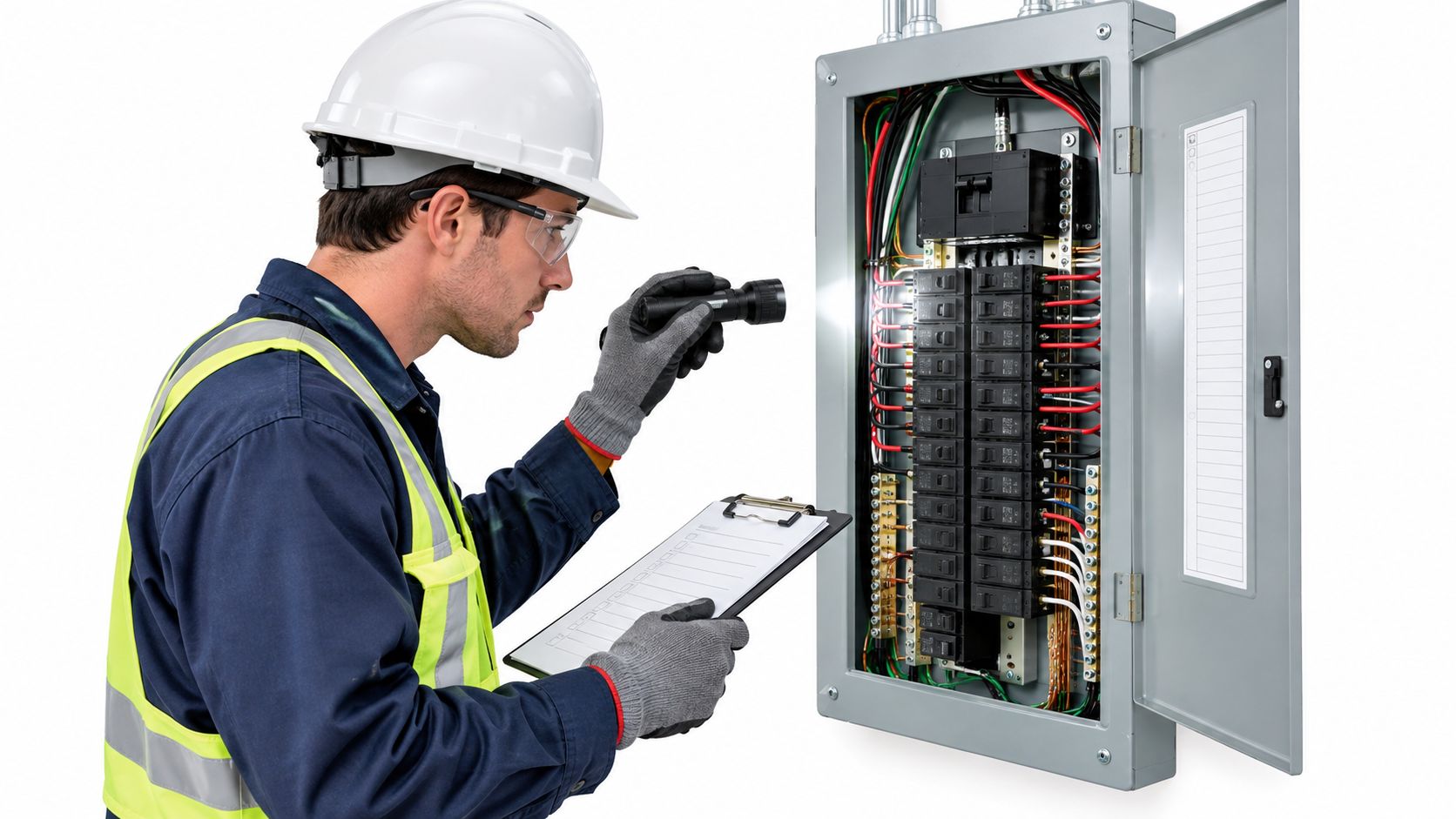
Stand at arm's length, use a flashlight, and keep your hands away from bus bars and exposed metal. The panel can tell you a lot without you touching anything except breaker handles.
The breaker position that fools people
A tripped breaker often doesn't slam all the way to OFF. It sits in a middle position between ON and OFF, and from a quick glance it can look normal. That's why a visual scan alone misses so many simple faults.
A practical diagnostic sequence for a half-house outage starts with mapping the outage pattern, then checking the main panel for any breaker sitting between ON and OFF, then checking GFCI and AFCI devices, and then comparing what you found against utility outage conditions. That sequence is widely recommended because a tripped breaker can look deceptively normal, and one failed GFCI can shut down several downstream receptacles even when the panel looks fine, as explained in this half-house power loss diagnostic guide.
How to reset a breaker correctly
Don't just nudge it. Reset it firmly.
- Push fully to OFF: Even if it looks off already.
- Pause briefly: Make sure the mechanism seats.
- Push firmly to ON: You should feel a definite snap.
If it trips again immediately, stop. Repeated resets don't solve the underlying fault and can make diagnosis harder.
Watch the double-pole breakers
Large appliances like ranges and dryers use double-pole breakers. Those breakers span both hot legs of the panel. Trouble there can mimic a wider outage, especially when one leg is lost and larger 240-volt appliances start acting strangely.
For main panel work, service damage, or a breaker issue that doesn't reset cleanly, homeowners are usually at the safe end of what they should do themselves. If you suspect the panel itself is part of the problem, this overview of main breaker panel repair and replacement helps explain what typically moves from homeowner troubleshooting into licensed electrical work.
Stop immediately if you see rust, water intrusion, melted insulation, or a breaker that won't stay set.
Walking Downstream for GFCI and Outlet Issues
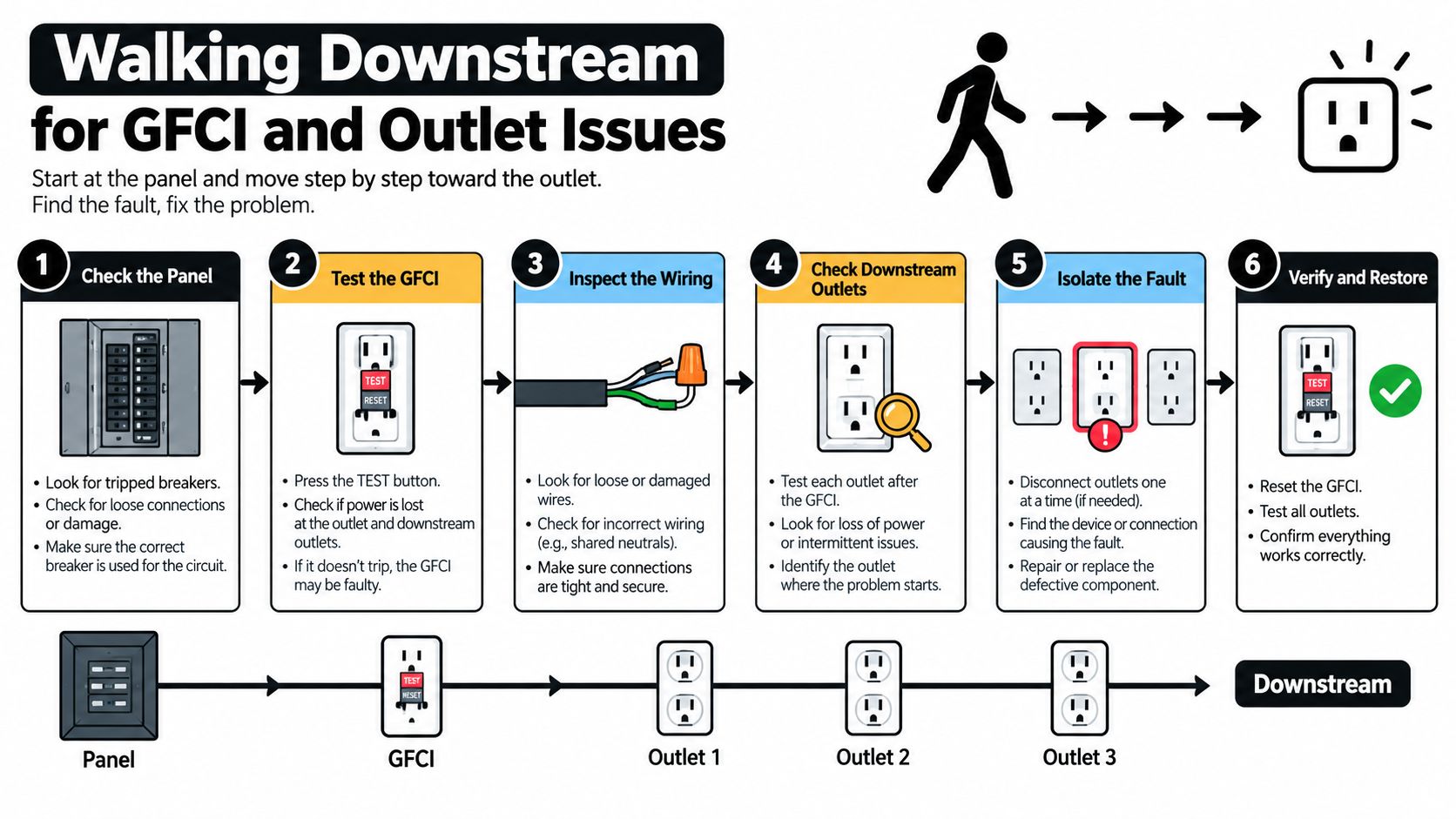
If the panel doesn't reveal the problem, move out into the house and follow the circuit path. Start with GFCI receptacles before you assume hidden wiring failed.
Check every GFCI, not just the nearest one
A dead bathroom receptacle may be protected by a GFCI in the garage. A kitchen counter outlet may depend on a device in the laundry room. That's normal in residential wiring, and it's why homeowners often miss the actual reset point.
Press RESET on every GFCI you can find in the kitchen, bathrooms, garage, laundry area, exterior, basement, and utility spaces. After that, press TEST and then RESET again so you know the device is functioning.
Unplug loads before you reset
Before you reset a dead circuit, unplug the appliances and chargers on it. If one of those loads is shorted, the breaker may trip again the moment the circuit comes back.
Then check the first dead receptacle you can identify on the run.
- Feel for warmth: Warmth without a heavy load is a warning sign.
- Look for damage: Scorching, melted plastic, or looseness matters.
- Listen closely: Buzzing from an outlet or switch usually means a poor connection.
One tripped GFCI can knock out several outlets that don't look related. The wiring path matters more than the room layout.
If you keep finding dead outlets after a reset, or a GFCI won't reset at all, there may be a fault farther downstream or a failed device at the head of the circuit. This is also where recurring nuisance trips often start, and a guide on why a GFCI outlet keeps tripping can help you separate a bad device from a real ground fault.
The Dangerous Causes Most Articles Skip
Most online advice treats a partial outage like a scavenger hunt for one tripped breaker. Sometimes that's all it is. But the two causes that deserve more respect are an open neutral and a lost service leg.
Those failures don't always announce themselves with a clean shutdown. They can leave part of the house energized in unstable ways.
Why open neutrals are a bigger deal than people think
Independent trade guidance increasingly stresses that the hazard in many half-house outages is not the easy stuff. It's the broken or loose neutral, or a service-leg failure at the meter, service entrance, or main panel. Those faults can create uneven voltage and damage appliances, as explained in this discussion of why half the house can lose power without a tripped breaker.
An open neutral can produce odd symptoms instead of simple darkness. You may see one light get unusually bright while another goes dim. Electronics may behave erratically. A fan may speed up in one room while another circuit struggles.
Lost service legs can look like interior wiring trouble
A lost leg from the utility or at the service equipment often kills one side of the panel without tripping branch breakers. Homeowners open the panel, see “nothing wrong,” and keep chasing outlets. That's backward.
For panel-level confirmation, trade guidance commonly uses a multimeter set to AC voltage to verify roughly 240 V between the two hot bus bars and about 120 V from each hot leg to neutral. That test separates a true service problem from a branch-circuit problem and also highlights the danger of unstable leg-to-neutral voltage, according to this emergency guide on half-house power loss and panel testing.
If voltage appears unbalanced, if lights are bright in one area and dim in another, or if a 240-volt appliance behaves strangely, stop using the system and escalate.
Common vs. Dangerous Partial Outage Symptoms
| Symptom | Likely Cause | Urgency |
|---|---|---|
| One room or one outlet string is dead | Branch breaker, GFCI, failed outlet, or local wiring issue | Moderate |
| Several outlets in separate rooms are dead after a bathroom or garage trip | Upstream GFCI interruption | Moderate |
| Half the house is out and breakers look normal | Lost service leg or main/service fault | High |
| Lights become unusually bright in one area and dim in another | Open neutral or unstable supply | Urgent |
| Dryer, range, or other 240-volt equipment runs abnormally or only partly works | Service leg or neutral problem | Urgent |
If the voltage isn't stable, this stops being a convenience problem and becomes a safety problem.
When to Call a Licensed Electrician
There's a clear line between homeowner checks and electrical diagnosis. Once you cross into service faults, live panel testing, recurring trips, or signs of damaged equipment, licensed work is the only sensible path.
Call an electrician if the breaker won't hold after one proper reset, if you hear buzzing from the panel, if you see scorching, or if part of the house remains dead after you've checked the likely GFCI locations. Call the utility first when the visible damage is at the service entrance, meter area, or overhead connection, or when neighboring homes show the same partial outage pattern.
Cases that shouldn't stay DIY
These are the ones I'd escalate without debate:
- Suspected open neutral: Bright and dim lights at the same time, unstable operation, or odd appliance behavior.
- Panel damage: Heat, corrosion, moisture, burnt insulation, or a breaker that feels loose or brittle.
- Service-side trouble: Problems at the weatherhead, meter connection, or incoming service conductors.
- Large appliance symptoms: A dryer, range, or air conditioner that starts acting wrong during a partial outage.
For homeowners in Palm Beach County, panel and service repairs often involve permit and code considerations, especially when the fault moves beyond a simple branch-circuit issue. If the problem turns out to be internal panel failure, service connection trouble, or emergency partial power loss, Lighthouse Energy Services is one local option that handles residential troubleshooting and repair in that category.
Don't think of calling a pro as giving up. Think of it as stopping before a troubleshooting exercise turns into damaged electronics or a burned connection.
Preventing the Next Partial Outage
Most partial outages don't come out of nowhere. The warning signs are usually there first. People just don't connect them until something goes dark.
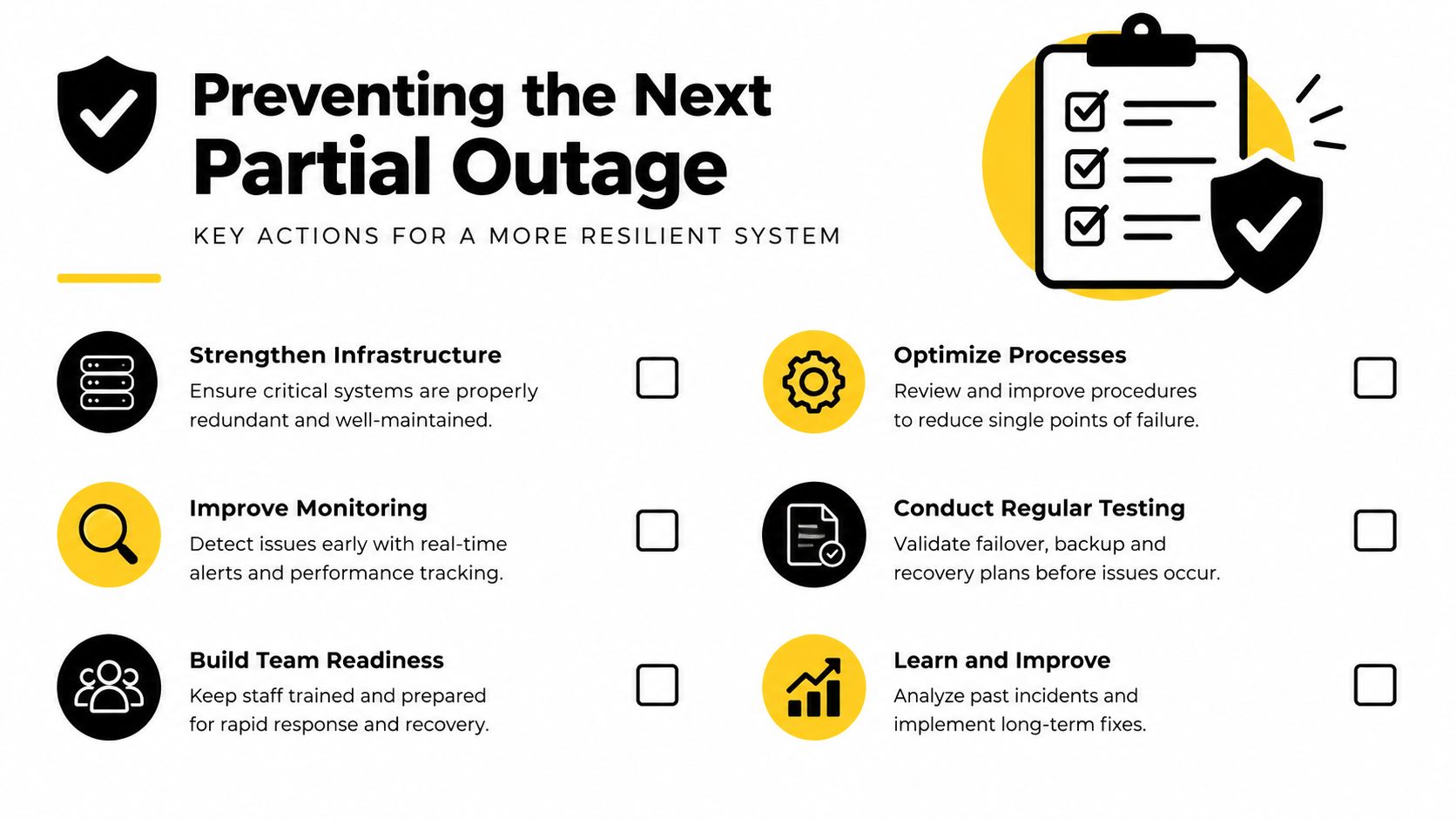
The best prevention mindset is simple. Reduce stress on the system, notice small changes early, and leave yourself a clean map for the next time something acts up.
Three habits that actually help
One is load management. Don't pile high-draw devices onto the same part of the system at the same time if you can avoid it. Microwaves, hair dryers, space heaters, and window units can expose weak points fast.
Another is an annual visual check. You're not opening up live equipment and poking around. You're paying attention to warmth, corrosion, buzzing, loose-feeling breakers, and devices that don't reset cleanly.
The third is proactive replacement of tired devices. GFCIs and breakers don't last forever. If an older device has become temperamental, replace it before it becomes mysterious.
Keep a panel-door checklist
Tape a simple note inside the panel door with:
- Breaker map: Which breaker feeds which room or equipment
- GFCI locations: Include garage, bathrooms, exterior, laundry, and kitchen
- Last inspection date: Note when you last checked for corrosion, heat, or nuisance trips
- Recent symptoms: Flickering, buzzing, intermittent outlet loss, or appliance oddities
That turns a stressful outage into a shorter diagnostic path.
If half the house loses power and a breaker reset and GFCI reset don't restore it within ten minutes, stop and call a licensed electrician.
That rule keeps people from overhandling a service fault that needs proper testing. Prevention costs less aggravation than emergency troubleshooting, and it protects against the dangerous failure modes homeowners miss most often.
If part of your home has power and part doesn't, Lighthouse handles the kind of electrical troubleshooting that starts with a confusing symptom and ends with a clear answer. Their team works on residential partial outage issues, panel faults, service problems, and emergency diagnostics throughout Palm Beach County. If you need help sorting out what's safe to check and what needs a licensed repair, visit Lighthouse Energy Services.