
If you're reading this because lights flickered during a storm, the air conditioner tripped a breaker again, or you caught a hot plastic smell near the garage panel, you're in the right place. Most homeowners in Palm Beach County don't think about the main breaker panel until something feels off. Then it goes from invisible to urgent fast.
That reaction makes sense. Your panel controls how power enters and moves through the house. When it starts failing, the issue isn't just inconvenience. It can affect safety, expensive appliances, and whether your home can keep up with modern loads like stronger air conditioning, pool equipment, EV charging, and updated kitchen circuits.
The hard part is knowing whether you need a simple repair or a full replacement. A lot of generic advice jumps straight to “replace the whole panel.” Sometimes that's right. Sometimes it's an expensive overreaction. Main breaker panel repair and replacement should be based on the actual condition of the panel, the breaker behavior, the age of the equipment, and what your home needs now.
Table of Contents
- Your Home's Electrical Heartbeat
- Is Your Panel a Ticking Time Bomb? Key Warning Signs
- Repair or Replace Your Panel? Making the Right Call
- The Replacement Process Timeline and Costs in Palm Beach County
- Emergency Steps and Choosing a Licensed Electrician
- Conclusion Your Home's Safe Electrical Future
Your Home's Electrical Heartbeat
A Florida home can feel perfectly fine until one high-demand moment exposes the weak point. The AC starts, the microwave kicks on, a few lights dim, and then a breaker trips. During storm season, homeowners often notice the problem when the house tries to recover from utility fluctuations and the panel doesn't respond cleanly.
That's why I describe the panel as the home's electrical heartbeat. It doesn't create power, but it directs it safely to every room, appliance, outlet, and circuit. When the panel is healthy, power distribution is steady and predictable. When it isn't, the warning signs show up in scattered ways that seem unrelated until someone traces them back to the same box on the wall.
For Palm Beach County homeowners, that matters because modern electrical demand is rarely light. Central air runs hard. Pool systems add load. Home offices stay active all day. Kitchen upgrades, tankless water heaters, and garage equipment push older panels past what they were designed to do. A panel that was acceptable years ago may now be running too close to its limits.
A bad panel problem rarely gets better on its own. It usually becomes more expensive, more disruptive, or more dangerous.
The good news is that not every panel issue means a full replacement. Some problems come from a single failing breaker, loose or degraded connections, or aging breakers in a panel that's still structurally sound. Other situations call for a complete swap because the equipment is obsolete, damaged, undersized, or unsafe.
The right decision starts with identifying symptoms accurately, then matching the fix to the actual condition of the panel. That approach protects both your family and your budget.
Is Your Panel a Ticking Time Bomb? Key Warning Signs
A failing panel usually gives warnings before it becomes an emergency. The mistake many homeowners make is treating those warnings as isolated annoyances. Flickering lights feel like a lighting problem. A tripping breaker feels like an appliance problem. A warm panel cover gets ignored because power is still on.
Those clues matter more when they start showing up together.
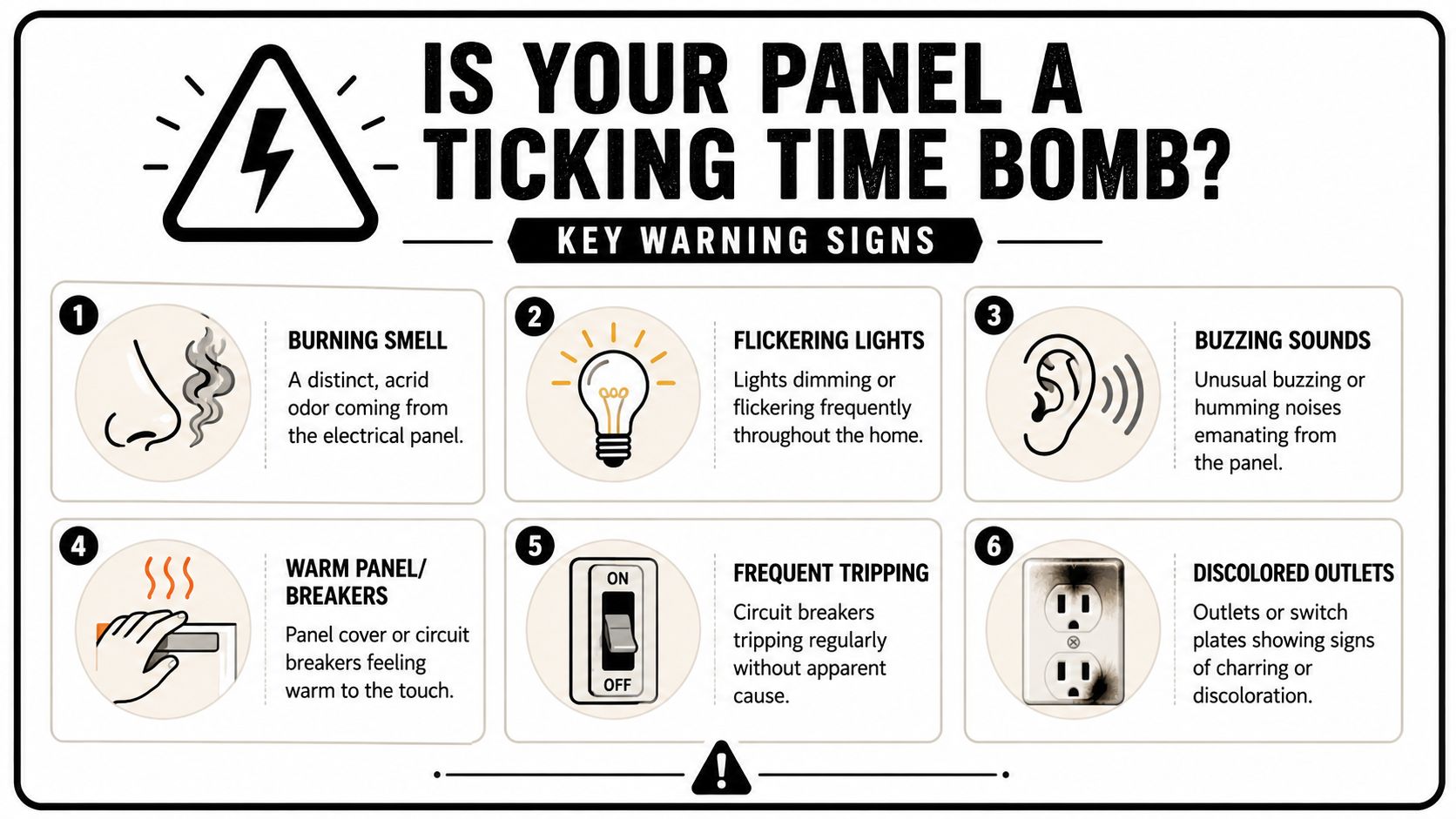
What you can smell, hear, and feel
Start with your senses. If you notice a burning smell, especially one that resembles hot plastic or scorched insulation, take it seriously. That odor can point to overheating breakers, loose connections, or damage where electricity is arcing instead of flowing cleanly.
Sound matters too. A healthy panel shouldn't make crackling, sizzling, or persistent buzzing noises. Those sounds can mean a poor connection or failing internal component. Heat is another direct clue. If the panel cover or a breaker feels warm, the system may be under strain or developing a fault.
Look closely at the panel exterior and the area around it.
- Scorch marks or discoloration often indicate overheating.
- Rust or corrosion can point to moisture intrusion.
- A stained or deteriorated panel surface suggests the equipment has been exposed to conditions that electrical gear doesn't tolerate well.
According to guidance on aging electrical panels and replacement signs, panels generally last 25 to 40 years, and common warning signs include frequent tripped breakers, flickering lights, warm or burning-smelling panels, crackling sounds, and scorch marks. That same guidance says homeowners with panels older than 25 years should strongly consider replacement.
Performance problems that point back to the panel
The second group of warning signs shows up in how the house behaves. Breakers that trip once after an obvious overload aren't unusual. Breakers that trip repeatedly without a clear reason deserve a proper diagnosis. If that's happening in your home, it helps to understand what causes a circuit breaker to keep tripping before assuming the whole panel is bad.
Watch for patterns like these:
- Lights that dim when major equipment starts can signal capacity strain or poor panel connections.
- Breakers that won't reset cleanly may indicate a failing breaker or a deeper panel issue.
- Rooms losing power intermittently can point to unstable breaker seating or internal wear.
- A panel that seems fine until hot weather may be struggling under Palm Beach County cooling loads.
If your panel is giving you a smell, a sound, and a performance issue at the same time, stop treating it as a nuisance. That combination deserves immediate professional evaluation.
One final warning sign is age plus reputation. Some outdated panel types and older fuse-based systems deserve extra caution because the design itself is no longer trusted for modern safety expectations. If your home still has obsolete equipment, the conversation often shifts from convenience to risk management.
Repair or Replace Your Panel? Making the Right Call
The choice homeowners make can lead to savings or unnecessary expenses. The right answer isn't “always replace” and it isn't “repair as long as possible.” It depends on what's failing.
Too many articles skip the middle ground. They describe symptoms that can come from a bad breaker, then recommend a full panel swap. In practice, that's not always the smart call.
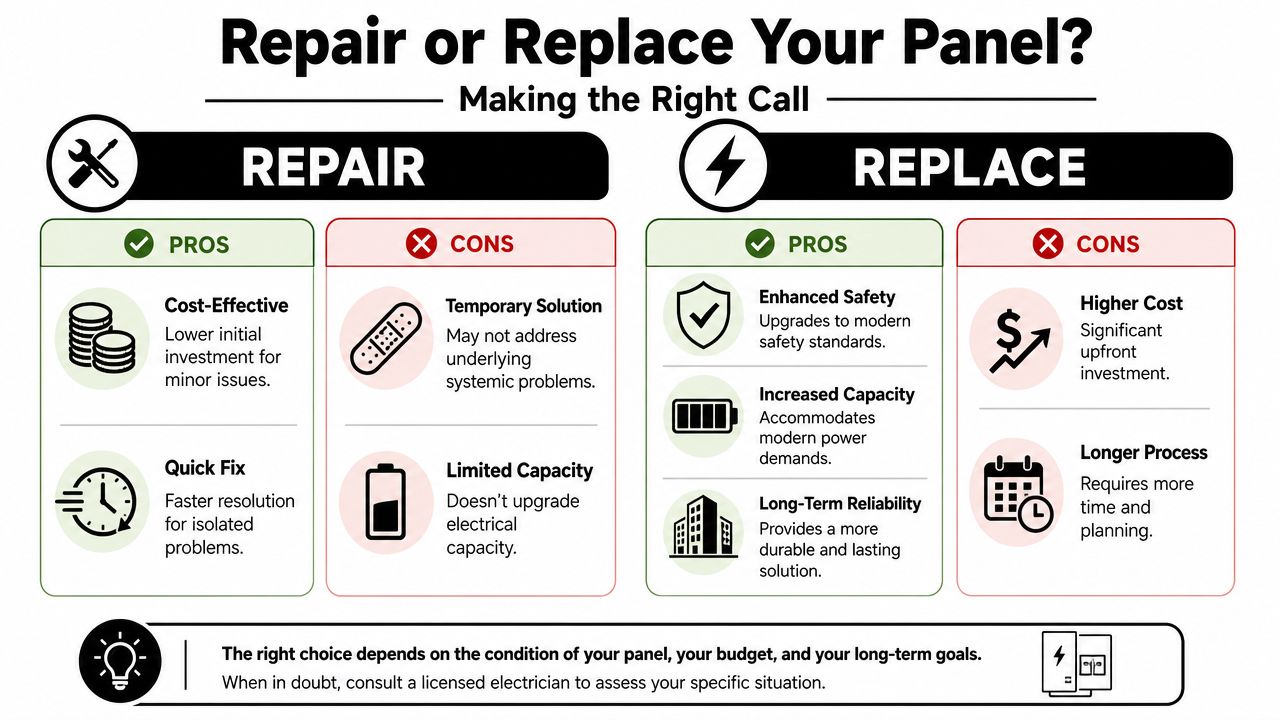
When repair is the smarter move
A repair often makes sense when the panel enclosure and bus structure are still in good condition, there's no major corrosion or water damage, and the issue is isolated to one or several breakers. That includes situations where a specific breaker has become weak with age and trips under normal load, or where multiple old breakers are wearing out but the panel itself remains serviceable.
One underused option is replacing all aged breakers within the existing panel instead of replacing the entire panel. A Reddit electrical expert highlighted that if the panel isn't badly designed but breakers are tripping, replacing the breakers can be a better value than jumping straight to a full $3,000 to $5,000 installation, as discussed in this homeowner discussion about whether a service panel needs replacing. That nuance gets missed a lot.
For Palm Beach County homeowners, that matters because homes often have one of two conditions. Either the house has a basically sound panel with tired breakers after years of heat and heavy AC use, or it has a panel that's very outdated, damaged, or undersized. Those are two very different jobs.
A repair-first approach usually works best when:
- The problem is isolated to one breaker or a small number of breakers.
- The panel has no visible deterioration such as rust, scorching, or moisture damage.
- The home's load is still reasonable for the existing service size.
- You need a practical fix without paying for capacity you won't use.
The same decision logic shows up in other property systems too. This piece on comparing appliance repair and replacement for rentals explains the same core principle well. Repair makes sense when the asset is fundamentally sound. Replacement makes sense when age, reliability, and long-term cost all point the other way.
Practical rule: If the panel body is sound and the problem lives in the breakers, don't pay for a full panel replacement just because the internet told you to.
When replacement stops being optional
Some conditions take repair off the table. If the panel shows extensive corrosion, contains outdated components such as a fuse box, or cannot handle modern electrical loads, replacement is usually the right call. Guidance on when panel replacement is recommended over repair also notes that when repairs start costing as much as a replacement, often exceeding $1,000, they no longer make sense for long-term safety and code compliance.
That's especially relevant in South Florida homes that have added equipment over time. A house that once ran on modest loads may now be supporting stronger cooling, upgraded kitchen appliances, outdoor circuits, and future electrification needs. If the service is undersized, no amount of patching changes the fact that the panel is behind the home.
Here's a simple decision view:
| Condition | Better path |
|---|---|
| Single faulty breaker, solid panel | Repair |
| Several old breakers, solid panel | Breaker replacement within existing panel |
| Rust, moisture, scorching, or obsolete equipment | Replace |
| Panel too small for current and planned loads | Replace |
If an estimate for piecemeal repairs climbs toward a major panel job, replacement usually wins on both safety and long-term value.
The Replacement Process Timeline and Costs in Palm Beach County
A panel replacement feels intimidating mostly because homeowners don't know what the day will look like, how long power will be off, or why one quote comes in much higher than another. The work itself is straightforward when it's planned correctly, permitted properly, and matched to the house.
In Palm Beach County, the process usually involves local permitting, utility coordination when needed, installation, inspection, and final signoff. The exact sequence can vary by municipality and by whether the job is a same-size swap or a service upgrade.
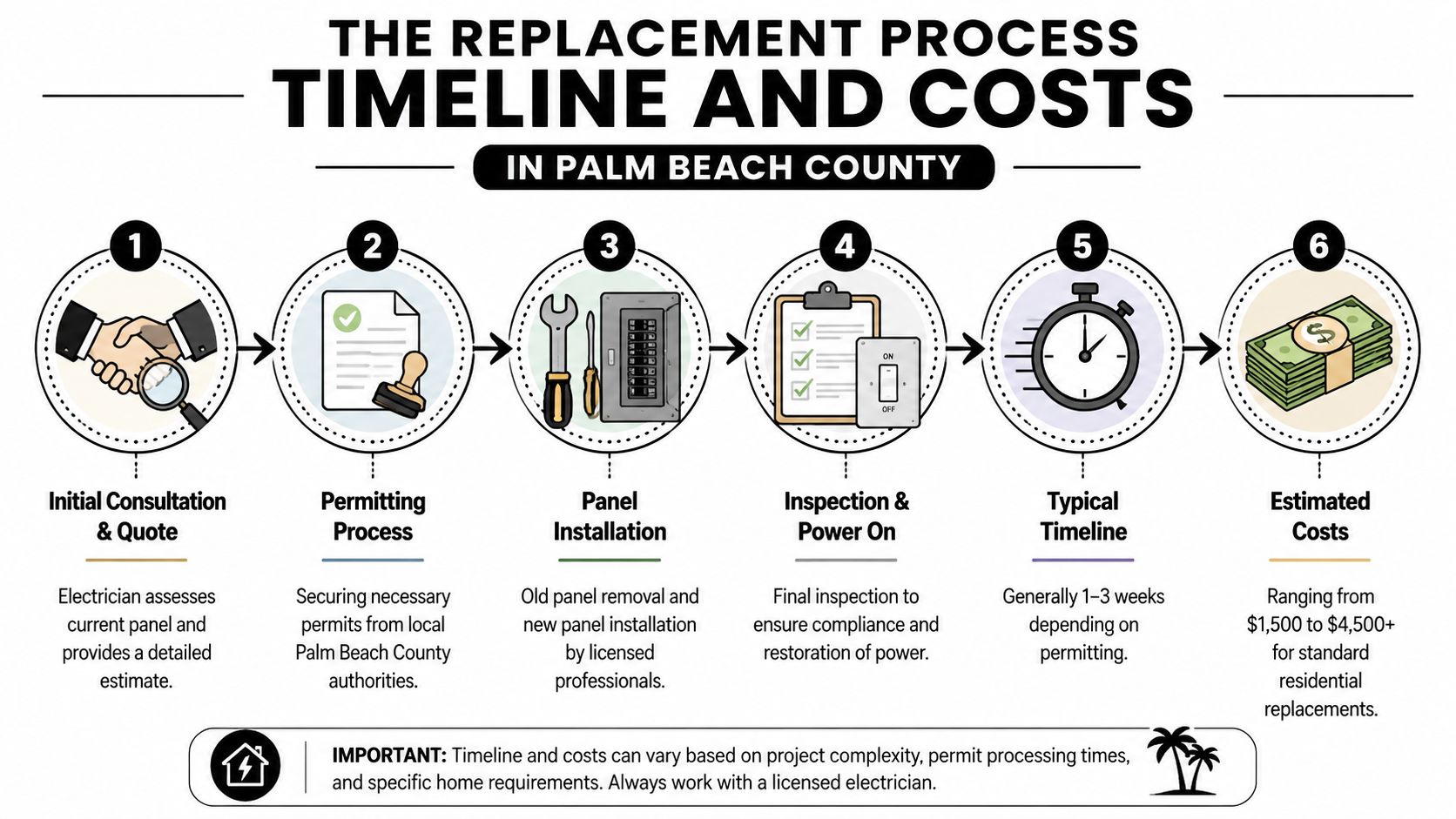
What the job usually looks like
A proper panel replacement starts with an on-site assessment. The electrician checks the existing panel, reviews the home's current load, and looks at what else may need attention, such as grounding, service entrance components, or cramped wiring from older work. If you're considering a capacity change, this is also when the load calculation matters.
Then the paperwork starts. Permits are part of the job, not an optional add-on. For homeowners comparing estimates, this matters because a low quote that ignores permit and inspection requirements isn't a bargain. It's a shortcut.
The installation day usually follows a sequence like this:
- Assessment and scope confirmation so the panel size and job details match the home.
- Permit submission and approval with the local authority having jurisdiction.
- Utility coordination if service disconnect or reconnection has to be scheduled.
- Old panel removal and new panel installation with circuits identified and re-landed correctly.
- Testing, labeling, and inspection before the system is considered complete.
According to cost guidance for circuit breaker box replacement, a straightforward panel replacement typically takes 4 to 8 hours, while more involved work can take longer. That source also states that labor rates for licensed electricians typically run $50 to $150 per hour, and permits usually cost $50 to $300.
If you're comparing budgets, this breakdown of home electrical panel upgrade cost considerations is useful because it helps homeowners understand why “simple panel swap” and “service upgrade” are priced very differently.
What affects the final cost
The biggest pricing factor is scope. A same-size replacement is one job. An amperage upgrade is another. Relocating the panel, replacing the main breaker section, upgrading grounding, or correcting code issues from older work all push the job upward.
The same Angi cost data reports that replacing a main breaker panel in the United States typically ranges from $519 to $2,187, with an average of $1,342, and costs can climb to $4,500 when main breaker replacement, relocation, or amperage expansion are involved. The main breaker itself can account for $500 to $2,000 of that total, and labor can reach $1,000 to $4,500 when a project takes 20 to 30 hours. The same source notes that when repair costs exceed $1,000, full replacement is often more cost-effective.
For homeowners thinking about capacity, guidance on panel age, amperage, and replacement cost ranges states that homes with panels older than 25 years, especially those supplying less than 100 amps, are strongly advised to move to at least 200-amp systems for modern demand. That source lists typical replacement ranges of $1,500 to $2,500 for 100-amp panels and $2,500 to $4,500 for 200-amp panels, with more complete service upgrades reaching $3,200 to $5,500.
The quote that matters isn't the cheapest number. It's the one that clearly explains what's being replaced, what's being brought up to code, and what you'll be able to run safely after the job is done.
For Palm Beach County homes, that future capacity question matters. A panel should solve today's problem without boxing you in next year.
Emergency Steps and Choosing a Licensed Electrician
Some panel issues can wait for a scheduled appointment. Others can't. If you smell burning, see sparks, or hear loud crackling from the panel, treat that as an active hazard.
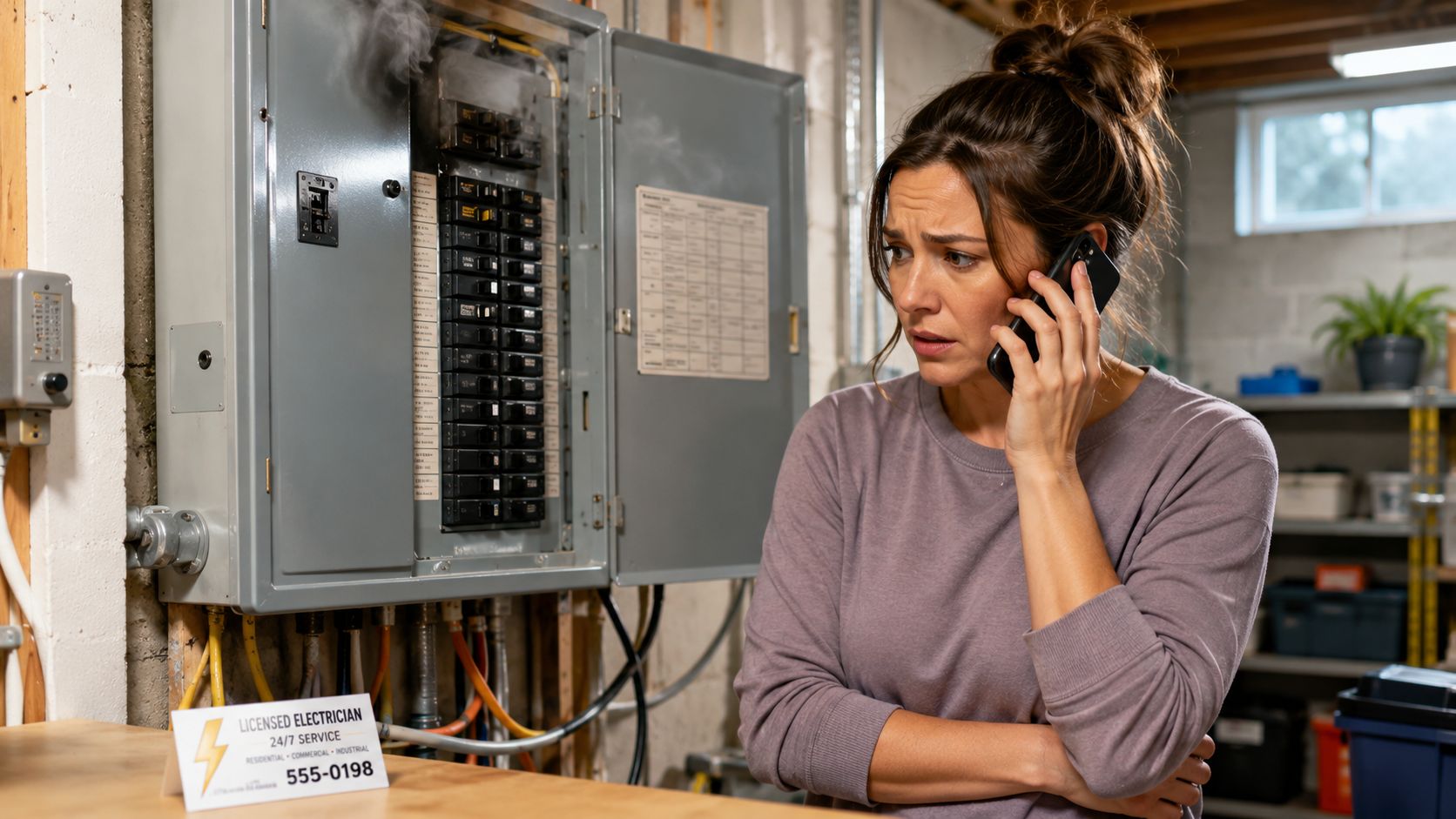
What to do right away
If there is visible smoke, active sparking, or fire risk, call 911 immediately. If you can safely stay clear of the panel, do that. Don't remove the dead front cover. Don't touch breakers that look melted or damaged. Don't try to diagnose it with a flashlight and a screwdriver.
If the main breaker is accessible and there is no arcing at the handle area, shutting off power may reduce risk, but only if it can be done safely and without reaching into a dangerous panel condition. If there's any doubt, back away and wait for emergency responders and an electrician.
Use this basic response order:
- Protect people first by keeping family members away from the panel and nearby area.
- Call emergency services if there's smoke, flame, or a clear fire hazard.
- Contact an emergency electrician once immediate danger is addressed.
- Leave the panel closed unless a licensed electrician tells you otherwise.
If a panel is smoking or crackling, your job is not to be brave. Your job is to get people clear and get qualified help on the way.
Who should touch your panel
Main breaker panel repair and replacement is not general handyman work. The person doing it should be licensed, insured, and experienced with service equipment, not just interior device replacement. In Palm Beach County, experience with local permitting and inspection expectations matters too.
When you hire, look for these basics:
- Current licensing and insurance so the work is legal and protected.
- Direct panel replacement experience rather than broad but shallow electrical claims.
- Detailed written estimates that spell out scope, permit handling, and likely code corrections.
- Strong local reputation with reviews that mention responsiveness, professionalism, and clean completion.
A contractor should also communicate clearly about downtime, inspection, and what happens if hidden issues show up after the panel is opened. If you need a checklist, this guide on how to find a good electrician gives homeowners a practical way to screen candidates.
Be cautious with anyone who wants to bypass permits, downplays obvious panel damage, or pushes a full replacement without explaining whether the trouble is really in the panel structure or just the breakers. You want diagnosis first, sales pitch never.
Conclusion Your Home's Safe Electrical Future
Panel problems create stress because they sit at the intersection of safety, comfort, and cost. The encouraging part is that the decision usually gets clearer once the symptoms are evaluated correctly. Frequent tripping alone doesn't always mean you need a full replacement. Sometimes a breaker repair, or even replacing all aging breakers in a sound panel, is the better financial move.
On the other hand, visible deterioration, obsolete equipment, moisture damage, or a panel that can't support the way your home uses power today should push you toward replacement. That's not overspending. It's removing a weak point from one of the most important systems in the house.
Main breaker panel repair and replacement should never be guesswork. The right choice protects your family, reduces nuisance outages, and gives your home room for the electrical demands that keep growing in Palm Beach County. A good panel doesn't just solve today's flicker or trip. It supports the AC, kitchen, electronics, and future upgrades you depend on.
If your panel has been giving you warning signs, don't wait for the next hot day, storm, or burned connection to make the decision for you. A professional inspection can tell you whether you need a targeted repair or a full replacement, and that clarity alone is worth a lot.
If you need fast, honest guidance on a panel problem in Palm Beach County, contact Lighthouse Energy Services. Their team provides true 24/7 electrical response, clear estimates, and experienced help for emergency troubleshooting, panel repairs, and full replacements done safely and professionally.