
You're probably here because the lights went out in one part of the house, the panel door is open, and one breaker keeps flipping off no matter how many times you reset it. Maybe it happens when the microwave runs. Maybe it happens when the AC kicks on. Maybe it seems completely random, which is often the most frustrating version of all.
A breaker that keeps tripping isn't being stubborn. It's doing its job. It functions similarly to a pressure relief valve in a plumbing system. When too much electrical “pressure” builds up, or when electricity starts flowing where it shouldn't, the breaker shuts power off before wires overheat and create a much bigger problem.
That's the fundamental reason why a circuit breaker keeps tripping. The breaker is rarely the whole story. It's the alarm bell. The actual cause might be a simple overload, a dangerous short circuit, moisture causing a ground fault, an aging breaker, or even a modern issue like smart home devices creating nuisance trips in a sensitive system.
Table of Contents
- That Annoying Click and Sudden Darkness
- The Most Common Culprit Circuit Overloads
- Dangerous Electrical Faults Short Circuits and Ground Faults
- When the Protector Becomes the Problem
- Your Safe Homeowner Troubleshooting Guide
- When to Call Lighthouse Energy Services Immediately
That Annoying Click and Sudden Darkness
That familiar click from the panel usually comes with a split second of confusion. One room goes dark. The refrigerator may still run. Half the kitchen may work while the other half doesn't. Then comes the question every homeowner asks. Why does this keep happening?
A circuit breaker is a safety switch, not a convenience switch. It shuts power off when the electrical flow on that circuit crosses a safe limit or when it detects a fault. That's why resetting it without understanding the cause is a little like silencing a smoke alarm without checking for smoke.
For everyday household circuits, a 15-amp breaker is typically rated for a maximum continuous load of 12 amps, and a 20-amp breaker supports up to 16 amps, based on residential electrical load guidance. When the current rises above what the circuit can safely handle, the breaker's internal bimetallic strip heats up and trips.
Why that matters in plain language
Think of a wire like a road and electrical current like traffic. A small road can handle normal flow all day. But when too many cars rush onto it at once, everything overheats, backs up, and the system needs a stoplight. The breaker is that stoplight.
Sometimes the stop happens slowly. A hair dryer, toaster oven, and microwave all running on one kitchen circuit may cause a trip after a short delay. Other times the trip is immediate, which usually points to something more serious than “too much stuff plugged in.”
A tripping breaker is a symptom. The real job is figuring out whether it's warning you about too much demand, damaged wiring, moisture, or a worn-out protective device.
The first mindset shift
Don't assume the breaker is bad just because it trips. In many cases, it's the one part of the system that's working exactly right.
If you understand that one idea, the rest gets easier. You stop treating repeated trips like an annoyance and start treating them like a clue.
The Most Common Culprit Circuit Overloads
Most of the time, the answer to what causes circuit breaker to keep tripping is simple. The circuit is overloaded. Overloaded circuits account for about 75% of residential breaker interruptions, according to NFPA findings and local Palm Beach County utility reporting. In Palm Beach County, overload-related trips rise by 35% in summer compared with winter, often when cooling loads and everyday appliances pile onto the same circuit.
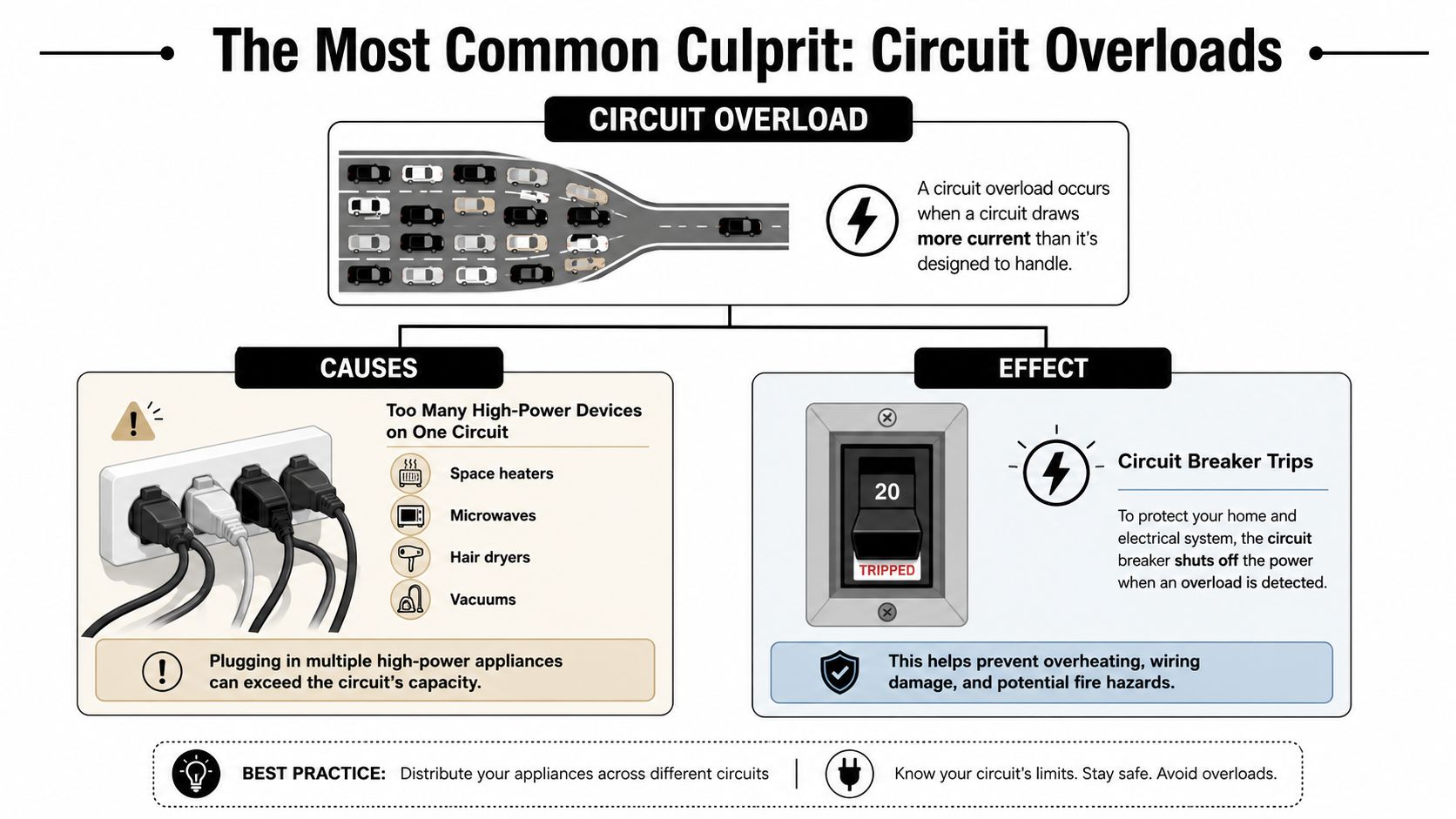
How an overload actually happens
An overload is exactly what it sounds like. The circuit asks for more current than it was designed to carry.
A standard 15-amp circuit can safely support 1,800 watts in simple math terms, but for continuous loading you don't want to ride right at the edge. Now think about what happens when several heat-producing appliances land on that same line. Space heaters, hair dryers, microwaves, toaster ovens, and portable AC units can all draw a lot of power fast.
A good analogy is a one-lane bridge. One car crossing is fine. A steady stream of small cars is fine. But if several heavy trucks try to cross together, the bridge reaches its limit. The breaker trips before the “bridge” in your wall wiring overheats.
Why Palm Beach County homes see this so often
Palm Beach County homes deal with a very real pattern. Air conditioning runs hard for long stretches, especially in the hottest months. If the same part of the house also feeds plug-in appliances, TVs, chargers, or a dehumidifier, the total demand adds up quickly.
Older homes are even more likely to struggle because many weren't designed around modern living. Years ago, a bedroom circuit might have supported a lamp, an alarm clock, and maybe a small television. Now that same room may carry monitors, chargers, a treadmill, and a portable cooling unit.
If your home seems to be outgrowing its panel, it may be worth learning when a 150-amp to 200-amp service upgrade makes sense.
What you can do right now
A simple overload is one of the few breaker problems a homeowner can often fix safely by changing habits.
- Separate the heavy hitters: Don't run a space heater, hair dryer, and vacuum on the same circuit.
- Watch heat-making appliances: Anything that creates heat usually draws more power than people expect.
- Pay attention to timing: If the breaker trips only when two or three specific things run together, that pattern matters.
- Use different circuits: Move one appliance to a receptacle in another part of the house if you know it's on a different breaker.
Here's a quick way to think about common loads:
| Situation | Likely meaning |
|---|---|
| Breaker trips after several minutes of use | Often points to overload |
| Trips only during heavy appliance use | Often points to load stacking |
| Trips at the hottest time of day | Cooling demand may be pushing the circuit over the edge |
| Stops tripping after you unplug a device | The load was likely the issue |
Practical rule: If the breaker holds after you unplug devices and only trips when certain appliances run together, overload is the leading suspect.
Dangerous Electrical Faults Short Circuits and Ground Faults
Overloads are common. Faults are the ones that deserve immediate respect.
Short circuits and ground faults account for 25% of residential electrical disruptions, with short circuits alone at 18%, based on ESFI residential electrical incident data. That same data notes that 40% of short circuits come from damaged or aged wire insulation, and 65% of ground fault incidents show up in moisture-prone spaces like bathrooms and kitchens.
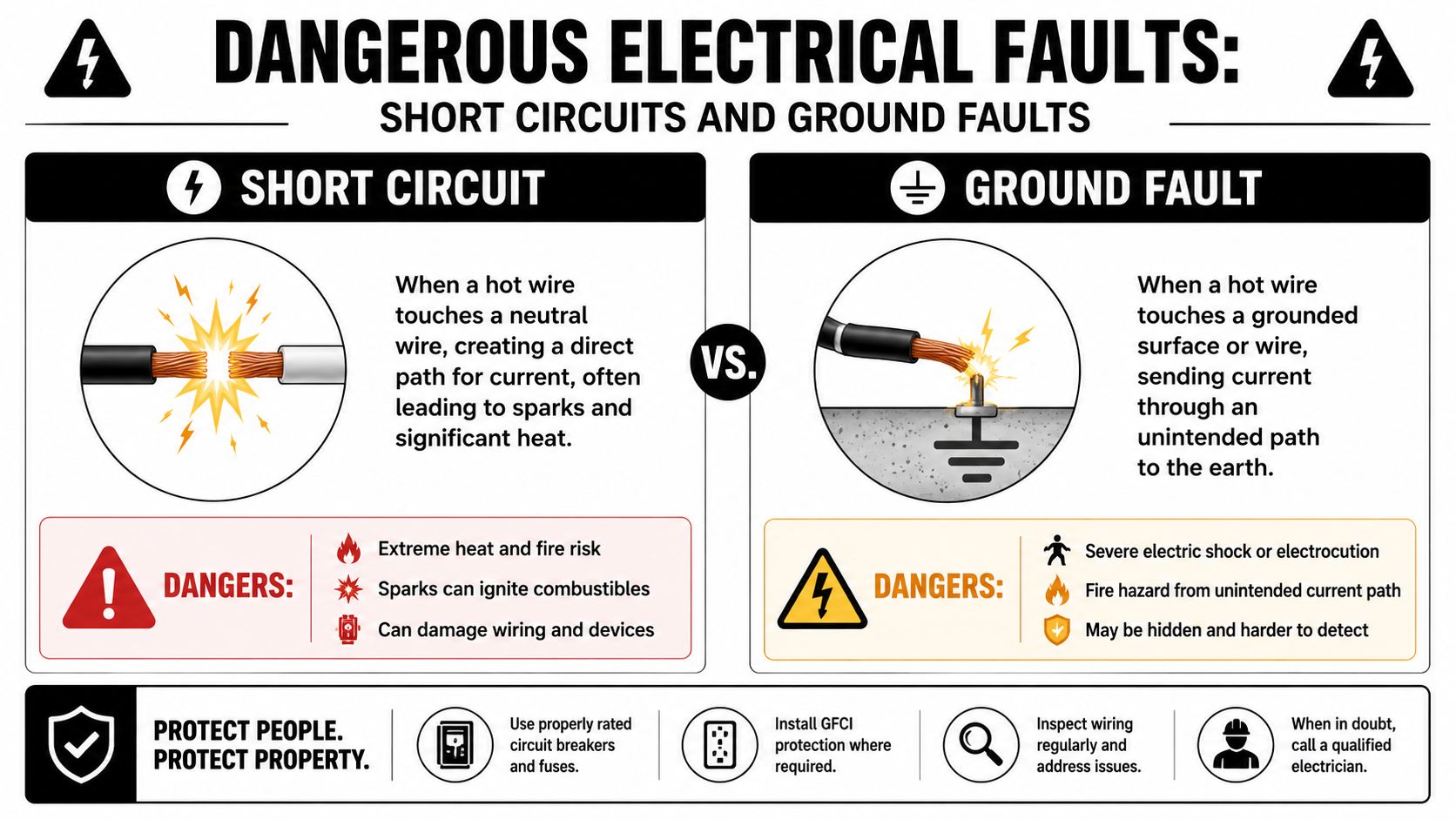
Short circuit versus ground fault
These two problems get lumped together a lot, but they aren't the same.
A short circuit happens when a hot wire touches a neutral wire. That creates a low-resistance path and a sudden surge. The breaker reacts almost instantly. Homeowners often describe this as a breaker that won't stay on for more than a moment, sometimes with a pop, spark, or burnt smell.
A ground fault happens when the hot wire touches a grounded surface instead. That may be a metal box, grounded wire, or another path to ground. Bathrooms, kitchens, garages, laundry areas, and outdoor circuits see this more often because moisture makes bad conditions worse.
Clues that point to a fault instead of an overload
An overload often gives you a little delay. A fault usually doesn't.
Watch for these warning signs:
- Immediate trip after reset: The breaker snaps off right away, even with little or nothing running.
- Burning smell: That sharp hot-plastic or scorched odor means stop.
- Scorch marks or discoloration: Especially around outlets, switches, plugs, or the panel.
- Popping or crackling: Electricity should be silent in normal operation.
- Moisture history: A damp wall, past leak, wet outdoor box, or steamy bathroom can point toward a ground fault.
If a breaker trips the instant you reset it, treat it like a wiring problem first, not a convenience problem.
Why faults are different
An overload is often about demand. A fault is about electricity going somewhere it should never go.
That's why a fault is not a DIY “keep resetting and see what happens” issue. Faults can generate intense heat in a hidden place, such as inside a wall cavity, inside a damaged cord, or behind an outlet. If you see or smell signs of damage, leave the breaker off and get the circuit inspected.
When the Protector Becomes the Problem
Sometimes the circuit isn't overloaded. Sometimes there isn't an obvious short. Sometimes the breaker itself, or the protective technology attached to it, is what's causing the confusion.
That's where a lot of homeowners get stuck. They unplug everything, reset the breaker, and it still trips. Or it trips only on humid days. Or it started after a remodel, a panel update, or adding connected devices around the house.
Old breakers can trip for the wrong reasons
Breakers are mechanical devices. They wear out. Springs weaken. Internal parts lose accuracy. In older homes, that matters more than people think.
In homes built before 1980, 40% of unexplained breaker trips are due to internal breaker mechanism failure rather than wiring faults, according to U.S. Department of Energy 2025 data and electrical trade analysis. So yes, a breaker can become oversensitive, inconsistent, or unreliable.
A few signs that point in that direction:
- The trip seems random: No obvious appliance pattern.
- The breaker feels loose or won't reset cleanly: It doesn't click with a firm, normal action.
- The problem follows the breaker, not the load: A pro can test this properly.
- The panel is older: Age alone doesn't prove failure, but it raises suspicion.
For a deeper look at recurring panel issues, this guide on circuit breaker tripping solutions can help you understand the repair path.
Sensitive breakers and Florida humidity
Modern AFCI and GFCI breakers protect against fire and shock hazards. That's a good thing. But in humid climates like Florida, sensitive breakers can sometimes react to moisture, especially when walls, exterior boxes, or older wiring systems hold dampness.
Homeowners often call this nuisance tripping. The breaker isn't necessarily “wrong” to react. It may be detecting leakage or irregular behavior that an older breaker would have ignored. The tricky part is that the source may be hidden inside a wall, around an exterior light, or in a bathroom circuit that has been exposed to repeated moisture over time.
Smart home devices and hidden load quirks
This is one of the newer reasons people ask what causes circuit breaker to keep tripping. Traditional advice usually talks about hair dryers and microwaves. It doesn't say much about connected switches, smart thermostats, monitoring devices, or automation hubs.
Those systems can introduce strange symptoms. A circuit may not be heavily loaded in the old-fashioned sense, but electronics can create intermittent spikes, harmonics, or communication-related behavior that sensitive protection devices don't like. To a homeowner, it feels random. To an electrician with testing equipment, it looks like a pattern.
Field insight: When tripping starts after adding connected controls, upgraded breakers, or monitoring hardware, the timeline itself is a diagnostic clue.
Your Safe Homeowner Troubleshooting Guide
If you want a practical answer to what causes circuit breaker to keep tripping, start with a safe process. Not guesswork. Not repeated resets. A calm checklist.
If a breaker trips immediately upon reset and keeps doing it regardless of appliance load, a fault is present, and industry safety guidance on breaker faults and fire risk says the right move is to stop resetting and have a licensed electrician inspect the wiring.
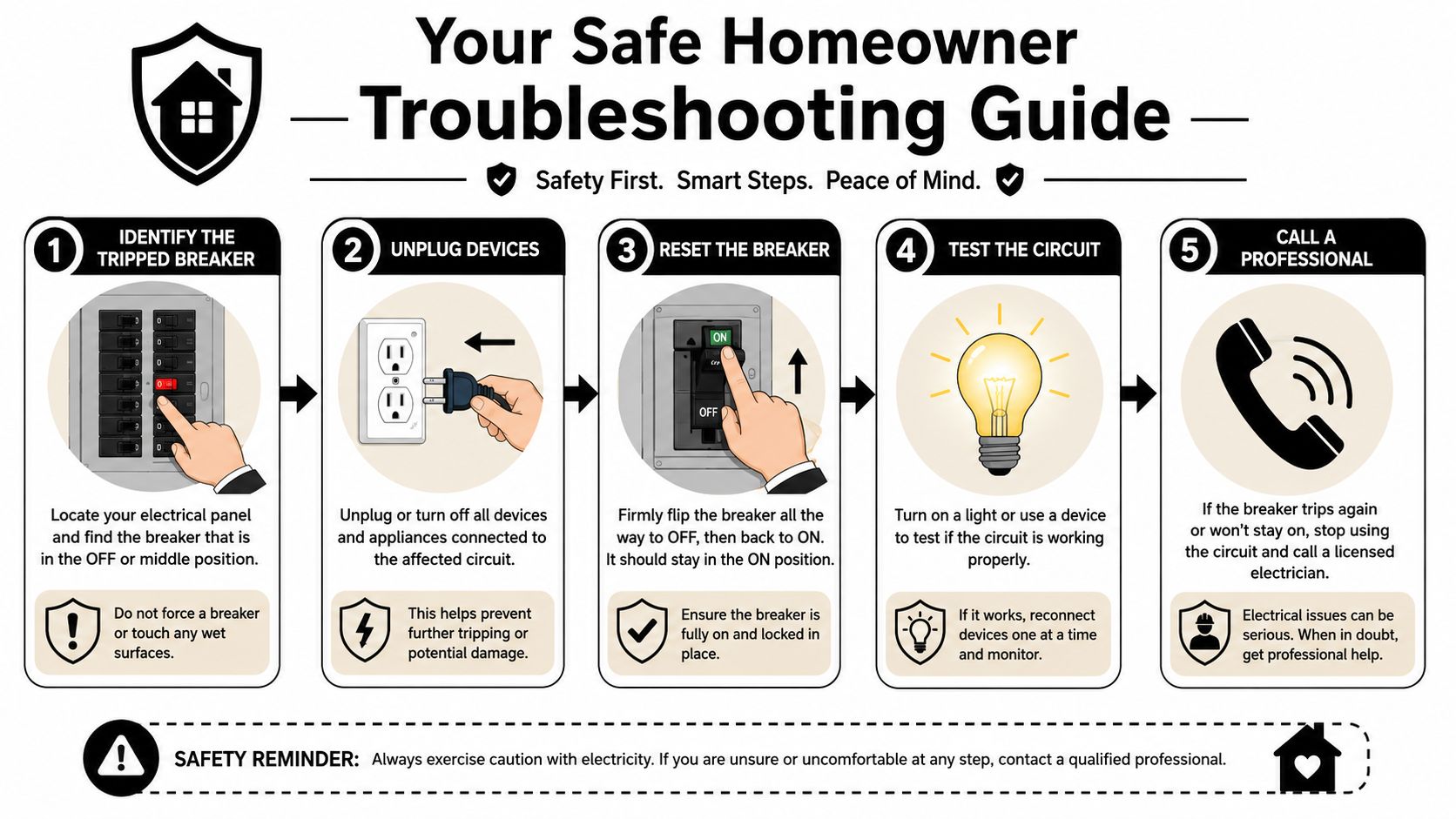
A simple flowchart you can follow
Use this sequence once. If the circuit gives you danger signs, stop there.
Find the tripped breaker
Open the panel and look for the switch sitting between ON and OFF, or slightly out of line with the others.Turn it fully OFF first
Breakers usually need a full reset. Push it all the way to OFF before switching it back to ON.Unplug everything on that circuit
Lamps, appliances, chargers, power strips, countertop equipment. Clear the circuit as much as you can.Reset the breaker once
If it holds, leave the circuit empty for a moment.Plug items back in one at a time
Give each item a chance to run before adding the next. If one device triggers the trip, that device may be faulty or the total load may be too high.
Here's the decision path in a compact view:
| What happens | What it usually suggests | What to do |
|---|---|---|
| Breaker resets and stays on with everything unplugged | Load issue or bad appliance is possible | Reintroduce devices one by one |
| Breaker trips only when certain appliances run together | Overload is likely | Spread those appliances to different circuits |
| Breaker trips instantly with nothing plugged in | Fault or failed breaker is possible | Stop and call a licensed electrician |
| Breaker trips near bathrooms, kitchen, exterior, or damp areas | Ground fault or moisture issue is possible | Leave it off and have it tested |
What not to do
These are the mistakes that create extra risk:
- Don't keep forcing resets: One reset for testing is reasonable. Repeated resets against a fault are not.
- Don't swap breakers yourself: Panel work exposes live parts even when one breaker is off.
- Don't ignore smells or sounds: Buzzing, crackling, and burning odors are stop signs.
- Don't assume the last thing plugged in is always guilty: Sometimes that device only revealed a hidden wiring problem.
Unplugging devices is homeowner territory. Diagnosing faults inside the panel, walls, or breaker hardware is professional territory.
When to Call Lighthouse Energy Services Immediately
Some breaker problems can wait until morning. Some shouldn't.
A 2024 NECA report found a 15% rise in breaker trips linked to smart home integration issues, where devices can create micro-sags or current spikes that mimic faults, according to NECA reporting on smart home related breaker trips. Those are exactly the kinds of problems that can fool homeowners because they don't look like classic overloads.

Red flag checklist
Call right away if any of these are happening:
- The breaker is hot to the touch: Warmth at the panel is never something to shrug off.
- You smell burning: Especially near the panel, an outlet, or inside a wall.
- You hear buzzing or crackling: Healthy electrical systems don't make those noises.
- The breaker trips immediately every time: That points away from a simple overload.
- You see scorch marks, melted plastic, or smoke: Leave the circuit off.
- The problem started after water intrusion: Roof leaks, wall moisture, wet exterior boxes, or storm exposure matter.
- The tripping began after adding connected controls or smart devices: Those problems often need professional testing, not trial and error.
Why repeated trips need professional testing
A licensed electrician doesn't just “reset and hope.” They isolate the circuit, test whether the breaker is failing, check for hidden ground faults, inspect terminations, and verify whether a device or section of wiring is misbehaving.
That matters in Palm Beach County homes because the environment adds its own challenges. Humidity, aging panels, heavy cooling demand, and moisture-prone outdoor equipment can produce symptoms that overlap. To a homeowner, everything looks like “the breaker keeps tripping.” To a trained electrician, the pattern tells the story.
If the issue looks urgent, an emergency electrician in Palm Beach County is the safer next step than more experimenting at the panel.
The good news is that a tripping breaker is often fixable once the cause is identified clearly. The dangerous part is assuming all trips are the same. They aren't. A delayed trip during heavy use suggests one path. An instant trip with smell, heat, or moisture suggests another. Knowing that difference protects your home.
If your breaker keeps tripping and you're not sure whether you're dealing with an overload, a hidden fault, a worn-out breaker, or a modern nuisance-tripping issue, Lighthouse Energy Services can help. Their team serves Palm Beach County with true 24/7 electrical service, and your call is answered by licensed electrical professionals who know how to troubleshoot urgent panel and circuit problems safely.