
The call usually comes at the worst time. In Palm Beach County, that often means wind pushing rain sideways, lights flickering, the air conditioner dropping out, and one breaker that will not stay reset no matter how carefully you try it. Other times it is less dramatic but just as disruptive. Half the kitchen plugs stop working before guests arrive, a condo panel starts buzzing, or a property manager gets a late-night message that a common-area light circuit is down.
When that happens, people often do the same thing. They search fast, scan stars, call the first number that picks up, and hope the person on the other end is qualified. That is understandable. It is also how people end up hiring the wrong electrician for the wrong kind of job.
In Palm Beach County, electrical hiring has a local layer that generic advice misses. Storm exposure matters. Fast response matters. Florida licensing matters. Some buildings need specialized work, not just standard residential troubleshooting. If your property has rooftop equipment, commercial service gear, industrial loads, or aircraft obstruction lighting, the pool of suitable electricians gets much smaller.
A good electrician is not just someone who can eventually solve the issue. It is someone who can diagnose safely, work cleanly, communicate clearly, and handle the kind of property and urgency you have.
Why Your Search for an Electrician Needs a Strategy
A rushed hire usually costs more than a careful one.
In Palm Beach County, the pressure is real. A storm pushes water toward a recessed light in Boca Raton. A breaker feeding part of the house keeps tripping during August heat in Wellington. A restaurant in West Palm loses a panel section that affects lighting, refrigeration, and point-of-sale equipment. In each case, the job feels urgent, but the wrong hire can turn one problem into three.
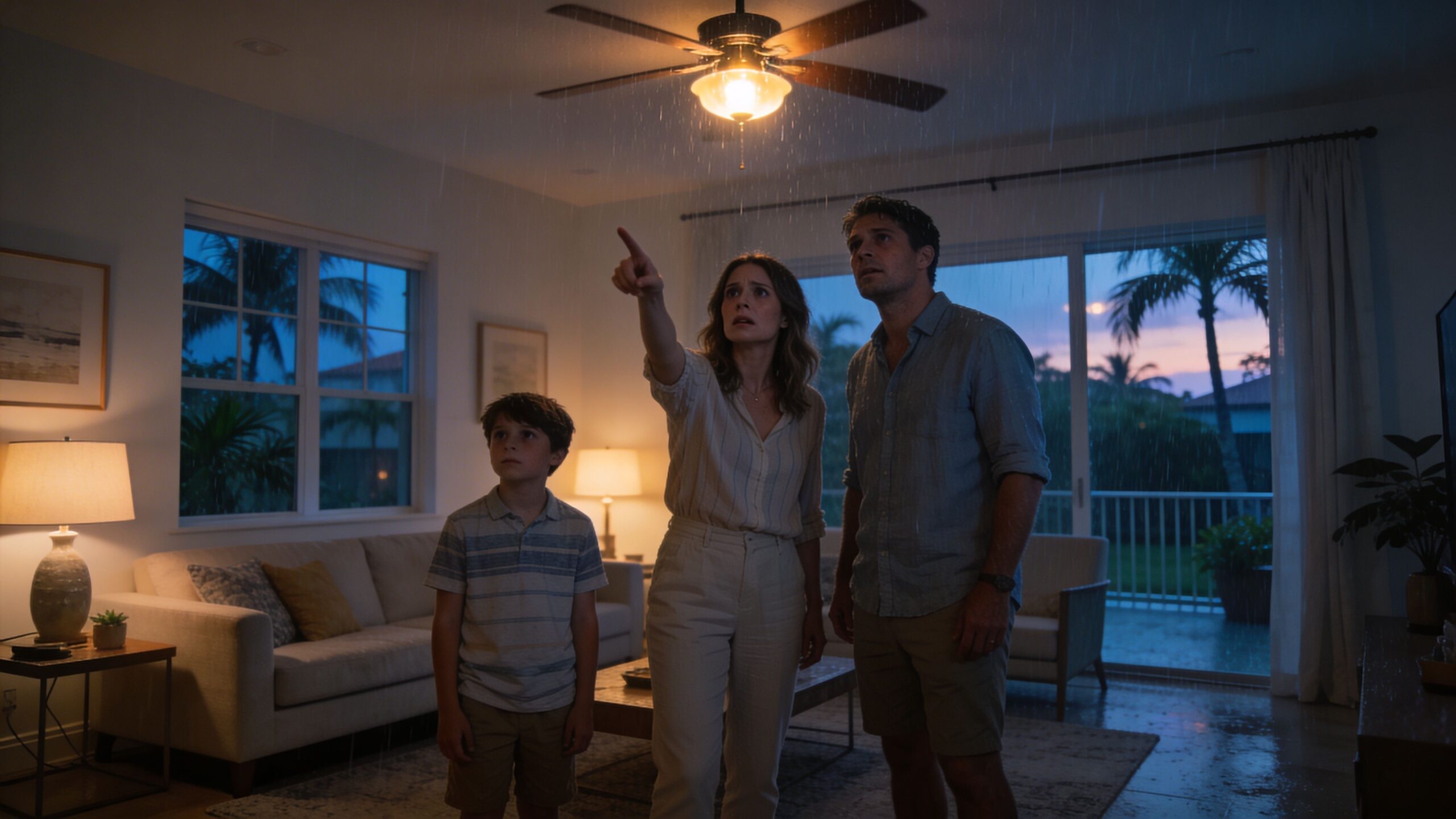
The practical goal is not just speed. It is fast response from the right kind of electrician. Some companies are strong at routine residential service calls and weak at storm-related diagnostics. Some answer after hours but send whoever is available, not the person qualified for a service issue, commercial troubleshooting call, or specialty lighting system. That difference matters more here than it does in many other counties.
Good electricians are harder to book than they used to be
The labor market is part of the reason. Employment of electricians is projected to grow 9% from 2024 to 2034, with about 81,000 job openings projected each year (U.S. Bureau of Labor Statistics electrician outlook), and nearly 40% of electricians were age 45 or older as of May 2023 (U.S. Bureau of Labor Statistics electrician outlook).
That shows up in the field. Reliable shops stay booked. Experienced troubleshooters get pulled toward larger projects, repeat clients, and emergency work that matches their skill set. If you wait until the power is half out to decide how you will screen contractors, you are making a hard decision under bad conditions.
That is especially true for owners planning renovations or new construction. A guide to hiring an electrician for a new home build helps on the front end, but the same principle applies to service calls. The better the screening process, the better the result.
Palm Beach County makes fit matter more
This is not a one-size-fits-all market. The county includes older homes with aging panels, coastal properties with corrosion issues, condos with shared systems, retail spaces, medical offices, warehouses, HOAs, and facilities with specialized equipment. The range of work is wide. So is the range of contractor ability.
A company that handles a ceiling fan replacement neatly may not be equipped for a commercial service problem, generator tie-in coordination, hurricane-related emergency response, or aircraft obstruction lighting near regulated approach areas. Florida licensing checks matter here too. So does knowing whether the contractor regularly pulls permits in the jurisdictions where you need the work done.
Practical takeaway: If the job affects safety, cooling, operations, inspections, or code compliance, build a shortlist before you hire anyone.
What a strategy protects you from
The usual mistakes are predictable.
- Choosing by price alone: Low bids often leave out permit handling, correct materials, cleanup, or the time needed to diagnose the actual fault.
- Choosing by speed alone: Fast arrival helps only if the electrician can identify the problem safely and has the authority and experience to fix it properly.
- Choosing by ratings alone: The star count matters less than review patterns about punctuality, communication, callbacks, and whether the final invoice matched the quote.
- Choosing by broad claims: “We do everything” does not tell you whether the company has real experience with condo service gear, commercial panels, storm damage, or specialty exterior lighting systems.
A hiring strategy is simple. Match the electrician to the job, verify the basics, and screen for the risks that are common in Palm Beach County. That approach works better whether you need a dead outlet fixed in Jupiter, an emergency panel diagnosis in West Palm Beach, or rooftop obstruction lighting service near an airport corridor.
Building Your Shortlist of Reputable Candidates
A bad shortlist usually starts the same way. Someone loses power after a storm in Boynton Beach, opens Google, calls the first number with five stars, and hopes the truck that shows up can handle the job. Sometimes that works. In Palm Beach County, it often leaves people with the wrong contractor for the property, the scope, or the urgency.
Build the list before you start calling.
Referrals still carry real weight. Research found that 54% of customers choose electricians based on recommendations from friends, family, or colleagues, while Google and TrustPilot influence 42% of hiring decisions, according to the BigChange survey on how customers select electricians. That matches what I see in the field. Good referrals usually come from someone who watched the electrician solve the problem, protect the property, and finish without drama.
Start with people who have seen the electrician work
Ask people who deal with contractors regularly, not just people who remember a name.
Neighbors, condo managers, HOA board members, building engineers, commercial property managers, and other trades can give better referrals than a general social media post. A roofer or HVAC contractor knows which electricians show up prepared, coordinate inspections properly, and do not leave a mess for the next trade.
Ask better questions.
- What kind of work did they do: Service change, troubleshooting, dock power, tenant buildout, pool equipment wiring, storm repair, or exterior lighting all point to different skill sets.
- How did they handle problems: Good electricians explain delays, hidden damage, and code issues clearly instead of disappearing for two days.
- Did they finish clean: In occupied homes, condos, and medical or office spaces, jobsite discipline matters.
- Would you call them again for the same kind of job: That answer usually tells you more than any star rating.
In Palm Beach County, local experience matters more than people realize. An electrician who is solid on tract homes in western communities may not be the right fit for oceanfront corrosion issues, older service equipment in West Palm, condo coordination in Boca Raton, or specialty work such as aircraft obstruction lighting near regulated corridors.
Use Google to read patterns, not just ratings
After you have a few names, search each company and read reviews like a contractor would.
Skip the vague praise and look for repeated proof of how they operate. Comments about arrival windows, troubleshooting, permit handling, communication with property managers, and invoice consistency are more useful than twenty reviews that only say “great service.”
Here is the pattern check that helps:
| Review pattern | What it usually means |
|---|---|
| Multiple mentions of “found the issue fast” | Strong diagnostic skill |
| Reviews mention clean work areas and labeled panels | Organized field practices |
| Customers describe clear pricing before work begins | Better estimate discipline |
| Repeated complaints about rescheduling or no-shows | Dispatch or staffing problems |
| Reviews only mention “nice guy” but not results | Weak evidence of technical quality |
Read the low reviews too. One angry review does not disqualify a company. A string of complaints about missed appointments, surprise charges, or unfinished punch-list items usually points to a real operating problem.
Build a shortlist that fits the job
Three to five candidates is the right range for most projects. More than that turns into noise, especially if the work is urgent.
Each name on the list should earn its place for a specific reason:
- Direct referral strength: Someone you trust saw the work firsthand.
- Palm Beach County track record: The company works regularly in your city or building type.
- Service match: Their day-to-day work looks like your project, whether that is residential service, commercial troubleshooting, HOA common-area lighting, emergency storm response, or specialty exterior systems.
- Review consistency: The same good habits show up across different platforms and time periods.
- Real local presence: A usable website, local address or service area, and clear descriptions of the work they perform.
If the project is larger than a service call, early screening saves money later. A contractor who is fine for replacing switches may not be the right one for a full remodel, service upgrade, or new construction. This guide on hiring an electrician for a new home in Palm Beach County shows how that early fit check prevents expensive mismatches.
What not to overvalue
A polished website proves the company invested in marketing. It does not prove field quality.
A long service list can be misleading too. Some contractors list every electrical service they can think of, from generator installs to industrial controls to aircraft warning lights. That does not mean the same crew handles those jobs well, or handles them often enough to stay sharp.
Put more weight on evidence that matches your exact situation. If you need hurricane-related emergency response, look for proof they stay active during storm events. If you manage a condo or commercial site, look for reviews that mention coordination, access, and follow-through. If the work is specialized, narrow the list to electricians who do that kind of work routinely.
A good shortlist makes the rest of the hiring process easier. It gives you a workable group of candidates who already fit the job, the property, and the local conditions.
Verifying Licenses Insurance and Qualifications
A Palm Beach County electrician can sound polished on the phone and still be the wrong hire. The check that saves people from trouble is simple. Verify the license, verify the insurance, then verify who will be on site to do the work.
Reviews help later. Credentials decide whether the company should stay in the running at all.

Check the Florida license first
In Florida, a license claim is easy to make and easy to verify. Use the Florida Department of Business and Professional Regulation search and match the contractor’s legal business name, status, and license type to the estimate in front of you. That one step screens out a lot of risk. Annual audits have flagged unlicensed operators often enough to make this a real issue, including the 15% figure cited in this guide on how to choose the right local electrician.
The details matter. In Palm Beach County, I would look harder at licensing on any job involving service upgrades, condo work, commercial tenant build-outs, marina properties, hurricane-related repairs, or specialized systems such as aircraft obstruction lighting. Those jobs leave less room for guesswork, and permit scrutiny tends to be tighter.
Check these basics:
- Active status: The license should be current, not expired, inactive, or suspended.
- Correct business identity: The company name on the proposal should match the licensed entity.
- Proper classification: The license should fit the type of work being quoted.
- Willingness to provide details: A legitimate contractor should give a license number without delay.
If you want a local benchmark for what a properly credentialed company should look like, review what a licensed electrical contractor in Palm Beach County presents before you compare bids.
Insurance is part of the hire
Insurance becomes important the minute a ceiling gets opened, a ladder goes up, or a panel cover comes off.
Ask for current certificates for general liability and workers' compensation. Verbal assurances are not enough. The company name and policy dates should match the contractor you are hiring.
General liability covers property damage tied to the contractor’s work. Workers' compensation covers injuries to crew members on your property. That distinction matters more than homeowners expect. A low bid from an uninsured outfit can get expensive fast if someone gets hurt in an attic, on a tile roof, or near service equipment after a storm.
Palm Beach County adds its own wrinkles. Emergency calls after hurricanes, salt-air corrosion near the coast, and work on older homes with patched-together additions all raise the chances of hidden conditions. Insurance does not fix poor workmanship, but it does protect you when a job goes sideways.
Know who will be on site
A lot of homeowners check the owner’s credentials and stop there. The better question is who will perform the work, who supervises it, and who makes the call if conditions change once the job is opened up.
Ask plainly. Will a master electrician oversee the work? Is the crew made up of employees or subcontractors? Who handles permit corrections or inspector comments if they come up?
Here is the practical difference:
| Credential level | What it generally tells you |
|---|---|
| Apprentice | Still training under supervision |
| Journeyman | Broader field experience and independent installation ability |
| Master electrician | Higher level of expertise, deeper code knowledge, stronger fit for complex work |
For a simple device replacement, a supervised crew may be perfectly fine. For a generator tie-in, service change, commercial troubleshooting call, or specialty lighting system, higher-level field experience matters a lot more.
Use reviews after the hard checks
Once the license and insurance are confirmed, go back to reputation and read it with better context. The same how to choose the right local electrician guidance recommends looking for a 4.8+ average on Google or Yelp with 100+ reviews. That is a useful screen, but only after the legal and financial checks are done.
A clean way to vet a candidate is this. Confirm DBPR status. Confirm insurance. Confirm the working supervisor. Then decide whether the company has the track record to justify a spot on your final list.
Decoding Estimates and Asking the Right Questions
An estimate is not just a price. It is a preview of how the electrician thinks.
Good estimates are specific, calm, and easy to compare. Weak estimates are vague, rushed, and designed to get a yes before you understand what is missing. The decision on how to find a good electrician often gets made here.
The first phone call tells you a lot
Pay attention to how the company handles the initial conversation.
A strong office or licensed professional usually asks smart questions before throwing out numbers. They want to know the property type, age of the building, symptoms, urgency, and whether the issue is isolated or affecting multiple circuits. That signals discipline.
A weak call often sounds like this: “Yeah, probably no big deal, we can take care of it.” That is not confidence. That is guesswork.
Ask direct questions such as:
- Who will perform the work?
- Have you handled this exact kind of issue before?
- Will you troubleshoot first or quote the repair immediately?
- Do you pull permits when the job requires them?
- What is your workmanship warranty?
- What parts are included, and what could change the price?
- What is the expected timeline once work starts?
The answers should sound clear, not rehearsed. A seasoned electrician can explain technical issues in normal language without talking down to you.
Compare scope before comparing price
The biggest estimate mistake is comparing one bottom-line number to another. That only works if the scope is the same.
One quote may include diagnostics, replacement materials, code corrections, panel labeling, haul-away, permit coordination, and final testing. Another may include only the visible repair and leave the rest for change orders later.
Use this table when comparing proposals:
| Estimate item | What to look for |
|---|---|
| Scope of work | Specific tasks, not broad promises |
| Materials | Named components or clear descriptions |
| Permits | Included when required, or clearly excluded |
| Labor model | Hourly, flat-rate, or phased |
| Timeline | Start window and expected duration |
| Warranty | Parts, labor, and any exclusions |
| Cleanup | Removal of debris and restoration expectations |
If one estimate is dramatically lower, ask why. Sometimes the answer is efficient operations. Other times it is omitted work, lower-grade materials, or inexperience with the problem.
Flat-rate versus hourly
Neither pricing model is automatically better. Each has trade-offs.
Flat-rate pricing
This works well for common repairs and well-defined tasks. It gives the customer cost clarity upfront. It also rewards electricians who diagnose quickly and work efficiently.
The downside is that some companies force a flat rate onto jobs that are not well-defined yet, which can lead to broad exclusions and surprise add-ons.
Hourly pricing
This can make sense for complex troubleshooting, older homes, intermittent faults, or commercial systems where the issue is not fully visible at the start. You pay for actual time spent diagnosing and correcting.
The downside is uncertainty if the company does not communicate progress well.
Practical rule: If the issue is simple and visible, flat-rate can work well. If the issue is hidden or intermittent, hourly with clear checkpoints is often more honest.
Red flags that should end the conversation
Some warning signs are not minor concerns. They are reasons to move on.
- A quote without seeing the job: For anything beyond the most basic service, this is risky.
- Pressure for a large cash payment upfront: Especially before materials are ordered or work is scheduled.
- No written estimate: Verbal promises are hard to enforce.
- Vague language: “Miscellaneous electrical repairs” is not a useful scope.
- Refusal to discuss warranty: Good contractors stand behind their work in writing.
- Dismissive answers about permits or code: That attitude usually causes bigger trouble later.
Ask one question often overlooked
Ask, “What do you think could change the price after you open this up?”
That question separates practical electricians from sales-oriented ones. A good answer will mention hidden damage, code issues discovered in the field, obsolete equipment, or access limitations. It will also explain how those changes would be documented before extra work proceeds.
This is not about trying to trap the electrician. It is about finding someone who has done enough real work to know where jobs usually shift.
The cheapest quote often costs more later
Electrical work is unforgiving. A low bid can mean the contractor missed code issues, underestimated labor, planned to use lower-grade parts, or wants to win the job and renegotiate once the walls are open.
Good hiring is not about paying the most. It is about paying for a complete, competent scope. When two estimates are close, choose the one that is clearer, more accountable, and easier to defend six months from now if something goes wrong.
Evaluating Specialized and Emergency Electrical Services
At 11:40 p.m. in August, a breaker failure during a storm is a different hiring problem than a daytime outlet repair. The same goes for an HOA lighting outage, a rooftop obstruction light fault, or an efficiency retrofit tied into HVAC equipment. In Palm Beach County, those calls punish the wrong hire fast.
A contractor can be solid on routine residential work and still be a poor fit for after-hours dispatch, regulated lighting systems, or jobs that affect tenant operations and storm readiness. Specialized work needs matching experience, not broad promises.
True 24 7 service is rarer than it sounds
Plenty of companies advertise emergency service. Far fewer have a real after-hours system with an informed dispatcher, stocked trucks, and a technician who can make the property safe before sunrise.
One source on hiring an electrician and verifying emergency response claims reports that residential electrical emergencies in Florida storm seasons rose 18%, and only 22% of online electrician listings specify true 24/7 service.
That gap shows up every hurricane season. In Palm Beach County, I would treat "24/7" as a claim that needs proof.
Ask direct questions:
- When I call after hours, who answers?
- Can that person tell the difference between a tripped breaker, a meter issue, and an active hazard?
- Do your service vehicles carry common emergency parts?
- What is your after-hours rate and minimum charge?
- If parts are unavailable tonight, can you isolate the fault and leave the property safe?
Clear answers matter. Fuzzy answers usually mean the company has an answering service, not an emergency operation.
For a local standard, this Palm Beach emergency electrician guide gives a useful picture of what real response should include.
Specialist work should stay with specialists
Palm Beach County has more niche electrical work than national hiring guides usually acknowledge. Coastal properties bring corrosion issues. High-end homes add complex controls and larger service demands. Commercial roofs and tall structures can involve aircraft obstruction lighting, where code, access, and documentation all matter.
Aircraft obstruction lighting is the category that gets underestimated most often. Building owners and property managers sometimes assume any commercial electrician can handle it. That assumption causes delays, repeat trips, and compliance trouble.
Ask whether the contractor has serviced obstruction lighting systems before, whether they know the reporting and maintenance expectations tied to the equipment, and how they handle roof access and intermittent faults. A confident electrician should be able to describe the work plainly, without guessing.
The same rule applies to other specialty categories:
- Commercial and HOA electrical systems: Common-area lighting, service equipment, signage, tenant coordination, and work in occupied spaces
- Industrial electrical work: Higher-capacity gear, lockout procedures, motor controls, and more involved troubleshooting
- Energy-saving controls and upgrades: Electrical work that affects HVAC operation, load profiles, and long-term maintenance
Ask specialty questions that expose real experience
Generic screening questions stop working once the job affects compliance, downtime, or another building system.
For aircraft obstruction lighting, ask:
- Have you repaired rooftop or tower lighting systems in South Florida conditions?
- How do you document troubleshooting and completed repairs?
- If the problem is intermittent, what is your testing process?
For commercial or industrial work, ask:
- Have you worked in occupied facilities where shutdown timing matters?
- Who plans the outage and communicates with building management?
- What larger distribution or service equipment do you work on regularly?
For energy-saving upgrades, ask:
- Have you installed controls such as Smartcool ECO3?
- How do you decide whether the equipment is a good fit for the site?
- What happens if the savings are disappointing because the HVAC system has underlying actual issues?
Those questions get to judgment, not just licensing. That is the difference on specialized jobs.
One product example comes up in efficiency discussions. Smartcool states that its technology can reduce AC electricity consumption by up to 25% on its Smartcool ECO3 product information. That potential matters only when the installer understands the mechanical side, verifies the application, and sets realistic expectations about payback.
Match the electrician to the risk
General electricians have an important place. For routine residential repairs, panel troubleshooting, receptacle replacement, and many service calls, a skilled general contractor is often the right hire.
For after-hours failures, regulated lighting, industrial equipment, HOA common areas, and systems that must keep operating through storm season, choose someone who handles that exact class of work regularly. In Palm Beach County, the local conditions raise the cost of trial-and-error.
Ask one final question before you book the job: How often do you handle this exact problem in this exact type of property? That answer usually tells you more than the sales pitch.
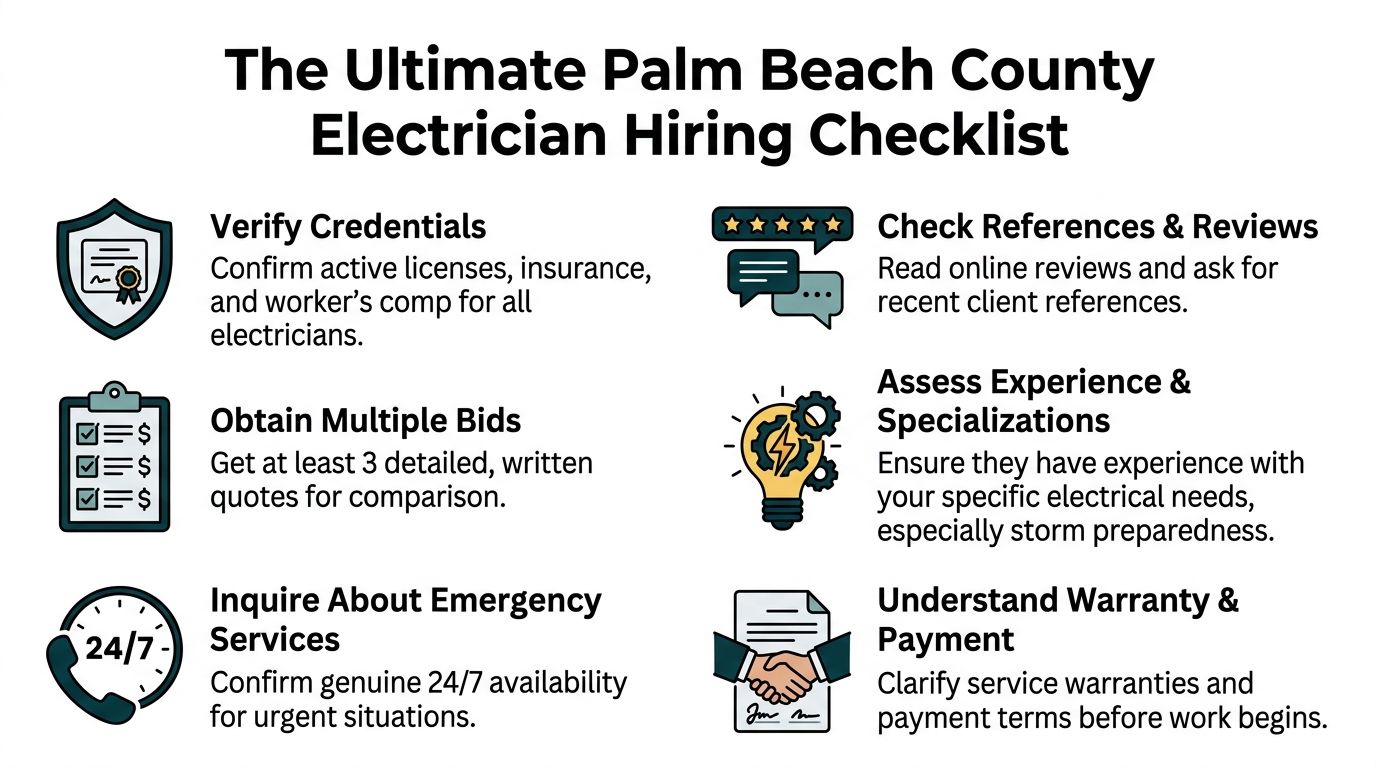
The Ultimate Palm Beach County Electrician Hiring Checklist
A rushed hire in Palm Beach County usually goes wrong in predictable ways. The truck shows up without the right equipment, the scope changes once the panel is open, or the contractor says he can handle specialty work he rarely touches. A simple checklist cuts out a lot of that risk.
Your quick screen
- Start with firsthand referrals: Ask neighbors, building engineers, property managers, HVAC contractors, or roofers who have seen the electrician’s work and follow-through.
- Keep the shortlist tight: Three to five realistic candidates is enough. More than that usually creates noise, not better decisions.
- Verify the Florida license: Check the license status and make sure the business name on the estimate matches the licensed company.
- Confirm insurance: Ask for current certificates for general liability and workers' compensation.
- Match the contractor to the job: A company that is solid on residential service calls may not be the right fit for commercial gear, HOA common areas, storm damage diagnostics, or aircraft obstruction lighting.
Your call and estimate review
- Ask who will be on site: Find out who is doing the work, who is supervising, and whether subcontractors are involved.
- Get the scope in writing: The estimate should spell out what is included, what is excluded, and what could trigger added cost.
- Ask about permits early: If the job may require one, confirm who pulls it and who handles inspections.
- Read the warranty terms carefully: Parts and labor coverage should be written clearly, with timeframes and exclusions.
- Watch for obvious warning signs: High-pressure sales tactics, vague pricing, missing paperwork, and soft answers usually lead to field problems later.
Your Palm Beach County specialty check
- Test after-hours response: If emergency service matters, ask who answers the phone at night, how dispatch works, and what the response area looks like during storm conditions.
- Check storm-readiness: Coastal properties and older service equipment create a different kind of service call. Choose a contractor who regularly handles outage tracing, water intrusion issues, temporary safety repairs, and hurricane-season failures.
- Confirm niche experience: If your property has rooftop equipment, large commercial service gear, energy-management controls, or FAA-regulated lighting, ask for direct experience with that exact system type.
Palm Beach County has more specialty electrical work than many owners expect. Hangars, private airfields, waterfront properties, condos, and storm-exposed commercial sites all come with their own failure points. If your job touches aircraft obstruction lighting or control-based efficiency upgrades, skip the general promise that they can "take care of it" and hire someone who does that work regularly.
Use this checklist exactly as written. It helps you rule out the wrong hire before the first truck rolls.
Making Your Final Decision with Confidence
The right hire usually becomes obvious once you stop chasing the fastest or cheapest option.
Choose the electrician who checks the legal boxes, communicates like a professional, gives you a written scope you can understand, and has real experience with the kind of property and urgency you have. In Palm Beach County, that local fit matters. Storm response, code awareness, specialty capability, and consistent follow-through are what separate a dependable contractor from a risky one.
If two companies look similar on paper, trust the one whose process is cleaner. Better questions, better documentation, clearer expectations, and less sales pressure usually lead to better field work.
That is the practical answer to how to find a good electrician. Not luck. Not ad position. Not one glowing review. A methodical hiring process protects your home, your building, your tenants, and your budget.
When readers want a pre-vetted local option that reflects the standards covered above, Lighthouse Energy Services stands out. The company serves Palm Beach County with licensed and insured residential, commercial, and industrial electrical work, true 24/7 availability, specialized aircraft obstruction lighting expertise, and transparent pricing without after-hours surprises. That combination is what many people are trying to find when the need is urgent and the stakes are real.
If you need a reliable Palm Beach County electrician and want a team that handles residential repairs, commercial projects, emergency response, industrial work, and specialized lighting with licensed professionals, contact Lighthouse Energy Services.