
You're standing in a dark garage, pressing the reset button on the same outlet for the third time. The garage door opener is dead, the freezer has lost power, and the GFCI trips again as soon as you plug the extension cord back in. It's tempting to blame the receptacle and replace it immediately.
That often misses the core issue. A GFCI outlet is a safety sensor, and a repeated trip usually means it's detecting current escaping the intended circuit path. The device may be responding to moisture, a damaged appliance, wiring trouble, or several small leakage paths adding together. GFCI protection has expanded through National Electrical Code cycles because wet-area and outdoor circuits create serious shock risks, from early pool-lighting requirements to broader kitchen, bathroom, and exterior coverage over later decades, as documented in this history of GFCI code requirements.
You can safely perform a basic reset and load-isolation test before calling a licensed electrician in Palm Beach County. The important boundary is knowing when the problem is beyond a homeowner test.
Table of Contents
- Why Your GFCI Outlet Keeps Tripping in the First Place
- The Most Common Causes of Repeated GFCI Trips
- Step-by-Step Troubleshooting You Can Safely Try
- Why the Trip Keeps Coming Back
- Likely Repairs and What They Typically Cost
- When to Stop and Call a Licensed Electrician
- Putting It All Together and Getting Help Fast
Why Your GFCI Outlet Keeps Tripping in the First Place
The GFCI compares the current leaving on the hot conductor with the current returning on the neutral. If some current takes another path, possibly through wet equipment, damaged insulation, or a person, the device opens the circuit. Class A GFCIs are designed to trip at 4 to 6 milliamps of ground-fault current, with a nominal threshold around 5 milliamps, and technical guidance describes very rapid operation under fault conditions, often within about 25 milliseconds (technical GFCI guidance).
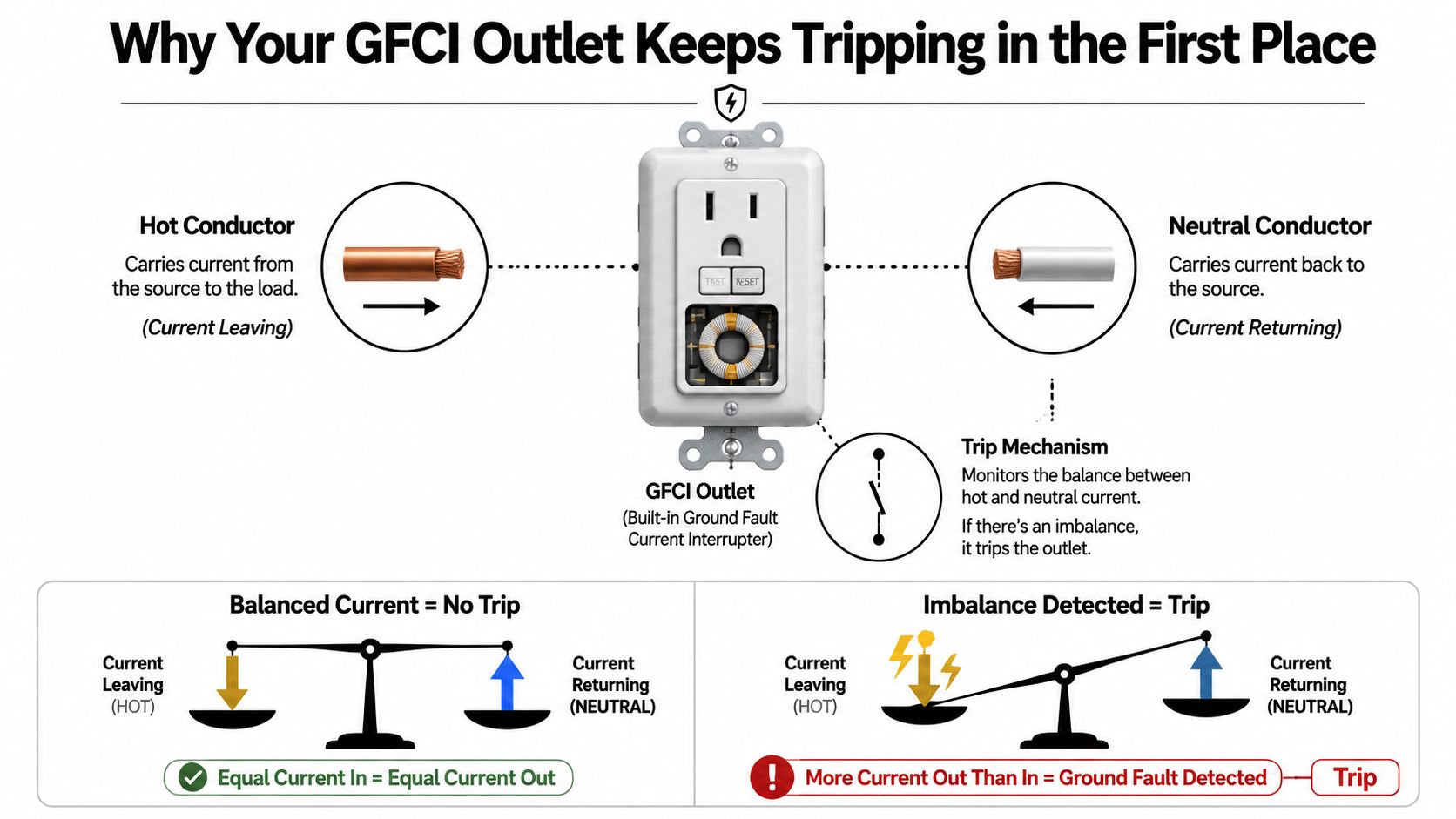
That makes the reset button less useful as a diagnosis than as a temporary restoration step. A device that trips repeatedly may be doing exactly what it was built to do. In one nationwide dataset summarized by ESFI, GFCI breakers represented 15% of reported tripped breakers, while a later regional summary reported 19%. The same survey material reported an average of 2.2 service calls for GFCI breakers and dual-function AFCI/GFCI breakers, which supports treating recurring trips as a genuine service issue rather than a one-time annoyance (ESFI AFCI and GFCI Performance Survey).
Four categories cover most investigations
A ground fault occurs when current reaches ground through an unintended path. A wet pressure-washer plug, damaged outdoor lights, a failing pool pump, or a hair dryer near a sink can cause an immediate trip.
An overload is different. The breaker usually handles excessive current, while the GFCI detects leakage. In a real garage, though, a heavily loaded circuit may also contain equipment with motors, electronic filters, or aging insulation that contributes leakage and makes the GFCI trip.
Cumulative leakage is the system-level problem many homeowners miss. Several appliances may each leak a small amount to ground, and the combined current can approach the GFCI's trip threshold even when no single appliance appears defective. Shared neutrals, incorrect line and load connections, and downstream wiring faults create another category.
One GFCI in a kitchen, bathroom, garage, or exterior location can protect outlets farther along the circuit. The receptacle that loses power may not be the location where the fault begins. For a plain explanation of the device and its protective role, see this guide to what a ground-fault circuit interrupter does.
The Most Common Causes of Repeated GFCI Trips
Start with the timing. A GFCI that trips the instant you plug in one appliance points in a different direction from one that trips only after rain or after several devices have been operating for a while.
Match the symptom to the likely cause
| Symptom Pattern | Most Likely Cause | Where It Usually Shows Up |
|---|---|---|
| Trips when one appliance starts | Ground fault, motor leakage, or damaged cord | Pool equipment, pressure washers, refrigerators, outdoor tools |
| Trips after rain or high humidity | Moisture intrusion or deteriorated insulation | Exterior boxes, garages, landscape equipment, pool areas |
| Trips only after several devices run | Cumulative leakage or circuit loading | Kitchens, laundry areas, garages, workshops |
| Trips immediately with nothing connected | Downstream wiring fault, neutral problem, or moisture in the box | Exterior receptacles, shared circuits, older wiring |
| GFCI resets but a remote outlet stays dead | Downstream protection or wiring issue | Kitchen counters, bathrooms, garage outlets |
A wet device is the classic single-event fault. Remove the equipment, dry the plug and surrounding area, and don't reconnect it until you've checked the cord, housing, and location for a reason water could reach it. Drying the face of the receptacle won't solve moisture inside the electrical box or conduit.
Overload symptoms deserve careful interpretation. A space heater, window air conditioner, microwave, or motor load can push a circuit hard, especially when other appliances share it. The GFCI itself isn't a substitute for overcurrent protection, so if the panel breaker also trips, stop treating the issue as an outlet-only problem.
Cumulative leakage is more subtle. Modern appliances with motors, electronic controls, and filtering components can each contribute a small leakage current. Guidance on chasing intermittent GFCI trips explains why those small contributions can add together across multiple connected loads and long cable runs.
Wiring faults include a shared neutral on a multi-wire branch circuit, a neutral-to-ground connection downstream, damaged insulation, corrosion, or moisture in an exterior box. If the outlet trips with every load removed, the fault is likely in the wiring or device installation rather than in an appliance.
Step-by-Step Troubleshooting You Can Safely Try
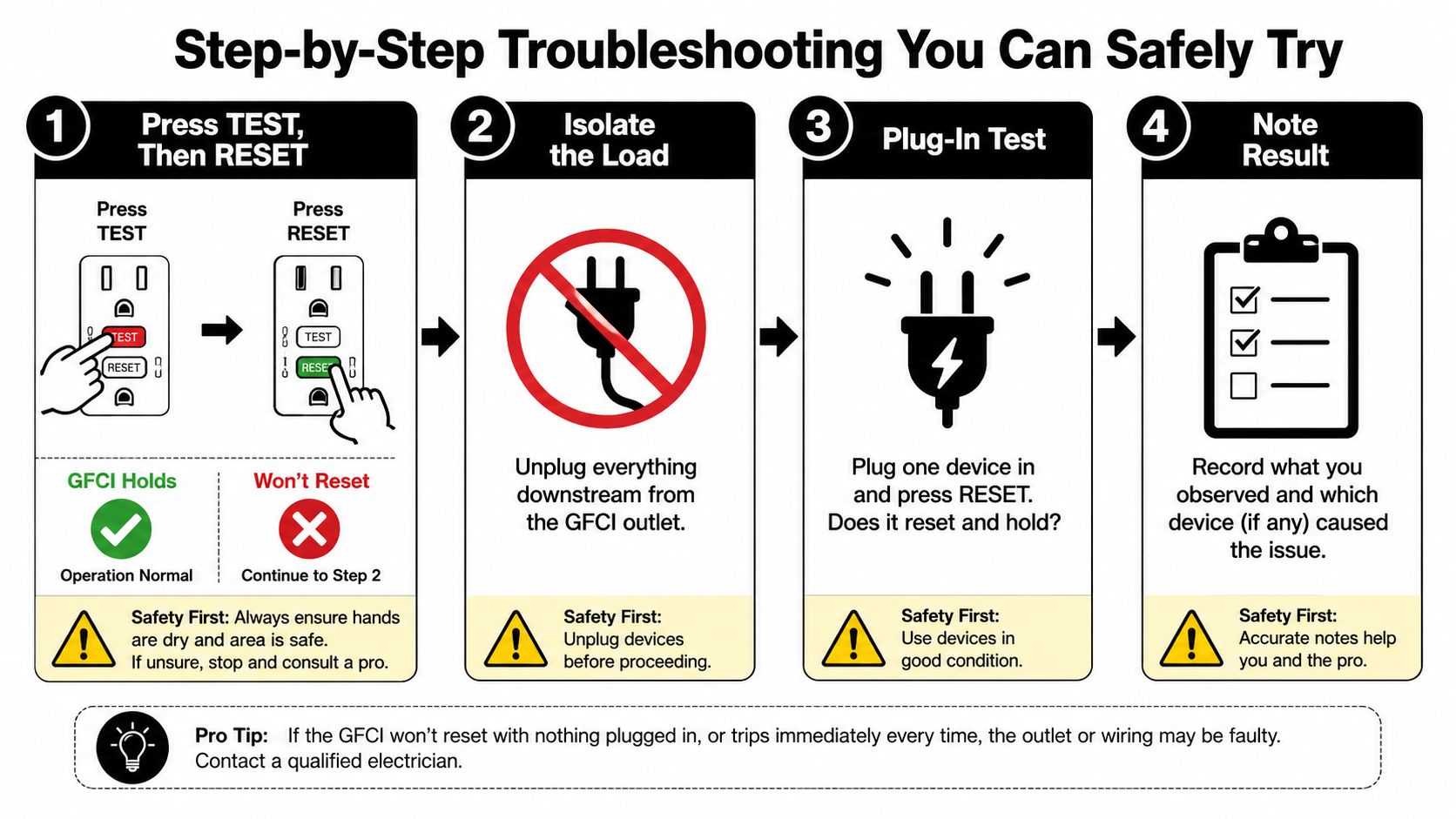
Keep this test limited to plugs, buttons, and visible conditions. Don't remove the cover plate or pull the receptacle from the box while the circuit is energized.
Start with the buttons
- Press the TEST button. The GFCI should click off.
- Press RESET firmly until it clicks and stays in.
- Note what happens. If it resets and holds with nothing connected, continue with load isolation. If it won't reset, leave downstream equipment disconnected and stop there.
A failed reset can indicate a continuing fault, no incoming power, incorrect line and load connections, or a damaged GFCI. Don't keep forcing the button.
Remove every connected load
Unplug everything from the GFCI and the outlets it protects. Look beyond the receptacle that has the buttons. A garage GFCI may feed another wall outlet, a freezer, a door opener, or an outdoor receptacle, and a bathroom GFCI may protect additional outlets on the same branch.
Reset the device with all loads disconnected. If it holds, reconnect equipment one item at a time. Wait long enough for motors and electronically controlled devices to start. When one appliance causes the trip, remove it from service and inspect its cord, plug, housing, and operating environment.
Practical rule: Don't reconnect a device that trips more than one GFCI. The appliance may have a leakage fault that needs repair or replacement.
Use a simple lamp as a controlled test
With downstream loads disconnected, plug a basic lamp directly into the GFCI face. If the lamp trips the device, the problem isn't a complicated collection of appliances. Stop and arrange a professional diagnosis.
Never open the box to inspect terminals while energized. If the circuit must be de-energized for an electrician's inspection, the breaker should be off and a non-contact voltage tester should confirm the conductors are dead. Even then, stored energy and incorrectly labeled breakers can create hazards. The safety principles in this guide to finding an electrical short safely are more important than completing a repair quickly.
A licensed electrician can use a milliamp clamp meter to measure cumulative leakage and can test for neutral-to-ground faults, insulation breakdown, and leakage from connected equipment. Those readings explain problems that a reset button and visual inspection can't.
Why the Trip Keeps Coming Back
A hard fault has a clear shape. You reset the GFCI, plug in the pool pump or outdoor tool, and the device trips immediately. That pattern usually points to one load, one wet connection, or one damaged cord.
A slow-drift fault behaves differently. The circuit works after a reset, then trips during a humid afternoon, after rain, under a heavy load, or after several appliances have been operating. The cause may be moisture moving into an exterior box, insulation becoming less reliable with age, a marginal termination, or several small leakage paths reaching the device's operating threshold.
Hard trip versus slow drift
| Failure Shape | What You Notice | What It Suggests |
|---|---|---|
| Hard trip | Immediate trip when one load is connected | Appliance fault, wet plug, damaged cord, or direct wiring fault |
| Slow drift | Works for a while, then trips during heat, humidity, rain, or heavier use | Moisture intrusion, aging insulation, marginal connection, or cumulative leakage |
| No-load trip | Trips with all appliances unplugged | Wiring fault, shared neutral issue, moisture in the box, or defective installation |
In Palm Beach County, outdoor circuits face repeated exposure to humidity, rain, and salt-laden air. That environment can aggravate aging insulation, corrosion, and moisture intrusion, even when the receptacle face looks dry. A weather-related trip that disappears after conditions improve still deserves attention if it keeps returning.
Shared neutrals can create another recurring pattern. A multi-wire branch circuit must be arranged correctly so the current returning on the neutral matches the protective device's expectations. A neutral-to-ground connection downstream can also send part of the return current along an unintended path, which the GFCI reads as an imbalance.
Daisy-chained GFCI protection adds confusion because one device can protect several locations. Replacing the first outlet may make the reset button feel new without correcting the downstream condition.
The reset restores power. It doesn't remove the path that caused the imbalance.
That's why a GFCI that keeps tripping is often a symptom of system drift, not proof that the receptacle itself is defective. The underlying leakage path re-establishes itself after each reset.
Likely Repairs and What They Typically Cost
Repair decisions should follow the test results. Replacing a GFCI is reasonable when the device has failed its test function, won't reset after the circuit conditions are verified, or shows physical damage. It's not a complete repair when the same circuit trips with a new device.
A standard GFCI receptacle commonly costs $20 to $40 for the part, while licensed installation commonly runs $90 to $175, depending on access and local conditions. Those figures are practical planning ranges, not a promise. Weather-resistant or tamper-resistant equipment can cost more, and an exterior installation may require attention to the box, cover, conduit, and sealing.
Repair choices depend on the fault
If several small leakage sources are sharing one protected branch, an electrician may recommend circuit segmentation. Separating kitchen, laundry, garage, or exterior loads can prevent one collection of equipment from pushing a single GFCI toward its threshold. This work commonly falls around $200 to $450, depending on panel access and run length.
Damaged insulation or a shared-neutral fault requires a wiring repair rather than a receptacle swap. A short repair may begin around $300, while a partial rewire can reach $1,200 or more, depending on how much cable is accessible and what the inspection finds.
| Repair Type | Typical Cost Range | DIY Feasible? |
|---|---|---|
| Standard GFCI replacement | $20 to $40 part, $90 to $175 installed | Limited, only for qualified homeowners who follow local rules |
| Circuit segmentation | $200 to $450 | No |
| Short wiring repair | From $300 | No |
| Partial rewire | $1,200 or more | No |
| Diagnostic visit | $75 to $150 | No, specialized testing is involved |
Diagnostic fees often run $75 to $150 and may be waived when the homeowner proceeds with the recommended repair. New circuit work in Palm Beach County may require permits and inspection, so the lowest immediate price isn't always the lowest-risk choice.
DIY replacement can save labor when the diagnosis is certain, but it shifts safety, code, liability, and insurance concerns onto the homeowner. If the cause is unknown, paying for diagnosis is usually more sensible than installing multiple new devices and hoping the trips stop.
When to Stop and Call a Licensed Electrician
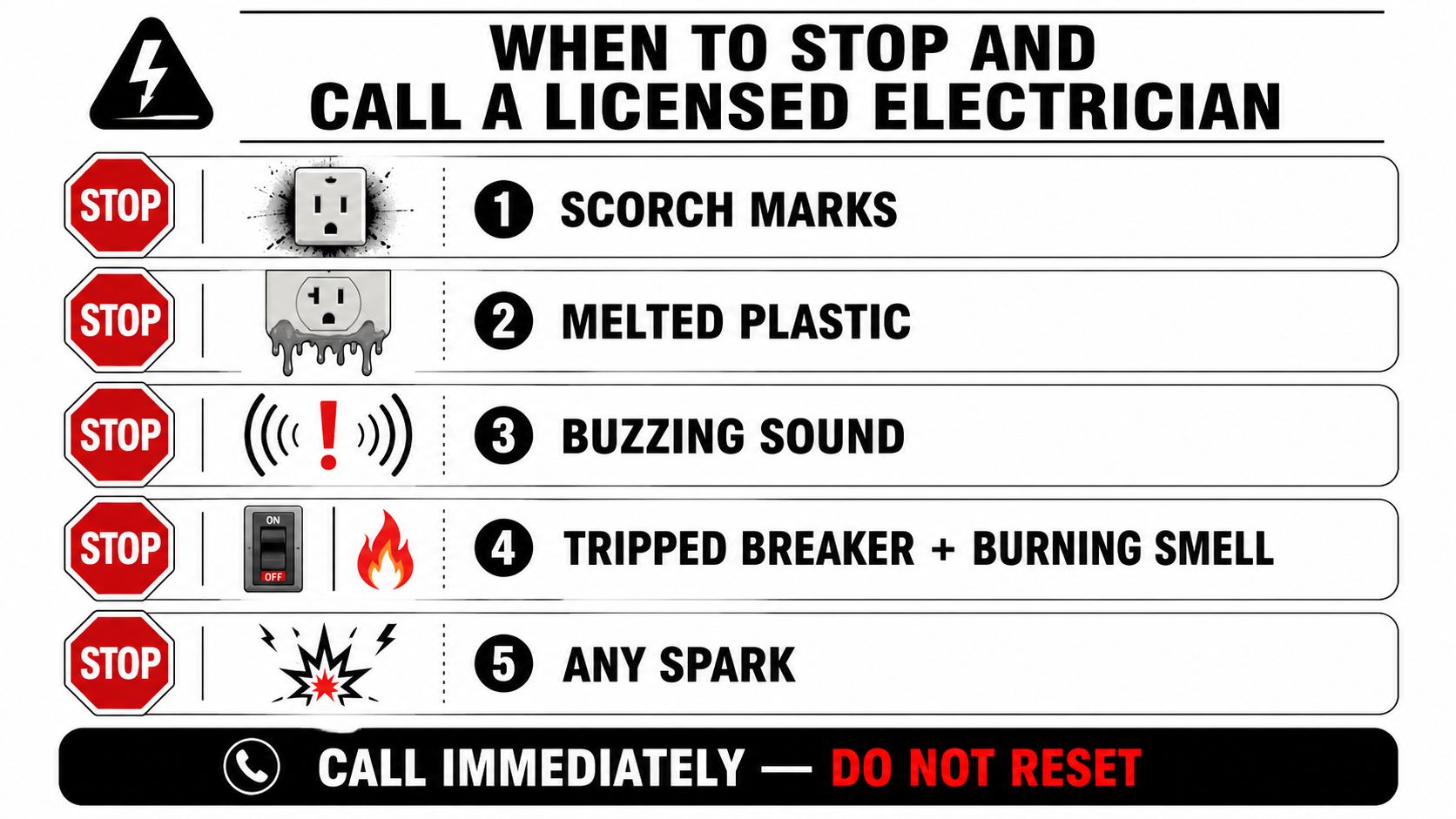
Stop troubleshooting immediately if you see scorch marks, melted plastic, active sparking, or damaged insulation. Buzzing, a burning smell, or a tripped breaker paired with heat or smoke can indicate arcing or an insulation failure that a reset won't correct.
Call for professional help when the GFCI won't reset with every load disconnected. Persistent tripping after a clean reset and load-isolation test points toward the box, downstream wiring, a shared neutral, moisture in a concealed location, or a panel-side issue.
Non-negotiable stop signs
- Scorch marks: Blackened plastic or discoloration means the connection may have overheated.
- Melted parts: Deformed receptacle bodies or covers should stay untouched.
- Buzzing sounds: Noise from the outlet, switch, or panel requires inspection.
- Breaker and burning smell: Don't re-energize the circuit after this combination.
- Panel symptoms: A tripping main, warm breakers, or visible corrosion around the bus bar requires panel-level diagnosis.
- Rain-related recurrence: Repeated outdoor trips suggest moisture in the box, conduit, cover, or connected equipment.
- Unapproved prior work: New circuits, panel work, and questionable earlier alterations need a licensed professional and may require permit review.
Outdoor and wet-location faults can travel through conduit and connected equipment, so a dry-looking receptacle doesn't rule out moisture. Likewise, a device that resets today may still have a deteriorating connection that fails under heat or humidity. For guidance on evaluating electrical service providers, use this resource on how to find a good electrician.
If you've reset the outlet more than twice in 24 hours, stop resetting it and call a licensed electrician. Repeated resets can restore power without addressing the hazard.
Putting It All Together and Getting Help Fast
The practical sequence is simple. Reset the device, unplug every downstream load, reconnect equipment one at a time, and record whether the trip follows a particular appliance, rain event, time of day, or heavier period of use. If the GFCI still trips with loads removed, the circuit needs meter-based diagnosis.
A single trip after rain may involve moisture or one affected device. Persistent, unexplained, or repeat-after-reset trips call for a licensed electrician who can check leakage, neutral relationships, insulation, and panel-side conditions instead of guessing at the receptacle.
Homeowners and property managers can also use this home-services lead generation guide when building a reliable process for finding and contacting qualified service providers.
For Palm Beach County homeowners, Lighthouse Energy Services provides same-day diagnostics from licensed, insured residential electricians serving Boca Raton, Delray Beach, Boynton Beach, Lake Worth, West Palm Beach, Wellington, and Jupiter. The company offers 24/7 dispatch with no after-hours service fee, fully stocked vans, and up-front pricing before work begins, so a device replacement, circuit split, neutral correction, or panel-side diagnosis can often be completed in one visit.
If your GFCI outlet keeps tripping, Lighthouse Energy Services can test the full protected circuit instead of just swapping the receptacle. Visit Lighthouse Energy Services to request Palm Beach County electrical help, including same-day troubleshooting and 24/7 emergency service without an after-hours fee.