
TL;DR: A Ground Fault Circuit Interrupter (GFCI) is a fast-acting safety device that helps prevent electric shock by detecting tiny imbalances in electrical current and shutting off power in approximately 1/40 of a second. Class A GFCIs are designed to trip at 4 to 6 mA, which is why they’re so important anywhere moisture, wet surfaces, or outdoor conditions raise the chance of current leaking where it shouldn’t.
If you live in Palm Beach County, you probably use electricity near moisture every day without thinking much about it. Bathroom sinks, kitchen counters, lanais, pool equipment, garage refrigerators, outdoor lighting, and even holiday décor all create the kind of conditions where one small fault can turn dangerous fast.
Your Home's Unsung Electrical Safety Hero
A humid Florida morning can turn an ordinary outlet into a real safety concern. You set a hair dryer on a damp bathroom counter, your hands are not fully dry, and the sink is only a few inches away. That everyday scene is exactly why GFCI protection matters in a home.
A ground fault circuit interrupter is a safety device designed to cut power fast when electricity starts traveling somewhere it should not. That stray current might move through water, a wet countertop, damaged insulation, a metal fixture, or a person touching the wrong surface at the wrong moment.
In simple terms, a GFCI stands guard where electricity and moisture are more likely to meet.
That matters even more in South Florida. Humid air, bathroom steam, rain blowing onto patios, condensation around outdoor equipment, and wet feet coming in from the pool all increase the chances of a dangerous shock. Water makes it easier for current to leave the wiring path it is supposed to follow.
Older homes deserve special attention here. Many were built before current GFCI rules covered as many locations as they do now, so a house may look fine on the surface while still missing protection in bathrooms, garages, outdoor areas, or near kitchen counters.
A good homeowner rule is simple. If an outlet is near water, exposed to weather, or likely to be used with wet hands, GFCI protection is usually required and always worth confirming.
If you are unsure which outlets in your home are protected, a home electrical safety check can identify missing GFCI coverage and other safety issues that often show up in older wiring.
How a GFCI Prevents Electric Shock
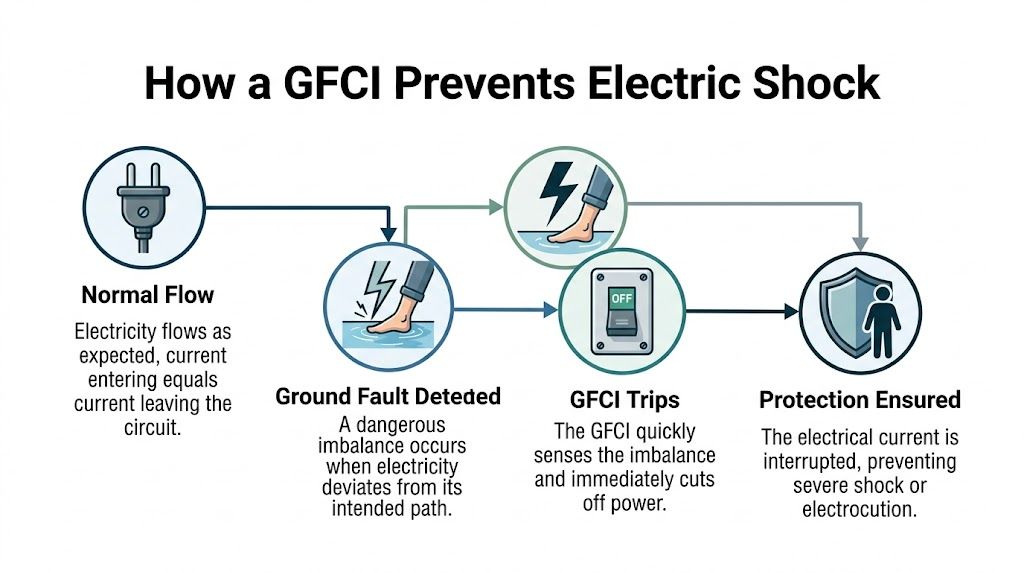
A GFCI works like a fast checkpoint for electrical current. It watches the electricity leaving on the hot wire and compares it to the electricity returning on the neutral wire. In a healthy circuit, those two amounts match.
If they do not match, some of the current has left the intended path.
That stray current may be traveling through water on a bathroom floor, across a damp patio surface after a Florida rain, through a metal sink, or through a person touching a faulty appliance. The device does not need a dramatic short circuit to react. It is built to notice even a small mismatch and shut the circuit off quickly.
What a ground fault actually means
A ground fault happens when electricity finds another path to ground instead of staying in the wiring loop it was supposed to follow. Electricians often describe it as current leaking away from the circuit.
A common example helps. Say a blender cord near the kitchen sink has damaged insulation. Moisture gets involved, the damaged spot touches a conductive surface, and current starts escaping. A standard receptacle may keep supplying power because the overall load still looks normal. A GFCI is watching for a different problem. It checks whether all the current that left the device came back.
What’s happening inside the device
Inside the GFCI, a sensing component compares outgoing and returning current continuously. If the two values stop matching, the device interprets that difference as a possible shock path and trips open.
Texas Instruments’ AFE3010 technical documentation on GFCI operation explains that a GFCI uses a current transformer to detect differential current. When that imbalance is large enough, the device triggers a mechanism that separates the electrical contacts and stops power flow.
For a homeowner, the important part is simple. The GFCI is not waiting for wires to spark or a breaker to see a heavy overload. It is looking for leakage that could mean electricity is going somewhere dangerous.
Why speed matters so much
Speed is what makes this device such an effective layer of shock protection. When current starts leaving the normal path, the safer response is to shut power off before that exposure continues.
That matters even more in humid Florida conditions, where wet skin, damp concrete, condensation, and outdoor moisture can lower the body’s resistance and give stray current an easier route. In those situations, a problem can develop fast. The GFCI is built to react fast too.
As noted earlier, GFCIs were developed to interrupt dangerous faults quickly. Their job is personal safety. They are there to reduce the chance that a wet location, damaged cord, or faulty appliance turns into a serious shock incident.
The quick version
- Normal condition: Current leaves on hot and returns on neutral in equal amounts.
- Fault condition: Some current leaks to water, metal, earth, or a person.
- GFCI response: The device senses that mismatch and disconnects power quickly.
- Safety benefit: The shock path is interrupted before exposure continues.
That is the core of how a GFCI prevents electric shock. It monitors current balance constantly and cuts power when electricity starts taking the wrong path.
The Three Main Types of GFCI Protection
Homeowners usually run into GFCIs in one of three forms. The protection principle is the same, but the way it’s applied is different depending on the outlet location, the circuit layout, and whether the protection needs to be permanent or temporary.
GFCI outlet
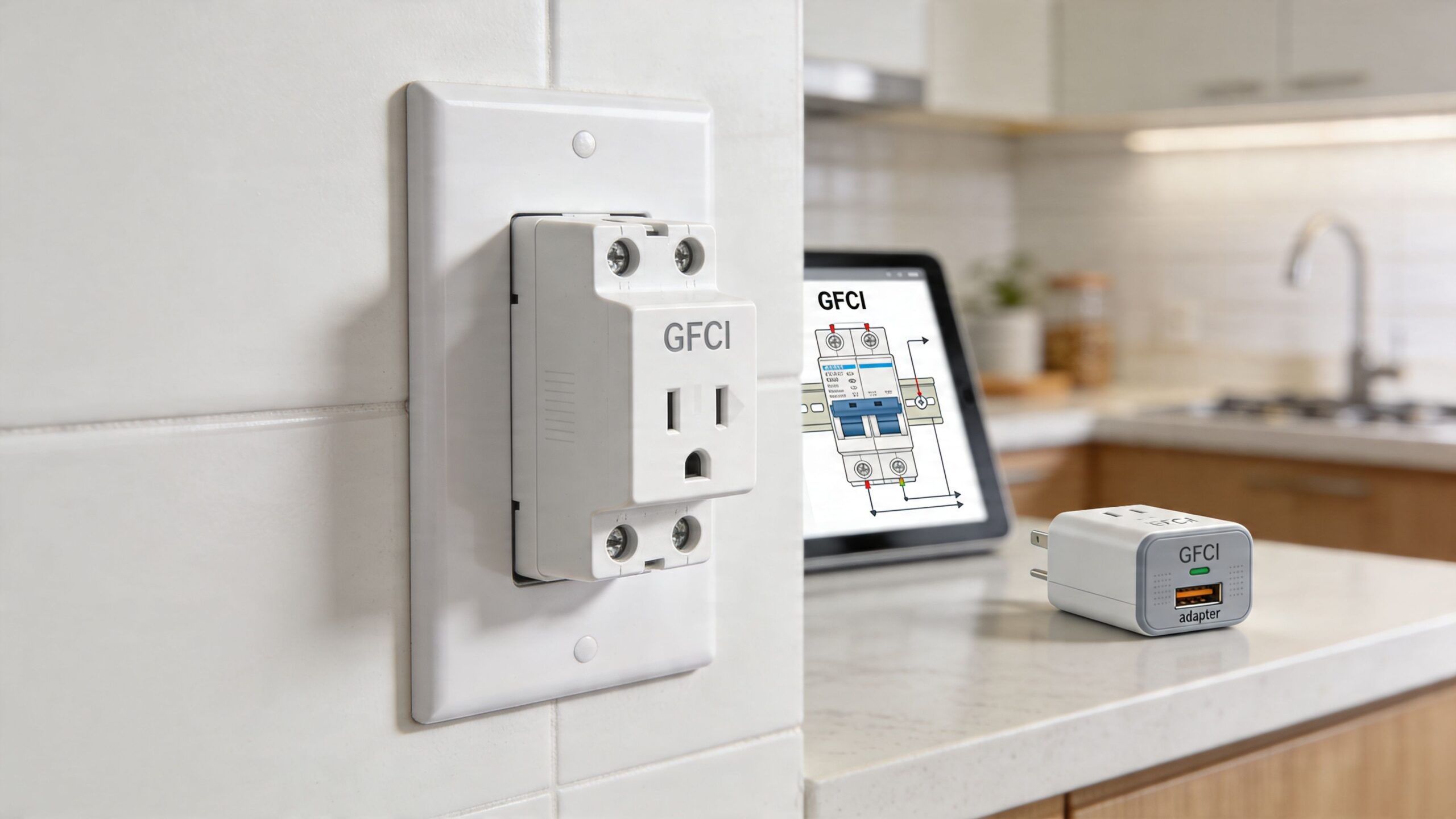
This is the commonly recognized version. It installs at the receptacle itself and usually has TEST and RESET buttons on the face.
A GFCI outlet is often the right choice when you want protection at one location, like a bathroom vanity, kitchen backsplash, laundry sink area, or patio receptacle. Depending on how the circuit is wired, it can also protect downstream outlets connected to its load side.
GFCI breaker
A GFCI breaker installs in the electrical panel instead of at the wall outlet. It protects the entire branch circuit from the panel outward.
This option often makes sense when one breaker feeds several receptacles in places that all need protection, or where panel-based protection is cleaner than replacing multiple devices. It can also be useful when the receptacles themselves are hard to access or when you want one point of protection for a whole circuit.
Portable GFCI
A portable GFCI plugs in temporarily between the power source and the equipment you’re using. These are common for extension cords, outdoor tools, pressure washers, or temporary work setups around a home.
For homeowners, this type is helpful when you need added protection for equipment used outside or in damp conditions but don’t have permanent GFCI protection exactly where you need it.
Comparing GFCI Types
| GFCI Type | Protection Scope | Best For | Installation |
|---|---|---|---|
| GFCI Outlet | One receptacle and sometimes downstream outlets | Bathrooms, kitchens, garages, patios | Installed at the outlet box |
| GFCI Breaker | Entire circuit | Multi-outlet circuits, panel-based upgrades | Installed in the electrical panel |
| Portable GFCI | Temporary protection for connected equipment | Outdoor tools, extension cords, temporary work | Plug-in device |
If you’re deciding between outlet protection and breaker protection, the real question is where you want the protection to begin. At one device, or at the panel for the whole circuit.
For permanent home upgrades, matching the right type to the wiring layout matters. The wrong choice can leave part of a circuit unprotected, or create confusion later when one GFCI controls multiple outlets that aren’t obviously connected.
Where GFCIs Are Required in Your Home
A simple way to think about GFCI placement is this. Wherever water, damp surfaces, weather exposure, or grounded materials increase shock risk, GFCI protection becomes essential.
In a Florida home, that usually means more than just the bathroom. Moisture moves through the house in ways people don’t always notice. It’s in kitchen cleanup, garage condensation, outdoor receptacles, pool areas, and equipment spaces that stay humid most of the year.

Bathrooms and kitchens
Bathrooms are the most obvious place because people handle appliances with wet hands near sinks and plumbing. Kitchens have similar risk, especially around counters and receptacles near sinks where water, metal fixtures, and portable appliances all come together.
These are the classic high-risk zones. If a blender cord, toaster, or grooming appliance develops a fault, the user may be standing on a hard floor and touching grounded surfaces at the same time.
Garages, laundry areas, and unfinished spaces
Garages aren’t dry, clean environments the way living rooms are. They often have concrete floors, appliance cords, utility sinks, and occasionally rain blowing in. Laundry areas bring water lines, drain connections, and damp conditions around washers and utility sinks.
Unfinished basements and crawl spaces also create higher shock risk because surfaces can be damp, equipment may be exposed, and contact with grounded materials is more likely.
Outdoor outlets and pool areas
Any receptacle exposed to weather should be taken seriously. Rain, irrigation, humidity, and morning condensation can all create a path for current to leak. Outdoor kitchens, outdoor lighting connections, holiday decorations, and pressure-washing equipment all raise the stakes.
Pool environments deserve even more caution because swimmers, wet decks, and electrical equipment are such a dangerous combination. If you have questions about lighting or receptacles near water features, a qualified pool light electrician can evaluate those specific hazards.
A practical room-by-room check
Walk your home and ask these questions:
- Near sinks: Does every receptacle close to water have GFCI protection?
- Bathrooms: Do all vanity-area outlets have test and reset capability, or panel protection?
- Garage and exterior walls: Are the receptacles protected from ground-fault shock risk?
- Outdoor living areas: Are patio, lanai, and yard outlets properly protected?
- Wet-equipment zones: Are pool, spa, or similar nearby circuits evaluated by an electrician?
Many homeowners assume a home is protected because they can see one GFCI outlet somewhere in the kitchen. That may or may not mean the rest of the nearby outlets are protected too. It depends on how the circuit was wired.
How to Test and Maintain Your GFCIs
GFCIs aren’t “install and forget” devices. They need to work on the day a fault happens, not just on the day they were installed. The good news is that a basic check is easy for most homeowners.
How to do a manual test
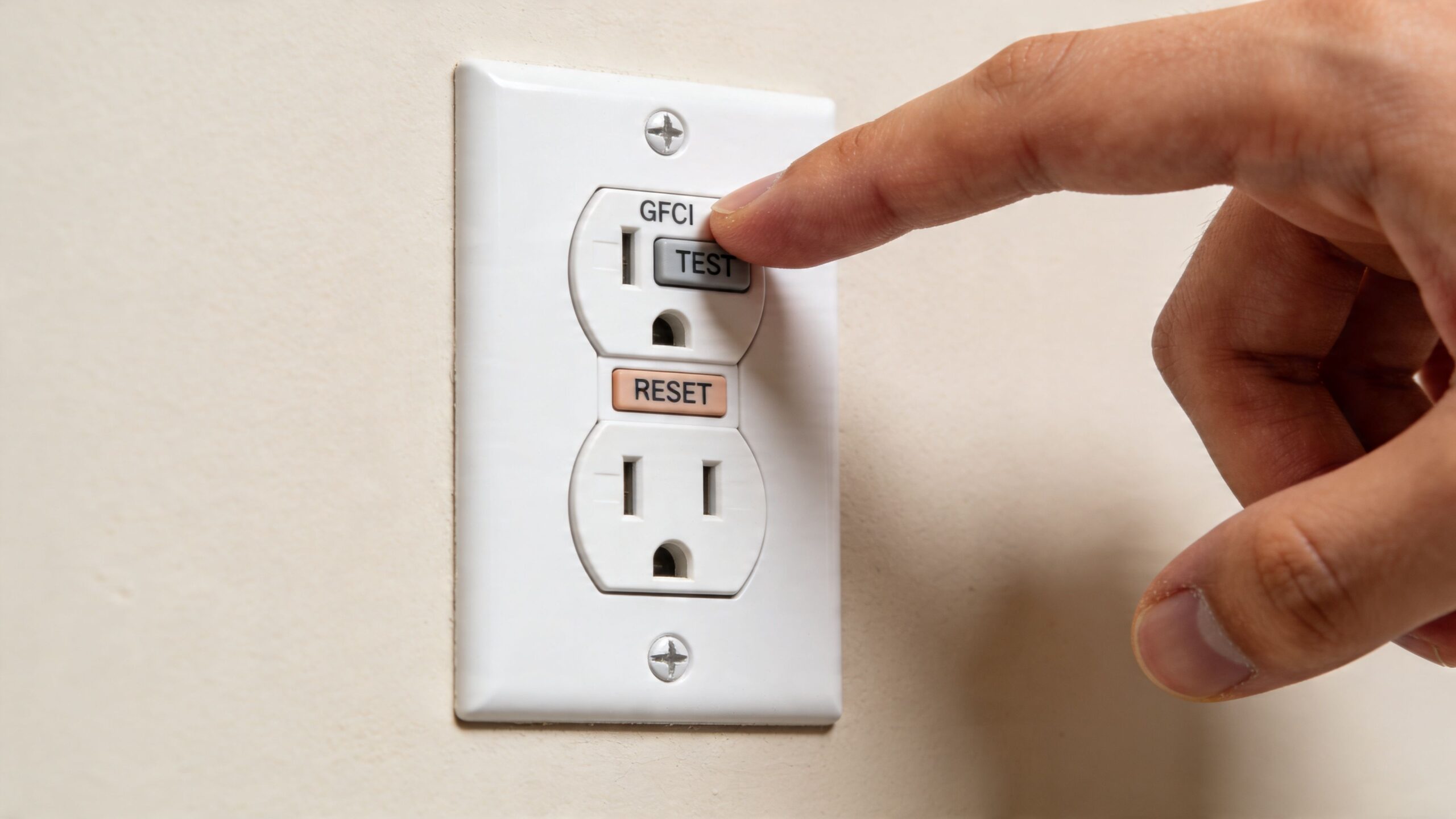
Start with the outlet in normal operation. If a lamp or small device is plugged in, it should be on.
Then follow this sequence:
- Press TEST. The outlet should trip, and the connected device should lose power.
- Confirm power is off. If the lamp stays on, the device may not be functioning correctly.
- Press RESET. Power should return.
- Repeat if needed. If it won’t trip or won’t reset, stop using that outlet until it’s checked.
What modern GFCIs do on their own
Today’s Class A GFCIs are designed to trip when ground fault current reaches 4 to 6 mA, and modern units include self-test features that detect end-of-life degradation, often with a blinking LED, according to InterNACHI’s technical overview of GFCI operation and UL 943 self-testing.
That self-test feature is useful, but it doesn’t mean you should ignore warning signs. If a light is blinking, if the device won’t reset, or if power cuts in and out unpredictably, the safest next step is to have the outlet or circuit evaluated.
Maintenance note: A GFCI that won’t reset is giving you information. Treat it like a safety signal, not an inconvenience.
What homeowners should watch for
- Blinking indicator light: Often points to a failed self-test or end-of-life condition.
- Loose feel at the buttons: Can indicate wear or age.
- Frequent unexplained trips: May mean the device is doing its job, or that an appliance or wiring problem needs diagnosis.
- No protection where you expect it: Sometimes an upstream GFCI has tripped and controls that outlet.
If you own an older home, replacing aging GFCIs with current self-testing models is often a sensible safety upgrade.
Troubleshooting Common GFCI Problems
The most common homeowner complaint isn’t “What is a ground fault circuit interrupter?” It’s “Why does this thing keep tripping?”
That frustration is understandable. A GFCI can trip because it detected a real hazard, because an appliance is leaking a small amount of current, or because the device itself is failing. The trick is to troubleshoot in a safe order.
Start with the easy isolation check
First, unplug everything on the affected outlet or circuit. That includes countertop appliances, garage tools, refrigerators on that branch, outdoor gear, and anything plugged into downstream receptacles the GFCI may control.
Then reset the GFCI.
If it holds, plug items back in one at a time. When the GFCI trips again, you’ve likely found the problem appliance or cord. In Florida, moisture intrusion into outdoor devices, old extension cords, garage freezers, and patio equipment are common culprits.
When the problem points to wiring
If the GFCI trips immediately with nothing plugged in, don’t keep forcing resets. That can point to a wiring issue, a damaged receptacle, a line-load mix-up, or leakage somewhere hidden on the circuit.
Watch for these signs:
- Trips with no load connected: More likely a circuit or device issue than an appliance issue
- Won’t reset at all: Possible failed GFCI or active fault
- Only trips during rain or high humidity: Moisture may be entering an exterior box or connected equipment
- Multiple dead outlets nearby: One upstream GFCI may have tripped and shut down downstream receptacles
Some “nuisance trips” aren’t nuisance trips at all. They’re the first warning that a cord, appliance, or outdoor connection has started leaking current.
If you’re dealing with repeated trips, partially dead receptacles, or confusing downstream outlet behavior, this guide to dead outlet troubleshooting and repair can help you understand when the issue may be larger than a single receptacle.
What a GFCI Does Not Protect Against
Homeowners often misunderstand the GFCI's role. A GFCI is excellent at one job. It helps protect people from ground-fault shock. It does not do every electrical safety job in the house.
A GFCI does not protect against overloads, short circuits, or arc faults. For overall safety, especially in older properties, a combination of GFCIs for shock protection and AFCIs for fire protection is necessary, as explained in Home Depot’s guide to GFCI requirements and the difference from arc-fault protection.
Think of it as layered protection
A standard breaker protects the wiring from too much current. A GFCI protects people from shock caused by current leaking to ground. An AFCI helps protect against fire caused by dangerous arcing in damaged or deteriorated wiring.
Those are different hazards.
A simple example
If you overload a circuit by plugging in too many high-draw devices, the breaker is the device that should respond.
If a damaged appliance leaks current through a wet countertop, the GFCI is the device that should respond.
If a loose or damaged conductor starts arcing inside a wall or cord, that calls for AFCI protection.
The safest homes don’t rely on one device to do everything. They use the right protective device for the specific hazard.
That distinction matters a lot in older Florida homes, where you may have wet-location risks, aging wiring, and panel limitations all at the same time.
Frequently Asked Questions About GFCIs
Can I install a GFCI outlet myself
You can replace a receptacle yourself if you are experienced and the wiring is straightforward, but a GFCI has one detail that trips people up. The line terminals bring power in. The load terminals protect outlets farther down the circuit. If those wires are mixed up, the outlet may appear to work while leaving other receptacles unprotected.
That is a risky guess in older Florida homes, especially in bathrooms, garages, patios, and other damp areas where proper protection matters most. If the wiring is unclear, or the box contains multiple cables, a licensed electrician should handle it.
Why is the light on my GFCI blinking
A blinking indicator usually means the device failed its self-check or has reached the end of its service life. Some units also blink after a trip until they are reset correctly.
Start with the simple step first. Press reset once. If it will not reset, or starts blinking again right away, the device should be replaced or checked by a professional.
Why did one bathroom outlet trip and now another room is dead
A single GFCI can protect several outlets downstream, so the outlet that shut off may be in a different room from the one that tripped. Homeowners often run into this in bathrooms, garages, outdoor receptacles, and certain kitchen or laundry circuits.
It helps to picture the circuit like a chain. One GFCI can sit near the beginning of that chain and guard the outlets that follow. So if a guest bathroom outlet loses power, the reset button you need might be in the garage or on an exterior wall.
How much does it cost to have a GFCI installed
The price depends on the type of protection needed, the condition of the existing wiring, how easy the location is to access, and whether other updates are needed to bring the area up to current safety standards. In Florida homes, that can vary quite a bit between a simple bathroom receptacle swap and a larger wet-area correction.
For a general overview of what shapes electrical service costs, this electrician pricing guide explains the common factors.
When should I call a professional
Call if a GFCI will not reset, trips with nothing plugged in, keeps blinking, or seems to control outlets you cannot easily identify.
You should also call if you are updating a kitchen, bathroom, pool area, patio, laundry room, or garage. Those are the places where moisture and electricity are more likely to meet, which is why correct GFCI protection matters so much in Palm Beach County homes. Lighthouse Energy Services handles GFCI installation, troubleshooting, and wet-location safety upgrades for local homeowners.