
You're sitting in the living room at night, everything's quiet, and then the ceiling light gives that irritating little flutter. Maybe it happens once when the AC starts. Maybe it's been happening for weeks. Maybe now you've noticed it in the kitchen too.
That's usually the moment homeowners start asking the right question. Not “How do I make it stop?” but what causes flickering lights in a house, and is this a nuisance or a warning sign?
The honest answer is that it can be either. A loose bulb is common. So is an LED dimmer mismatch. But flickering can also point to a failing switch, a stressed circuit, damaged wiring, or a utility-side neutral problem. The trick is knowing which problems you can safely rule out yourself and which ones need a licensed electrician right away. If you want another homeowner-friendly explanation of why your lights constantly flicker, that resource is a helpful companion read.
Table of Contents
- That Annoying Flicker An Introduction to Your Home's Electrical Health
- Start with the Obvious The Simple Culprits You Can Fix in Minutes
- Is Your Switch the Snitch? Faulty Dimmers and Connections
- The Big Gulp Why Lights Dim When Appliances Turn On
- Serious Signs Your Wiring Is Crying for Help
- When the Whole House Flickers A System-Wide Problem
- Don't Be Left in the Dark Your Next Steps for a Safe Home
That Annoying Flicker An Introduction to Your Home's Electrical Health
A flickering light gets under your skin because it feels unpredictable. One night it's the hallway can light. The next morning it's the bathroom vanity. Homeowners often tell me the same thing: “It seems minor, but it doesn't feel normal.” That instinct is usually right.
Some flicker is simple. A bulb loosens in the socket. An aging lamp starts failing. A dimmer and LED combination never played nicely together in the first place. Those are frustrating, but often manageable. Other flicker patterns are your home's way of flagging a larger electrical problem before it becomes impossible to ignore.

The part that worries electricians isn't the annoyance. It's the pattern. Does it happen in one fixture or several? Only when something else turns on? Is there buzzing? Does a switch feel warm? Those details matter more than one might assume.
Practical rule: If flickering is new, recurring, or spreading to other rooms, treat it as a symptom worth investigating, not background noise.
A healthy electrical system should feel boring. Lights should turn on cleanly, stay steady, and not react dramatically to normal use around the house. When they don't, you don't need to panic, but you also shouldn't shrug it off for months.
Start with the Obvious The Simple Culprits You Can Fix in Minutes
Before you assume you need rewiring, start with the easiest checks. This is the same order many electricians use mentally when a homeowner describes a single flickering light. Rule out the simple stuff first, then move deeper only if the symptom remains.
Your safe first checks
Start with the fixture that's flickering. Turn the switch off and let the bulb cool if needed.
- Tighten the bulb carefully. A bulb that isn't fully seated can make inconsistent contact and flicker.
- Swap in a known good bulb. If the flicker disappears, the bulb was likely the problem.
- Check whether the bulb type fits the fixture. Not every bulb behaves well in every fixture, especially enclosed fixtures or dimmed fixtures.
- Notice the pattern. If only one light flickers and a bulb swap fixes it, you've likely solved it. If the new bulb flickers too, keep digging.
A failing bulb often gives warning signs before it quits completely. The light may pulse, hesitate at startup, or brighten and dim unevenly. That's annoying, but it's also a useful clue because it points you toward the fixture first, not the whole house.
DIY versus call a pro
Use this simple framework:
- DIY is reasonable if the problem is isolated to one bulb, the fixture works normally after tightening or replacing it, and there's no heat, odor, buzzing, or breaker activity.
- Call a pro if the same fixture keeps flickering after a bulb replacement, multiple bulbs in the same fixture misbehave, or the switch seems involved.
Sometimes the next suspect is the wall control, not the lamp. If the light responds oddly when you touch the switch, or the switch feels loose in the box, that's no longer a bulb issue. A worn switch can create an intermittent connection. If that sounds familiar, this guide on a broken light switch can help you recognize the difference between a minor control problem and something more serious.
If a “new bulb” doesn't solve the problem, don't keep buying more bulbs. Repeated bulb changes often hide a switch, socket, or wiring issue.
What usually doesn't work is guessing. Homeowners lose time replacing every bulb in a room when the problem is one bad connection upstream. A quick bulb check is smart. Replacing half the house without a pattern isn't.
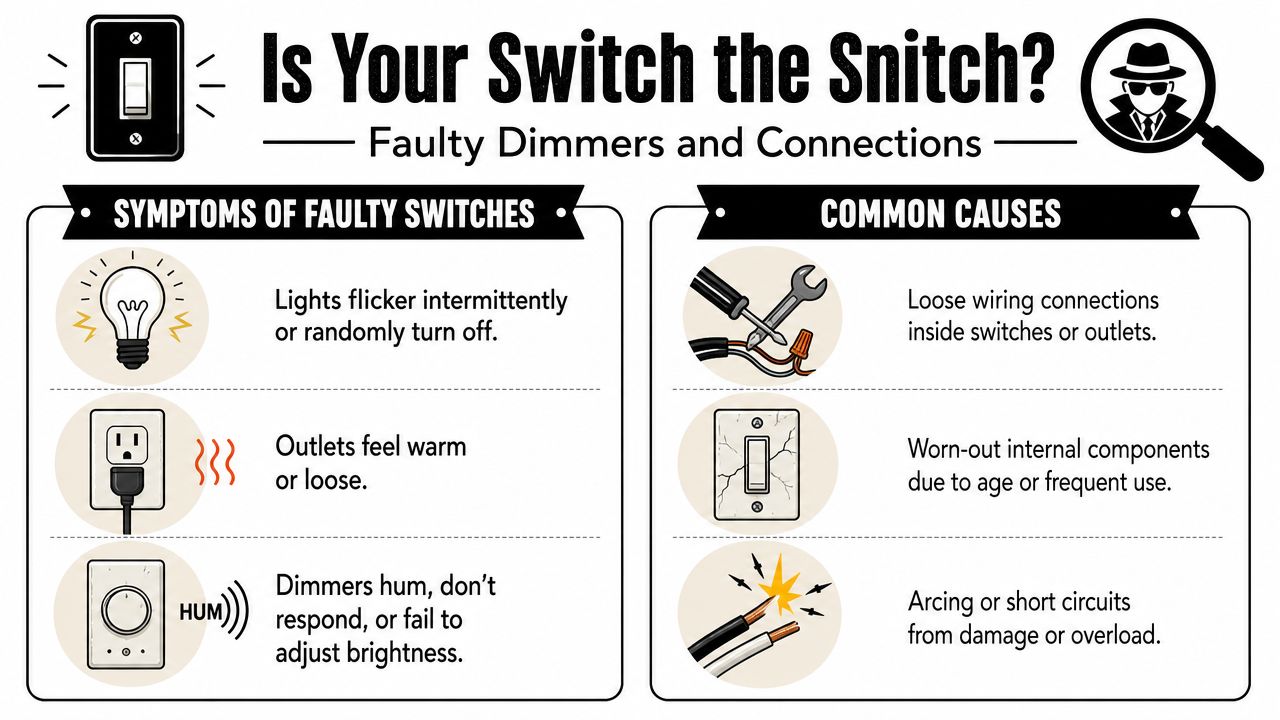
Is Your Switch the Snitch? Faulty Dimmers and Connections
When a flicker isn't coming from the bulb itself, the next place to look is the switch, dimmer, or fixture connection, which is a common source of trouble for many homeowners, particularly after upgrading to LEDs.
When one fixture flickers and the rest of the house doesn't
A single fixture or one room acting up often points to a local problem. That can mean a worn switch, a loose device connection, a tired lamp holder, or a dimmer that was never compatible with the bulb now installed.
Signs that the switch may be involved include:
- Touch-sensitive behavior. The light changes when you flip the switch slowly, press on the plate, or jiggle the toggle.
- Intermittent operation. The fixture works normally for days, then flickers randomly without the rest of the house doing the same.
- Dimmer weirdness. The light hums, won't dim smoothly, or drops out at certain brightness levels.
If you have a standard on-off switch, there isn't much safe DIY beyond observing the symptom and checking whether the switch feels physically loose or abnormal. Opening a switch box means working around live conductors unless power is properly isolated and verified. That's professional territory.
The LED dimmer mismatch that fools homeowners
One of the most common answers to what causes flickering lights in house today is simple: older dimmers and newer LEDs don't always cooperate.
According to this technical explanation of LED flicker and dimmer compatibility, LED flickering primarily stems from incompatible power supplies or dimmers. The same source notes that industry benchmarks recommend Electronic Low Voltage (ELV) or Magnetic Low Voltage (MLV) power supplies and that the dimmer needs to meet the minimum voltage load requirement to prevent persistent flickering in residential installations.
That sounds technical, but the homeowner version is straightforward. Older dimmers were often selected for older lighting technology. LEDs draw differently, respond differently, and can flicker even when the wiring is fine if the control device isn't designed for them.
Here's the practical split:
- DIY check: If flicker happens only on a dimmer-controlled light, test the light at full brightness. Then test with a bulb listed for dimming. If the problem changes with dimmer position, compatibility is a strong suspect.
- Call a pro: If the dimmer buzzes, the flicker is persistent, the fixture cuts out, or you aren't sure whether the setup needs ELV, MLV, or a different dimmer type.
What works is matching the lamp, driver, and dimmer. What doesn't work is forcing an old dimmer to control a modern LED setup it was never built for.
The Big Gulp Why Lights Dim When Appliances Turn On
Your kitchen lights dip for a second when the refrigerator starts. The hallway fixture softens when the AC kicks on. That pattern usually points to motor startup demand, not a bad bulb.
Electricians call that inrush current. Motors and compressors often need a brief surge of power to get moving. During that moment, the lights on the same branch circuit, or sometimes across a strained electrical system, can show a quick drop in brightness.
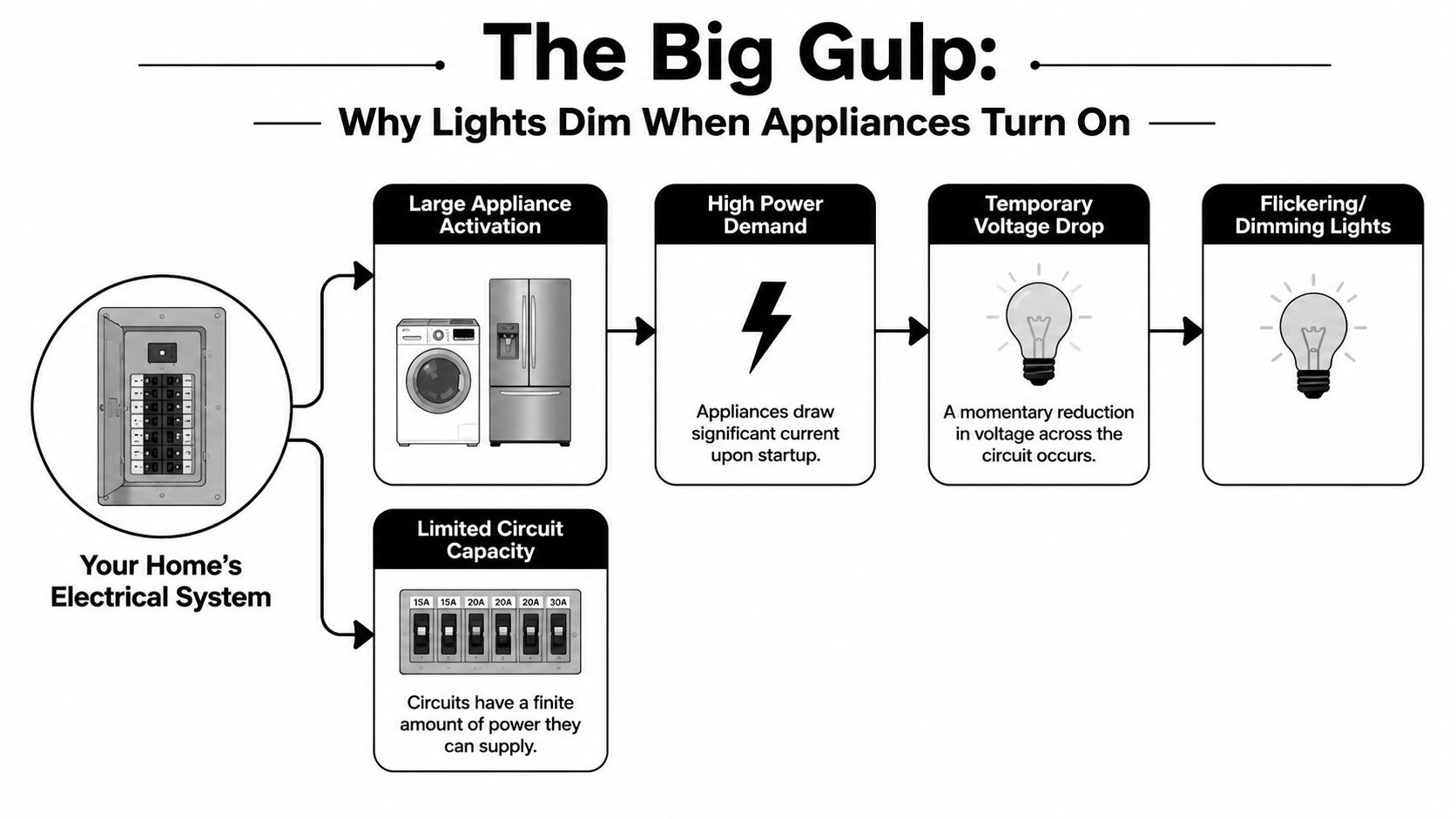
A brief, mild dip can be normal. The part that matters is the pattern.
If one specific appliance causes a small, momentary dimming and the lights immediately return to normal, that is often startup behavior. If the dimming is strong, lasts longer than a moment, affects multiple areas of the house, or seems worse than it used to be, the problem may involve circuit loading, panel balance, or service capacity.
Older homes tend to show this more often. I see it in houses where lighting and receptacles were grouped together in ways that made sense decades ago but do not fit current appliance use. A home can function for years with that setup, then start showing strain once larger HVAC equipment, extra refrigerators, freezers, or workshop loads are added.
DIY check versus professional diagnosis
You can narrow this down safely without opening the panel or removing devices.
- DIY observation: Watch for a repeatable trigger. Does the flicker happen only when the air conditioner starts, the microwave runs, or the refrigerator compressor cycles on? Does it affect one room or several?
- DIY comparison: Try the same test at different times of day. If the response is mild and tied to one appliance startup, that gives a useful clue. If ordinary household loads stack up and the whole house reacts, the electrical system may be near its limit.
- Helpful context: If you are wondering whether the issue points to an undersized service or a house that has outgrown its original setup, this guide on when 150 amp service is plenty, when it's not, and what to do explains what to look for.
- Call a pro: Schedule an electrician if lights dim hard, breakers trip, the panel hums, large appliances struggle to start, or the problem shows up in several parts of the home.
One trade-off homeowners should understand is this. A dedicated circuit, panel adjustment, or service upgrade costs more than swapping bulbs, but it addresses the actual load problem. Replacing lamps and fixtures will not solve dimming caused by heavy startup demand.
The goal is to identify whether you are seeing a normal motor-start dip or a house that is asking for electrical corrections. That distinction is what keeps a nuisance issue from turning into a reliability or safety problem.
Serious Signs Your Wiring Is Crying for Help
A homeowner usually notices this section of the problem at the worst time. A light flickers, then a switch starts buzzing, an outlet feels warm, or a breaker trips for what seems like no clear reason. At that point, the question is no longer whether the flicker is annoying. The question is whether a loose connection, damaged conductor, or failing device is creating heat where it should not.
Flickering tied to bad wiring is dangerous because the failure point can hide inside a box, at a splice, in a backstabbed receptacle, or at a worn section of branch wiring. I tell homeowners to treat heat, noise, smell, and repeated breaker trips as warning signs of a fault that needs diagnosis, not trial-and-error fixes.
Older homes deserve extra attention here. Aging insulation, worn terminations, aluminum branch wiring, and outdated methods can all cause intermittent flicker that comes and goes before it becomes an obvious failure. If your house still has very old conductors, this article on knob and tube wiring, a vintage charm or a fire hazard explains why unstable lights should never be brushed off as part of an old house's personality.
DIY vs. call a pro: how to handle wiring warning signs
Homeowners can make a few safe observations from the outside.
- DIY observation: Note whether the flicker happens on one circuit or in one part of the room. Pay attention to sound, heat, odor, and whether a breaker trips with the event.
- DIY safety step: If a switch plate or outlet feels warm, if you smell something sharp or burnt, or if you hear sizzling, stop using that device or area. Turn off the circuit if you can do it safely.
- Call a pro: Do not open boxes, pull devices, or tighten connections unless you are trained to test the circuit and inspect the full fault path. Hidden arcing and damaged conductors are easy to miss and easy to make worse.
Symptoms you should treat as urgent
Certain combinations matter more than the flicker alone.
- Buzzing or sizzling at a switch, receptacle, or fixture. That often points to arcing at a loose or damaged connection.
- Warm outlets or switch plates. Heat usually means unwanted resistance, overload, or a failing device.
- Breaker trips that happen with the flicker. The circuit is reacting to a fault or load problem that needs diagnosis.
- Burning smell, scorch marks, or discoloration. Stop using that circuit and get service right away.
- Random flicker in an older home. Age increases the odds of worn terminations, brittle insulation, and outdated wiring methods.
The electrical panel also deserves a hard look, especially in older Florida homes. Some legacy panels have a history of poor breaker performance and unsafe failure modes. This Florida homeowner's Zinsco panel safety guide is worth reviewing if your panel may be part of the problem.
Shut off use of the affected area if flickering comes with heat, smell, noise, or breaker trips. Fire risk takes priority over convenience.
Dangerous Wiring Symptom Checker
| Symptom | Potential Cause | Risk Level | Action Required |
|---|---|---|---|
| Flicker plus buzzing at a switch or fixture | Loose connection, arcing, failing device | High | Stop using it and call a licensed electrician |
| Flicker plus a warm outlet or switch plate | Resistance from a poor connection or overload | High | Turn off the circuit if possible and get immediate service |
| Flicker plus repeated breaker trips | Overloaded circuit or damaged wiring | High | Don't keep resetting. Have the circuit diagnosed |
| Random flicker in an older home | Aging insulation, worn connections, older wiring methods | Elevated | Schedule a professional inspection |
| Flicker with burning smell or visible discoloration | Damaged wiring or overheated component | Critical | Treat as urgent and call immediately |
There is a real trade-off here. Waiting may avoid a service call today, but it raises the chance of damaged devices, failed circuits, or a fire hazard inside the wall. In this category, DIY should stop at observation and safe shutdown. Diagnosis and repair belong to a licensed electrician.
When the Whole House Flickers A System-Wide Problem
A single light flickering points you toward a local issue. The whole house flickering points somewhere much bigger. When lights in different rooms flutter together, or one side of the home brightens while another dims, the problem is often not inside one fixture at all.
How to tell this isn't a single-fixture issue
The strongest clue is scope. If kitchen lights, bedroom lights, and exterior lights all react around the same time, think service problem, not lamp problem. Verified guidance says flickering throughout an entire home is most commonly caused by a loose neutral connection originating from the utility company's service line. If flickering affects the entire house, the issue likely originates on the utility side between the meter and the pole, and it requires immediate contact with the utility company before it escalates, according to this discussion of whole-house flicker and loose neutral problems.
That doesn't mean your panel is automatically cleared. Main service connections and panel terminations can also cause broad instability. But whole-home behavior changes the priority. You're no longer troubleshooting one switch. You're dealing with the path that feeds the house.
Who to call first and what to say
If multiple rooms are involved, take these steps:
- Observe the pattern. Does it happen during wind, heavy appliance use, or randomly at all hours?
- Check outside your walls. If neighbors are having similar trouble, that strengthens the utility-side suspicion.
- Call the utility company promptly. Tell them the entire home is flickering and that you're concerned about a possible loose neutral.
- Then arrange an electrician if needed. If the utility clears their side, the home's main service equipment still needs inspection.
Be specific on the phone. “One dining room light flickers sometimes” gets a different response than “lights across the whole house flicker together.” Good description speeds up the right response.
Whole-house flicker is not a wait-and-see issue. It deserves same-day attention because service neutrals and main connections affect everything downstream.
Don't Be Left in the Dark Your Next Steps for a Safe Home
Most flickering lights start with a simple question and end with a decision. Is this a basic fix, or is it time to bring in a licensed electrician? That's the right way to think about it.
If the issue is one loose bulb, one failing lamp, or one obvious dimmer mismatch, a homeowner can often rule that out safely. If the pattern involves warm devices, buzzing, repeated breaker trips, older wiring, heavy appliance strain, or flickering across the entire home, it's no longer a DIY project. It's a safety issue.
That's the practical answer to what causes flickering lights in house. Sometimes it's minor. Sometimes it's the first visible symptom of a dangerous fault. The mistake is ignoring the difference.

For homeowners in Palm Beach County, the safest next move is simple. Pay attention to the pattern, stop using anything that shows heat or odor, and get qualified help when the symptoms point past the fixture. Electrical problems don't reward delay, but they do respond well to the right diagnosis done early.
If your lights keep flickering and you're not comfortable guessing, Lighthouse Energy Services is the team to call. They've served Palm Beach County since 2005, bring more than 100 years of combined experience, and offer true 24/7 response with licensed electrical professionals answering the phone. Whether it's a single-room issue, an appliance-related voltage problem, aging wiring, or a whole-house service concern, they can diagnose it safely and fix it the right way, especially when it needs attention right now.