
If you're managing a marina in South Florida, you already know the uneasy feeling that comes when a dock loses power at the wrong time. A busy weekend is underway. Boats are full. Air conditioning, battery charging, refrigeration, and dock operations all depend on a system most tenants never think about until it fails. Then every minute matters.
At a marina, electrical service isn't a background utility. It's part of safety, tenant retention, vessel protection, and day-to-day operations. In South Florida, that pressure is even higher because salt air attacks equipment, storms stress every exposed connection, and code requirements are stricter for good reason.
Table of Contents
- The High Stakes of Power at the Dock
- Anatomy of a Marina Electrical System
- South Florida Code and Environmental Realities
- Beyond Wires Uptime and Emergency Response
- Navigating Service Costs and Agreements
- How to Choose Your South Florida Marina Electrician
- Frequently Asked Questions
The High Stakes of Power at the Dock
A summer storm rolls through, a pedestal trips, and within minutes the office phone starts ringing. One tenant has lost battery charging. Another reports low voltage alarms onboard. A dockhand smells insulation getting hot near a connection. At that point, the problem is no longer a simple outage. It is a safety risk, a tenant-relations problem, and a revenue problem all at once.
Marina power failures carry higher stakes than failures in most commercial properties because the load is concentrated at the waterline and the margin for error is small. Boats depend on shore power for chargers, pumps, refrigeration, air conditioning, and other onboard systems that owners expect to stay online while docked. If power is unstable, the effects show up fast. Equipment trips. Connectors overheat. Slip holders lose confidence in the facility.
South Florida raises the pressure. Salt air works into enclosures and terminations. Wind-driven rain finds weak seals. Heat pushes already stressed connections harder, and storm season exposes every shortcut in installation and maintenance. Those code requirements that can seem excessive on paper usually come from hard lessons. They exist to reduce shock risk, corrosion-related failure, fire exposure, and service interruptions that get expensive quickly.
Reliability is an operations issue
Managers sometimes treat dock power as a repair item that can wait until something clearly fails. In a marina, that approach usually costs more. The visible problem might be one tripped breaker, but the actual cause may be a loose lug upstream, a pedestal that has taken on moisture, or a dock circuit carrying loads it was never set up to handle.
A waterfront system also punishes ordinary commercial habits. Temporary fixes last a shorter time near salt and humidity. Parts that are acceptable in a dry inland property can fail early at the coast. An electrician who does not understand vessel demand, corrosion patterns, and dock distribution can restore power for the afternoon and leave the underlying hazard in place.
Practical rule: If the electrician cannot explain why the failure happened, not just how to reset it, your marina is still at risk.
Good marina electrical service starts with two priorities. Keep people safe. Keep power dependable without hiding defects that will come back during the next busy weekend or the next storm. That means checking the entire chain of failure, not just the last device that tripped: feeder condition, terminations, enclosure integrity, pedestal wear, grounding, and how the loads are distributed across the dock.
Budget matters, but false economy shows up quickly on the waterfront. A cheaper repair that leaves corrosion, water intrusion, or overheating in place often turns into a larger outage, emergency labor, damaged equipment, and unhappy tenants. Marina managers need clear answers on what must be fixed now, what can be scheduled, and what upgrades will reduce repeat calls over the next season.
Anatomy of a Marina Electrical System
A marina electrical system works a lot like a tree. The main service is the trunk. Distribution equipment forms the large branches. Dock feeds and pedestal circuits are the smaller branches. The receptacle and the vessel connection are the leaves where the end use happens. If the trunk is undersized, the whole system suffers. If one branch corrodes or overheats, the problem may show up much farther downstream.
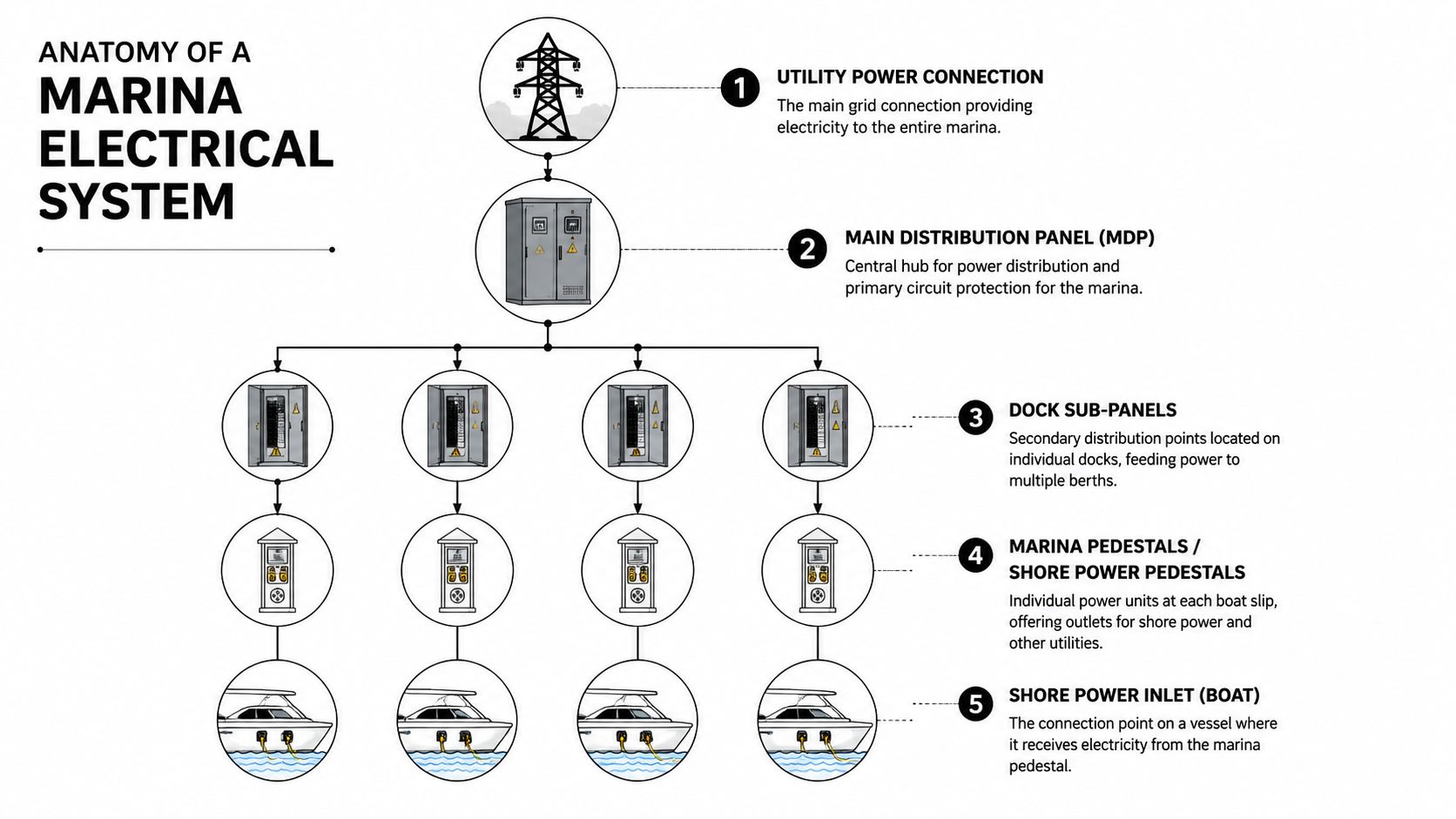
How power moves from shore to vessel
Power begins at the utility connection and enters the marina's main distribution equipment. From there, it passes to dock sub-panels, then to shore power pedestals, and finally to the boat's shore power inlet. Every transfer point matters because every splice, lug, breaker, enclosure, and receptacle is exposed to vibration, humidity, salt residue, and frequent use.
The pedestal gets the most attention because it's visible, but many of the expensive problems begin upstream. A weak termination in a panel, an aging feeder, or a damaged conduit run can create nuisance trips, voltage instability, heat buildup, or intermittent service that tenants report as "bad power" at the dock.
A well-built system usually includes these core elements:
- Main distribution gear: Incoming power is divided and protected by this gear. If this gear is outdated, undersized, or poorly labeled, troubleshooting takes longer and outages spread farther.
- Dock sub-panels: These shorten runs and localize distribution. Good layout here makes isolation easier when one dock section develops a fault.
- Shore power pedestals: These are the tenant-facing devices and the most abused part of the system. Loose receptacles, cracked housings, failed breakers, and damaged weather seals are common field issues.
- Protection devices: Ground-fault protection, overcurrent protection, and surge protection all serve different purposes. Managers sometimes assume a breaker protects everything. It doesn't.
- Conductors and cable pathways: In a waterfront environment, conductor choice is not a detail. It's a reliability decision.
Where marina systems usually fail
South Florida marina wiring has to survive one of the harshest electrical environments in regular commercial use. Salt exposure changes the material conversation completely. Marine wiring should use tinned copper conductors because they're more resistant to corrosion in saltwater conditions. According to marine electrical standards guidance from MD Marine Electric, un-tinned copper can experience up to 15% increased resistance after 5 years in marine conditions, while tinned variants maintain under 3% degradation. That difference matters on long dock runs where resistance, heat, and voltage drop can turn into service calls and fire risk.
What doesn't work is trying to save money with materials that perform fine inland but break down on the coast. What does work is specifying components for marine exposure from the beginning. That includes conductors, insulation type, enclosure selection, sealing, and hardware suited to corrosive conditions.
A marina manager doesn't need to memorize every component. They do need to know that the cheapest visible fix is often attached to a hidden failure point upstream.
If a contractor replaces a pedestal but doesn't inspect the feeder, terminations, and panel condition feeding it, the repair may look complete and still fail under load. That's why sound marina electrical services in South Florida are diagnostic before they're cosmetic.
South Florida Code and Environmental Realities
South Florida marinas don't operate in a forgiving environment. Salt spray gets into enclosures. Heat cycles loosen terminations. Wind-driven rain finds weak seals. Tidal changes and storm conditions create scenarios inland electrical systems never face.
That environment is why marina code provisions are so specific. They aren't arbitrary. They're written around real hazards that show up where electricity and water meet.
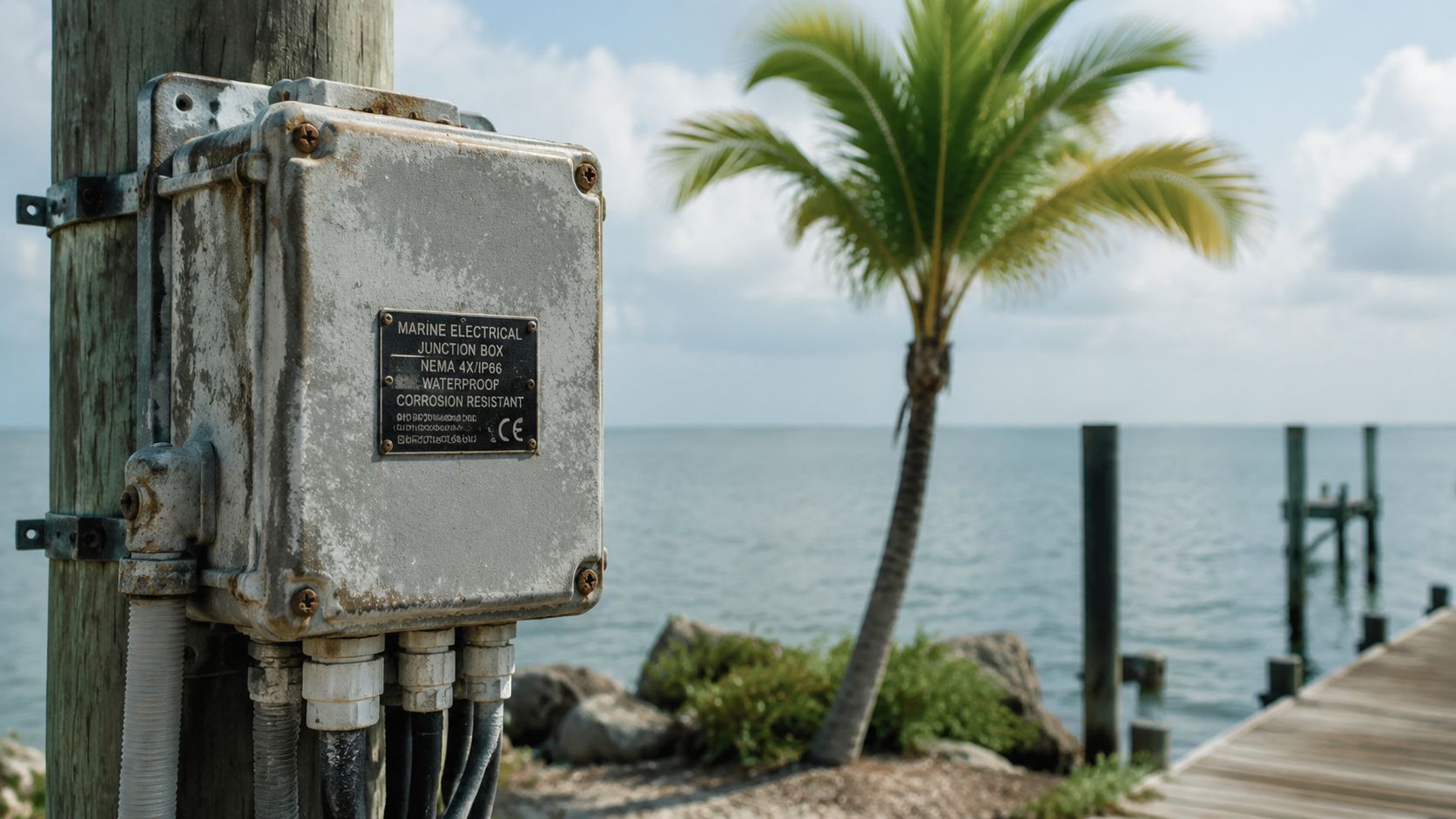
Why coastal conditions change the rules
One of the clearest examples is shore power receptacle placement and protection. Under NEC Article 555, shore power receptacles at marinas must be GFCI protected and mounted at least 36 inches above the deck. The reasoning is practical. That mounting height helps keep receptacles above water exposure during high tides or storm surge, reducing the risk of dangerous faults in a place where water conductivity makes mistakes less forgiving. The requirement is outlined in this NEC Article 555 marina and boatyard reference.
Managers sometimes see code correction as a paperwork issue because the deficiency isn't causing a visible outage yet. That's the wrong frame. Most serious electrical failures manifest subtly at first. A little corrosion. A little moisture intrusion. A nuisance trip that only happens during peak occupancy. If your property has unresolved deficiencies, a contractor focused on Florida electrical code violation correction can help translate inspection findings into an actual repair plan instead of a patchwork response.
What compliance protects you from
The operational value of code compliance comes down to three things.
- Protecting people in a wet environment: Fault current behaves differently around docks, pedestals, shore cords, and metal equipment near water.
- Protecting infrastructure during weather events: The right mounting heights, protection methods, and equipment choices reduce the odds that one storm turns into a multi-dock rebuild.
- Protecting service continuity: A compliant system is easier to isolate, test, maintain, and restore.
Field judgment: In South Florida, "still working" is not the same thing as "still safe."
Hurricane exposure adds another layer. Even if a direct hit never comes, repeated storm seasons stress supports, enclosures, fittings, and dockside equipment. Good marina electrical work plans for movement, moisture, and corrosion before they show up as failures. That's why experienced contractors don't just ask what broke. They ask what the system has been exposed to.
Beyond Wires Uptime and Emergency Response
When dock power fails, the quality of the response matters almost as much as the repair itself. Managers don't need an answering service that takes a message and calls back later. They need someone who can sort the urgent from the routine, understand the risk, and move the right crew with the right parts.
What real emergency service looks like
A marine electrical emergency call should do three things right away. First, confirm whether the issue is isolated to a vessel, a pedestal, a dock branch, or the main distribution path. Second, identify immediate safety steps for staff onsite. Third, dispatch someone who understands marine power distribution instead of treating it like generic commercial troubleshooting.
That phone process matters more than many owners realize. If you're curious about the workflow challenges electricians face during active jobs, this breakdown on managing emergency calls while working is useful because it shows why knowledgeable call handling affects response quality before the truck even rolls.
If the first person you reach can't distinguish between a pedestal issue and a feeder issue, the clock is already working against you.
Preventive work protects revenue
Emergency response is necessary. It just shouldn't be your only strategy.
The marinas with fewer disruptive outages usually have a routine for inspecting pedestals, checking enclosure condition, verifying terminations, testing protective devices, reviewing load complaints, and documenting recurring trouble spots by dock. That kind of preventive work doesn't eliminate failures, but it catches many of the ones that would otherwise appear during full occupancy.
Storm resilience fits into the same conversation. If your operation depends on continuity for office systems, pumps, security, or other critical loads, backup planning belongs in the electrical budget. For facilities evaluating resilience measures, hurricane backup generator installation in Florida is one practical part of a broader continuity plan.
Good marina electrical services in South Florida don't stop at restoring power. They help you avoid repeating the same emergency under a different work order number.
Navigating Service Costs and Agreements
Most marina managers end up choosing between two service models. They either call when something breaks, or they put the electrical system on a maintenance program that includes regular inspection and planned correction. Neither model is automatically right for every facility, but the trade-offs are clear.
Reactive service versus planned service
Per-call service feels cheaper in the short term because you only spend when a problem becomes visible. The downside is that marinas rarely fail at convenient times. When service is entirely reactive, repairs tend to happen under pressure, with tenants waiting and temporary decisions driving permanent outcomes.
A maintenance agreement shifts the spending pattern. You pay for regular attention to the system, and in return you usually gain earlier fault detection, better records, and less scrambling when occupancy is high or weather is coming in.
Here is the practical comparison.
| Feature | Per-Call Repair Model | Maintenance Agreement Model |
|---|---|---|
| When work happens | After a failure, complaint, or visible damage | On a planned schedule, with issues corrected before they escalate |
| Budget pattern | Irregular and harder to forecast | More predictable for operating budgets |
| Outage risk | Higher, because many defects stay hidden until they trip or overheat | Lower, because common wear points are inspected routinely |
| Response priority | Depends on current workload and urgency | Often tied to agreed service expectations |
| Recordkeeping | Usually centered on individual incidents | Usually organized around system condition and recurring issues |
| Best fit | Small facilities with simple infrastructure and low occupancy pressure | Marinas where uptime, tenant experience, and risk control matter daily |
What to look for in an agreement
Not all service agreements are worth signing. Some are just prepaid dispatch arrangements dressed up as maintenance.
A solid agreement should spell out:
- Inspection scope: Which panels, pedestals, feeders, and related equipment are included.
- Service intervals: How often the contractor returns and what gets checked each visit.
- Response expectations: What counts as emergency service and how calls are handled.
- Documentation: Whether you receive written findings, deficiency lists, and repair recommendations.
- Repair boundaries: Which parts or corrective tasks are included, and which require separate approval.
The main budget question isn't "What does the service call cost?" It's "What does avoidable downtime cost this property?" For most active marinas, the answer points toward at least some level of planned maintenance.
How to Choose Your South Florida Marina Electrician
A marina manager usually starts asking harder questions after a failure. A pedestal overheats on a humid weekend, a dock loses power after a storm, or a nuisance trip turns into tenant complaints by sunset. In South Florida, those problems rarely come from one bad part alone. Salt intrusion, heat, vibration, deferred maintenance, and code-sensitive conditions near the water tend to stack up. The electrician you hire needs to see that whole chain, not just replace the device that failed first.
General commercial experience is not enough for dock power work. Marina systems demand people who understand feeders on docks, pedestal wear, wet-location equipment, corrosion patterns, grounding and bonding concerns, and how to troubleshoot without creating more downtime. The best hiring decisions usually come from asking one simple question: do they treat this as specialty infrastructure, or as ordinary service work in a harder location?

What to verify before anyone starts work
Start with the contractor's legal and technical fit for the job, then press on how they inspect and diagnose waterfront systems.
- State licensing: Verify that the license matches the scope of work being proposed.
- Marine-specific experience: Ask how much of their field work involves marinas, dock distribution, pedestals, feeders, and troubleshooting near the water.
- Insurance fit: Waterfront work carries different exposure than inland commercial service. Coverage should reflect that reality.
- South Florida familiarity: Salt air, wind-driven rain, storm recovery, and accelerated corrosion affect material choices, enclosure condition, and service life.
- Diagnostic process: Ask how they isolate a fault at one slip versus a feeder, panel, or upstream service issue.
- Documentation quality: You want written findings, not vague verbal updates after the call.
Estimate quality matters too. A vague quote usually means vague responsibility once the work starts. Reviewing how contractors build scopes, quantities, and allowances can help managers spot weak proposals early. Resources tied to Exayard electrical estimating software are useful for that reason because they highlight the value of clear takeoffs, defined scope boundaries, and fewer pricing assumptions.
Lighthouse Energy Services is one option for marina-related electrical work in Palm Beach County, including pedestal installation, repairs, and feeder or main service upgrades in coastal conditions. Property teams that want a broader screening process can use this guide on how to find a good electrician as a starting point, then tighten that checklist for marina-specific risk.
Questions that reveal real experience
Ask questions that force the contractor to explain cause and method.
If one slip is dead and the adjacent slips still have power, how do they narrow the fault? What signs tell them the problem is in the pedestal versus the branch circuit or upstream distribution? Which materials do they prefer in corrosive dock environments, and what failure pattern are they trying to prevent by choosing them? How do they record deficiencies that are not yet causing outages but are likely to become budget items soon?
A qualified marina electrician answers in system terms.
They should talk about isolation, load path, enclosure condition, connection integrity, and replacement priorities. They should also be able to explain trade-offs. Stainless hardware may hold up better in one application but raise cost. A full pedestal replacement may cost more today but avoid repeat service calls on a deteriorated assembly. Fast emergency repairs have their place, but a manager needs to hear what still remains at risk after the power is restored.
References should come from marina managers or facility teams with similar operating pressure, not just from general commercial properties. Dock electrical work looks straightforward until weather, corrosion, tenant demand, and code exposure show up at the same time. The right contractor understands that reliability, safety, and budget control are tied together, and their inspection process, proposal detail, and field answers should prove it.
Frequently Asked Questions
For marina managers
How often should marina electrical equipment be inspected?
There isn't one schedule that fits every property. Occupancy patterns, weather exposure, system age, and past trouble spots all matter. A high-use marina on the coast usually benefits from routine inspections focused on pedestals, panels, terminations, enclosure condition, and recurring nuisance trips.
Can a standard commercial electrician handle dock power work?
Sometimes for limited tasks, but that isn't the standard you want for critical marina infrastructure. Marine environments introduce corrosion, water exposure, and code issues that require more specific experience.
For boat owners
Why does my boat seem to have power issues only at certain slips?
That often points to a dockside issue rather than a vessel-wide problem. Pedestal condition, receptacle wear, feeder problems, or load-related issues on a specific section of dock can all show up that way. The vessel should still be evaluated, but slip-specific symptoms usually deserve marina-side inspection too.
Why does the marina care so much about shore power equipment condition?
Because a worn connection isn't just your problem. Heat, fault conditions, and damaged equipment at one connection point can affect safety and reliability nearby.
For property owners and facility teams
What qualifications should I look for in the people doing the work?
Look for proper licensing, real marine experience, and the ability to explain code and risk in plain language. If you're curious how qualification pathways differ internationally, this overview of the UK electrician qualification process is a useful contrast. It highlights a broader truth that applies anywhere: electrical work gets safer when training, standards, and field experience all line up.
What is the first sign a marina electrical system needs attention?
Often it's inconsistency, not total failure. Repeated nuisance trips, complaints tied to specific slips, visible corrosion, heat discoloration, damaged covers, or equipment that only fails during busy periods are all warning signs worth acting on early.
If you need a licensed team for dock power repairs, pedestal replacement, feeder upgrades, or urgent troubleshooting in Palm Beach County, Lighthouse Energy Services is available for marina and coastal electrical work with a practical focus on safe restoration, clear scope, and dependable response.