
You don't start thinking seriously about a backup generator when the weather is perfect. You start when the storm has passed, the street is dark, the refrigerator is warming up, the house is getting hotter by the hour, and every update from the utility sounds vague. In Palm Beach County, that situation isn't hypothetical. It's part of living on the coast.
A lot of homeowners still think of generators as optional equipment, something in the same category as convenience upgrades. That view changes fast after a long outage. In South Florida, a standby generator is closer to storm infrastructure. It protects food, keeps medications cold, runs medical devices, maintains lighting and communications, and gives you a house that can function when the grid can't.
If you're researching Hurricane backup generator installation in Florida, the biggest mistake is treating it like a simple appliance purchase. In Palm Beach County, the scope of work involves load planning, fuel selection, placement, permits, wind exposure, flood risk, transfer equipment, and final inspection. If any of those parts are wrong, the generator may fail the day you need it.
Table of Contents
- Why a Standby Generator Is a Necessity Not a Luxury
- Sizing Your System and Choosing the Right Fuel
- Navigating Palm Beach County Permits and Codes
- The Professional Installation Process Explained
- Hiring a Contractor and Understanding the Full Cost
- Post-Installation Testing and Hurricane Readiness
Why a Standby Generator Is a Necessity Not a Luxury
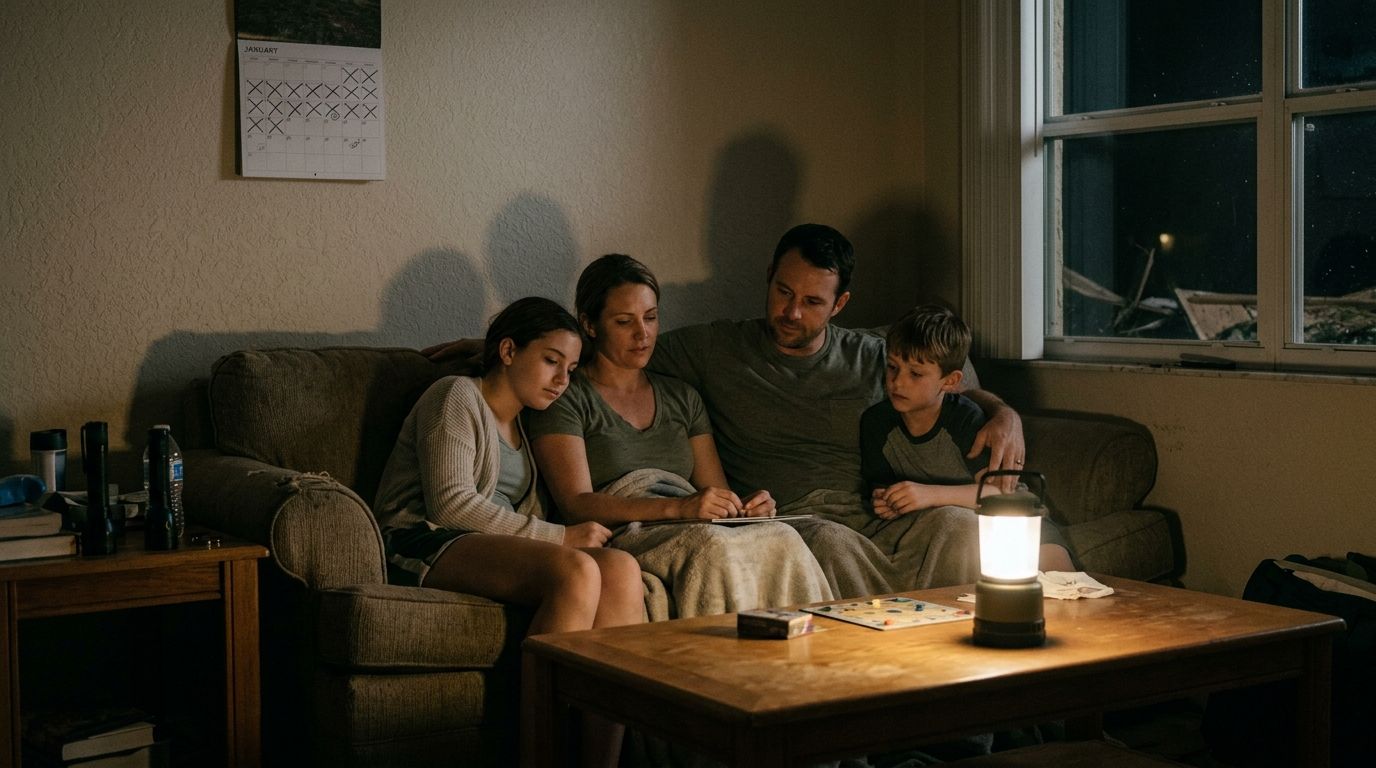
What a long outage actually looks like
Palm Beach County homeowners don't need a lecture on hurricanes. They need a realistic plan for what happens after the wind passes. The hardest outages aren't always the dramatic first hours. It's day two, day four, day seven, when fuel is harder to find, indoor temperatures keep climbing, and basic routines stop working.
That risk became unmistakable when Hurricane Irma in 2017 caused outages affecting about two-thirds of all electric customers across Florida, with some Palm Beach County residents without power for nearly two weeks, according to Irma outage reporting and generator context. A storm that leaves people without power that long changes how you evaluate preparedness.
Practical rule: If your backup plan only works for a short interruption, you don't have a hurricane plan. You have a temporary workaround.
For many homes, the biggest issue isn't comfort. It's continuity. Refrigeration, internet access, lighting, garage access, security systems, gate operators, sump or lift equipment where applicable, and a safe sleeping environment all matter. If someone in the home depends on powered medical equipment, the stakes go up immediately.
Why standby beats temporary solutions
Portable units have a place. They can keep a refrigerator and a few cords running if you know how to use them safely. But they require manual setup, active refueling, and constant attention. That's not ideal in heavy rain, overnight conditions, or when the homeowner is out of town.
A standby generator is fixed in place, connected through a transfer system, and built to start when utility power drops. That's the difference between reacting to an outage and riding through it.
Standby systems also fit the way South Florida homes are used. A lot of local houses have larger cooling loads, more electronic equipment, motorized gates, pool equipment, and home offices. Even when owners only want essential circuits backed up, those circuits need to be selected carefully so the house stays livable without overloading the system.
- Safety first: The generator has to be installed outside, in the right location, with proper clearances and exhaust management.
- Storm survivability: The unit itself has to be mounted and protected so it can still operate after the weather hits.
- Legal operation: The installation has to pass permitting and inspection, not just "work" on day one.
In Palm Beach County, that's why Hurricane backup generator installation in Florida should be approached like electrical infrastructure, not like shopping for a big appliance.
Sizing Your System and Choosing the Right Fuel
Start with the loads that matter
At 2 a.m., after the first feeder trips and the house goes dark, the question is simple. What has to come back on within seconds, and what can wait until the storm passes?
That is how a generator gets sized correctly in Palm Beach County. Start with the loads you cannot lose, then build from there. Homes here often carry bigger air-conditioning demand, more refrigeration, gate motors, lift stations, pool equipment, and home office loads than owners first realize. If the design is based on square footage alone, the system is often wrong before the permit set is even submitted.
For many 2,000-square-foot homes, an essential-load standby setup lands well below whole-house capacity, while larger systems are needed once central air, electric water heating, cooking equipment, or multiple large motors are included. Generac's home generator sizing guidance gives a useful starting point, but field sizing still needs a circuit-by-circuit review.
A proper load review usually splits the house into two groups:
- Must stay on: Refrigerator, freezer, selected lighting, internet equipment, security system, garage door, medical devices, well or lift pump if present, and at least one cooling zone in many South Florida homes.
- Can stay off during the outage: Water heater, range, dryer, pool heater, most pool equipment, laundry circuits, and secondary air-conditioning zones unless the owner is sizing for near full-house operation.
Motor starting current matters as much as running wattage. Air handlers, condensers, pumps, and refrigeration compressors all hit harder at startup. I see homeowners miss that point all the time, then wonder why a unit that looked big enough on paper struggles in real operation.
If the service equipment or breaker layout needs work before a transfer switch can be added, review this electrical panel upgrades guide early. Panel age, bus condition, and available spaces often shape the generator design.
Generator Fuel Comparison for Florida Homeowners
| Fuel Type | Availability & Storage | Upfront Cost | Best For |
|---|---|---|---|
| Natural gas | Utility-supplied where service is available. No on-site refueling, but dependent on gas service at the property. | Often avoids a separate fuel tank installation. | Homes already served by natural gas and owners who want low day-to-day handling. |
| Liquid propane | Stored on site in a dedicated tank. Good option where natural gas isn't available. | Usually includes tank planning and placement. | Homes needing long-duration standby fuel independent of utility gas lines. |
| Diesel | Stored on site and commonly used for some larger or specialty applications. Requires fuel management. | Can involve added storage and maintenance considerations. | Properties with specific operational needs or existing diesel infrastructure. |
Fuel choice affects more than runtime. It changes tank placement, pipe routing, refill logistics, maintenance routines, and sometimes the permit path.
Natural gas is convenient where utility service is already at the property, but that does not make it the automatic winner. Some homes in western parts of the county do not have gas available at all. Propane solves that problem and gives on-site storage, but the tank location has to work with setback rules, flood exposure, and access for delivery. Diesel is less common on single-family homes here and usually makes more sense for specialty applications where the owner already manages diesel equipment. For homeowners comparing those fuel types, these Wuxi Winteam Technology generator fuel insights are a useful background read.
Palm Beach County adds another layer. In low-lying neighborhoods and flood-prone sites, fuel system layout and generator elevation can become part of the design conversation early, not after the slab is poured. A unit that is sized properly but placed too low, too tight to an opening, or too far from a workable fuel connection creates expensive revisions later.
Three questions that decide the right setup
Three jobsite questions usually settle the design.
First, what loads must return immediately for the house to stay safe and livable?
Second, what fuel is realistic for that property, not just attractive on paper?
Third, does the owner want whole-house comfort during an outage, or a tighter essential-load plan that keeps cost, fuel use, and equipment size under control?
Good sizing is not about buying the biggest unit that fits the pad. It is about matching the generator to the way the house has to function during a Palm Beach County storm outage, while keeping the installation legal, serviceable, and dependable.
Navigating Palm Beach County Permits and Codes
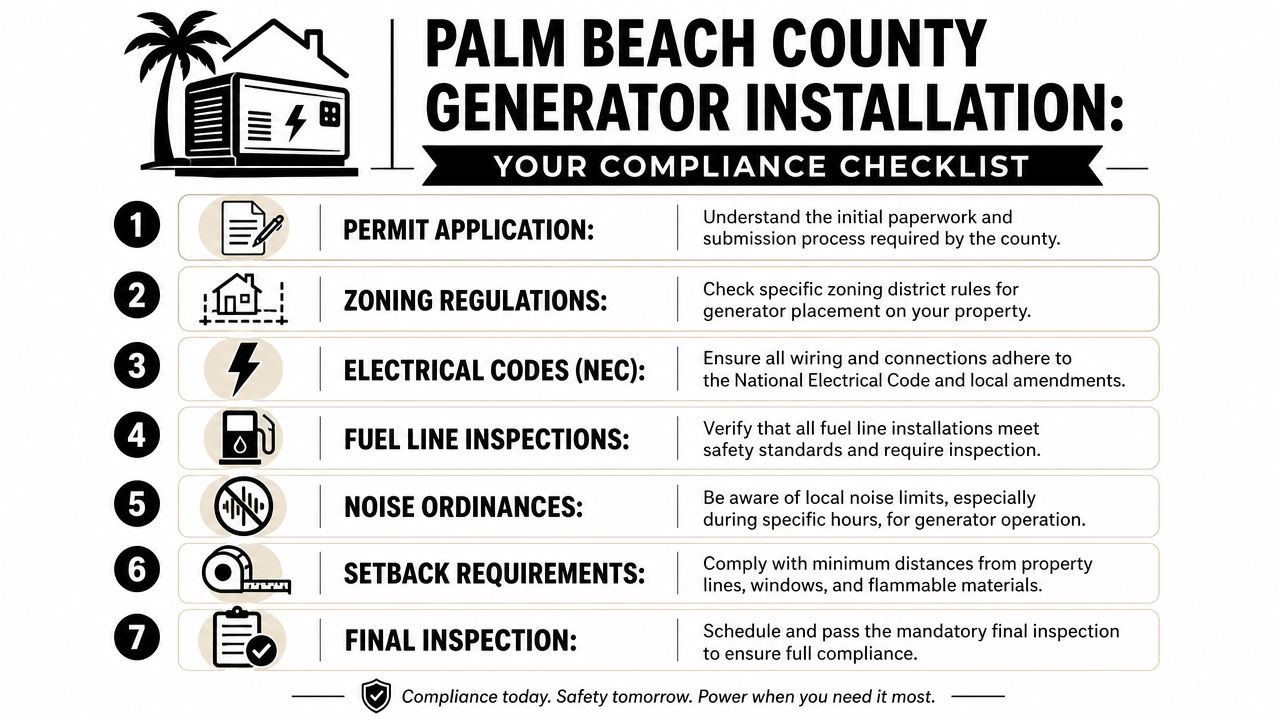
Codes protect the generator from the storm
A generator that powers the home during calm weather but fails under storm conditions wasn't installed for Florida. Palm Beach County jobs have to account for more than basic wiring. Local conditions bring in zoning review, utility coordination, structural anchoring, fuel piping inspection, and site-specific placement issues tied to wind exposure and flood-prone areas.
One code issue gets missed far too often. Wind- and impact-rated generator enclosures are a critical requirement in Florida hurricane zones, especially in settings where regulations already mandate them, and guidance on wind-rated generator enclosures in Florida makes the reason clear. If the enclosure or mounting approach can't handle storm conditions, the generator can be damaged before it ever carries the load.
In Palm Beach County, homeowners should also expect the installer to consider practical site realities such as slab elevation in flood-prone areas, drainage around the equipment, and whether nearby openings, property lines, or pathways create a placement problem. Good installers don't treat these as paperwork details. They treat them as survivability details.
A helpful comparison is water-heater work in Florida. The reason homeowners need local code awareness there is the same reason generator work can't be done casually. This FL water heater installation guide shows how state and local requirements shape installation decisions long before final inspection.
What to ask before signing a contract
Ask direct questions. If the answers sound vague, keep looking.
- Permit handling: Will the contractor pull the permit, submit the required documents, and attend inspections?
- Flood and grade review: Has the installer evaluated whether the slab or pad needs elevation because of site drainage or flood exposure?
- Wind protection: Can they explain how the generator will be anchored and whether the enclosure and installation approach are appropriate for hurricane conditions?
- Setback compliance: Do they know the placement rules for openings, lot lines, and safe access?
- Fuel inspection path: Who coordinates the electrical and fuel inspections, and in what order?
Permits don't slow the job down when they're handled correctly. They prevent a bad installation from becoming your problem later.
A legal, code-compliant installation protects resale value too. If the unit is unpermitted, incorrectly placed, or tied into the home with shortcuts, those issues tend to surface when insurance questions arise, when buyers inspect the property, or when the system finally fails under real storm pressure.
The Professional Installation Process Explained
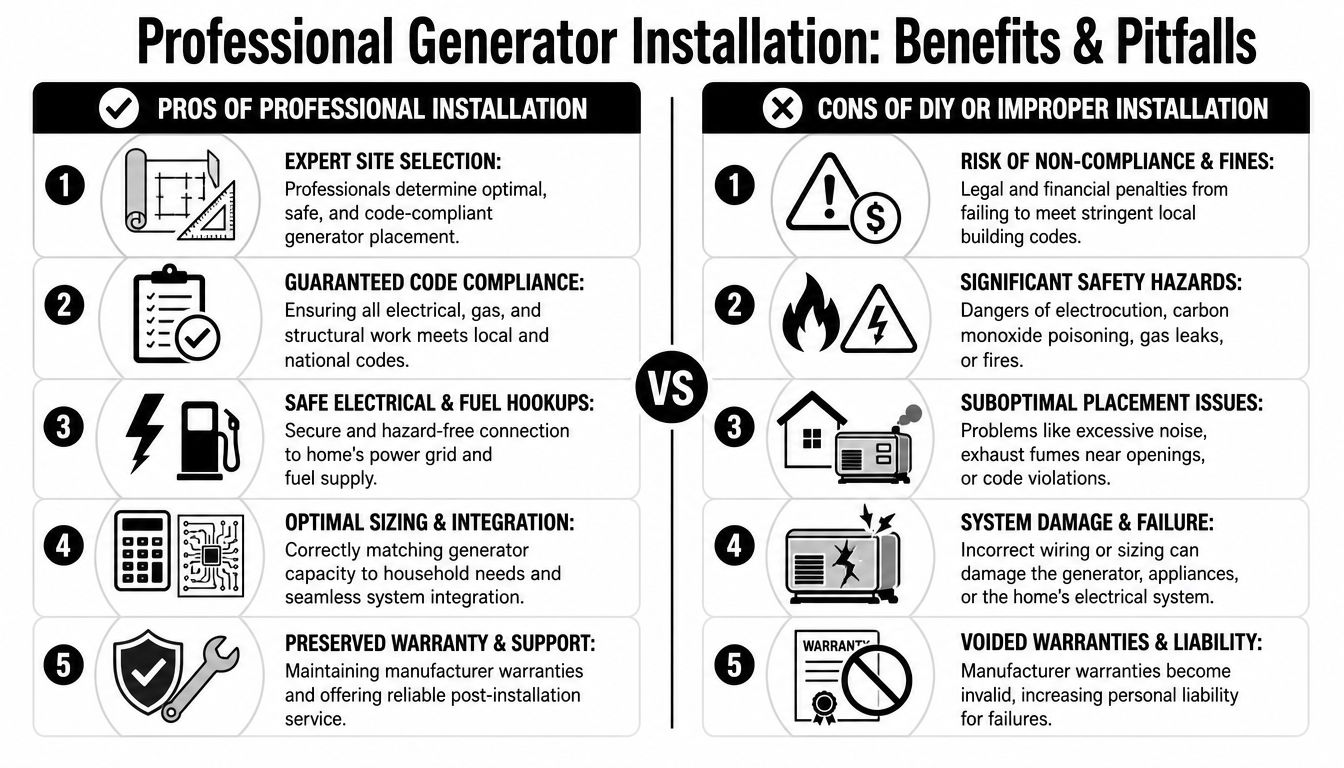
What happens before the unit is set
On a proper job in Palm Beach County, installation day starts with verification, not guesswork. The crew should already have an approved location, a defined electrical path, a fuel plan, and a clear understanding of grade, drainage, and service access.
That matters here because a generator pad that looks fine in dry weather can become a problem after a hard rain or storm surge event. In low areas, the unit may need to sit higher to stay clear of standing water and to satisfy local flood plain requirements. The mounting base also has to be solid enough to handle wind loads and keep the enclosure secure during hurricane conditions.
Placement usually drives the whole job. Homeowners often want the unit tucked out of sight, but code, exhaust safety, and maintenance clearance set the actual limits. The City of Miami generator safety guidance warns against placing generators too close to windows, doors, or vents. In practice, that affects where the slab goes, how the exhaust is oriented, and whether the proposed spot will pass inspection.
The Critical Role of the Transfer Switch
The transfer switch is what makes the system safe to use with a house. It isolates the home from utility power before generator power is introduced. If that isolation is missing, the system can back-feed the utility side, which puts lineworkers and anyone servicing the electrical system in danger.
I tell homeowners to focus less on the generator box and more on how power is transferred. A clean installation includes properly sized transfer equipment, correct load management if the house is not backing up every circuit, and labeling that makes the system clear to inspectors and future service technicians.
Automatic transfer equipment also changes how the house behaves during an outage. Utility power drops. The generator starts, stabilizes, and the selected loads transfer in the proper sequence. When utility power returns, the switch transfers the house back after the source is stable, then shuts the generator down through its cooldown cycle.
What homeowners should see on installation day
Good work is visible.
The crew should confirm measurements on site, protect finishes where conduit or equipment is being brought through, and install the generator on a base that is level, anchored, and appropriate for local conditions. Electrical runs should be neat and supported. Exterior penetrations should be sealed correctly. Fuel and electrical work should be coordinated so one trade is not forcing shortcuts on the other.
A proper startup matters too. Mounting the equipment is only part of the job. Before the installer leaves, the system should be exercised, the transfer sequence should be tested, and the homeowner should be shown how to shut the unit down, how to read basic fault indicators, and what service intervals to expect.
For homeowners comparing installers, this residential electrical contractor guide for 2026 is a useful reference for evaluating workmanship, licensing, and scope. In this area, Lighthouse Energy Services handles standby generator installations for homes and commercial properties in West Palm Beach as part of its electrical service work. The ultimate standard is whether the contractor can deliver a legal, storm-ready installation that will hold up under Palm Beach County conditions.
Hiring a Contractor and Understanding the Full Cost
A low quote can get expensive fast in Palm Beach County.
I have seen homeowners buy the right generator and still end up with the wrong project because the proposal left out elevation work, permit costs, transfer equipment, or service upgrades. In this county, the installed price is shaped as much by code, flood exposure, and site layout as it is by the generator itself. A house in a flood zone, a tighter side yard, or a panel that needs rework can change the job scope before the unit ever arrives.
The full price usually includes the generator, transfer switch, mounting pad or slab, electrical labor, fuel piping or tank work, permit fees, inspections, startup, and load testing. It may also include panel changes, trenching, bollards if the location needs physical protection, and elevation or anchoring details required by local conditions. Those are not extras you discover after the fact. They should be written into the estimate.
Lead time matters too. During storm season, equipment availability tightens and installation calendars fill up. Waiting until a named storm is in the forecast usually means fewer equipment options, more schedule pressure, and a greater chance that someone will rush decisions on placement or scope.
How to vet a Palm Beach County installer
A useful quote is specific. It names the equipment, the transfer method, the fuel scope, the permit responsibility, and the startup procedure. If the proposal is vague, expect change orders.
Ask direct questions:
- Who is pulling the permit? In Palm Beach County, that answer should be clear before any work starts.
- Does the price include code-required placement and anchoring details? That matters in high-wind exposure areas and on sites with drainage or flood concerns.
- What panel work is assumed? Older homes often need more than a simple tie-in.
- Is startup and load testing included? A generator that is installed but not properly commissioned is unfinished work.
- Who coordinates the fuel trade and electrical trade? If nobody owns that coordination, mistakes show up at inspection.
For a broader screening framework, use this residential electrical contractors guide for 2026. It helps homeowners compare licensing, scope detail, and workmanship standards before signing a contract.
Safety should be part of the hiring conversation, not an afterthought. Temporary cords, backfeeding, and improvised connection methods injure people every hurricane season. The LuminAID guide on generator safety is a good homeowner reference for outage risks and safe operation basics.
One more point matters here. Fast is fine. Unpermitted work, incomplete scope, and poor placement are what cost money later, especially in Palm Beach County where inspections, flood rules, and wind exposure are not minor details.
Post-Installation Testing and Hurricane Readiness
Commissioning is where the job proves itself
A generator installation isn't finished when the crew leaves. It's finished when the system starts automatically, carries the intended loads, transfers cleanly, and returns the house to utility power without trouble. That requires a real commissioning process.
The homeowner should see a simulated outage test. Utility power is interrupted in a controlled way, the generator starts, the transfer equipment operates, the selected circuits pick up, and then the system transitions back once utility power is restored. That test answers the question that matters most: will it work under stress?
Testing should also include practical homeowner instruction.
- Auto mode: The owner needs to know the system must remain in the correct operating mode before a storm.
- Alarm awareness: They should know what a warning or fault indicator looks like.
- Access and clearance: The area around the unit has to stay clear for airflow and service.
- Fuel awareness: If the system uses on-site fuel, someone needs to monitor supply before storm conditions arrive.
What to do before storm season starts
The worst time to think about service is when a named storm is already in the forecast. By then, contractor schedules tighten, parts become harder to get, and homeowners start trying risky workarounds.
That isn't just a common-sense problem. Data from 2025 to 2026 shows that 68% of Florida homeowners who waited until July to schedule generator installation were without backup power during the first major storm, according to Florida timing data on delayed generator scheduling. In practice, that means spring and early pre-season planning give you the best chance of having a working system before weather starts stacking up.
A yearly service visit should include inspection, startup verification, and a review of anything that could interfere with operation. Homeowners should also think about the rest of the electrical system, not just the generator. Sensitive electronics can still be exposed to utility fluctuations and storm-related surges, which is why a whole-house surge protector overview belongs in the same conversation.
For a homeowner refresher on safe day-to-day generator use during outages, this LuminAID guide on generator safety is a useful supplemental read.
A standby generator is emergency equipment. Treat it the way you treat any other safety system. Test it before you need it, not after it fails.
Your pre-storm routine
When a storm is approaching, keep the checklist simple.
- Confirm operating status: Make sure the generator is ready to start automatically and there are no active fault alerts.
- Check the area around the unit: Remove debris, yard clutter, and anything that could block airflow or create a hazard.
- Verify fuel readiness: If the system uses stored fuel, confirm supply well before conditions deteriorate.
- Review critical loads: Know which equipment the generator is intended to carry so there are no surprises during the outage.
- Protect the rest of the home: Unnecessary plug-in loads and damaged cords create avoidable problems during storm operation.
Hurricane backup generator installation in Florida pays off only when the system is maintained, tested, and ready before the forecast turns serious. The homeowners who have the smoothest storm experience are rarely the ones making last-minute calls.
If you need a code-compliant standby generator plan for your Palm Beach County property, Lighthouse Energy Services can evaluate your load needs, review site and permitting requirements, and handle installation with the electrical and safety details that matter in South Florida storm conditions.