
You know the routine in Palm Beach County. A storm track shifts east, the cone tightens, gas lines form, bottled water disappears, and everyone starts asking the same question too late: what happens if the power stays out for days? In this part of South Florida, that's not a theoretical problem. It affects refrigeration, air conditioning, internet, gate systems, sump equipment, medication storage, and in some homes, medical devices that can't just wait for utility crews.
That's where emergency home generator installation stops being a luxury upgrade and starts looking like basic storm preparation. A permanent standby generator isn't just about convenience. It's about keeping the house livable, protecting what's inside it, and removing the scramble that comes with portable cords, fuel cans, and unsafe hookups. In Palm Beach County, where hurricane prep and code compliance both matter, the difference between a proper installation and a shortcut job is huge.
Table of Contents
- Why Backup Power Is a Necessity in South Florida
- Planning Your Installation and Sizing Your Needs
- Choosing Your Generator and Transfer Switch
- The Installation Process Demystified
- Navigating Permits and Project Costs in Palm Beach County
- Safety Maintenance and Avoiding Common Pitfalls
Why Backup Power Is a Necessity in South Florida
When a hurricane watch goes up, most homeowners start with the basics. Shutters. Patio furniture. Flashlights. Ice. Then more significant concerns arise. Will the refrigerator stay cold? Will the bedrooms stay safe to sleep in? Will the house be bearable after the storm passes and the humidity settles in?
That's the point where a permanent standby generator changes the conversation. Instead of planning around extension cords and selective sacrifice, the house has a system that senses utility loss and takes over automatically. For families with kids, older relatives, refrigerated medication, or anyone working from home, that automatic protection matters more than people realize before their first long outage.
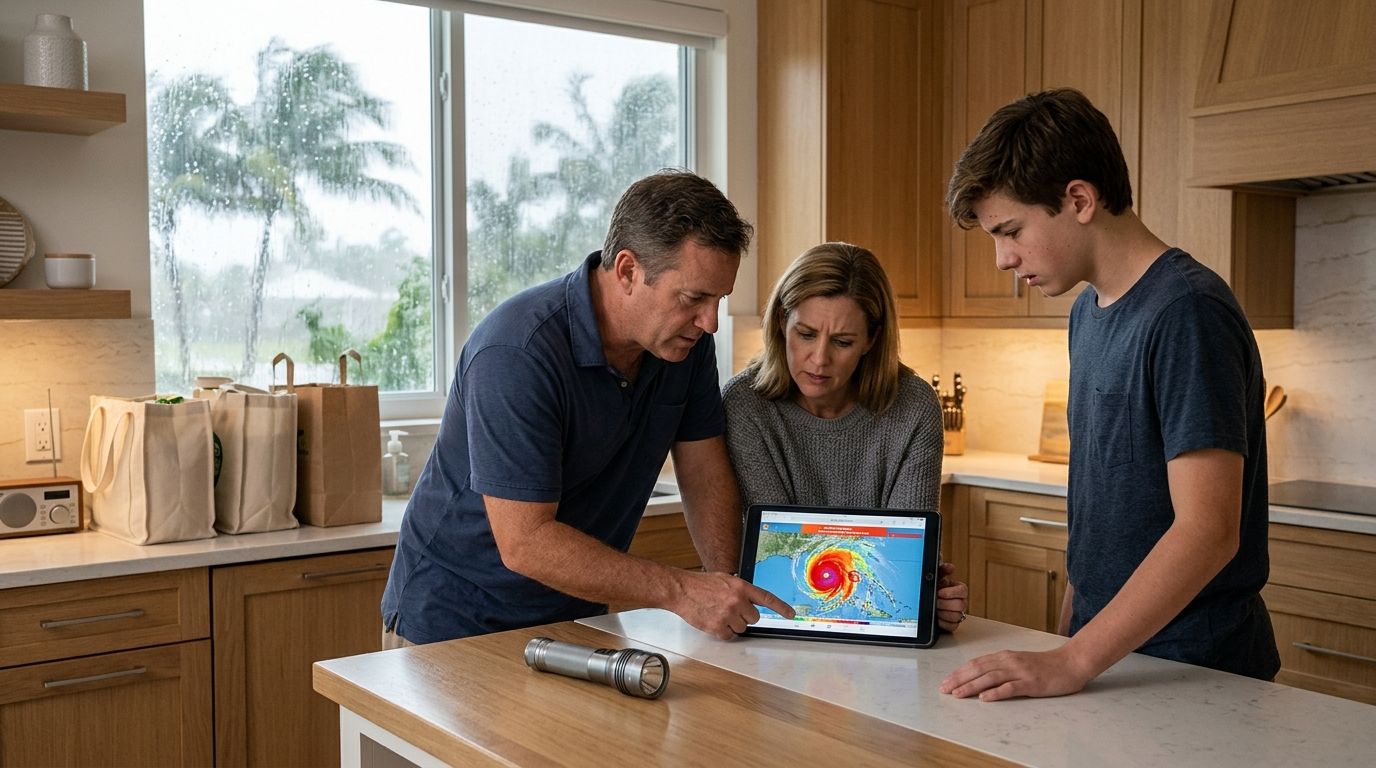
In South Florida, portable units have their place, but they also create the same problems every storm season. Homeowners have to drag them out, fuel them, start them, protect them from rain, and keep them far enough from the structure to avoid exhaust hazards. A standby system avoids that entire scramble. If you're evaluating whether that makes sense for your home, this Florida hurricane backup generator installation overview gives a helpful local starting point.
The real value is continuity
A professionally installed standby generator protects more than comfort. It helps preserve food, maintain lighting, keep garage access working, support communication, and reduce the chaos that starts the moment power drops.
In practice, I'd break the difference down like this:
- Portable setup means manual deployment, temporary cords, fuel handling, and limited circuits.
- Standby setup means fixed equipment, automatic transfer, permanent wiring, and a code-based installation.
- Handyman shortcut usually means trouble. The problem might not show up until the first outage or the first inspection.
Practical rule: If the generator is going to connect to your home's electrical system, it needs to be designed, permitted, and installed like real electrical infrastructure, because that's exactly what it is.
Storm prep in Palm Beach County is different
This county has coastal exposure, strict municipal review in many areas, and a lot of properties with tight side yards, HOAs, and high expectations for appearance. That combination catches people off guard. They buy equipment first, then find out the location they had in mind won't pass review or won't work safely.
That's why emergency home generator installation should start with layout, load planning, and code. The machine comes after that.
Planning Your Installation and Sizing Your Needs
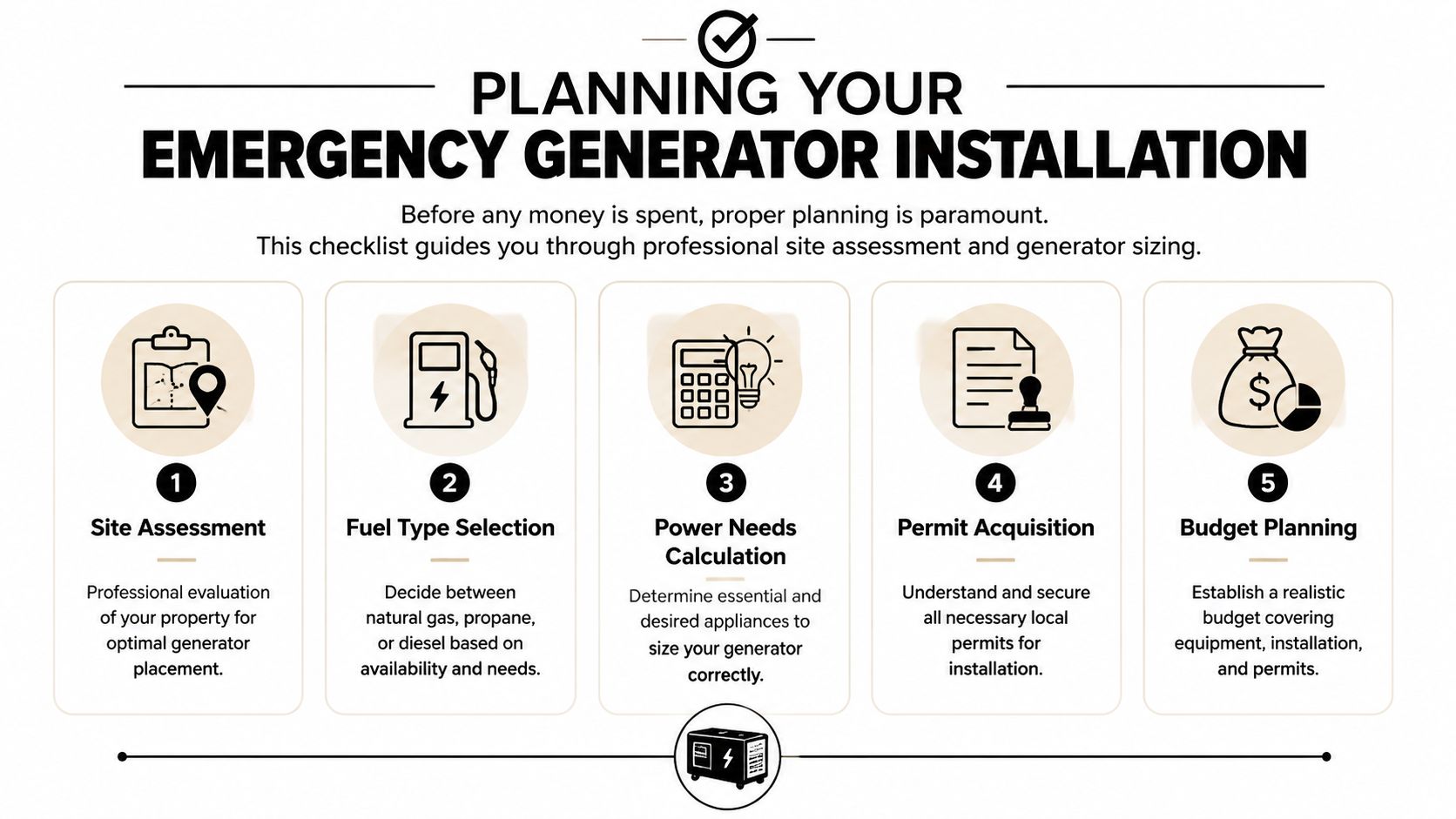
Most expensive generator mistakes happen before any trench is dug or wire is pulled. A homeowner picks a unit based on online descriptions, a neighbor's recommendation, or the biggest name on the box. Then the property layout, fuel supply, or actual electrical load tells a different story.
Planning has to start at the house itself.
Start with the loads that matter
Not every home needs full-house backup. Some do. Many don't. The right answer depends on how you live in the house and what absolutely must stay energized during an outage.
A practical site visit usually sorts loads into three groups:
- Must-run loads such as refrigeration, selected lighting, internet equipment, gate or garage access, and medical equipment.
- Comfort loads such as bedroom cooling, water heating, cooking equipment, or laundry.
- High-demand loads such as large air conditioning systems or other equipment that may push the project into a larger generator and more involved installation.
That's why a load calculation matters more than a brochure. If you want a deeper look at that process, this guide on sizing a home generator is a useful companion.
A generator that's too small causes nuisance problems. A generator that's too large can push the project cost higher than necessary and may complicate fuel planning.
Placement rules matter before you pick equipment
In Palm Beach County, location is never just a convenience question. It's a code, safety, and approval question. You need a spot that works for exhaust, service access, utility connections, setbacks, and neighborhood restrictions.
One issue homeowners often miss is that local rules and related project requirements can add more than expected. As one homeowner-focused guide puts it, “The hidden cost of fuel-system compliance and permitting is rarely quantified in homeowner guides, yet local bylaws often mandate concrete pads, plumbing connections, and municipality fees that can add 20–35% to the base generator price” and “HOA noise restrictions and neighbor-distance mandates for generator placement are frequently overlooked in installation guides” in ways that can delay a project.
A few local planning checks make a big difference:
- HOA review: Some communities want submittals before work begins.
- Service access: The unit needs room for maintenance, not just enough room to fit.
- Fuel route: Natural gas or propane routing can shape where the generator can realistically go.
- Bedroom and window considerations: Even when a spot looks convenient, it may be a poor choice for noise and exhaust.
Choose fuel based on your property, not marketing
For most homes here, the fuel decision comes down to natural gas or propane. Diesel can make sense in some situations, but it's not usually the first residential choice in dense neighborhoods.
A simple comparison helps:
| Fuel type | What works well | Common trade-off |
|---|---|---|
| Natural gas | Continuous utility supply where available, no on-site refueling routine | Depends on service availability and gas routing |
| Propane | Good option where gas service isn't practical | Requires tank planning and tank placement |
| Diesel | Strong choice for certain backup applications | Fuel storage, noise, and residential fit can be harder |
If propane is part of the plan, homeowners should understand tank size, refill logistics, and where the tank can sit on the property. This homeowner's guide to 400 lb tanks is a good plain-English reference before you talk with your installer and fuel supplier.
The best planning meeting ends with clear decisions on three things: what the generator must power, where it can legally and safely go, and what fuel source the site can support without forcing a bad compromise.
Choosing Your Generator and Transfer Switch
Once the site and load plan are nailed down, the equipment choice gets easier. At this point, homeowners often focus too much on the generator enclosure and not enough on the electrical hardware that makes the system safe.
The generator matters. The transfer switch matters just as much.
What homeowners should compare
At the equipment level, the smartest comparison isn't brand hype. It's suitability for the house. A good residential standby setup should match the expected load, fit the available location, and work cleanly with the electrical service.
When reviewing options, pay attention to:
- Fuel compatibility: The unit should match the fuel source already chosen for the property.
- Physical footprint: A generator may fit on paper and still create clearance or service issues on site.
- Operating strategy: Some systems are intended to carry the full home. Others are better paired with selected essential circuits.
- Serviceability: If a technician can't access filters, panels, and connections cleanly, future maintenance becomes harder.
In practical terms, a modestly sized home with selected backup loads needs a different setup than a larger waterfront property trying to support broader comfort loads during an extended outage. Treat those as different projects, because they are.
The transfer switch is not an accessory
The Automatic Transfer Switch, or ATS, is what separates a real standby installation from a dangerous patchwork arrangement. It monitors utility power, signals the generator to start, and transfers the electrical load in a controlled way. It also isolates the home from the utility line so power doesn't backfeed onto the grid.
That isolation is not optional. It's a life-safety issue for utility workers, occupants, and the equipment itself.
According to this transfer switch wiring reference, a critical step is proper ATS sizing and placement. The switch must be rated for 63–100A depending on load and mounted within 5 feet of the main distribution board. The same source notes the main power supply connects at the upper line and neutral positions, while the generator feed uses 6 AWG cable to the lower slots and terminates in a dedicated 32A, 240V inlet arrangement for compliant connection.
That technical detail tells you something important. This is not handyman work. It requires correct load assessment, conductor sizing, switch selection, and termination.
If someone proposes tying a generator into a panel without a properly specified transfer method, stop the conversation there.
What goes wrong when the hardware is wrong
A bad switch choice creates problems in two directions. If the switch is undersized, the system may overheat, fail under load, or create nuisance transfer issues. If it's installed poorly, inspectors can reject the job and the house can be left with unsafe wiring.
The transfer switch also shapes how the home behaves during an outage. A whole-house ATS creates one experience. A selected-load setup creates another. Neither is automatically better. The right answer depends on your priorities, your service, and your budget.
Homeowners usually don't need to memorize every terminal layout. They do need to understand this much: the transfer switch is the control point that makes a standby generator automatic, safe, and code-compliant. If an installer downplays it, that's a red flag.
The Installation Process Demystified
A proper generator installation looks simple when it's finished. Before it's finished, it's a coordinated job involving site prep, fuel work, electrical integration, inspection planning, and testing. That's why these projects go wrong when one person tries to do every trade without the right license or scope.
Residential demand for backup systems is also substantial. In 2023, residential installations accounted for 4.3 million of the 19.7 million emergency power generators sold globally, according to emergency power generator market data. The same source states that permanent fossil fuel generators must be placed at least 20 feet from the home, with exhaust directed away from windows, doors, and intake vents.
What happens before the electrician makes the tie-in
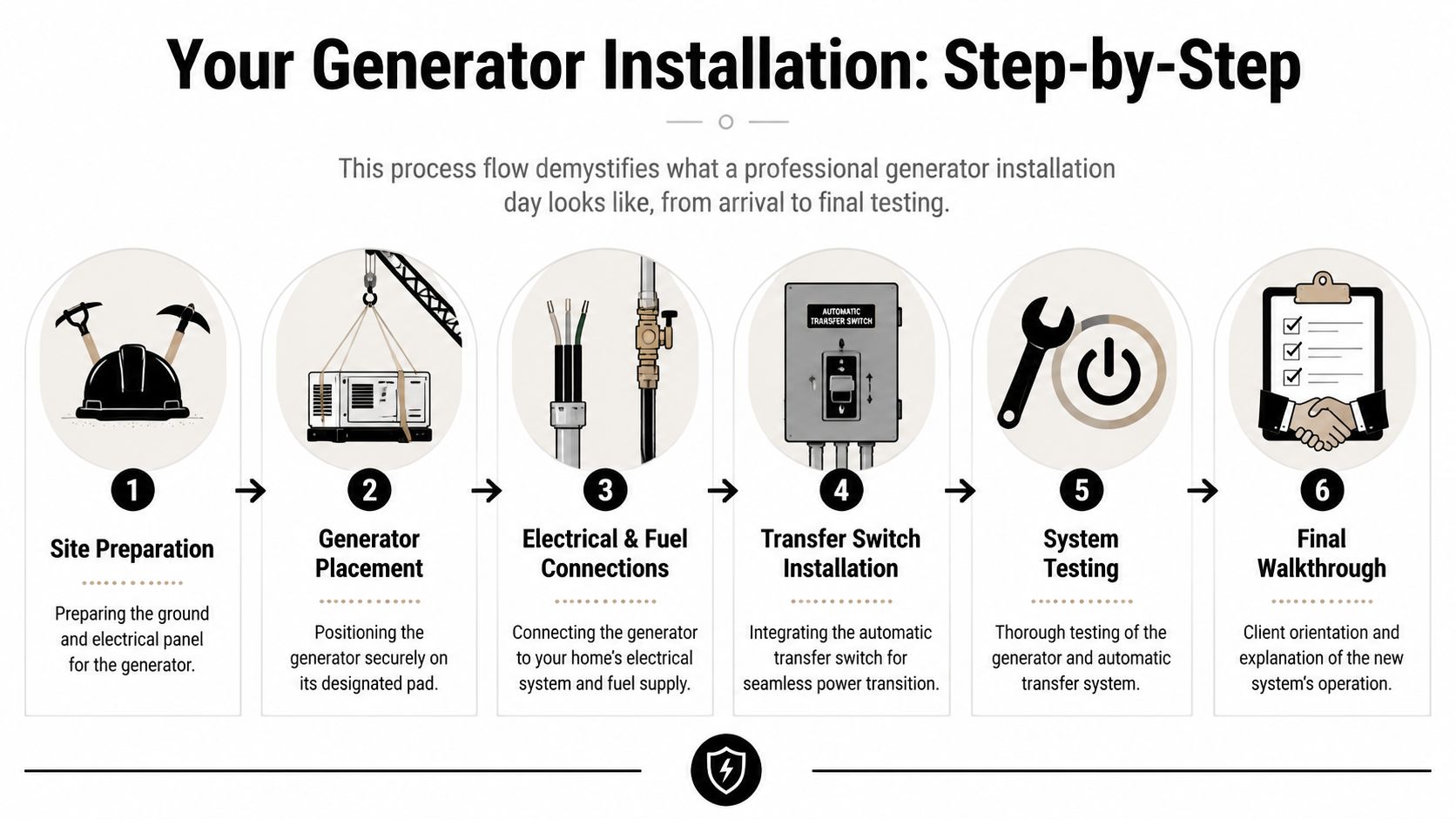
The first stage is site preparation. That usually means establishing the exact generator location, preparing the base, and confirming clearances. The pad matters more than homeowners expect. If the generator sits poorly, everything downstream gets harder, from fuel alignment to enclosure vibration.
Then the equipment gets set in place and the fuel connection is handled through the appropriate licensed trade. For natural gas or propane systems, that portion of the work must be done correctly and cleanly. Sloppy fuel piping isn't just ugly. It can stop the project at inspection.
A typical sequence looks like this:
- Pad and location prep: The crew verifies the approved spot and prepares the base.
- Generator placement: The unit is positioned for service access, airflow, and connection routing.
- Fuel line installation: The fuel supply is run and tested by the qualified trade handling that portion.
- Electrical rough-in: Conduit, conductors, grounding, and transfer switch work begin.
If you want a broader homeowner perspective on what professional electrical work should look like during this kind of project, the Access Electrical guide to installations is a useful read.
What the electrical work actually involves
This is the part most often misunderstood. The electrician is not just “hooking up a generator.” The electrician is integrating a standby power source into the home's electrical system in a way that complies with code and behaves predictably under outage conditions.
That usually includes:
- Installing the transfer switch in the correct location relative to the service equipment.
- Running feeders and control wiring between the generator and switchgear.
- Making panel connections that align with the approved design.
- Completing grounding and bonding work required for safe operation.
- Testing startup, transfer, retransfer, and shutdown before final handoff.
The final test isn't a formality. It's where you find out whether the system starts cleanly, transfers properly, and returns to utility power without drama.
Why DIY fails here
A lot of unsafe advice online makes this seem easier than it is. It isn't. Once a generator becomes part of the house wiring, the work involves load management, overcurrent protection, conductor sizing, transfer equipment, grounding, and permit compliance.
A homeowner can understand the process without doing the process. That distinction keeps people safe.
Navigating Permits and Project Costs in Palm Beach County
The first number homeowners ask for is usually the equipment price. That's understandable, but it's incomplete. The installed price is what matters, because that includes the labor, transfer equipment, permitting, and coordination work that turns a generator into a legal standby system.
According to this home backup generator cost guide, the installation of a permanent standby home generator in 2026 typically ranges from $7,500 to $22,000, with professional installation adding $2,000 to $5,000. The same source states that permit fees alone typically cost $50 to $200, and that the installation cost covers work such as the automatic transfer switch and compliance with NEC Article 702.
What drives the final price
Two homes can choose similar generator sizes and still end up with very different final numbers. In Palm Beach County, project cost usually rises or falls based on site conditions and scope.
The biggest pricing variables are usually:
- Electrical complexity: A simple service layout is easier than a crowded panel area with limited working room.
- Fuel connection scope: The farther or more difficult the fuel route, the more coordination the job needs.
- Placement constraints: Tight side yards, decorative hardscape, and access problems increase labor.
- Load strategy: Essential-circuit backup and broader home coverage are not the same install.
- Municipal and HOA requirements: Review, revisions, and compliance steps add time.
Some homeowners also underestimate labor because they think of the installation as mostly set-and-wire work. It isn't. The labor covers equipment assembly, placement, wiring, code-based connection work, and permit coordination.
Why permits are part of the job, not an extra
In Palm Beach County, permits aren't paperwork for paperwork's sake. They are how the municipality confirms that the equipment location, electrical tie-in, and related work meet applicable rules.
A proper generator project may involve more than one approval path depending on the site. That can include the electrical side and, where required, the fuel side. In practice, experienced contractors deal with these issues before work starts, not after a failed inspection.
Here's what a homeowner should expect from a legitimate contractor:
| Project item | What you should see |
|---|---|
| Scope review | Clear explanation of what loads are being backed up |
| Permit handling | Application and coordination through the proper local authority |
| Site plan awareness | Placement that accounts for access, exhaust, and property constraints |
| Inspection readiness | Work staged so the inspector sees a clean, code-based installation |
Inside advice: If someone says permits can be skipped “to save time,” what they usually mean is they want to save themselves accountability.
What Palm Beach County homeowners should ask up front
Before signing, ask direct questions:
- Who is pulling the permit?
- Who is doing the electrical connection?
- Who is handling the fuel work?
- What happens if the inspector requires corrections?
- Will the final proposal identify what is and isn't included?
That last question matters. A clean quote prevents disputes over trenching, pad work, utility coordination, and permit responsibility. In generator work, vague proposals are where “surprise costs” begin.
Safety Maintenance and Avoiding Common Pitfalls
A standby generator only proves its value when the lights go out. That means the installation has to be safe on day one and the system has to stay reliable afterward. Too many homeowners assume the project ends when the unit starts for the first time.
It doesn't. It moves into maintenance.
What keeps a standby system reliable
A good maintenance routine doesn't need to be complicated, but it does need to be consistent. Homeowners should know how to confirm the system is ready, and a qualified technician should handle the deeper service work.
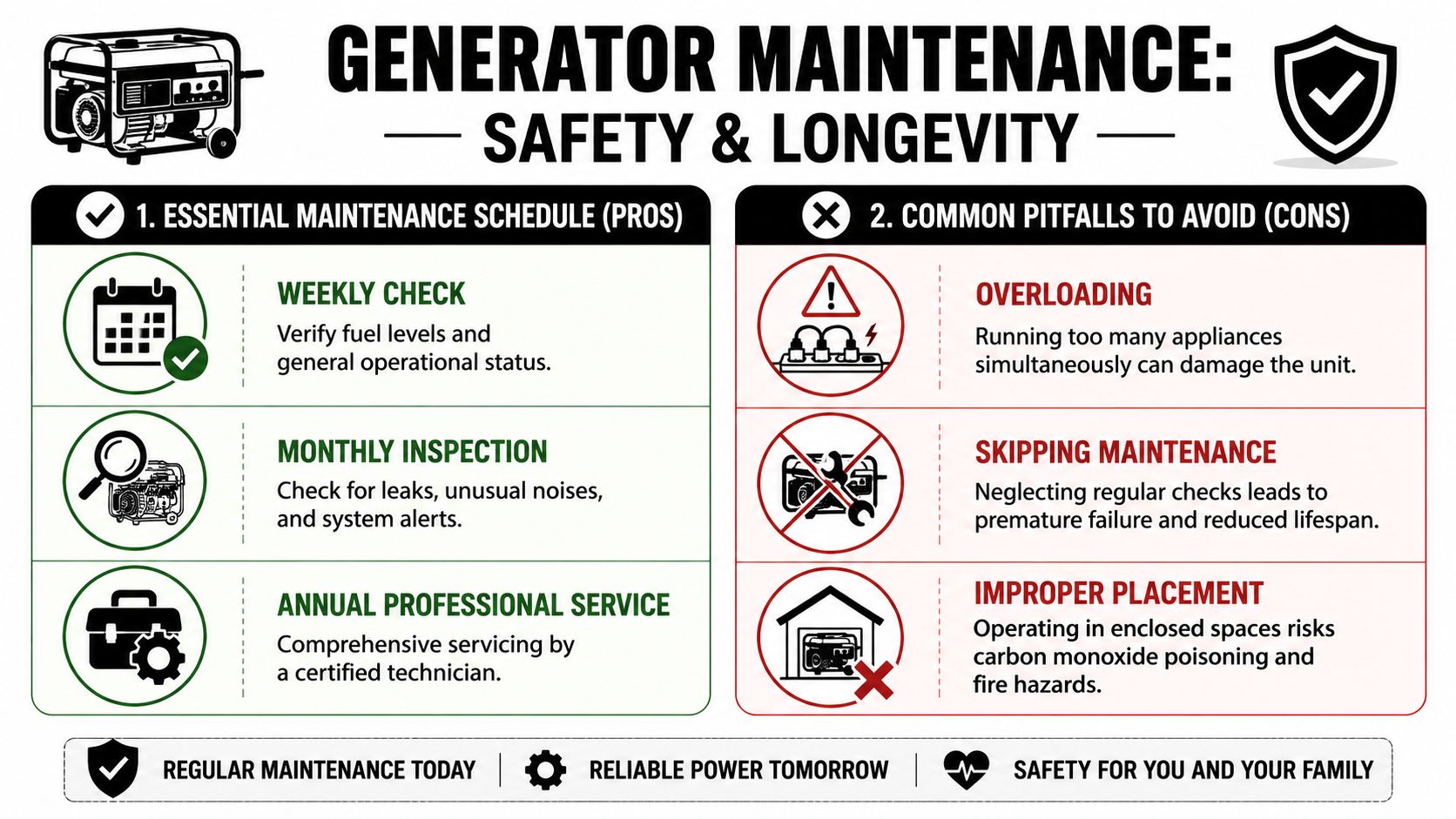
A practical routine looks like this:
- Weekly awareness check: Look for alerts, visible damage, or anything unusual around the enclosure.
- Monthly visual review: Check that the area stays clear and that there are no obvious fluid, fuel, or corrosion issues.
- Professional annual service: Have the system inspected, exercised, and serviced by a qualified technician.
For homes with sensitive electronics, outage planning should also include surge protection strategy. A generator solves one problem. Voltage events can create another. This whole-home surge protector overview helps explain how those protections fit together.
Mistakes that cause failed inspections and unsafe operation
Some generator failures start with maintenance neglect. Others are built in from the first day because the installation was rushed or done by someone outside their lane.
According to this standby generator installation guide, grounding the generator to a copper rod driven into the soil is a mandatory safety step that can reduce electrical fire risk by 85% when done correctly. The same source states that 22% of standby generator installations fail initial inspection due to improper fuel line connections or missing grounding.
Those numbers line up with what electricians see in the field. The same avoidable problems come up over and over:
- Missing or poor grounding: This creates both inspection trouble and real safety risk.
- Bad fuel connections: These can delay approval and compromise operation.
- Improper placement: Putting the unit where exhaust or service access becomes a problem creates issues that are expensive to fix later.
- Unlevel base work: A generator needs stable support. If the pad is off, vibration and alignment problems follow.
- Do-it-yourself panel work: Dangerous shortcuts surface quickest in this context.
The worst time to discover a bad installation is during a hurricane warning, when parts are backordered, inspectors are busy, and every contractor in the county is booked.
What works and what does not
What works is simple. Licensed electrical work. Proper fuel trade coordination. Permits. Inspection. Testing. Ongoing maintenance.
What doesn't work is trying to save money by blending a little DIY, a little handyman labor, and a little unpermitted wiring into one critical life-safety system. That approach may look cheaper on the front end. It usually costs more when corrections, delays, and failures show up.
For Palm Beach County homeowners, the goal is not just to own a generator. The goal is to own one that starts, transfers, runs safely, and passes inspection without excuses.
If you want emergency home generator installation handled the right way in Palm Beach County, Lighthouse Energy Services is a strong local choice. They serve homeowners across the county with licensed electrical expertise, 24/7 availability, and the kind of code-based workmanship that matters when backup power can't fail. Reach out if you want a real site review, a clear scope, and an installation plan built for South Florida conditions.