
Imagine a security guard posted at the main gate of your property. Their job isn't to check every single person's ID, but to spot an obvious threat—like a car trying to smash through the gate—and immediately stop it. That's a perfect analogy for how a whole home surge protector works: it stands guard at your electrical panel, constantly watching the power coming into your house.
The moment it detects a dangerous voltage spike, it springs into action, diverting that harmful electrical surge away from your home's wiring before it can ever reach your sensitive electronics. It’s your single most important line of defense.
Your Home's Ultimate Defense Against Power Surges
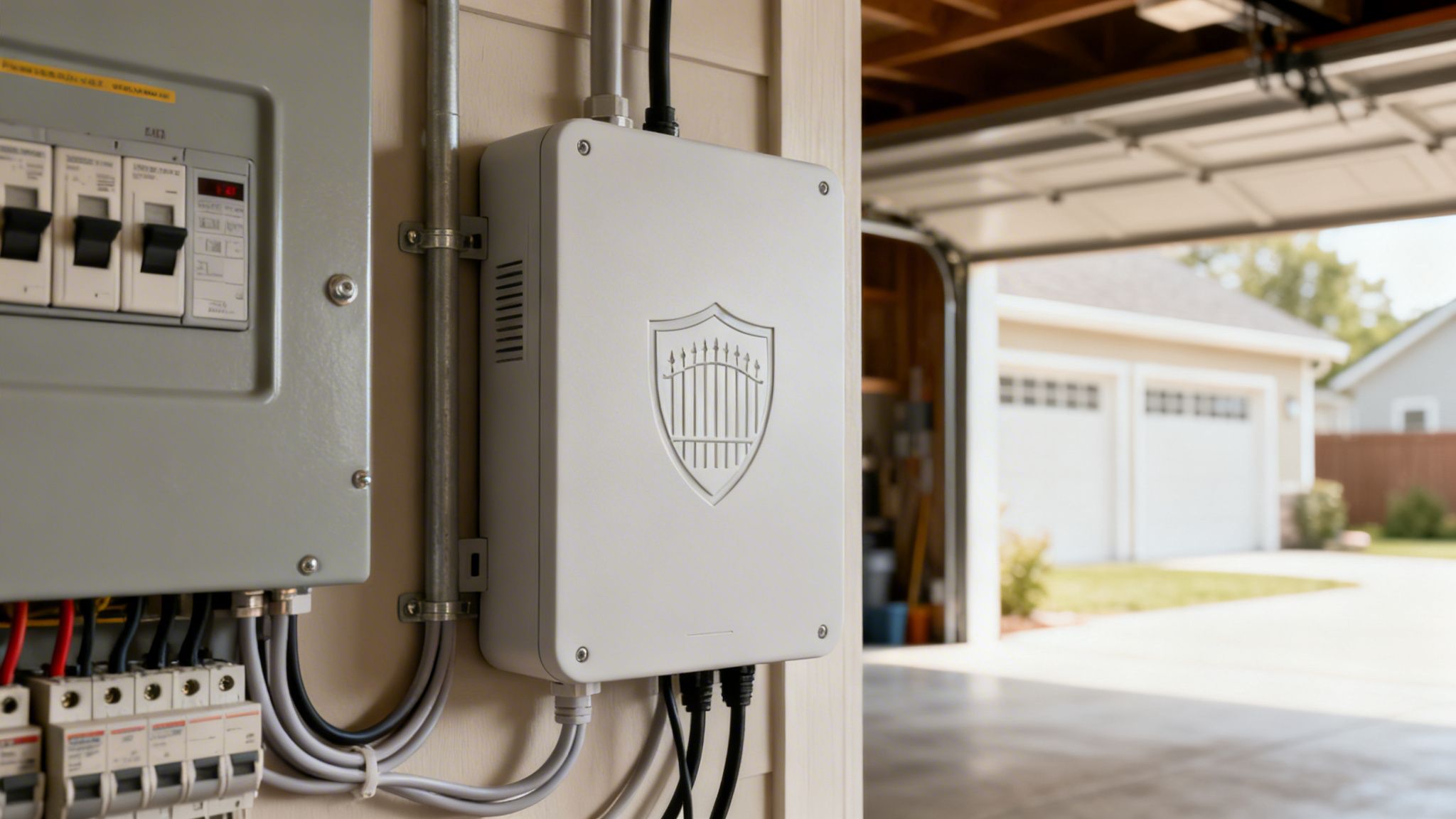
A whole-home surge protector, often called a Surge Protective Device or SPD by electricians, is a small box that gets hardwired right into your main electrical panel. Think of it as a central filtration system for all the electricity your home uses. Its primary job is to ensure that only clean, stable power makes it past the panel and into your home's circuits.
When a massive, unexpected voltage spike hits—whether from a nearby lightning strike, routine grid adjustments by the power company, or even just your own AC unit kicking on—the surge protector reacts in nanoseconds. It instantly creates a safe escape route, shunting all that excess, damaging energy directly into your home's grounding system. The harmful voltage is harmlessly discharged into the earth, neutralizing the threat before it can fry the delicate circuit boards in your TV, computer, or smart appliances.
It's Not a Circuit Breaker
It’s easy to get surge protectors and circuit breakers mixed up, since they both live in or around your electrical panel. But they have completely different jobs, and understanding the distinction is crucial for home safety.
The table below breaks down the unique role each device plays in protecting your home.
| Feature | Whole Home Surge Protector | Circuit Breaker |
|---|---|---|
| Primary Function | Guards against overvoltage (voltage spikes). | Protects against overcurrent (too much amperage). |
| Protects | Sensitive electronics and appliances. | House wiring and prevents electrical fires. |
| Trigger | Sudden, high-voltage events (e.g., lightning). | Sustained high electrical load or a short circuit. |
| Result | Diverts excess voltage to the ground. | "Trips" and shuts off power to a circuit completely. |
Essentially, a circuit breaker is there to stop a fire when you plug too many things into one outlet. A surge protector is there to stop your expensive electronics from getting fried by unstable power.
A power surge won't trip a breaker. Without a dedicated SPD, your devices are left completely exposed.
Why This Centralized Protection Matters
Our homes in 2026 are packed with more microchips than ever before. It's not just computers and TVs anymore; your refrigerator, washing machine, HVAC system, and even your LED lightbulbs all have sensitive electronic components. A whole-home unit is the only way to realistically protect everything.
- Total Home Coverage: It shields every single outlet and hardwired appliance in your house. You can't plug your furnace, dishwasher, or EV charger into a power strip, but a whole-home unit protects them all.
- Defense Against All Threats: It protects you from the big, dramatic surges from outside and also the smaller, more frequent "internal" surges that slowly degrade your electronics over time.
- Peace of Mind: You get constant, silent protection for the technology you rely on every single day. It’s a set-it-and-forget-it solution.
By installing this one robust device at the source, you're creating a powerful electrical shield that defends your investments and keeps your modern home running safely and smoothly.
The Science of How a Surge Protector Works
Think of a whole-home surge protector as a lightning-fast security guard for your electrical system. Under normal circumstances, it just sits quietly at your main panel, letting the standard 120 volts of power flow uninterrupted to all the circuits in your home. It’s completely passive.
But the moment an abnormally high voltage—a power surge—hits your line, that guard springs into action. In less than a nanosecond, it instantly diverts the dangerous electrical spike away from your sensitive electronics and safely into your home's grounding system. This all happens before your devices even know what hit them.
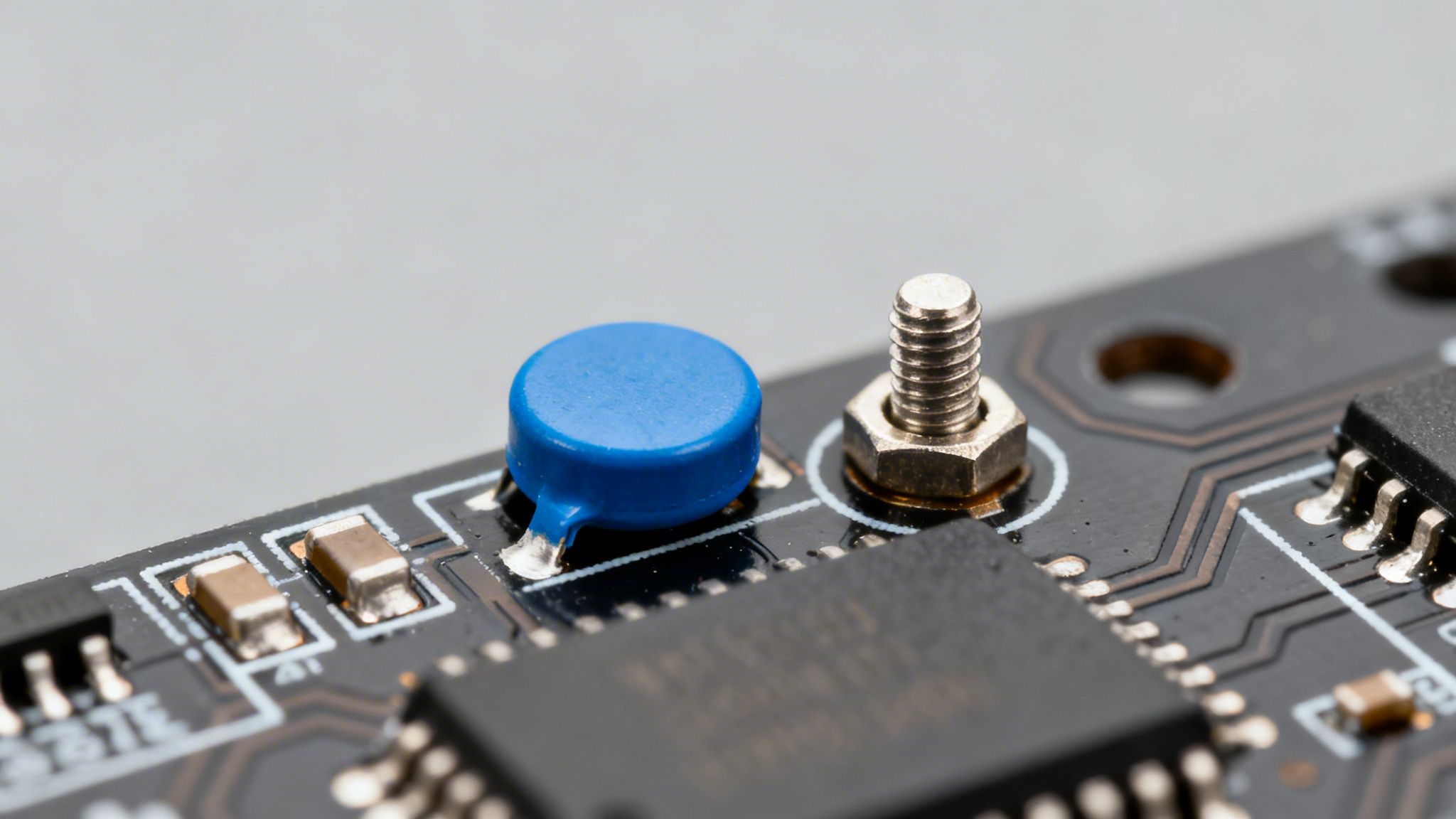
The real workhorse inside these units is a component called a Metal Oxide Varistor, or MOV. These are the unsung heroes of surge protection.
The Role of the Metal Oxide Varistor (MOV)
An MOV is a special kind of resistor whose behavior changes based on voltage. At normal voltage levels, its resistance is incredibly high. It essentially acts like a closed gate, forcing all the electricity to follow its proper path into your home's circuits.
When the voltage spikes past a certain point, however, the MOV's resistance instantly drops to almost zero. It becomes an open gate, creating an easy, low-resistance path for the surge to follow. Electricity always takes the path of least resistance, so the massive surge current floods through the MOV and straight to the ground wire, bypassing your home's wiring entirely.
Think of it like this: Imagine a dam with a huge spillway. The spillway gates are the MOVs. As long as the reservoir's water level (your voltage) is normal, the gates stay shut. But if a flash flood (a power surge) raises the water to a dangerous level, the gates automatically swing open, safely channeling the excess water down the spillway (your ground wire) to prevent the dam from breaking.
Once the surge passes and the voltage level returns to normal, the MOV’s resistance shoots back up, effectively closing the gate. The whole system goes back to its quiet, watchful state. It's this incredible speed that makes a whole-home unit so effective against powerful threats, protecting your entire home as a critical part of your electrical distribution systems.
Understanding Key Surge Protector Specs
When you start looking at different models, you’ll see a few technical specs. These aren't just marketing fluff; they tell you exactly how well a device will perform its job. The two most important numbers to know are the clamping voltage and the joule rating.
Clamping Voltage (VPR): This tells you how high the voltage has to get before the MOV "opens the gate" and starts diverting power. A lower clamping voltage is better because it means the protector activates sooner, letting less of the surge through to your electronics. Good whole-home units typically clamp between 400 and 600 volts.
Joule Rating: This is a measure of how much total energy the surge protector can absorb over its lifetime before its components wear out. A higher joule rating is better, as it indicates a more durable device that can handle larger or more frequent surges before it needs to be replaced.
These specs are put to the ultimate test during severe weather. A single lightning bolt can carry up to 1 billion volts of electricity. With Florida accounting for roughly 25% of the 20 million cloud-to-ground lightning strikes in the U.S. during 2023, having robust protection is non-negotiable.
A well-chosen surge protector with a low clamping voltage and a high joule rating can take that immense energy and shunt it directly to ground before it ever gets a chance to fry a single device in your home.
Decoding External Threats and Internal Dangers
When you hear “power surge,” what’s the first thing that comes to mind? For most people, it’s a massive lightning strike, the kind you see in the movies. While those spectacular, high-energy events are definitely a real threat, they’re only part of the picture. The far more common danger is the one being generated inside your own home, over and over, all day long.
To really understand the value of a whole-home surge protector, you have to know about both external and internal surges. It’s not just a shield against lightning; think of it more like a full-time electrical filter, constantly working to protect the sensitive technology you depend on every day.
The Obvious Threat: External Surges
External surges are the heavy hitters. They originate outside your house and hit with incredible force, capable of causing immediate, catastrophic damage to anything plugged in. If one of these gets past your defenses, it can instantly fry circuit boards, melt wiring, and turn expensive appliances into doorstops.
So, where do these big, dramatic voltage spikes come from?
- Lightning Strikes: A nearby or direct hit can inject millions of volts into the power grid or even straight into your home’s electrical system. It's the most powerful and destructive type of surge.
- Utility Grid Switching: Your power company is constantly balancing the grid, and that process can send brief but powerful surges down the line and right into your house.
- Downed Power Lines: Whether from a storm or a car accident, fallen power lines create massive instability in the system, sending dangerous, unpredictable voltage spikes into nearby homes.
These events are rare, but the damage they cause is anything but minor. A whole-home surge protector acts as your first and best line of defense, like a pressure-relief valve that instantly diverts that massive electrical flood safely into the ground.
The Hidden Danger: Internal Surges
While external surges get all the headlines, the real silent killer for your electronics is lurking inside your own walls. In fact, more than 80% of all power surges are internal. They're created every time a large appliance cycles on or off. That jolt you feel when the AC compressor kicks on? Or the refrigerator starting its cooling cycle? Each one creates a small but meaningful voltage spike.
On their own, these “micro-surges” don't seem like much. But their cumulative effect is like a slow-acting poison for your electronics. Each little spike puts a tiny bit of stress on delicate microprocessors and circuit boards. Over time, this constant electrical wear-and-tear degrades the components, leading to glitches, malfunctions, and eventually, total failure.
This is exactly why a perfectly good TV or computer sometimes just dies for "no reason" after a few years. It wasn't one big knockout punch; it was death by a thousand tiny surges. This relentless internal activity is what quietly shortens the lifespan of almost every modern device you own.
This hidden danger is everywhere. It’s not just your own appliances. A nearby business like a Jupiter warehouse cycling industrial equipment or even grid fluctuations from Palm Beach County's growing solar farms can send hundreds of these micro-surges into your home—up to 100 per day in some areas. A whole-home unit from Lighthouse Energy Services installed at your panel works like a vigilant gatekeeper, filtering out this constant electrical "noise." This simple act can prevent the cumulative damage that often shortens an appliance's life by 20-30%. You can explore the technical details of how these devices work over at DITEK.
The Dual Role of a Whole-Home SPD
This is where you see the true genius of a whole-home surge protection device (SPD). It’s not doing one job; it's doing two critical ones at the same time.
- Catastrophic Event Protection: It's always on guard, ready to block the massive, high-energy surge from a lightning strike or grid failure.
- Continuous Power Filtration: It's also actively cleaning up the constant stream of small, internal surges, protecting your devices from a slow death.
By tackling both threats, a whole-home SPD does more than just prevent a disaster. It actively extends the functional life of your investments—your smart TV, computer, HVAC system, and high-efficiency appliances all run on the stable, clean power they were designed for. That saves you a lot of money and headaches on premature repairs and replacements down the road.
Layering Your Defenses: A Fortress for Your Home’s Electrical System
When it comes to protecting your home's electronics, one single device just won't cut it. True electrical safety comes from a strategic, layered approach—what we in the industry call cascading protection. It's the most effective way to shield your home from damaging power surges.
Think of it like defending a castle. You have your high outer walls for big threats, the inner walls for anything that gets past, and finally, the guards at the most sensitive locations. In your home, this system works with your existing circuit breakers to create a complete defense.
Different types of Surge Protective Devices (SPDs) are placed at key points, working together to defend against surges from both outside and inside your home.
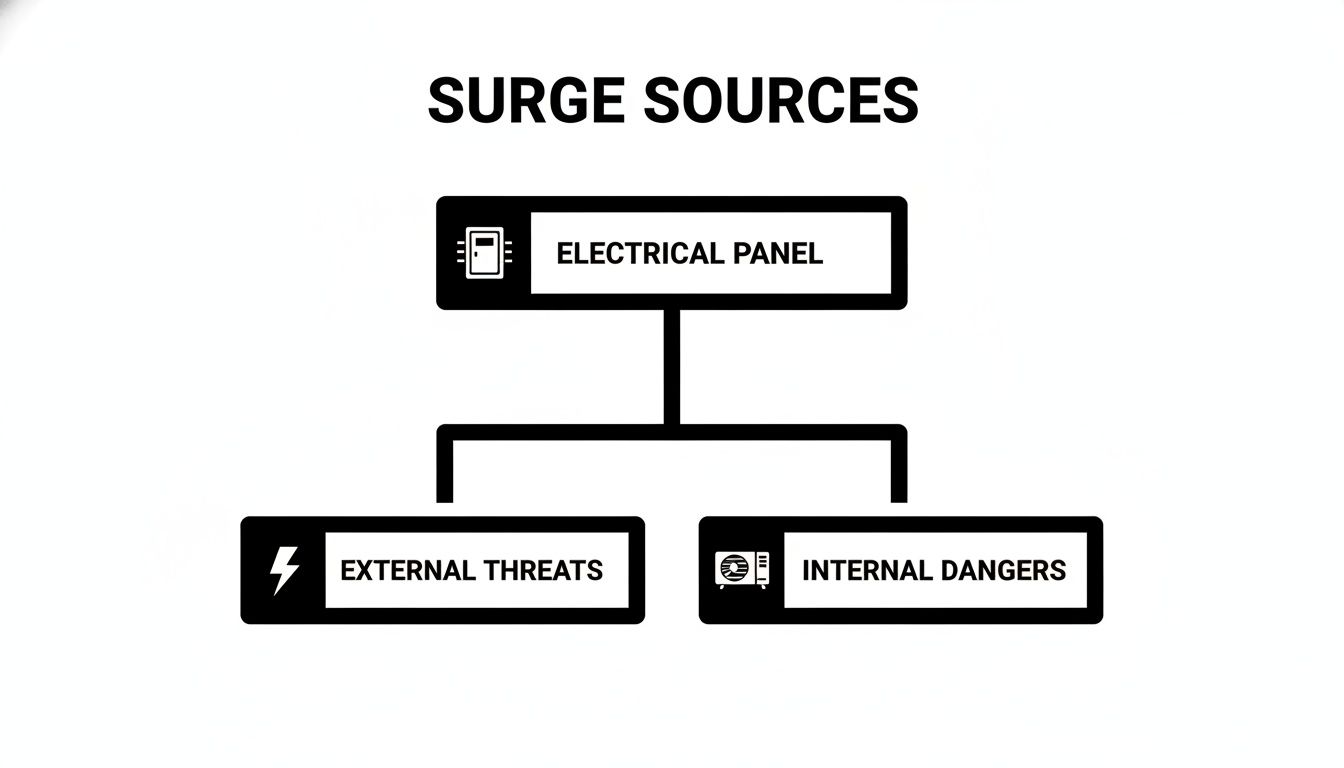
As you can see, the threats are coming from everywhere. A layered system is the only way to be truly prepared.
The First Line of Defense: Your Whole-Home SPD
Your primary shield is the whole-home surge protector installed right at your main electrical panel. This is your "outer wall," and it’s usually either a Type 1 or Type 2 SPD.
- Type 1 SPDs: These are the heavy-hitters. Installed at the service entrance (often before the main breaker), they’re built to stop massive external surges from things like lightning strikes or major utility grid issues.
- Type 2 SPDs: This is the most common type we install in homes. It sits on the "load side" of your main breaker, meaning it protects every circuit in your house from both external surges and the smaller, more frequent internal surges created by your own appliances.
This main unit does the heavy lifting, absorbing and diverting the vast majority of a surge's power before it ever gets a chance to spread through your home's wiring.
A layered approach isn't just a good idea—it's now the standard. The 2020 National Electrical Code (NEC) made Type 1 or Type 2 SPDs a requirement for all new home construction, a clear sign of how crucial this first line of defense has become.
The Second Line of Defense: Point-of-Use Protection
Even the best whole-home unit can't stop 100% of a surge. A tiny amount of leftover voltage—what we call "let-through voltage"—can sometimes sneak past. While it's a fraction of the original surge, it can still be enough to degrade and eventually destroy highly sensitive electronics.
This is where your second layer comes in: the Type 3 SPD.
You probably already own several of these. A Type 3 SPD is simply a point-of-use surge protector, like the power strip your computer or TV is plugged into. Their job is to be the final "cleanup crew," neutralizing that last bit of residual voltage.
This combination is absolutely critical. By 2026, the average American home is expected to have over 25 sensitive electronic devices—a 50% jump from 2015. Here in Florida, where we see over 1.2 million lightning strikes a year, a professionally installed whole-home unit is a must. The systems we install at Lighthouse Energy Services can handle enormous 80,000-amp surges, something a simple power strip can't even dream of. While a whole-home unit can absorb 40,000+ joules of energy, a cheap strip might only handle 80 joules before failing.
It’s a classic "belt and suspenders" strategy. Your Type 2 SPD at the panel stops the big hit, and your Type 3 SPDs at the outlets clean up anything left over. This two-part system ensures your most valuable and delicate electronics get the clean, stable power they need to last, making it one of the smartest electrical upgrades for your home.
The Installation Process: What to Expect on Service Day
Having an electrician work inside your main electrical panel might sound like a big deal, but installing a whole-home surge protector is a surprisingly quick and clean job. In the hands of a Lighthouse Energy Services pro, the entire process is usually wrapped up in under an hour.
It's a focused, routine procedure for us, designed to seamlessly integrate this vital shield into the heart of your home’s electrical system. Here’s a look at exactly what happens on service day, step-by-step.
Initial Panel Assessment
Before we touch a single wire, the first job is a quick but crucial check-up on your main electrical panel. We’re not just looking for a spot to stick the new device; we’re confirming the foundation of your system is solid.
This brief inspection covers:
- Available Space: Your technician will confirm there’s a physical spot to mount the surge protector and an open, dedicated two-pole breaker space.
- Panel Condition: We'll scan for any signs of corrosion, burnt connections, or outdated components that could be a safety risk or hinder the new device.
- Grounding Verification: Most importantly, we verify your home has a proper, effective grounding system. This is the "escape route" the surge protector needs to do its job.
This initial check is all about ensuring the installation will be safe, up to code, and ready to offer maximum protection from the moment it's powered on.
The Wiring and Grounding Connection
With the assessment done, the actual installation begins. We’ll need to turn off the main power to your home for a short time for safety. Then, we get to work creating a solid, reliable connection between the surge protector, your panel’s main power lines, and the grounding system.
The ground wire is the single most important part of this entire system. A whole-home surge protector is useless without a proper path to dissipate excess voltage. Think of it as an emergency exit—if the door is blocked, no one can get out. Our licensed electricians ensure that this pathway is clear and secure.
The technician will wire the surge protector directly to a new two-pole circuit breaker inside the panel. The black and red wires from the Surge Protective Device (SPD) connect to this breaker, while its white (neutral) and green (ground) wires are tied into their respective bus bars. This direct connection is the secret to its effectiveness, placing it right at the front door to monitor all incoming electricity.
To learn more about what to look for in a professional electrical partner, take a look at our residential electrical contractors guide.
Final Verification and Power-Up
Once the device is mounted and every wire is double-checked for a tight, correct connection, your electrician will restore power to the house. Now for the satisfying part: watching the device’s status lights blink on.
Most whole-home surge protectors use simple LED lights to give you an at-a-glance status report:
- Green Light: This means the unit is powered on and all its protective components are standing guard. You are fully protected.
- Red or No Light: This indicates the unit has done its job and sacrificed itself to stop a major surge. Its protective elements are spent, and it now needs to be replaced to restore protection.
Your electrician will confirm the lights are working as they should and answer any final questions. Just like that, your home is officially shielded from destructive power surges.
Frequently Asked Questions About Whole Home Surge Protection
Even after digging into the technical side of things, it’s completely normal to have some practical questions. We get them all the time. Here are straightforward answers to the most common things homeowners ask, helping you decide if this is the right move for your home.
Will a Whole Home Surge Protector Lower My Electric Bill?
Not directly, no. A whole-home surge protector’s job is purely defensive—it’s not designed to manage or reduce your energy consumption. Think of it as a security guard, not an accountant.
However, it absolutely saves you money in the long run. By blocking the thousands of tiny, unseen micro-surges that hit your home's wiring every year, it dramatically extends the life of your appliances. That means fewer surprise repair bills and a longer wait before you have to replace that expensive refrigerator, HVAC unit, or home computer.
For homeowners looking to tackle both protection and efficiency, we often pair a surge protector with other energy-saving systems. This gives you a complete solution.
Is This a One-Time Purchase, or Does It Wear Out?
It definitely wears out. Think of your surge protector like a bodyguard that takes a hit for you. The internal components, called MOVs (Metal Oxide Varistors), absorb the damaging energy from surges, and each one takes a small toll.
A huge surge, like from a nearby lightning strike, could use up all its protective capacity in a single, self-sacrificing moment. More commonly, it’s the constant barrage of thousands of smaller, internal surges over many years that gradually wears it down. It's not a "set it and forget it forever" device.
Most quality units come with a simple status light. If the light is green, your shield is up and you're protected. If that light turns red or goes out completely, the device has done its job and is spent. It's time for a replacement.
We also recommend a professional check-up every few years, especially if you’ve had a major electrical storm in your area, just to be sure everything is still in top shape.
Can a Surge Protector Be Installed in an Older Home?
Absolutely. In fact, older homes are often the perfect candidates for a whole-home surge protector. Their wiring wasn't designed for the demands of today’s countless electronics and can be more susceptible to stress from power fluctuations. A surge protector acts as a vital modern safeguard.
A licensed electrician will always start by inspecting your main electrical panel. They’ll check its condition and make sure there's enough physical space. Occasionally, a small panel tune-up is needed to get everything safe, up to code, and ready for the installation to be truly effective.
No matter the age of your home, professional installation is non-negotiable to ensure everything is wired correctly and safely.
Do I Still Need Power Strips with a Whole-Home System?
Yes, you do! Using both is the best practice in the industry, something we call layered protection. It creates a two-tiered defense that provides the most complete safety net for your most sensitive and expensive electronics.
Here’s how it works:
- The Whole-Home Unit (Layer 1): This is your frontline defense at the main panel. It stops the big, powerful surges from ever getting inside your house, taking the brunt of the impact.
- The Point-of-Use Strip (Layer 2): Any small amount of excess voltage that "leaks" past the main unit is then caught by a quality surge-protecting power strip at your desk or entertainment center. It acts as a final cleanup crew.
This one-two punch is the best way to defend valuable gear like computers, high-end TVs, and sound systems from any and all electrical threats.
Protecting your home is more than just a good idea; it's a critical step in preserving the technology you rely on every day. If you have more questions or are ready to secure your home's electrical system, the experts at Lighthouse Energy Services are available 24/7. Contact us today for a professional assessment.