
A simple outlet replacement in Palm Beach County can run about $165, while a 100A-to-200A panel upgrade averages $3,200. The actual electrical installation cost depends less on the device itself and more on access, distance, and load, because those are the things that turn a small job into a bigger one.
If you're standing in the kitchen trying to figure out what a charger, fan, or new circuit should cost, that's the right place to start. The number on the device is rarely the full price. The panel location, the route to the load, and whether the existing system can carry the demand usually matter more.
Table of Contents
- Why One Outlet Is Never Just One Outlet
- The Five Cost Drivers Behind Every Electrical Estimate
- Real Price Ranges for Common Residential Electrical Work
- Commercial and Industrial Pricing by Building Type
- Hidden Line Items That Move Palm Beach Quotes by Thousands
- Why the Cheapest Quote Often Becomes the Most Expensive Job
- A Simple Estimator You Can Use Before Calling a Contractor
- Choosing the Right Electrician and Lowering Your Long-Term Bill
Why One Outlet Is Never Just One Outlet
A homeowner in Palm Beach calls and asks for a price on one 220V outlet for an EV charger. On paper, that sounds like a small job. In the field, the answer depends on whether the panel has room, how far the run is, whether the route is easy to access, and whether the installation needs permitting or inspection. A job like that can stay in the low hundreds if the conditions are simple, or climb fast when the panel is full and the wiring has to travel through finished space. That is the shape of electrical installation cost in this market.
The device itself is only the starting point.
Most homeowners hear one number and expect one fixed price. That is rarely how the work pencils out. The first questions I ask at the kitchen table are the ones that move the bill. Where is the panel? How much room is left in it? How long is the run? Can we get to the path without opening up finished walls or ceilings?
Practical rule: if a quote does not mention the panel, the route, and the inspection path, it is not a real electrical estimate yet.
Palm Beach properties make that clear fast. Older homes, additions, detached garages, and guest spaces often turn a short device install into a longer wire run with tighter access. A simple receptacle can become a larger scope once you factor in wall repair, attic work, slab routing, or a panel that needs correction before the new circuit can be added.
Grounding work matters too. Details like ground wire pigtails and bonding are part of what keeps the install safe and code-compliant, especially when new devices tie into older systems that were not built for today's load demands.
That is why an outlet, a charger, or a new appliance circuit should be priced as a system, not as a single part. The device is the visible line item. The cost comes from the conditions around it, and those conditions decide whether the job stays simple or turns into a larger electrical upgrade.
The Five Cost Drivers Behind Every Electrical Estimate
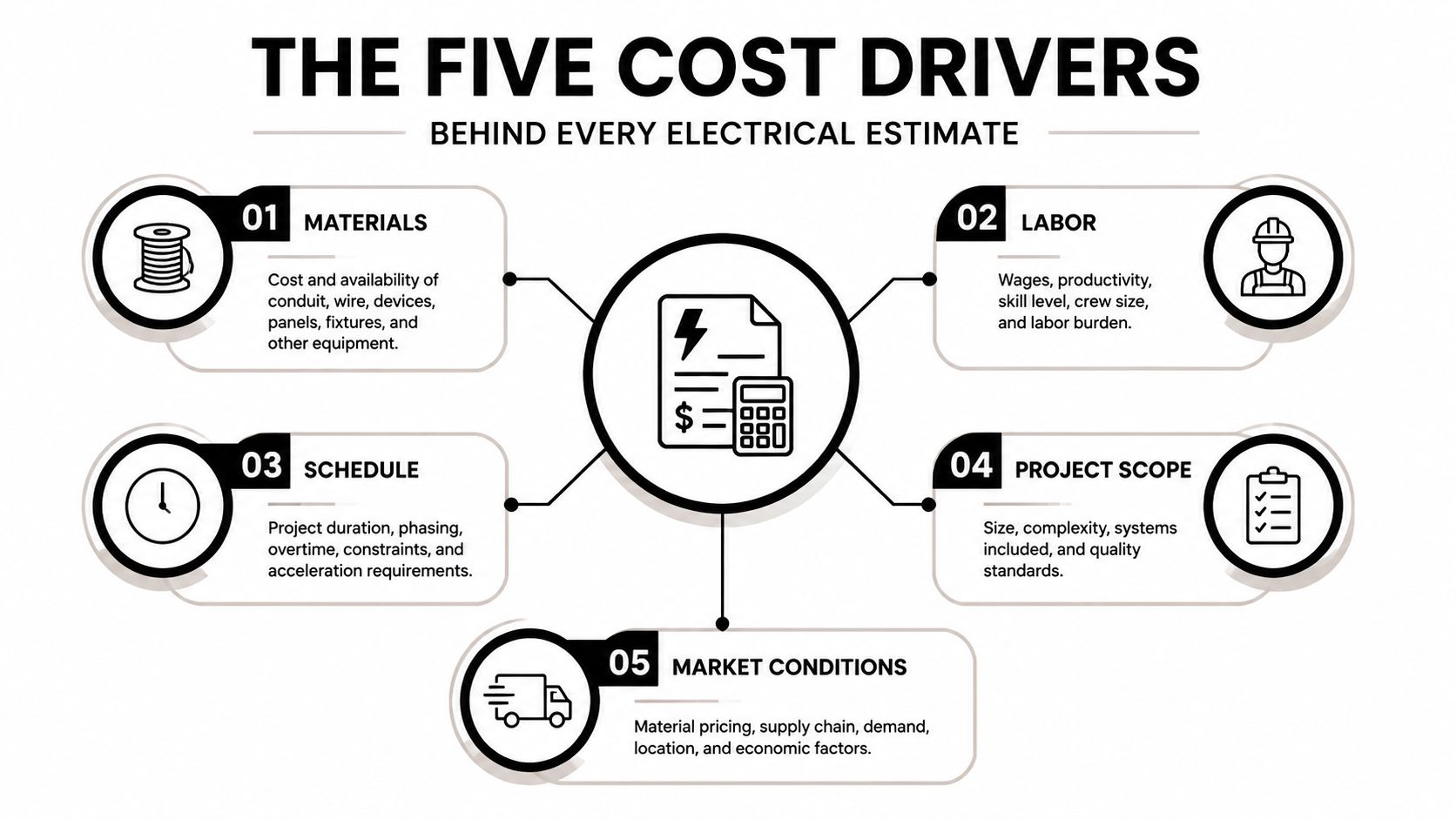
A solid estimate usually comes down to five things, and they show up on nearly every Palm Beach job. Labor hours come first, because the time it takes to get to the work often matters more than the part itself. Materials and wire runs follow, then permits and inspections, then site access, and finally timing, especially when the call is urgent or after hours. Each one can move the price in a different direction.
Labor, materials, and access work together
A Boca Raton condo retrofit can look simple from the hallway, but if the panel is buried behind cabinetry or the run has to snake through finished space, labor climbs fast. HomeGuide notes electrical wiring at $6 to $8 per linear foot for typical residential work, while rough-in labor commonly runs $50 to $130 per hour, so long or inaccessible runs can push cost faster than the wire itself. HomeGuide electrical wiring cost
In coastal homes, material choice can also move the number. Salt air, exposed outdoor equipment, and weather-prone locations often call for more durable components, and that raises the job cost even when the scope looks small on paper.
Permits, timing, and utility coordination
A West Palm Beach tenant improvement can get delayed by paperwork long before the first conduit is hung. A permit line item that looks minor can still change scheduling, inspection timing, and the sequence of work. That's why a quote should separate the physical installation from the administrative pieces.
Good estimating starts with access, not parts. If the electrician can't see the route, reach the panel easily, or confirm the utility coordination, the quote is only a placeholder.
The same logic applies to timing. When the service call is urgent, emergency or after-hours pricing can jump, and the contractor's response window becomes part of the value. The quote that seems slightly higher upfront is often the one that includes the full job.
Real Price Ranges for Common Residential Electrical Work
Palm Beach homeowners usually want one thing first, a realistic number they can use without guessing. The numbers below are a practical read on common residential electrical jobs, but the high end usually shows up when access is tight, the run is long, or the work reaches into the panel or service equipment. In this market, panel capacity, distance, and access drive the bill more than the device itself.
| Typical Palm Beach County Residential Electrical Installation Cost Ranges | ||
|---|---|---|
| Job | Typical Price Range | What Drives the High End |
| Outlet replacement | $165 | Tight access, damaged box, added troubleshooting |
| New 20-amp circuit | $425 | Long run, finished walls, panel distance |
| 220V outlet for EV charger or dryer | $975 | Panel work, longer run, permit and inspection |
| 100A-to-200A panel upgrade | $3,200 | Utility coordination, meter work, code corrections |
| Whole-house rewire, 1,800 sq ft home | $12,500 to $18,500 | Finished interiors, plaster or drywall restoration, permit scope |
What these numbers leave in and out
The low end usually covers a straightforward swap where the existing infrastructure is ready and the route is open. The higher end appears when the job includes access problems, old wiring, service corrections, or extra circuit work that the homeowner did not see from the outside. A whole-house rewire is the clearest example, because labor, permits, and scope turn that project into a serious expense quickly. The $12,500 average and the $18,500 upper range reflect that reality, and the same kind of labor-heavy pricing shows up in other electrical work discussions, including HomeFixx cost to install electric.
A panel conversation should happen early. If the service cannot support the new load, the device install stops being a simple device install and becomes an upgrade project first.
A note on load-driven upgrades
EV charging, dryers, and backup power setups often force the issue. A quote is only honest if it says whether the panel can take the new circuit as-is or whether the home needs upstream work first. That is the point where the price stops looking like a small add-on and starts looking like a system upgrade.
Palm Beach homes are also getting more electrified, so this question comes up more often than it used to. Induction cooking, heat pump equipment, and EV chargers all ask more from the service than a basic outlet swap does. A contractor should spell out whether the existing panel has room, whether the new run crosses finished space, and whether the meter or utility side needs attention before the work can pass inspection. That is where Lighthouse Energy Services commercial electrical installation projects and residential upgrades share the same rule, the estimate has to follow the actual electrical path, not just the device on the wall.
Commercial and Industrial Pricing by Building Type
Commercial work does not price like residential work. A warehouse, office, and multi-tenant property can have the same square footage and still fall into very different pricing bands because the cost comes from distribution, metering, access, and special loads. A practical commercial electrical installation guide should make that clear before anyone signs a bid. One industry estimator places warehouse fit-outs at $4 to $9 per sq ft, office buildouts at $6 to $12 per sq ft, and multi-tenant facilities at $7 to $14 per sq ft, with regional labor rates ranging from $75 to $135 per hour across the South to West Coast.
Why the building type matters
A warehouse can look simpler because it is open, but the work can still include special circuits, service distribution, and planning for future use. Office buildouts usually bring more branch circuits, more coordination with finishes, and more tenant expectations around timing and clean installation. Multi-tenant facilities add metering, panelization, and code-driven separation that can expand the scope fast.
A quote that looks high on a spreadsheet may be the correct one if it covers the entire electrical architecture. That becomes even more true when the building needs 3-phase loads, dedicated equipment circuits, or flexibility for tenant changes later. In Palm Beach, where property owners are adding EV charging, backup power, and higher-demand equipment, the estimate has to reflect the service path, not just the devices on the wall.
What property managers should listen for
A good commercial estimate should explain what is included in the distribution path and what is still open. If the scope mentions only devices and not service capacity, the number is probably incomplete. The cost question is often not, “How many fixtures?”, but, “How much infrastructure has to be built to support the property?”
A fair commercial bid does not win by being the cheapest line. It wins by matching the building's actual electrical load and use case.
Property managers should listen for direct answers about panel capacity, feeder routing, meter work, and how much access the crew has to the electrical spaces. Tight mechanical rooms, occupied suites, and finished common areas all add labor because they slow the work and limit shortcuts. If a contractor cannot explain those trade-offs plainly, the quote is leaving something out.
Hidden Line Items That Move Palm Beach Quotes by Thousands
Palm Beach jobs often get more expensive because of geography and site conditions, not because of the device itself. Underground routing is a good example. Independent cost guides show underground service commonly running about $10 to $25 per foot, trenching adding $5 to $12 per linear foot, and a 500-foot run reaching $5,000 to $12,500. Another guide notes residential underground service can start around $1,500 to $10,000 and exceed $20,000 for larger or more complex jobs. Lehmann Electrical underground electrical service costs
Distance and ground conditions change everything
A detached garage, guesthouse, pool equipment pad, or remote meter point can turn a short-looking request into a long run. Once trenching enters the job, the bill starts tracking soil conditions, route length, and restoration work. The quote may still be accurate, but it won't be cheap.
Slab-on-grade construction creates its own challenge. When the electrician can't run easily through attic or basement space, the path often shifts to surface-mounted conduit or more difficult routing, and that adds labor. In coastal properties, underground work can also require more coordination and better planning because the route and the restoration are part of the finished job.
The hidden part is often the coordination
If the service upgrade needs utility involvement, the schedule can stretch even when the physical install itself is straightforward. That coordination doesn't show up in a glossy device quote, but it affects the total cost and the timeline. The same is true when permits, inspections, or code correction work gets folded in.
Palm Beach owners who want to sanity-check a quote should ask three things. Where does the run start and end, what surface has to be opened or restored, and does the existing service need outside coordination? That one conversation usually exposes the line items that move a bid by thousands.
For a related compliance scenario, code violation correction electrician Florida is a useful internal reference when old work needs to be brought up to current standards before anything new can pass inspection.

Why the Cheapest Quote Often Becomes the Most Expensive Job
The lowest quote usually looks attractive because it compresses the job into the smallest possible number. The problem is that the cheapest number often leaves out permits, undersized wire, or the panel work needed to make the installation code-compliant. When the inspection fails, or when the homeowner later adds an EV charger or hot tub, the missing scope comes back as a redo.
What gets left out
A stripped-down bid may skip the permit entirely, which sounds cheaper until the work has to be reopened. It may also assume the existing panel has enough room when it doesn't. In either case, the project gets more expensive after the first visit, not less.
A better quote names the work accurately. If the installation needs a panel upgrade, the quote should say so. If the job depends on a longer run or on special materials for the environment, that should be visible in the estimate before anyone signs.
The right kind of urgency costs less than the wrong kind of cheap
After-hours and emergency calls can run time-and-a-half to double standard rates, so the price should reflect the time of day as well as the scope. A contractor who answers the phone at 2 a.m., shows up, and gives a clean, all-in number is often cheaper in the true sense than the headline-low bidder who keeps adding charges later.
That's why the quote needs to be read like a scope document, not a bargain tag. If it doesn't explain what's included, it probably doesn't include enough.
A Simple Estimator You Can Use Before Calling a Contractor
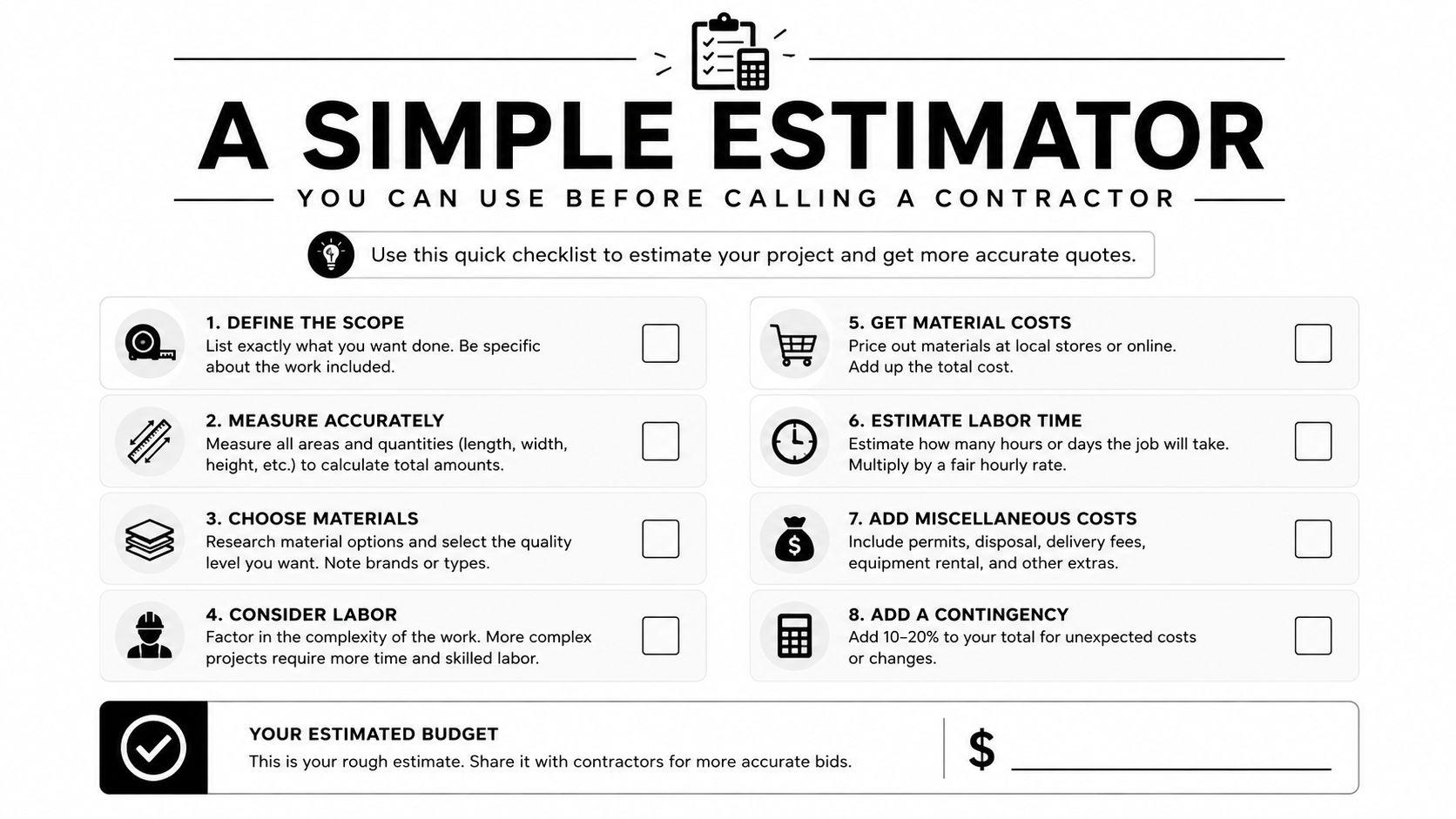
A homeowner in Palm Beach can save time on the first call by answering three things up front. What are you installing, how far is it from the panel, and does the panel still have room for the new load? Those answers usually narrow the electrical installation cost quickly, because they tell the electrician whether the job is a clean add-on, a longer circuit run, or a service upgrade before anything goes in.
Use this quick decision path
- Small device swap: If the wiring is already there and the work is a straight replacement, the price usually sits at the lower end.
- New run to an existing panel: If the electrician has to pull a new circuit or outlet a meaningful distance, labor starts to carry more weight.
- Load upgrade needed: If the panel cannot support the new equipment, the project often shifts into upgrade territory before the device itself is installed.
A Level 2 EV charger is a common example in South Florida. If the panel has spare capacity and the route is simple, the installation stays in the simpler range. If the panel is already full, the charger becomes a panel project first, and the cost rises because the upstream work is part of the job.
Budget rule: start with the load, then the route, then the access. If you start with the device, the estimate usually comes in too low.
That order matters in Palm Beach because houses, condos, and light commercial spaces vary a lot in layout, age, and service condition. A property owner who can describe the panel location, the approximate run distance, and the size of the load gives the contractor enough information to build a tighter quote and avoid surprise add-ons later. For a practical checklist on choosing the right help, how to find a good electrician is a useful starting point.
Choosing the Right Electrician and Lowering Your Long-Term Bill
A good electrical contractor should be licensed, clear in writing, and ready to explain exactly what the price includes. Ask for a written quote, check references, and confirm that the scope covers materials, permits, and inspections where they are required. If the answer stays vague, the final invoice usually does too.
What matters in practice
In South Florida, response time matters as much as technical skill when a home or property is down. Lighthouse Energy Services is one option for Palm Beach County owners who need residential, commercial, or industrial work, including 24/7 response, phones answered by licensed electrical professionals, transparent pricing, and aircraft obstruction lighting for rooftops and towers. For a practical checklist on choosing help, how to find a good electrician is a useful starting point.
Long-term operating cost matters too. Load efficiency can lower what a property spends month after month, especially in homes and buildings that are adding new electrical demand. Smartcool ECO3 is one device used to optimize air conditioners and can reduce electricity consumption by up to 25 percent, so it belongs in the conversation for owners trying to control ongoing bills. That kind of upgrade does not replace sound wiring or a properly sized panel, but it can help lower the monthly burden once the electrical side is in order.
The best long-term move is simple. Hire someone who scopes the job accurately, sizes the system correctly, and does not hide the costs that will show up later. For Palm Beach properties, that usually means choosing an electrician who looks at the panel, the route, and the access before the first quote is written.