
The most popular advice for finding an affordable electrician near me is also the advice that produces the biggest surprise bills. Get three bids, people say. Pick the lowest hourly rate. That sounds disciplined, but it only works if all three quotes cover the same work, use the same materials, and stop at the same finish line.
They rarely do. One bid includes diagnosis, a permit, the correct breaker, and testing after the repair. Another includes a cheap trip charge and a promise to figure out the rest on site. The second truck looks cheaper until the wall is open and you're approving extras one at a time with the power still off.
I would judge affordability by a different test. Can you read the written total before work starts, see what's excluded, and know exactly what triggers a change order. If a contractor can't put that in writing, you don't have a low price. You have an opening number.
That distinction matters in Palm Beach County, where humidity corrodes connections, older condos hide tired wiring behind finished walls, and an HOA access window can turn a simple job into two trips. A fair bill isn't the smallest number in an ad. It's the number that doesn't move.
Table of Contents
- What an Affordable Electrical Job Really Costs
- How to Hire a Licensed Electrician Near You
- When Waiting for a Cheaper Quote Is Unsafe
- Avoid a Cheap Install That Costs More Later
- Get a Written Quote from Lighthouse Energy
What an Affordable Electrical Job Really Costs
Start with the total, not the teaser. An hourly rate tells you nothing about diagnosis time, materials, permit fees, attic access, or whether nights and weekends cost more. Two electricians can quote the same labor rate and land hundreds apart because one priced the whole job and the other priced the first hour.
That anxiety is rational. A 2025 U.S. News survey found that 60% of homeowners rank unexpected repairs to essential systems, including electrical systems, among their top concerns. The fear isn't paying for work. It's not knowing what the work will cost until it's already underway.
Sample Totals for Common Palm Beach Electrical Jobs
Use the rows below as a filter, not a price list. Your electrician should be able to map any quote onto these categories and tell you, in writing, what's inside the total and what's still an allowance. If a bid can't be mapped, discard it and ask for one that can.
| Job | Often left out of a cheap quote | Firm price realistic? |
|---|---|---|
| Diagnostic service call | Diagnosis waived only if you accept unapproved repairs | Yes, after the visit |
| Outlet, switch, or GFCI replacement | Correct device type, box repair, permit if required | Usually yes |
| New dedicated circuit | Wire fishing, drywall patch, AFCI or GFCI breaker | Yes if the path is visible |
| Level 2 EV charger | Load calculation, panel space, long conduit | Only after a load check |
| After-hours emergency | Separate diagnosis, materials, and return trip | Only if the after-hours policy is written |
A like for like device swap is the easiest job to price firmly. The device is visible, the box is accessible, and the scope ends when the new outlet tests correctly. The price moves when the box is damaged, the conductors are short or heat damaged, or the location now needs a different type of protection than what's installed.
A new circuit, a 100-amp to 200-amp panel upgrade, or an EV charger is different. Nobody honest can firm price hidden damage, an overloaded panel, utility coordination, or a wire path through finished ceilings over the phone. Those jobs need an on-site diagnosis first, then a written allowance for the unknowns and written approval before anyone exceeds it.
Practical rule: A phone number is a range. An on-site diagnosis is what turns that range into a price you can hold someone to.
Why Palm Beach County Jobs Drift
Local conditions explain many change orders that look like upsells. Coastal humidity attacks panel lugs, exterior devices, and conduit fittings. Older condo buildings from Boca Raton through Jupiter may have aluminum branch circuits that need listed connectors and extra care at every termination, which adds labor a flat teaser rate never mentions.
Access costs money too. HOA work windows, elevator reservations, gate procedures, and attic runs in August heat all stretch a job that looked simple on paper. None of that justifies an open-ended bill. It justifies a quote that names access assumptions up front, the way you'd expect when you compare local plumbing repair prices and find wall opening and patching listed separately from the fixture work.
Before you approve anything, ask for five lines in writing. Diagnosis, labor, materials, permit and inspection, and testing, plus the after-hours rule. Our breakdown of how electrical repair costs are built walks through that structure in detail. A contractor who won't separate those lines is asking you to trust a lump sum, and lump sums are where surprise bills hide.
Compare the exclusions, not the headlines. The cheapest advertised rate that omits the permit, the breaker, and the return trip for inspection isn't cheaper. It's incomplete.
How to Hire a Licensed Electrician Near You
Hiring well is a sequence, and the order matters. Price comparison comes near the end, after you've confirmed the person can legally and safely do the work. If you start with price, you'll compare numbers that don't describe the same job.
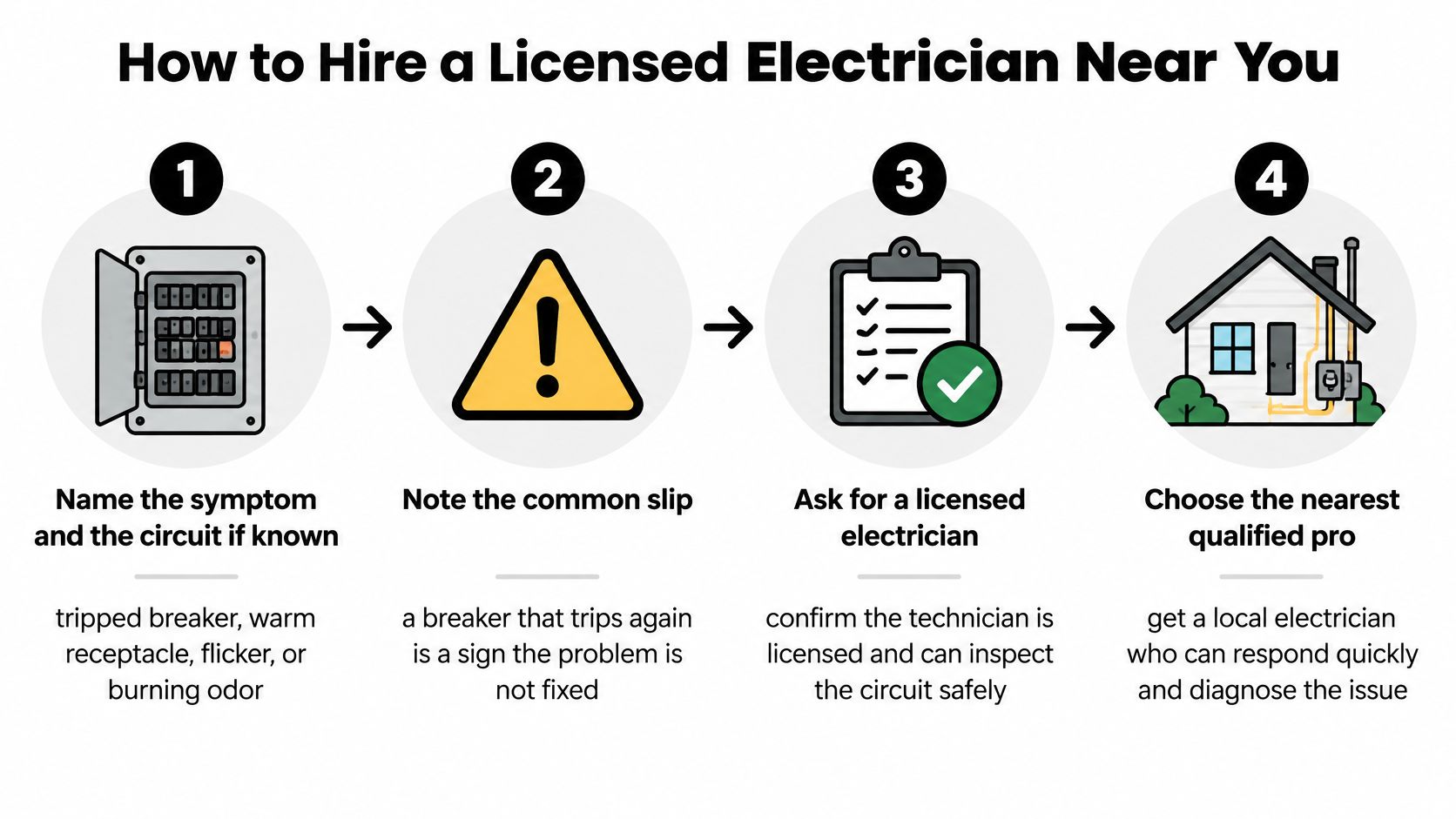
Seven Steps in the Right Order
Name the symptom and the circuit if you know it. Say tripped breaker, warm receptacle, flickering light, or burning odor, and note when it happens and what else was running. The common slip is describing the fix you assume you need, such as a new breaker, instead of the symptom. A breaker that trips again after reset is reporting a fault, not asking for a replacement.
Confirm the Florida electrical license and insurance before you share gate codes or access details. You want a Palm Beach County contractor whose phone is answered by someone who can discuss the work, not a call center reselling the lead. The slip here is checking reviews first and credentials never. Reviews tell you about manner. The license tells you who's legally responsible.
Ask how they'll make the circuit safe. The answer should include identifying the affected circuit, isolating or de-energizing it, verifying absence of voltage with properly rated test equipment, and checking for backfeed or induced voltage. Under OSHA standard 1910.333, qualified persons must test circuit elements and equipment to confirm de-energization, and only qualified persons may work on circuits that haven't been de-energized. If the answer is a shrug, end the call.
Require a written diagnostic scope. It should cover fault isolation, voltage verification, connection inspection, load assessment, the repair itself, and functional testing after power is restored. The slip is approving a parts swap with no testing. A new device on a loose termination fails the same way the old one did.
Match the license and experience to the job. House branch circuits, service equipment, commercial distribution, and industrial systems are different work. A handyman rate for panel or service work isn't a bargain, it's a mismatch. For commercial or multi-tenant properties, ask about experience with the equipment's nominal voltage too.
Collect two or three itemized quotes built on the same scope. Same diagnosis, same materials, same permit responsibility, same warranty terms, same after-hours rule. Our guide on how to find a good electrician covers the screening side of this in more depth. Quotes built on different scopes can't be compared, no matter how far apart the totals look.
Approve extras in writing before the work expands. If the cause turns out to be different once a device or panel is opened, you should get a revised price and approve it before drywall, panel, or device work proceeds. Keep the final invoice with the permit paperwork. That packet is what an insurer, a buyer, or the next electrician will ask for.
The Phone Script
You don't need electrical training to run this call. You need seven answers.
- Who holds the license, and who will be on site. The name on the license and the person holding the meter should connect.
- Are you insured for this property type. A single family home, a condo tower, and a warehouse aren't the same risk.
- Is diagnosis included, credited toward the repair, or billed either way. Any of the three can be fair. Not knowing which one you agreed to is the problem.
- Who pulls the permit and meets the inspector. If the answer is you, the quote just got more expensive in time.
- Does the warranty cover labor, devices, or both. A parts-only warranty on a labor-heavy job protects very little.
- Do nights, weekends, and holidays carry surcharges. Get the rule while it's still hypothetical.
- Will you stop for written approval if the cause differs from the symptom. This one question prevents most disputed invoices.
Property managers should add three more. Ask about nominal voltage experience, tenant access coordination, and whether the quote covers one unit or the house panel. The same vetting logic applies when facility teams vet local boiler installers for mechanical work. Credentials first, scope second, price last.
Red Flags and Safer Replacements
Cash only with no invoice should become an itemized invoice or no deal. One lump sum should become line items you can compare. Unlicensed helpers testing live equipment should become a licensed lead on site. Pressure to skip a permit should become permit confirmation in writing, and a vague after-hours promise should become a written rate.
A circuit protective device must not be manually re-energized until the equipment and circuit are determined safe.
That principle is the whole hiring test in one line. The success metric isn't same-day arrival. It's documented isolation, a named cause, a verified repair, and no repeat trip after the power comes back on. Any electrician who describes success that way is worth comparing on price. Anyone who leads with price and can't describe the process hasn't earned the comparison yet.
When Waiting for a Cheaper Quote Is Unsafe
Some symptoms end the price hunt. A burning smell, scorched or discolored outlets, a breaker that won't stay on, buzzing or heat at the panel, water in electrical equipment after a storm, or partial power loss that suggests a loose service neutral aren't annoyances to schedule around. They're faults, and shopping for three bids while they sit energized is how small jobs become fire calls.
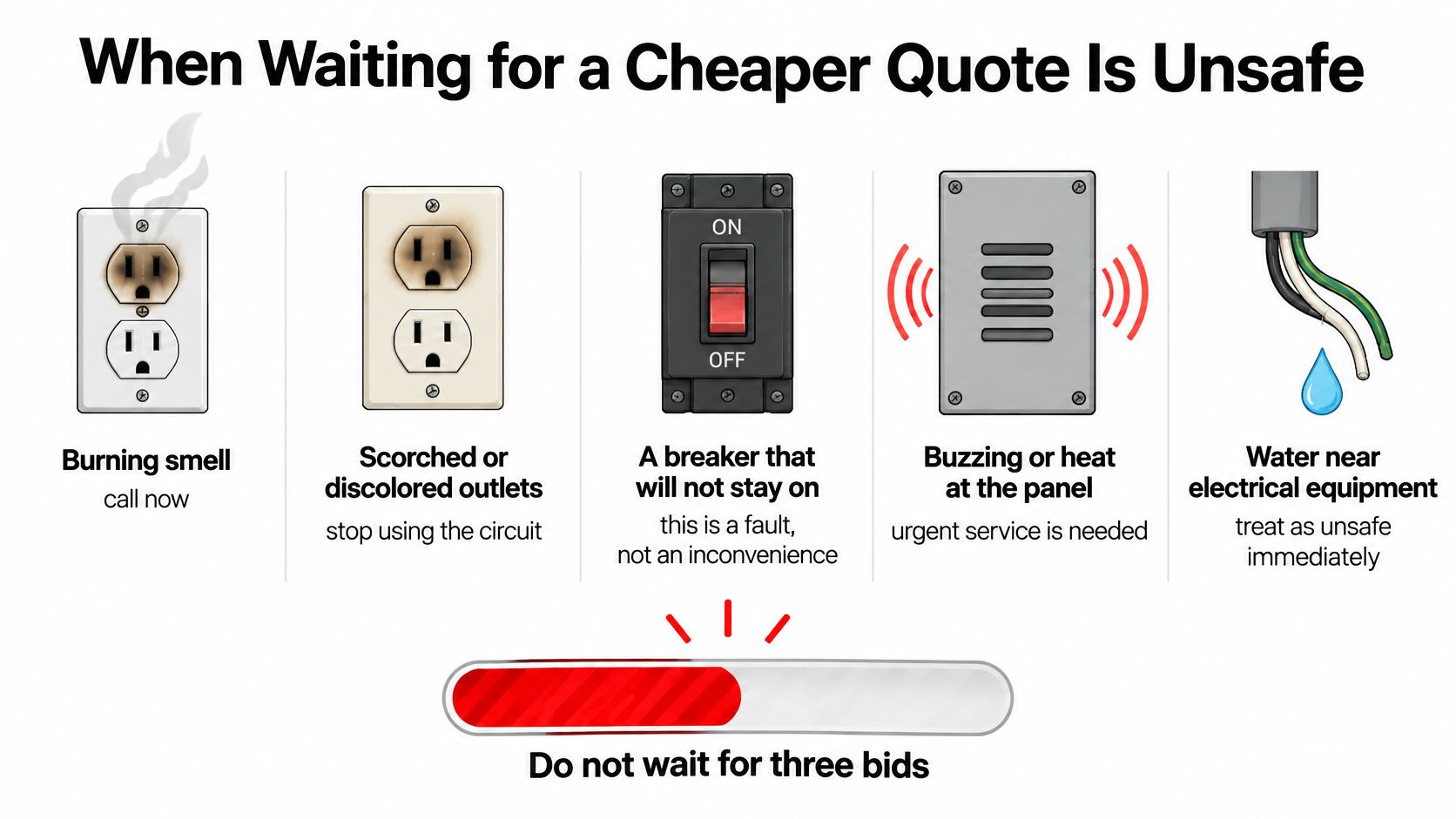
These aren't reset and hope problems. A protective device that keeps operating may be responding to overload, a short circuit, a loose termination, or damaged insulation. Re-energizing the circuit before it's proven safe feeds power back into exactly the condition the device is trying to interrupt.
The scale of that risk is not abstract. The National Fire Protection Association estimated that U.S. fire departments responded to an annual average of 46,652 home electrical structure fires during 2020 to 2024, causing an estimated average of 527 civilian deaths, 1,580 civilian injuries, and $2.4 billion in direct property damage each year, with the count still at 48,757 in 2024. Modern devices haven't made the problem disappear.
What You Can Safely Do While Waiting
Your job is limited, and that's deliberate. Leave the affected breaker off. Unplug what you can reach without touching a warm or discolored device. Keep people away from standing water near outlets or equipment, and leave the panel closed rather than investigating inside it.
- Breaker off, hands off. Don't keep resetting to test whether it holds.
- Unplug from a safe distance. If the plug or faceplate is warm, leave it alone.
- Keep water and people apart. Wet floors near electrical equipment are a shock path.
- Note the details. Which rooms lost power, what was running, and when it started will shorten the diagnosis.
A same-night premium is cheaper than displacing a household after a fire, but urgency doesn't excuse a blank invoice. Even at midnight, the bill should name the cause found, the repair made, and any temporary measures that still need a return visit. If an electrician makes a circuit safe tonight and schedules the permanent repair, that sequence should be written down before the truck leaves.
Property managers shouldn't improvise this at 2 a.m. Write the after-hours rule before hurricane season. Name the contractor, the authorization limit, and who approves work beyond it, so tenants and on-call staff don't take the first truck in the lot.
Cheap can wait for a ceiling fan. It can't wait for a hot panel.
Avoid a Cheap Install That Costs More Later
A repair bill ends when you pay it. An installation bill keeps running every month in your utility costs, and it can force a second project if nobody checked capacity first. The question worth asking before any new load goes in is simple. Will this still look affordable in two years?
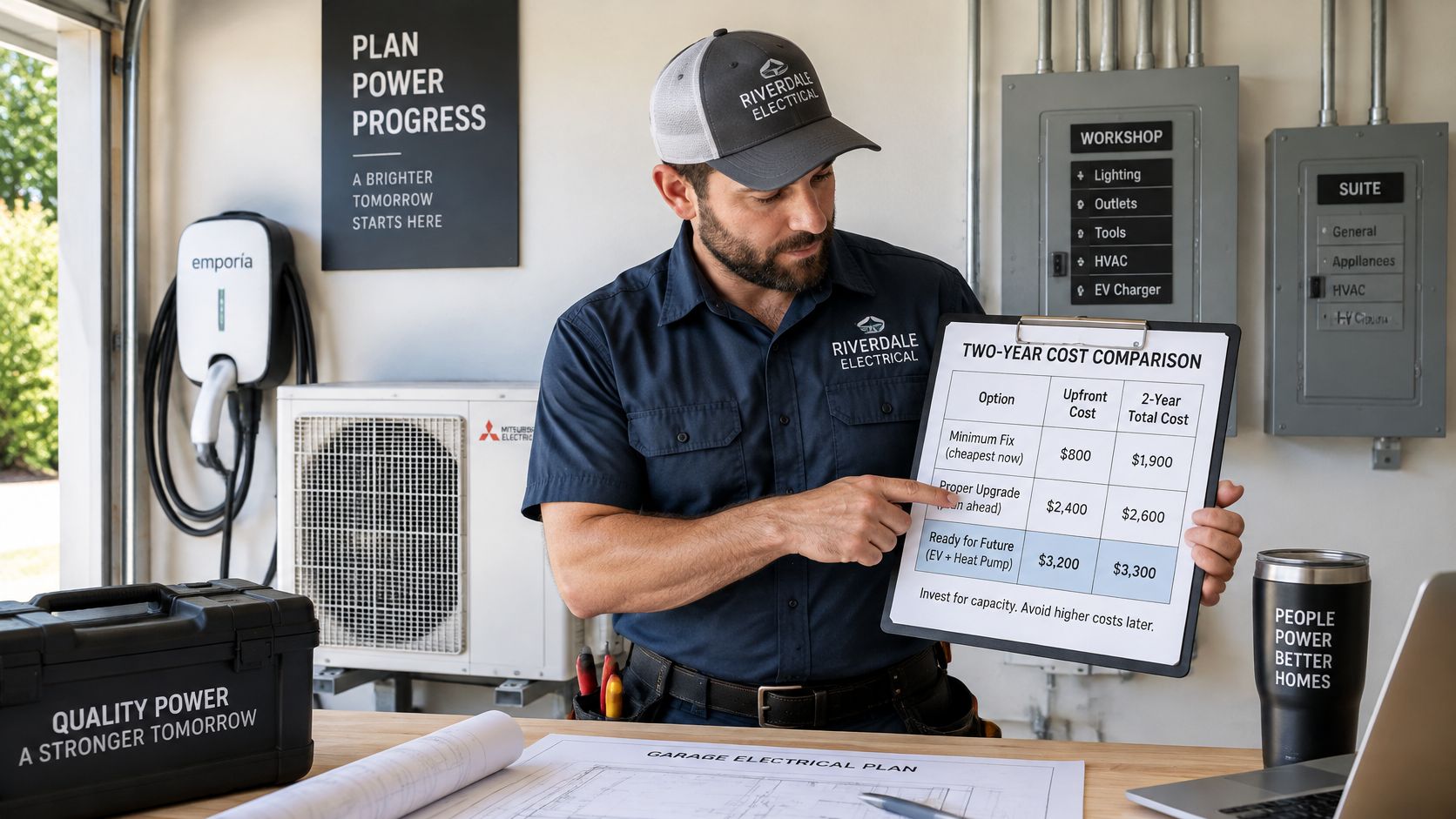
Start With a Load Assessment, Not a Breaker Space
Empty breaker spaces prove nothing. A panel can have physical room for another breaker and still lack the capacity for an EV charger, a second heat-pump condenser, a workshop circuit, or a commercial kitchen line. The load assessment is what separates a panel that looks available from one that is.
Ask four questions before you approve the install.
- What's my available amperage after existing loads. Not the panel rating, the remaining capacity.
- What happens when the new load and the air conditioner start together. In Palm Beach County, that's not a corner case. That's every summer afternoon.
- Is permit inspection included in this price. If not, add it before comparing quotes.
- What discovery would force a change order. A full bus, corroded lugs, or an undersized feeder should be named now, not billed later.
Sometimes the affordable path is a staged one. A smaller charger setting or a load-managed circuit today, with a planned service upgrade later, can beat forcing the largest charger onto a full panel and paying for nuisance trips, then paying again for the upgrade anyway. Planned work, including a future electrical wiring upgrade, is almost always cheaper scheduled than improvised.
The Local Math Nobody Puts in the Quote
Palm Beach County loads are dominated by cooling. Long air-conditioning seasons mean your biggest electrical decisions involve equipment that runs for hours daily, not minutes. On larger commercial accounts, time-of-use and demand-based rates add another layer, since a new load that starts at the wrong moment can raise the peak the whole bill is measured against.
Efficiency can beat capacity. Reducing what existing air conditioners draw, coordinating when large loads run, or staging equipment starts can cost less than upsizing feeders and service equipment. Rooftop and tower lighting makes the same point from the compliance side, since it has to stay lit and code compliant without nuisance trips sending a tech up repeatedly.
The national picture shows where this pressure leads. A 2025 Purdue summary reported that reinforcing U.S. distribution infrastructure for widespread home and vehicle electrification could cost $350 to $790 billion, or approximately $2,000 to $6,400 per household through 2050, while efficiency and coordinated device operation could reduce that burden. Your panel is the household version of that same math.
The lowest upfront price is poor value when it guarantees a second panel visit.
Buy the upgrade your load calculation supports now. Schedule the one it doesn't. An electrician who tells you which is which, before selling you either, is pricing the next two years and not just the afternoon.
Get a Written Quote from Lighthouse Energy
Everything above reduces to one decision. Choose the contractor whose scope, license, and after-hours rule you can read before the truck rolls. If you can see the diagnosis charge, the permit responsibility, and the approval process in writing, you're comparing real prices. If you can't, you're comparing advertisements.
For homeowners from Boca Raton to Jupiter, plus property managers and small commercial sites across Palm Beach County, that means one call that reaches a licensed electrician, a stated arrival window, and a quote that separates diagnosis, repair, materials, and code-required upgrades. Lighthouse Energy Services works that way, handling residential through industrial electrical work in the county, with phones answered by licensed electricians, 24/7 response, and no after-hours call fee.
Match the next step to the situation you're in.
- Burning smell, hot panel, or partial power tonight. Request an emergency visit and leave the affected breaker off until help arrives.
- Panel upgrade, EV charger, or a new circuit this week. Request a written estimate with the load check included, so the price you approve is the price you pay.
- Recurring trips or a warm outlet that hasn't failed yet. Book the diagnostic visit now, while it's still a diagnosis and not a restoration.
Have three things ready when you call. The symptom in plain language, the address with gate or access notes, and the recent trip history, including what was running each time. That information lets the first truck arrive with the right devices and test equipment, which is the cheapest visit there is.
Property managers formalizing this across a portfolio can adapt these scope of work tips for facility managers into a standing electrical scope, so every call starts from the same written terms. Building owners can also fold aircraft obstruction lighting and AC-efficiency retrofits into the same conversation instead of treating them as separate emergencies later.
Don't collect another hourly rate. Collect a written total, read the exclusions, and hire the electrician whose number you can verify line by line.
If you've got a burning smell, a dead panel, a panel upgrade, or an EV charger quote that keeps moving, Lighthouse Energy Services will put the diagnosis, materials, permit, and after-hours terms in writing before work starts, with licensed electricians answering the phone around the clock in Palm Beach County. Visit the site, describe the symptom and your access details, and request the visit that fits your situation, whether that's an emergency call tonight or a firm written estimate this week.