
A typical small electrical repair cost lands around $150 to $400, and a licensed electrician's average hourly rate is $135 HomeFixx pricing data. If a quote for a dead outlet, switch, or breaker swap comes in inside that band, you're usually looking at a normal service call, not a rip-off.
That's the range I'd expect a Palm Beach County homeowner to hear when the problem is local, accessible, and doesn't turn into a panel issue or a code correction. Once you know how electricians build the bill, the numbers stop feeling random.
Table of Contents
- What You Actually Pay For When You Call an Electrician
- Breaking Down Labor, Parts, Permits, and Diagnostic Fees
- Common Electrical Repairs and Their Real Price Ranges
- Big-Ticket Repairs That Move From Fix to Project
- Emergency and After-Hours Electrical Pricing
- What Quietly Inflates an Electrical Repair Estimate
- Smart Ways to Keep Electrical Repair Costs in Check
- Questions Homeowners Ask After They See the Quote
What You Actually Pay For When You Call an Electrician
A breaker trips in your kitchen, the outlet near the sink goes dead, and now you've got a choice. You can keep guessing, or you can pay for a licensed electrician to show up, diagnose the fault safely, and fix it without turning the problem into a bigger one.
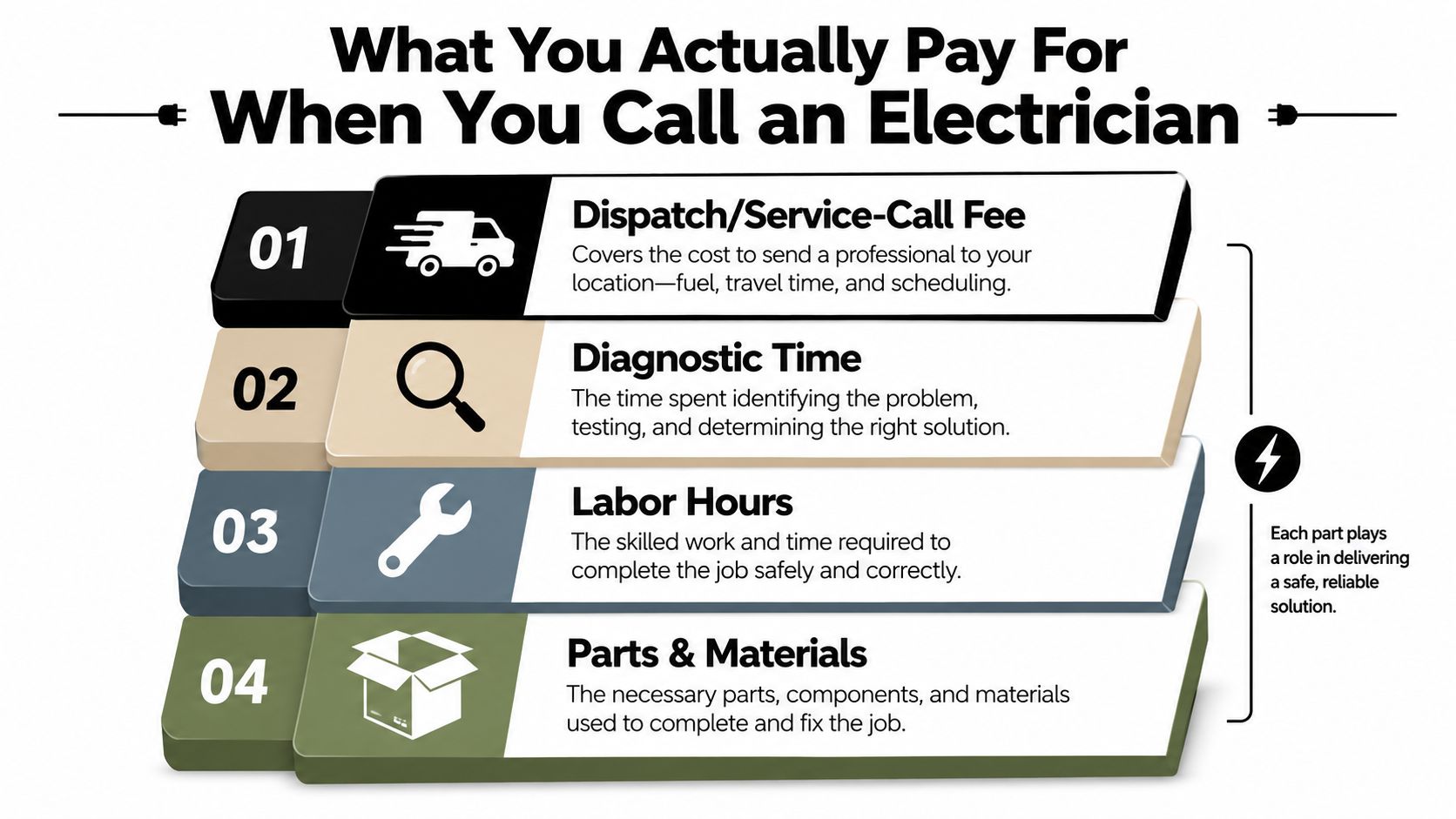
The invoice usually stacks four charges. First comes the dispatch or service-call fee, then diagnostic time, then labor hours, then parts and materials. On a small repair, that diagnostic minimum is the whole game, because a licensed pro still has to drive out, test the circuit, open the box, confirm the fault, and stand behind the work.
Practical rule: if a quote sounds expensive for a tiny job, check whether the price includes the visit, the diagnosis, and the first hour of labor. That's where the real cost sits.
A standard outlet or switch replacement averages about $150, a GFCI outlet installation about $180, and a circuit breaker replacement about $150 HomeFixx pricing data. Those aren't just part prices. They reflect the electrician's time, the truck roll, and the fact that small jobs can't be priced like a box of screws at the store.
For homeowners in Palm Beach County, the smart question isn't, “What does an outlet cost?” It's, “What does it cost to get a licensed electrician to my house, find the fault, and fix it correctly on the first visit?” That's the number that matters.
Breaking Down Labor, Parts, Permits, and Diagnostic Fees
A homeowner calls for a simple outlet repair and gets a quote that looks bigger than expected. That usually happens because the bill is built from separate pieces, and each one has a real purpose. Labor covers the electrician's time and the trip to your house. Parts include the device, breaker, wire, connectors, and anything else that gets installed. Permits and inspections come into play when the work crosses into code-driven repairs. Diagnostic fees pay for the time spent finding the fault, and with intermittent problems, that can cost more than the replacement part.
| Typical Line Items on an Electrical Repair Invoice | Typical Range | What It Covers |
|---|---|---|
| Service call or dispatch fee | $75–$150 | Truck roll, arrival, initial assessment, and the first look at the problem |
| Diagnostic time | Often bundled into the visit | Testing, tracing, and troubleshooting the fault |
| Labor hourly rate | $50–$130 per hour | Active repair time after the diagnosis starts |
| Small parts and materials | Varies by job | Devices, wire, breakers, connectors, and consumables |
| Permit and inspection costs | Project dependent | Code-required sign-off for larger repairs |
That breakdown is why a quote for a small repair can jump once the electrician starts testing. Current pricing guides show service call fees of $100 to $200 and hourly labor at $50 to $130, with minor jobs commonly landing at $150 to $600 HomeGuide pricing data. On the homeowner side, the fix may take only minutes. On the contractor side, the truck roll, diagnosis, and minimum billing still have to be covered.
Permits are part of compliant work when the job requires city sign-off. For a clear example of how permit charges are separated from labor and materials, look at the structure of fees for Georgia construction permits. That separation is the right model for electrical work too, because the permit is a required project cost, not a hidden add-on.
A contractor who lists these pieces gives you a cleaner quote than someone who throws out one vague number. If the estimate does not show what is included, ask for the breakdown before anyone starts work.
Common Electrical Repairs and Their Real Price Ranges
The bread-and-butter repairs are pretty predictable, and that's good news. Most homeowners aren't dealing with a full panel swap. They're dealing with outlets, switches, breakers, or a fixture that stopped working.
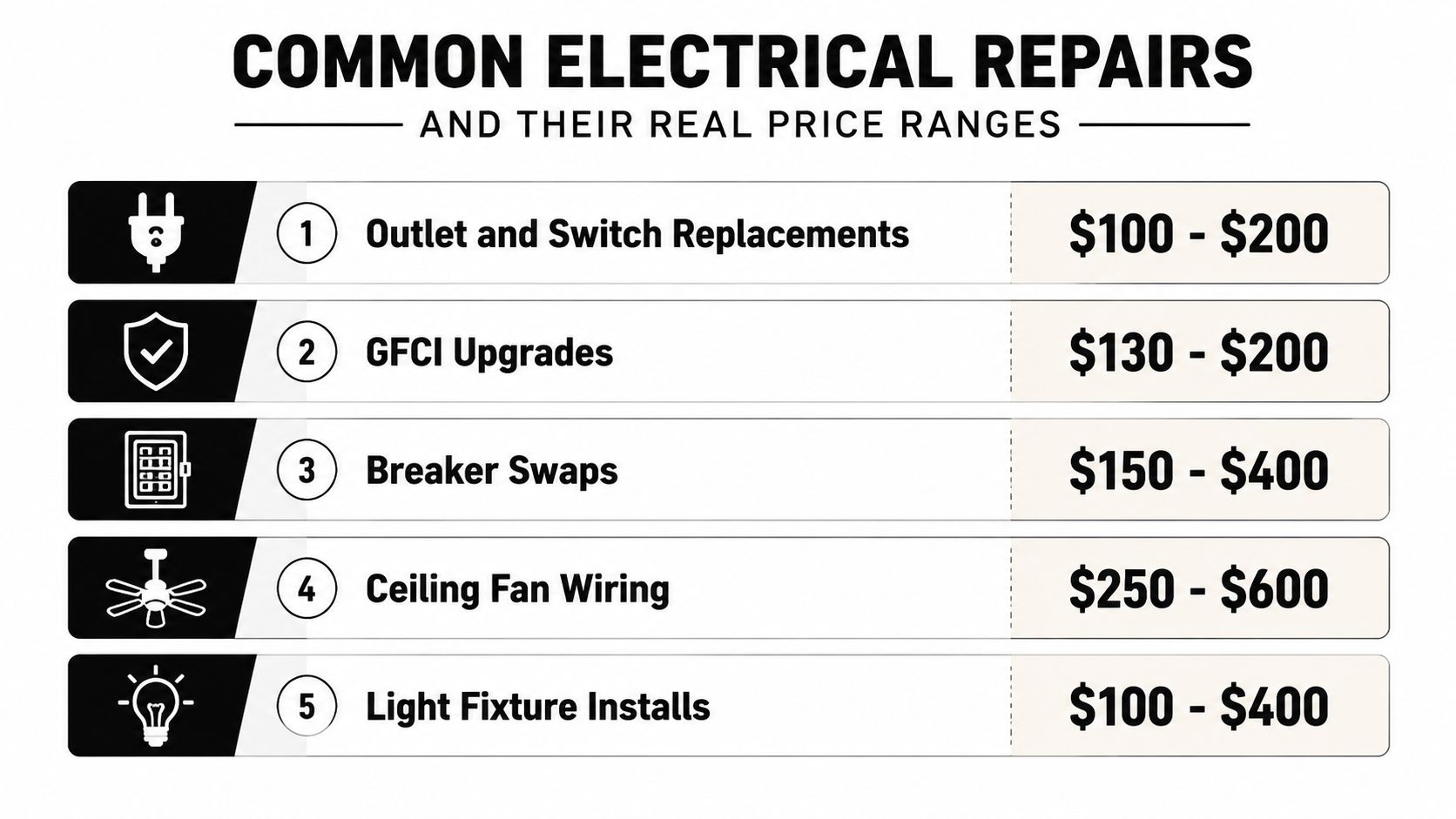
| Repair Type | Typical Price Range | What It Usually Covers |
|---|---|---|
| Outlet and switch replacements | $100–$250 | Device swap, testing, and basic labor |
| GFCI upgrades | $130–$200 | Safer kitchen, bath, garage, or outdoor protection |
| Breaker swaps | $100–$300 | Single breaker replacement and verification |
| Ceiling fan wiring | Qualitative | Wiring, support, and installation complexity varies by ceiling access |
| Light fixture installs | Qualitative | Fixture mounting, wiring, and fit-up work |
Outlet and switch work stays affordable when the box is accessible and the circuit behaves. Once the electrician finds damaged wiring, crowded boxes, or a bad connection deeper in the circuit, the price climbs because the job is no longer a simple device swap. That same logic applies to breakers. A breaker replacement is usually straightforward until the panel is packed, mislabeled, or showing signs of age.
The homeowner mistake is bundling every repair into one mental bucket. A standard outlet replacement near a kitchen sink is not the same thing as a ceiling fan job in a tight attic access space. If you're comparing quotes, ask what's included in the number. The answer should tell you whether the contractor is pricing a quick replacement or a more involved troubleshooting visit.
If you're dealing with a gate that won't open, a lot of the same repair logic applies, especially when the fault is in the controls rather than the obvious moving part. A useful reference for that kind of troubleshooting is the common electric gate faults guide, because the cheapest visible fix isn't always the underlying issue.
Big-Ticket Repairs That Move From Fix to Project
Some jobs stop being “repairs” the moment the electrician sees the core problem. Panel upgrades, whole-house rewires, and service-capacity changes are projects, not quick fixes. If you are looking at one of these, stop thinking in terms of a service call and start thinking in terms of scope, permits, access, and restoration.
| Major Electrical Repair Projects at a Glance | Typical Scope | Permit Required | Realistic Total Cost |
|---|---|---|---|
| 100A to 200A panel upgrade | Replacing the service panel and related components | Often yes | About $3,800 on average HomeFixx pricing data |
| Whole-house rewiring, 2,000 sq ft home | Full system replacement | Often yes | About $12,500 on average |
| Whole-house rewiring, broader benchmark | Full-system replacement in older homes | Often yes | Roughly $8,000 to $20,000 or more National Electrical Repair Authority estimates |
| 2,000 sq ft two-story rewire with drywall open | Rewire plus access and restoration complexity | Often yes | About $14,485 to $42,485 depending on tier |
The jump in price is not mysterious. You are paying for access, code compliance, coordination, inspections, and the labor needed to make an older system safe and usable again. Once a job turns into a larger project, the quote reflects more than the hardware on the wall.
Older buildings and concealed wiring routes drive the bill more than the device itself.
That is why older homes, wall construction, and hidden conduit paths matter so much. A panel upgrade can look expensive on paper, but the panel is rarely the whole story. The electrician has to make the system compliant, open what needs to be opened, replace what is failing, test the work, and restore the area cleanly. If you want another point of comparison on larger upgrade pricing, this internal resource on home electrical panel upgrade cost is worth reading before you approve anything.
For a homeowner, the decision is straightforward. If the problem is a single bad device, fix it. If the system is outdated, overloaded, or unsafe, replace the larger component and move on. That is usually the cheaper move over time, and it avoids paying for repeated service calls on a tired system.
Emergency and After-Hours Electrical Pricing
A breaker trips at 9 p.m., the panel is warm, and the house starts smelling like something is burning. That is not the time to haggle over every line item. After-hours electrical work costs more because the contractor has to pull a licensed electrician off a scheduled day, send them out fast, and absorb the disruption of urgent service. That premium is normal, and it usually shows up as a surcharge on top of the standard repair rate.
The bill structure matters more than the label on the ad. A company can call it “emergency service” and still price it the same old way, service call plus labor plus surcharge. A homeowner should ask one direct question before agreeing to anything. “Is there an after-hours fee on top of the repair price?”
If the answer is yes, make them spell it out in plain English. If the answer is no, that is a real difference in the final bill. For local emergency pricing details, see our guide on emergency electrical repair in Palm Beach County. Some electrical contractors, including Lighthouse Energy Services, answer calls with licensed electrical professionals and do not tack on extra after-hours charges. That setup is cleaner for urgent repairs because the price conversation starts with the work itself, not a penalty for calling at night.
A real emergency is a hot panel, a sparking outlet, a burning smell, or a partial outage. That is when speed matters more than chasing the lowest invoice. You still deserve a clear quote before anyone starts opening boxes in the dark.
What Quietly Inflates an Electrical Repair Estimate
The number on the estimate is only the starting point. The multiplier is usually hidden in the house. Age of wiring, access, permits, and urgency can turn a simple repair into a much bigger labor event.
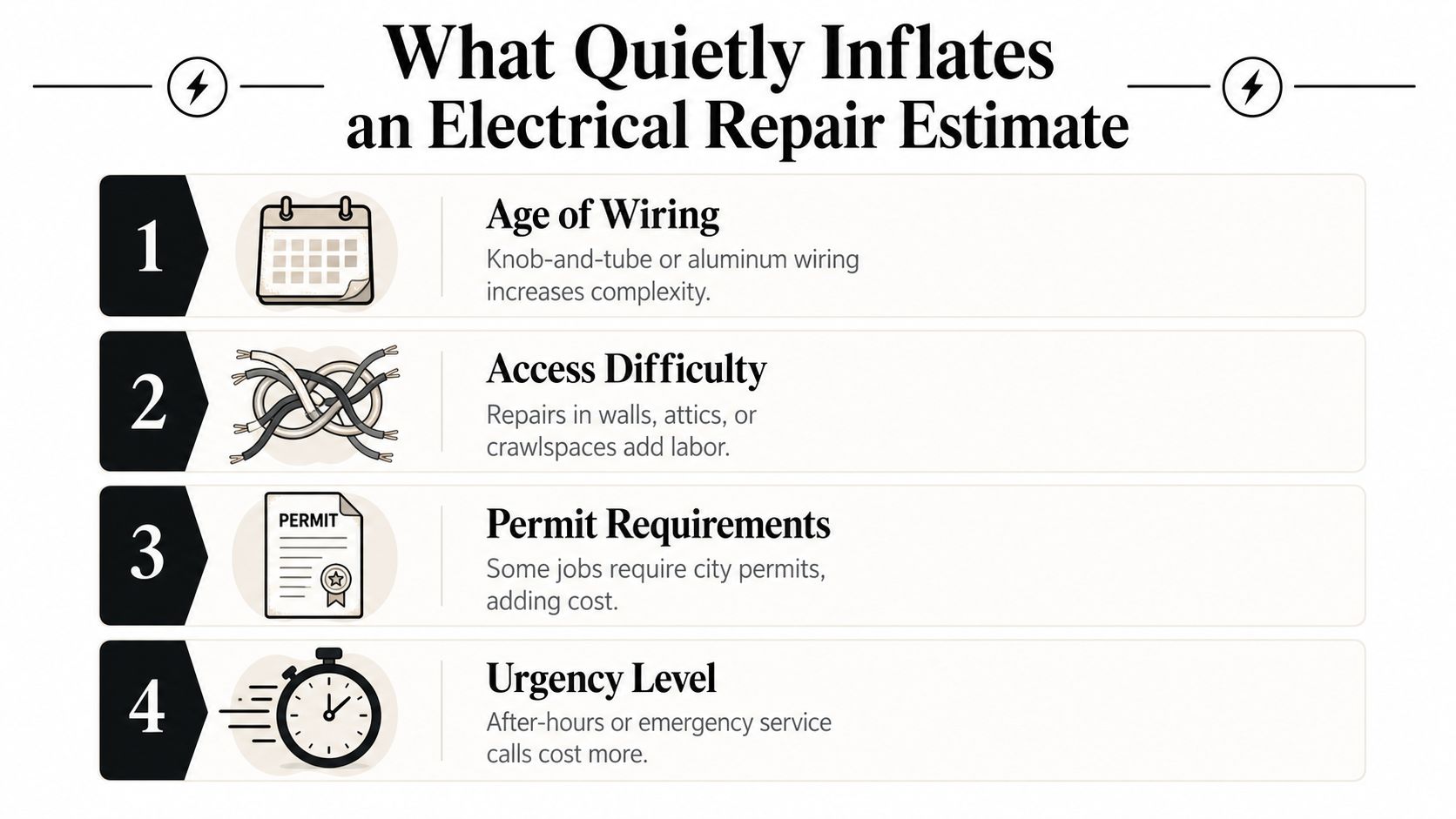
| Cost Multiplier | Why It Raises the Bill |
|---|---|
| Age of wiring | Older systems, including obsolete wiring types, take more care and often more replacement work |
| Access difficulty | Finished walls, attics, and crawlspaces add labor and restoration time |
| Permit requirements | Code-driven sign-offs add administrative and inspection steps |
| Urgency level | After-hours calls usually carry a surcharge |
The biggest surprise for homeowners is access. An open wall is one thing. Fishing wire through finished drywall, tight attic bays, or a cramped crawlspace is another. That extra labor is why older homes and concealed routes often push estimates high. For code-related repairs in Florida, this internal guide on code violation correction electrician Florida is a useful reminder that the cost isn't just the fix, it's the compliance work behind it.
Here's the clean takeaway. If you want the estimate to hold, ask what the electrician sees behind the walls, whether permits are needed, and whether the quoted price includes access and restoration. The quote that looks cheaper up front can become the expensive one if it leaves out the hard parts.
Smart Ways to Keep Electrical Repair Costs in Check
Saving money on electrical work is mostly about sequencing. Bundle the small jobs. If you've got three outlets acting up and a switch that's loose, have them looked at in the same visit so the diagnostic minimum gets spread across multiple fixes. That's the easiest way to lower the effective cost per repair.
Ask for a flat quote when the scope is clear. Hourly billing is fine for true troubleshooting, but it's a lousy surprise when the issue is straightforward. You also want the invoice broken out, not buried in one lump sum. That's how you compare contractors fairly.
Smart homeowner move: pay for clarity before you pay for the repair.
A few habits save real money:
- Verify license and insurance first. If the contractor can't prove both, don't let them touch your panel.
- Request a line-item estimate. You should see labor, parts, and any permit or service-call charge.
- Schedule non-urgent work during normal hours. Emergency premiums are for emergencies, not convenience.
- Bundle related fixes. One visit beats three separate truck rolls every time.
Lighthouse Energy Services fits the kind of contractor model that reduces friction, with licensed professionals answering the phone, on-time arrival, and transparent pricing. That doesn't magically make a repair cheap, but it does make the price easier to understand before the work starts.
Questions Homeowners Ask After They See the Quote
How long should the warranty last? Long enough that the contractor stands behind the labor, not just the part. Get that in writing before the job starts.
When does a repair need a permit? Usually when the work crosses into panel changes, new circuits, or anything the code treats as more than a like-for-like swap. If the quote doesn't say whether permitting is included, ask.
How do you know if old wiring is hiding behind the walls? You don't guess. You ask the electrician what they saw during the diagnosis, and you compare that with the symptoms, repeated trips, warm devices, or intermittent outages.
For a second opinion on whether the estimate is structured clearly, it can help to compare it with a written offer from another licensed company and even use a resource like request your free quote as a reminder that a quote should be specific, not vague.
If your estimate is missing labor, parts, or permit language, push back before you sign.
If you want a straight answer on electrical repair cost, Lighthouse Energy Services gives Palm Beach County homeowners licensed diagnostics, transparent quotes, and 24/7 response when the problem can't wait. Visit Lighthouse Energy Services to request service and get the repair priced the right way before anyone starts work.