
Commercial electrical cost equals labor crew-hours times a loaded labor rate, plus materials, permits, travel or after-hours charges, equipment and contingency, with a job-specific planning range built from straightforward access at the low end and shutdowns or concealed conditions at the high end. A useful commercial electrical service calculator shows those assumptions separately instead of producing one unexplained price.
You might be holding a tenant's equipment list, a quote for a panel upgrade and a deadline that won't move. Before approving the work, you need to know whether you're paying for necessary capacity, difficult installation conditions or an emergency schedule. The right estimate makes those distinctions visible.
Table of Contents
- Commercial Electrical Costs at a Glance
- Labor, Materials and Equipment Costs
- How the Calculator Builds a Quote and Its Fees
- Load and Panel Work Behind the Service Size
- Three Worked Examples You Can Compare
- Confirm Your Estimate With a Licensed Electrician
- Frequently Asked Questions About Commercial Service Calculators
Commercial Electrical Costs at a Glance
A commercial electrical service calculator turns building type, floor area, equipment, access, operating hours and permit requirements into a structured estimate. Its output should be a planning range built from a line-item breakdown. Square footage helps describe a project, but the work items determine what goes into the quote.
An office and a restaurant can occupy similar spaces and still require very different electrical work. An office might need accessible receptacle circuits; a restaurant may need kitchen equipment connections, rooftop work, shutdown coordination and distribution equipment changes. The gap comes from scope, access and operating constraints, not floor area alone. Nameplate load also differs from measured demand, so the equipment list should be considered alongside actual operating conditions when service work is being priced.
Typical planning ranges for common commercial electrical jobs
For South Florida budgeting, use these scope boundaries to request low and high estimates. The table gives no local dollar figures: without quantities, labor rates and a site review, a dollar amount would imply more precision than the available information supports.
| Job type | Main cost drivers |
|---|---|
| Single dedicated circuit or outlet | Circuit rating, route length, spare panel capacity, wall repairs |
| Tenant suite lighting or receptacle upgrade | Fixture count, access, after-hours timing |
| Business-hours diagnostic call | Diagnostic time, minimum billed hours, parts found |
| After-hours emergency repair | Contractor's after-hours policy, parts availability, urgency, number of technicians |
| Small commercial panel capacity upgrade | Existing feeders, grounding, shutdown requirements, equipment compatibility |
| Full new service with switchgear | Utility coordination, service routing, switchgear specifications, engineering and excavation |
For a small tenant change, pin down routing, device counts and whether the existing panel can support the addition. For a service replacement, establish utility requirements and equipment specifications before relying on a preliminary estimate. These are different scopes, so compare quotes only after confirming that they include comparable work.
Budgeting rule: Ask what the low estimate assumes and which specific conditions would move the job toward the high estimate.
In Palm Beach County, occupied businesses, restricted access to equipment and utility interruption coordination can add labor. Put these conditions in the scope so their cost is visible in the quote.
Scope size and timing are the first inputs to settle. A defined project scheduled for an agreed shutdown is easier to price than an urgent request with an unknown fault and no access plan. Use the table to identify the job category and compare the scope and assumptions in each quote.
Labor, Materials and Equipment Costs
Worker wages aren't customer billing rates. A contractor's loaded labor rate must recover payroll burden, insurance, supervision, vehicles and overhead, while the final selling price must also support profit. Comparing an employee's hourly wage with an invoiced service rate won't tell you whether a quote is reasonable.
Geography matters, too. RSMeans commercial electrical estimating guidance describes localized material, labor, equipment and productivity information across more than 970 North American markets, supporting the use of local inputs rather than a national flat rate.

Planning crew-hours by electrical task
Crew-hours count everyone assigned to the task. In a hypothetical example, a pair of electricians working for six hours uses twelve crew-hours, not six. The estimator should distinguish productive installation time from setup, isolation, material handling and restoration.
| Task | Planning crew-hours | What changes the number |
|---|---|---|
| Troubleshooting a fault | Allow separately for diagnosis and repair | Panel access, circuit identification, intermittent symptoms |
| Device or fixture swap | Quantity multiplied by task-specific installation time | Ceiling height, lift setup, fixture weight |
| Exposed conduit run | Measured route multiplied by installation time per unit length | Bends, surface type, mounting height |
| Conductor pulling in conduit | Pull setup plus crew time for each planned pull | Conductor size, bends, conduit fill |
| Panel replacement | Isolation, removal, installation and reconnection allowances | Feeder condition, circuit identification, shutdown window |
| Testing and labeling | Time for the agreed test schedule and circuit inventory | Number of circuits, documentation requirements |
| Permit coordination | Application, drawing coordination and inspection attendance | Jurisdiction, review comments, drawing needs |
Don't accept a crew-hour allowance that describes only mounting equipment. For commercial electrical installation, scope should include how electricians reach the work, make it safe, install it and return the space to service.
Materials and equipment need quantities
Price conductors and conduit by measured lengths and purchasing units. Count devices, fittings, breakers, supports and terminations separately, then identify the allowance for cutoffs and small parts. A blanket waste percentage can distort a short, simple job or understate an installation with awkward routing.
Equipment deserves its own line: lift delivery, rental duration, access requirements and collection can matter as much as the rental itself. Ask whether ordinary tools are included in overhead before accepting a separate equipment charge.
For a hypothetical arithmetic check, sixteen crew-hours at an assumed loaded rate of $125 produce $2,000 in labor before materials. That's a calculation example, not a Palm Beach County billing benchmark.
Contractors managing estimating workload should also distinguish project labor from office estimating expense. HireArchitects' resource on the cost of expanding estimating capacity is relevant when deciding how to staff takeoffs and quote preparation, rather than hiding that decision inside installation hours.
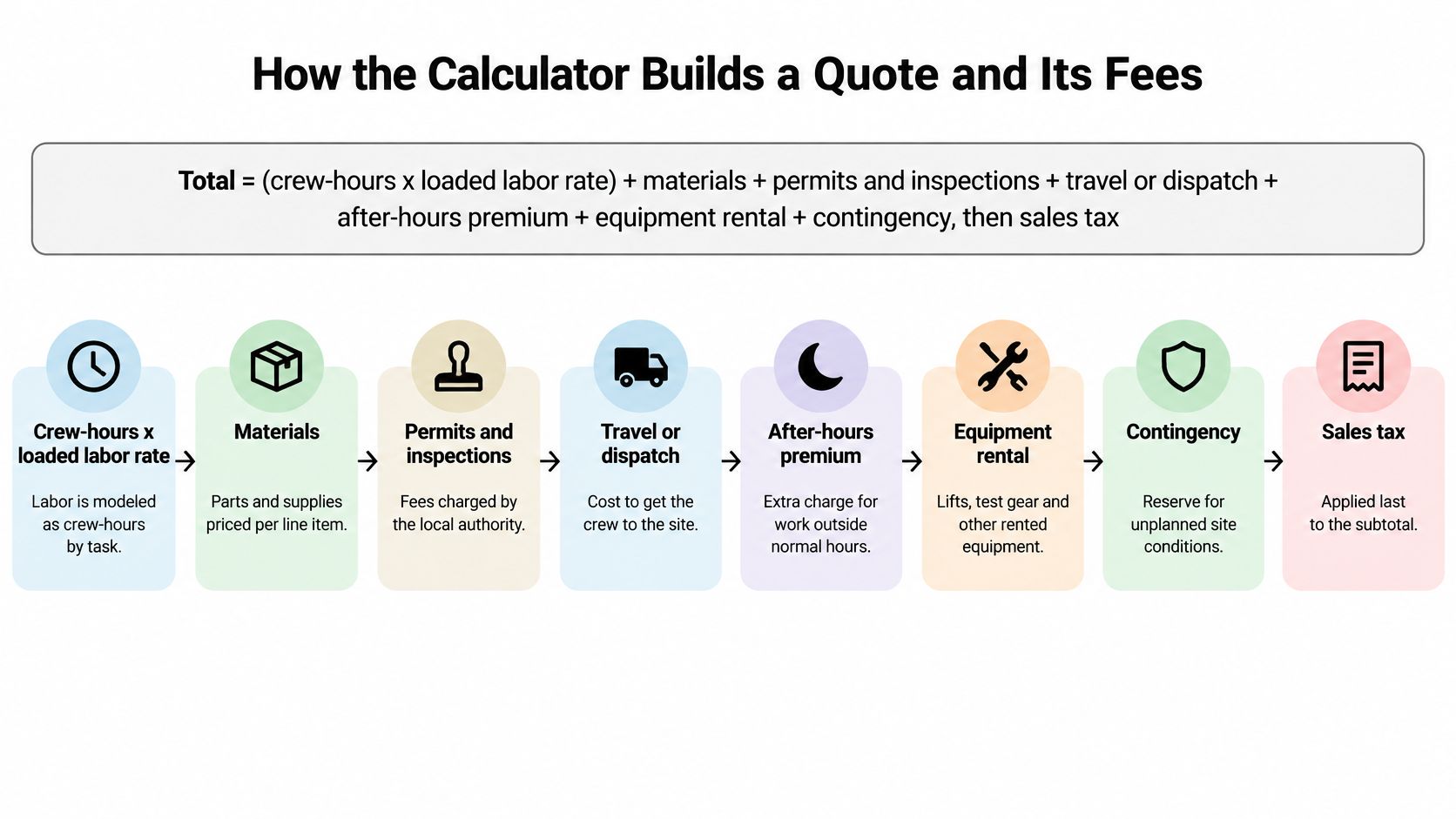
How the Calculator Builds a Quote and Its Fees
Total = (crew-hours × loaded labor rate) + materials + permits and inspections + travel or dispatch + after-hours premium + equipment rental + contingency, then applicable sales tax.
A quote should let a facility manager trace the price from defined work to visible line items. Two buildings of the same size can produce very different totals when access, routing, repair scope, timing or equipment needs differ. Even the load information used to define the work matters: nameplate totals, calculated demand and measured demand are not interchangeable.
A contractor may present one bundled selling price, but the estimate behind it should still identify the scope, allowances and exclusions. Check each charge once, and confirm what it covers.
Build the estimate in a checkable sequence
Define the deliverable. Specify what must be working when the crew leaves. Review drawings, equipment schedules and photographs, then confirm routing and access with a site walk. State whether demolition, patching, painting and disposal are included.
Count labor by task. Keep investigation separate from installation. A fault-finding allowance shouldn't become an unlimited repair authorization. A panel replacement may also require circuit tracing, even when the existing labels appear complete.
Apply the labor rate consistently. Confirm whether the estimate uses individual worker rates or a blended crew rate. Identify supervision and specialist testing so they are not counted both in overhead and as extra field labor.
Price the material takeoff. Match equipment to the required voltage, interrupting rating, enclosure and existing system. Include freight and procurement conditions where relevant. A lower-priced breaker that is incompatible with the panel does not reduce the cost of a correct installation.
Identify permit and inspection costs. Confirm the permitting authority before entering an allowance. Keep Palm Beach County or municipal charges open until the responsible department confirms the applicable schedule, review requirements and inspection process.
Add travel and timing conditions. State dispatch charges, return-trip treatment and any premium for the requested work window. Define whether the premium applies only to labor or to another stated portion of the quote.
Allow for equipment and uncertainty. Price lifts and other rentals against the actual schedule. Tie contingency to specific unknowns, such as concealed raceway damage or inaccessible junction boxes. A general allowance should not mask an incomplete takeoff.
Present low and high totals. Explain the assumptions behind each figure. The high estimate should show a plausible complication and its cost effect, rather than applying an arbitrary increase to the whole job.
Typical fee lines and how they are charged
These are items to verify in the contractor's terms, not universal charges or local fee amounts.
| Fee | How it is usually charged | Planning amount |
|---|---|---|
| Permit and plan review | According to the responsible authority's published schedule | Confirm with the local building department |
| Re-inspection | Additional inspection charge where the authority requires it | Enter the authority's confirmed charge and contractual responsibility |
| Travel or dispatch | Per trip, service area or an included mobilization allowance | Use the contractor's written dispatch charge |
| Emergency diagnostic minimum | Minimum billable attendance stated in service terms | Confirm the minimum before authorizing attendance |
| Evening after-hours labor | Separate premium or an agreed inclusive rate | Enter the contractor's written evening policy |
| Weekend or holiday labor | Separate premium or an agreed inclusive rate | Enter the contractor's written weekend policy |
A disclosed surcharge is fair; an undisclosed one is the problem. A facility manager who approves an hourly rate should not later discover that travel, diagnostic minimums and premium time were also charged without clear terms.
Confirm who pays for a return inspection and under what circumstances. Installation deficiencies should be distinguished contractually from additional visits caused by owner changes, unavailable access or incomplete work by another trade.
Put every allowance beside its trigger. “Concealed conduit replacement if existing raceway is unusable” is more useful than “miscellaneous extras.”
Compare scope before negotiating totals
When quotes differ, compare permits, dispatch, work hours and exclusions first. Then check whether both contractors included the same routing, restoration, shutdown support and testing. A lower total may reflect omitted work rather than a more efficient price.
For contractors choosing estimating systems, evaluate software costs with JobsiteStack rather than judging an office tool only by its advertised subscription. That business expense is separate from project field charges and should not appear as an unexplained surcharge.
The quote should give the facility manager a clear way to approve changes before work proceeds. Specify who can authorize extra work, what documentation is required and whether the contractor must stop at an agreed spending limit.
Load and Panel Work Behind the Service Size
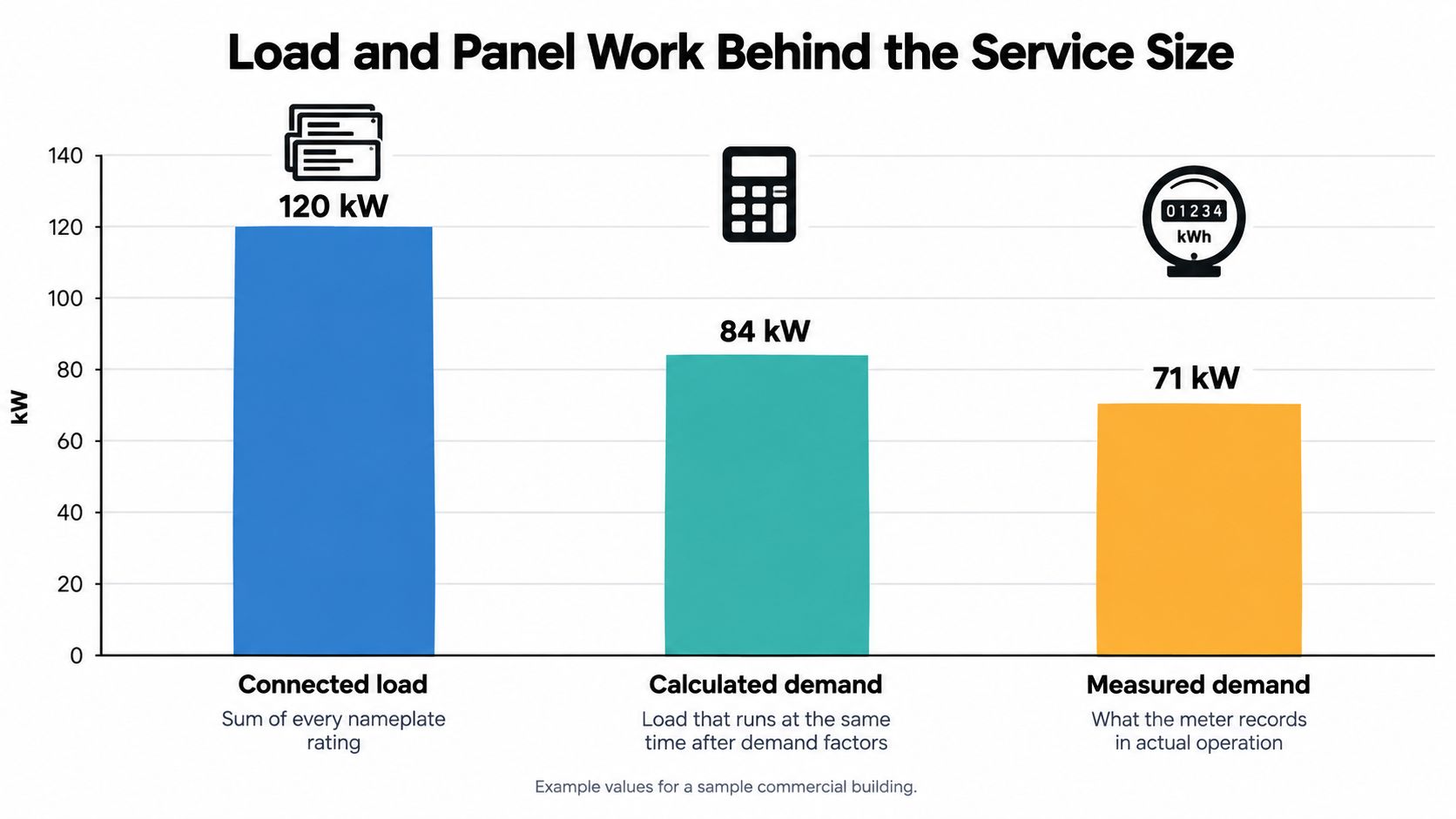
A restaurant kitchen doesn't run every burner at full output throughout the day, but its electrical design still has to accommodate the applicable operating conditions. That's why adding every equipment label and immediately selecting a larger service can produce the wrong recommendation.
Connected load is the inventory of nameplate loads. Calculated demand applies the permitted calculation method to those loads. Measured demand describes actual operation recorded by metering, subject to the quality and suitability of the records.
Keep the calculation auditable
Under NEC Article 220 methodology, loads must be classified rather than assigned one building-wide discount; EC&M's commercial load calculation guidance also explains the separate 125% treatment of continuous loads relevant to sizing. Apply the applicable provisions to the appropriate loads, not as a blanket multiplier after every other adjustment.
A useful calculator should preserve the following record:
| Calculation line | What the output should show |
|---|---|
| General lighting | Occupancy basis, connected VA and applicable demand treatment |
| Receptacles | Counted load and the applicable calculation method |
| HVAC and motors | Equipment ratings and required motor or equipment adjustments |
| Kitchen and other fixed equipment | Nameplate load, permitted demand treatment and operating assumptions |
| Continuous loads | Applicable sizing adjustment without duplicate counting |
| Calculated total | Adjusted VA, voltage, phase and resulting current |
For balanced three-phase calculations, current = VA ÷ (√3 × line-to-line voltage). For single-phase calculations, current = VA ÷ voltage. These formulas convert a properly established apparent-power load into current; they don't establish the correct demand factors or select the final protective equipment.
A three-phase electrical installation also requires attention to phase distribution, existing conductors and equipment ratings. A total-current calculation can conceal an overloaded phase if loads aren't distributed appropriately.
Challenge the data before buying capacity
Monthly energy consumption isn't the same as peak demand. Kilowatt-hours describe energy over time, while kilowatts describe real power and kilovolt-amperes describe apparent power; power factor affects the relationship between the latter quantities.
Check whether utility records cover the building's actual occupancy, seasonal cooling and proposed operating pattern. A quiet period before a restaurant opens won't represent its later kitchen and air-conditioning demand.
A larger service doesn't repair a loose connection, unsuitable breaker or damaged feeder. Diagnose the limitation before paying to increase capacity.
If separate tenant measurements are part of the project, Axis Meter Solutions' guide to electricity submeter installation permits and licensing helps frame the permitting questions. Keep metering scope separate from assumptions about available service capacity.
The output should present alternatives: retain existing capacity, investigate further, manage selected loads or upgrade. Each alternative needs its own technical assumptions and installation scope.
Three Worked Examples You Can Compare
The following quotes are hypothetical arithmetic examples, not local market prices. They use assumed labor rates, material allowances, fees and contingency to show how the same calculation structure handles very different jobs.
The supplied comparison graphic illustrates a separate set of sample projects. Use the written table below for the office, restaurant and warehouse calculations discussed here.
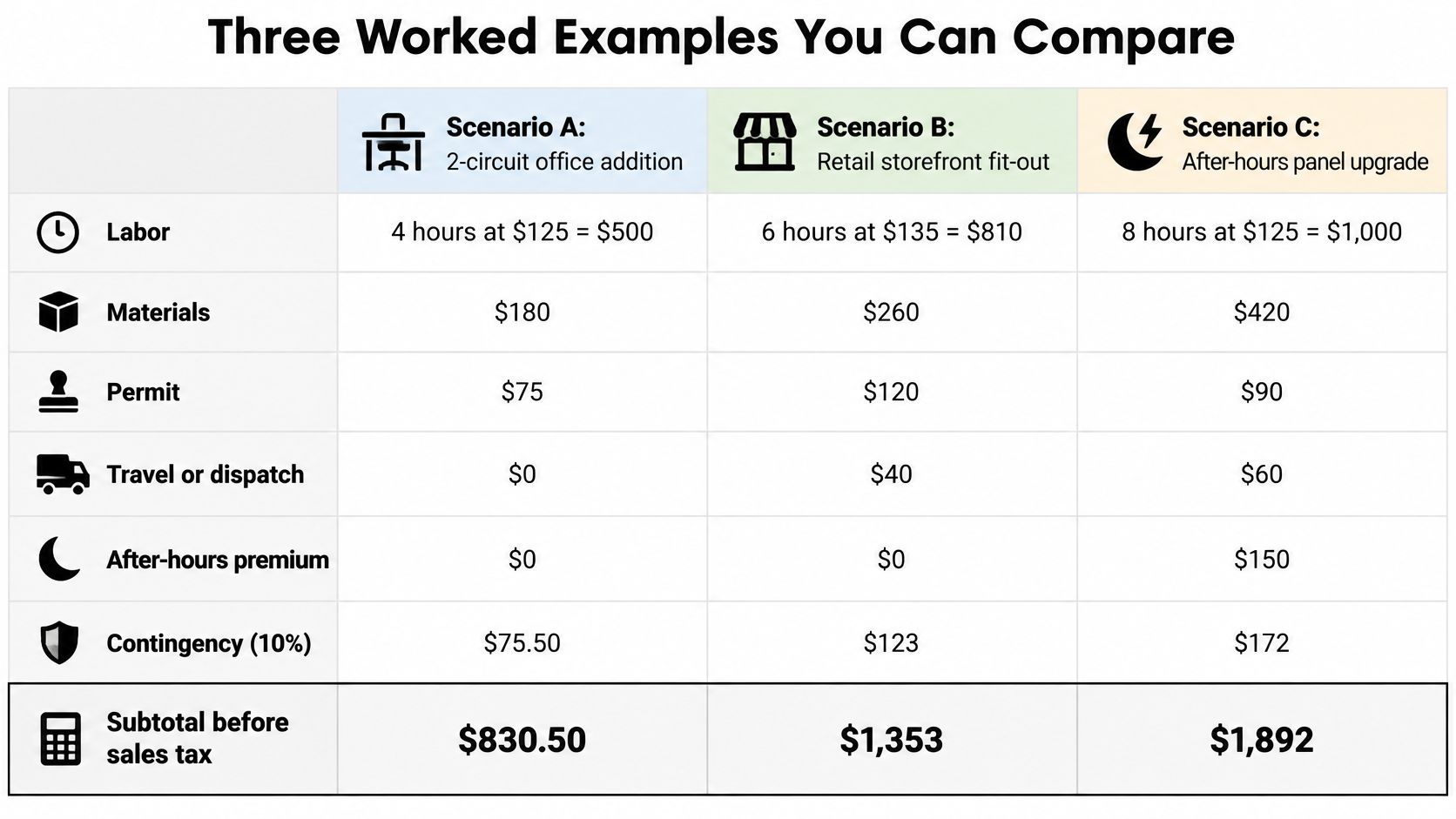
Three commercial quotes built with the same line structure
For these hypothetical scenarios, assume a $125 loaded hourly rate, a 10% contingency on the listed subtotal, and no sales tax in the displayed totals. The warehouse example assumes an after-hours labor multiplier of 1.5, solely to demonstrate the arithmetic.
| Cost line | A: 2-circuit office add | B: 200A to 400A restaurant upgrade | C: After-hours warehouse fault |
|---|---|---|---|
| Labor | 4 hours × $125 = $500 | 32 hours × $125 = $4,000 | 3 hours × $125 × 1.5 = $562.50 |
| Materials | $180 | $7,500 | $240 |
| Permit | $75 | $800 | $0 assumed for this example |
| Travel or dispatch | $0 | $0 | $150 |
| Contingency (10%) | $75.50 | $1,230 | $95.25 |
| Total | $830.50 | $13,530 | $1,047.75 |
The office addition assumes accessible routing and usable existing capacity. Its estimate would need revision if electricians discover that the planned circuits require a different panel location, difficult fishing or wall restoration.
The restaurant upgrade commits much more of its hypothetical budget to distribution equipment and materials. Don't read the example as evidence that every restaurant needs a service increase; the load assessment must justify that scope first.
The warehouse fault shows why a short repair can still carry mobilization and timing costs. Its assumed permit allowance isn't a declaration that emergency repairs are exempt from permits. The contractor must confirm the actual requirements and any follow-up work.
Installation cost isn't operating cost
For a hypothetical operating comparison, equipment drawing 10 kW for 10 hours daily throughout a 365-day year would consume 36,500 kWh. At the 2025 U.S. average commercial electricity price of 13.41 cents per kWh, published by the U.S. Energy Information Administration, that assumed consumption would cost approximately $4,895 annually.
That national average isn't a Palm Beach County tariff or a complete model of a particular utility bill. Ask for a separate operating-cost comparison using your actual tariff, expected schedule and relevant demand charges before choosing equipment solely on installation price.
Confirm Your Estimate With a Licensed Electrician
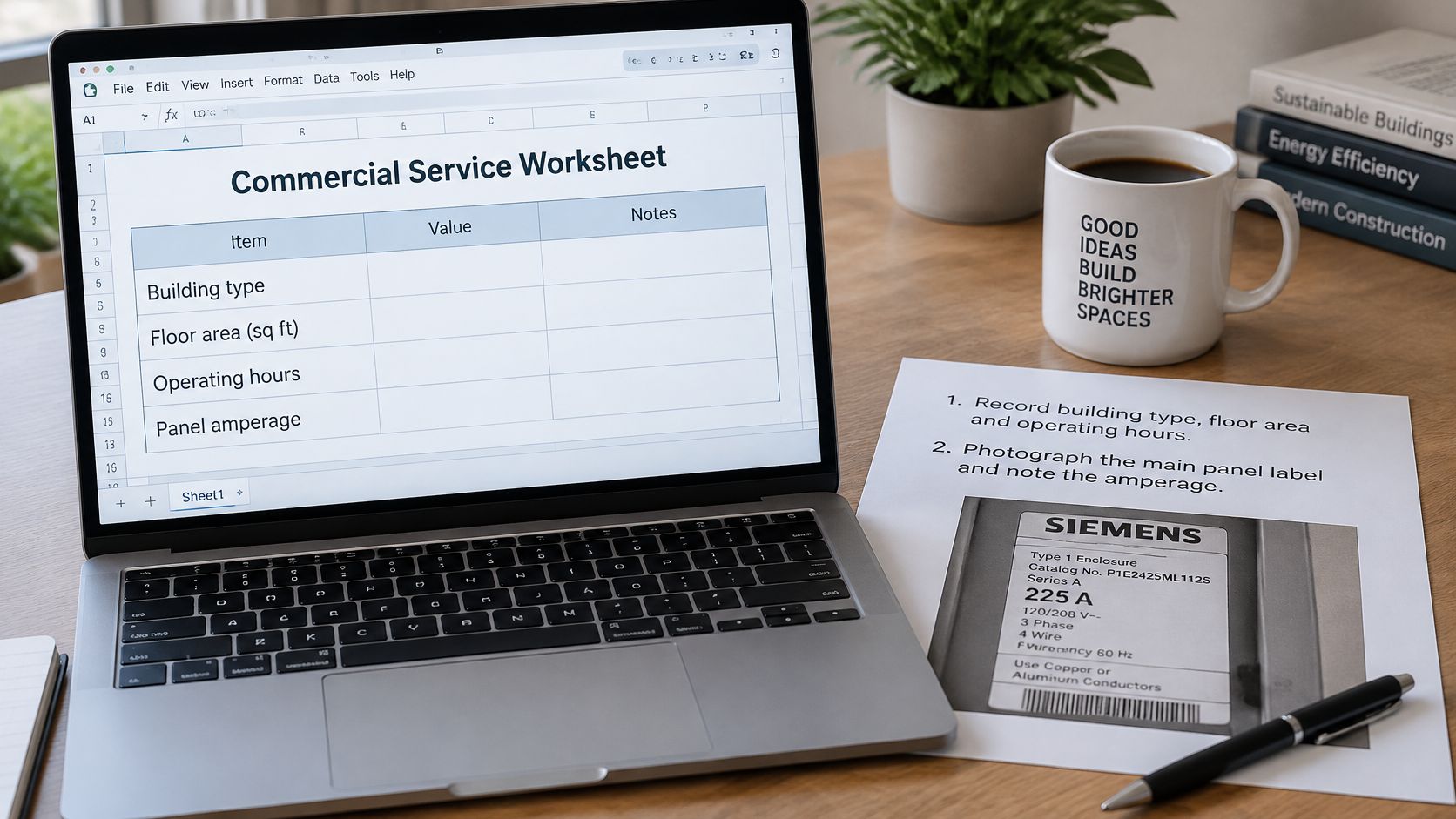
Start a spreadsheet with columns for item, quantity, assumption, supporting document and unresolved question. Copy the checklist below into it, then attach the information a contractor needs to replace assumptions with verified scope.
- Describe the facility. Record its use, floor area, occupancy pattern and operating hours.
- Document the existing service. Photograph accessible exterior labels and the panel directory without removing covers or approaching exposed parts.
- Inventory equipment. Collect nameplate photographs showing power, voltage, current and phase where available.
- Gather utility information. Request demand records and interval data, not just bill totals.
- Define each task. Separate investigation, installation, demolition, restoration and testing.
- List purchasing needs. Identify major materials, owner-supplied equipment and potential rentals.
- Record project constraints. Note the permitting jurisdiction, access arrangements, shutdown window and urgency.
- Track uncertainty. List the conditions requiring an allowance and the information needed to remove it.
Make verification part of the purchase
A spreadsheet can't inspect conductor condition, confirm equipment compatibility or establish what the local authority will accept. Electrical design and installation must be checked against the applicable safety framework and local requirements, as explained in NFPA's overview of the National Electrical Code.
Ask the electrician to identify which assumptions changed after the site visit. That conversation is more useful than requesting a lower total outright, because it reveals whether the savings come from a better route, a reduced scope or an omitted requirement.
For a Boca Raton facility, use the commercial electrical contractor service information to frame the work you need assessed. Send the equipment list and access constraints with the estimate request so the discussion starts with the actual project.
Before approval: Obtain a written scope, exclusions, payment terms, change-authorization process and completion criteria.
If a quote includes investigation before a final repair price, define the investigation deliverable. You should know whether you'll receive test findings, a repair recommendation and a revised authorization request before additional work begins.
Frequently Asked Questions About Commercial Service Calculators
Can a calculator use utility bills to size an existing service?
Yes, if the records meet the applicable measured-demand method. Existing-service load calculation guidance describes using one year of maximum-demand information, or qualifying continuous recording for at least 30 days at 15-minute intervals, with representative occupancy and heating or cooling loads.
An ordinary energy bill may not include demand data. Ask the electrician to confirm that the records cover the facility's seasonal cooling demand before using them to calculate service size.
Can load management avoid a service upgrade?
It can, when the proposed equipment and applicable rules allow a listed power-control system to affect the load calculation. Guidance discussing the 2026 NEC discusses circumstances where these systems may be used.
Request a written comparison of managed and unmanaged operation. It should identify control limitations and utility coordination requirements, so the potential reduction in service work is clear.
Why can equally sized buildings have different costs?
Floor area alone does not determine the quote. A 2,000 sq ft office may have a different service scope from a 2,000 sq ft commercial kitchen with refrigeration and a restricted shutdown window. Refrigeration, machinery, distribution equipment, difficult access and installation timing all affect materials and labor.
Is the calculator result a final price?
The calculator result is a planning estimate. The contractor must verify the site and define the contractual scope before issuing a dependable final quote. The written quote should state what is included, what remains uncertain and how additional work will be authorized.
Lighthouse Energy Services provides commercial electrical assessments, installations, upgrades and emergency diagnostics across Palm Beach County, with around-the-clock availability and no extra charges for after-hours calls. Visit Lighthouse Energy Services to request an estimate, and send your equipment list, panel-label photographs and preferred work window to help define the project scope.