
A September storm has left your Palm Beach County home without FPL power for days. The refrigerator is warming, the internet is down, the central air conditioner is silent, and the “backup plan” turns out to be one window unit, a cooler, and a short extension cord. That's when many homeowners realize that buying a generator and designing a reliable backup power system are two very different jobs.
A proper backup generator installation starts before anyone orders equipment. You need to decide which loads must operate, how the generator will be isolated from the utility grid, where the unit can legally sit, how fuel will reach it, and which permits and inspections Palm Beach County and FPL will require. The generator itself is only one part of the system.
Table of Contents
- What Backup Generator Installation Actually Involves
- Sizing the Generator for Your Home's Real Load
- Choosing the Right Generator Type and Fuel
- Site Preparation, Mounting, and Transfer Switch Wiring
- Permits and Inspections in Palm Beach County
- Costs, Timelines, and Hiring a Licensed Electrician
- Commissioning, Testing, and Ongoing Maintenance
What Backup Generator Installation Actually Involves
A standby generator project in South Florida coordinates electrical work, fuel, site preparation, permits, inspections, and utility requirements. The design comes first. Decide which circuits must run, how the generator will isolate from FPL, and where the equipment can legally operate before selecting hardware.
The electrical contractor normally performs the load assessment, selects and wires the transfer equipment, installs conductors and grounding, coordinates inspections, and commissions the system. A licensed gas fitter or plumber handles fuel piping and pressure testing. A concrete or general contractor may prepare the pad, trench, and site access.
Sequence affects both reliability and cost. Choosing a generator before calculating the load can leave the unit tripping when an air conditioner starts. Choosing a side-yard location without checking required clearances can lead to a failed inspection, relocation work, or changes to the fuel and conduit routes.
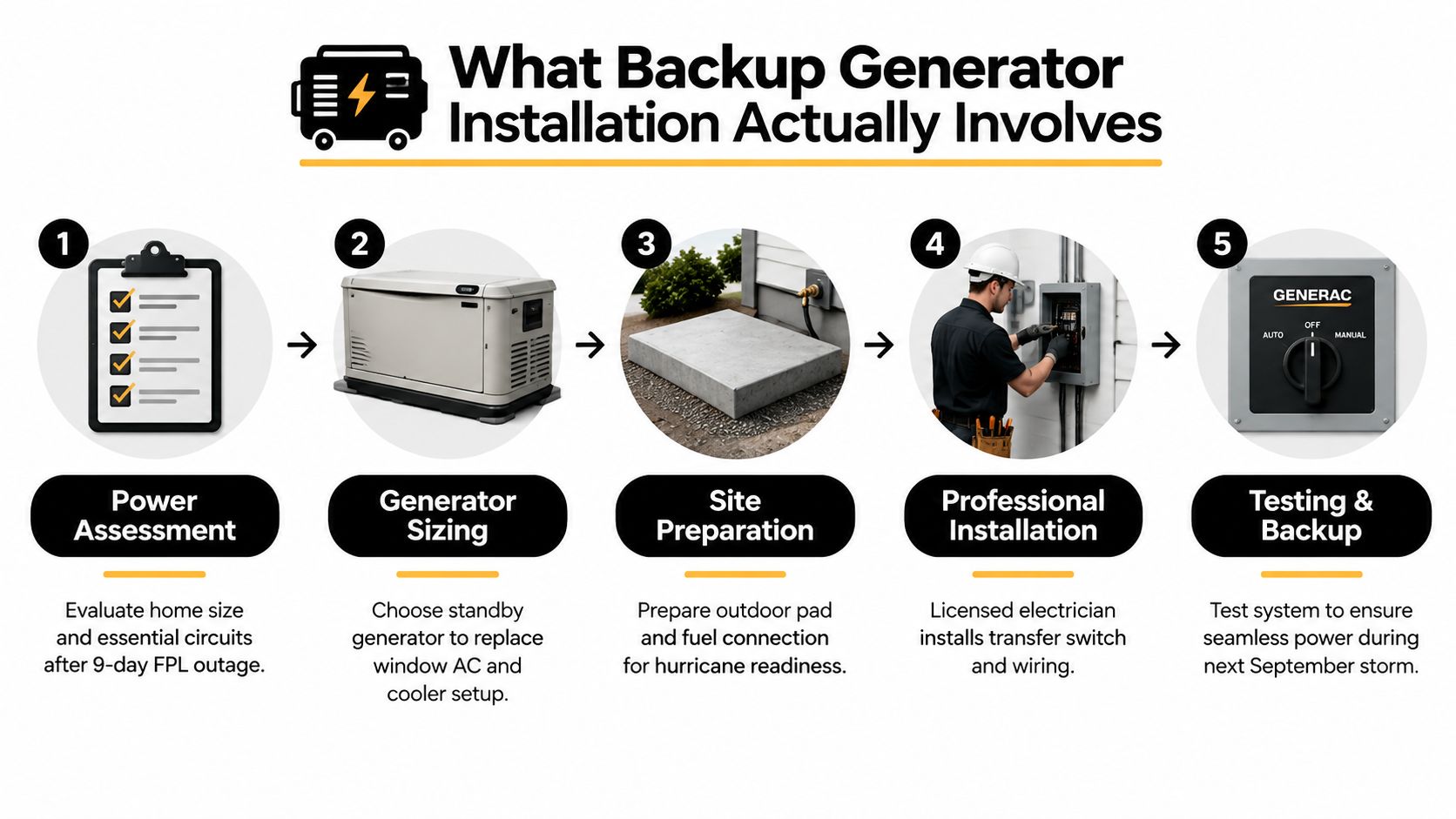
The decisions made before equipment arrives
A sound project generally follows this order:
- Define the critical loads. Identify whether the system will support refrigeration, internet, security, lighting, pumps, selected air-conditioning circuits, or nearly the entire home.
- Calculate electrical demand. Review running loads and motor-starting demands, then compare the calculation with measured panel data when practical.
- Choose the isolation method. A stationary generator connected to the building wiring requires hardwiring and an automatic transfer switch. The transfer equipment must prevent backfeeding into FPL lines, protecting utility workers and keeping the installation compliant.
- Confirm the site and fuel route. The pad, equipment clearances, exhaust direction, gas capacity, conduit path, and service access must function as one plan.
- Submit, inspect, and commission. The permit package, rough inspection, applicable FPL coordination, final inspection, automatic exercise cycle, and simulated-outage test complete the installation.
Palm Beach County inspectors will review whether the installation matches the approved plans and applicable code requirements. FPL coordination may also affect the schedule, particularly when the service equipment or utility connection is involved. Those requirements should be resolved before equipment arrives, not after the generator is set.
A typical South Florida project takes several weeks from signed contract to the first exercise test. Equipment availability, permit review, fuel work, utility coordination, and inspection scheduling often determine the calendar more than the physical installation.
Practical rule: Do not approve a generator model or pad location until the load calculation, fuel plan, transfer method, and permit pathway have been reviewed together.
Sizing the Generator for Your Home's Real Load
Generator sizing starts with the equipment you need to keep operating, not the square footage printed on the property record. A smaller home with two large air-conditioning systems may place more stress on a generator than a larger home with efficient, carefully managed loads.
The contractor should identify each selected circuit, record its running demand, and account for starting current. Motors such as compressors, well pumps, pool pumps, and some refrigeration equipment can draw substantially more power during startup than they use after reaching operating speed. The generator's nameplate should be read for both continuous or running capacity and surge capacity. Surge capacity helps with motor starting, but it isn't a substitute for an adequate continuous rating.
Two practical Palm Beach examples
Consider a single-story home of roughly 1,800 square feet with essential-circuit coverage. The requested loads include refrigeration, two air-conditioning zones, a well pump, internet equipment, lighting, and the garage door opener. A properly engineered selection may land near the 14 to 16 kW range, depending on actual equipment nameplates, starting characteristics, and load management.
A larger two-story home of roughly 3,200 square feet requesting whole-home operation, three air-conditioning zones, and an EV charger may fall between 22 and 26 kW. That number still requires verification. An EV charger or multiple compressors can change the result quickly, and a managed whole-home transfer system may be needed to prevent competing loads from starting together.
The calculation should follow the applicable NEC Article 220 method and use measured or documented load information rather than a phone estimate. For additional practical sizing guidance, review this generator sizing guide for homeowners.
Sample Generator Load Calculations for Palm Beach Homes
| Appliance / Load | Running Watts | Starting (LRA) Watts | Home A: Essential Circuits | Home B: Whole Home |
|---|---|---|---|---|
| Refrigerator | Nameplate-specific | Compressor surge | Included | Included |
| Freezer | Nameplate-specific | Compressor surge | Included where required | Included |
| Air-conditioning zone | Nameplate-specific | Compressor LRA | Two zones | Three zones |
| Well pump | Nameplate-specific | Motor starting demand | Included | Included where installed |
| Internet and security | Low continuous load | Minimal surge | Included | Included |
| Lighting | Circuit-dependent | Minimal surge | Selected circuits | Whole-home coverage |
| Garage door opener | Motor-dependent | Motor starting demand | Included | Included |
| EV charger | Manufacturer-specific | Managed or continuous load | Usually excluded | Included only after load review |
An essential-circuit design often uses a dedicated backed-up panel containing selected circuits. A whole-home system may use a service-rated transfer switch with load management, but “whole home” doesn't mean every major load can start simultaneously without controls.
Oversizing adds equipment and fuel expense without automatically improving performance. Undersizing causes voltage drop, nuisance trips, and failed air-conditioner restarts. The right selection is the smallest system that can reliably carry the planned continuous load and handle the documented starting demand.
Choosing the Right Generator Type and Fuel
During a South Florida outage, the generator choice determines who must be outside, what can run, and whether the fuel supply remains practical after a storm. A portable unit can support limited loads, but someone must place it outdoors, connect it correctly, refuel it, and start it. A listed transfer device or properly approved interlock can reduce project cost, while leaving setup and fuel management with the homeowner.
An automatic standby generator is mounted permanently outdoors and starts when the transfer equipment detects a utility interruption. Residential standby systems commonly fall within the 8 to 26 kW range. The equipment must be matched with a permanent, code-compliant transfer arrangement, and the chosen fuel must suit the property rather than the brochure.
Natural gas is convenient when the existing utility service can provide the generator's required flow and pressure. Propane works where natural gas is unavailable, but the tank must be filled before hurricane season and kept accessible for inspection and service. Fuel availability after a storm is part of the design decision.
Comparing system choices
| Type | Capacity Range | Fuel | Automation | Installed Cost (Palm Beach County) | Best For |
|---|---|---|---|---|---|
| Portable generator | Model-specific | Gasoline, propane, or dual-fuel | Manual | Lower initial project cost, but site and connection work still apply | Temporary essential loads |
| Mid-duty portable with approved connection | Model-specific | Gasoline, propane, or dual-fuel | Manual or limited | Moderate, depending on transfer equipment and panel work | Budget-conscious owners who can manage setup |
| Automatic standby generator | 8 to 26 kW | Natural gas or propane | Automatic | Higher because it includes permanent site, fuel, transfer, and permit work | Hands-off residential backup |
| Diesel standby system | Application-specific | Diesel | Automatic | More complex because of storage and fuel-system requirements | Specialized or larger installations |
The table's cost descriptions are planning categories, not quotes. Final pricing depends on the service equipment, transfer method, fuel work, site conditions, permits, and inspection requirements.
Fuel availability after a storm
Natural gas can support long-duration operation while the utility network remains available. Propane provides stored fuel at the property, but the tank level becomes part of hurricane preparation. Diesel is uncommon in typical residential work because on-site storage adds maintenance, permitting, spill-control, and fuel-quality concerns.
Dual-fuel and hydrogen-ready designs are entering some commercial and critical-facility projects. For a homeowner, the decision still centers on the complete fuel system: available supply, monitoring, maintenance arrangements, connectivity, ventilation, and long-term service. Industry coverage of standby generator technology trends also shows why resilience features belong in the design review before equipment is selected, not added after installation.
Site Preparation, Mounting, and Transfer Switch Wiring
A clean installation depends on four physical choices: where the generator sits, what supports it, how fuel reaches it, and how the system separates from the utility. In Palm Beach County, the location must also work for inspection access, service clearance, exhaust control, drainage, and property constraints.
The pad and placement
The generator needs a stable, level, noncombustible mounting surface. For a typical residential air-cooled unit weighing roughly 400 to 500 pounds, a properly prepared concrete pad is usually more defensible than loose pea rock. Loose aggregate can settle, shift, obstruct service access, or fail to provide the stable support an inspector and manufacturer expect.
Clearance is model-specific and must follow the manufacturer's installation instructions and local requirements. A common planning envelope is approximately 18 inches at the sides and 60 inches at the service front, but the approved drawing controls. Windows, doors, vents, combustible walls, fences, landscaping, and roof overhangs can affect the final location.
Exhaust must discharge away from openings and air intakes. The unit also needs enough room for oil service, filter replacement, battery access, controller inspection, and eventual repairs. A site that barely fits the enclosure may not be serviceable.
Fuel and electrical routing
Natural-gas piping must be sized for the generator's demand and the length of the run. Pressure can fall sharply across a long or undersized route, especially when other appliances operate. The gas professional should confirm the meter capacity, pipe material, regulator arrangement, shutoff location, sediment or drip-leg requirements, and pressure-test procedure before the trench is closed.
The electrical contractor normally runs protected conductors in conduit between the generator and the automatic transfer switch. The ATS may be installed beside the existing service equipment or at another approved location, depending on whether the design transfers selected loads or the whole service. Grounding and bonding must be checked against the service configuration and equipment instructions.
Transfer switch or interlock
NEC Article 702 allows compliant generator connections through a listed transfer switch or, under conditional requirements, a properly installed interlock. Utility rules and local interpretation may be stricter, and some utilities require a UL 1008 transfer switch rather than accepting an interlock. An interlock also must be listed for the specific panel and installed so the generator breaker and utility main can't be closed in a dangerous combination.
| Factor | Listed Transfer Switch (NEC 702.4) | Interlock Kit (NEC 702.6 conditional) |
|---|---|---|
| Operation | Automatic or approved manual transfer | Manual operation at the panel |
| Panel compatibility | Equipment must be properly rated and installed | Must be listed for the specific panel |
| Utility acceptance | Often the preferred service-side path | May be rejected by the utility or jurisdiction |
| Load control | Supports selected-load or whole-service designs | Depends on panel capacity and user operation |
| Backfeed protection | Built into the transfer sequence | Depends on correct interlocking and procedure |
| Best use | Permanent standby systems | Limited, approved portable-generator applications |
Before choosing between these methods, ask what the panel manufacturer, FPL, and the local authority having jurisdiction will accept. This transfer switch guide explains why the isolation device is central to safe generator integration.
Permits and Inspections in Palm Beach County
Permit sequencing matters. A contractor who buries conduit or gas piping before the rough inspection may have to expose the work again, causing avoidable delay and extra labor.
The normal sequence
The contractor begins by submitting the required building permit package through the Palm Beach County Building Division process. Depending on the project, the package may include electrical, mechanical, and plumbing or gas permits, along with the site plan, generator specifications, transfer equipment information, and load calculation.
The site plan should show the proposed generator, property lines, structure, openings, clearances, pad, gas route, conduit route, and service equipment. Manufacturer installation drawings are important because generic placement assumptions don't override the equipment's approved requirements.
A rough inspection should occur before trenches are backfilled. The inspector may need to see conduit depth, separation between utilities, warning tape, fittings, sleeves, bonding, and gas-piping installation. The project team should photograph concealed work as part of the permanent record, but photographs don't replace an inspection when the jurisdiction requires access.
Utility coordination and final signoff
If the ATS is installed on the supply side of the meter or affects the service disconnect, FPL coordination may be required before the service-side work proceeds. The contractor should identify that requirement during design, not after the equipment is mounted.
Final electrical, mechanical, and gas inspections can often be coordinated closely, but the responsible trades must ensure each part is complete and accessible. Common correction items include an unlabeled disconnect, an improperly arranged gas drip leg, inadequate working clearance around the ATS and main panel, missing bonding details, and a site that doesn't match the approved plan.
Inspection insight: Inspectors evaluate the installed system, not the sales brochure. If the pad, clearances, piping, labels, and transfer equipment differ from the approved documents, expect questions.
The homeowner should receive permit closure, manufacturer documentation, operating instructions, and commissioning records. Don't treat the generator as ready merely because it starts. It must transfer the intended loads safely and return to utility power correctly.
Costs, Timelines, and Hiring a Licensed Electrician
A generator quote should describe a complete electrical and fuel project, not only the equipment. In Palm Beach County, planning examples include a 14 kW air-cooled standby system with a 200-amp service-rated ATS, a 20 kW whole-home installation with a gas-line extension, or a 26 kW liquid-cooled system. Final pricing depends on site access, service size, panel condition, fuel distance, pad work, utility coordination, permitting, and concealed underground conditions.
Treat any range as a starting point for design discussions, not a promise. The load calculation and transfer method should come before the equipment price, because the selected loads determine both generator capacity and the electrical work required to isolate the home from FPL.
Where the project budget goes
A written proposal should separate equipment, labor, gas and electrical materials, permits, inspections, site work, and allowances for unknown conditions. This makes competing bids easier to compare and exposes omissions that can appear as “extras” after the equipment arrives.
Schedule discussions need the same care. The full process can extend well beyond the physical installation because design, permit review, equipment delivery, utility coordination, and inspections all affect completion. Permit issuance and equipment availability may control the calendar, while the on-site installation itself can take much less time.
Vet the contractor before signing
Ask each electrical contractor for:
- License verification: Confirm the Florida electrical contractor license through the state licensing system.
- Insurance documentation: Request proof of general liability and workers' compensation coverage.
- Relevant references: Speak with South Florida customers whose projects included standby generator work, not only general electrical repairs.
- Written engineering basis: Require the load calculation, equipment schedule, transfer method, fuel scope, permit responsibility, and commissioning plan.
- Clear exclusions: Confirm whether pad construction, gas work, trenching, FPL coordination, restoration, and inspection corrections are included.
A contractor should also explain which loads will remain on the backed-up panel and how load management affects the design. A proposal that names only a generator size leaves too much of the decision unresolved.
Homeowners can use this electrician lead generation guide to understand how electrical-service companies organize inquiries and qualification. For the actual project, prioritize licensing, insurance, documented standby experience, and a scope that matches Palm Beach County inspection requirements. A directory of standby generator installers can help frame questions before requesting site visits.
Commissioning, Testing, and Ongoing Maintenance
通電與最終檢查不是工程的終點。試運轉要確認控制器、引擎、切換設備、斷路器、接地、燃料供應與備用迴路能作為完整系統運作。Palm Beach County 的檢查重點不只在設備是否啟動,也包括公用電源與發電機是否正確隔離,以及實際供電範圍是否符合設計。
技師應執行自動測試週期,依製造商規格確認轉換性能,並在受控條件下模擬停電。測試時,主電源會被斷開,發電機啟動,ATS 將指定負載轉移到發電機供電。若系統採用負載管理,非必要迴路應保持斷開。恢復公用電源後,ATS 應正確重新轉換,發電機則完成冷卻與停機程序。測試結果、異常狀況與修正內容都應留存紀錄,方便日後維修及檢查追蹤。
NFPA 110 依故障可能造成的後果,將緊急電力系統分為 Level 1 與 Level 2。住宅系統仍應依核准設計、設備說明與當地檢查要求執行,不要只看發電機能否運轉。維護品質會直接影響啟動可靠度。定期保養能及早發現電池、燃料、接線、冷卻與控制元件的問題。The maintenance presentation from Curtis Power Solutions列出的常見故障模式,也包括燃料污染、電纜腐蝕、散熱器堵塞、皮帶與軟管老化,以及控制故障。
Standby Generator Maintenance Schedule for Palm Beach Homes
| Task | Air-Cooled Standby | Liquid-Cooled Standby |
|---|---|---|
| Exercise test | Monthly loaded exercise, following the service plan | Monthly loaded exercise, following the service plan |
| Oil and filter | Based on run hours and manufacturer instructions | Based on run hours and manufacturer instructions |
| Spark plugs | Inspect or replace according to the engine schedule | Usually not applicable in the same form |
| Coolant | Not applicable to many air-cooled units | Check level, condition, hoses, and cooling system |
| Battery | Conductance and terminal inspection | Conductance and terminal inspection |
| Valves | Adjust according to engine service requirements | Adjust according to engine service requirements |
| Post-storm review | Check enclosure, wiring, fuel connections, debris, and water intrusion | Check enclosure, controls, fuel system, cooling system, and water intrusion |
| Records | Keep exercise, service, and repair logs | Keep exercise, service, and repair logs |
NFPA 相關指引要求發電機組至少每月運轉一次,每次至少 30 分鐘。若現場負載無法達到銘牌容量的 30%,指引建議每年進行負載箱測試,分階段以 25%、50% 與 75% 負載測試,總時間為兩小時。這些測試可在暴風雨或停電前暴露電池電力不足、燃料變質、電纜腐蝕、散熱器堵塞、皮帶磨損、軟管老化,以及感測器或控制器故障。
停電後也要檢查外殼、進水、碎屑、燃料接頭與線路。南佛羅里達的高溫、潮濕、鹽分與颶風 debris 都會加速劣化,維修紀錄應包含測試日期、運轉狀況、保養項目與待處理缺陷。Lighthouse Energy Services 為 Palm Beach County 住宅與商業客戶提供負載評估、切換開關安裝、電氣整合、許可支援、測試與試運轉服務。可透過 Lighthouse Energy Services 預約現場評估,確認備用發電機安裝符合核准設計與當地要求。