
A transfer switch is a safety device that lets a building switch electricity between the utility grid and a backup generator without backfeeding power into utility lines. The National Electrical Code requires one whenever a generator powers a building's wiring system.
After a storm rolls through Palm Beach County, the outage itself is only the first problem. A homeowner may have a portable generator ready in the garage, but the important question is how to connect it to the house without energizing the utility lines or damaging the building's electrical system. Property managers face the same decision on a larger scale, especially when a building needs reliable power for pumps, refrigeration, security systems, elevators, or other critical equipment.
A transfer switch creates a controlled connection between the generator and the electrical panel. It disconnects the utility source before connecting the generator, so both sources can't feed the building at the same time. That simple sequence protects utility workers, equipment, occupants, and the property itself.
Table of Contents
- Why Your Generator Needs a Transfer Switch
- How a Transfer Switch Works
- Manual vs Automatic Transfer Switches
- Sizing Your Transfer Switch for the Right Load
- Safety Codes and Permit Requirements
- Costs Maintenance and When to Call a Professional
Why Your Generator Needs a Transfer Switch
A hurricane-related outage can leave a portable generator ready in the garage while the house remains without power. Approved extension cords may run individual appliances, but they do not safely energize the building's hard-wired circuits. Connecting a generator to a panel or wall receptacle without listed transfer equipment can send current backward through the wiring and onto utility conductors that line workers may believe are de-energized.
That condition, called backfeeding, is the central reason a generator connection needs engineered source isolation. A transfer switch works like a controlled gate between the utility service, generator, and building panel. It separates one source before allowing the other to supply the selected loads.
In North America, equipment must be selected and installed under applicable electrical requirements, including NFPA 70, NFPA 110, and UL 1008 standards for transfer switch equipment. The listing is not just paperwork. It addresses how the equipment switches sources, withstands fault current, and fits the system's voltage and grounding arrangement.
Practical rule: If a generator will supply any part of a building's wiring, use listed transfer equipment designed for that electrical system rather than an improvised connection.
The National Electrical Code requires transfer equipment when a portable or standby generator supplies a building's wiring system. The installation must prevent an unplanned interconnection between utility and generator power. Whether the switch is service-rated or installed downstream, its enclosure, overcurrent protection, interrupting capability, and source isolation must match the installation.
What happens without one
Skipping the switch can create several risks at once:
- Worker danger: Backfeed may energize utility conductors during an outage and expose line crews to lethal voltage.
- Equipment damage: Utility restoration or an incorrectly connected generator can damage the generator, panel, and connected appliances.
- Fire exposure: Overloaded conductors, loose terminations, or unsuitable equipment can overheat.
- Inspection problems: Missing listed equipment, incorrect neutral handling, or inadequate source isolation can cause an installation to fail inspection.
- Insurance and liability concerns: Unpermitted or unsafe electrical work can complicate claims and increase the property owner's responsibility.
The switch also defines which circuits receive generator power. A portable unit may serve selected circuits through a dedicated transfer panel, while a permanently installed standby system may supply a larger portion of the building. The design depends on service rating, generator output, voltage, phase, grounding and neutral bonding, fault current rating, and the loads that must operate during an outage. Multi-voltage buildings may need separate arrangements so a generator does not place the wrong voltage on sensitive equipment.
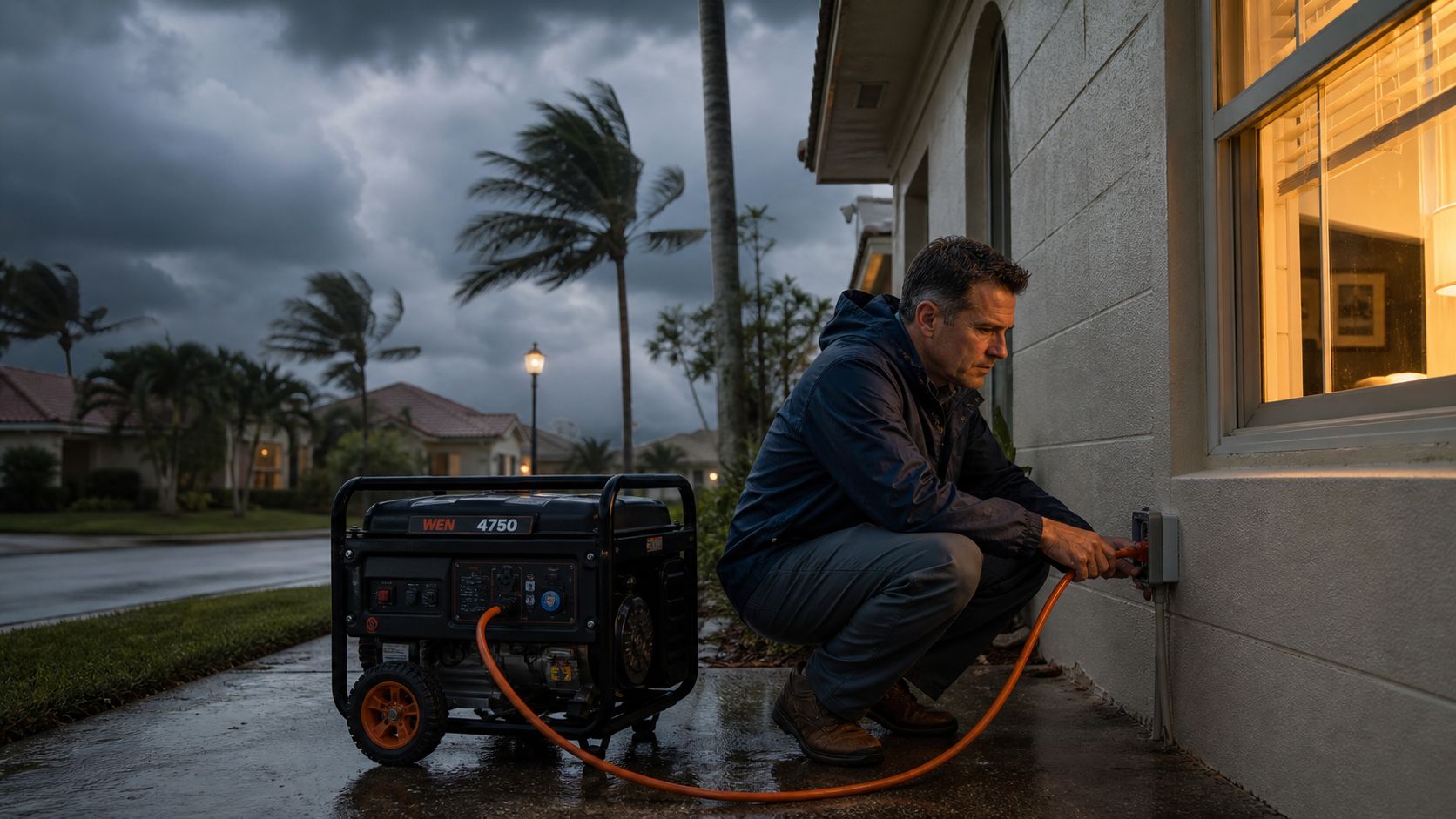
For a homeowner, backed-up circuits might include refrigeration, selected lighting, internet equipment, or a well or lift pump. A property manager may need life-safety equipment, access control, emergency lighting, or elevator systems. Elevator equipment has operating and control requirements that differ from an ordinary receptacle circuit, so understanding elevator backup power helps clarify why it needs separate planning.
A licensed electrician must determine whether the project needs a service-rated switch, a downstream switch, a switched neutral, or an enclosure suited to the location. Homeowners considering a permanent system can review standby generator installation in Palm Beach County before selecting equipment, then have the final design based on a site-specific electrical evaluation and local permit requirements.
How a Transfer Switch Works
During a utility outage, the transfer switch controls which power source can feed the building. Utility power enters through one path, and generator power enters through another. The mechanism permits only one source to connect to the building at a time, preventing an energized generator from feeding utility lines.
A typical transfer sequence uses break-before-make operation. The switch opens the connection to the source serving the load, confirms that the sources are separated, then closes the connection to the other source. The brief interruption is intentional. It prevents the two supplies from overlapping, even for an instant.
The switching sequence
Manual and automatic systems follow the same electrical principle. The operator or control board performs different parts of the sequence.
- Utility power is monitored or selected. During normal operation, the building receives utility power while the generator remains isolated.
- The outage is identified. An automatic controller senses a loss or unacceptable utility condition. A manual system depends on an operator recognizing the outage.
- The generator starts when applicable. An automatic transfer switch sends a start signal to a compatible standby generator. With a manual switch, the operator starts the portable or standby unit.
- The source is separated. The transfer mechanism opens the utility contacts before closing the generator contacts.
- The load is transferred. The selected circuits or building service receive generator power through the transfer equipment.
- Utility power returns. An automatic system waits for acceptable utility conditions, transfers the load back, and allows the generator to cool before stopping.
A mechanical interlock controls the most important safety action. It physically prevents both source contacts from closing together. Some equipment uses a double-throw assembly, while other approved systems use a related interlocking arrangement. The construction can vary, but the result must be the same: no position may accidentally connect both sources.
Where the switch sits
A service-rated transfer switch can serve as the service disconnect when installed in the correct location within the electrical distribution system. It includes the features required for that role. A non-service-rated switch normally sits downstream of an existing service disconnect and does not replace that upstream equipment.
The neutral requires separate attention. If the generator neutral is bonded to its frame, the installation may require a switched neutral so the grounding point exists in only one place at a time. If the generator neutral floats, the neutral generally is not switched, and the grounding arrangement remains tied to the service equipment.
The transfer switch must match the generator's neutral architecture. That choice affects fault-current paths, bonding, and whether the generator functions as a separately derived system. Technical guidance on neutral switching explains why the decision belongs in the design rather than as a last-minute wiring adjustment.
A wrong neutral arrangement can cause nuisance tripping, objectionable current on grounding paths, or an inspection failure. An electrician therefore verifies the generator, transfer switch, service equipment, and grounding conductors as one system. Work involving the building panel also needs the same care as a major electrical upgrade, including a review of whether electrical panel replacement belongs in the project.
Manual vs Automatic Transfer Switches
The best transfer switch isn't automatically the most complex model. It should match the generator, the loads, the building's occupancy, and the amount of time someone can spend operating the system during an outage.
A manual transfer switch requires a person to start the generator, confirm that it's producing suitable power, and move a handle or selector. It works well with a portable generator and a selected-circuit setup in a smaller home. The homeowner must be present, understand the operating sequence, and manage the generator load.
A semi-automatic switch occupies the middle ground. Depending on the design, it can detect an outage or initiate generator starting, but it still requires manual confirmation before the load transfers. This approach can suit a building where staff want control over the final connection but don't want to perform every step from scratch.
An automatic transfer switch, or ATS, continuously monitors the utility source. When the controller identifies a failure, it signals the standby generator, waits for generator voltage and frequency to stabilize, transfers the load, and later returns the load to utility power. Automatic equipment is particularly useful when occupants may be away, when the property has frequent outages, or when critical equipment can't wait for someone to arrive.
| Feature | Manual MTS | Semi-Automatic | Automatic ATS |
|---|---|---|---|
| Response | Depends on an operator | Partly automated, with manual approval | Automated after the generator reaches operating conditions |
| User involvement | Start, verify, transfer, and retransfer | Confirm key steps | Mainly periodic testing and maintenance |
| Complexity | Mechanically simple | Moderate control complexity | More controls, sensing, and generator integration |
| Best fit | Portable generator and selected circuits | Managed facilities needing operator control | Permanent standby systems and critical loads |
| Main trade-off | Lower convenience during an outage | Balanced control and automation | Greater equipment and installation complexity |
Matching the switch to the property
For a seasonal residence, a manual switch may be practical if a responsible person can reach the property and operate the generator safely. A year-round home with a permanently installed standby generator usually benefits from automatic operation, particularly if refrigeration, medical equipment, pumps, or security systems need prompt support.
Commercial buildings need a more deliberate assessment. A retail space may prioritize refrigeration and point-of-sale equipment. An office may need communications, access control, and limited lighting. A multifamily property may need life-safety systems, elevators, fire pumps, or other loads subject to separate requirements.
A switch's purchase price is only one part of the decision. A lower-complexity manual system may require more attention during every outage, while an ATS demands correct controls, generator compatibility, commissioning, and ongoing testing. The right question isn't “Which switch costs less?” It's, “Who needs power, how quickly, and who will operate the system when the storm arrives?”
Sizing Your Transfer Switch for the Right Load
Transfer switch selection should match the generator, the loads, the building's occupancy, and how quickly power is needed during an outage. Start with the building's electrical service and intended load, then verify voltage, current, phase configuration, fault conditions, conductor arrangement, and grounding design.
Automatic transfer switches are available for several voltage levels, including 120, 208, 240, 480, and 600 volts. Their continuous current ratings can range from 30 amperes to 4,000 amperes, with common sizes including 100, 200, 400, 800, 1,200, 2,000, 3,000, and 4,000 amperes, according to automatic transfer switch specifications. These ratings describe what the equipment can handle continuously. They do not determine how much power the generator can produce.
Three questions determine the specification
Voltage comes first. A typical home may use a 120/240-volt single-phase arrangement. Commercial properties may use 208-volt or 480-volt three-phase power. The generator, transfer switch, distribution equipment, and connected loads must use compatible voltage arrangements. A multivoltage switch still requires correct field configuration.
Current determines switch capacity. A whole-home installation on a 200-amp service generally needs transfer equipment that can handle that service rating, even if the generator cannot operate every connected load simultaneously. Load management or selected-circuit design can restrict operation during an outage. It must still coordinate with the service rating, overcurrent protection, and conductor sizes.
Phase affects compatibility. A single-phase generator cannot replace a three-phase source for equipment that requires three-phase power. Motors, pumps, elevators, refrigeration equipment, and industrial machinery may also create starting-current demands that require review before the equipment is selected.
Fault performance matters as much as normal load. The switch needs an appropriate short-circuit current rating, including withstand and closing capability. Available fault current varies by property and utility service. An electrician verifies the prospective fault current and coordinates the transfer equipment with upstream breakers or fuses. A switch that carries the running load can still be unsuitable for the building's fault conditions.
Neutral and grounding choices
Neutral handling determines how current returns to the source and how the grounding system operates. A bonded generator neutral may require a switched-neutral transfer switch, while a floating-neutral generator may use a solid neutral arrangement. The selection also affects whether the generator operates as a separately derived system. The generator, transfer switch, panelboards, and grounding electrode connections must be evaluated together.
| Application | Generator Size | Transfer Switch Amps | Voltage/Phase | Neutral Config |
|---|---|---|---|---|
| Selected home circuits | Determined by essential loads | Matched to the selected-circuit equipment | Commonly 120/240V single-phase | Depends on generator bonding |
| Whole-home residential service | Determined by load calculation | Matched to service and protection | Commonly 120/240V single-phase | Switched or solid neutral as designed |
| Commercial distribution | Determined by connected and critical loads | Selected from the service and load requirements | Commonly 208V or 480V three-phase | Engineering and grounding review required |
A commercial property may use more than one voltage arrangement. Configurable multivoltage equipment can support that situation. A 2026 multivoltage transfer switch announcement describes equipment supporting 208 to 480 volts up to 600 amperes. That flexibility may simplify specification and inventory, while site-specific fault-current, load, and grounding reviews remain necessary.
For homeowners, begin with a load calculation and service inspection. A residential electrical evaluation can identify panel limitations, conductor conditions, grounding concerns, and the circuits that need generator support. In Palm Beach County, those findings also help define the equipment and installation details that should be reviewed during permitting and inspection.
Safety Codes and Permit Requirements
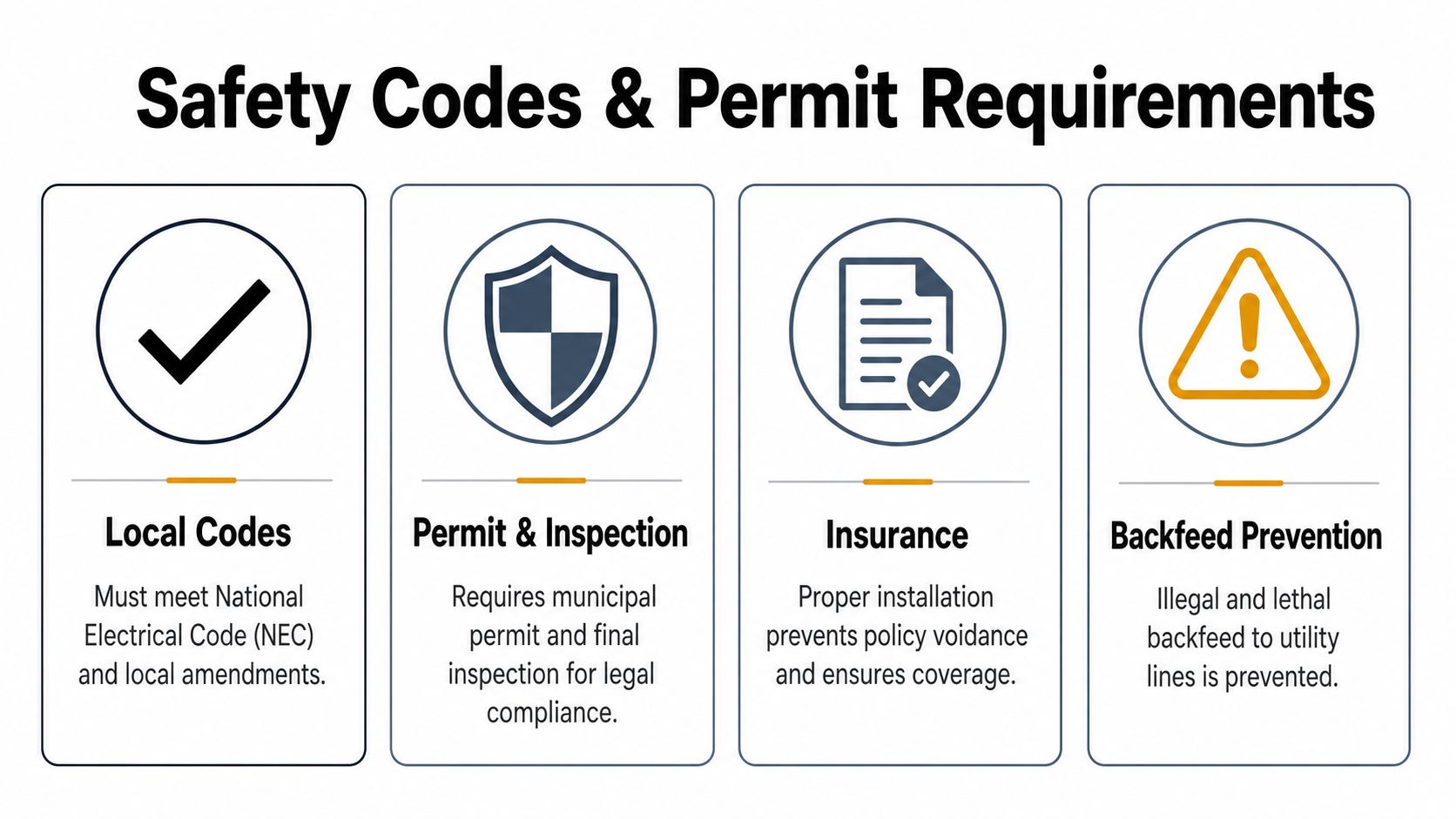
Code compliance protects people before, during, and after an outage. The permit is evidence that the installation entered the local review process, but the core protection comes from selecting listed equipment, applying the correct wiring method, verifying source isolation, and testing the finished system.
Different generator applications fall under different National Electrical Code categories. Article 700 addresses emergency systems, Article 701 addresses legally required standby systems, and Article 702 addresses optional standby systems commonly used in homes. Article 445 applies to generator installations. The installation also needs to satisfy the product requirements associated with UL 1008, which covers transfer switch equipment.
The source-isolation requirement is the central safety principle. A listed, electrically operated and mechanically held device must prevent utility and generator sources from being interconnected inadvertently. Generator requirements guidance describes the need for transfer equipment that prevents an intermediate position from connecting both sources.
Palm Beach County project checks
A generator transfer installation in Palm Beach County normally needs coordination with the local building authority and the applicable utility requirements. The electrical contractor should determine the permit path, submit the required electrical information, arrange inspections, and confirm any utility documentation before the system is energized.
The exact process can vary with the municipality, property type, service arrangement, and generator location. A contractor should verify requirements before work begins rather than assuming a residential process applies to a commercial or multifamily property.
Inspection failures commonly arise from details that look minor until the system operates:
- Neutral and bonding errors: Unapproved neutral-to-ground connections can place current on grounding paths.
- Grounding conductor problems: An undersized or improperly terminated grounding conductor can compromise fault clearing.
- Incorrect switch rating: Voltage, ampacity, phase, or fault-current ratings may not match the service.
- Poor working clearance: The enclosure needs accessible space for operation, inspection, and maintenance.
- Missing labels or disconnect information: Service personnel need clear identification of normal and alternate sources.
- Improper enclosure selection: Outdoor equipment needs an enclosure suited to its exposure and location.
A transfer switch can be mechanically installed and still be electrically wrong. Inspection depends on the complete system, not just whether the box is mounted on the wall.
Property owners also need to think beyond the final inspection. Unpermitted generator work can create problems with future electrical modifications, property transactions, insurance reviews, and responsibility for injuries. If a contractor proposes connecting a generator without a listed transfer device, or suggests bypassing the permitting process, treat that as a serious warning sign.
A qualified electrician can document the existing service, identify the available fault current information, confirm the generator's neutral arrangement, select compatible transfer equipment, and test the system before requesting final approval. That process costs less than correcting an unsafe installation after a storm.
Costs Maintenance and When to Call a Professional
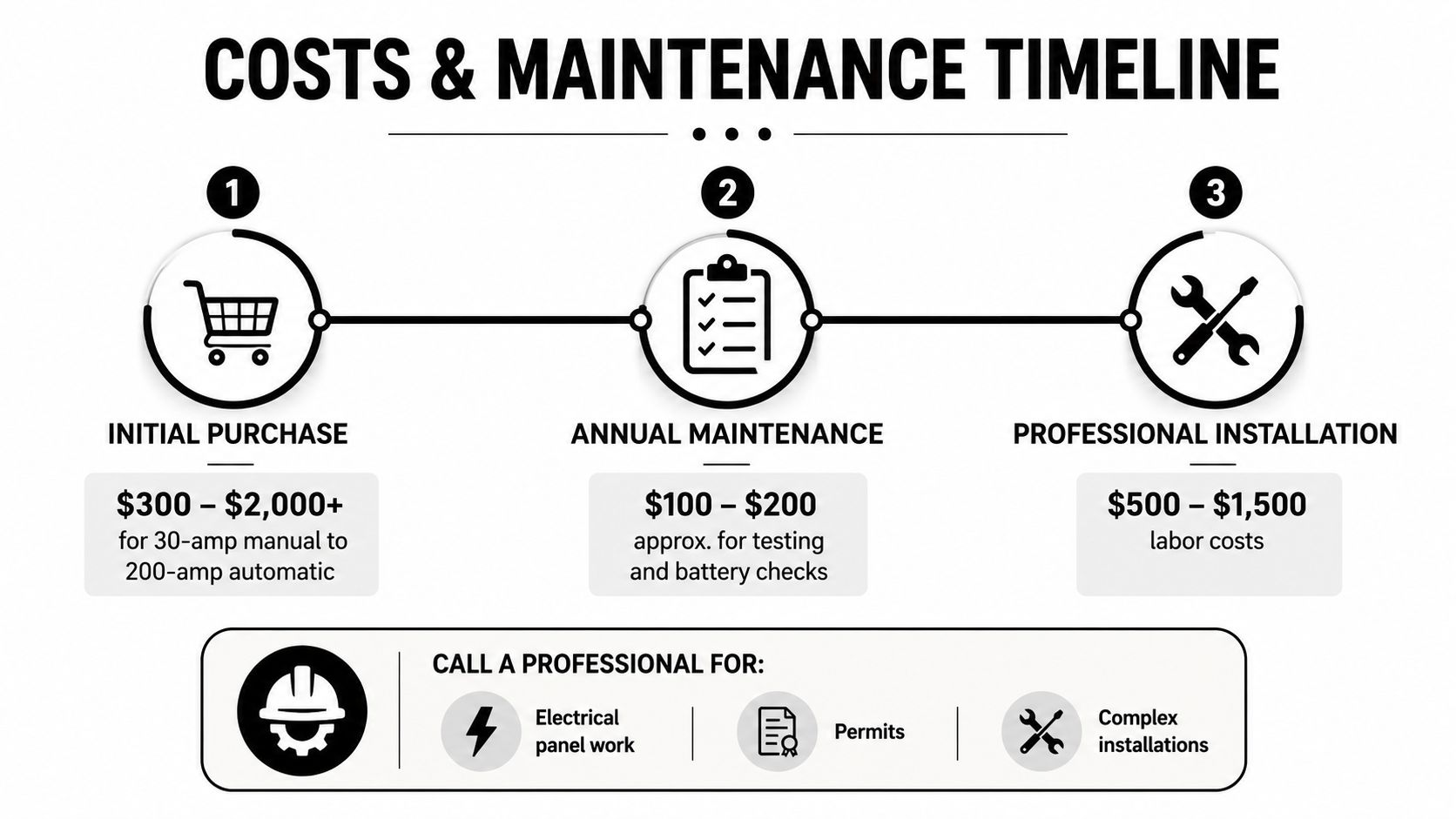
The purchase price doesn't tell you what a transfer switch system will cost to own. Equipment selection, service modifications, conduit routing, generator location, permits, commissioning, and future testing all affect the project. A simple portable-generator arrangement has a different scope from a whole-building automatic system serving a commercial service.
Before accepting a proposal, ask for a clear breakdown of:
- Equipment: Transfer switch, enclosure, controls, inlet or generator connection, and protection.
- Installation: Conductors, conduit, panel modifications, mounting, terminations, and labeling.
- Compliance: Permit coordination, inspections, testing, and required documentation.
- Maintenance: Generator servicing, transfer operation, battery checks where applicable, and inspection of connections.
Maintenance protects the mechanism
A transfer switch contains contacts and moving parts that must remain clean, properly connected, and free from corrosion. Coastal Palm Beach County conditions can expose outdoor equipment to salt air, humidity, wind-driven rain, and storm debris. Keep the enclosure closed, and don't store chemicals, tools, or other materials against it.
A practical maintenance routine includes:
- Visual checks: Look for corrosion, water entry, discoloration, damaged conduit, loose covers, or burning odor.
- Controlled exercising: Test the generator and transfer sequence according to the equipment instructions, without creating an unsafe live-work condition.
- Professional inspection: Have an electrician inspect connections, controls, source isolation, and operating behavior.
- Post-storm review: Check outdoor equipment after flooding, wind damage, water intrusion, or visible impact.
Don't remove covers or tighten energized connections yourself. A transfer switch can remain connected to a live utility source even when the generator is turned off.
Know when the system needs help
Call a qualified professional when you're installing a new generator, replacing a service panel, changing the generator's neutral configuration, upgrading from portable to standby power, or correcting a failed inspection. A professional should also evaluate any switch that makes unusual sounds, shows heat damage, smells burned, fails to transfer, transfers unexpectedly, or trips repeatedly.
Lighthouse Energy Services works with Palm Beach County homeowners, property managers, commercial facilities, and industrial sites on generator connections, transfer equipment, panel work, troubleshooting, and emergency electrical service. The contractor can review the existing service, identify the correct transfer-switch arrangement, coordinate permitting, and test the completed installation.
A transfer switch should be treated as part of the generator system, not as an accessory added after the generator purchase. When the switch, generator, panel, grounding, protection, and permits all align, the building has a safer and more dependable path through the next outage.
If you're planning generator backup or need an existing transfer switch inspected, contact Lighthouse Energy Services for help with sizing, installation, permitting, troubleshooting, and testing in Palm Beach County. Ask for a system review before purchasing equipment so your generator and transfer switch work together safely when utility power fails.