The hurricane alert hits your phone in the afternoon. By evening, the gas stations are crowded, the grocery shelves are thinning out, and everyone in West Palm Beach is doing the same mental checklist. Water. Batteries. Flashlights. Phone chargers. Then the bigger question lands: what happens if the power stays out for days, not hours?
That's when a whole-house generator stops sounding like a luxury item and starts looking like part of the house itself. Not because it's flashy, but because it keeps the basics running when the grid doesn't. Air conditioning, refrigeration, lighting, garage access, internet, alarm systems, and the routine parts of home life that become a lot more important when a storm is sitting over South Florida.
A lot of homeowners start shopping for a generator by looking at brand, size, and price. Those matter. But in West Palm Beach, two issues cause more delays and bad decisions than almost anything else: HOA approval and fuel reliability during a multi-day outage. If you miss either one, you can end up with a system that's delayed, relocated, or less dependable when you need it most.
Table of Contents
- The Storm Is Coming Are You Ready
- Why a Generator Is a Critical Investment in Palm Beach County
- Choosing Your Power Plant Sizing and Fuel Type
- West Palm Beach Codes and HOA Rules for Generators
- The Generator Installation Process Step by Step
- Understanding Generator Costs and Financing in Florida
- How to Choose Your Electrical Specialist in West Palm Beach
The Storm Is Coming Are You Ready
The most common call comes right before a storm watch turns serious. A homeowner has lived through enough outages to know the routine. The refrigerator warms up, the house gets uncomfortable fast, the internet drops, and the garage door becomes a problem at exactly the wrong time. They're not asking abstract questions anymore. They want to know how to keep the house functioning.
That's a familiar situation in West Palm Beach because storm prep isn't theoretical here. You're not planning for some rare event. You're planning for a season where losing power is always on the table. A standby generator gives you something most storm prep doesn't: control. When utility service fails, the home doesn't go dark and disorganized.
For homeowners thinking through the full picture, a broader guide to Florida home weather protection is useful because backup power works best as part of a larger storm-hardening plan, not as a stand-alone purchase.
A generator doesn't stop the storm. It stops the outage from taking over the house.
The peace of mind is real, but the practical side matters more. If someone in the home depends on refrigerated medication, medical equipment, reliable cooling, or remote access for work, the stakes go up quickly. Even without those issues, it's generally undesirable to spend the first day after a storm hunting for fuel, extension cords, or a place to stay.
A properly installed whole house generator in West Palm Beach is about continuity. The key is installing the right one, in the right place, under the right local rules.
Why a Generator Is a Critical Investment in Palm Beach County
In Palm Beach County, a standby generator is less about convenience and more about keeping the house usable after the grid goes down. Power outages here are tied to tropical weather, heat, flooding, and utility restoration delays. For many homeowners, the main question is not whether backup power would be nice. It is whether the home can function safely for several days without it.
That matters more in West Palm Beach than in places with mild weather and shorter outage windows. A house without air conditioning, refrigeration, internet, working garage access, or powered security systems gets difficult fast. If someone in the home relies on refrigerated medication, medical equipment, or remote work connectivity, the problem goes from inconvenient to serious.
A standby system also has value before the first outage happens. In this market, buyers understand storm exposure and ask practical questions about resilience, not just finishes and square footage. As noted in this West Palm Beach standby generator overview, installation cost commonly varies with system size, fuel choice, and site conditions. Those same factors affect long-term reliability, which matters more than nameplate specs during a multi-day storm event.
The real benefit is continuity
A properly installed whole house generator keeps the house operating in a controlled way during utility failure. That includes:
- Cooling and humidity control: South Florida homes can heat up and trap moisture quickly after an outage.
- Food and medication storage: Refrigerators and freezers stay online.
- Security and access: Alarm panels, cameras, gate operators, exterior lighting, and garage doors can keep working.
- Basic communication: Routers, phones, charging equipment, and home office gear remain available.
- Sump, lift, or specialty equipment: Some homes have systems that cannot sit idle for long.
Those are practical protections. They reduce disruption, prevent avoidable loss, and make it easier to stay in the house instead of leaving at the worst time.
There is also a local issue many homeowners miss at the start. The generator itself is only part of the project. In West Palm Beach, HOA approval, placement restrictions, noise concerns, fuel availability, and municipal code requirements often decide whether the installation goes smoothly or stalls out. That is one reason planning early matters. It gives enough time to choose a fuel source that will hold up through a long outage and to get ahead of HOA review before storm season pressure hits.
Waiting creates expensive problems
Last-minute generator purchases usually lead to rushed decisions. I see the same mistakes over and over: equipment sized from a sales sheet instead of a load calculation, a placement plan that does not clear code setbacks, or a fuel choice that looks fine on paper but becomes a problem after two or three days without utility service.
A better approach is to treat the generator as part of the home's storm infrastructure. Start with the loads that are essential to run, then review the property constraints, HOA rules, and fuel options. If you want a sizing reference before meeting with an installer, this home generator sizing guide for Florida homeowners is a useful starting point.
In Palm Beach County, this is a resilience decision first and a home upgrade second. Homeowners who plan early usually end up with a system that passes inspection, satisfies the HOA, and keeps running when the outage lasts longer than expected.
Choosing Your Power Plant Sizing and Fuel Type
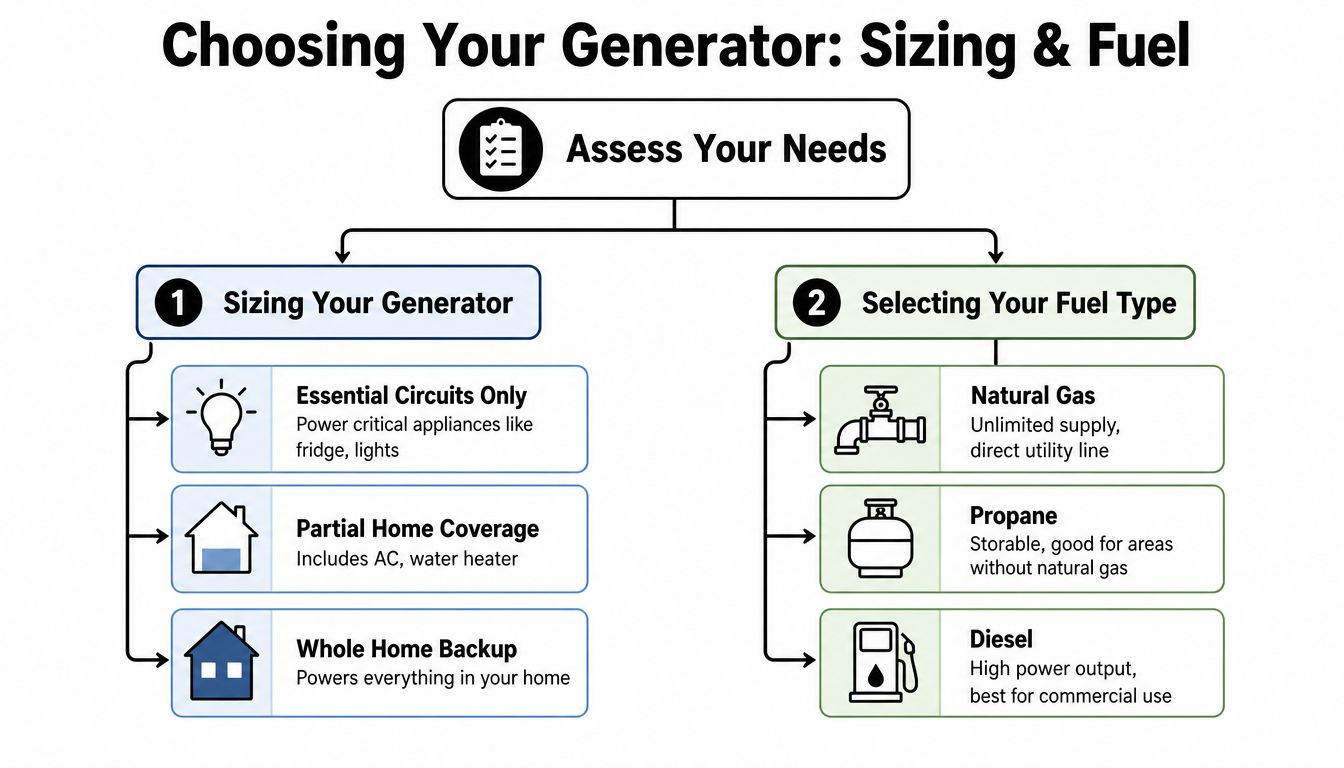
Generator sizing starts with one question. What has to stay on when the utility drops out for several days?
That answer is different for a condo-sized home, a two-story house with multiple AC systems, and a waterfront property with pool equipment, elevators, or a large well pump. In West Palm Beach, I usually see standby systems in the 18 kW to 48 kW range for typical residential backup plans, while larger custom homes can go much higher. The right number comes from a real load calculation, not a sales estimate. If you want a plain-language primer before meeting with an installer, this home generator sizing guide for Florida homeowners is a useful starting point.
What size actually means in a real house
A proper sizing review looks at how the house behaves under backup power, not just at the total square footage.
| Backup approach | What it usually covers | Best fit |
|---|---|---|
| Essential circuits | Refrigerator, lights, internet equipment, a few outlets | Homeowners focused on food safety, basic cooling, and communications |
| Partial home coverage | Essentials plus selected larger loads such as one AC system or water heating | Households that want comfort without carrying every circuit |
| Full home backup | The house runs close to normal, including major mechanical loads if the calculation supports it | Owners who want nearly normal operation during an outage |
The trade-off is straightforward. Bigger units carry more load, but they also cost more, use more fuel, and may create more placement problems on a tight lot.
Motor starting current matters too. Air conditioners, pool pumps, refrigerators, and well pumps draw far more power at startup than they do while running. A generator that looks adequate on paper can still bog down if too many motors hit at once. That is why a good electrician reviews the panel schedule, confirms the service size, checks major equipment nameplates, and decides whether certain loads need priority controls or load shedding.
Fuel choice during hurricane season
Fuel choice is where a lot of West Palm Beach projects go wrong.
Brochures treat fuel as a preference. In hurricane country, fuel is part of the reliability plan. The question is not which option sounds convenient on install day. The question is what will still be working on day three of a widespread outage, when roads are blocked, deliveries are delayed, and utility restoration is uneven.
Here is the practical breakdown:
- Natural gas works well if your neighborhood has stable gas service and the utility infrastructure is dependable in storms. The big advantage is that you are not relying on tank refills.
- Propane gives you stored fuel on site. That matters to homeowners who want more control during a long outage, especially if they are planning for several days without normal deliveries.
- Diesel is less common for standard residential standby in this market, but it can make sense for some large-load applications where storage and maintenance are handled correctly.
There is no perfect answer. Natural gas avoids refill logistics, but it still depends on utility service. Propane gives you independence from the gas utility, but runtime depends on tank size and how much load the generator is carrying. A house trying to run two AC systems, water heating, cooking equipment, and pool loads will burn through fuel much faster than a house backing up one cooling zone, refrigeration, lighting, and internet.
For West Palm Beach homeowners, the two hidden issues are usually fuel endurance and property restrictions. A propane setup may be the better storm choice for one house, then become harder to approve because of tank placement, screening, or lot-line constraints. A natural gas unit may be easier to fit, but less appealing to an owner who wants stored fuel on site for a long hurricane outage.
This part needs an honest conversation with the installer. Ask how long the system will run at 50 percent and 100 percent load. Ask what loads should be left off during extended outages. Ask whether the fuel choice still makes sense if the outage lasts four or five days instead of one. That is how you end up with a generator that works in the conditions West Palm Beach homeowners face.
West Palm Beach Codes and HOA Rules for Generators
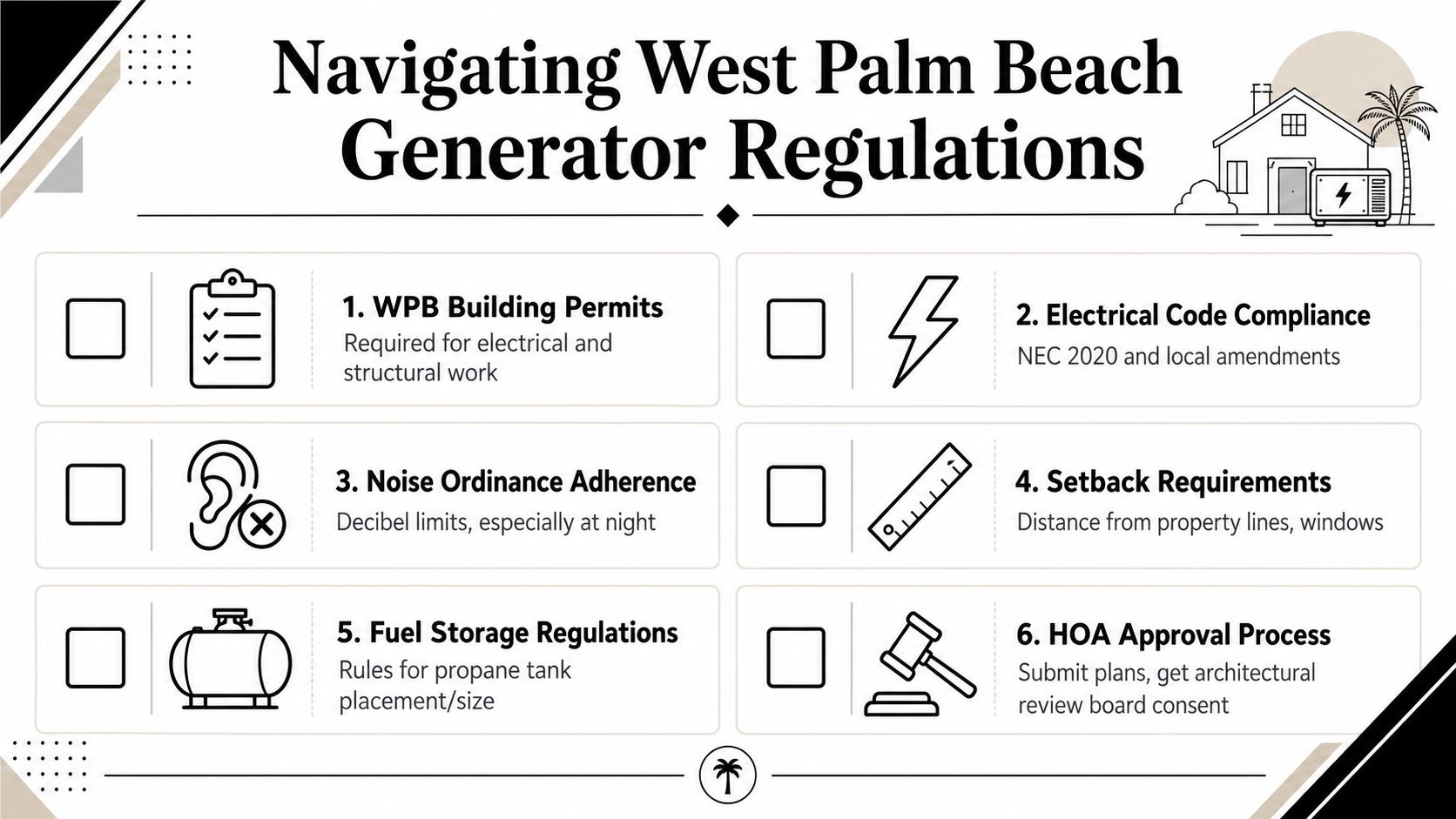
A West Palm Beach generator job can look simple on paper, then stall for weeks over one avoidable problem. The usual trouble spots are placement, permitting, and HOA approval. The electrical work only moves after those three pieces line up.
In Palm Beach County, standby generators are reviewed closely because they affect life safety, utility isolation, fuel systems, and property setbacks. Inspectors want to see an automatic transfer switch installed correctly so the generator cannot backfeed the utility. They also check grounding and bonding, working clearances, outdoor wiring methods, and exhaust location near doors, windows, and air intakes. If the unit is squeezed into a side yard without enough service access or setback clearance, that problem usually shows up before final approval.
The local code issue homeowners miss most often is the site plan. A permit set needs more than the generator model and an address. It should show the pad location, distances to openings and property lines, the fuel route, the transfer equipment, and how a technician will service the unit once it is in place.
HOA review is often the harder part.
Many West Palm Beach communities care as much about appearance and noise as they do about safety. I regularly see boards ask for screening details, color or finish notes, pad dimensions, and a clear view of the proposed location from the street and neighboring lots. Some also want to know whether the fuel line or electrical conduit will cross common areas, pass under pavers, or run along an exposed wall.
That matters because the best electrical location is not always the easiest HOA approval. A side yard near the meter may shorten conduit and gas piping, but it can create visibility issues, violate setback rules, or put the unit too close to a bedroom window or pool equipment area. A rear-yard location may satisfy the HOA and create a cleaner look, but it can raise installation cost because trenching, pipe runs, and voltage drop all get harder.
For hurricane planning, this Florida hurricane backup generator installation guide is a useful reference because it addresses Florida storm conditions, not just generic standby setup.
Homeowners should also pay attention to the pad itself. The generator needs a stable base that stays level, drains properly, and meets manufacturer support requirements. If you want a general example of how equipment pads are built and supported, these PA and NJ equipment pad solutions show the kind of base planning that matters before equipment is set.
A strong HOA submittal usually includes:
- A scaled site plan with setbacks and distances to windows, doors, meters, and property lines
- Generator specifications, including sound data and dimensions
- Pad details and screening plan
- Fuel tank location or gas service information, if applicable
- Conduit and fuel line routing
- Photos of the proposed area from the street or neighboring view
The practical advice is simple. Get HOA approval before ordering equipment, and get the installer involved in that package early. A clean approval package saves more time than any shortcut on the back end.
The Generator Installation Process Step by Step
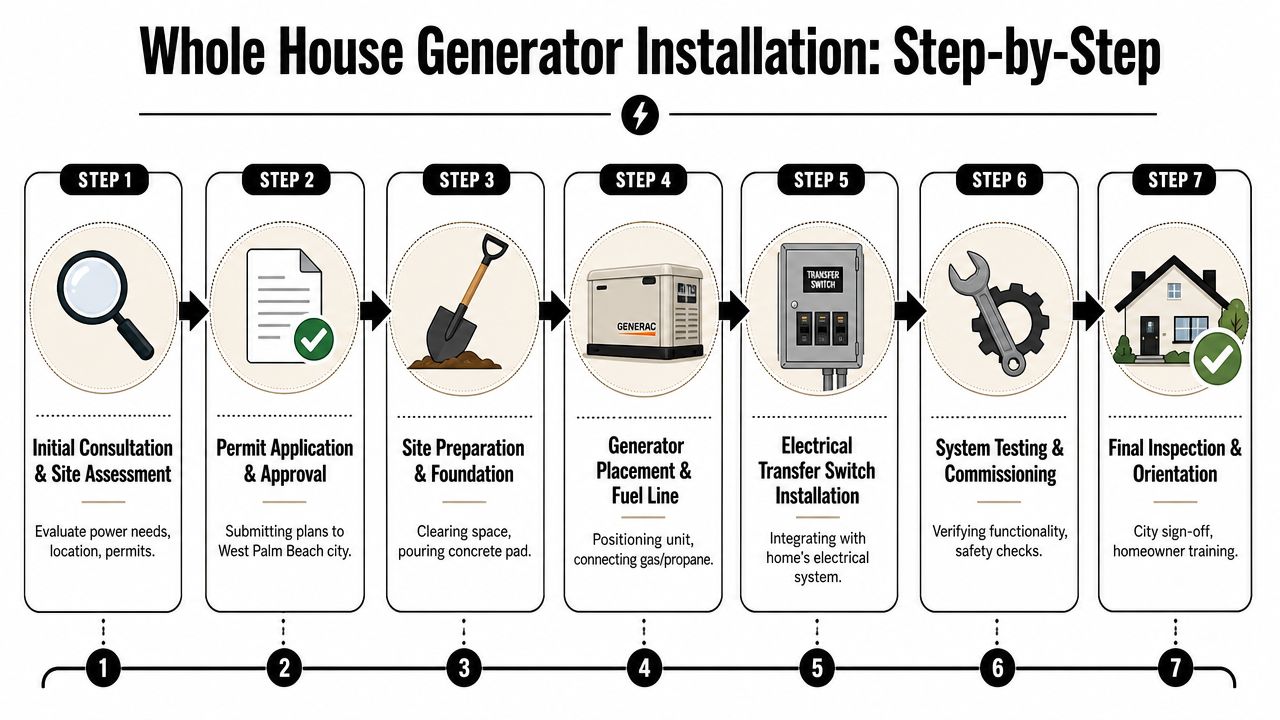
Once the sizing, siting, and approval issues are settled, installation becomes much more predictable. Homeowners are often less concerned about the electrical work itself than the uncertainty around timeline and disruption. A clear sequence solves most of that anxiety.
From site visit to approved plan
The process starts with an on-site assessment. The electrician reviews the service equipment, panel capacity, major loads, access paths, ventilation, fuel source, and the best outdoor location for the generator. If the home has old service equipment, mixed wiring conditions, or limited clearance, those issues need to be identified before the permit set is prepared.
Then come the paperwork and layout decisions:
Load review and equipment selection
The electrician matches generator output, transfer switch size, and fuel configuration to the home.Site plan and permitting
The plan has to satisfy the city, utility requirements where applicable, and often the HOA.Pad and location approval
The generator needs a stable base with proper clearance and service access. Homeowners who want a sense of how equipment pads are approached in other regions sometimes find examples like these PA and NJ equipment pad solutions useful for visual reference, even though Florida siting requirements and code review are their own category.
What happens on installation day
The field work usually follows a set order, even if timing varies by property.
- Site preparation: The crew clears the area and prepares the mounting surface.
- Generator placement: The unit is set in its final location with attention to clearances.
- Fuel connection: Gas or propane piping is installed and tested.
- Electrical integration: The transfer switch and feeder connections are completed.
- Startup and commissioning: The system is tested under controlled conditions.
A good installer also checks whether the existing electrical system is ready for the generator. Some houses need panel cleanup, breaker reconfiguration, or other corrections before a standby system can be tied in safely. That isn't upselling. It's part of making sure the house can accept backup power without nuisance trips or unsafe conditions.
The generator is only one part of the system. The panel, transfer equipment, grounding, fuel supply, and placement all have to work together.
After installation, the city or authority having jurisdiction completes the required inspection. Once the inspector signs off, the homeowner should get a walkthrough that covers startup logic, normal operating sounds, shutoff location, maintenance basics, and what to expect during an actual outage.
That last part matters. People are much calmer during a storm when they already know exactly how the system behaves.
Understanding Generator Costs and Financing in Florida
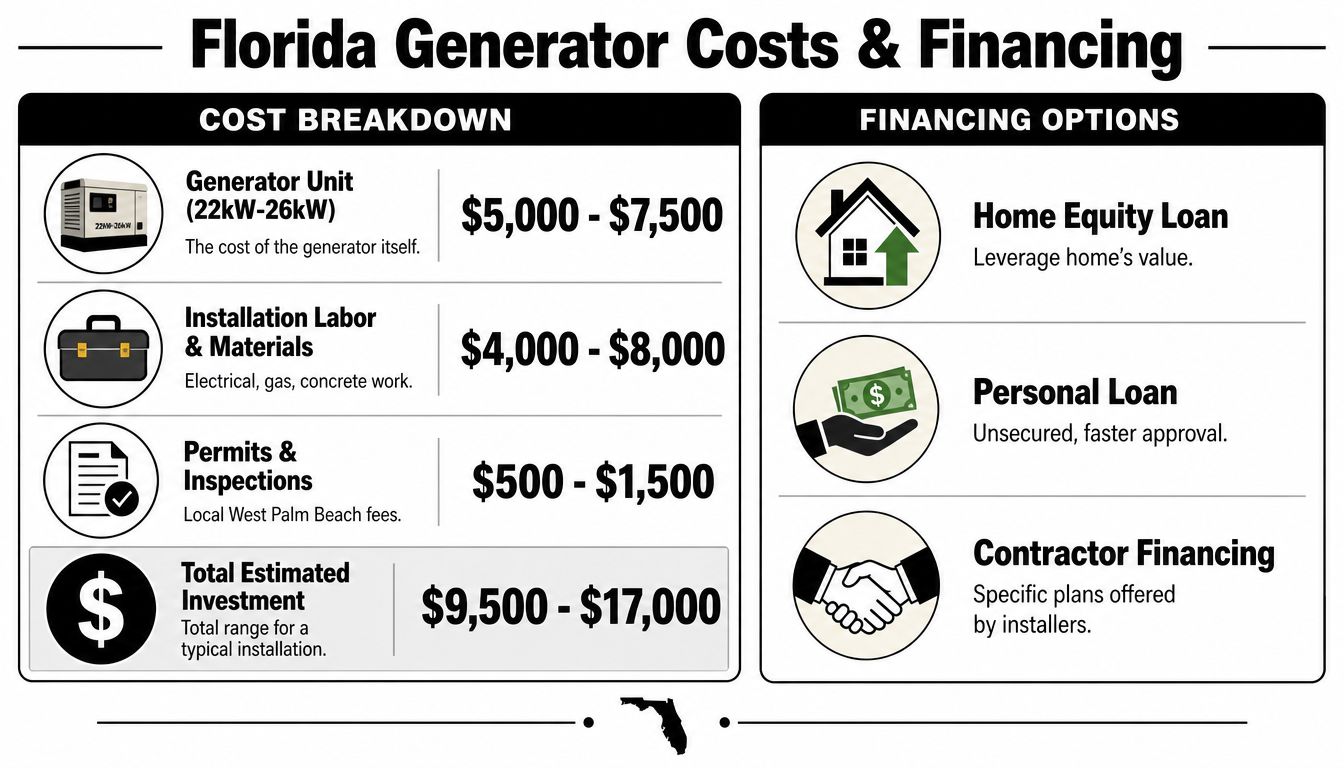
Generator pricing gets confusing because people often compare the equipment price to the installed price. They're not the same number. In Florida, the total cost to install a whole-house generator typically ranges from $5,000 to over $10,000, and professional installation alone can add $2,000 to $6,000, depending on site preparation and electrical upgrades. That same Florida cost overview notes that entry-level 7 to 10 kW systems generally cost $3,000 to $5,000 but won't support central air conditioning, mid-range 12 to 20 kW systems are typically $5,000 to $10,000, and 22 to 30+ kW units can exceed $10,000. It also notes annual maintenance commonly runs $200 to $500 per year, and that homeowners can use the Florida PACE program for eligible financing through property tax assessment with no upfront payment required, according to this Florida whole-home generator cost and PACE guide.
What drives the final price
Two houses can buy the same generator and end up with very different installed costs.
Common cost drivers include:
- Electrical upgrades: Older panels or service configurations may need corrective work.
- Fuel line distance: Longer or more complex runs increase labor and materials.
- Pad and site access: Tight side yards, drainage concerns, and elevation issues affect labor.
- HOA compliance items: Acoustic screening or revised placement can add work.
That's why flat phone estimates are often misleading. The actual price lives in the details around the house, not just the label on the generator cabinet.
How homeowners usually pay for it
Some homeowners pay cash because they want the project completed without loan paperwork. Others prefer financing so they can preserve liquidity for shutters, roofing, or other storm-related upgrades happening at the same time.
A few financing routes commonly come up:
- PACE financing: For eligible projects, repayment can be structured through property taxes.
- Refinance or equity-based borrowing: Some owners look at broader home-financing options when bundling resilience upgrades. For homeowners exploring refinance structures, this FHA cash-out refinance overview from New American Funding can help frame how equity-based funding works.
- Installer-specific financing: Some contractors offer payment programs directly.
If you want a local cost discussion focused specifically on this project type, this whole-house generator installation cost guide provides a useful starting point.
The right financial approach depends on the house, the urgency, and whether the generator is part of a larger improvement plan.
How to Choose Your Electrical Specialist in West Palm Beach
A generator installation can pass the driveway test and still be poorly built. The critical work is in the load calculation, transfer equipment, fuel planning, grounding and bonding, permit coordination, and the decisions made before the pad is ever poured.
In West Palm Beach, I would not judge an installer by the brochure, the cabinet brand, or the sales pitch. I would judge them by how they answer site-specific questions. This market has two failure points that catch homeowners off guard. HOA approval can stall a job before permits are filed, and fuel assumptions can fall apart during a long storm outage. A qualified electrician should address both early, not after you have signed a contract.
Questions worth asking before you sign
Use the estimate meeting to test whether the contractor is thinking like an installer or like a salesperson.
- How are you sizing the generator? The answer should include an actual load calculation and a discussion about what you want to run during an outage. If they jump straight to a standard model size, that is a warning sign.
- Who handles permitting, utility coordination, and inspections? You want a clear scope of responsibility.
- How do you handle HOA review before installation day? In many neighborhoods, placement, screening, setbacks, and noise are practical issues, not paperwork details.
- What happens if the existing panel or service needs corrective work? Older equipment, limited breaker space, or code deficiencies can change the job.
- What fuel source do you recommend for multi-day outages here, and why? The answer should reflect local storm conditions, not a generic preference.
A good contractor gives direct answers. They should be able to explain what will be backed up, where the generator can legally sit, what fuel limitations apply to your property, and what could delay approval.
What a qualified local installer should already understand
West Palm Beach projects are detail-driven. Salt air affects equipment life. Wet-location wiring methods matter. Setbacks and working clearances matter. Flood-prone areas, drainage, and condenser locations can limit placement options. HOA boards may care as much about visibility and noise as the city cares about code compliance.
Fuel planning deserves extra scrutiny. Natural gas is convenient where service is stable and available at the required volume, but not every property has the same utility conditions. Liquid propane gives independence from the gas utility, but now tank size, refill logistics, and placement rules matter. During hurricane season, the best fuel on paper is not always the most dependable fuel for your specific lot and neighborhood.
The right electrician should also tell you when your expectations and the house do not match. If you want full-house backup on a small air-cooled unit, that needs to be addressed up front. If the only location you like will trigger HOA objections or fail clearance rules, that needs to be addressed before permits. If the quoted price leaves out panel upgrades or gas work, it is not a complete project cost.
Lighthouse Energy Services is one local company homeowners may consider for residential standby generator installation in Palm Beach County. The main point is simpler. Hire a contractor who can handle the full job from assessment through approval, installation, startup, and service, and who can explain each step in plain language.
Clarity is usually the best screening tool. If the electrician can walk you through load calculation, fuel trade-offs, HOA constraints, electrical readiness, and inspection requirements without dodging specifics, you are likely talking to someone who understands generator work in West Palm Beach.