
A tropical storm's outer bands are moving across Palm Beach County. The lights blink, the air conditioner stops, and the refrigerator falls silent. Across the street, a neighbor's standby generator starts on its own. Your portable unit is still in the garage, and even if you get it outside safely, it won't power the entire house automatically.
That moment explains why whole house generator installation deserves more planning than a delivery and equipment swap. The generator is only one part of the system. Electrical integration, fuel capacity, permits, utility coordination, placement, inspections, and future load growth all determine whether the system works when the grid fails.
Table of Contents
- Why Whole House Generator Installation Is a Project, Not an Appliance
- Sizing Your Generator With a Real Load Calculation
- Choosing the Right Fuel for Your Property
- Permits, Codes, and Utility Coordination
- Site Prep and Transfer Switch Selection
- Realistic Timeline and Total Installed Cost
- Commissioning, First Startup, and Year-One Maintenance
Why Whole House Generator Installation Is a Project, Not an Appliance
A homeowner may choose a generator quickly, approve the proposal, and expect installation to follow. On site, the work depends on several decisions lining up first. The contractor must verify the electrical load, select a code-compliant location, prepare the equipment pad, connect the fuel supply, install transfer equipment, secure approvals, and pass inspection.
For Palm Beach County properties, the schedule can slow before the installation crew arrives. An HOA may review equipment visible from the street. The gas utility may need to confirm that the existing meter can serve the generator while other appliances operate. The building department may require separate electrical and gas permits, and concrete work for the pad may be scheduled independently from the electrical installation.
Practical rule: Settle the generator location, fuel source, and transfer-switch design before ordering equipment. Otherwise, the project can stall even while the unit waits in a warehouse.
The demand for backup power reflects real outage concerns. An EIA-based estimate found that about 6.61 million U.S. homes had a whole-home or standby generator, while portable generators were present in about 20.26 million homes. Generator ownership reached about 20.3% of occupied primary residences, and roughly one in five households experienced an outage lasting at least 24 hours in 2024, according to the EIA-based home backup power estimate.
Full-house coverage is not the right answer for every property. The decision should account for outage exposure, critical equipment, comfort expectations, existing service capacity, and planned electrification. An electric vehicle charger, heat-pump water heater, or larger cooling system can change the future load and affect today's generator and transfer-switch choices.
Sizing selects the equipment. Fuel selection affects runtime and available capacity. Permits and utility coordination determine when the system may be energized. Site preparation and service clearances determine whether the completed installation remains safe and maintainable. That combination makes whole house generator installation a coordinated electrical, fuel, permitting, and construction project, not an appliance delivery.
Sizing Your Generator With a Real Load Calculation
Square footage is a poor substitute for a load calculation. A smaller home with a large air-conditioning compressor can demand more startup capacity than a larger home with efficient equipment and carefully managed circuits.
Start with a worksheet that identifies what the home uses during an outage:
- Cooling equipment: Record the running load and compressor starting demand for the air conditioner, air handler, heat pump, or other HVAC equipment.
- Refrigeration and pumps: Include the refrigerator, freezer, well pump, booster pump, pool equipment, and any sump or drainage system.
- Daily-use circuits: Add lighting, garage door openers, internet equipment, security systems, kitchen circuits, and selected receptacles.
- Sensitive or essential equipment: List medical devices, home-office equipment, communications equipment, and anything that must remain operational.
- Future loads: Account for planned electrification, such as an EV charger or heat-pump water heater, before selecting the generator.
The important distinction is between running watts and starting watts. A compressor may draw a manageable operating load but demand a much larger surge when its motor starts. A whole-house system must handle that event without unacceptable voltage drop. An essential-load system can use a smaller generator if the installer moves selected circuits into a backed-up panel and applies load management.
A practical worksheet
The table below shows the structure of a worksheet. The figures are illustrative placeholders for the electrician to verify from equipment nameplates and manufacturer data, not a substitute for a site-specific calculation.
| Appliance or System | Running Watts | Starting (LRA) Watts | Notes |
|---|---|---|---|
| HVAC compressor | Verify on nameplate | Verify LRA | Check compressor startup and soft-start compatibility |
| Air handler | Verify on nameplate | Verify motor demand | Include blower and controls |
| Refrigerator | Verify on nameplate | Verify startup surge | Compressor load matters |
| Well or booster pump | Verify on nameplate | Verify motor surge | Confirm whether it must run with HVAC |
| Lighting circuits | Add connected loads | Usually limited surge | Separate essential circuits from discretionary lighting |
| Internet and networking | Verify equipment load | Usually limited surge | Useful during extended outages |
| Garage door opener | Verify motor load | Verify startup surge | Consider whether it needs automatic coverage |
| Medical or office equipment | Verify equipment load | Confirm sensitivity | Review manufacturer requirements |
Convert verified wattage to kilowatts by dividing watts by 1,000. Then evaluate which large motors may start at the same time. A contractor may use load-shedding modules, soft-start equipment, or staged controls rather than purchasing a substantially larger generator.
For a deeper worksheet approach, review this guide on how to size a generator for your home. In Palm Beach County, two-stage and variable-speed compressors deserve particular attention because their controls and locked-rotor amperage can change the startup behavior. The correct answer isn't just the largest unit that fits the budget. It's the smallest system that starts the required loads reliably while leaving room for the home's expected electrical direction.
Choosing the Right Fuel for Your Property
Fuel selection affects more than operating cost. It determines how the generator is supplied during a prolonged outage, where the equipment can sit, what permits are needed, and how much trenching or storage work the property requires.
Natural gas is convenient when the home already has a suitable gas service. The utility connection can support extended operation without a tank delivery, but the generator may impose a demand that the existing meter or regulator wasn't designed to handle. A meter upgrade, pressure test, or new gas run can become the critical path.
Propane gives the homeowner more independence from the local gas network. A properly selected on-site tank can support extended operation, but the tank introduces its own placement, access, and setback requirements. The contractor must evaluate expected runtime, generator demand, available tank capacity, and whether the tank can be replenished during storm-related access problems.
Diesel can suit larger liquid-cooled systems and properties that already manage liquid fuel safely. It requires dedicated storage, spill control, maintenance, and compliance planning. Those requirements can make diesel impractical for a typical residential lot even when the engine's operating characteristics are attractive.
The property decides the fuel
A natural-gas installation may have the shortest equipment supply path but still require a long trench from a remote meter. Propane may simplify utility coordination but consume valuable side-yard space. Diesel may support a substantial load but create storage and environmental responsibilities that don't fit a residential setting.
Fuel also affects the pad location. The generator needs service access, safe exhaust direction, proper separation from openings and air intakes, and a regulator or tank arrangement that doesn't interfere with maintenance. The fuel line must be sized for the generator's demand, not merely extended from the nearest connection.
A fuel decision is incomplete until the contractor confirms availability, pressure, routing, runtime expectations, and code-compliant placement.
The load calculation and fuel decision should happen together. A correctly sized generator still fails the homeowner if the gas supply can't maintain pressure, the propane arrangement can't support the expected operating period, or the liquid-fuel system can't be serviced safely.
Permits, Codes, and Utility Coordination
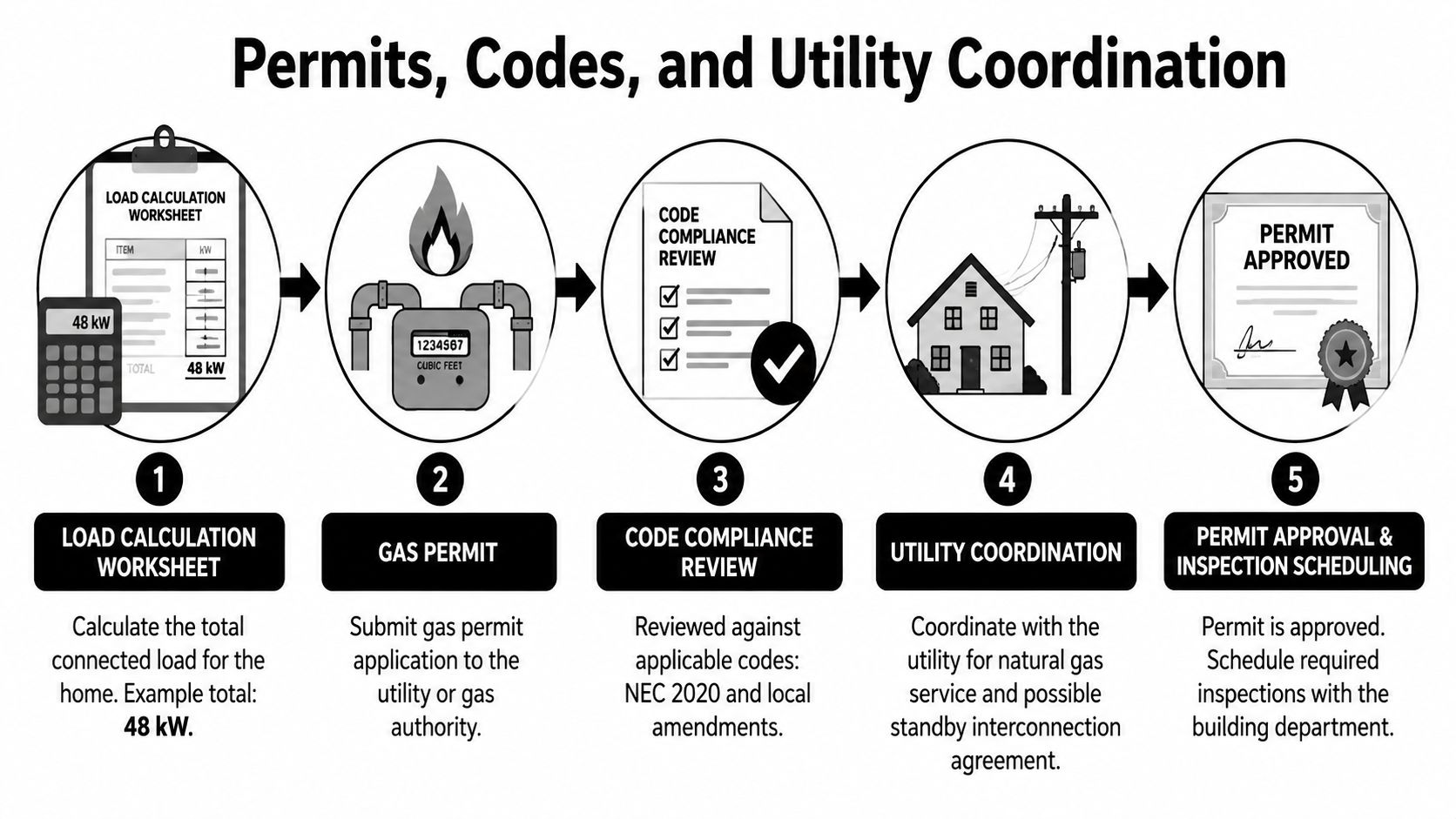
The paperwork sequence matters because each approval can affect the next physical step. A contractor typically begins with the load calculation and site plan, then prepares the electrical permit package. If the project adds or upsizes a fuel line, a gas permit and utility review may follow.
Palm Beach County installations must account for the locally adopted 2023 Florida Building Code, along with applicable requirements from NFPA 37 for generator installation and clearances, NFPA 54 for fuel-gas piping, and 2020 NEC Article 702 for optional standby systems. The precise application depends on the property and design, so the installer should verify the current local amendments with the permitting authority.
The sequence that controls the schedule
- Load calculation and site plan: Document the electrical demand, generator location, pad, feeder route, transfer equipment, and fuel path.
- Electrical permit: Submit the standby-system design, panel connection details, grounding approach, and equipment information.
- Gas permit and utility review: File the fuel-line work when the project requires a new or upsized connection.
- HOA architectural review: Obtain written approval if community rules regulate visible equipment, side-yard structures, sound, or exterior modifications.
- Utility coordination: Confirm the meter configuration, service-side or load-side connection, and any required notification or agreement before energization.
- Inspection scheduling: Arrange rough and final inspections after the installation is ready and all required documentation is available.
An HOA review can add a substantial waiting period before a permit application is even pulled. Utility coordination can also affect the gas meter, electrical service, and final energization. Before trenching, the contractor must request an underground utility locate through 811, then wait for the route to clear.
Hurricane-rated anchoring and Wind Zone 3 fastening details can generate plan-review comments. Those comments need resolution before the rough inspection, not after the equipment is installed. A contractor who treats permitting as an administrative afterthought usually creates avoidable gaps between concrete work, fuel work, electrical work, and inspection availability.
Site Prep and Transfer Switch Selection
The pad and transfer switch should be designed as one system. The pad determines where the generator sits, while the switch determines how power moves between the utility and the generator. If the two decisions are made separately, the final feeder route, maintenance clearance, fuel regulator location, or service access may not work.
For a typical installation, the contractor should confirm a level concrete or composite base, a practical delivery route, and access for future service. The planned location should maintain the required clearances, including 18 inches from the house wall, 5 feet from operable windows or doors, and separation from air intakes, subject to the equipment listing and locally enforced code requirements. The installer must also consider exhaust direction, landscaping growth, flood exposure, and the route used by technicians.
Automatic or manual transfer
An Automatic Transfer Switch, or ATS, monitors utility power, starts the generator after an outage, and transfers the selected load without homeowner action. It is the practical choice when the homeowner expects whole-house coverage or may be away when an outage begins.
A Manual Transfer Switch, or MTS, requires a person to start the generator and operate the switch. It can work for a smaller essential-load arrangement, but it adds a human step during a storm, at night, or when the property is unoccupied.
| Feature | Automatic Transfer Switch (ATS) | Manual Transfer Switch (MTS) |
|---|---|---|
| Outage response | Starts and transfers without homeowner action | Requires someone to operate the system |
| Best fit | Whole-house or automatic standby coverage | Smaller essential-load systems |
| Convenience | High, including when the home is unattended | Lower during a real outage |
| Design focus | Generator controls, transfer logic, and load management | Safe switching procedure and user access |
| Risk to plan for | Incorrect sensing or overloaded startup | Missed activation or incorrect operation |
The feeder conductors must match the generator output and connection method. The design also needs the required generator disconnect, grounding and bonding details under NEC 250, and enough working space around the equipment. The gas regulator shouldn't sit where it blocks the technician's service footprint or forces the fuel line across access panels.
For a plain-language explanation of the transfer equipment, see what a transfer switch does for generators. A good installation leaves the homeowner with a system that can be inspected, serviced, and operated without moving landscaping, stored items, or vehicles.
Realistic Timeline and Total Installed Cost
A generator can be set on site in a few days, yet the project often waits on permits, utility coordination, and fuel-line work. A practical planning sequence is:
- Assessment and quote: Allow 1 to 2 weeks for the site visit, load calculation, fuel review, design, and proposal.
- Permitting and HOA approval: Plan for 4 to 8 weeks, depending on architectural review and the building department.
- Equipment and scheduling: Allow 2 to 6 weeks when manufacturer availability and the selected capacity affect delivery.
- Installation and inspections: The crew may work on site for 2 to 3 days, followed by utility sign-off that can take 1 to 2 weeks.
From a signed contract to the first exercise run, the total elapsed schedule is roughly 10 to 16 weeks. Equipment can arrive before the permit is approved, or the pad can be ready while a gas meter upgrade remains pending. Those dependencies commonly control the schedule, even when the electrical installation itself is straightforward. Generator installation timeline guidance provides a useful planning reference, but the actual sequence still depends on the property and local approvals.
What the budget actually includes
The generator usually represents only about 30% to 40% of installed cost. The remaining work may include the transfer switch, concrete or composite pad, gas work, conduit and conductors, permits, labor, inspections, and required service changes. A larger generator may also support future load growth, but that choice can increase equipment, feeder, fuel, and site costs now.
For the residential ranges described in the project brief, a 22 kW air-cooled system commonly totals $12,000 to $18,000 installed, while a 26 to 38 kW liquid-cooled system commonly falls between $18,000 and $30,000 installed in Palm Beach County. These are project-level estimates, not guaranteed quotes. The final number depends on the load calculation, equipment design, property access, fuel route, and electrical service.
| Component | 22 kW Air-Cooled | 26-38 kW Liquid-Cooled | Share of Total |
|---|---|---|---|
| Generator and controls | Project-specific | Project-specific | Often a minority of installed cost |
| Transfer switch | Project-specific | Project-specific | Depends on service and load design |
| Pad and anchoring | Project-specific | Project-specific | Varies with site and wind requirements |
| Gas line or fuel system | Project-specific | Project-specific | Longer routes cost more |
| Feeder, conduit, and disconnect | Project-specific | Project-specific | Depends on routing and panel work |
| Permits, inspections, and labor | Project-specific | Project-specific | Driven by scope and coordination |
Long gas runs, a full existing panel, driveway trenching, and difficult limestone substrate can change the estimate more than the generator model alone. Fuel work may require coordination with the utility or a meter upgrade, making it a schedule issue as well as a cost item. A proposal that leaves out these parts may look attractive without describing the finished, inspected system.
Review the whole house generator installation cost factors before comparing proposals line by line. Ask each contractor to identify included work, excluded work, allowances, and any changes needed to support future electrical loads.
Commissioning, First Startup, and Year-One Maintenance
A generator is not ready for storm service when it is merely bolted to the pad. Commissioning confirms that the equipment, fuel supply, transfer equipment, controls, and connected loads operate together under conditions that resemble a real outage. It also creates the records needed for maintenance, warranty support, and future troubleshooting.
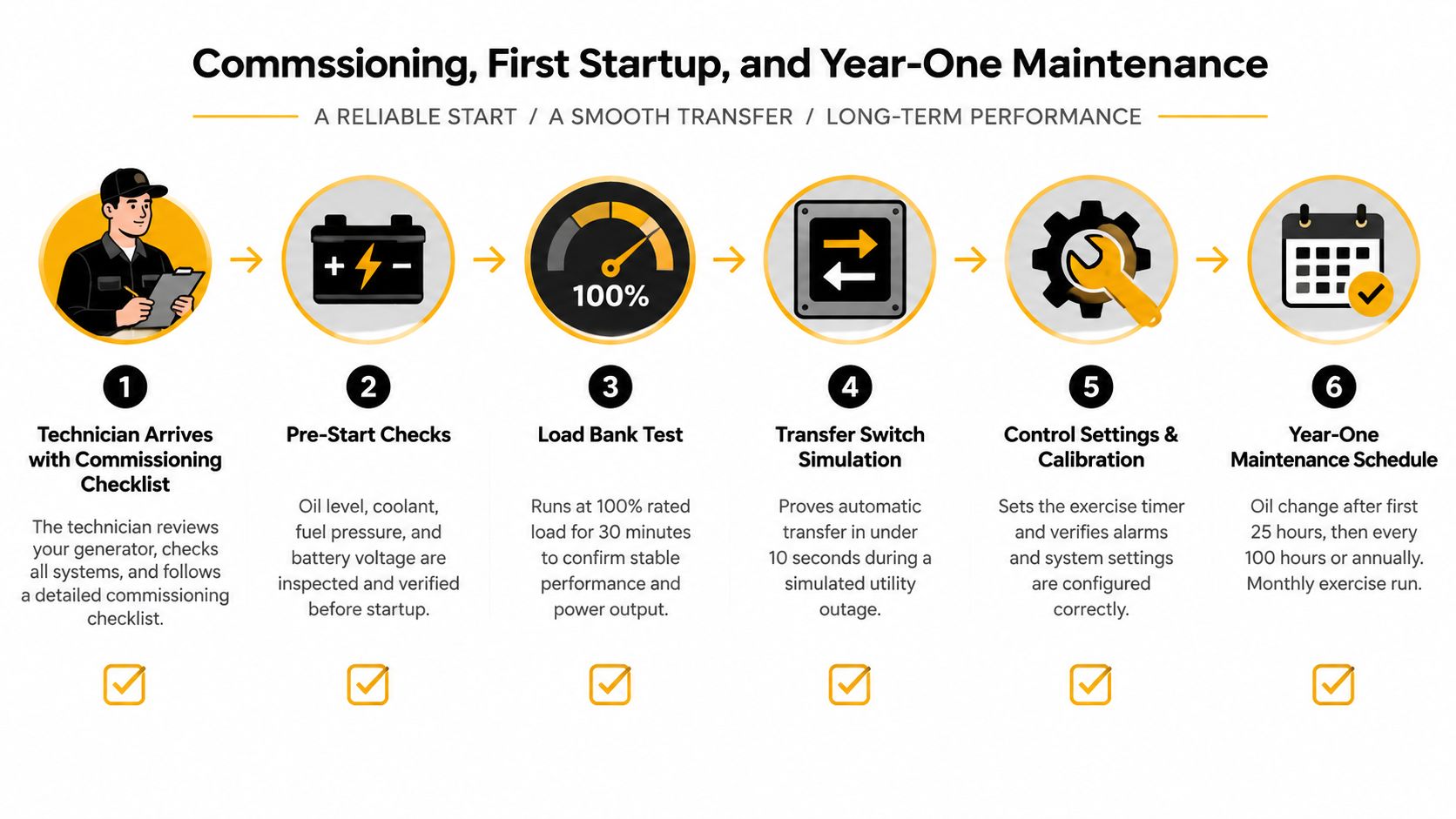
The technician should arrive with a commissioning checklist and verify the equipment model, installation records, pad, anchoring, clearances, fuel connection, electrical terminations, and grounding. Before starting the engine, the technician checks oil level, battery condition, control settings, fuel pressure, and visible connections.
Propane and natural-gas systems require adequate pressure while the generator is operating. A static pressure reading does not prove that the supply will hold under generator demand. The fuel line, regulator, meter, and utility connection may need to be checked together, especially if the property has a long run or other gas appliances operating at the same time.
The first simulated outage
The technician starts the unit and measures voltage and frequency at the generator and main panel. The transfer switch is then tested under a simulated utility failure. The test should confirm that the generator starts, the switch transfers the intended circuits, selected loads remain stable, and the system returns to utility power correctly after normal service is restored.
A load bank test or controlled load test can expose problems that an unloaded startup misses. The crew watches for voltage drop, abnormal sounds, unstable frequency, fuel-pressure loss, overheating, alarm conditions, and nuisance trips. Starting the HVAC compressor, pumps, or other motor loads together can reveal a design problem that a simple no-load run will not show.
The manufacturer's run-in procedure still applies. The installer records the initial operating hours and explains what the homeowner should expect during the break-in period, including any limits on early loading or required follow-up service.
The first year is part of the installation
A standby generator needs an ownership routine, not only an installation certificate. The controller may run an automatic exercise cycle, but the homeowner still needs to watch for failed starts, warning lights, battery issues, fuel concerns, and unusual operating noise.
The maintenance schedule for this project includes:
- Weekly exercise: Confirm that the automatic cycle runs and that the controller shows no active alarm.
- First oil service: Change the oil and filter at 25 operating hours or one year, following the manufacturer's instructions.
- Engine service: Check spark plugs and valve clearance at 100 operating hours where the equipment design requires those tasks.
- Battery testing: Perform a battery load test and inspect terminals for corrosion or looseness.
- Annual thermal inspection: Check electrical lugs and terminations with thermal imaging to identify abnormal heating before it causes a failure.
- Documentation: Keep startup records, maintenance invoices, alarm history, and inspection paperwork with the warranty documents.
Homeowners can keep the generator area clear, check the controller, observe exercise runs, look for visible fuel or oil problems, and confirm that vents and exhaust paths are unobstructed. They should not open energized panels, alter transfer-switch wiring, adjust gas pressure, or change engine controls unless they have the qualifications and authorization to perform that work.
A decision checklist before signing
Undersized from the nameplate: A contractor selects equipment from generator output or square footage without evaluating compressor startup.
Correction: Require a written load calculation that addresses running load, starting demand, and planned load management.
Poor placement: The unit sits too close to a window, door, intake, wall, or air-conditioning equipment.
Correction: Approve the location only after the installer marks clearances, exhaust direction, service access, and pad dimensions.
No startup strategy: The generator stalls when the HVAC compressor and another motor start together.
Correction: Ask whether load shedding, soft-start equipment, or staged starting is included in the design.
Unresolved fuel supply: The proposal assumes the existing gas service is adequate without a pressure check or meter review.
Correction: Make utility coordination and fuel verification written scope items.
Permit treated as someone else's problem: The homeowner hears that paperwork is included but receives no schedule or permit status.
Correction: Request permit numbers, HOA submission status, inspection sequence, and utility responsibilities before signing.
Future loads ignored: The design leaves no practical plan for an EV charger, heat-pump water heater, expanded cooling, or other electrification.
Correction: Discuss future demand during the initial load calculation. Decide whether the system needs managed loads, additional capacity, storage integration, or another energy-control strategy. Home standby generator market outlook reflects the broader shift toward energy management and storage integration, so future planning remains relevant even when a generator is the primary backup source.
The project has moved beyond an equipment swap when the home has multiple panels, planned electrification, a long fuel route, or driveway trenching. Those conditions affect engineering, inspections, restoration work, utility coordination, and commissioning. Lighthouse Energy Services handles standby generator installation, transfer-switch integration, fuel connections, permitting, testing, and homeowner demonstration for Palm Beach County properties that need a coordinated electrical plan.
Lighthouse Energy Services can evaluate your home's loads, fuel supply, transfer-switch design, site clearances, permits, and future electrical needs before equipment is ordered. Visit Lighthouse Energy Services to schedule a Palm Beach County generator consultation and turn a storm backup idea into an installed, inspected, and maintainable system.