
A summer storm is rolling across the Everglades, and you're watching it from a Boca Raton living room. The new induction range is wired in, the Control4 panel is keeping the house comfortable, and a $30 power strip is sitting under the television. The question is reasonable: will that strip protect the expensive equipment when the lights flicker?
Usually, it protects only what's plugged directly into it, and only at that receptacle. Whole home surge protection installation starts at the electrical service, where a properly listed surge protective device, or SPD, can protect the home's branch circuits as part of a coordinated system. The installation still depends on panel compatibility, grounding, conductor routing, code requirements, and the equipment connected downstream.
Table of Contents
- What Whole Home Surge Protection Actually Does
- Types of Surge Protective Devices and How They Layer
- Pre-Install Evaluation of Your Home's Electrical System
- Permits, Codes, and Local Requirements in Palm Beach County
- What Happens on Install Day
- Cost Breakdown and What Affects Your Quote
- Testing, Maintenance, and Choosing the Right Contractor
What Whole Home Surge Protection Actually Does
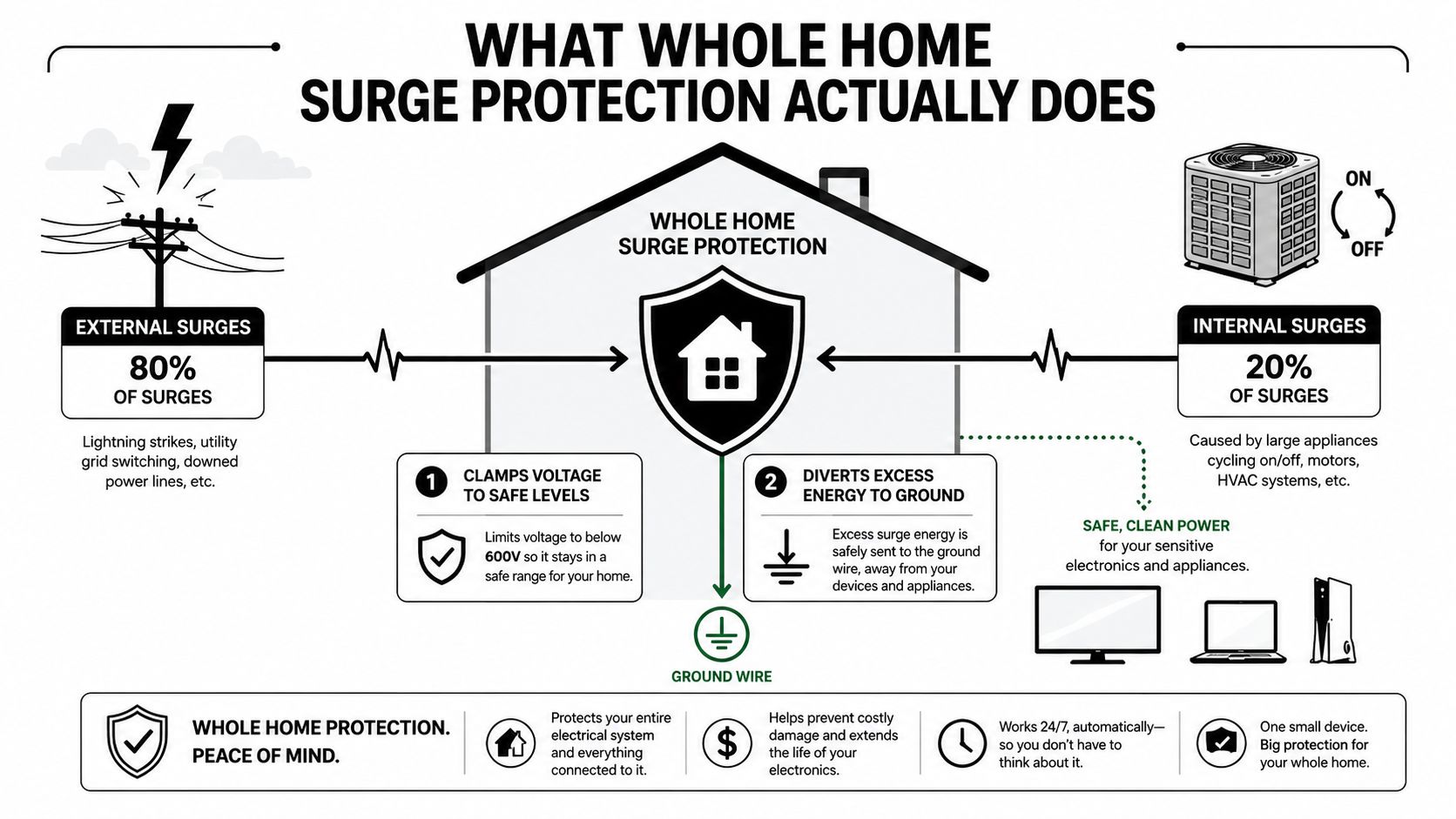
A whole-home SPD is a hardwired protective device installed at or beside the service equipment. Its job is to respond when voltage rises above the level connected equipment should see, clamp the transient, and divert excess energy through the grounding path instead of allowing that energy to travel farther into branch circuits.
That makes it different from a conventional power strip. A plug-in protector works at the receptacle and primarily serves equipment connected to that strip. A panel-mounted Type 1 or Type 2 SPD works at the electrical system's entry point, so it can protect circuits throughout the home. It won't guarantee that every device survives every electrical event, but it gives the system a stronger first layer.
Surges can enter from outside the property through utility switching or lightning-related disturbances. They can also originate inside the home when motor-driven equipment changes state, including air-conditioning systems, refrigerators, pumps, and garage door openers. The practical distinction matters because a clear sky doesn't mean the electrical system is free from transient activity. You can review the difference between internal and external events in this guide to what causes power surges in a house.
The grounding path does the heavy lifting
The SPD doesn't absorb a surge in isolation. It redirects energy through conductors connected to the service grounding and bonding system, which is why a grounding problem can undermine an otherwise suitable device. A technician should inspect the grounding electrode system, bonding connections, and conductor route before treating the job as a simple accessory installation.
The lead path also matters. The 2020 National Electrical Code requires dwelling-unit services to have a Type 1 or Type 2 SPD, with the device integral to the service equipment or immediately adjacent to it, as summarized in NEC Article 230.67 guidance. The same technical guidance emphasizes short, straight conductors because excess length, coils, and sharp bends add inductive impedance and can reduce clamping effectiveness.
Practical rule: One SPD at the main service is the foundation. It isn't automatically the finish, especially when the property has sub-panels, detached structures, solar equipment, an EV charger, or sensitive communications hardware.
The right expectation is not “this box makes the home surge-proof.” The right expectation is a system that intercepts surge energy early, uses a sound grounding path, and adds downstream protection where wiring distance or equipment sensitivity creates another exposure point.
Types of Surge Protective Devices and How They Layer
The three SPD types are best understood by location and role, not by a simple good, better, best ranking. A service-entrance device handles the largest portion of energy entering through the electrical service. A downstream device addresses residual exposure at another distribution point, while a receptacle-level protector adds a final layer close to delicate electronics.
| SPD Type | Installed At | Protects | Typical Use |
|---|---|---|---|
| Type 1 | Ahead of or at the service entrance, subject to utility and service configuration requirements | Service equipment and the home's incoming supply | Service-entrance applications where the installation permits this arrangement |
| Type 2 | On the load side of the service equipment, commonly at or inside the main panel | Branch circuits and equipment downstream of the panel | Most residential panel-mounted whole-home installations |
| Type 3 | At the receptacle or point of use | Specific connected electronics | Televisions, computers, networking equipment, and control electronics |
A Type 2 SPD is often the practical starting point for an existing Palm Beach County home. The electrician places it at the main panel or immediately beside the service equipment, uses the manufacturer-approved breaker and wiring arrangement, and keeps the connection as short and direct as the panel allows.
Where the second layer earns its place
A detached garage, workshop, pool equipment area, or boat-lift panel can sit far enough from the main service that a single device at the house doesn't provide the same degree of localized protection. A properly selected SPD at the sub-distribution board can catch residual surge energy at that location. The same reasoning applies to a dedicated EV-charging panel or a separate structure with its own feeder.
Homes with rooftop solar need the electrical system evaluated around the inverter and disconnects. A Type 2 device on the alternating-current side of the inverter may be appropriate, but the final selection depends on the equipment listing, service arrangement, and manufacturer instructions. Adding a random protector without checking those details is not coordination.
Point-of-use protection still has a job. A television connected to cable or network equipment, a computer, and a home-control rack can have multiple connected paths. A panel SPD protects the electrical supply, while a properly selected Type 3 device at the equipment can provide supplementary suppression close to the load.
Why one box can fall short
The IEC-focused guidance on coordinated surge protection describes a multi-stage approach that can include Type 1 and Type 2 protection at the service entrance, Type 2 devices at sub-distribution boards, and Type 3 devices at points of use. That approach addresses a problem consumer advice often skips: surge energy can enter through multiple paths, and voltage can re-escalate along longer wiring runs.
A waterfront property exposed to frequent storms may justify a more thorough coordinated design than a compact home with one service panel and short branch circuits. Neither property should receive a device chosen only because it fits the panel cover. The electrician should identify the service arrangement, connected equipment, feeder lengths, and grounding condition before deciding how many layers make sense.
Pre-Install Evaluation of Your Home's Electrical System
A competent electrician shouldn't quote whole home surge protection installation from a photograph of the panel door. The first visit is an assessment of whether the equipment can accept the SPD safely and whether the grounding system gives the device a usable discharge path.
Expect the technician to remove the panel cover, after taking appropriate safety precautions, and identify the panel manufacturer, model, age, service rating, and physical condition. Known compatibility concerns with older or problematic panel families can change the plan. In some cases, a nearby enclosure or sub-panel solution is safer than forcing a new breaker into equipment that should be evaluated for replacement.
The panel checklist
The electrician will look for:
- A suitable breaker position: Many panel-mounted SPDs use a two-pole breaker or an approved integrated connection. If the panel is full, the solution may involve rearranging circuits, using an approved tandem arrangement where permitted, or adding a small sub-panel.
- Service configuration: A meter/main combination can place the service disconnect outside, while the interior panel functions as downstream distribution equipment. That location affects whether a Type 1 or Type 2 arrangement fits the installation.
- Bus and enclosure condition: Heat damage, corrosion, loose terminations, overcrowding, or an outdated panel can make surge protection a secondary issue. The electrical system may need correction before the SPD is installed.
- Grounding and bonding: The technician should trace the grounding electrode conductor, inspect the grounding electrode connections, verify bonding at the appropriate equipment, and look for the intersystem bonding termination.
A solid grounding electrode system can include ground rods, a supplemental grounding connection where required, a bonded metal water-piping system when present and applicable, and a proper connection for communication systems. The SPD doesn't repair a broken or undersized grounding path. It depends on the electrical system being correctly bonded and grounded.
What the assessment should produce
Allow enough time for a real inspection, not just a sales conversation. The homeowner should receive a recommendation that identifies the SPD location, breaker arrangement, grounding condition, permit responsibility, and any work excluded from the base price.
If the assessment uncovers panel limitations, compare the surge-protection recommendation with the broader economics of an electrical panel upgrade. A panel that has no spare capacity or shows corrosion may be a poor place for a new protective device, even if the SPD itself is suitable.
A low quote often means someone priced the device before checking the panel, the grounding path, or the service configuration.
Permits, Codes, and Local Requirements in Palm Beach County
The 2020 NEC requires all dwelling-unit services to be protected by an SPD, and the device must be Type 1 or Type 2. It must be integral to the service equipment or located immediately adjacent to it, which makes placement part of compliance rather than a cosmetic choice. The history behind the modern framework reaches back to UL 1449, first published in 1985, updated in 1996, and significantly revised in its third edition, published on September 29, 2006, with mandatory adoption on September 29, 2009, according to this UL 1449 and SPD standards summary_0317.pdf).
That standardization replaced the older TVSS terminology with SPD for power-circuit devices within its stated scope and gave manufacturers, inspectors, and installers a clearer safety framework. For a Palm Beach County homeowner, the practical question is less about memorizing terminology and more about whether the selected device is listed, compatible, correctly located, and installed under the applicable local rules.
Retrofit work still needs a clean paper trail
A voluntary SPD added to an existing service isn't the same trigger as a new service or a service replacement. Even when the specific new-service requirement doesn't apply to a retrofit, panel work can still require a local permit and inspection. The licensed electrical contractor should identify the authority having jurisdiction, pull the permit, and explain whether the work is handled through Palm Beach County or the relevant municipality.
An HOA may also have its own approval process for exterior equipment, service changes, or work that affects a shared electrical area. That private approval doesn't replace a building permit, and a permit doesn't replace HOA approval.
What the inspector is checking
The contractor should give the homeowner the permit number and a clear way to verify inspection status through the applicable building department's online portal. At inspection, the reviewer may examine:
- The SPD listing and product identification.
- The approved breaker or connection method.
- The conductor routing and proximity to the service equipment.
- The grounding and bonding connections.
- The workmanship, enclosure condition, and labeling.
For owners handling corrective work, this overview of Florida electrical code violation correction can help frame the difference between an installation upgrade and a correction required by an inspection.
Local adoption and enforcement can vary, so the installer should confirm the current requirement with the local authority before work begins. That verification belongs in the contractor's scope, not as a surprise task handed to the homeowner after the invoice is issued.
What Happens on Install Day
On a straightforward job, the electrician arrives, confirms the scope, and walks through the service equipment with you before touching the panel. The technician should explain where the SPD will sit, which breaker space will be used, how the grounding connection will be made, and whether the service must be interrupted.
The first physical step is usually a controlled shutdown. Depending on the equipment and work location, the electrician may turn off the main disconnect, arrange the required service interruption, or use another approved procedure. The panel cover comes off, circuits are identified, and the technician confirms that the planned connection matches the device instructions.
The work at the panel
For a common Type 2 installation, the electrician typically:
- Mounts the SPD: The unit may fit inside the panel or in a listed enclosure beside it, using an approved knockout and weather-resistant arrangement where necessary.
- Uses the nearest suitable breaker location: The conductors should be kept short and straight, without unnecessary loops or sharp bends.
- Connects the required conductors: Phase, neutral, and grounding conductors follow the manufacturer's diagram and the service configuration.
- Checks terminations: Lugs and breaker connections are tightened to the manufacturer's specified torque, not tightened by feel.
- Verifies the grounding route: The SPD's grounding connection must reach the properly bonded grounding system.
Install day can become a decision day if the panel has no space, a tandem breaker is not suitable, a disconnect is undersized, or the grounding electrode connection is corroded. An older ground rod may need replacement, but the technician should explain why the repair is necessary and list it separately from the SPD installation.
Timing and homeowner decisions
A clean Type 2 installation commonly takes two to four hours, while grounding repairs or sub-panel work can extend the job to about half a day. Those are planning ranges, not promises. The panel's condition and service arrangement matter more than the device's physical size.
Don't approve an improvised shortcut because the installation is taking longer than expected. If the electrician proposes relocating a breaker, adding an enclosure, or changing the disconnect arrangement, ask what problem the change solves, whether it requires a permit revision, and how it affects the final price.
After wiring, the technician restores power, checks the SPD's status indicators, verifies the panel, and cleans the work area. You should receive the product information, warranty details, permit information, and an explanation of what the indicator means if the device later shows a fault condition.
Cost Breakdown and What Affects Your Quote
A transparent quote separates the protective device from the work needed to install it correctly. For Palm Beach County homeowners, a mainstream residential Type 2 SPD may cost $150 to $400, depending on the device category, enclosure, ratings, and included features. Clean-install labor may fall around $300 to $600, while permit and inspection charges may be $50 to $150 when shown as separate line items.
These are planning ranges, not a guaranteed local price. The global whole-house surge protection device market forecast indicates that whole-home protection is now a substantial equipment category, but market size doesn't determine what your electrician should charge. Your invoice reflects the service equipment, access, labor, permitting, and any corrective work at your property.
| Line Item | Typical Range | Notes |
|---|---|---|
| Type 2 SPD | $150 to $400 | Mainstream residential unit, selected for the panel and service |
| Installation labor | $300 to $600 | Clean access with an approved breaker position |
| Permit and inspection | $50 to $150 | May vary by jurisdiction and project scope |
| Grounding repairs | Varies | Corroded, damaged, or inadequate grounding components |
| Sub-panel or enclosure work | Varies | Used when the main panel lacks capacity or compatibility |
| Premium or exterior enclosure | Varies | May be needed for location, weather, or equipment requirements |
Why two homes receive different quotes
A standard interior panel with an available breaker space is usually simpler than a meter/main combination with limited room. A 400-amp service, multiple distribution panels, solar equipment, an EV charger, or a detached structure can require more evaluation and more than one protective layer.
Panel access also changes labor. An easily reachable garage panel is different from equipment behind finished walls, in a cramped utility closet, or outdoors in a corroded enclosure. A failed SPD replacement may be quick if the wiring and breaker are already suitable, while a first-time installation can expose grounding or compatibility problems.
What a good quote shows
Look for the device manufacturer and model, SPD type, listing, mounting location, breaker or connection method, conductor work, permit responsibility, inspection handling, labor warranty, product warranty, and exclusions. Grounding repairs and sub-panel work should appear as separate options or line items.
Red flags include a quote that names only “surge protector,” promises protection without inspecting the panel, excludes permits without explanation, or uses a device that isn't listed for the equipment. The cheapest box isn't a bargain if the installer leaves long conductors, ignores torque requirements, or connects it to a defective grounding system.
Testing, Maintenance, and Choosing the Right Contractor
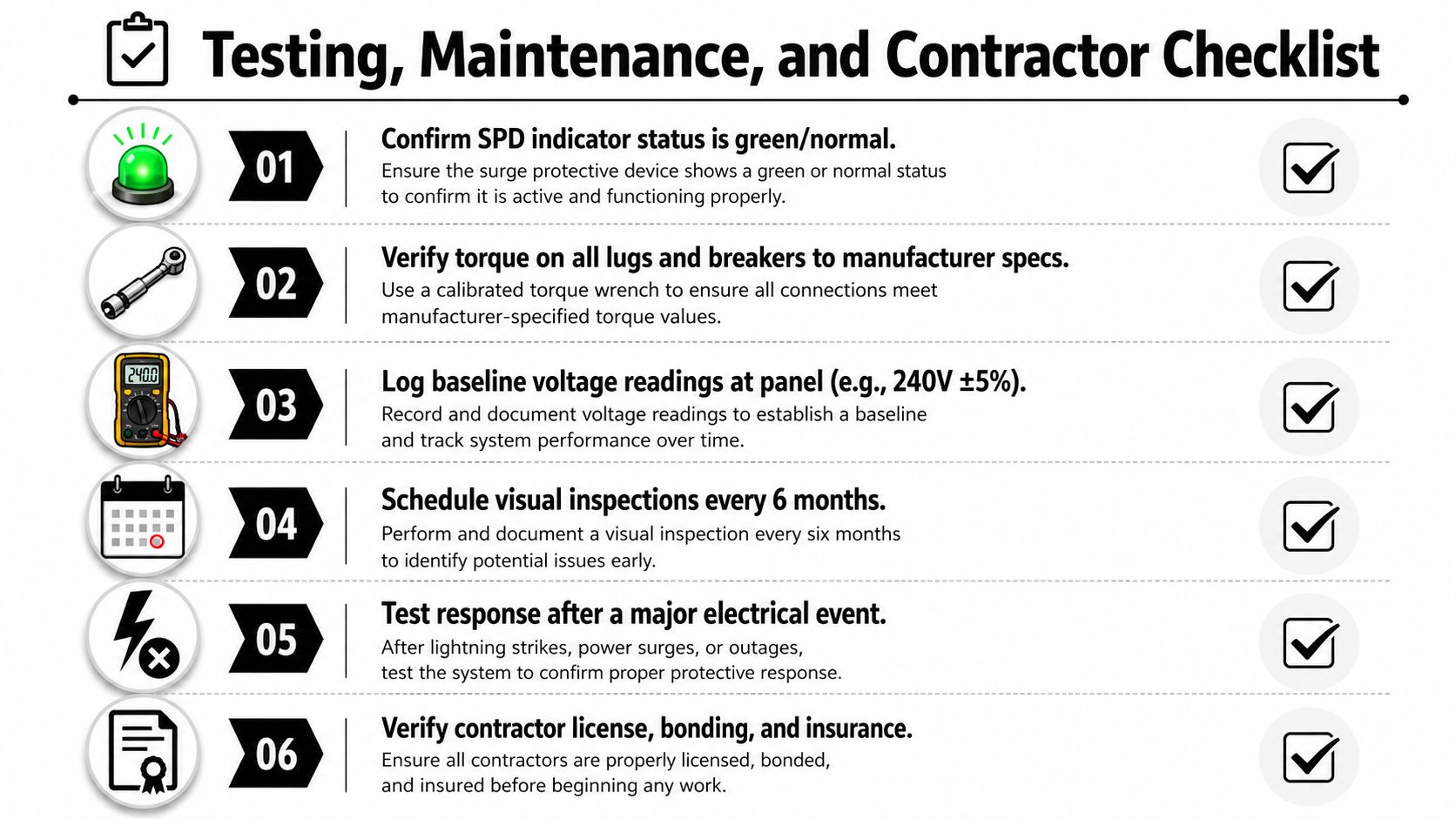
The final connection isn't the end of the job. Before leaving, the electrician should confirm the SPD's protection indicator, check the breaker and lug terminations, verify the grounding connection, and explain what a normal status looks like. A photograph of the installed faceplate gives you a useful baseline for future checks.
Surge protection equipment can degrade as it handles electrical events. The indicator is a practical warning signal, but it isn't a complete diagnostic of the home's wiring or every connected path. Schedule visual checks periodically, inspect after a significant lightning event or utility disturbance, and replace the device according to its condition, manufacturer instructions, and the level of exposure at the property.
The checks that belong on your calendar
- Confirm the indicator: Look for the normal protected status shown on the device face.
- Keep the baseline: Save the installation photographs, product model, permit number, and any readings the electrician records.
- Inspect the surroundings: Check for moisture, corrosion, heat damage, or a changed indicator after a major storm.
- Review downstream equipment: Keep point-of-use protection on sensitive electronics and examine separate panels serving detached buildings or high-value equipment.
- Plan replacement deliberately: The service life depends on surge exposure, device design, and manufacturer guidance. Don't wait for a failed appliance to discover that the SPD has reached its end of life.
The contractor matters as much as the hardware. Verify a current Florida electrical contractor license through MyFloridaLicense.com, confirm Palm Beach County or municipal registration, and request proof of liability and workers' compensation insurance.
Questions to ask before signing
Ask for recent local references involving surge protection, not only general electrical repairs. Require a written line-item quote and clarify whether the price includes the permit, inspection scheduling, panel access, grounding corrections, and cleanup.
You should also ask:
- Which SPD type is being installed, and why?
- Where will it be mounted, and how will the conductors be routed?
- What happens if the panel has no approved breaker space?
- How will solar, EV, detached-building, or sub-panel equipment be coordinated?
- What warranty covers the device, and what warranty covers labor?
- Who pulls the permit and schedules the inspection?
Lighthouse Energy Services provides residential electrical evaluation, panel-mounted surge protection installation, and post-installation testing for Palm Beach County properties. The company also handles broader electrical repairs and upgrades, which can be useful when the assessment finds a panel, grounding, or service issue that must be addressed before the SPD can be installed correctly.
Lighthouse Energy Services can evaluate your Palm Beach County service equipment, recommend a coordinated whole-home surge protection installation, and handle the permitted installation and verification. Visit Lighthouse Energy Services to request an assessment and get a clear scope for your home.