
Your lights blink for a split second. The air conditioner kicks on. A moment later, the Wi-Fi drops, the TV restarts, or a kitchen appliance suddenly stops working. Most homeowners blame the storm outside.
Sometimes they're right. But most of the time, the trouble started inside the house.
If you've been wondering what causes power surges in a house, the answer is usually less dramatic than a lightning strike and more practical. It often comes down to how electricity moves through your home's wiring when large appliances start and stop, and what happens when power returns after an outage. Once you understand that, protecting your home gets much easier.
Table of Contents
- That Sudden Flicker An Introduction to Household Power Surges
- The Silent Culprit Within Your Walls Internal Surges
- Powerful Threats From the Outside World External Surges
- The Hidden Danger of Power Restoration Surges
- Telltale Signs Your Home Has a Surge Problem
- Your Complete Guide to Power Surge Protection
- When to Call the Professionals at Lighthouse Energy Services
- Frequently Asked Questions About Power Surges
- Do surge protector strips need to be replaced?
- Can lots of small surges be as harmful as one big surge?
- Is a power strip the same thing as a surge protector?
- Will a circuit breaker stop a power surge?
- Should I unplug electronics during a storm or outage?
- Is whole-house surge protection enough by itself?
That Sudden Flicker An Introduction to Household Power Surges
A power surge is a brief burst of extra electrical pressure moving through your home's wiring. Your lights may only flicker for an instant, but sensitive electronics can still feel that hit. It's much like a sudden blast of water pressure in a plumbing line. The pipe may stay intact, but the fixtures at the end take the stress.
That helps explain why a surge can be confusing. You might not see a dramatic event. There may be no loud pop, no smoke, no obvious failure at that moment. Instead, a device starts acting strangely later. A computer randomly reboots. A microwave panel goes dim. A garage door opener becomes unreliable.
Many Palm Beach County homeowners assume surges only happen during storms. That's one cause, but it isn't the whole story. Everyday electrical activity inside the home can create repeated small hits that wear electronics down over time, and the moment power returns after an outage can be especially rough on plugged-in equipment.
A surge doesn't have to destroy something instantly to be damaging. Repeated stress can shorten the life of electronics long before they fail outright.
If your home has smart appliances, televisions, computers, chargers, doorbell cameras, or modern HVAC controls, you have more equipment now that depends on delicate internal components. Those components don't need a dramatic event to be affected. They just need unstable voltage.
The Silent Culprit Within Your Walls Internal Surges
Lightning is often the first image that comes to mind. In real homes, the bigger day-to-day issue is much closer.
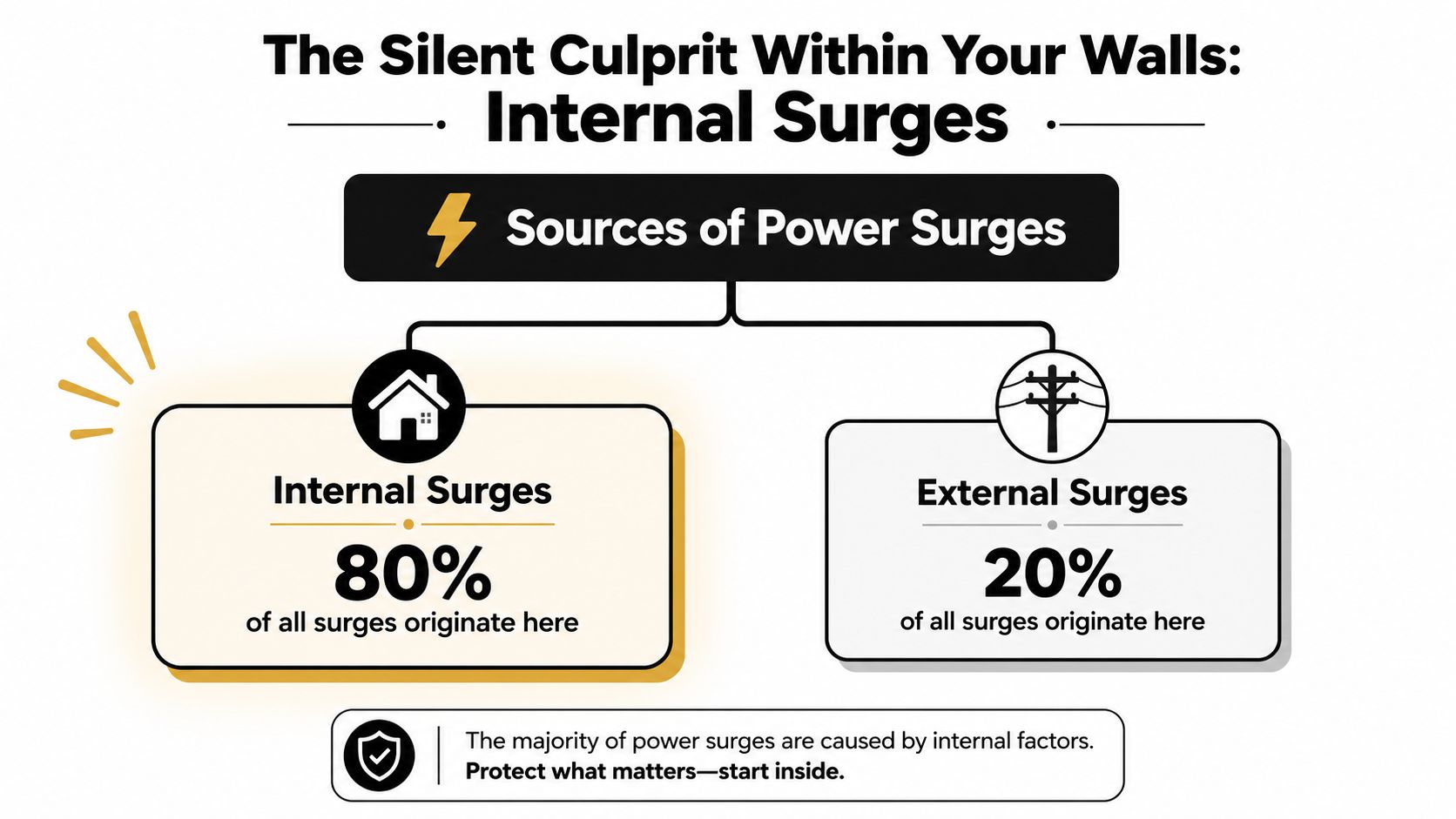
Eighty percent of all power surges and voltage spikes in residential homes are caused internally by the everyday powering on and off of major appliances, with refrigerators and air conditioners identified as major culprits, according to the City of Marion power surge guide.
What a surge actually is
The simplest way to understand this is to picture your electrical system like a network of water pipes. Under normal conditions, electricity flows steadily. When a large motor starts, it demands a heavy burst of power. When it shuts off, that demand suddenly changes again. That abrupt change sends a pressure wave through the system.
Inside a house, those internal events happen far more often than people realize. Motors in HVAC equipment, washing machines, and pumps start and stop repeatedly throughout the day. The same Marion reference notes that this internal surge activity can happen dozens of times per day, and typical internal surges can range from five to ten volts up to thousands of volts depending on the appliance.
That doesn't mean every event destroys an appliance on the spot. More often, the damage is cumulative. Small control boards, charging circuits, and microelectronics take the punishment first.
Which appliances create the most trouble
Some devices are harder on a home's wiring than others because they use compressors, motors, or heating elements that pull substantial power at startup.
Common troublemakers include:
- Air conditioners and heat pumps: These systems cycle regularly, especially in South Florida heat, and startup demand can jolt nearby electronics.
- Refrigerators and freezers: They seem quiet and harmless, but compressor cycling makes them frequent internal surge sources.
- Washing machines and pumps: Anything with a motor can create abrupt changes in electrical demand.
- Kitchen and family room clusters: The Marion guide points out that kitchens with several large appliances on shared circuits, and family rooms packed with computers and entertainment equipment, are especially vulnerable.
Practical rule: If a light dips whenever a large appliance starts, your house is telling you that the circuit is feeling strain.
This is also where panel condition matters. An older panel, crowded breakers, or poor circuit layout can make internal surge problems more noticeable. If you're trying to understand whether your system is set up to handle modern loads, this guide to electrical panel upgrades for homeowners is a helpful next step.
Powerful Threats From the Outside World External Surges
External surges are less common than internal ones, but they hit with much more force. These are the events most homeowners think about first, and for good reason. When they happen, they can overwhelm a home's electrical system very quickly.
According to Pipe Electric's explanation of surge causes, external power surges are less frequent but significantly more severe and typically originate from direct or indirect lightning strikes, which can inject thousands to millions of volts into utility lines even if the strike occurs hundreds of feet away.
Why nearby lightning matters
A direct strike is the nightmare scenario, but a nearby strike can also be enough to cause damage. Homeowners sometimes assume they were safe because lightning didn't hit the house itself. That's not how surge behavior works. If a strike energizes nearby utility lines, the resulting voltage can travel into the home through the electrical system.
That speed is part of what makes external surges dangerous. The event is over almost as soon as it begins, but the damage can already be done to televisions, routers, appliances, and hardwired equipment.
Other outside causes homeowners miss
Storms aren't the only outside source. Utility switching, transformer problems, and restoration events tied to grid operations can all create voltage spikes. These aren't dramatic from the homeowner's point of view. You may only notice a blink, a click, or a brief outage.
If you're curious about the broader infrastructure behind electric service, looking at regional generation and grid assets such as Oklahoma Gas & Electric facilities can help make sense of how much equipment and switching activity sits between a power plant and a wall outlet. The path is complex, and every transition point matters.
External surges tend to be the brute-force problem. Internal surges are the wear-and-tear problem. A well-protected home plans for both.
The Hidden Danger of Power Restoration Surges
Many homeowners think the dangerous part is the outage itself. Often, the more hazardous moment is when power comes back.
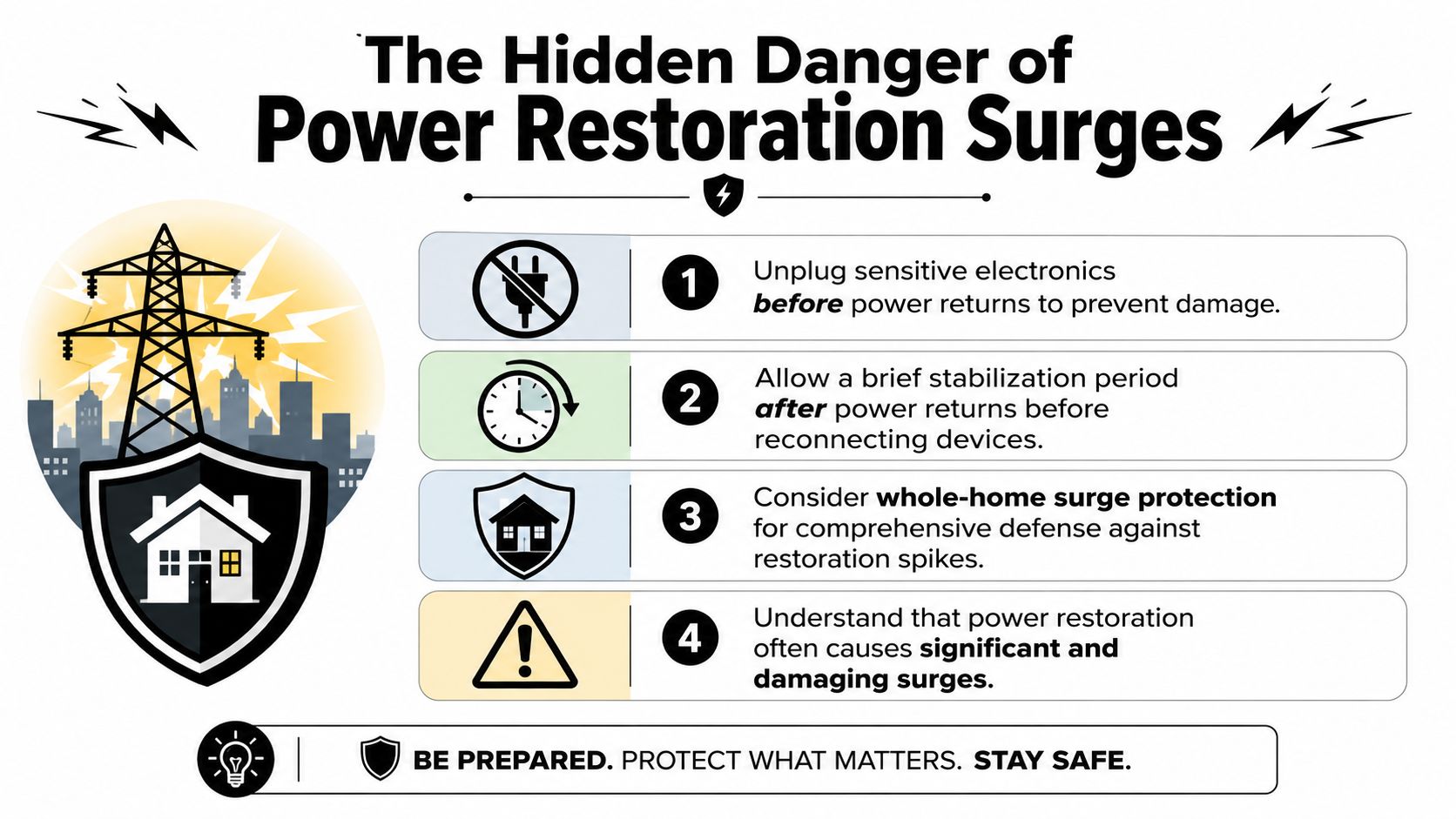
The McLeod Cooperative warning on power surges specifically cautions homeowners to beware of the post-outage surge. It notes that the post-outage surge is a rarely emphasized cause of damage, and homeowners often leave sensitive devices plugged in, risking destruction from the sudden voltage spike when power returns.
Why the return of power is risky
When the house goes dark, people focus on candles, flashlights, and whether the food in the refrigerator will stay cold. That's understandable. But the return to normal power isn't always a smooth, gentle transition.
Instead, power can come back with a sharp jump. Sensitive electronics that sat plugged in through the outage are still connected, waiting at the outlet, and they take the hit first. This catches homeowners off guard because the emotional response is relief. The lights are back on, so the danger must be over. In reality, that may be the moment to be most cautious.
Unplugging devices after the outage starts still helps. What matters is that delicate electronics aren't connected when restoration voltage hits the home.
What to do during an outage
You don't need a complicated emergency plan. You need a clear one.
- Unplug sensitive electronics. Prioritize computers, televisions, gaming systems, routers, chargers, and anything with delicate control boards.
- Turn off or disconnect nonessential devices. This reduces what is exposed when service returns.
- Leave one light on. It gives you a quick visual sign that power is back.
- Wait briefly before reconnecting electronics. Let the system stabilize before plugging everything back in.
- If the outage follows storm damage or obvious electrical trouble, get help. A homeowner should never guess whether service is returning safely. For urgent situations, emergency power restoration support can help when normal troubleshooting isn't enough.
This is one of the most overlooked answers to what causes power surges in a house. Not the storm itself. Not just the outage. The moment power returns.
Telltale Signs Your Home Has a Surge Problem
A surge problem doesn't always announce itself with a ruined appliance. More often, it shows up as a pattern of odd behavior that homeowners shrug off for too long.
What to watch for day to day
Watch for these clues around the house:
- Lights that dip or flicker: If it happens when the AC starts, the refrigerator cycles, or another heavy appliance kicks on, pay attention.
- Electronics that reset themselves: A clock losing time, a router rebooting, or a TV acting glitchy can point to unstable voltage.
- Devices that fail earlier than expected: When chargers, smart devices, or control boards seem to burn out too often, surges may be part of the story.
- Intermittent nuisance behavior: A garage door opener that works inconsistently or a microwave display that looks faint can reflect electrical stress.
When a warning sign means stop and act
Some signs deserve more urgency because they may indicate damage, not just annoyance.
- Outlet discoloration or scorch marks: Any darkening around a receptacle means stop using it until it's inspected.
- Buzzing from outlets, switches, or the panel: Electricity shouldn't sound active in normal household devices.
- A burnt plastic smell: That sharp, acrid odor near electronics or the electrical panel is a warning sign.
- Warm outlets or switch plates: Heat where it doesn't belong suggests a wiring or load problem.
If you see scorch marks, smell burning, or hear buzzing from the panel, don't keep testing things. Shut off the affected area if it's safe to do so and call for service.
The key is pattern recognition. One weird event may be nothing. Repeated symptoms usually mean your electrical system needs attention.
Your Complete Guide to Power Surge Protection
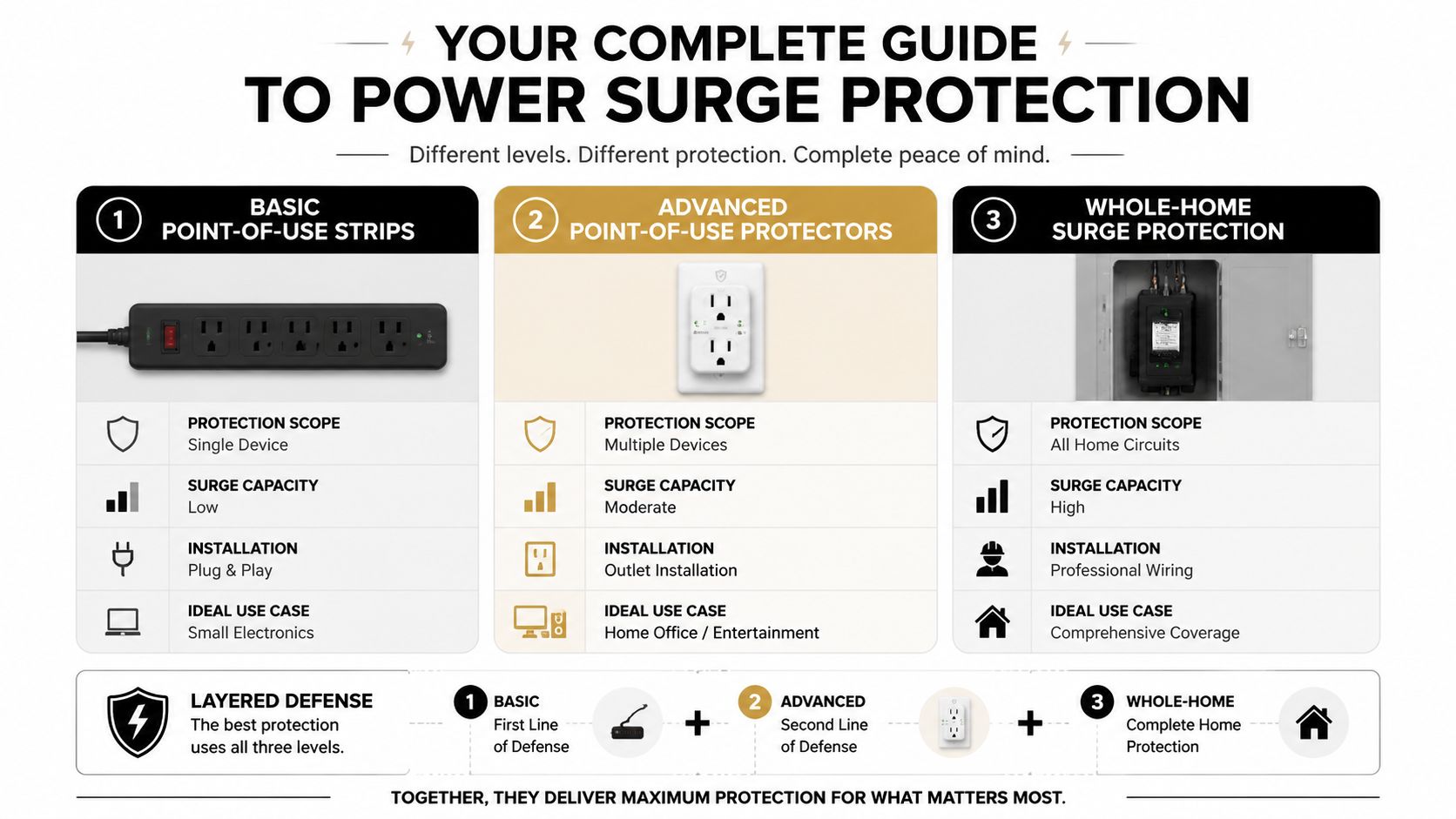
Protection works best in layers. A single power strip isn't a complete plan, especially in a home full of appliances, smart devices, and sensitive electronics.
Layer one point of use protection
Plug-in surge protectors have a place. They're useful for electronics concentrated in one area, such as a home office, media center, or charging station. They act as the last line of defense between a surge and the device.
But homeowners often misunderstand them. A cheap power strip and a true surge protector are not the same thing. Also, surge protectors don't last forever. They absorb punishment over time, and eventually they wear out.
A few practical points matter when choosing and using them:
- Check for actual surge protection: Don't assume every strip with multiple outlets offers meaningful protection.
- Use them where electronics are concentrated: Desks, TV consoles, and network equipment benefit most.
- Replace old or suspect units: If a protector has taken a hit, shows damage, or no longer indicates protection, don't trust it indefinitely.
Layer two whole house protection
A whole-house surge protector is installed at the electrical panel. The easiest way to think about it is this: it acts like a guard at the front door, intercepting excess voltage before it spreads through branch circuits.
That's a major upgrade over protecting only a few outlets. It helps cover the home more broadly, including hardwired systems that plug-in strips can't protect well, such as HVAC equipment, large appliances, and other built-in electrical loads.
For homeowners comparing options, this overview of whole-house surge protectors and how they protect your home explains what panel-level protection does and why it matters.
Layer three grounding and circuit design
Surge protection only works properly when the house has a sound path for excess voltage to go where it's supposed to go. That's where grounding comes in. If grounding is poor, even a good protective device can't perform the way it should.
Circuit layout matters too. Large appliances should have properly designed circuits so they aren't constantly stressing shared wiring with delicate electronics. In kitchens and living areas, that separation can make a big difference in day-to-day reliability.
A practical layered approach looks like this:
- At the panel: Whole-house protection handles incoming surge energy.
- At key outlets: Point-of-use protectors shield electronics that are most sensitive.
- At the system level: Proper grounding and smart circuit design reduce how much stress your wiring sees in the first place.
Surge protection methods compared
| Feature | Plug-In Surge Protector Strips | Whole-House Surge Protector (WHSP) |
|---|---|---|
| Coverage | Protects selected plugged-in devices | Protects circuits throughout the home |
| Best use | Home office, TV area, computer equipment | Broad defense for the house, including many hardwired loads |
| Installation | Homeowner plugs it in | Licensed electrician installs it at or near the panel |
| Main limitation | Doesn't protect the entire home and wears out over time | Still works best when paired with point-of-use protection and proper grounding |
| Ideal role | Final layer close to sensitive electronics | First major layer at the home's main electrical entry |
When damaged electronics do need replacement, don't just toss the old equipment in the trash. Proper disposal matters for safety and environmental reasons. This guide on the benefits of recycling old electronics responsibly is a useful resource if a surge has already claimed some devices.
When to Call the Professionals at Lighthouse Energy Services
Some electrical issues are appropriate for observation. Others call for a licensed electrician right away.

Call a professional if you notice repeated flickering tied to appliance startup, outlets with scorch marks, burning smells, buzzing at the panel, or electronics failing for no clear reason. Those aren't just inconveniences. They can point to wiring problems, overloaded circuits, grounding issues, or panel trouble.
A professional inspection also makes sense if you're planning to add a whole-house surge protector, update an older panel, or separate major appliances onto better-designed circuits. These aren't guessing games. Proper installation matters because surge protection is only as good as the system supporting it.
For Palm Beach County homeowners, Lighthouse Energy Services brings the kind of support people need during electrical problems. The company has served the area since 2005, offers true 24/7 availability, answers phones with licensed electrical professionals, and doesn't add after-hours charges. With more than 100 years of combined experience on the team, they handle troubleshooting, repairs, upgrades, and surge protection work with the kind of steady approach homeowners want when power issues get stressful.
Frequently Asked Questions About Power Surges
Do surge protector strips need to be replaced?
Yes. They don't last forever. A surge protector absorbs electrical stress, and over time that protective ability wears down. If it's old, damaged, or no longer shows that protection is active, replace it.
Can lots of small surges be as harmful as one big surge?
They can be, especially for sensitive electronics. A single large event can destroy equipment immediately, but repeated smaller hits can shorten the life of control boards, chargers, routers, and other devices that rely on delicate internal components.
Is a power strip the same thing as a surge protector?
No. Some outlet strips give you more places to plug things in. A true surge protector is designed to help limit voltage spikes reaching connected equipment.
Will a circuit breaker stop a power surge?
Not in the way most homeowners think. Breakers are meant to respond to overcurrent conditions. Surge protection addresses sudden voltage spikes, which is a different problem.
Should I unplug electronics during a storm or outage?
If practical, yes. That's one of the simplest ways to reduce exposure for sensitive devices. It's especially smart during outages, because the return of power can be a risky moment.
Is whole-house surge protection enough by itself?
It's the strongest broad defense, but the best setup is layered. Whole-house protection at the panel plus point-of-use protection for valuable electronics gives better coverage than either approach alone.
If you're seeing flickering lights, unexplained device failures, or signs of electrical stress in your home, Lighthouse Energy Services can help you get clear answers and a safe solution. Their licensed team serves Palm Beach County with 24/7 electrical service, surge protection installations, panel upgrades, and emergency troubleshooting, so you don't have to guess what's happening behind your walls.