
You may be staring at your summer bill and wondering why it climbed even though your habits didn't seem to change. In Palm Beach County, that feeling is common, especially when the air conditioner has been running hard and the bill still looks higher than expected. Time of use electricity rates can be part of the answer, but the question is whether your home has the capability to shift electricity use when prices change.
That distinction matters. A rate plan only helps if your schedule, equipment, and habits can move load away from expensive hours. If they can't, the plan can feel less like a savings tool and more like a penalty for normal life.
Table of Contents
- What Time of Use Electricity Rates Actually Mean
- How Utilities Set Peak and Off Peak Periods
- Comparing TOU to Flat Rate and Tiered Rate Structures
- Real World Examples of TOU Pricing Spreads
- Evaluating Whether TOU Rates Are Right for Your Home
- Actionable Strategies to Reduce Bills on TOU Rates
- Sample Calculations and Palm Beach County Considerations
- Next Steps for Enrolling and Managing Your TOU Rate
What Time of Use Electricity Rates Actually Mean
A lot of homeowners first notice the issue when the bill jumps in July, even though the house didn't suddenly start using wildly more power. That's where time of use electricity rates come in. They don't change how many kilowatt-hours you use, they change when each kilowatt-hour costs more or less.
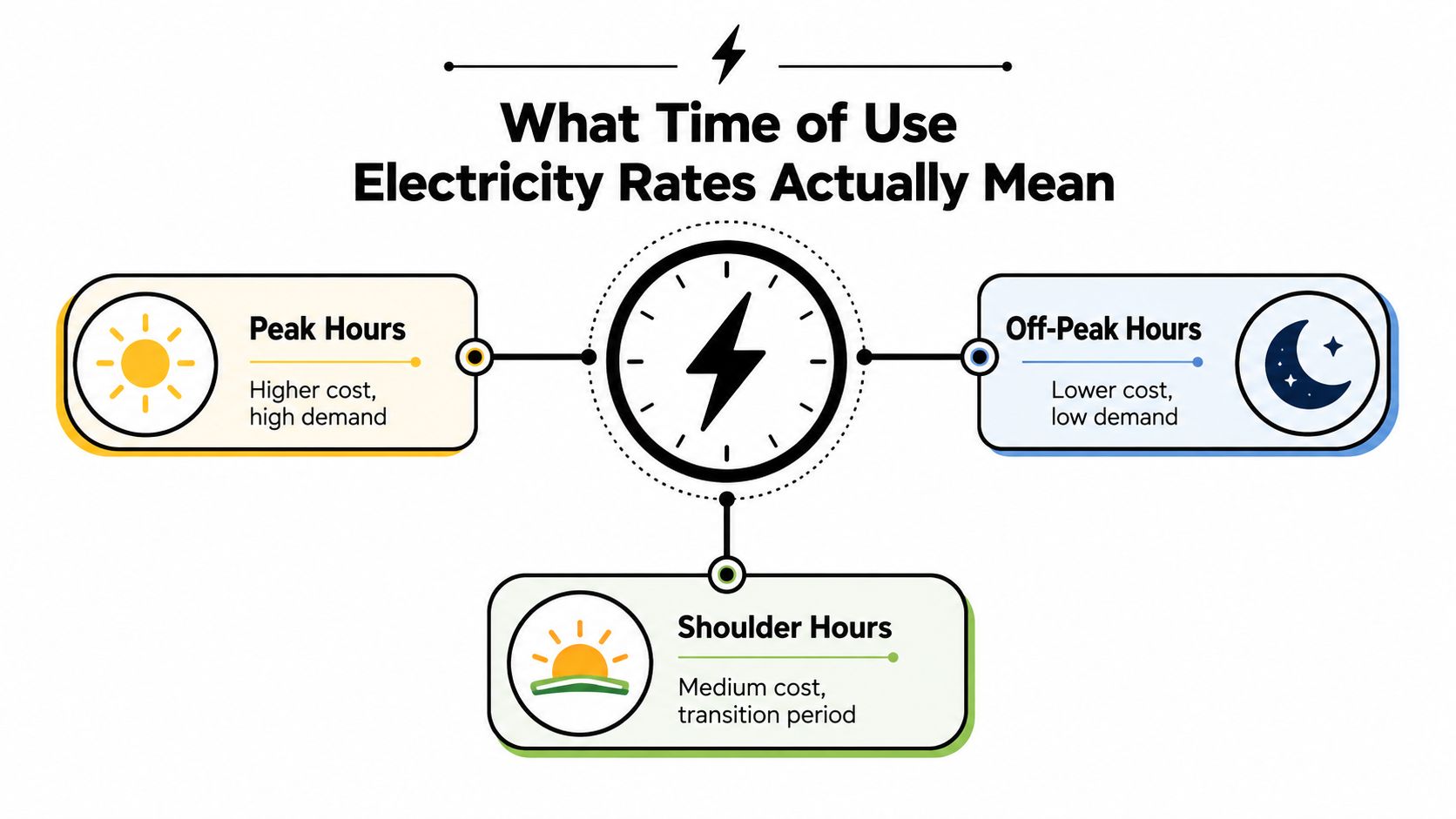
In plain terms, the utility assigns different prices to different parts of the day. Peak hours are the expensive windows, off-peak hours are the cheaper ones, and some plans also include a middle-priced shoulder or mid-peak period. That structure reflects how hard the grid is working, not just how much power your home happens to need.
Practical rule: if your biggest loads happen when everyone else's do, your bill is more likely to feel TOU pressure.
These plans aren't new or exotic. They've been used for years in commercial settings, and they're now showing up more often in residential billing. The logic is simple, electricity is pricier to deliver when the system is stressed, and cheaper when demand is light.
For a homeowner, the important part is not memorizing utility jargon. It's recognizing that a bill can rise because your usage stayed in the same hour blocks while the price of those hours changed. That's why summer cooling in South Florida can expose the difference so quickly.
How Utilities Set Peak and Off Peak Periods
Utilities usually don't pick TOU windows at random. Mature designs commonly use 2 to 4 fixed pricing blocks tied to system load conditions, with peak periods in the late afternoon or early evening and off-peak periods overnight or early morning, according to the Public Power time-of-use guide. The point is to mirror when the grid is most strained and when it has room to breathe.
Why the clock matters more than the market
That matters because most residential TOU plans are not real-time pricing. They don't change hour by hour with wholesale market swings. Instead, the utility sets seasonal blocks that stay fixed long enough for customers to plan around them.
Electricity gets expensive when lots of people want it at the same time.
That's the underlying design logic. In warm climates, the most expensive window often lines up with late-day cooling, cooking, laundry, and home arrival routines. In other words, the utility is turning a grid problem into a household price signal.
The signal is meant to be easy to read. When demand on the grid rises, the rate rises in those hours. When demand falls, the rate drops. That creates a reward for shifting flexible loads to quieter parts of the day.
Seasonal structure matters too. Summer windows are often broader and pricier in places where air conditioning dominates demand, while winter patterns can be different. The exact schedule depends on the utility, but the logic stays the same, pay more when the system is tight, pay less when it isn't.
For homeowners, the schedule is only useful if they can match it to daily life. That's why the next question isn't “What's the cheapest hour?” It's “Can my home move load into that hour?”
Comparing TOU to Flat Rate and Tiered Rate Structures
Compare rate plans by asking which one is cheapest is the wrong first question. A better question is which structure fits how your home uses power.
| Electricity Rate Structure Comparison | How Pricing Works | Best For | Savings Potential |
|---|---|---|---|
| Flat Rate | Every kWh costs the same at all times | Households that want predictability and don't want to manage timing | Limited, because timing doesn't change the bill |
| Tiered Rate | Price rises as monthly usage moves into higher brackets | Homes that can cut total consumption, not necessarily shift timing | Moderate if you can reduce overall use |
| TOU Rate | Price changes by time of day, and sometimes by season | Homes that can shift laundry, charging, cooling, or other flexible loads | Higher when you can move real usage out of peak windows |
Flat rates are easy to understand. You use electricity, you pay one price, and that's that. The downside is obvious, there's no reward for moving a dishwasher cycle to midnight or waiting until morning to charge a car.
Tiered rates work differently. They can push households to conserve, but they still treat 2 p.m. and 2 a.m. the same if both fall into the same usage bracket. That means a careful customer can still pay more because the house consumed a lot of power overall.
TOU is more demanding. It rewards people who can shift load, but it asks for more attention, more planning, and sometimes a bit of automation. That's why it fits some homes much better than others.
Good rule of thumb: if your biggest electric loads are flexible, TOU has a better chance of helping. If your biggest loads are fixed, the plan may just expose you to price swings.
For a homeowner in Palm Beach County, this comparison usually comes down to comfort and control. If the AC is running hard during the hottest part of the afternoon, you may not have much room to maneuver. If you've got flexible loads, though, the structure starts to work in your favor.
Real World Examples of TOU Pricing Spreads
A TOU plan starts to feel real once you see the gap between hours. In one California default TOU plan studied by Berkeley researchers, households paid $0.2835 per kWh during the summer peak window of 5 p.m. to 8 p.m., compared with $0.1166 per kWh from midnight to noon, while the mid-peak period was $0.1611 per kWh (Berkeley research archive). That kind of spread changes the whole calculation for running heat, charging equipment, or starting appliances.
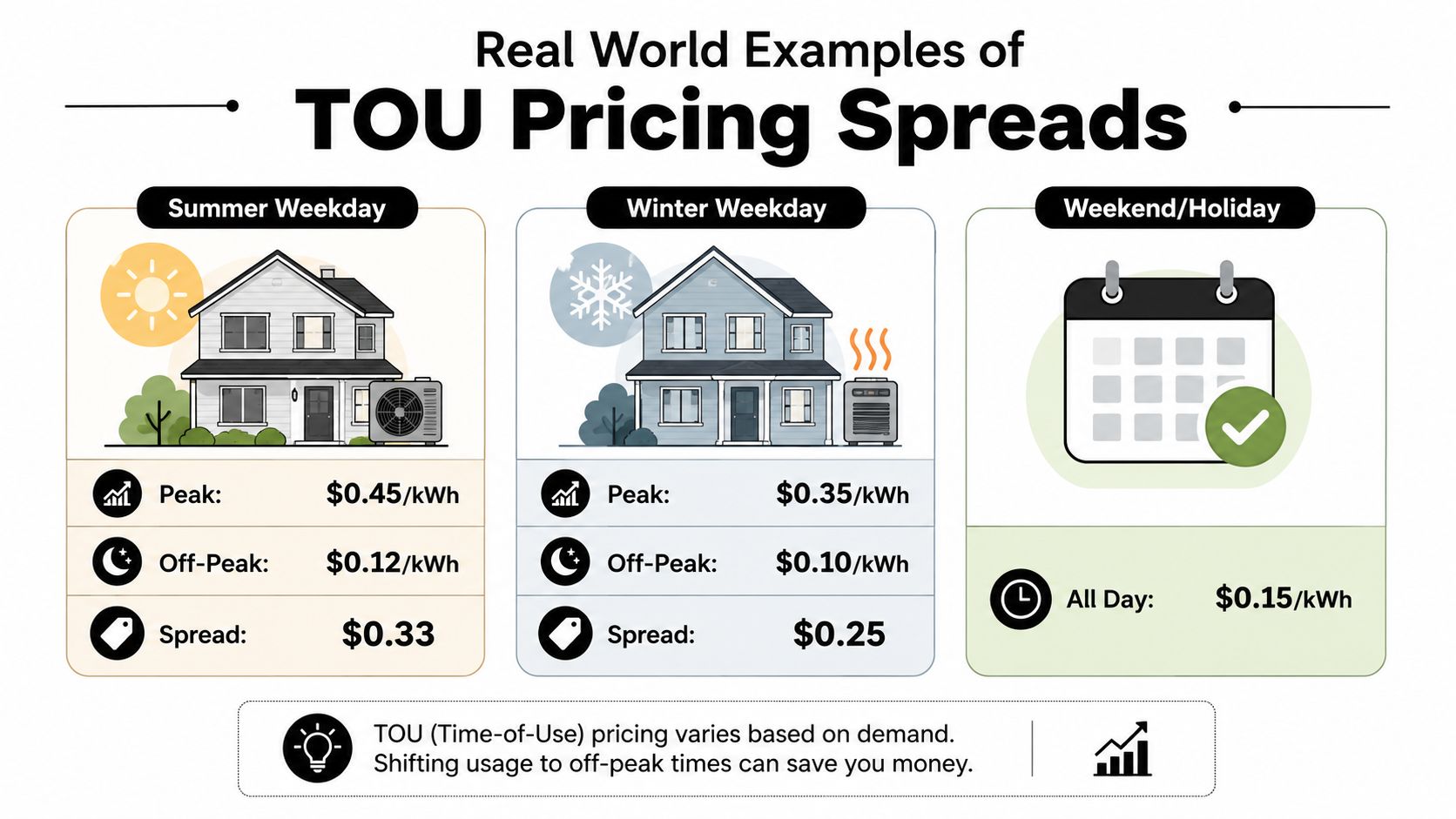
What a larger spread does to daily choices
Con Edison's summer TOU plan gives another clear example, with $0.2786/kWh during peak hours and $0.0522/kWh off-peak from June 1 to September 30 (Con Edison TOU rate page). A gap like that can make ordinary routines expensive if they land in the wrong time block.
Seattle City Light's TOU schedule shows a three-tier pattern with $0.1610/kWh peak, $0.1409/kWh mid-peak, and $0.0805/kWh off-peak (Seattle City Light schedule). The shapes differ from one utility to another, but the lesson stays the same, the cheapest hour and the most expensive hour can be far apart.
Those spreads matter because they make timing show up on the bill. A dishwasher run, an EV charge, or a precooling cycle can cost very differently depending on the hour it starts. The savings come from moving real usage into a cheaper window, not from hoping the rate plan fixes the problem on its own.
Bottom line: TOU only pays off when timing changes. If usage stays in the same expensive window, the rate plan alone won't save you.
That is why one household can like TOU and another can feel stuck with it. The pricing structure may be the same, but the result depends on what the home can shift.
Evaluating Whether TOU Rates Are Right for Your Home
The best way to judge TOU is to treat it like a capability check. Ask whether your home can move electricity use without making life harder. If the answer is yes, TOU can work. If the answer is no, the plan can backfire.
Start with your schedule, not the rate sheet
Look at when the family is home. If people are away during peak hours, you've already got an advantage. If everyone comes home at the hottest part of the afternoon and the AC works hardest then, your flexibility is much lower.
Then look at your biggest loads. Water heating, laundry, dishwashing, pool equipment, and EV charging are often easier to shift than cooling. Cooling is different because comfort isn't optional in Palm Beach County heat.
The why is my electric bill so high question usually starts here, because the cause is rarely just one thing. A home may be using normal amounts of power, but the timing of that use, plus the weather, plus the rate structure, can all stack together.
Check whether your home has real control
A smart thermostat, scheduled appliances, and managed charging make TOU easier to live with. Without those tools, a family has to rely on memory and discipline, which is where savings often fall apart.
- Flexible appliances: Can laundry, dishwashing, or charging wait until later?
- Cooling load: Does the AC dominate your bill during the same hours prices rise?
- Daily routine: Are peak hours full of cooking, homework, or work-from-home use?
- Control tools: Do you already have timers, automation, or smart controls?
A useful question is whether the plan rewards discretion or punishes necessity. That's the big nuance most guides skip. In hot weather, a homeowner may not be able to “choose” when the AC runs, and that's why TOU is really a capability test, not just a pricing test.
If your home can't shift much load, a different rate structure may be more comfortable. If it can, TOU can become a practical way to turn routine habits into lower bills.
Actionable Strategies to Reduce Bills on TOU Rates
The easiest savings come from moving the loads you barely notice. Start with appliances that don't need your attention minute by minute. A dishwasher can run later, laundry can wait, and EV charging can usually be scheduled overnight through a charger or vehicle setting.

Use automation to do the heavy lifting
Smart thermostats and home energy management tools help because they remove guesswork. A thermostat can start precooling before the expensive period begins, so the home coasts through part of the peak window instead of fighting it with full compressor demand.
For homes with an EV, overnight scheduling is especially useful. If you're also planning a charger installation, it helps to think through the circuit, panel space, and charging behavior before the hardware goes in, which is why a clean EV charger installation at home setup matters for TOU planning.
Practical tip: the best savings usually come from three small moves, not one giant change. Shift charging, shift laundry, and shift cooling behavior where you can.
The air conditioner is the biggest opportunity in many Palm Beach County homes, because it's the load that runs when TOU pricing hurts most. A device like the Smartcool ECO3 can help optimize AC operation and reduce electricity consumption by up to 25 percent, according to the publisher information provided for Lighthouse Energy Services. That doesn't erase TOU pricing, but it can reduce the amount of power that gets exposed to it.
If you're also tackling broader home efficiency, energy-saving home improvements can make TOU less punishing by trimming the baseline load before you try to shift timing. Lower total use gives you more room to benefit from the cheaper hours.
Battery storage adds another layer. A battery can help a home use stored energy during the expensive window instead of buying it from the grid at peak price. That works best when paired with good scheduling, because the battery can only do so much if the house keeps pulling hard in the afternoon.
The key is to stack strategies. A little automation, a little load shifting, and a more efficient cooling system can work together in a way that any one measure alone can't.
Sample Calculations and Palm Beach County Considerations
Palm Beach County changes the math because cooling season is long and air conditioning often becomes the biggest load in the house. The same afternoon hours that keep a home comfortable are often the hours when time of use electricity rates are least forgiving. If your household depends heavily on afternoon cooling, the plan needs a careful look before you switch.
A simple household example
A plain comparison makes the point clear. Start with a home on a flat rate that pays the same way each month, then move that same home to TOU without changing habits, then move it again to TOU with real load shifting. The goal is not to forecast every bill exactly, it is to show how timing changes the result.
If the household shifts some usage out of peak hours, the bill can move in the right direction. If it does not, TOU can expose more of the home's usage to expensive periods instead of helping it.
That is why an EV is a useful case study. The cost of charging an electric car depends heavily on when charging happens, not just how much energy the car needs. In a TOU home, overnight charging is often the difference between a manageable routine and a painful monthly spike.
Local factors to keep in mind
Palm Beach County homes do not all follow the same rate schedule. Different utilities serve different neighborhoods, and each utility sets its own peak window, off-peak window, and bill impact. Two homes with the same equipment can see different results if the rate design is different.
Weather sets the pressure, but the rate design decides how that pressure shows up on the bill. In South Florida, the long cooling season means the AC is not a side issue, it is the center of the calculation. If a home is adding smart controls or an EV circuit, panel capacity matters too, and a home electrical panel upgrade may be necessary before those changes can be put in place.
The strongest savings usually come from homes that can shift usage without losing comfort. If the home cannot do that, the rate plan may still be worth understanding, but it should not be chosen blindly.
Next Steps for Enrolling and Managing Your TOU Rate
Before you enroll, gather your recent bill, your utility account details, and a sense of your highest-use hours. That gives you a baseline to compare against after the switch. Once you're on TOU, the bill becomes a tracking tool, not just a charge sheet.
Watch for which loads hit hardest during the expensive window. Cooling, charging, and appliance timing will usually show up first. If the bill rises after enrollment, don't assume the plan failed right away; check whether the home changed its behavior.
A licensed electrician is the right call when the change you need involves panel capacity, smart controls, battery readiness, or a new EV circuit. In Palm Beach County, it also makes sense to call for help if the bill spikes and you suspect the issue is electrical rather than behavioral.
Lighthouse Energy Services is a local option if you want a licensed electrician who understands TOU-driven load shifting, cooling efficiency, and practical home upgrades. They're available 24/7, and they install the Smartcool ECO3 for homeowners who want to make AC use less expensive and more manageable.
If you're trying to decide whether TOU is a fit, Lighthouse Energy Services can help you look at the home, the load profile, and the equipment that drives the bill. Visit Lighthouse Energy Services to talk through your options, ask about TOU-friendly upgrades, and get practical help from a local Palm Beach County electrical team.