
You pull into the driveway with a new EV and the first question hits before the excitement wears off. Where are you going to charge it tonight, and how long will that take?
Most homeowners start with the outlet they already have in the garage. That works for a short test, but it usually doesn't match real life. Once you start driving the car every day, you want charging to be automatic, safe, and ready when you wake up. That's what a proper home setup gives you.
In Palm Beach County, I see the same pattern over and over. A homeowner buys the vehicle first, shops chargers second, and only then finds out the electrical panel may not have room for the circuit they want. That panel check is where a smooth project either stays simple or turns into a bigger job.
Home charging isn't a niche add-on. It's the center of EV ownership. A PwC analysis of U.S. EV charging growth projects that by 2030, residential charging will account for about 80% of all EV charge points in the United States, including 25.7 million chargers in single-family homes. If you're planning an EV charger installation at home, you're not doing something unusual. You're building the setup most drivers will rely on.
Table of Contents
- Welcome Home Your New EV Now How Do You Charge It
- Before You Buy a Charger The Critical Home Electrical Audit
- Choosing the Right Level 2 Charger for Your Home and Vehicle
- Navigating Permits and Inspections in Palm Beach County
- The Installation Process What to Expect from Your Electrician
- Hiring the Right Electrician Your Most Important Decision
- Frequently Asked Questions About Home EV Charger Installation
- Do I need a panel upgrade
- Is a Level 2 charger worth it at home
- Should I install the charger in the garage or outside
- How long does the process take
- Can I install one at a condo or townhouse
- What affects the final installation cost
- How do I research incentives and rebates
- What should I do before calling for an estimate
Welcome Home Your New EV Now How Do You Charge It
You pull into the driveway with a new EV, plug it into a standard wall outlet that first night, and by morning the charge has barely climbed enough to cover the next day's driving. That is usually the moment homeowners realize the car purchase was the easy part. The charging setup at the house is its own electrical project.
A proper EV charger installation at home changes the routine. Instead of watching battery percentage and planning errands around charging stops, you park, plug in, and wake up ready to drive. For most households, that is the whole point of charging at home.
Home charging also puts the focus where it belongs. On the house, not the charger box.
If you want a broader view of how home charging fits with public and workplace charging, this EV charging infrastructure guide gives useful context. At the homeowner level, though, the question is much simpler. Can the electrical system support a charger safely, legally, and without unpleasant surprises after the equipment is already on the wall?
That question matters a lot in Palm Beach County. I see homes with plenty of available capacity and a straightforward route from the panel to the garage. I also see older homes with crowded panels, aging service equipment, detached garages, and outdoor parking areas that need weather-rated equipment and careful placement because of heat, humidity, and salt air.
The first conversation usually comes down to a few practical concerns:
- Will my panel support a Level 2 charger without overloading the service?
- Where should the charger go if the vehicle parks outside or the garage layout is tight?
- What does Palm Beach County require for permits and inspection?
- Will this turn into a larger electrical upgrade before the charger can be installed?
That last point gets missed all the time. Homeowners shop cord length, app features, and charger appearance before anyone checks service size, panel condition, breaker space, or the actual load calculation. If the house needs panel work first, the charger decision comes second. In many cases, electrical upgrades for home charging capacity are what make the installation possible and code-compliant.
A clean installation starts with the house telling us what it can handle. Then the charger choice makes sense.
Before You Buy a Charger The Critical Home Electrical Audit
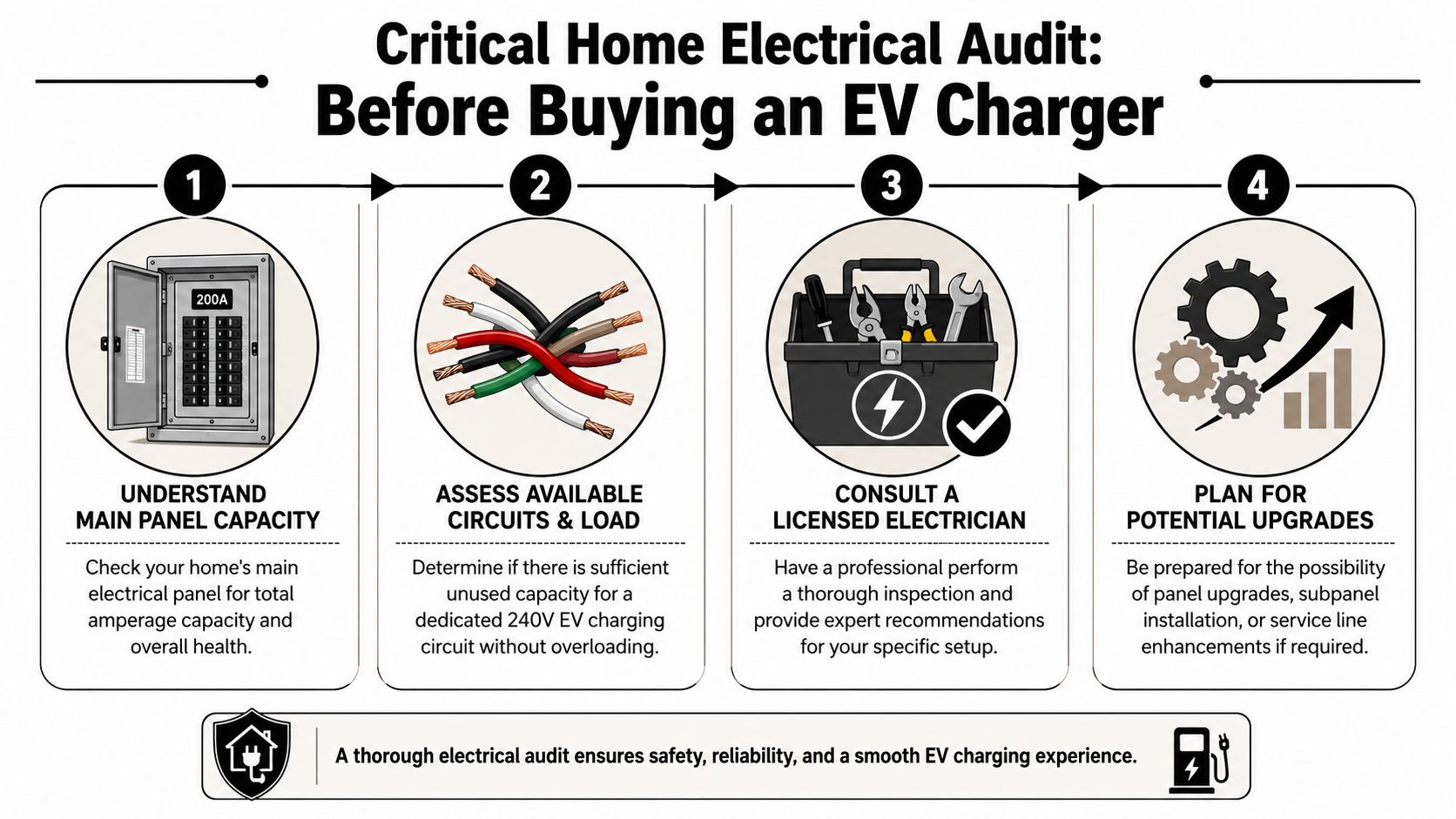
The biggest mistake homeowners make is buying the charger first. The box arrives, everyone is excited, and then the panel tells a different story.
An EV charger installation at home starts with the electrical system already in the house. If that system can't safely support the load, the charger choice doesn't matter yet. This is the step most online guides rush past, and it's the step that causes the most budget surprises.
Research cited in this topic estimates that 40% of U.S. homes lack sufficient electrical capacity for a Level 2 charger without a service panel upgrade, which is why this check needs to happen first, not after purchase, as noted in this capacity assessment reference.
Start at the panel and read what you actually have
Open the panel door and look for the main breaker rating. Homeowners usually find a number that identifies the service size. That's your starting point.
You're not doing live electrical work here. You're reading labels, noting breaker sizes, and checking panel condition. If anything looks damaged, corroded, hot, loose, or modified in a way you don't understand, stop there and let a licensed electrician take it over.
Write down these basics:
- Main breaker size. This tells you the service rating shown on the equipment.
- Panel brand and age if known.
- Open spaces available for a new dedicated circuit.
- Large existing loads such as air conditioning, water heating, pool equipment, ovens, dryers, and any other heavy electrical equipment.
A homeowner will often tell me, "I have room in the panel." What they usually mean is they see physical breaker spaces. That's not the same as having available capacity.
Look at the house load, not just empty breaker spaces
The practical aspects of the project come to the forefront. The home has to carry all the existing demand plus the charger load within code requirements. Air conditioning matters in Palm Beach County because it isn't occasional. It's a major everyday load.
A common problem looks like this. The house has an older service, multiple large appliances, and a homeowner wants a higher-amperage charger because they want faster charging. On paper, the charger sounds fine. On the load calculation, it may not be.
Practical rule: Assume the panel may be undersized until someone verifies the available capacity correctly.
If the house can't support the new EV circuit, the solution might be one of several paths:
- Install at a lower charging output if the vehicle usage pattern allows it.
- Reconfigure the panel if the issue is layout rather than total service limitation.
- Add a subpanel when that fits the design.
- Upgrade the service equipment when the existing service is the bottleneck.
For homeowners who want to understand what broader electrical changes can involve, this guide on home electrical upgrades is a useful background resource.
What to gather before you call an electrician
You don't need to diagnose the whole house yourself. You do want to give accurate information so the estimate and site visit start on solid ground.
Bring these details to the conversation:
- Vehicle information. Tell the electrician what you're driving and whether you want a basic overnight charging setup or the highest residential charging rate your car can use.
- Parking location. Garage wall, exterior wall, carport post, driveway side wall, or detached structure all change the routing plan.
- Panel photos. A clear photo of the panel interior, panel label, and surrounding area helps.
- Daily driving pattern. Someone with a short local commute doesn't need the same charging plan as a household turning over miles every day.
- Future plans. If a second EV is likely, say that now. It's easier to plan for growth during the first installation than retrofit later.
A good audit doesn't just answer "Can I install a charger?" It answers the question that matters more. What's the safest, smartest version of this project for this specific house?
Choosing the Right Level 2 Charger for Your Home and Vehicle
You get home with a new EV, park in the driveway, and start shopping chargers online. The listings make it sound simple. Pick the highest amperage, add smart features, and mount it on the wall. In practice, the right charger depends on where it will live, how your car charges, and what your electrical system can support without forcing unnecessary changes.
Hardwired versus plug-in in South Florida conditions
For Palm Beach County homes, I usually settle the connection method first.
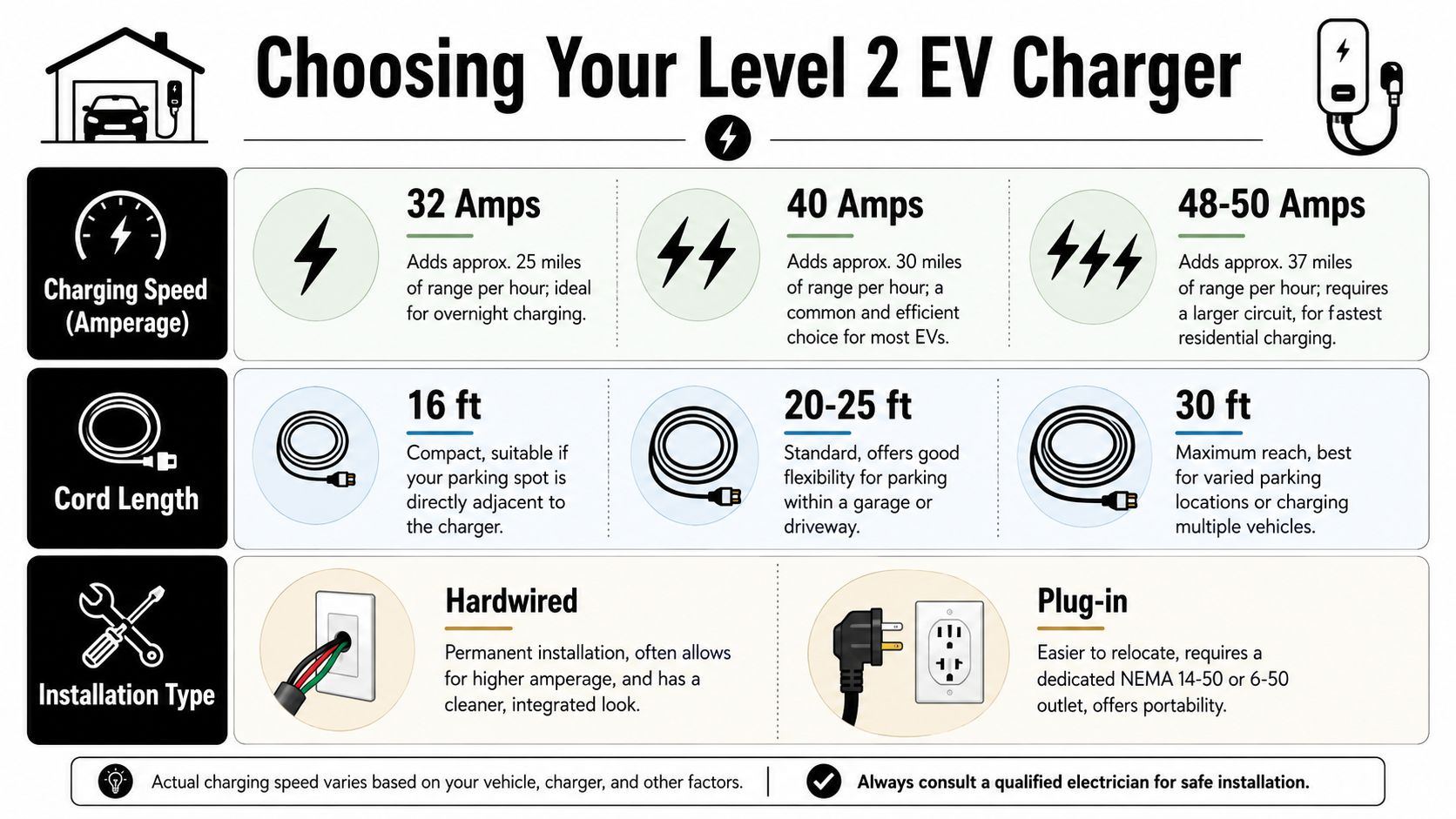
A hardwired charger is permanently connected to the branch circuit. A plug-in charger connects through a receptacle. Both can work, but they are not equally well suited to every location.
Outdoors, hardwiring is usually the better choice. It removes one connection point, gives the installation a cleaner weather-resistant finish, and avoids the long-term wear that receptacles and plugs can see in heat, humidity, and wind-driven rain. That matters more near the coast, where salt air and moisture shorten the life of exposed equipment.
Plug-in units still have a place. In a dry, enclosed garage, they can make sense for a homeowner who wants flexibility or may replace the charger later without rewiring. The trade-off is that the receptacle, plug, and enclosure all need to be right for the load and the location. If any part of that setup is marginal, the convenience is not worth it.
A simple comparison helps:
| Installation type | Where it fits best | Main trade-off |
|---|---|---|
| Hardwired | Outdoor walls, open carports, exposed garages, long-term installations | Better protection and a cleaner permanent install, but less portable |
| Plug-in | Covered indoor areas with the correct receptacle and circuit design | Easier to replace later, but less suitable for harsh outdoor conditions |
If the charger is going on an exterior wall in Palm Beach County, I recommend hardwiring in most cases.
Match the charger to the car and the circuit
In this scenario, homeowners often spend more money than they need to.
A higher-rated Level 2 charger does not automatically mean faster real-world charging. The vehicle's onboard charger sets one limit. The circuit size sets another. If your car can only accept a certain rate at home, buying a larger unit will not improve overnight charging.
Three questions usually sort this out fast:
- What charging rate can the vehicle accept on Level 2 power
- What circuit size is available for the charger installation
- How much range do you need to recover between drives
A household with a moderate daily commute may do perfectly well with a charger set below its maximum output. That approach often avoids larger conductors, a bigger breaker, or additional panel work. For a homeowner with two EVs, long daily mileage, or limited charging time overnight, sizing higher may be justified.
Some chargers can be field-configured to a lower output during installation. I use that option when the homeowner wants room to adjust later but the current electrical setup calls for a more conservative charging rate today.
Smart features that help and the ones that do not matter to every homeowner
The features that earn their keep are usually simple.
- Scheduling helps shift charging to preferred utility hours
- Usage tracking helps homeowners who want to monitor charging costs
- Access control is useful in shared garages or multi-driver households
- Load management compatibility matters if the home has limited spare capacity or may add a second charger later
Many app-heavy extras sound good in a sales listing and never get used after the first week. A charger should first be reliable, properly rated for the location, and set up correctly for the house. After that, convenience features are a bonus.
Homeowners who are unsure what fits their panel, parking layout, and vehicle often want guidance before they buy equipment. Lighthouse Energy Services handles that part of the process with site assessment and charger selection input, which helps prevent a common problem I see in the field. A homeowner buys a charger first, then finds out the location, circuit path, or panel capacity makes that exact model a poor fit.
The best Level 2 charger is the one that matches the house, the vehicle, and the installation conditions the first time.
Navigating Permits and Inspections in Palm Beach County
A home EV charger is not the kind of project that should happen with a handshake and no paperwork. In Palm Beach County, you're adding a dedicated electrical circuit and new equipment. That puts permitting and inspection squarely in the job.
Homeowners sometimes worry that a permit just adds delay. In reality, the permit is what documents that the work was reviewed, installed, and inspected as electrical work instead of improvised hardware hanging on a wall.
Why the permit matters
There are three practical reasons permits matter on this project.
First, safety. An EV charger is a continuous electrical load. It needs proper circuit sizing, wiring method, grounding, bonding, equipment mounting, and overcurrent protection.
Second, paper trail. If the house is sold later, permitted electrical improvements are much easier to stand behind than undocumented modifications.
Third, insurance and liability. If there's ever a problem, you want the installation to have been done through the proper channel, not outside it.
Permit paperwork doesn't make the installation safe by itself. It creates the process that verifies the work was done safely.
How the local process usually unfolds
The exact workflow can vary based on property type and municipality, but most homeowners can expect a sequence like this:
Site visit and scope review
The electrician confirms panel condition, charger location, circuit path, and whether additional work is needed before the charger can be added.Permit preparation
The contractor prepares the information required for the electrical permit application.Installation scheduling
Once the permit path is in motion, the work is scheduled according to the project scope and site conditions.Rough and final coordination if needed
Some jobs are simple enough to move cleanly to final. More complex routing or related electrical changes may need additional coordination.Final inspection
The inspector checks the completed work for compliance before the project is considered finished.
For Palm Beach County homeowners, one of the biggest advantages of hiring the right electrician is project management. You don't want to figure out permit submittals, inspection timing, corrections, and code interpretation on your own while also trying to learn EV charging equipment.
A good contractor handles the permit process, communicates what the inspector will expect, and is there to address issues if anything needs adjustment before sign-off.
The Installation Process What to Expect from Your Electrician
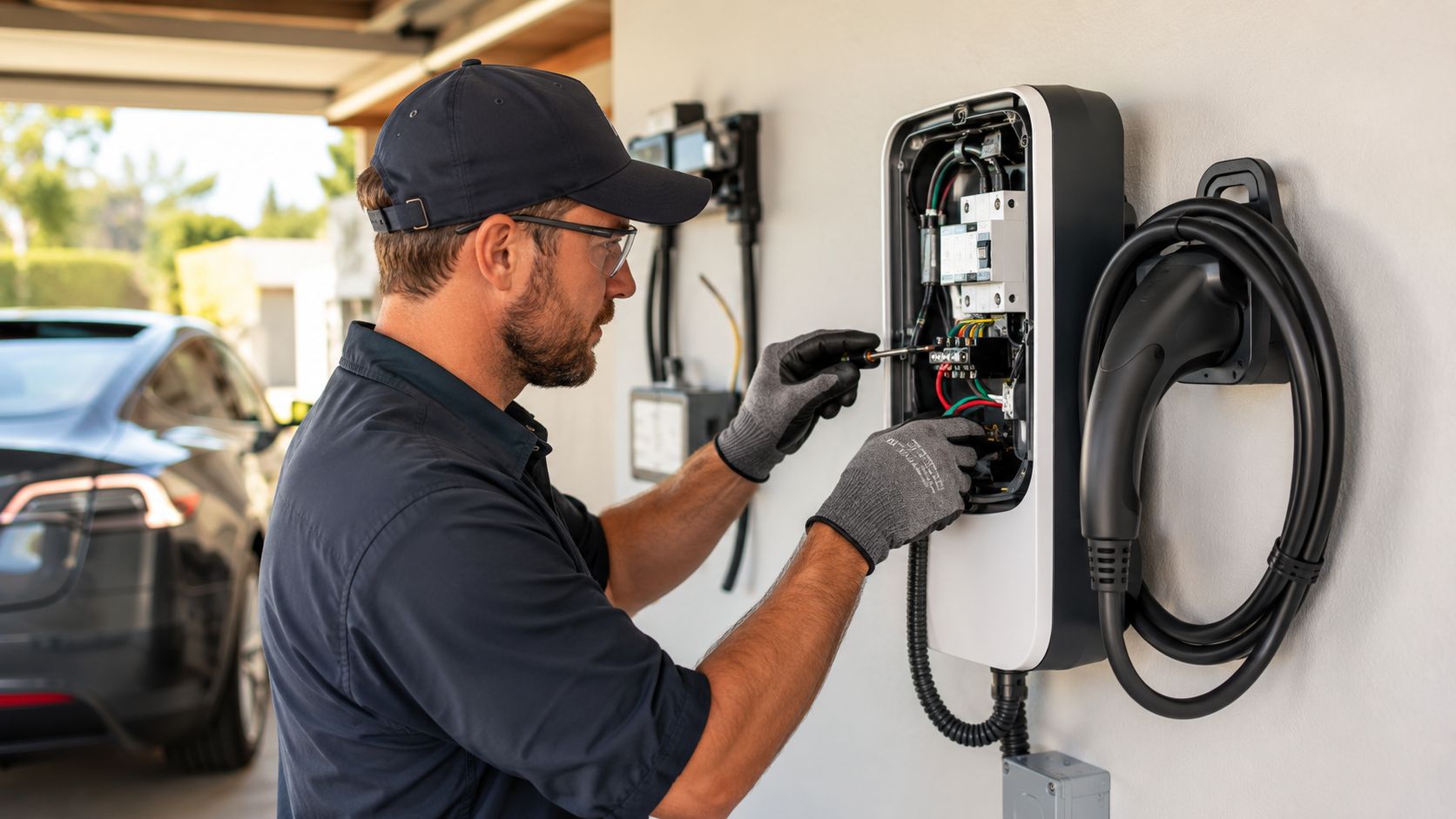
On installation day, the visible part is the charger going on the wall. The important part is everything behind it. That's the circuit design, conductor sizing, protection, routing, mounting, labeling, and testing.
A clean EV charger installation at home should look straightforward when it's done. That simplicity is earned by careful prep.
What happens on installation day
The electrician usually starts by confirming the mounting location and circuit route one more time. That's when final field conditions matter. Stud placement, wall type, panel access, attic path, exterior exposure, and parking position all affect the best exact location.
Then the power work begins. A dedicated branch circuit is run from the electrical panel to the charger location. Depending on the house, that might involve attic routing, surface-mounted conduit, exterior wall penetrations, or a combination of methods chosen for code compliance and durability.
The charger is then mounted securely, the conductors are terminated properly, and the circuit is labeled and tested before the system is energized.
Why wire size breaker size and mounting details matter
Shortcuts in this context result in heat, nuisance trips, and failed inspections.
For EV charging, the circuit breaker must be sized for a continuous load. The EPA home charging guidance states that the dedicated circuit breaker must be at least 125% of the charger's rated current, which means a 40-amp charger requires a 50-amp circuit. The same guidance also notes that installers often use 6 AWG copper wire for these circuits where appropriate to meet the design requirements safely.
That rule exists for a reason. EV charging isn't like a brief appliance cycle. The load can stay on for long periods, and the circuit has to handle that without overheating.
A few installation details matter more than homeowners expect:
- Dedicated circuit only. The charger shouldn't share a branch circuit with other loads.
- Correct conductor size. Wire is selected for the actual circuit and equipment requirements, not by guesswork.
- Proper protection method. Breaker sizing has to match the continuous-load rules and the charger configuration.
- Solid mounting. The equipment needs to be anchored securely. A charger hanging on weak backing or loose fasteners is asking for trouble.
- Weather-appropriate installation. Outdoor locations need a method and materials suited to moisture and heat exposure.
If the audit shows the house needs more service capacity before the charger can be added, homeowners often start by reviewing what a 150 amp to 200 amp service upgrade typically involves.
What the inspection checks before approval
The final step is not just flipping the breaker on and calling it done. Inspection confirms that the system was installed the way it needed to be.
Inspectors typically focus on the parts of the job that affect safety and code compliance most directly. That includes conductor protection, terminations, breaker sizing, equipment labeling, grounding, bonding, and the general workmanship of the installation.
Good EV charger work is quiet work. The breaker holds, the charger communicates properly, the cable reaches the car comfortably, and nothing runs hot.
A homeowner should also expect a brief walkthrough. You should know how to operate the unit, how to shut it off if needed, and what normal indicator behavior looks like.
Hiring the Right Electrician Your Most Important Decision
A lot of EV charger jobs look simple from the driveway. Mount the charger, run a circuit, turn it on. In Palm Beach County, that is rarely the whole job. The electrician you hire decides whether the panel is evaluated correctly, whether the permit is filed the right way, and whether the installation passes inspection without expensive rework.
What goes wrong with DIY and unlicensed work
I have seen homeowners get tripped up by the same few problems over and over. The charger itself is usually fine. The trouble starts behind it. A panel gets assumed to have room when it does not. A breaker is chosen by charger label instead of actual load calculations. An outdoor unit gets installed with materials that do not hold up well in our heat and moisture.
Inspection is where those shortcuts show up.
Common failures are basic electrical issues, not exotic ones. Loose terminations, grounding and bonding mistakes, conductor protection problems, poor equipment placement, and missing permit records can all stop approval. Even worse, some of those mistakes do not fail right away. They show up later as nuisance tripping, overheated connections, or water intrusion.
That creates real homeowner costs:
- Failed inspection and delays before the charger can be used
- Rework charges to correct installation mistakes
- Warranty questions if the manufacturer requires qualified installation
- Safety risks tied to heat, moisture, and improper connections
- Problems when future buyers or insurers ask whether the work was permitted
How to vet a Palm Beach County electrician
A good electrician should be able to explain the job in plain language and start with the house, not the charger model. In this county, I would be cautious of anyone who gives a flat quote over the phone without asking for panel photos, service size, charger location, and whether the equipment will be indoors or outside.
Ask direct questions:
- Are you licensed to perform this electrical work in Florida
- Will you handle the permit and coordinate the inspection
- Will you do a real panel capacity assessment before finalizing the scope
- Have you installed EV chargers in garages, carports, and exterior locations
- If my panel is full or undersized, what code-compliant options do I have
- Will you walk me through charger placement, cable reach, and shutoff access before installation starts
Homeowners who want a broader screening checklist can review this guide to hiring a new home electrician.
The right hire is the electrician who catches the hidden constraints early. In Palm Beach County, that often means identifying a crowded panel, aging equipment, service limitations, or permit details before any wire is pulled. That is what keeps the job safe, insurable, and ready to pass inspection the first time.
Frequently Asked Questions About Home EV Charger Installation
Do I need a panel upgrade
Maybe. The answer depends on your existing service, panel condition, and house load. Some homes can add a charger circuit with no major changes. Others need panel work or service upgrades before the installation can be done safely.
The panel audit is what answers this. If you skip that step and buy equipment first, you're guessing.
Is a Level 2 charger worth it at home
For most homeowners who drive regularly, yes. A Level 2 setup makes daily charging routine and practical in a way a standard outlet usually doesn't. The value isn't just speed. It's consistency.
If your vehicle sits overnight at home and you want dependable charging by morning, Level 2 is usually the setup that makes EV ownership feel easy.
Should I install the charger in the garage or outside
Either can work if the location is designed correctly. A garage installation is often simpler because the equipment is protected from weather and the wiring path may be shorter. An exterior installation can work very well too, but it needs the right mounting location, weather-suitable materials, and a layout that fits how you park.
The best spot is the one that lets you park naturally and plug in without stretching cords, blocking walkways, or forcing awkward parking habits.
How long does the process take
That depends on the house and the permit path. A straightforward installation moves much faster than a project that needs panel changes, service upgrades, or more complex routing.
The useful way to think about timeline is in stages:
- Assessment first so the scope is accurate
- Permit handling next so the work is documented properly
- Installation day after that once the job is ready to proceed
- Final approval last when inspection is complete
A simple job and a complex job can look similar from the driveway. Inside the panel, they're very different.
Can I install one at a condo or townhouse
Often yes, but the approval path is more layered. In attached housing, the electrical side is only part of the process. You may also need association approval, parking-area permissions, and coordination around common elements or shared electrical infrastructure.
The earlier you raise HOA or condo board requirements, the smoother the project usually goes.
What affects the final installation cost
Several things change the price materially:
- Distance from panel to charger location
- Whether the charger is indoors or outdoors
- Wall type and routing difficulty
- Whether service or panel upgrades are needed
- Permit and inspection requirements for the specific property
That's why responsible electricians don't give serious pricing based on the charger model alone.
How do I research incentives and rebates
Start with current federal tax guidance and then check your utility for any active EV charging or time-of-use programs. These programs can change, so the right move is to verify what's active at the time you're planning the installation.
Keep your permit records, invoice, and equipment documentation organized. If there's an incentive available, clean paperwork makes the process easier.
What should I do before calling for an estimate
Have these ready:
- A photo of the panel
- A photo of the parking area
- The vehicle model
- Whether you want indoor or outdoor mounting
- Any plans for a second EV later
That information speeds up the first conversation and usually leads to a more accurate site assessment.
If you're planning an EV charger installation at home in Palm Beach County, Lighthouse Energy Services can help you start with the part that matters most: a real evaluation of panel capacity, charger location, permit requirements, and the safest path to a code-compliant installation.