A standard Tesla Wall Connector installation in West Palm Beach usually lands between $750 and $1,800 for labor and materials in most homes. If you're getting ready to charge your Tesla at home, that's the practical starting point, but the actual answer depends on panel capacity, mounting location, permit requirements, and whether your home needs coastal-grade installation details.
Most new Tesla owners hit the same moment. The car is in the driveway, the mobile connector works, and then the question shows up fast: do you keep plugging into a basic outlet, or do you install the charger you want to use every day?
For most West Palm Beach homeowners, the Wall Connector is the right long-term move. It's cleaner, faster, and more convenient. But this isn't a place where generic online advice is enough. Palm Beach County permitting matters. Outdoor mounting details matter. Salt air, humidity, and common block-wall construction change how the job should be done.
That's where a local installation gets separated from a rushed one. A safe Tesla Wall Connector installation in West Palm Beach FL starts before the first screw goes in.
Table of Contents
- Welcome to the Tesla Family Your West Palm Beach Charging Guide
- Your Pre-Installation Checklist Before You Call an Electrician
- Navigating West Palm Beach Permits and Coastal Codes
- Breaking Down Your Tesla Charger Installation Cost
- What a Professional Installation Process Looks Like
- Why Lighthouse Energy Services is West Palm Beach's Choice
Welcome to the Tesla Family Your West Palm Beach Charging Guide
Owning a Tesla changes how you think about fueling your car. Instead of planning gas station stops, you start thinking about where the car sits overnight and how you want that charging setup to work every morning.
In West Palm Beach, the right answer usually isn't complicated for the homeowner. The charger should be easy to reach, mounted at a height that works for your daily parking habit, and fed by a dedicated circuit that your panel can support. What gets complicated is everything behind the wall.
A lot of people start with the same assumption: “It's just a charger on the wall.” In practice, a proper Tesla Wall Connector installation in West Palm Beach FL is an electrical project that touches code compliance, equipment selection, panel loading, and environmental durability.
Practical rule: The easier the charging feels after install day, the more planning happened before install day.
That's especially true in Palm Beach County homes. Some houses are newer and straightforward. Others have crowded panels, long wire runs, detached garages, or outdoor mounting locations that need extra attention because of moisture and corrosion exposure.
The good news is that the process is manageable when it's approached in the right order. First, figure out where the charger belongs. Then confirm your panel can support it. Then deal with permit and code details before anyone starts drilling, pulling wire, or setting hardware.
Your Pre-Installation Checklist Before You Call an Electrician
The fastest way to get an accurate quote is to do a little homework before the first call. You don't need to diagnose your electrical system. You just need to gather the details that affect the job.
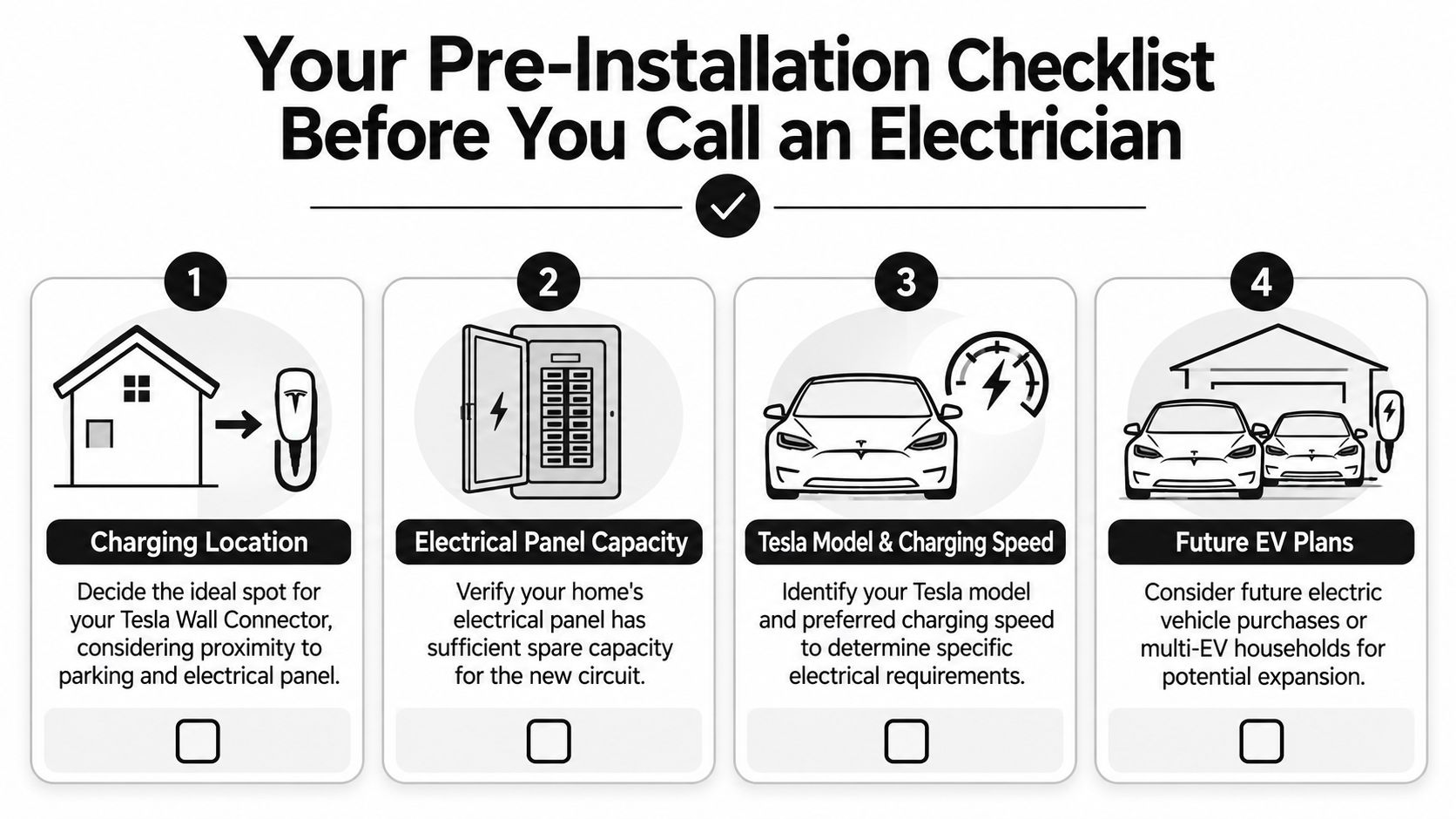
Pick the charging spot first
Start where the car parks. Don't pick the charger location by looking at an empty wall. Pick it by thinking through normal life.
- Daily parking position: Park the Tesla where you usually leave it. Then look at which side of the vehicle gives the cleanest cable path with the least stretching, crossing, or tripping risk.
- Indoor versus outdoor mounting: A garage install is usually simpler to protect. An exterior install can work well too, but in West Palm Beach it needs more attention to weather exposure and mounting surface.
- Distance to the panel: Shorter runs are usually cleaner and less labor-intensive. If the panel is on the opposite side of the home, that doesn't kill the project, but it does affect routing and finish work.
- Future use: If there's a chance a second EV shows up later, mention that early. It can affect where the charger goes and how the circuit planning is approached.
If you want a broader homeowner overview of EV charger installation at home, that guide is useful for framing the early questions before you get into Tesla-specific details.
Check the panel and the signal
Once you've picked the likely wall, go find the main electrical panel. Open the door and take clear photos of the breakers, the panel label, and the surrounding area. That gives the electrician a much better starting point than a verbal description.
Then look at the practical details:
- Panel accessibility: Is there clear working space in front of it, or is it buried behind storage?
- Available room: Are there open spaces, or does it already look packed?
- Mounting surface: Is the charger going on concrete block, stucco, drywall over studs, or another surface?
- Wi-Fi coverage: The Gen 3 Wall Connector relies on a stable connection for setup and smart features, so stand at the proposed charger location and confirm the signal is solid.
If the Wi-Fi barely works where you want the charger, the charging hardware may be fine but setup can turn into an avoidable headache.
There's another angle homeowners rarely think about. If you've ever wondered what it takes to legally work in this trade, the licensing path is more involved than one might expect. A practical overview of how to apply for a contractor license helps explain why qualified electrical work is more than just owning tools.
Bring all of that into the first conversation. Good photos, a realistic parking plan, and clear information about your home almost always lead to a better proposal and fewer surprises.
Navigating West Palm Beach Permits and Coastal Codes
Permit questions come up on almost every EV charger job. Some homeowners ask if they really need one. Others assume it's just paperwork. In West Palm Beach, it's neither optional nor trivial.
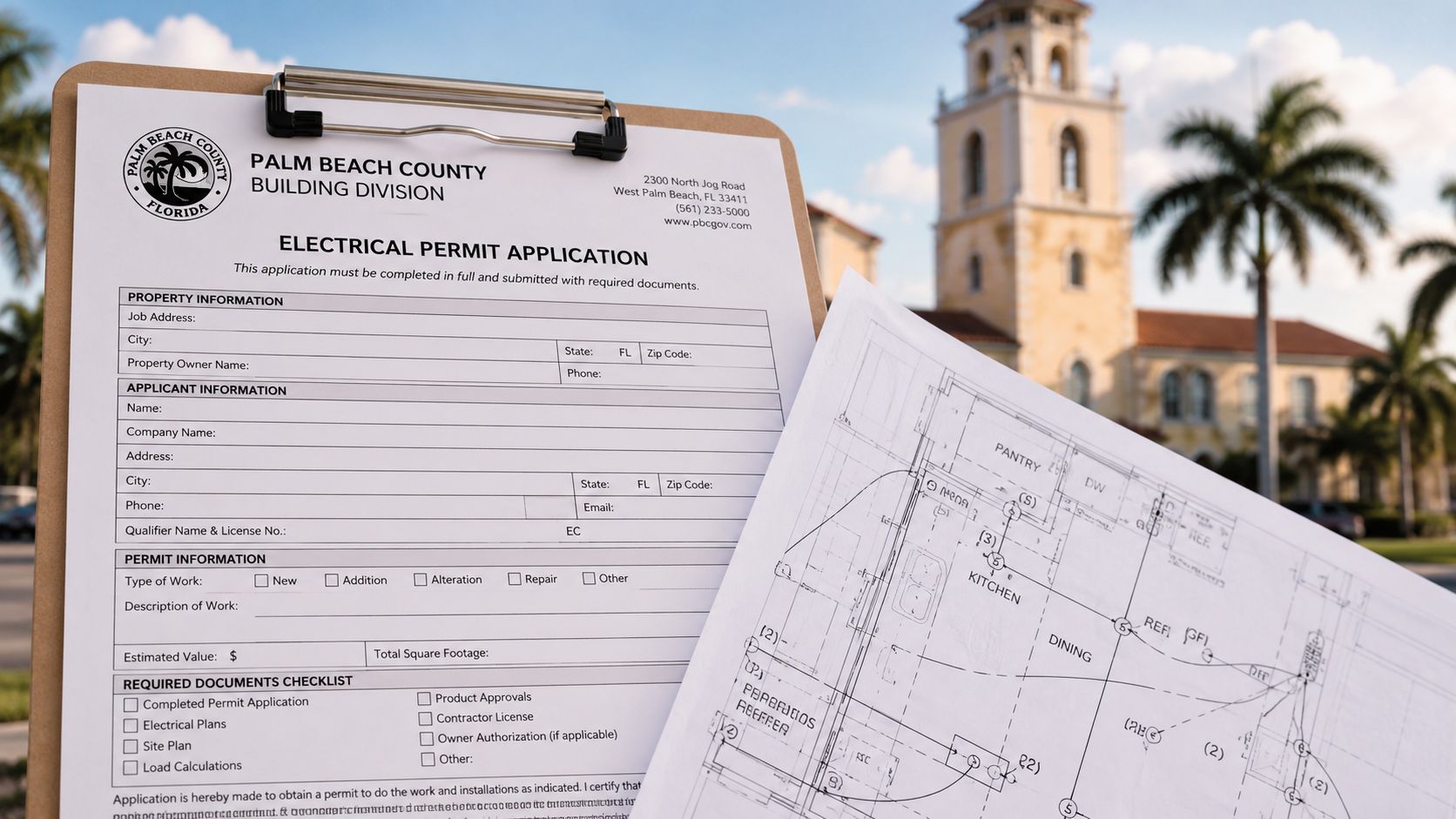
What the permit actually does
In Palm Beach County, the permit for an EV charger installation ranges from $175 to $450 as of 2026, and it's required so hardwired Level 2 charging work follows local safety codes before installation begins, according to Palm Beach County EV charger permit guidance.
That matters because a Tesla Wall Connector isn't an appliance you plug in and forget. It's a permanently installed electrical load that needs proper circuit protection, approved wiring methods, and inspection. The permit creates a paper trail that the work was done to code and reviewed as required.
For homeowners, the permit also affects timeline. It's part of the scheduling reality, not an add-on after the fact. If someone offers to “take care of it later” or suggests skipping it, that's not streamlining the job. That's creating risk.
A local service page on EV charging solutions in West Palm Beach FL is a helpful reference if you're comparing charger planning options for your property.
Why coastal code details matter here
National install videos usually show the wiring sequence and stop there. What they often miss is what coastal South Florida does to equipment over time.
West Palm Beach installations routinely deal with:
- Humidity exposure: Moisture changes how terminations age and how enclosures need to be protected.
- Salt-air corrosion: Outdoor hardware and fittings need to be chosen with durability in mind.
- Coastal-rated materials: Florida code updates tied to local conditions often push installers toward outdoor-rated enclosures, appropriate conduit choices such as Schedule 80 PVC in coastal applications, and corrosion-resistant hardware for wind and moisture resistance, as summarized in this Florida coastal installation discussion.
- Inspector expectations: Local inspectors don't review the job like a generic internet tutorial. They review the actual installation conditions at your property.
The charger can be perfectly good equipment and still fail as an installation if the surrounding materials and methods don't match the environment.
That's the part many homeowners never see. The charger itself gets the attention, but the enclosure rating, conduit routing, fastener choice, and weather sealing often determine whether the install stays trouble-free in a coastal setting.
Breaking Down Your Tesla Charger Installation Cost
The cost conversation gets easier once you separate hardware from labor, permit, and site conditions. Homeowners often focus on the charger box because it's the visible part. In reality, the hidden work usually drives the total.
Where the money usually goes
In South Florida, including West Palm Beach, a typical Tesla Wall Charger installation runs $750 to $1,800 in 2026, with labor averaging $100 to $150 per hour, and the Gen 3 Wall Connector hardware costs about $420 to $450, according to this South Florida Tesla home charger cost breakdown.
That total generally covers the standard version of the job. A straightforward installation usually means the panel can accept the new circuit, the wire run is manageable, the mounting area is accessible, and the charger location doesn't require major patching or rerouting.
What changes the price is complexity, not the Tesla logo on the charger.
- Short, clean wire path: Usually keeps labor and materials more manageable.
- Long routing path: Adds pulling time, conduit work, and finish considerations.
- Older electrical service: Can trigger larger corrections before the charger circuit is even added.
- Exterior placement: Often needs more weather-conscious materials and detail work.
Standard jobs versus complex jobs
Some houses are easy. Others need panel work before a charger can be installed with confidence. The source above notes that complex installations with panel upgrades can rise to $3,000 to $3,500+, while standard jobs typically stay in the normal residential range.
Here's a practical planning table.
| Cost Component | Standard Installation (Most Homes) | Complex Installation (e.g., Panel Upgrade) |
|---|---|---|
| Charger hardware | Gen 3 Wall Connector typically falls in the standard hardware range cited above | Same hardware cost, unless a different connector model is selected |
| Labor | Usually fits within the common all-in range when routing is simple and access is good | Higher because panel corrections, rerouting, or added electrical scope increase time on site |
| Permit | Required and should be included clearly in the proposal | Required and still separate from any larger electrical correction work |
| Materials | Normal wire, fittings, and mounting materials for a typical run | More materials if the run is longer or the service equipment needs modification |
| Overall budget | Commonly aligns with the standard residential range from the cited source | Can move into the higher range noted for jobs involving panel upgrades |
A clean quote should tell you whether you're paying for a charger install, a service-capacity problem, or both. Those are different issues.
If you're reviewing estimates, the most useful question isn't “Why is this number higher?” It's “Which part of my house is creating the extra work?” A good answer should be specific.
What a Professional Installation Process Looks Like
A quality install is defined by details most homeowners never see after the cover goes on. That's fine. You shouldn't have to become an electrician. But you should know what careful work looks like so you can spot the difference between a proper install and a rushed one.
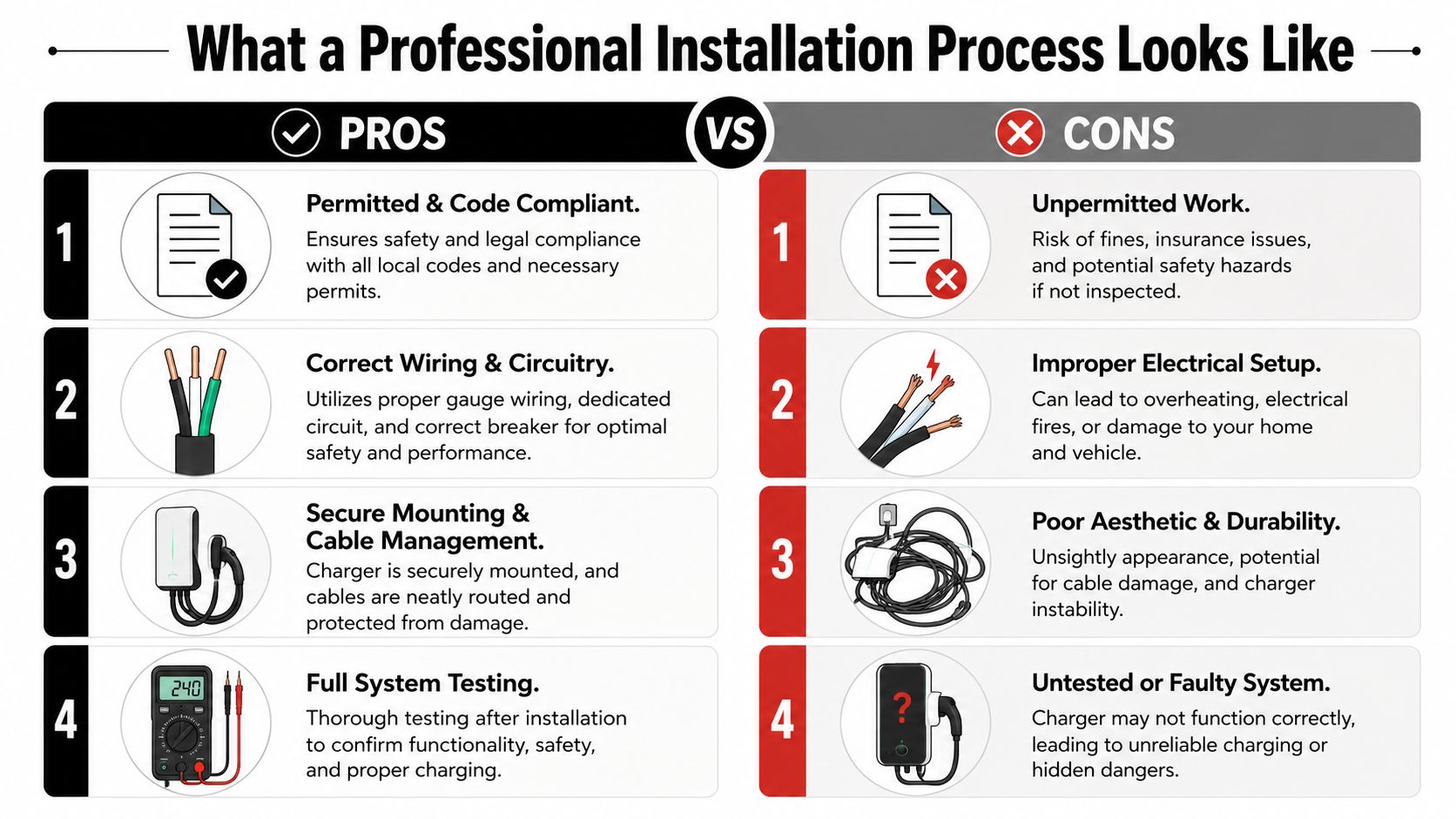
The small technical details that matter
For Tesla Wall Connector Gen 3 installations, the conductors must be stripped to exactly 5/8 inch and the terminal screws tightened with a calibrated torque screwdriver set to 20 in-lb. That torque requirement matters because failure to meet it accounts for about 34% of post-installation connection failures in humid coastal environments like Palm Beach County, based on this Tesla Wall Connector installation methodology reference.
That's not a minor spec. It's one of the places where good electrical work is either done correctly or it isn't.
A careful installation also matches the wall type. On concrete or block, the charger needs secure mounting hardware appropriate for that surface. On framed walls, the bracket should be anchored properly into structure where required, not just fastened for appearance. In South Florida, that matters even more because vibration, humidity, and heat cycles expose weak mounting work quickly.
There's also the setup side of the charger itself. The Wall Connector has internal configuration settings that must match the circuit and installation method. When those settings are wrong, homeowners often assume the equipment is defective, when the actual problem is installer setup.
If the installer can't explain how the charger was configured to match the circuit, that's a red flag.
What the finish work should look like
The best installations usually look simple when they're done. The conduit run is clean. The charger sits square. The cable path makes sense for the vehicle. Nothing feels improvised.
Look for these signs of solid work:
- Dedicated circuit planning: The charger should be treated as a real electrical load, not squeezed into a marginal setup.
- Neat conductor management: Inside the unit and at the panel, the wiring should be orderly and mechanically secure.
- Weather-aware sealing: Exterior openings, penetrations, and fittings should be handled with moisture in mind.
- Testing before handoff: The job shouldn't end when the breaker turns on. The charger should be commissioned, connected, and confirmed operational.
The final walkthrough matters too. A professional should show you basic operation, explain what was installed, and answer practical questions about charging behavior, breaker location, and what to watch for if anything changes later.
Why Lighthouse Energy Services is West Palm Beach's Choice
For a homeowner, the biggest challenge usually isn't buying the charger. It's finding someone who understands the mix of residential electrical work, Palm Beach County process, and coastal installation reality.
Local experience changes the outcome
A company can be perfectly capable in general electrical work and still miss the details that matter on EV charging in this part of Florida. The difference shows up in planning, permitting, mounting decisions, and how the installation is adapted to heat, humidity, and exterior exposure.
Lighthouse Energy Services is a family-owned electrical company in South Florida serving Palm Beach County with residential, commercial, and industrial electrical work, including EV charger installation support. The company has operated since 2005, offers true 24/7 availability, and is backed by more than 100 years of combined team experience, according to the publisher information provided for this article.
That kind of background matters because charger work rarely exists in isolation. Sometimes the job is simple. Sometimes the charger request uncovers an older panel issue, a poor mounting plan, or a compliance detail that needs correction before the installation should move forward.
What homeowners usually want most
Homeowners don't want a lecture on code. They want a charger that works every day, was installed legally, and won't create trouble later when the home is sold, inspected, or repaired.
That comes down to a short list:
- Clear scope: You should know what's included, what isn't, and why.
- Permit discipline: The paperwork should be handled the right way from the start.
- Jobsite precision: Clean routing, correct hardware, proper terminations, and full testing matter more than sales language.
- Straight answers: If your panel needs more work than expected, you should hear that plainly before the installation moves ahead.
A proper Tesla Wall Connector installation in West Palm Beach FL should feel boring after it's done. You park, plug in, and move on with your day. That's what good electrical work is supposed to feel like.
If you want a straightforward evaluation of your home charging setup, contact Lighthouse Energy Services for a professional consultation on Tesla Wall Connector installation, panel readiness, permit requirements, and the safest mounting approach for your West Palm Beach property.