You drive your new EV home in West Palm Beach, plug it into a standard wall outlet, and feel good for about one night. Then the routine sets in. Morning errands, a commute, school pickup, an evening run downtown, and suddenly that basic outlet feels less like a solution and more like a stopgap.
That's the point where most property owners start asking the right questions. Do you need a faster charger at home? Can your panel handle it? What does the city want to see on a permit? If you live in a condo, who approves what? If you own a business, how do you install charging that people will readily use without turning your parking lot into a maintenance headache?
In West Palm Beach, EV charging isn't theoretical anymore. It's already part of daily life in garages, driveways, municipal parking, condos, office lots, and turnpike travel patterns. The practical issue isn't whether charging is coming. It's choosing the right setup for your building and getting it installed safely the first time. If you're weighing your options, it helps to start with a licensed electrical contractor in West Palm Beach who understands local service equipment, permitting, and the reality of older and newer properties across Palm Beach County.
Table of Contents
- Your Guide to EV Charging in West Palm Beach
- Understanding EV Charger Levels From Trickle to Turbo
- Residential and Commercial Solutions in Palm Beach County
- The West Palm Beach Installation Process Step by Step
- Costs Rebates and Incentives for Floridians
- Charger Maintenance and Expert Troubleshooting
- Why Choose Lighthouse Energy Services for Your Installation
Your Guide to EV Charging in West Palm Beach
In West Palm Beach, the first charging mistake I see is treating an EV like a phone. People assume they can plug it in anywhere and work out the details later. That works for a short stretch, but it doesn't hold up once the car becomes part of your normal weekly routine.
A dedicated charging setup solves more than speed. It gives you a defined circuit, proper overcurrent protection, weather-appropriate equipment when the charger is outdoors, and a clean installation that doesn't rely on extension cords, adapters, or overloaded garage receptacles. Those shortcuts are common, and they're exactly what should stay off the plan.
West Palm Beach also has a broader charging environment already in place. Public infrastructure exists, but home and property-based charging still does the heavy lifting for convenience. That matters whether you own a bungalow near older neighborhoods with legacy electrical service, a newer house with room in the panel, or a condo unit where the charger itself may be easy but the approvals are not.
Local conditions matter more than spec sheets
A charger that looks perfect online can be wrong for the property. Historic homes often have tighter panel capacity, more difficult conduit routes, and aesthetic concerns about visible exterior runs. Newer homes may be easier electrically, but owners still need to think about parking layout, cable reach, and whether the charger will live in a garage, under a carport, or fully exposed to coastal weather.
Commercial properties have a different goal. They usually need charging that's predictable for multiple users, easy to manage, and placed where cars can park without blocking traffic flow or creating tripping hazards.
A good EV installation starts with the building, not the charger brochure.
The practical goal
For most owners, the right result is simple:
- Charge reliably at home or work so the car is ready when you need it
- Protect the electrical system instead of pushing an older panel past what it should carry
- Meet permit and inspection requirements so the installation doesn't create problems later
- Choose equipment that fits the site rather than paying for features nobody will use
That's how EV charging solutions in West Palm Beach FL should be approached. Not as a gadget purchase, but as an electrical project tied to your property.
Understanding EV Charger Levels From Trickle to Turbo
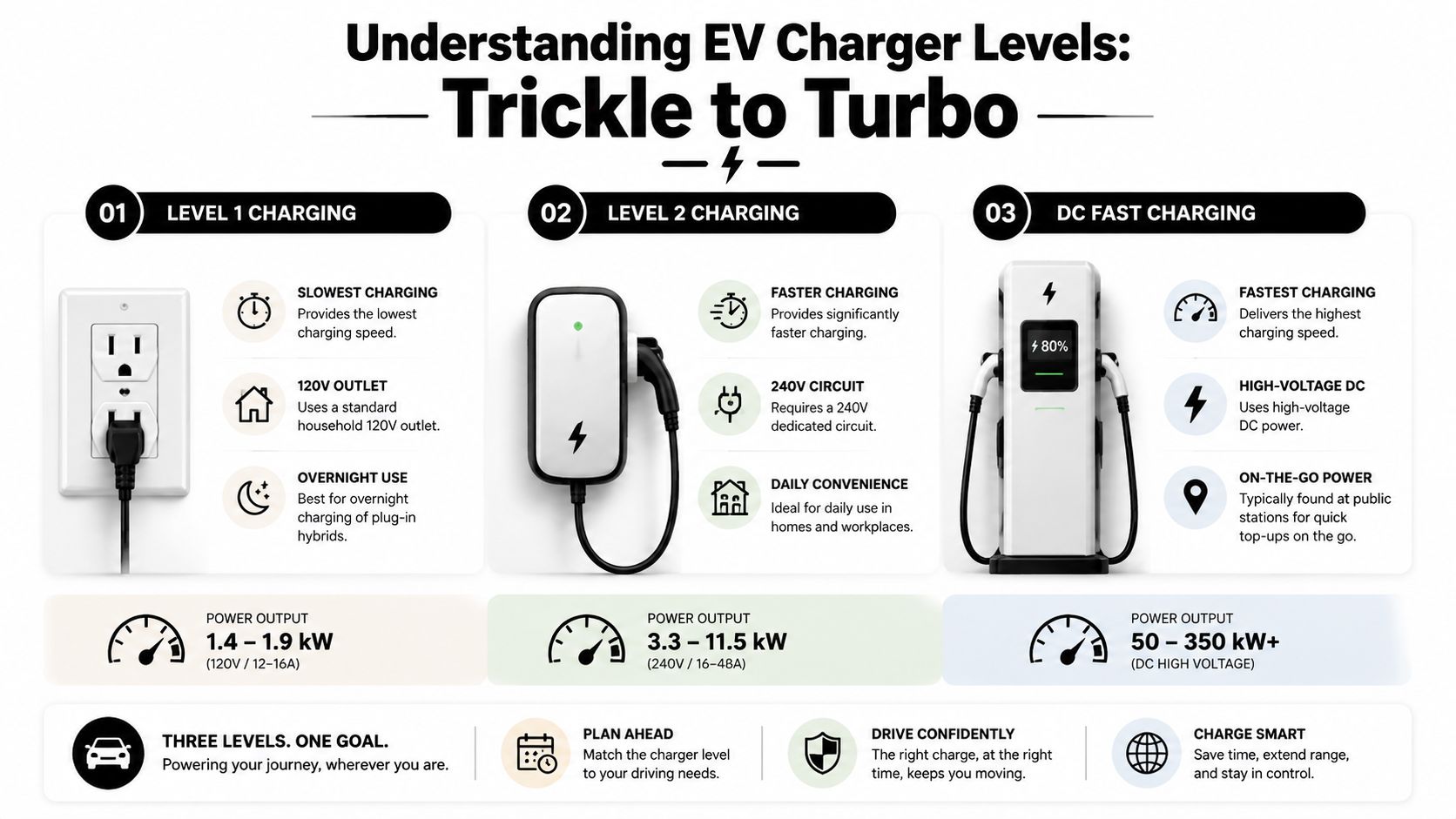
The easiest way to understand charger levels is to think about filling a pool. Level 1 is a trickle. Level 2 is a garden hose. DC fast charging is the fire-service line. All three move energy into the vehicle, but they do it at very different speeds and for very different reasons.
West Palm Beach already has a substantial public charging footprint. ChargeHub's West Palm Beach charging data lists 451 total charging stations in the city area, including 325 Level 2 stations, and notes that 72% of the stations are Level 2. That mix tracks with what works in daily life. Level 2 is the practical standard for destination charging, residential charging, workplace charging, and parking environments where a vehicle stays put long enough to add meaningful range.
What each level actually means
Level 1 uses a standard household 120V outlet. It's the slowest option, and practically it's usually best for very light driving patterns, temporary use, or certain plug-in hybrid owners. It can work if the car sits for long periods and your daily demand is modest. It usually fails when the vehicle has to recover from back-to-back driving days.
Level 2 uses a 240V dedicated circuit. This is the charger level most homeowners ask for and the one most businesses should evaluate first. It charges far faster than Level 1 and fits how people park. Overnight at home, several hours at work, or during a longer stop downtown. It also gives the installer room to match the equipment and circuit to the property's electrical capacity.
DC fast charging is different. It's high-power charging typically found at public sites, travel corridors, and service plazas. It's not a normal residential solution. It serves drivers who need a quicker top-up while traveling, not a routine home setup.
Practical rule: If the car sleeps at your property most nights, Level 2 is usually the target. If the charger is meant to support road travel, you're thinking about public fast charging instead.
A quick comparison
| Feature | Level 1 Charger | Level 2 Charger | DC Fast Charger |
|---|---|---|---|
| Power source | Standard 120V outlet | Dedicated 240V circuit | High-voltage DC equipment |
| Charging speed | Slowest | Faster for daily use | Fastest |
| Best fit | Light use, temporary charging, some plug-in hybrids | Homes, workplaces, apartments, destination parking | Public travel stops and corridor charging |
| Installation need | Often minimal if outlet is suitable | Professional electrical installation required | Specialized commercial infrastructure |
| Typical location | Home outlet | Garage, driveway, parking area, workplace | Public charging site |
What works and what doesn't
What works is matching charging speed to parking behavior. If your car sits overnight in your garage, a properly installed Level 2 charger usually makes the most sense. What doesn't work is buying around the property. A powerful charger won't solve undersized service equipment, a poor mounting location, or a panel that has no room for the required circuit.
For most West Palm Beach property owners, charger level isn't a tech question first. It's a use-pattern question.
Residential and Commercial Solutions in Palm Beach County
A charger for one homeowner and a charging setup for a condo or business may use similar equipment, but they are not the same project. The goals are different, the approvals are different, and the electrical planning is different.
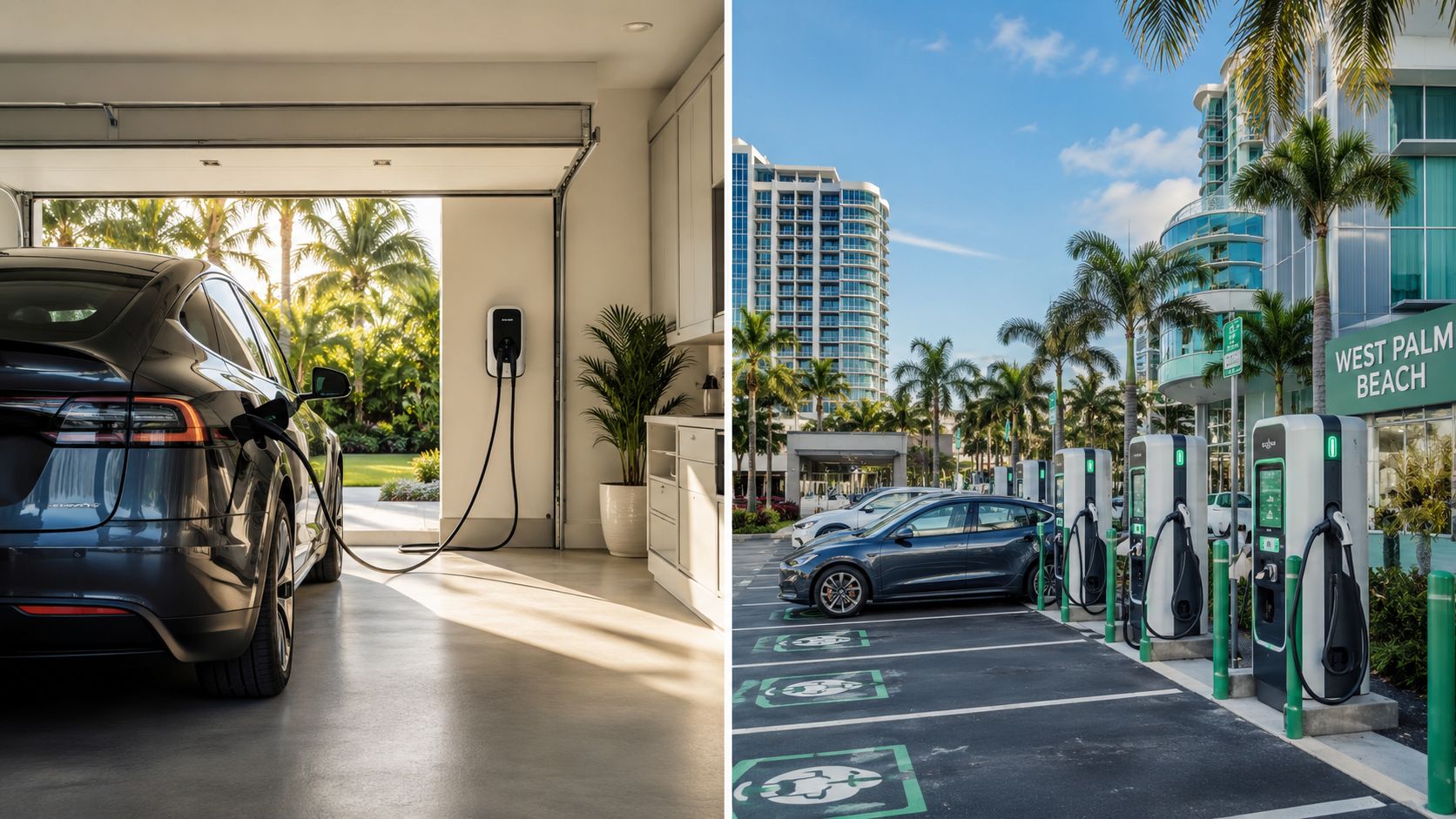
Palm Beach County owners also sit in a larger regional charging map. Florida's Turnpike charging expansion details note that in 2020 Florida Power & Light installed EV Level 3 charging stations at the West Palm Beach Service Plaza as part of a multi-plaza buildout. That matters because it reinforces a common pattern: drivers rely on fast corridor charging while traveling, but they still need dependable lower-power charging where they live, work, and park for longer stretches.
If you're planning around household service capacity, driveway layout, or garage placement, this kind of residential electrical planning guide can help frame the bigger picture before the first permit application is filed.
What works in single-family homes
For a house, the conversation usually starts with four things.
- Panel capacity: Can the existing panel support a new dedicated EV circuit without overloading the service?
- Parking pattern: Does the car park in a garage, on a driveway, under a carport, or along a side pad?
- Wire route: Is the charger close to the panel, or will the electrician need a longer conduit run through finished areas or exterior walls?
- Outdoor exposure: If the charger sits outside, the enclosure, mounting method, and conduit path need to hold up in heat, moisture, and everyday wear.
A detached garage can complicate things if the feeder is limited. Older homes can present another issue. The panel may be full, the grounding may need review, or prior renovations may have left little room for a clean new branch circuit.
What changes in condos apartments and commercial sites
Multi-user properties add a layer of coordination that single-family homes usually avoid.
In a condo, the hardest part may not be the charger itself. It may be board approval, common-area access, utility metering questions, or deciding whether the installation serves one parking space or supports a broader future plan. In apartment properties, the owner or manager has to think about fairness, billing, and whether several chargers can operate without causing load problems during peak demand.
Commercial sites have another set of priorities:
- Access control: Some owners want assigned use, while others want open use for staff, tenants, or customers.
- Cable management: Parking lots need chargers that don't leave cords where pedestrians can trip or vehicles can drag over them.
- Load strategy: Multiple chargers may require managed charging so the site doesn't call for unnecessary service upgrades.
- Placement: A charger needs to be useful to drivers without creating bottlenecks in traffic flow.
The right commercial charger isn't just the one that charges a car. It's the one staff can manage, users can understand, and the property can support every day.
What fails most often in shared properties is piecemeal planning. One charger gets installed quickly. Then another request comes in, then another, and nobody designed the electrical backbone for the long term.
The West Palm Beach Installation Process Step by Step
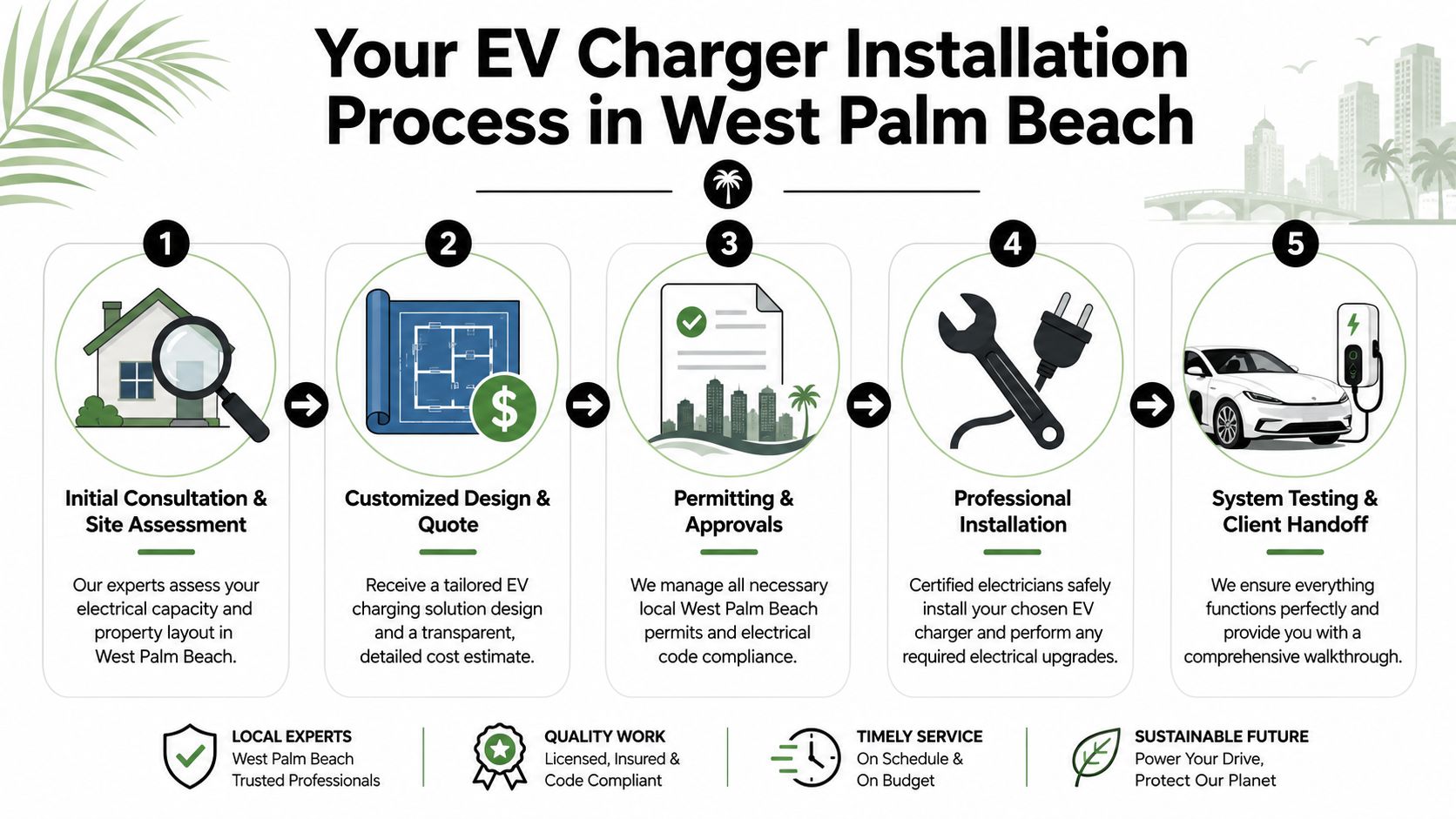
Most EV charger projects go smoothly when the order is right. Problems show up when owners buy equipment first, skip the electrical review, or assume every garage wall is installation-ready. In West Palm Beach, the cleanest jobs follow a sequence and document each part.
If the panel is older, crowded, or already carrying large loads, it helps to review the broader issue of electrical panel upgrades before locking in charger specs. Many charging delays aren't charger problems at all. They're service-capacity problems.
Step one through step three
1. Site assessment
A licensed electrician starts at the panel, not at the parking space. The assessment checks available capacity, breaker space, grounding and bonding conditions, likely conduit routes, charger location, and whether the unit will be indoors or exposed outside. The car's connector type and charging capability matter, but the building comes first.
For older West Palm Beach homes, hidden issues emerge. You may find outdated panel labeling, previous homeowner modifications, limited spare capacity, or a driveway layout that makes the ideal charger location different from the obvious one.
2. Equipment and circuit selection
After the assessment, the installer matches the charger and branch circuit to the property. Bigger isn't always better. A charger should fit the panel, the vehicle, and the way the owner drives.
A few practical choices get made here:
- Hardwired or receptacle-based installation
- Indoor or outdoor-rated equipment
- Cord length and mounting height
- Smart features such as scheduling or access control
- Future-proofing for a second EV
One factual option in the local market is Lighthouse Energy Services, which offers EV charger installation for homes and businesses along with panel evaluation, conduit and heavy-duty wiring installation, and commissioning and testing.
3. Permitting and approvals
This stage matters. West Palm Beach installations typically need local permit review and final inspection, and condo or HOA properties may need a separate approval path before electrical work begins. For homeowners, the common mistake is underestimating how long approvals can take when site plans, equipment cut sheets, or property management signoff are incomplete.
If a contractor treats permitting like a side issue, expect delays later.
Installation inspection and handoff
4. Physical installation
The electrician mounts the charger, runs conduit, pulls conductors, lands the breaker, makes final terminations, and labels the new circuit. On a straightforward garage installation, this can be relatively clean. On a carport, detached structure, masonry wall, or long exterior run, labor and layout become more involved.
Good installation work pays attention to the details owners notice later. Is the charger close enough to reach the port comfortably? Is the cord stored off the ground? Does the conduit route look intentional instead of improvised? Can the unit be serviced without removing other equipment?
5. Testing and inspection
Before the job is turned over, the system should be tested for safe operation. That includes confirming proper energization, checking that the charger communicates with the vehicle as intended, and verifying that protective functions operate correctly. Then comes the official inspection path required for approval.
6. Owner handoff
This is the part many installers rush. They shouldn't. The owner should know how to start and stop charging, how to reset the unit if needed, what normal indicator behavior looks like, and what warning signs justify a service call.
A proper handoff also covers limitations. The charger is a dedicated piece of electrical equipment. It isn't a place for makeshift adapters, extension cords, or DIY modifications after the fact.
Costs Rebates and Incentives for Floridians
The actual cost of EV charging solutions in West Palm Beach FL isn't just the charger on the wall. It's the charger, the circuit, the labor, the permit path, and any electrical corrections the property needs before that charger can run safely.
A simple installation costs less than a complicated one because the work is smaller. If the panel has room, the parking location is close, and the wire path is straightforward, the job is cleaner. If the panel is full, the charger sits far from the service equipment, or masonry and exterior routing are involved, the project becomes more labor-intensive.
What drives the price
These are the factors that usually move the budget the most:
- Electrical panel condition: A panel with no spare capacity can turn a simple charger install into a larger electrical project.
- Distance from panel to charger: Longer runs mean more conduit, more wire, and more labor.
- Installation surface: Garage drywall is simpler than concrete block, detached structures, or finished spaces that need careful routing.
- Mounting location: Indoor wall mounts are usually easier than exposed outdoor placements that need weather-ready methods.
- Property type: Single-family homes are often more direct than condos, HOAs, apartments, or commercial sites that require coordination and approvals.
- Number of chargers: One charger is one project. Multiple chargers bring load planning, user management, and layout questions into the budget.
That's why online “average install cost” articles are usually not very useful. They don't know your panel, your parking setup, or the route the conductors have to take.
Where owners sometimes save money
Owners can lower the total project cost in practical ways, but only when those savings don't create problems later.
- Choose the right charger size: Oversizing equipment can add cost without adding value if the property or vehicle won't use the extra capacity.
- Install in the best reachable location: A slightly different wall can reduce conduit length and improve daily use.
- Plan for future needs once: If a second EV is likely, it can make sense to design with that in mind rather than rebuilding the layout later.
- Bundle electrical corrections: If the panel needs work, handling it as part of one planned project is usually cleaner than patching things in stages.
For incentives, property owners should verify what's currently available before they buy equipment or file taxes. Programs change, eligibility rules shift, and some benefits depend on where the property sits or how the installation is documented. The smart move is to confirm current federal, utility, local, or property-type-specific incentives with the relevant program administrator and keep all invoices, permit records, and equipment documentation.
The cheapest quote often becomes the expensive install if it leaves out panel issues, permitting, or correction work the inspector will require anyway.
Charger Maintenance and Expert Troubleshooting
A properly installed charger doesn't need constant attention, but it does need basic care. Most long-term problems start small. A loose connection, water intrusion at a poor exterior entry point, repeated strain on the cable, or a breaker that was already marginal before the charger load was added.
Routine maintenance is simple. Keep the unit clean, store the cable correctly, and pay attention when charging behavior changes. If the charger starts acting differently, that's usually the first useful warning.
What you can safely check yourself
There are a few things an owner can do without taking risks.
- Inspect the cable jacket: Look for cuts, crushing, abrasion, or visible heat damage.
- Check the plug or connector fit: If the handle doesn't seat normally or feels damaged, stop using it until it's evaluated.
- Reset the charger if the manufacturer allows it: Some temporary faults clear with a basic reset.
- Look at the breaker position: If it has tripped, don't keep forcing it back on repeatedly.
- Check for obvious moisture issues: Outdoor chargers need intact covers, seals, and proper drainage around the installation.
These checks are observational. They do not include opening the charger, removing dead fronts, tightening terminals, or poking around inside the panel.
When to call an electrician
Frequent breaker trips are not normal. Neither is a charger that suddenly slows down, drops sessions, throws recurring fault lights, or works only if the cable is held at a certain angle. Those are electrical or equipment issues, not annoyances to work around.
Call a licensed electrician when you notice any of the following:
- The breaker trips more than once
- The charger or cable feels unusually hot
- Charging starts and stops unpredictably
- The unit shows repeated fault indications
- Lights dim or other circuits react when charging begins
- Water has reached the charger enclosure or conduit system
A nuisance trip is sometimes the system preventing a dangerous condition. Treat it like a warning, not an inconvenience.
Professional installation pays off over time. A charger tied into the right circuit, installed with sound terminations, protected from weather, and documented properly is much easier to troubleshoot than a rushed install with hidden compromises.
Why Choose Lighthouse Energy Services for Your Installation
An EV charger isn't just another wall device. It adds a sustained load to your electrical system, and in many West Palm Beach properties that means the installer has to think through panel capacity, wire routing, code compliance, outdoor exposure, and inspection readiness all at once.
That's why local experience matters. Historic homes, renovated houses, condos, retail buildings, and service properties across Palm Beach County all present different constraints. A clean installation has to respect both the vehicle owner's routine and the building's electrical reality.
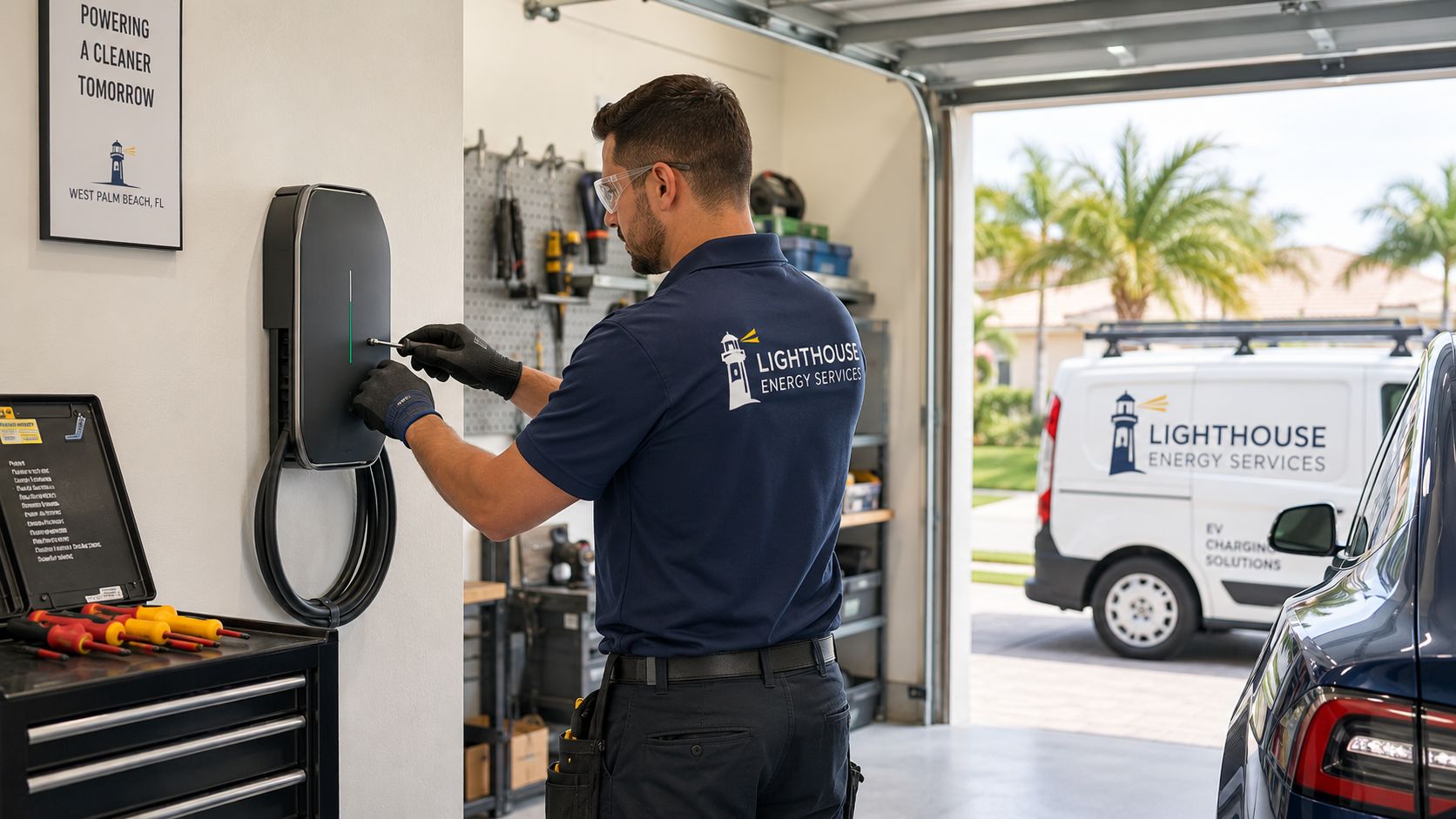
Lighthouse Energy Services has served Palm Beach County since 2005, with licensed electricians handling residential, commercial, and emergency electrical work. The company offers true 24/7 availability, upfront pricing without hidden fees, and electrical experience that fits the kind of charger projects covered here, from panel evaluation to final commissioning.
For property owners, the value is straightforward:
- Safety first: The charger is installed as part of a code-compliant electrical system, not treated like a plug-and-play appliance.
- Local permitting awareness: West Palm Beach and Palm Beach County projects often move better when the contractor understands the local approval rhythm.
- Clear troubleshooting path: If something changes later, you need an electrician who can diagnose the circuit, not just swap parts.
- Support across property types: Houses, condos, offices, and shared parking areas all need different installation planning.
If you want EV charging that fits your property instead of fighting it, start with a professional site assessment and build from there.
If you're ready to install a charger at your home, condo, or commercial property, contact Lighthouse Energy Services for a no-obligation assessment and a clear plan for safe, code-compliant EV charging in West Palm Beach.