
A typical West Palm Beach outage starts the same way. Wind builds, utility power drops, and the house goes quiet except for the devices and systems you suddenly realize you depend on. Refrigeration, air conditioning, lighting, internet, security, gate operators, sump or lift pumps, and medical equipment all move from convenience to priority in a few seconds.
Standby generator installation in West Palm Beach is really an electrical safety project with power backup attached. The generator matters, but the installation matters more. A properly designed system has to address transfer equipment, load calculations, fuel coordination, setback rules, flood and wind exposure, permitting, and final inspection. The biggest shortcuts usually happen in the electrical details homeowners never see, especially grounding and bonding mistakes that can energize metal parts, backfeed the utility, or create dangerous conditions for lineworkers and anyone standing near the equipment.
That is what separates a professional installation from a risky one. A licensed electrician does not just set a generator on a pad and tie it into the panel. The job has to be configured so the system switches power correctly, the neutral is handled the right way for the equipment installed, and the grounding and bonding scheme matches code and the manufacturer requirements. If any part of that is wrong, the generator may still run, but it will not be safe.
Lighthouse Energy Services treats standby power the way it should be treated in Palm Beach County. As permanent emergency equipment that must operate safely under real storm conditions, pass inspection, and protect the home, the family, and the utility crew outside. Homeowners who also want outage planning to fit into a connected home setup can review DigiDevice's smart home hub recommendations, but the first priority is always a code-compliant electrical installation.
Table of Contents
- Why West Palm Beach Homeowners Need a Resilient Power Plan
- Sizing Your Generator Essential Power vs Whole Home Coverage
- The Professional Standby Generator Installation Process
- Navigating Palm Beach County Generator Codes and Safety Rules
- Understanding Generator Installation Costs and Timelines
- Choosing Your Licensed Electrician The Lighthouse Energy Difference
- Frequently Asked Questions About Home Standby Generators
Why West Palm Beach Homeowners Need a Resilient Power Plan
At 2 a.m., after a summer storm rolls through West Palm Beach, the problem is not abstract. The air handler is off. The refrigerator is warming up. The Wi-Fi drops, the garage door may not open, and anyone in the house who depends on cooling, powered medical equipment, or refrigerated medication is suddenly on a clock.
That is why backup power should be planned like any other safety system in the home. A standby generator is only part of the answer. The electrical design behind it matters just as much, especially in older South Florida homes where service equipment, grounding electrode systems, and panel condition are not always ready for generator interconnection without corrections.
Homeowners often focus on the generator itself and miss the part that can create the most risk. A poor installation can backfeed utility lines, create dangerous neutral-to-ground problems, trip equipment unpredictably, or leave the house with code violations that show up during inspection or after a fault. Grounding and bonding mistakes are not small technicalities. They can put your family, your equipment, and lineworkers in danger.
What resilience actually looks like at home
A sound power plan starts with the house, not the brochure.
The first question is what must stay operational during an outage long enough to protect health, food, security, and basic livability. In West Palm Beach, that usually includes refrigeration, selected lighting, internet equipment, garage access, security devices, and at least some cooling. Some homes also need well or lift pumps, medical equipment circuits, or dedicated receptacles for work-from-home needs.
I also advise homeowners to think past the first hour. Overnight outages expose weak planning fast. A system that keeps a few lights on but cannot support the loads that matter by bedtime is not doing the job you thought you paid for. If you want a clearer framework for deciding between selective backup and broader coverage, our guide on how to size a generator for your home breaks that decision down in practical terms.
Some households also want backup power to support connected thermostats, cameras, and automation routines during an outage. If that is part of the plan, DigiDevice's smart home hub recommendations offer a useful starting point for the device-management side of the conversation.
Where homeowners get into trouble
Portable generators and extension cords may cover a short emergency, but they do not give full-time residents the safety, convenience, or code compliance of a permanent standby system.
The biggest shortcuts usually happen at the electrical connection point. I have seen transfer equipment selected incorrectly, neutrals handled the wrong way, grounding left uncorrected, and bonding duplicated where it should not be. Those errors can energize parts of the system that should be isolated, damage electronics, and create shock and fire hazards that are not obvious until something fails.
A professional installation accounts for the utility service, the main panel, transfer method, grounding and bonding configuration, surge protection, fuel coordination, equipment placement, permitting, and inspection. That is the difference between a generator that starts and a backup power system that is safe to live with in a storm-prone part of Florida.
Lighthouse Energy Services treats resilience as an electrical safety job first and an equipment purchase second. That standard is what separates a clean, code-compliant installation from a risky shortcut.
Sizing Your Generator Essential Power vs Whole Home Coverage
Generator sizing comes down to two practical paths. Back up the circuits you need to live safely, or size the system to carry the house with far fewer compromises.
That choice affects much more than comfort. It changes the transfer equipment, load management strategy, fuel demand, and how much discipline the installer brings to the electrical design. A generator that is oversized for the actual load can cycle poorly and cost more than it should. A generator that is undersized can struggle with air-conditioning startup, nuisance overloads, and frustrating load-shedding during an outage.
Start with the loads that matter
An essential-circuits setup is usually the right fit when the goal is protection first. That often includes refrigeration, kitchen receptacles, internet equipment, garage door operation, selected lighting, security equipment, medical devices if needed, and either a smaller cooling plan or one carefully selected air-conditioning load.
Whole-home coverage aims for a different standard. The house operates much closer to normal, which can make sense for larger homes, full-time residents, remote workers, or families who cannot afford to lose cooling for long during South Florida outages.
The right answer depends on the load profile, not the sales pitch.
A professional sizing review should account for:
- Running wattage and startup wattage
- Which cooling equipment must run, and which can wait
- Electric water heating, cooking, pool equipment, and well pumps
- Whether load-shedding modules are appropriate
- Fuel type and expected outage duration
- Panel capacity, transfer method, and service configuration
For a closer look at how electricians calculate demand and manage motor starting loads, see this guide to sizing a home generator correctly.
Essential circuits vs whole-home coverage
Here is the practical difference homeowners usually feel during an outage:
| Coverage approach | What it usually includes | Best fit for |
|---|---|---|
| Essential circuits | Core lighting, refrigeration, communications, garage access, and selected comfort loads | Homeowners who want safety, habitability, and lower project cost |
| Whole-home coverage | Most or all normal household loads, sometimes with managed high-demand equipment | Homeowners who want the home to function with minimal interruption |
There is also a middle ground. Many West Palm Beach homes do well with a properly sized generator plus intelligent load management, so the system can support major household functions without paying for true all-at-once capacity. That is often a better engineering decision than jumping to the largest unit that fits the yard.
Fuel choice changes the plan
Fuel selection is part of sizing because it affects runtime, service logistics, and operating expectations. Natural gas can be a strong option where utility gas is available and pressure is adequate under load. Propane can work very well too, especially when the tank size and refill plan match the property and the homeowner's outage goals.
The mistake is treating fuel as a separate decision after the generator is chosen. It is part of the load conversation from the start.
Where sizing mistakes become safety problems
This is also where weaker installations start to show. An installer who only adds up appliance labels can miss the electrical details that matter most, especially transfer switching, neutral handling, and grounding and bonding rules. Those are not minor technicalities. If the system is configured incorrectly, current can end up where it should not be, breakers may not behave as intended, and lineworkers or occupants can be exposed to serious hazards.
Lighthouse Energy Services approaches sizing as an electrical system design job, not just an equipment sale. That means matching the generator to the home, the service, the transfer method, and the code requirements that keep backup power safe in real storm conditions.
The Professional Standby Generator Installation Process
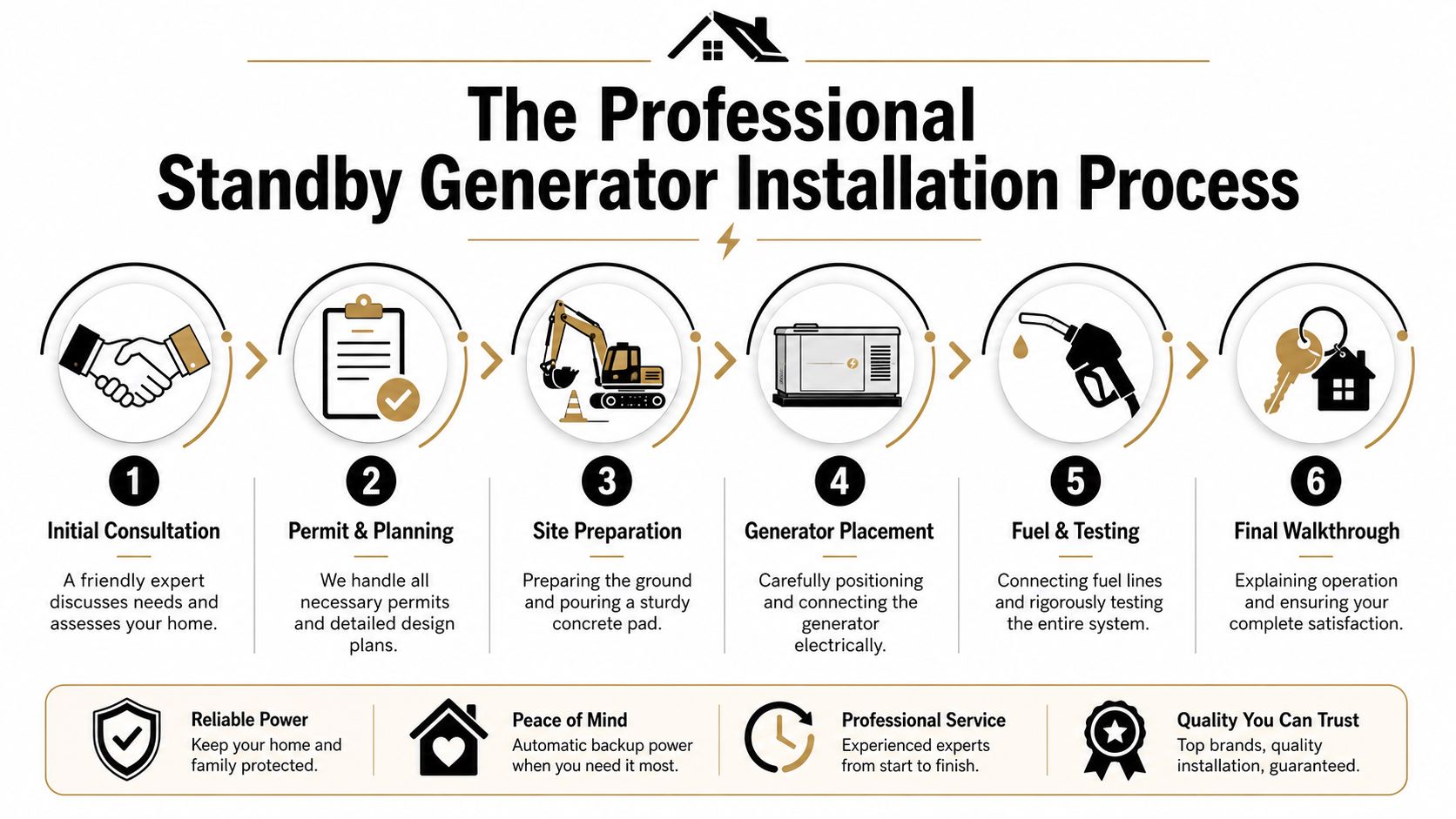
A professional installation shouldn't feel mysterious. It should feel organized. From the homeowner's side, the project usually starts with a site visit and ends with testing, inspection, and a clear explanation of how the system behaves when utility power fails.
What happens before equipment arrives
The first visit is about more than choosing a spot in the yard. The electrician needs to understand the service equipment, panel condition, transfer strategy, available clearances, and how the fuel connection will be routed. Older homes often reveal issues that need correction before the generator can be integrated safely.
Then the paper side starts. Generator projects in this area involve multiple trades and multiple approvals, so planning has to happen before labor is scheduled. If that early work is sloppy, the job drags later.
A proper pre-installation review usually covers:
- Load selection: Decide whether the system backs up essential circuits or the whole home.
- Site placement: Confirm the location can satisfy clearance, service access, and exhaust rules.
- Electrical integration: Determine where the transfer equipment goes and whether the panel needs upgrades.
- Fuel planning: Coordinate gas piping or propane arrangements with the rest of the project.
- Permit sequencing: Make sure each trade is working from the same approved plan.
What happens on installation day and after
The physical work starts with the base. The generator needs a stable mounting surface, and in this market that usually means a code-compliant concrete pad. After that, the set is placed, anchored, and connected.
The electrical work is the heart of the system. Here, the automatic transfer switch, service conductors, control wiring, grounding method, and overcurrent protection all have to be coordinated correctly. Good installers don't rush this part because most serious generator problems are created by bad electrical decisions, not by the enclosure sitting outside.
A clean installation is quiet in the best sense. The routing makes sense, the labeling is clear, access is preserved, and nothing looks improvised.
After the electrical and fuel connections are complete, the system is tested under controlled conditions. The crew verifies transfer operation, startup behavior, shutdown behavior, and whether the selected loads perform as expected. Then comes inspection and homeowner turnover.
At the end of a professional job, the homeowner should know:
- How outage transfer works: What the system does automatically when utility power drops.
- What to watch for: Normal exercise cycles, alert indicators, and when to call for service.
- What not to do: No homeowner modifications, no blocked ventilation, no storage around the unit.
- What maintenance looks like: Keep the unit serviceable and inspected so it works when the storm arrives.
Navigating Palm Beach County Generator Codes and Safety Rules
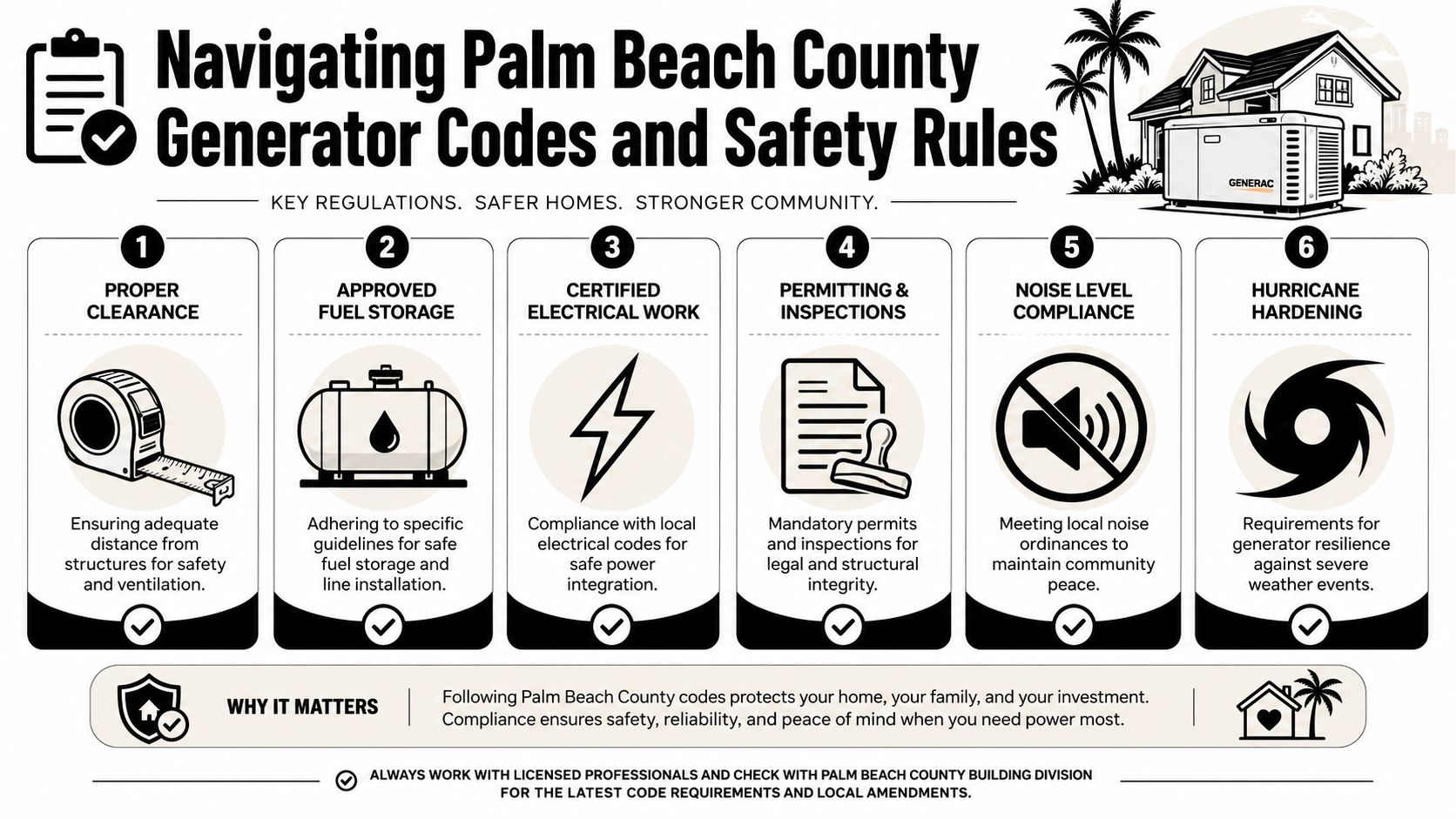
A generator that starts during an outage but was wired or placed incorrectly can still put people in danger. In West Palm Beach, the distinction between a professional installation and a risky shortcut is not the box outside. It is whether the electrical system, fuel connection, clearances, grounding, bonding, and permitting were handled to code.
Why placement rules are strict
Clearance rules exist because standby units produce heat, exhaust, vibration, and service hazards in one location. Manufacturer instructions, NFPA 37, and the NEC all matter here, and the installer has to follow the most restrictive applicable requirement. A unit set too close to an opening, tucked into a tight side yard, or crowded by shrubs and fencing can create carbon monoxide risk, overheating, and service access problems.
The practical checks are straightforward. The generator needs proper separation from doors, windows, and air openings. Exhaust has to discharge where fumes are less likely to re-enter the home. Electricians and service technicians also need working space that stays clear after the installation is complete. That means no squeezing the unit into a spot that looks convenient on day one but becomes unsafe the first time someone needs to troubleshoot it in bad weather.
Carbon monoxide protection is part of this conversation, not an afterthought. If the placement plan ignores how air moves around bedrooms, exterior doors, soffits, and neighboring walls, the installation is already headed in the wrong direction.
If you want a plain-language overview of how permit requirements are typically framed for homeowners before you get into local specifics, the HomeProBadge permit guide is a useful general reference.
Why permits and electrical code details matter
A permanent standby system usually involves multiple permits because several trades are tied together in one piece of equipment. The electrical portion covers the transfer equipment, feeder or service connections, overcurrent protection, and the interconnection that prevents backfeed into utility lines. The building portion addresses the pad, anchoring, elevation, and wind resistance. The fuel permit covers piping, regulators, shutoffs, sizing, and pressure testing.
That permit stack protects more than paperwork.
| Requirement | Why it exists | What it prevents |
|---|---|---|
| Electrical permit | Verifies safe transfer equipment and code-compliant wiring | Backfeeding, improper grounding and bonding, unsafe panel modifications |
| Building permit | Verifies support, anchoring, placement, and site conditions | Settlement, storm movement, clearance violations |
| Gas or mechanical permit | Verifies safe fuel piping and testing | Leaks, poor combustion, nuisance shutdowns |
The part many installers gloss over is grounding and bonding. This is one of the most misunderstood areas in generator work, and it is where I see dangerous shortcuts. Whether the generator is treated as a separately derived system depends on the transfer switch design and how the neutral is switched. Get that wrong and current can travel on paths it was never meant to use, including metal raceways, equipment grounds, gas piping, and other bonded metal parts. That creates shock hazards, nuisance tripping, equipment damage, and serious danger for utility workers during an outage.
A professional installation starts by identifying the service grounding electrode system, confirming neutral-to-ground bonding occurs only where the code allows, and matching the transfer equipment to the generator design. Then the installer verifies conductor sizing, fault current path, disconnecting means, labeling, and access for future inspection. None of that is decorative work. It is what makes the system safe under fault conditions, not just functional during a test run.
For hurricane-prone homes, backup power should be planned as part of a larger storm-readiness strategy. Homeowners who want that broader view can review Florida hurricane backup generator installation guidance from Lighthouse Energy Services.
Good code compliance means the generator starts safely, transfers safely, and shuts down safely, even in the middle of a storm.
Understanding Generator Installation Costs and Timelines
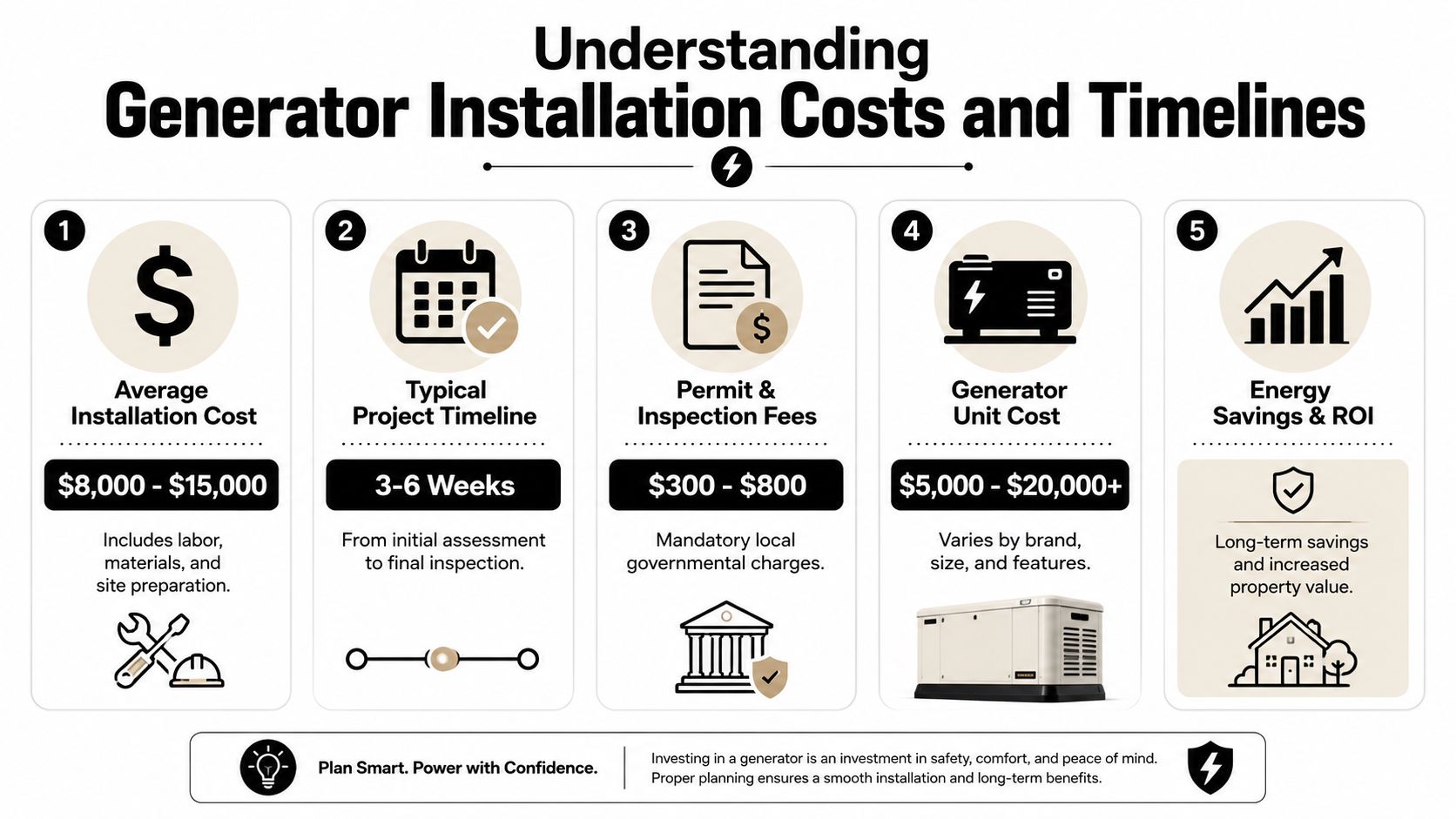
A standby generator price only makes sense when the full installation is on the table. In West Palm Beach, two homes can buy similar equipment and end up with very different project totals because the actual cost sits in the electrical work, fuel connection, permitting, site conditions, and the corrections needed to make the system safe.
Where the money goes
The generator itself is only one line item. A proper proposal should spell out the transfer equipment, pad or mounting base, electrical labor, fuel piping, permits, inspections, startup, and load testing. If an older home has panel deficiencies, grounding issues, or service equipment that does not meet current standards, those corrections belong in the scope too.
That is where low bids get risky.
A price that looks far below the rest often leaves out permit costs, assumes a simpler fuel run than the property allows, or skips electrical corrections that should be handled before the generator is tied into the house. Homeowners usually do not see the problem until the job stalls in inspection or the installer starts issuing change orders.
In practice, cost usually shifts based on a few job-specific factors:
- Generator size and coverage goal: Backing up selected loads costs less than covering most or all of the home.
- Transfer switch configuration: The transfer equipment has to match the generator design and the home's service layout.
- Fuel source and distance: Natural gas and propane setups each bring different labor and material costs.
- Site access and placement: Tight side yards, flood concerns, and clearance requirements can increase labor.
- Existing electrical condition: Older panels, service upgrades, and code corrections can add meaningful scope.
- Permits and inspections: These are part of the job, not optional extras.
Homeowners who want a clearer budget framework before requesting estimates can review this whole-house generator installation cost guide, which explains the line items that tend to change proposals the most.
How to think about timing
The calendar for a standby generator project is rarely just the install day. A professional job includes an on-site evaluation, load review, equipment selection, permit preparation, utility and fuel coordination when needed, installation scheduling, inspections, and final commissioning. Some parts move quickly. Permitting, product availability, and inspection scheduling often do not.
Storm season changes the pace. Once a serious weather threat starts getting attention, lead times usually stretch because equipment, inspectors, and qualified crews are all in higher demand at the same time.
The safest plan is to start before the rush. That gives enough time to size the system correctly, address any electrical deficiencies, and complete the work without pressure to cut corners.
Choosing Your Licensed Electrician The Lighthouse Energy Difference
The electrician you hire matters as much as the equipment you buy. Most homeowners know to verify licensing and insurance. That's necessary, but it isn't enough for standby generator installation in West Palm Beach.
A significant difference between a routine contractor and a careful one often shows up in the electrical details they volunteer before you ask.

The contractor vetting question that matters
Ask this: How do you handle grounding and neutral bonding on a standby generator with transfer equipment?
That question cuts through sales language fast. A critical but often overlooked safety issue is the grounding and neutral-bonding protocol. A common mistake is bonding the neutral and ground at the generator when the transfer equipment is handling the switching. That mistake can create dangerous backfeeding risks and can electrocute utility workers during outages (grounding and neutral-bonding safety discussion for standby generators).
A weak answer sounds vague. A risky answer sounds overconfident and dismissive. A professional answer is careful, specific, and tied to the actual transfer configuration being installed.
What a professional answer sounds like
You want an electrician who talks about the house as a system, not the generator as a box.
Look for these signs:
- They discuss the transfer method first: Bonding decisions depend on how the transfer equipment is designed.
- They explain backfeeding in plain English: Not as a scare tactic, but as a real hazard that correct installation prevents.
- They don't brush off inspection requirements: Good electricians expect scrutiny because they install to pass.
- They care about serviceability: Clean routing, clear labeling, and accessible equipment aren't cosmetic. They reduce mistakes later.
Lighthouse Energy Services distinguishes itself. The company serves Palm Beach County with licensed electrical professionals, genuine 24/7 availability, and a reputation built on doing code-driven work the right way, not the fast way. When a homeowner needs standby generator installation in West Palm Beach, the gold standard is a crew that answers technical questions clearly, handles the permit process correctly, and treats grounding, bonding, transfer equipment, and safety clearances as paramount.
Frequently Asked Questions About Home Standby Generators
Do I really need a permanent standby generator instead of a portable one
A portable unit can keep a few items running for a short outage. A standby generator serves a different purpose. It starts automatically, transfers power through listed equipment, and is wired into the home by a licensed electrician.
For many West Palm Beach homeowners, that difference matters during nighttime outages, storm evacuations, and extended utility interruptions. If the goal is reliable backup without extension cords, manual setup, or fuel handling in bad weather, a permanent standby system is the safer choice.
Can I install a standby generator myself
No.
A standby generator installation ties into the home's electrical service, transfer equipment, and usually the gas system. In West Palm Beach, that work must be permitted and inspected, and it has to be done by the right licensed trades. The legal issue is only part of it. The bigger concern is safety.
The mistakes that worry electricians are not always obvious from the outside. An incorrect transfer connection can backfeed the utility. Improper grounding or bonding can energize metal parts that should never carry fault current. Those are the kinds of errors that put your family, first responders, and utility workers at risk.
What maintenance should I expect
Expect regular service, not just a startup test once a year.
A standby generator should be inspected, exercised, and maintained on a schedule that matches the manufacturer's requirements and the site conditions. That usually includes battery checks, oil and filter service, air filter inspection, fuel system review, transfer switch testing, and a general inspection for corrosion, loose connections, or rodent damage. In South Florida, salt air, heat, and humidity are hard on outdoor equipment, so skipped maintenance shows up fast.
Is natural gas cheaper to run than propane
In many cases, yes, but operating cost is only one part of the decision.
Natural gas often makes sense when the home already has reliable gas service and the available meter capacity supports the generator load. Propane can still be the better fit for properties without natural gas access or for homeowners who want an on-site fuel supply. The right choice depends on fuel availability, outage patterns, refill logistics, and how long you expect to run during a major storm event.
What separates a safe install from a risky one
The difference is in the details that homeowners rarely see after the job is finished.
A safe installation uses the correct transfer equipment, proper conductor sizing, approved overcurrent protection, code-compliant placement, solid mounting, clear labeling, and a grounding and bonding setup that matches the transfer switch design. A risky installation often looks fine from ten feet away, but it may have neutral-to-ground errors, poor terminations, missing disconnects, bad exhaust placement, or shortcuts that fail under load.
That is where experience shows. Lighthouse Energy Services handles standby generator installation with the standards a licensed electrician should bring to service equipment work. If you want a code-correct system in West Palm Beach, contact Lighthouse Energy Services for licensed installation and clear answers before the generator is ever set in place.