
At 3 a.m., one sharp chirp from the ceiling can wake the entire house. You replace the backup battery, wait for silence, and then hear the same smoke detector hardwired beeping again a few minutes later. That usually means the battery wasn't the whole problem.
A hardwired alarm still has a battery, and it also depends on building power, a wiring harness, a sensor, and any interconnected alarms in the home. Before touching anything, identify whether you're hearing a warning chirp, a full alarm, or a repeating pattern from several units. If there's smoke, a burning smell, heat, or any uncertainty about a fire, leave immediately and call emergency services. Troubleshooting comes only after the home is safe.
Table of Contents
- Why Your Hardwired Smoke Detector Keeps Beeping
- What Different Beeps and Chirps Actually Mean
- Safe Reset and Battery Backup Replacement You Can Do Yourself
- When Beeping Continues After a New Battery
- Power Wiring and Interconnect Issues That Need an Electrician
- Keep Your Hardwired Smoke Detectors Reliable for Years
Why Your Hardwired Smoke Detector Keeps Beeping
The first question isn't “How do I stop it?” It's “What exactly is it doing?” A single chirp at regular intervals usually points to a maintenance condition, while a loud repeating alarm can indicate smoke, contamination, or a signal from another connected detector. Those sounds may seem similar when you're tired, but they lead to very different decisions.
Hardwired smoke alarms receive primary power from the building wiring and use battery backup. Modern residential codes also require interconnected alarms so activation of one unit causes the others in the dwelling to sound together. A widely cited milestone is 1989, when NFPA 74 required newly constructed homes to have interconnected hardwired alarms on every level and outside sleeping areas, as described in this CPSC smoke alarm reference.
Start with the sound pattern
Stand beneath each alarm, listen, and note which unit appears to start the sequence. Don't remove every detector at once. The alarm with the flashing indicator, recent exposure to steam or cooking aerosols, or visible dust may be the initiating unit, while the others are only repeating its signal.
- One brief chirp at a regular interval: Usually a low backup battery, power interruption, or maintenance warning.
- A loud repeating alarm: Treat it as a possible fire first. Check the home without delaying evacuation.
- Several alarms sounding together: The interconnect may be doing exactly what it was designed to do, or one unit may be reporting contamination or failure.
- A chirp that returns after a battery change: Look beyond the battery. Power, contamination, a loose connector, interconnect signaling, or end-of-life status may be involved.
For a broader explanation of distinguishing an unwanted activation from a genuine emergency, this guide to troubleshooting a false alarm can help. The important point is simple: don't silence a hardwired system by disconnecting it and leave the home unprotected.
What Different Beeps and Chirps Actually Mean
The sound pattern gives you a useful first filter, but it isn't a universal code. Manufacturers use different tones and intervals, so the owner's manual remains the authority for a particular model. Even so, the patterns below are practical starting points for deciding what to inspect first.
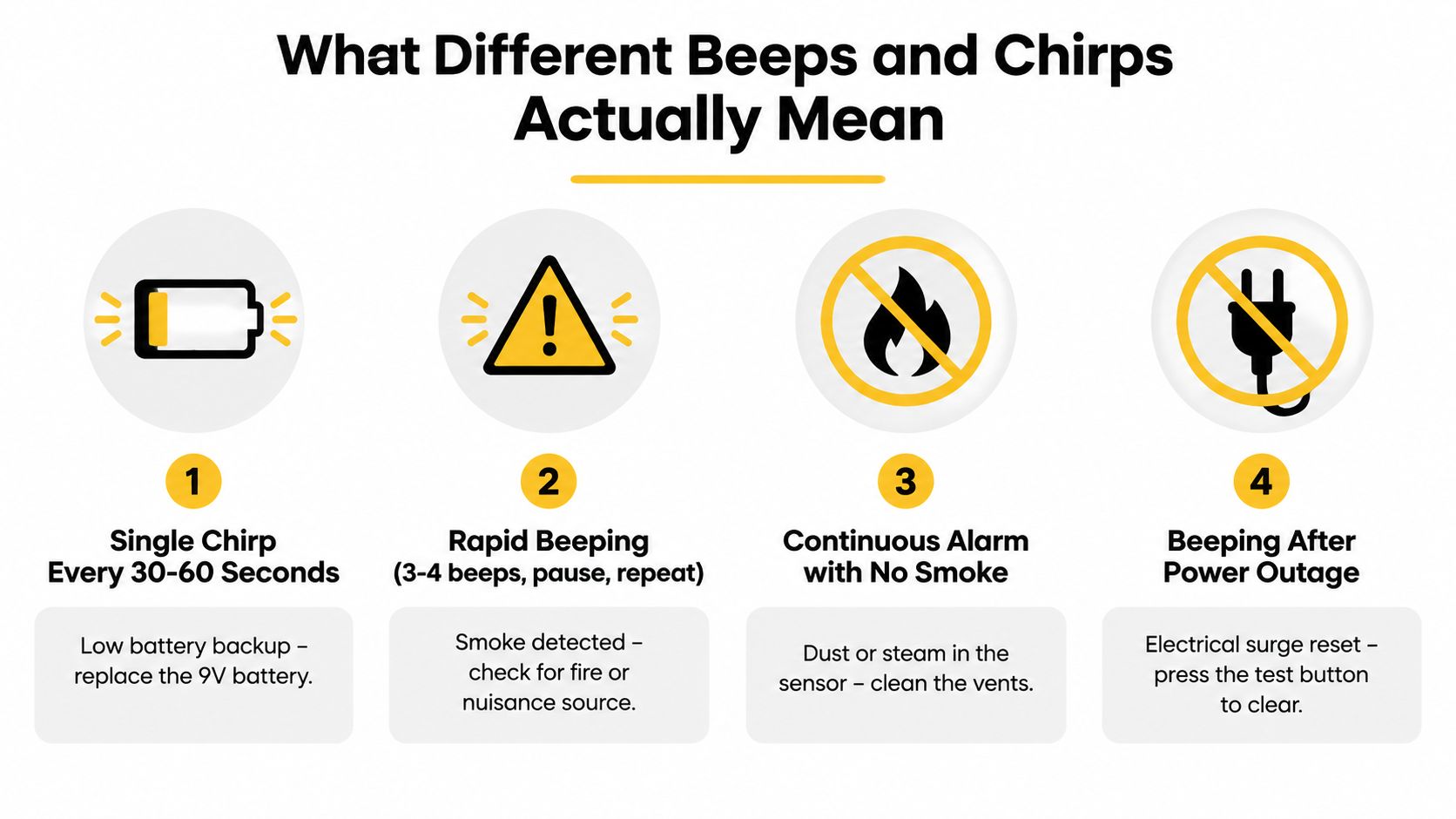
| Beep Pattern | Likely Cause | What to Check First |
|---|---|---|
| Single chirp at regular intervals | Low backup battery or maintenance signal | Battery seating, battery type, alarm status light |
| Rapid repeating beeps or alarm bursts | Smoke, cooking aerosols, steam, or another interconnected unit | Fire conditions, nearby kitchen or bathroom, other alarms |
| Continuous alarm with no visible smoke | Dust, sensor contamination, humidity, or steam | Vent openings and recent household activity |
| Beeping after a power outage | AC interruption or reset condition | Breaker, recent outage, harness connection, test/reset behavior |
| Persistent chirp after a new battery | End-of-life warning, power issue, contamination, or interconnect trigger | Manufacture date, all linked alarms, circuit condition |
A true emergency signal deserves priority over diagnosis. Cooking aerosols can enter a sensor without visible smoke, and steam can affect an alarm near a bathroom. Dust also changes how air reaches the sensing chamber. Those conditions can create nuisance alarms, and repeated nuisance alarms carry a serious behavioral risk. RAND's household smoke alarm research reports that more than one-third of households had disabled a smoke alarm to prevent nuisance alarms.
Read the whole system, not one ceiling unit
If three alarms sound together, don't assume three detectors failed at the same time. Interconnected hardwired alarms share a common signal, so one initiating unit can make every connected alarm sound. A focused explanation of three beeps from a smoke detector may help you compare the audible pattern, but use the exact instructions for your installed model before interpreting it as a definitive code.
The practical distinction is between notification and fault reporting. A full alarm may be warning you about a sensed condition or a signal from another unit. A short chirp often reports a condition that needs maintenance. Don't repeatedly press TEST/RESET without identifying which category you're hearing.
Safe Reset and Battery Backup Replacement You Can Do Yourself
A homeowner can usually handle the backup battery and a controlled reset, provided the alarm is accessible without dangerous climbing and there are no signs of damaged wiring. The sequence matters because a hardwired alarm can retain electrical charge after power is removed, and replacing the battery without resetting the unit may leave the original chirp active.
Before starting, tell everyone in the home what you're doing. Keep another working alarm active, don't work during a suspected fire condition, and don't proceed if the breaker is unlabeled, the alarm is mounted over a stairwell, or the wiring looks scorched or loose.
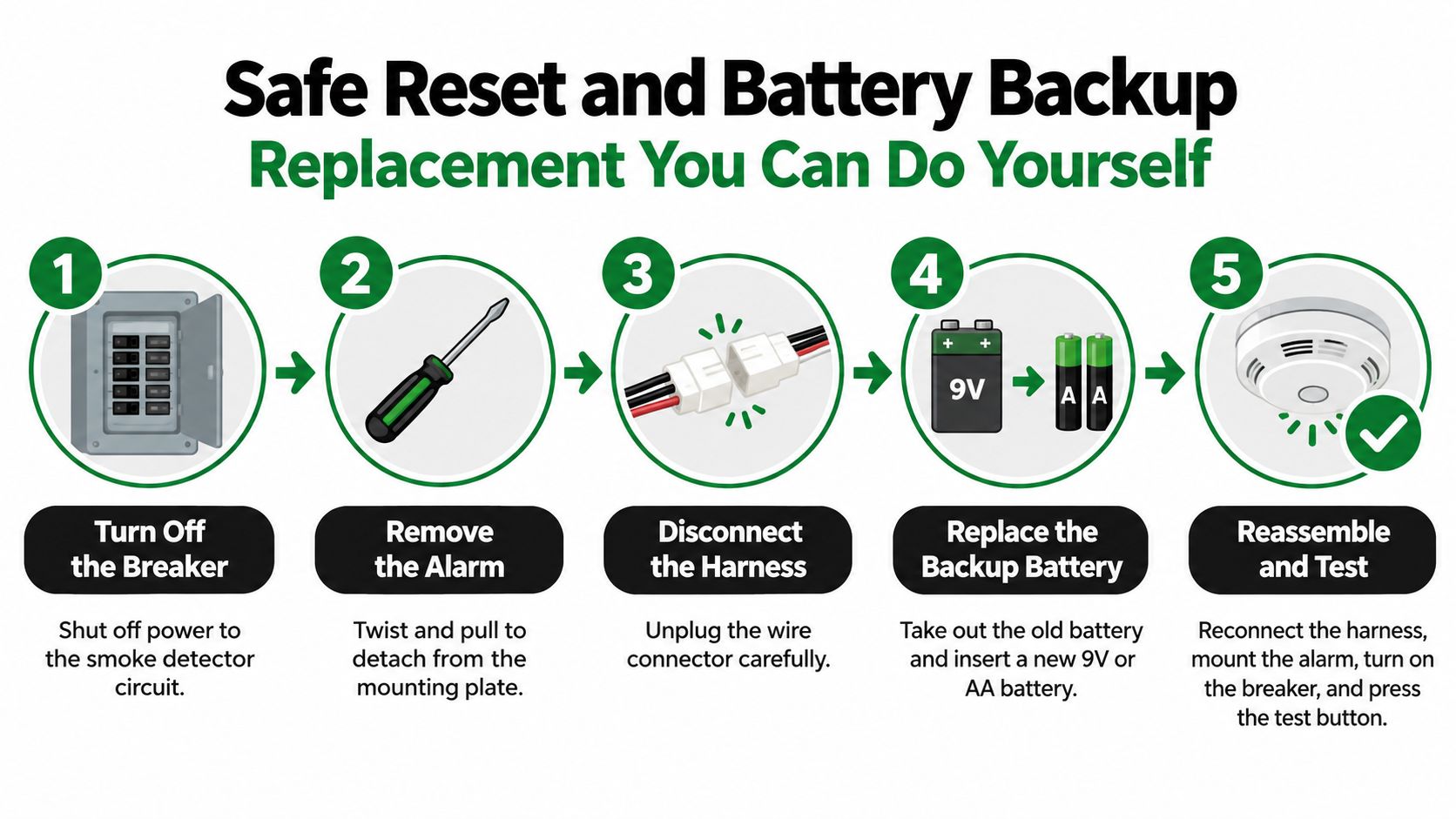
Follow the safe order
Turn off the breaker. Switch off the circuit supplying the smoke alarms. Verify that the alarm's power indicator changes as expected, and never assume a panel label is correct without caution.
Remove the alarm from its bracket. Most units twist and pull away from the mounting plate. Support the alarm with one hand so it doesn't hang from the wiring.
Disconnect the harness. Unplug the connector from the alarm. Don't cut wires, pull conductors from the electrical box, or bypass the interconnect.
Replace the backup battery. Install the exact battery type listed on the alarm. Some units use a 9V battery, while others use AA cells. Check polarity, close the compartment fully, and make sure the battery door latches.
Drain residual charge and reassemble. With the battery removed and the harness disconnected, hold TEST/RESET for 15 to 20 seconds. This helps drain the internal capacitor that can keep a unit chirping after the battery has been changed, as outlined in this hardwired detector reset sequence. Reconnect the harness, mount the alarm, restore the breaker, and press TEST.
Know what not to do
Don't leave the alarm hanging, tape over the sounder, remove the backup battery permanently, or disconnect one unit because it seems to be the source. Those actions may stop the noise while also defeating whole-home notification. If you need broader planning for stored power systems, keep that work separate from alarm maintenance and review this information about home battery backup power.
If the alarm still chirps after the complete sequence, stop repeating the battery swap. The next suspects are system-level issues, not a battery that needs to be changed again.
When Beeping Continues After a New Battery
A new battery removes only one possible cause. Persistent smoke detector hardwired beeping after a battery swap usually calls for isolation and observation, not more resets.
Start with recent conditions. Was the alarm near a kitchen during cooking, a bathroom after a hot shower, a dusty renovation area, or a room with unusual humidity? Aerosols, steam, and dust can enter sensing chambers and cause nuisance activity. NIST has noted that newer smoke alarm standards aim to reduce cooking-related nuisance alarms, which reflects a practical problem homeowners encounter repeatedly.
Check the alarm's age
End-of-life signaling is easy to mistake for low battery trouble. Smoke alarms have a limited service life, and an older unit may continue chirping even with a correctly installed battery. If the manufacture date is missing, unreadable, or indicates the alarm has reached the replacement point specified by the manufacturer, replacement is safer than repeated cleaning and resetting.
Look at every interconnected alarm, not just the loudest one. One detector may be initiating the signal while the others reproduce it. If the pattern begins near a recently used kitchen or bathroom, clean the exterior vents according to the manufacturer's instructions and improve ventilation. Never spray cleaner, compressed liquid, or insect treatment into the sensing chamber.
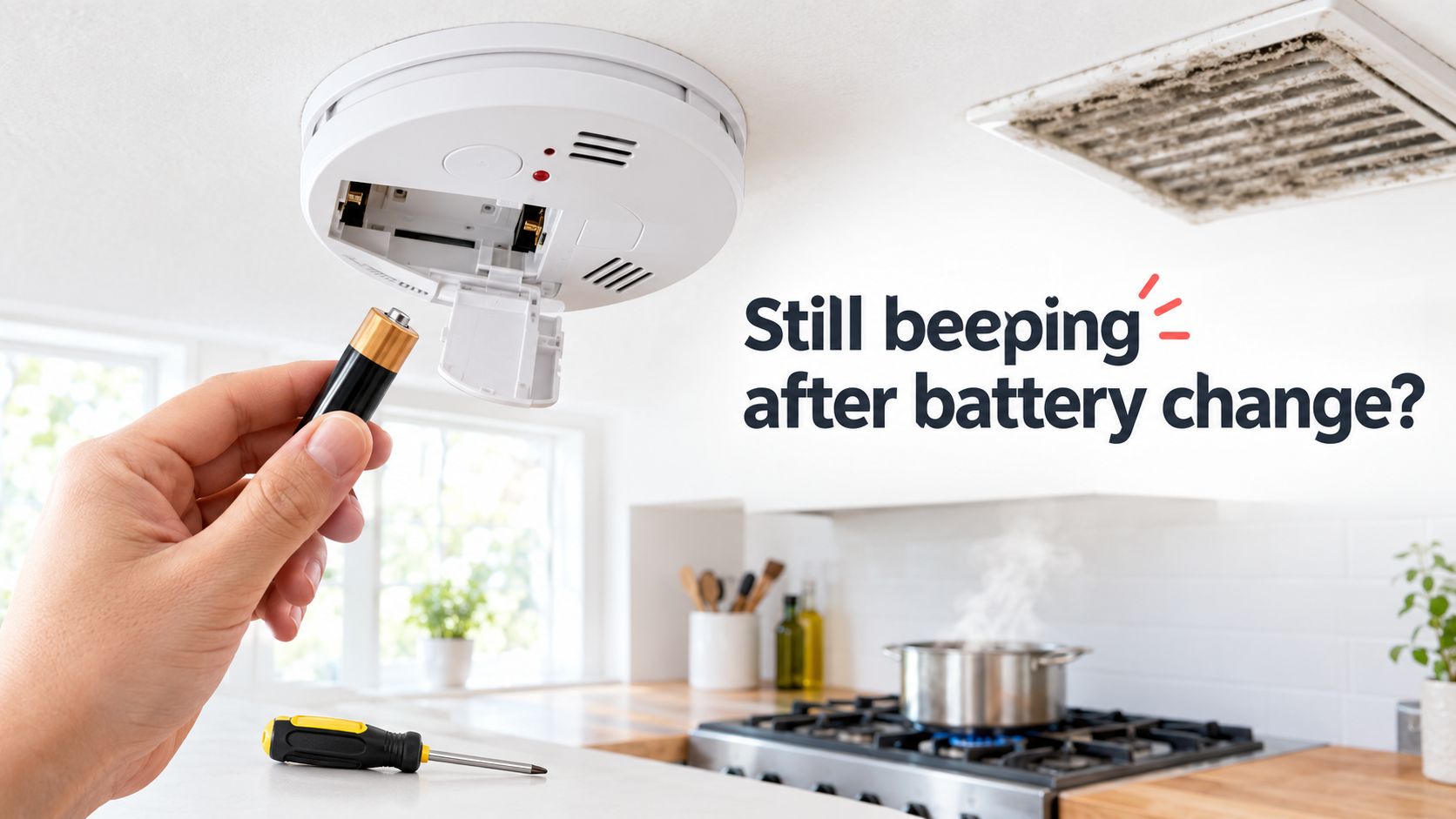
Separate contamination from electrical trouble
A clean, recent alarm that chirps after a power interruption deserves more attention to the AC supply and connector. A loose harness, tripped breaker, interrupted circuit, or failing unit can create symptoms that a battery replacement won't correct. If only one alarm behaves differently, that unit may be defective. If the entire group reacts together, the interconnect or initiating alarm deserves investigation.
A replacement guide such as Forward Electrical's Dublin smoke detector guide can provide useful general context on replacement decisions. Local electrical conditions and the installed alarm model still control the correct repair. Don't remove a detector from the interconnect to make the rest of the house quiet.
Power Wiring and Interconnect Issues That Need an Electrician
The boundary is clear: changing a listed backup battery is maintenance, while opening the electrical box, tracing conductors, or altering interconnect wiring is electrical work. Current code summaries describe hardwired alarm systems as commonly using 120-volt circuits with minimum 14 AWG interconnect wiring, and listed systems commonly support 12 to 18 alarms on one interconnect loop, according to the CPSC smoke alarm reference.
That wiring arrangement explains why one small fault can create a house-wide disturbance. A breaker may trip, an AC feed may be interrupted, a harness may loosen, or one alarm may send a signal across the interconnect. The battery can keep an alarm operating during a power event, but it doesn't repair a failed supply or a damaged signal conductor.
Stop point: If the alarm circuit, electrical box, breaker, or interconnect wiring needs testing or alteration, stop DIY work and call a licensed electrician.
NFPA identifies disconnected or non-working power sources as the most common broad cause associated with smoke alarm failures in U.S. home fires, with battery problems the most common specific failure, as explained in its smoke alarm failure research. That makes a recurring chirp after a proper battery replacement a reason to check power quality and installation, not permission to disable the alarm.
What the electrician will check
A licensed electrician can identify the correct breaker, test for voltage at the alarm circuit, inspect the harness and junction box, evaluate the interconnect conductors, and determine whether one alarm is pulling the system into a fault condition. They can also replace alarms with compatible listed units while preserving the required whole-home signaling.
Call immediately if you smell burning, see heat damage, find exposed conductors, hear alarms after a breaker trip, or can't safely access the device. For Palm Beach County homeowners, 24/7 residential electrical repair is the appropriate service category when the issue has moved beyond battery maintenance.
Keep Your Hardwired Smoke Detectors Reliable for Years
Reliable protection comes from treating the alarms as a system, not as isolated ceiling accessories. Keep every interconnected unit installed, accessible, and matched to the manufacturer's requirements. Queensland's legislation, for example, requires photoelectric alarms that are interconnected, hardwired to mains power, and paired with a secondary power source, showing how alarm performance can sit inside a broader compliance framework, as described by Queensland Fire and Emergency Services.
Use a simple maintenance routine
- Test regularly: Press each alarm's TEST button on a monthly schedule and confirm that the expected connected alarms respond.
- Replace batteries annually: Install the specified backup battery before the old one begins chirping.
- Clean carefully: Keep dust from the exterior vents using the method approved for the model. Don't introduce liquids into the alarm.
- Record dates: Write the installation or replacement date inside the alarm cover or in a household maintenance log.
- Replace aging units: Follow the manufacturer's service-life guidance and replace an alarm that signals end of life, fails a test, or shows physical damage.
- Protect placement: Keep alarms away from avoidable steam and cooking aerosols while maintaining the required coverage and interconnection.
A photoelectric or dual-sensor replacement may be appropriate depending on the home's layout, local requirements, and the existing system's listing. Don't mix devices casually. Compatibility, interconnect approval, and correct mounting all matter.
For an older home or a system with undocumented modifications, a home electrical inspection checklist can help organize a professional review. The inspection should include alarm power, mounting, backup batteries, visible condition, and whole-home response.
Lighthouse Energy Services provides 24/7 electrical troubleshooting for Palm Beach County homes, including hardwired smoke alarm power, wiring, and interconnect problems that battery replacement won't solve. If your alarms keep beeping or won't test correctly, visit Lighthouse Energy Services to request help from a licensed electrical professional.