
The lights flicker, the dishwasher stops, and your phone starts filling up with storm alerts while the house gets quieter than it should. In Palm Beach County, that usually means you're staring at a tropical-storm blackout and wondering whether the food in the fridge, the Wi-Fi, and the AC are all going to make it through the night.
A home battery backup power system is built for that exact moment. It sits permanently in the home, stores electricity, and automatically feeds selected circuits or the whole house when the grid goes down. For a lot of homeowners, the key question isn't whether to have backup at all, it's whether that backup should stand alone, pair with solar, or be installed as a system that can do both outage protection and everyday energy management.
Table of Contents
- What Home Battery Backup Power Is
- How the Core Components Work Together
- Comparing System Types and AC vs DC Coupling
- Sizing Your Home Battery for Real Outages
- Real Costs, Incentives, and Return on Investment
- Installation Process and Permitting in Palm Beach County
- Maintenance, Safety, and Monitoring Essentials
- Decision Checklist and When to Call a Licensed Electrician
What Home Battery Backup Power Is
A Palm Beach County homeowner often starts thinking seriously about backup after the first long outage of storm season. The fridge is warm by morning, the garage door won't cooperate, and a work call gets pushed because the router is dead. A permanently installed battery is meant to close that gap.
A home battery backup power system is a wall-mounted or floor-standing electrical system that stores energy, usually as direct current, then converts it into household alternating current when the grid fails. The basic hardware includes battery modules, an inverter or inverter-charger, and an automatic switching device that separates the home from the utility when needed. Many systems also include a monitoring gateway or app, and some include a smart panel that lets you prioritize only the circuits you really care about.
What it is not matters just as much. It is not a fuel-burning generator, so there is no gasoline or propane to manage during an emergency. It is also not the same thing as rooftop solar, unless the battery is paired with panels and designed to recharge from them. Portable power stations are in a different category too, since they are usually movable, lower-capacity units rather than permanently installed backup systems tied into the house wiring.
Practical rule: if a system is meant to protect a whole home or a dedicated critical-loads panel, it should be evaluated like electrical infrastructure, not like a gadget.
That distinction matters in South Florida. Hurricanes make outages a recurring reality, summer demand stresses the grid, and remote work has turned “temporary inconvenience” into missed income, missed school, and a lot of spoiled food. If your home is in Palm Beach County and you want outage protection that is available 24/7, a battery is often the cleaner fit than waiting on a generator workflow or trying to solve everything with a portable unit.
For homeowners who also want to understand the panel side of the house, this guide pairs naturally with a look at whole-home surge protection, because backup and surge defense are often discussed together for a reason. In practice, they solve different problems, but they live in the same electrical conversation.
How the Core Components Work Together
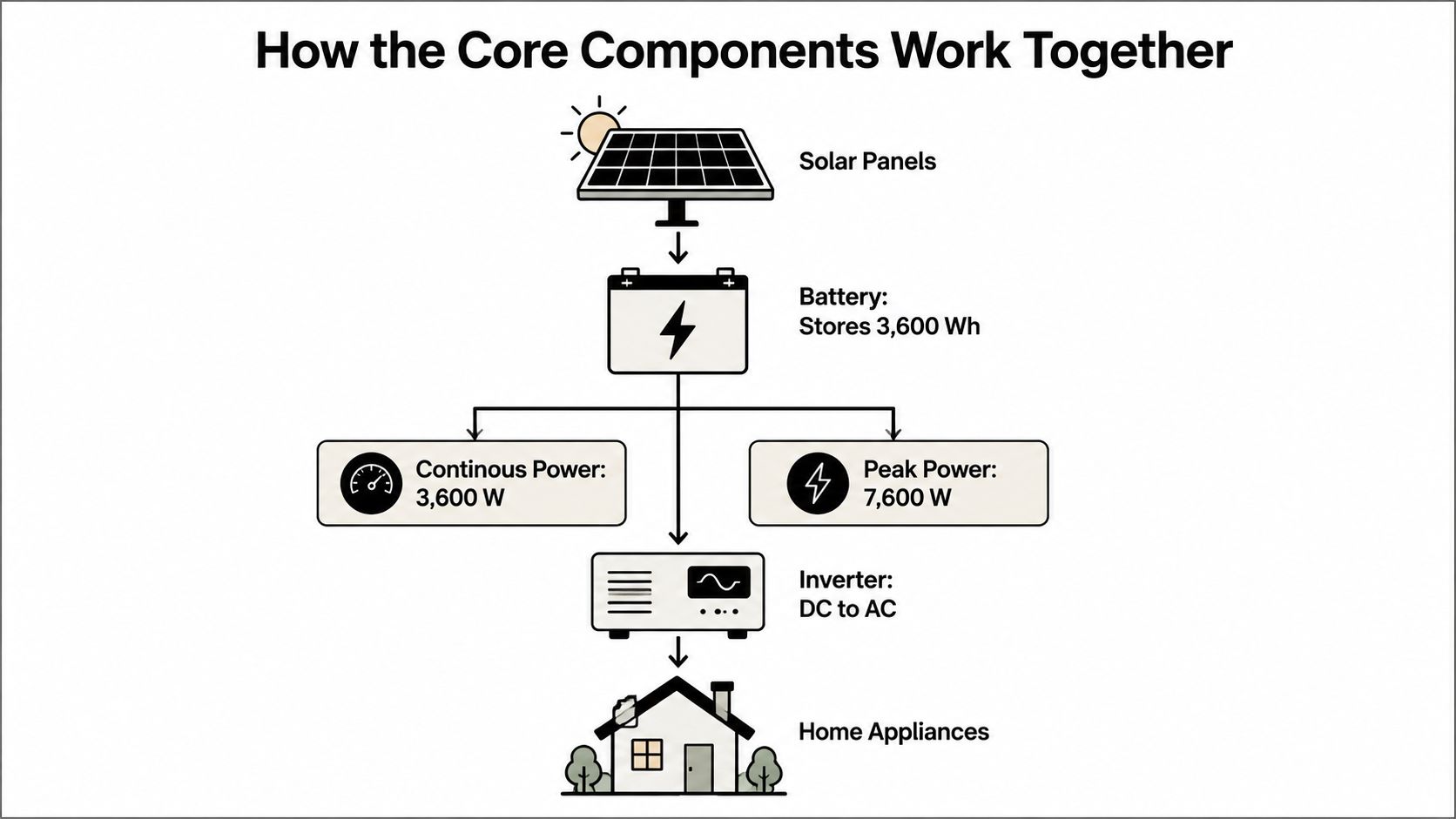
A home battery does not move power into the house the same way a tank sends fuel to an engine. It stores electricity as DC, then the charger and inverter decide when to hold it, convert it, and send AC power back to the home circuits. That conversion path is why a battery can look generous on paper and still fall short for a refrigerator compressor or an air conditioner if the inverter cannot deliver enough startup power.
One technical reference lists 3,600 Wh of capacity with 3,600 W continuous output and 7,600 W peak output (UC Denver backup power options). The lesson is simple. Energy capacity and instantaneous power solve different problems. A battery may hold enough electricity for hours, yet still shut down if a motor asks for a hard start all at once.
What each part does
- Battery modules: store the energy.
- Battery management system: protects the cells, balances charging, and keeps the pack within safe limits.
- Inverter or inverter-charger: converts DC into AC for household loads.
- Automatic transfer switch or gateway: isolates the home from the utility during an outage.
- Monitoring app or portal: shows charge state, usage, and fault conditions.
The inverter's continuous rating and surge rating often matter more than raw storage size. Compressors, pumps, and refrigerators need a brief power burst to start. If your home has a well pump, pool equipment, or central air, those startup demands can expose a weak design long before the battery is empty.
Modern residential batteries often use LiFePO4 chemistry because it is made for repeated cycling and tends to handle heat stress better than other chemistries. One technical reference lists 6,000 cycles to 70% capacity, 120 V, 3,600 W AC output, and ≤10 ms UPS transfer time. The same reference lists a 400 V system with 9.7 kWh usable energy, 5 kW continuous output, and 94.5% roundtrip efficiency (MR Solar technical reference). Those numbers show whether a battery is built for quick backup or for heavier whole-home loads.
If your panel is old, crowded, or undersized, the battery spec alone will not fix it. The battery still has to connect to a home electrical system that can accept it safely, which is why a panel upgrade conversation belongs in the design, not as an afterthought.
Comparing System Types and AC vs DC Coupling
A Palm Beach County homeowner might start with a simple question. The house needs backup power, but the roof may not be ready for solar yet, or the utility paperwork may slow that path down. That is why the system choice matters before anyone talks about batteries, panels, or the panel inside the garage.
A lot of confusion comes from people using “battery backup,” “solar battery,” and “whole-home battery” as if they mean the same setup. They describe different architectures, and the architecture affects how the system charges, how efficiently it runs, and how easy it is to fit into an existing house.
The four real configurations
| Configuration | Best For | Inverter Setup | Typical Efficiency | Retrofit Friendly |
|---|---|---|---|---|
| Battery-only backup | Homes that want outage protection without rooftop solar | Dedicated battery inverter or inverter-charger | Good, with grid charging | Yes |
| Solar-plus-storage | Homes adding backup and solar self-supply together | Hybrid inverter or coordinated inverter pair | Good to very good | Sometimes |
| AC-coupled retrofit | Existing solar homes adding storage later | Battery has its own inverter and works alongside the solar inverter | Good | Yes |
| DC-coupled new build | New solar installs where battery is planned from day one | Solar and battery share a hybrid inverter | Often slightly better | Best for new work |
AC-coupled storage uses a battery with its own inverter that works alongside the existing solar inverter. That makes it a practical retrofit choice when solar is already installed. DC-coupled storage uses a shared hybrid inverter for both solar and battery, which can reduce conversion loss and keep the equipment stack simpler on a new install.
The hardware details tell you a lot about what kind of backup a system can support. A LiFePO4 home battery is often chosen for frequent cycling because it is rated for repeated use, and one technical reference lists 6,000 cycles to 70% capacity and ≤10 ms UPS transfer time for sensitive electronics. The same reference also lists a 400 V system with 94.5% roundtrip efficiency, which helps explain why higher-voltage designs can fit larger homes and longer cable runs more comfortably (MR Solar technical reference).
For a homeowner, that translates into a simple design question. Is the battery meant to keep selected circuits alive through outages, or is it part of a larger solar system that will also carry daytime production and self-supply? That answer shapes the inverter choice, the wiring path, and the amount of flexibility the system has later.
Practical rule: if the house already has solar, retrofit logic usually points toward AC-coupled storage. If the home is getting solar and storage together, DC-coupled design is often the cleaner path.
Battery-only backup deserves a fair hearing too. A grid-charged battery can protect a home first, even when solar is not part of the project yet. That matters in Palm Beach County, where roof space, HOA review, utility interconnection, or a long wait on solar approvals can slow one project, while outage protection is needed now.
If the goal is to handle hurricanes, a utility interruption, or a 24/7 electrical emergency without waiting for a roof solar plan, battery-only backup can be the right first step. For a home that is clearly headed toward solar, pairing the battery with panels from the beginning usually gives a more integrated system, and this guide to sizing a home generator is a useful comparison point for understanding backup loads, even though a battery system is a different kind of equipment.
Sizing Your Home Battery for Real Outages
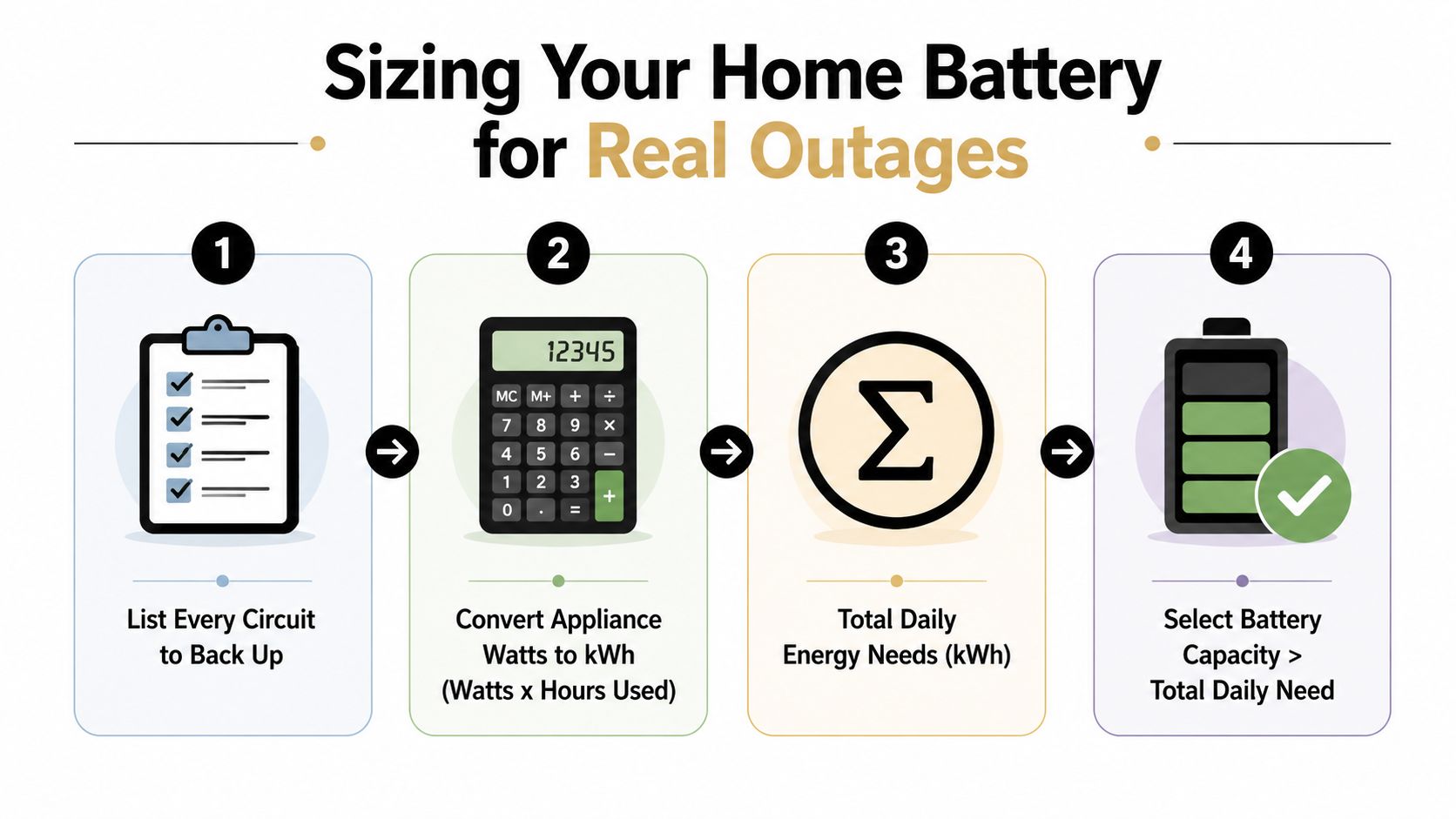
Sizing goes wrong when homeowners guess based on house size instead of actual loads. A small condo with electric cooking can need a different backup plan than a larger house with gas appliances, and a big home can still need only a modest battery if it's backing up a small set of circuits.
Start with the loads you actually want alive
A good installer should ask which circuits matter most. That usually means the refrigerator, a few lights, Wi-Fi, outlets for charging, maybe a medical device, and maybe one cooling circuit if the budget and hardware allow it. Then the electrician should convert those running watts into daily energy use and add the starting surge for compressors, pumps, and other motor loads.
That surge piece is where many DIY estimates fail. A battery can appear large enough in kilowatt-hours, but if the inverter can't deliver the startup spike, the equipment still won't run. That's why the backup design has to balance runtime and motor-start demand.
What a 30 kWh battery can do
A 2022 Lawrence Berkeley National Laboratory model, as cited by Palmetto's homeowner guide, showed that a 30 kWh battery could supply 98% of home needs during a one-day outage, 100% during three days without heating and cooling, and 92% during a 10-day outage with heating and cooling. That's a useful benchmark because it shows how quickly a real backup design starts to become a multi-day resilience tool, not just a short ride-through device.
Practical rule: for many Palm Beach County homes, a smaller critical-loads panel is more realistic than trying to keep every appliance online during a storm.
A simple way to self-sort before getting quotes looks like this:
- Small essentials only: battery sized for lights, fridge, Wi-Fi, and charging.
- Essentials plus kitchen loads: battery sized for a broader set of daily-use circuits.
- Whole-home with managed loads: battery and panel strategy designed for heavier equipment and more careful load control.
If you want to compare a battery-sized design with generator thinking, the math should be just as disciplined. This generator sizing guide is useful because the load-listing process is nearly identical, even though the equipment is different.
Real Costs, Incentives, and Return on Investment
A battery quote can look tidy on paper and still miss the actual work hidden behind the wall. The installed price includes the battery modules, inverter, wiring, conduit, labor, permits, inspection time, and sometimes panel or interconnect upgrades. That is why a quote for “a battery” and the final project total can feel like two different conversations.
For a Palm Beach County homeowner, the easier way to think about cost is by job size and by what the system is meant to keep alive during a storm. A backup-only setup usually stays lower because it protects a smaller set of circuits, uses a simpler inverter path, and relies on a smaller battery bank. A mid-size system costs more once it starts carrying more of the kitchen and living area, because the electrical work grows with the load. Whole-home projects sit higher still, since they often need smart panel coordination, larger storage, and more wiring work to keep heavier equipment running under control.
The federal 30% Residential Clean Energy Credit may matter for many solar and storage projects, but the tax result can change when battery backup is installed without rooftop solar. That is a tax question, not a sales pitch, because the answer depends on the equipment, the configuration, and how the system is set up in the home.
The market signal is still clear. U.S. residential battery storage grew sharply in 2024, and the U.S. Energy Information Administration recorded 673 MW of new residential battery storage in Q1 2026, a record level (Bloomberg report). That does not mean every battery pays for itself through utility-bill savings alone. It does show that home storage has moved from a niche add-on to a common part of the electrical conversation.
Start with the loads you want alive
The return on a battery starts with what it protects. If the goal is to keep the fridge, a few lights, Wi-Fi, and charging outlets on during a hurricane, the value is different from a system meant to hold a larger portion of daily life together through a long outage. In Palm Beach County, that question is shaped by storm outages, FPL interconnection requirements when solar is part of the project, and the need for power during 24/7 electrical emergencies.
Here is where the value comes from in practical terms.
- Avoided outage costs: spoiled food, hotel stays, lost work time, and business disruption.
- Everyday energy use: load shifting, if the system is set up for it.
- Grid programs: some batteries can take part in virtual power plants or other utility services.
Backup-only batteries often do not shine on utility-bill payback alone, but they can still make sense because resilience has a real household value. SolarBuilder makes the related point that when a battery is sold only as backup, homeowners may leave value on the table because batteries can also be used for grid services and peak shaving (SolarBuilder grid-services discussion).
That is the more disciplined way to shop. Ask what the battery protects, what it can do on normal days, and whether the system can still serve a useful role when the grid is up and the sky is clear.
Installation Process and Permitting in Palm Beach County
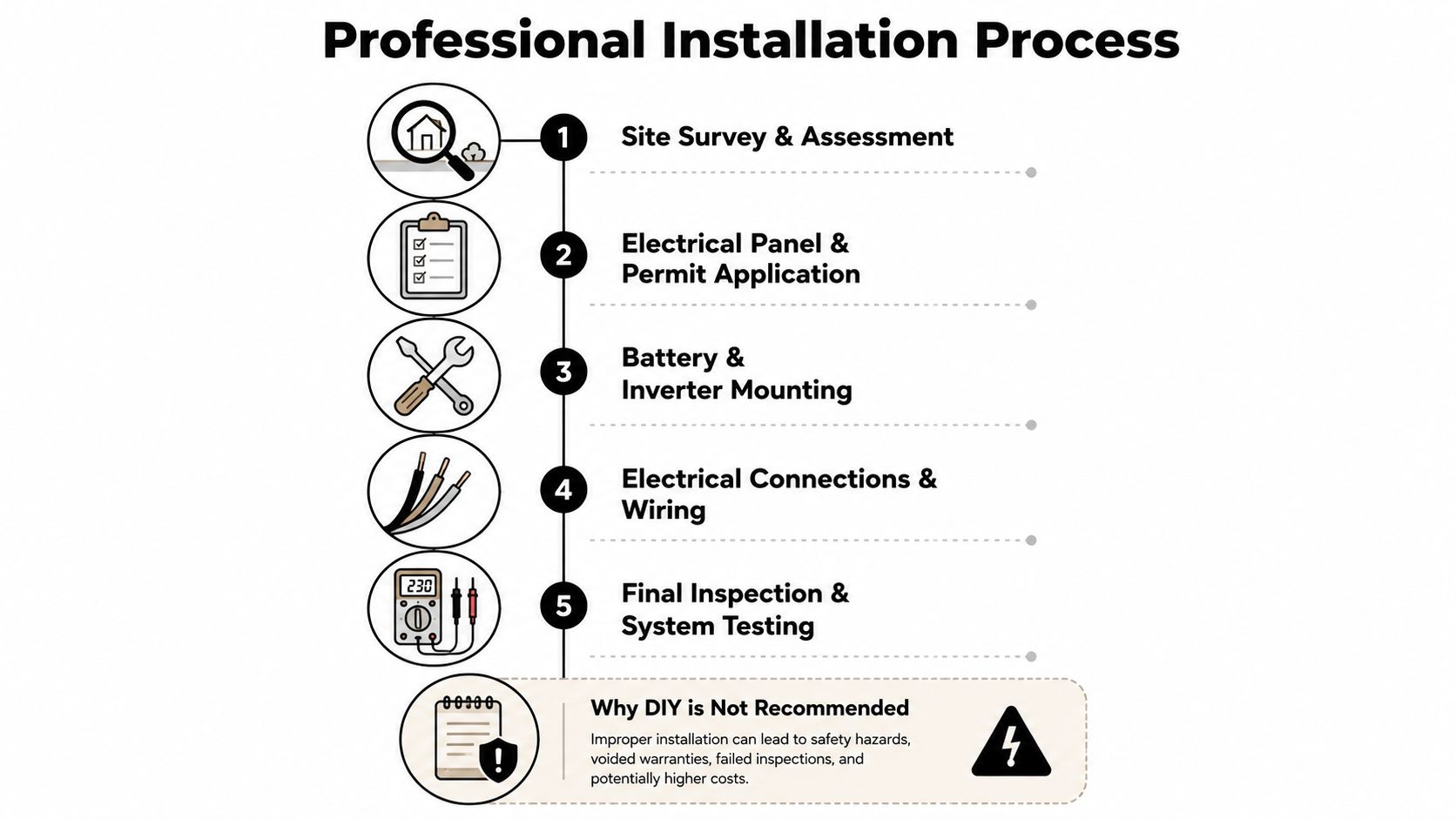
A battery job starts on paper and at the panel, not with a drill. A licensed electrician looks at the service equipment, the wall space available for the battery and inverter, the clearances around the equipment, the route for conduit, and the home's electrical load. In Palm Beach County, that first walk-through also has to account for hurricane exposure, possible 24/7 emergency backup needs, and, if solar is part of the project, the FPL interconnection steps that must be lined up before the system is put into service.
The field work usually follows a clear sequence, but each step has a reason behind it.
- Site survey and load review. The installer confirms which circuits will be backed up and checks whether the panel can accept the new equipment without forcing unsafe shortcuts.
- Permit preparation. The electrical permit package is assembled for the local authority having jurisdiction, whether that is the City of West Palm Beach or another Palm Beach County jurisdiction.
- Equipment mounting. Battery modules and inverter hardware are installed with the required working space and clearances.
- Electrical integration. Conduit, wiring, automatic transfer equipment, and monitoring gear are tied into the home's system.
- Inspection and commissioning. The system is tested, labeled, and cleared for operation.
That order matters because a battery is not just a box on the wall. It has to work with the home the way a generator inlet, a service panel, and a transfer switch all have to agree on what is allowed to run and what must stay off. If the project includes solar, the battery and array also have to play by the utility's interconnection rules so the home and the grid stay in sync.
A licensed electrician earns their keep in that paperwork and wiring process. They know how to coordinate the permit, keep the submittal clean, and avoid the kind of mistake that does not show itself until an inspector or utility reviewer asks for it.
Practical rule: if the project touches the service equipment, the transfer device, or the interconnection paperwork, it should be treated as licensed electrical work from the start.
Timing is rarely instant. Permit review, utility coordination, and inspection scheduling can stretch the job into weeks, not days, and Palm Beach County homeowners are better served by a careful install than by rushed after-hours improvisation when a storm is already approaching.
Maintenance, Safety, and Monitoring Essentials
A home battery should settle into the background once it is installed. The homeowner's role becomes much simpler, because the inverter, the battery management system, and the monitoring software handle most of the day-to-day work. If the system is healthy, it should show charging, discharging, a fault, or an offline condition before the house ever feels the outage.
The chemistry matters, but it does not make the system casual to handle. LiFePO4 is popular because it is stable, yet the battery still stores significant DC energy, and that is not something to touch, move, or troubleshoot without the right training. Any repair, diagnostic work, or wiring change belongs with a licensed electrician, not a handyman with a toolbox and good intentions.
Software now plays a bigger role than many homeowners expect. Some systems update through a gateway, and that matters because a monitoring problem can live in firmware just as easily as in a loose wire. A proper annual service visit should include a visual inspection, a thermal check of connections, and torque verification on critical lugs. Those steps sound small until a loose termination starts heating up where it should not.
If a battery system should be quiet, predictable, and boring, then strange behavior deserves attention right away. A burnt smell, repeated error codes, or an app fault you cannot explain are all signs to stop treating the system like normal and have it checked.
What to watch for
- Unusual smells: often point to heat or electrical trouble.
- Repeated error codes: usually mean the inverter or battery wants service.
- App alerts: treat them as actionable, not decorative.
- Unexpected capacity drop: some degradation over time is normal, but a sudden change deserves a closer look.
Battery-only systems without solar still make sense for outage resilience in Palm Beach County. They are often the cleanest answer for a homeowner who wants backup during hurricane season, during utility interruptions, or during a 24/7 electrical emergency without adding rooftop solar right away. The trade-off is simple. Grid-charged backup usually does not produce the same bill savings as solar-charged storage, so the question should stay split between “keeps me powered” and “cuts my utility bill.”
Insurance and paperwork deserve a place in the plan too. Check with your insurer to see whether the system needs any special rider, and keep the permit set, spec sheets, and tax documentation together if you are using the federal credit. If service is needed later, having those records in one place makes the next call much easier.
Decision Checklist and When to Call a Licensed Electrician
A battery decision gets clearer once you answer three plain questions. What do you want to keep running, how long do you want it to stay on, and do you want the system to do anything useful on the many days when the grid is working normally? If the answer is only “survive the outage,” backup-only is often the cleanest fit. If the plan also includes solar self-supply or grid services, the design should account for that from the start.
A good checklist keeps the conversation practical:
- Define the must-back-up circuits: refrigerator, Wi-Fi, lighting, medical loads, or cooling.
- Choose the system type: battery-only, solar-plus-storage, AC-coupled retrofit, or DC-coupled new build.
- Pick the architecture and chemistry: ask what inverter topology and battery chemistry are being proposed.
- Request three site-specific quotes: compare equipment, labor, permit handling, and commissioning, not just capacity.
- Confirm who handles permit and utility steps: that includes local permitting and FPL interconnection when solar is involved.
- Ask about utility programs: VPP or other grid-service participation can change the value equation.
That last point is easy to miss. Batteries are no longer just emergency boxes. Some systems can support grid services or peak shaving, so a well-matched design can do real work even when the weather is calm. Industry analysis has made the same point, a battery sold only as backup can leave value on the table if the homeowner might also benefit from other operating modes.
For Palm Beach County homeowners, a licensed electrical contractor with true 24/7 availability is the right handoff when the panel is faulted, the transfer gear will not behave, or a storm has knocked part of the system offline. Lighthouse Energy Services is one example of a local electrical contractor that handles residential battery installs, emergency troubleshooting, and after-hours calls with licensed staff answering the phone. That kind of support matters when a system needs attention at 11 p.m. during storm season.
If the system smells hot, trips repeatedly, or throws fault messages you cannot explain, stop treating it like routine equipment. A battery setup should be quiet and predictable. When it is not, the safest next step is to have a licensed electrician check the inverter, transfer equipment, wiring, and battery status before the problem grows.