
You're tied to a Palm Beach marina on a Friday evening when the shore-power breaker trips again. The battery bank is already weak, refrigeration is warming, the bilge pump is silent, and a storm watch has you thinking about every system that could fail next. A general electrician may be available, but availability alone doesn't make someone qualified to work on a vessel.
A marine electrical contractor understands that a boat combines AC power, DC power, batteries, charging equipment, navigation electronics, bonding, grounding, and dock infrastructure in a wet, moving, corrosive environment. The right technician won't just restore voltage. They'll find out why the breaker tripped, whether the fault is aboard the vessel or at the pedestal, and whether the repair creates a dangerous bonding or leakage problem.
Table of Contents
- When You Need a Marine Electrical Contractor Instead of a Regular Electrician
- What Marine Electrical Contractors Actually Do on a Vessel or Dock
- Certifications and Standards That Define a Qualified Marine Electrical Contractor
- Seven Warning Signs Your Boat or Dock Needs a Marine Electrical Specialist
- Typical Costs and Timelines for Common Marine Electrical Jobs
- Hiring Checklist and Questions to Ask a Marine Electrical Contractor
- Palm Beach County Considerations for Marine Electrical Work
- Choosing the Right Marine Electrical Contractor for Your Situation
When You Need a Marine Electrical Contractor Instead of a Regular Electrician
It is Friday night at a Palm Beach County marina. The shore-power breaker trips again, refrigeration is warming, the bilge pump is silent, and a storm is approaching. A general electrician may be available, but availability does not qualify someone to diagnose a vessel connected to a dock.
Call a marine electrical contractor when the fault involves shore power, batteries, charging equipment, navigation electronics, bonding, grounding, or dock infrastructure. These systems operate in humidity, salt, heat, vibration, and repeated wet-dry cycles. A repair that works in a dry building can fail quickly aboard a boat.
A general electrician can test voltage or replace a damaged receptacle. Marine work demands more. The contractor must understand marine-rated terminations, vessel bonding, galvanic isolation, battery compartments, and the interaction between AC and DC systems. Dock installations also fall under NEC Article 555, while vessel work follows applicable ABYC requirements. The detailed standards belong in the certification discussion, but the hiring decision starts here: choose someone who works on boats and marinas regularly.
Why the environment changes the diagnosis
Corrosion often hides inside a crimp, behind a panel, beneath insulation, or around a connection exposed to spray. Replacing the visible component may leave the actual fault untouched. A competent technician traces the failure through the complete system.
The inspection may cover:
- Pedestal or dock fault: The receptacle, breaker, feeder, neutral, grounding path, and signs of heat or water intrusion.
- Vessel-side failure: The inlet, shore-power cord, main AC panel, transfer equipment, inverter or charger, and branch circuits.
- Bonding issue: Unintended current paths or damaged connections that can accelerate underwater metal loss.
- Battery or DC failure: Charging behavior, cable sizing, fuses, disconnects, and voltage under load.
Practical rule: If a shore-power breaker trips more than once, stop resetting it and call a marine specialist.
The right contractor repairs the immediate fault without casually changing the grounding arrangement or fitting household materials where marine-rated components are required. They should also document the work clearly for marina records, insurers, and future surveys.
Marine electrical contracting developed as a dedicated shipboard trade, not as residential wiring adapted to water. That history reflects the specialized conditions, materials, and safety practices the work still requires today. Read the historical background on marine electrical contracting
What Marine Electrical Contractors Actually Do on a Vessel or Dock
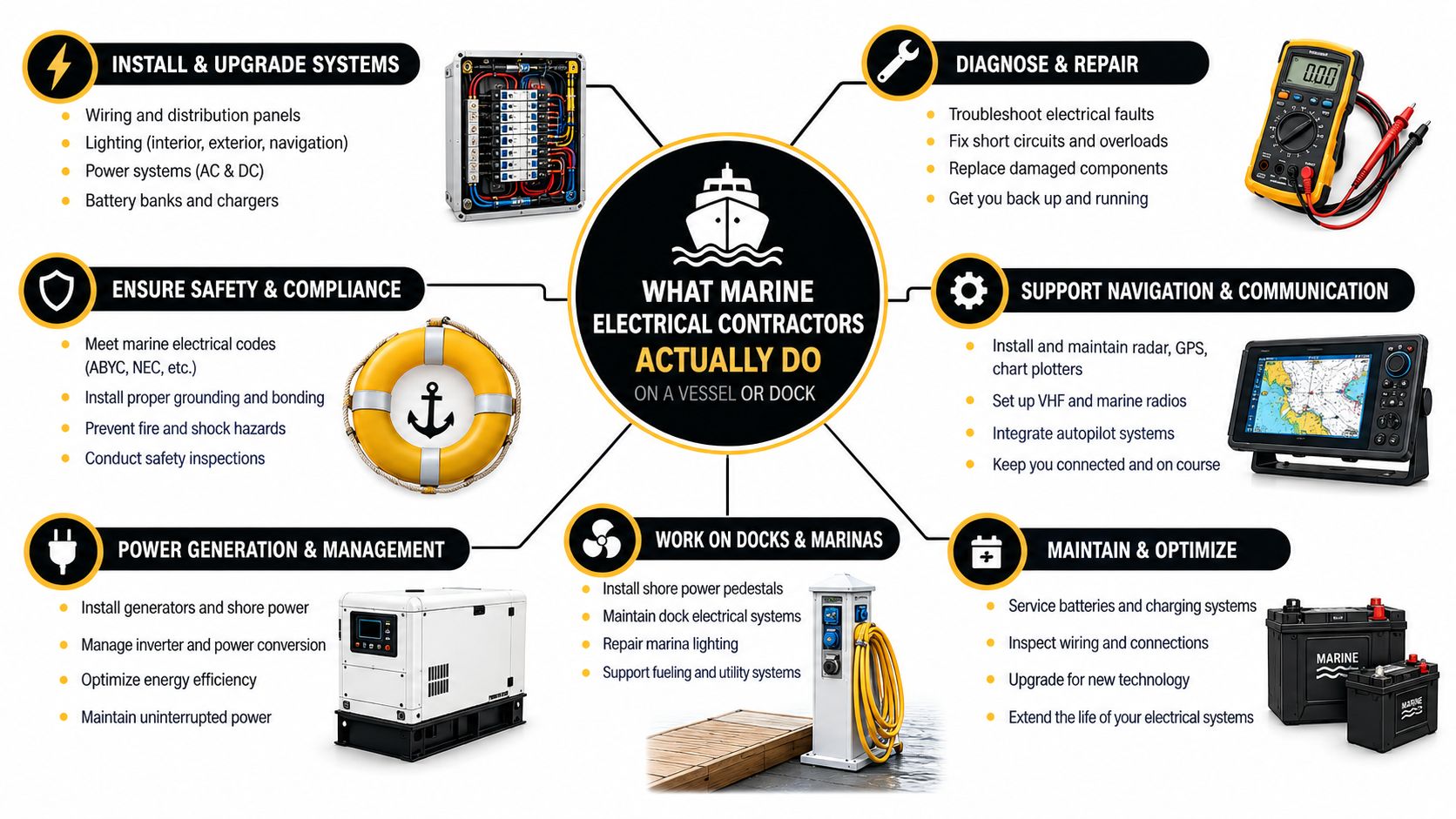
A qualified marine electrical contractor works across four connected areas. Each one has its own failure modes, materials, testing methods, and safety rules. Treating them as one generic wiring job is how owners end up with repeated faults.
Shore power is a vessel interface, not a household outlet
The shore-power system begins at the marina feeder and pedestal, passes through the cord and inlet, and continues into the vessel's AC distribution. A contractor checks polarity, grounding, leakage protection, connections, inlet condition, cord heating, and transfer equipment. The technician may also assess an ELCI, reverse-polarity indication, and galvanic isolation equipment where installed.
A general electrician may focus on whether power reaches the boat. A marine specialist asks whether the neutral and grounding conductors are behaving correctly once the vessel is connected to the dock, and whether the arrangement creates a current path through underwater metals.
For marina owners planning new infrastructure or repairs, the scope should include feeder capacity, disconnect placement, pedestal selection, bonding, inspection access, and coordination with local requirements. See the detailed guidance on marina electrical services in South Florida.
DC systems must deliver power under real load
Battery banks, alternators, chargers, inverters, bilge pumps, refrigeration, lighting, and electronics depend on properly sized DC circuits. Long cable runs create voltage loss, especially when connections have corrosion or the conductor is too small. A pump may run slowly, an inverter may shut down, or electronics may reboot even though a meter shows battery voltage at rest.
A marine contractor uses tinned copper conductors, protected fusing, sealed terminations, suitable cable supports, and charging equipment configured for the battery type. They test voltage while equipment is operating, not only when the circuit is idle.
Electronics need clean power and disciplined routing
Navigation and communication systems include chartplotters, VHF radios, AIS equipment, radar, transducers, and network backbones. These systems can suffer from poor power connections, ground noise, electromagnetic interference, bad data-cable routing, and incorrect termination.
The fix isn't always replacing the display. A competent technician isolates the power, network, antenna, and bonding conditions that affect the equipment. They also label the installation so a future fault can be traced without dismantling half the helm.
Bonding and corrosion control protect the vessel
Bonding connects selected underwater metals and related components through a controlled system. Grounding provides a fault path. Those functions overlap in the owner's mind, but they're not interchangeable. Incorrect connections can allow damaging current to travel through fittings, shafts, propellers, or neighboring boats.
The contractor may inspect bonding continuity, anodes, isolation devices, grounding conductors, and connections near through-hulls. This work requires marine judgment because a quick “extra ground” can create the very loop the technician should eliminate.
Certifications and Standards That Define a Qualified Marine Electrical Contractor
A Florida electrical license is necessary for regulated electrical work, but it isn't proof that a contractor understands vessel systems. The meaningful qualification is a combination of state licensing, marine-specific training, relevant standards knowledge, insurance, and documented field experience.
ABYC standards provide the marine framework most relevant to recreational vessels in North America. ABYC E-11 addresses AC and DC electrical systems, including conductor sizing, protection, installation practices, and voltage drop. ABYC E-31 addresses battery installations, an area where poor ventilation, weak restraint, incorrect fusing, or unsuitable conductors can create serious consequences.
The voltage-drop rule buyers should understand
ABYC E-11 requires conductors to satisfy both ampacity and voltage-drop limits. For critical circuits such as navigation lights, bilge pumps, and electronic equipment, the limit is 3%, while non-critical lighting circuits may use 10% under the standard's guidance. Review ABYC's explanation of voltage drop
That means the larger conductor wins whenever ampacity and voltage-drop calculations point to different sizes. A technician who sizes wire only by breaker rating may install a circuit that doesn't overheat but still performs poorly at the equipment.
Credentials worth verifying
| Credential | What It Covers | Who Issues It |
|---|---|---|
| Florida electrical contractor license | Legal authority for applicable electrical contracting work in Florida | Florida licensing authorities |
| ABYC electrical certification | Marine electrical installation knowledge and standards-based practice | American Boat and Yacht Council |
| ABYC E-11 knowledge | AC and DC system design, conductor sizing, protection, and voltage drop | American Boat and Yacht Council standard |
| ABYC E-31 knowledge | Battery installation, protection, restraint, and related safety practices | American Boat and Yacht Council standard |
| NEC Article 555 familiarity | Marina and boatyard electrical distribution | National electrical code framework |
| NFPA 303 familiarity | Fire protection considerations for docking facilities | National fire-protection standard |
| USL&H coverage | Protection relevant to certain waterfront and maritime work exposures | Insurance provider and applicable federal framework |
Ask for the lead technician's ABYC status, not just the company's general marketing language. Verify the Florida license through the state's official licensing lookup, request a current certificate of insurance, and ask whether the policy covers vessel and dock work. Marina vendor credentials also matter because access rules, escort requirements, and work permits vary by facility.
A contractor who dismisses ABYC as unnecessary, treats Article 555 as irrelevant, or can't explain how they test bonding continuity hasn't earned the job. The standard isn't paperwork. It controls how the system is designed, installed, and tested.
Seven Warning Signs Your Boat or Dock Needs a Marine Electrical Specialist
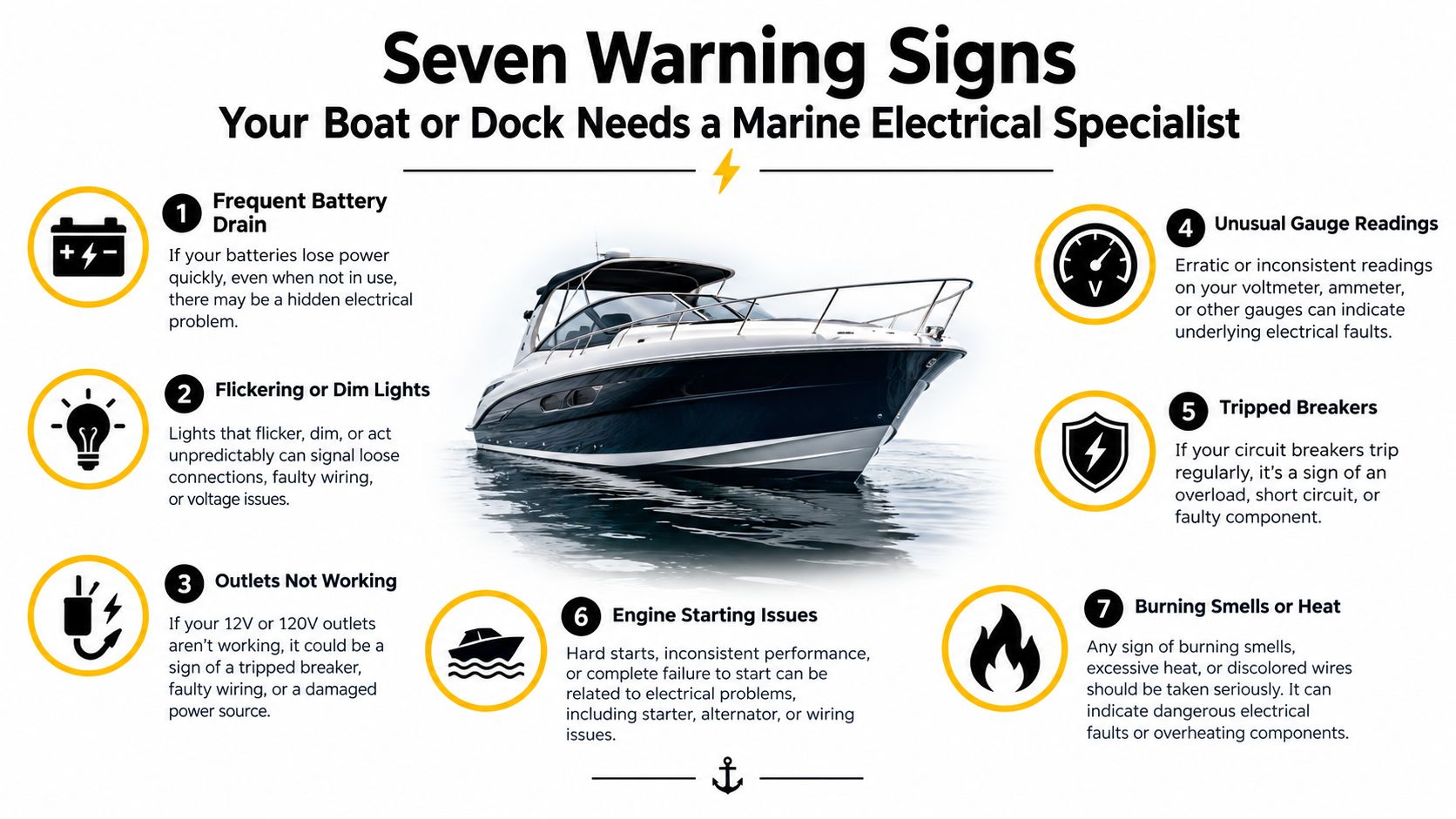
Electrical problems rarely announce themselves with a dramatic flash. More often, the vessel gives you small warnings until one circuit finally fails at the wrong time. In Palm Beach County's salt-heavy environment, these signs deserve prompt attention.
The shore-power breaker trips, then trips again.
A recurring trip can indicate leakage, a damaged cord, a failing appliance, an inverter problem, or a pedestal fault. Resetting the breaker only restores the symptom. A marine technician isolates the vessel from the dock and tests each part of the connection.Bonding connections show white, green, or crusted corrosion.
Corrosion at bonding jumpers, terminals, grounding plates, or underwater hardware can interrupt continuity or create unwanted current paths. Don't clean the visible surface and assume the connection is sound. The technician should inspect, test, and replace the affected hardware with suitable marine materials.Navigation lights flicker or electronics reboot.
Intermittent equipment often points to voltage drop, loose terminals, shared-circuit interference, or a failing network connection. The fault may appear at the display but originate near the panel, battery, or ground bus.An outlet or shore-power cord smells warm.
Heat indicates resistance, overload, a loose terminal, damaged contacts, or a poor connection. Disconnect the source safely and stop using it until the technician examines the cord, inlet, receptacle, and breaker.
The dock GFCI keeps cutting out.
Repeated trips may come from leakage on one vessel, a damaged pedestal, moisture, or a fault in the dock distribution. The marina should identify the source before allowing another boat to connect to the same equipment.House-bank voltage dims under ordinary loads.
Dimming lights or a pump that slows during normal operation can indicate weak batteries, charging trouble, undersized conductors, corroded connections, or excessive cable length. Load testing separates a battery problem from a distribution problem.The pedestal receptacle is pitted or discolored.
Pitting, browning, melted plastic, or loose contacts signal heat and deterioration. A pedestal repair may require shutting down the feeder, replacing the receptacle, checking the enclosure, and documenting the repair for the marina.
These symptoms look minor until they disable pumps, refrigeration, communications, or navigation. Use the cost guide and hiring questions below to decide whether you need a repair, a system inspection, or a full corrective project.
Typical Costs and Timelines for Common Marine Electrical Jobs
Pricing depends heavily on access, corrosion, vessel size, parts, and whether the technician is working during an active failure. Any contractor who gives a firm marine electrical price without seeing the vessel, pedestal, or damaged equipment is guessing.
| Job Type | Typical Cost Range (USD) | Typical Timeline |
|---|---|---|
| Shore-power cord and pedestal repair | Request an itemized site assessment | Same-day to scheduled service, depending on parts and access |
| AC panel upgrade on a mid-sized vessel | Request a vessel-specific written estimate | Planned work, with duration determined by panel condition and access |
| Full DC house-bank rewiring | Request a scope-based quote | Multi-stage project when circuits, batteries, and compartments require access |
| Navigation electronics installation | Request an equipment and installation quote | Scheduled appointment, with timing affected by wiring routes and commissioning |
| Bonding and grounding system overhaul | Request a marine inspection and corrective estimate | Planned work, potentially requiring haul-out or access to underwater hardware |
| GFCI dock-pedestal replacement | Request a feeder and pedestal assessment | Coordinated shutdown and inspection window |
| Emergency after-hours troubleshooting | Request the emergency service rate before dispatch | Immediate response depends on technician and marina access |
A useful quote separates labor, marine-rated materials, testing, permits, haul-out or lift requirements, disposal, and follow-up corrections. For shore-power distribution projects, review the scope of shore-power distribution systems before comparing proposals.
Older vessels can cost more because technicians spend time tracing undocumented circuits, removing seized fasteners, opening inaccessible panels, and replacing corroded hardware. OEM parts may carry different pricing and lead times than compatible aftermarket components, but the cheapest substitute isn't automatically suitable for a wet, vibration-prone installation.
Emergency work also costs more in practical terms, even when the immediate goal is only to restore a critical circuit. Hurricane preparation can tighten technician availability and parts access, so schedule inspections before a storm threatens the marina rather than waiting for the first outage.
Hiring Checklist and Questions to Ask a Marine Electrical Contractor
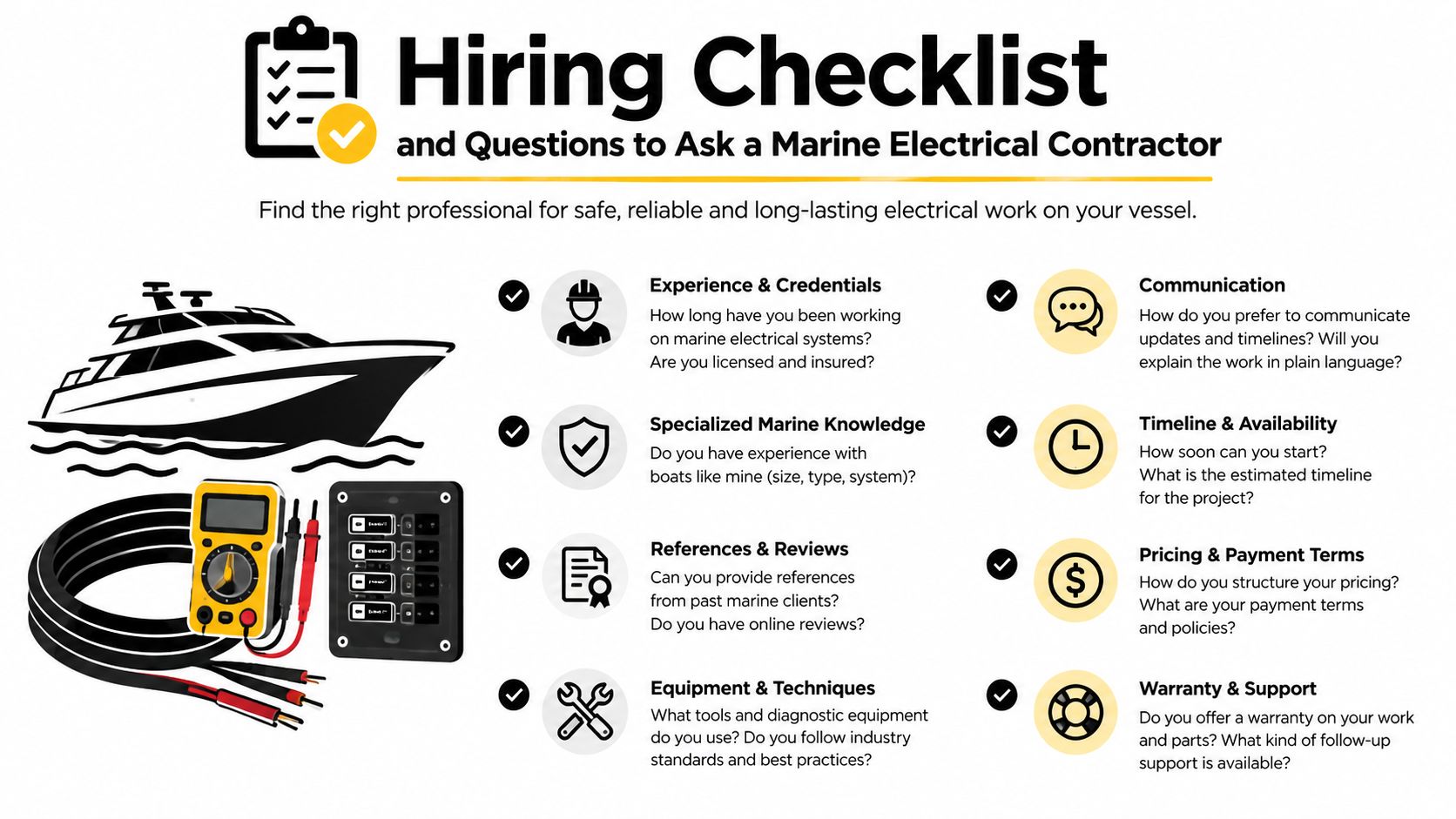
Start with documents. Before anyone touches the vessel or pedestal, confirm the contractor's Florida license status through the state licensing lookup, request current general liability and marine-related insurance certificates, and ask whether the lead technician holds relevant ABYC certification.
Then verify experience with projects similar to yours. Two references from marina, yacht, or waterfront clients are more useful than a long list of unrelated residential jobs. Ask what the contractor personally tested, replaced, or documented on those projects.
Questions that expose real marine competence
- How will you check galvanic isolation? The answer should address the shore connection, bonding system, isolation equipment, and testing method.
- How will you size the conductors? Look for a response that considers ampacity, voltage drop, run length, load, insulation, protection, and marine-rated materials.
- How do you test bonding continuity? The contractor should describe test equipment, connection points, acceptable results, and how they document defects.
- What wire and terminations will you use? Ask specifically about tinned copper conductors, sealed crimp terminals, marine heat-shrink, strain relief, and support.
- What happens if you find undocumented wiring? A careful contractor will stop, explain the risk, revise the scope, and label the corrected circuits rather than burying the problem.
- What will I receive at completion? Require an itemized invoice, test results where appropriate, updated labels, photographs of concealed work, and any permit or inspection records.
Red flag: A contractor who quotes from a phone description, says ABYC standards don't matter, or refuses an itemized written estimate is asking you to accept the risk they should be managing.
Palm Beach marina work also requires practical coordination. Ask whether the contractor can respond during hurricane preparation, whether they already hold access credentials at marinas around Riviera Beach, Lake Worth, or Palm Beach Inlet, and who handles dock permits or shutdown coordination.
Insurance deserves its own check. If you need help understanding marine liability exposure before approving work, talk to ABS Insurance Brokers and ask what documentation your insurer may expect after an electrical repair or upgrade.
Palm Beach County Considerations for Marine Electrical Work
Palm Beach County punishes shortcuts. Salt air reaches terminals, fasteners, panels, lifts, pedestals, and exposed conduit throughout the year. Humidity keeps moisture present, while heat and vibration work loose any connection that wasn't properly supported or sealed.
For that reason, tinned copper wire, marine-grade heat-shrink, sealed terminals, corrosion-resistant enclosures, and suitable stainless hardware should be treated as normal specifications. They're not decorative upgrades. They're part of building a system that can survive the environment.
Storm preparation starts before the forecast
Hurricane season runs from June through November. Owners shouldn't wait for a named storm to discover that the shore-power inlet is damaged, the battery bank won't charge, or the bilge-pump circuit has a weak connection. A pre-season inspection should identify what must be disconnected, secured, isolated, protected, or serviced before the vessel is moved or stored.
Marina managers need a broader review. Pedestals, feeder connections, disconnects, dock lighting, lift circuits, emergency equipment, and bonding infrastructure all need clear responsibility and documented condition. A contractor who knows waterfront work can coordinate shutdowns and inspections without treating the dock like an ordinary parking lot.
Permits and environmental access affect scheduling
Dock rewiring, lift circuits, service upgrades, and pedestal installation may involve Palm Beach County Building Division requirements as well as municipal rules. The applicable authority can depend on the property, the municipality, the dock configuration, and the work's relationship to waterfront infrastructure.
Access also matters near the Intracoastal Waterway and Lake Worth Lagoon. In-water work may be restricted when it disturbs sediment, and projects near manatee or sea turtle habitat can require additional scheduling and coordination. These constraints can affect the order of operations even when the electrical repair itself is straightforward.
For dock infrastructure, review the planning considerations for dock power pedestal installation. A specialist should explain who obtains approvals, who coordinates with the marina, and what testing happens before the system is energized.
Choosing the Right Marine Electrical Contractor for Your Situation
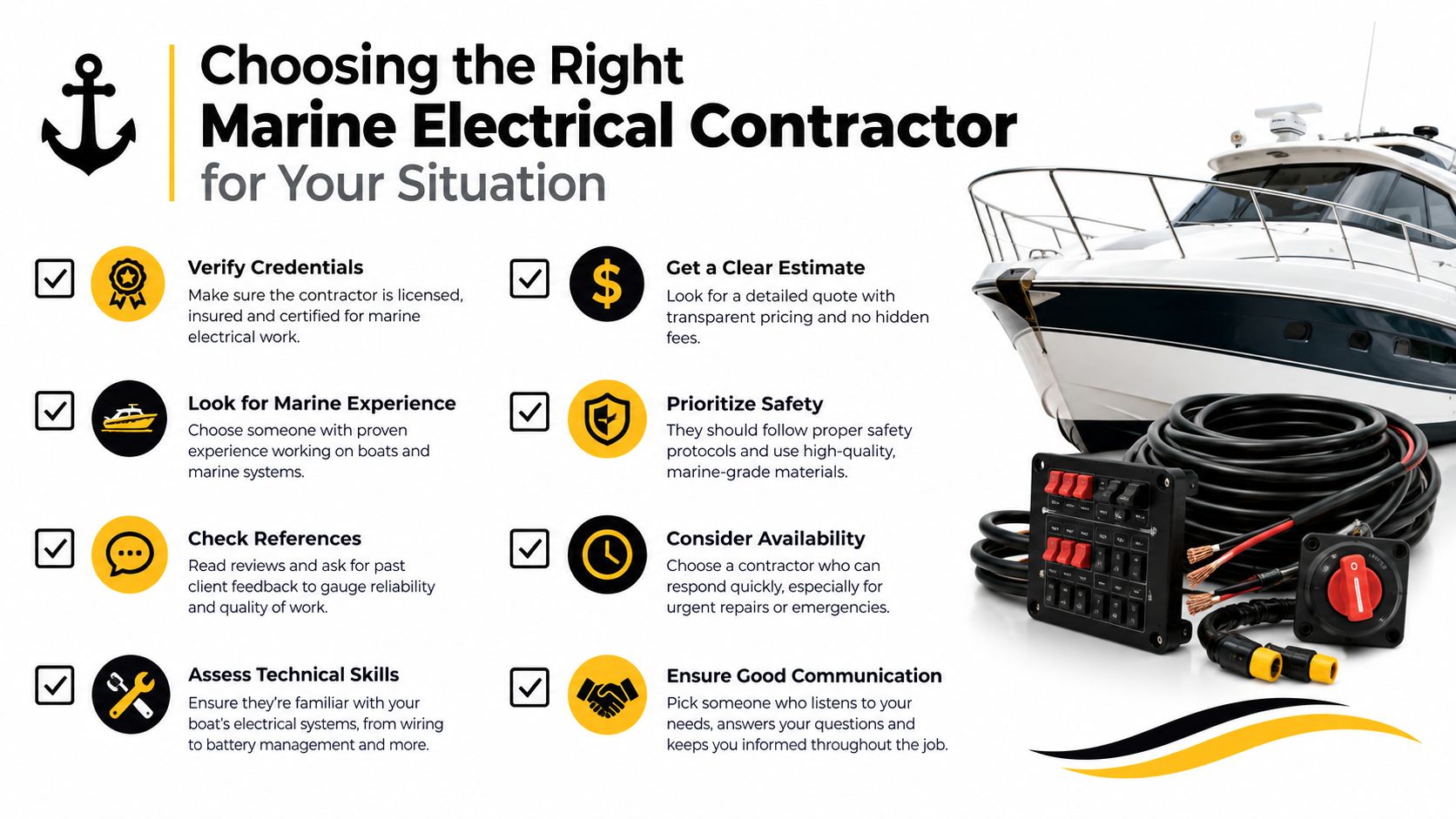
Match the contractor to the job, not the other way around. A solo marine electrician with ABYC knowledge and strong local references may be the right choice for a battery installation, shore-power cord replacement, navigation-light fault, or limited troubleshooting visit.
A larger project needs more capacity. Full panel rewiring, generator work, marina pedestal retrofits, post-storm restoration, and multi-vessel dock upgrades require a contractor who can provide a crew, coordinate shutdowns, manage material procurement, and maintain consistent documentation. Ask about relevant manufacturer training when the work involves specialized charging, propulsion, or monitoring equipment.
Use the response window as a selection filter
Active emergencies and planned improvements should not be evaluated the same way.
- For an active emergency: Confirm whether the contractor offers same-day or 24-hour dispatch, what systems they classify as urgent, and whether they can access your marina after hours.
- For a planned upgrade: Give priority to inspection quality, written scope, material specification, testing, labeling, and a realistic schedule rather than the earliest available appointment.
- For storm preparation: Book early enough to allow for parts, permits, marina coordination, and corrective work discovered during inspection.
- For a commercial dock: Confirm crew size, safety procedures, shutdown planning, insurance, reporting, and experience working around multiple connected vessels.
Ask about labor and parts warranties in writing. Clarify whether dock coverage is included in addition to vessel liability, who pays for return visits caused by defective parts, and whether the final invoice includes test documentation.
The best contractor communicates clearly. They return a detailed quote, explain findings in plain language, label every affected circuit, and tell you what remains unresolved. Price matters, but a low quote that omits corrosion repair, testing, access, or compliant materials isn't a bargain.
Lighthouse Energy Services handles electrical repairs, upgrades, installations, emergency troubleshooting, marina services, pedestal work, and dock-related feeder and service projects across Palm Beach County. If your vessel or waterfront property has a recurring fault, a planned upgrade, or an urgent outage, choose the service level that matches the risk and demand written documentation when the work is complete.
Lighthouse Energy Services provides Palm Beach County electrical repairs, installations, dock power pedestal work, feeder upgrades, and emergency troubleshooting for waterfront properties. Visit Lighthouse Energy Services to request service and discuss the marine electrical problem with a team that supports planned projects and urgent failures.