
You've got the pedestal on site, the boat owner wants power back, and the dock still isn't ready. That's the moment a lot of jobs go sideways, because the shiny new enclosure is only the visible part of the system. If the feeder is undersized, the disconnect is missing, or the bonding path is incomplete, the install can look finished and still fail when the first load comes on. Dock power pedestal installation works best when the whole dock electrical system is treated as the project, not just the box bolted to the deck.
Table of Contents
- Why a Dock Pedestal Project Is More Than the Box on the Dock
- What a Dock Power Pedestal Actually Does
- The Installation Sequence From Mounting to Energization
- NEC Article 555 and the Code Requirements Most Guides Skip
- Cost and Timeline Drivers for a Real Project
- Verifying Long-Term Reliability After the Install
- What to Expect From a Licensed Marine Electrician
Why a Dock Pedestal Project Is More Than the Box on the Dock
A private dock owner calls for a pedestal replacement after the old unit has corroded and tripped too many times. The new pedestal arrives, the deck crew is ready, and then the electrician opens the site and finds the upstream feeder doesn't match the load, the disconnect is nowhere near the shoreline, and the bonding path was never built correctly in the first place. At that point the pedestal is no longer the problem, it's the symptom.
That's the trap with dock electrical work. People see the enclosure, the receptacles, and maybe a meter, so they assume the job ends at the pedestal body. In reality, the pedestal sits at the end of a chain that starts at the service equipment and runs through the feeder, disconnecting means, grounding and bonding, and branch-circuit protection.
Practical rule: if the dock wiring can't support the pedestal, the pedestal doesn't fix anything. It just exposes the weakness faster.
On waterfront properties, that distinction matters for safety, insurance, and inspections. A pedestal that energizes a boat can still leave the dock noncompliant if the upstream system is undersized or poorly protected. The market is also moving toward more capable shoreline power, with the global power pedestal market projected to rise from USD 645.0 million in 2024 to USD 957.2 million by 2030, a stated CAGR of 6.8% (Strategic Market Research). That growth reflects smarter metered units, marine charging needs, and a steady push for safer marina infrastructure.
The commercial reality has been building for years. Earlier shore-power pedestal data already placed the category at USD 318.1 million in 2022 (Data Insights Market). In plain terms, this isn't a novelty product anymore, it's part of a larger waterfront electrical system that has to work in salt air, flood exposure, and real-world use.
What a Dock Power Pedestal Actually Does
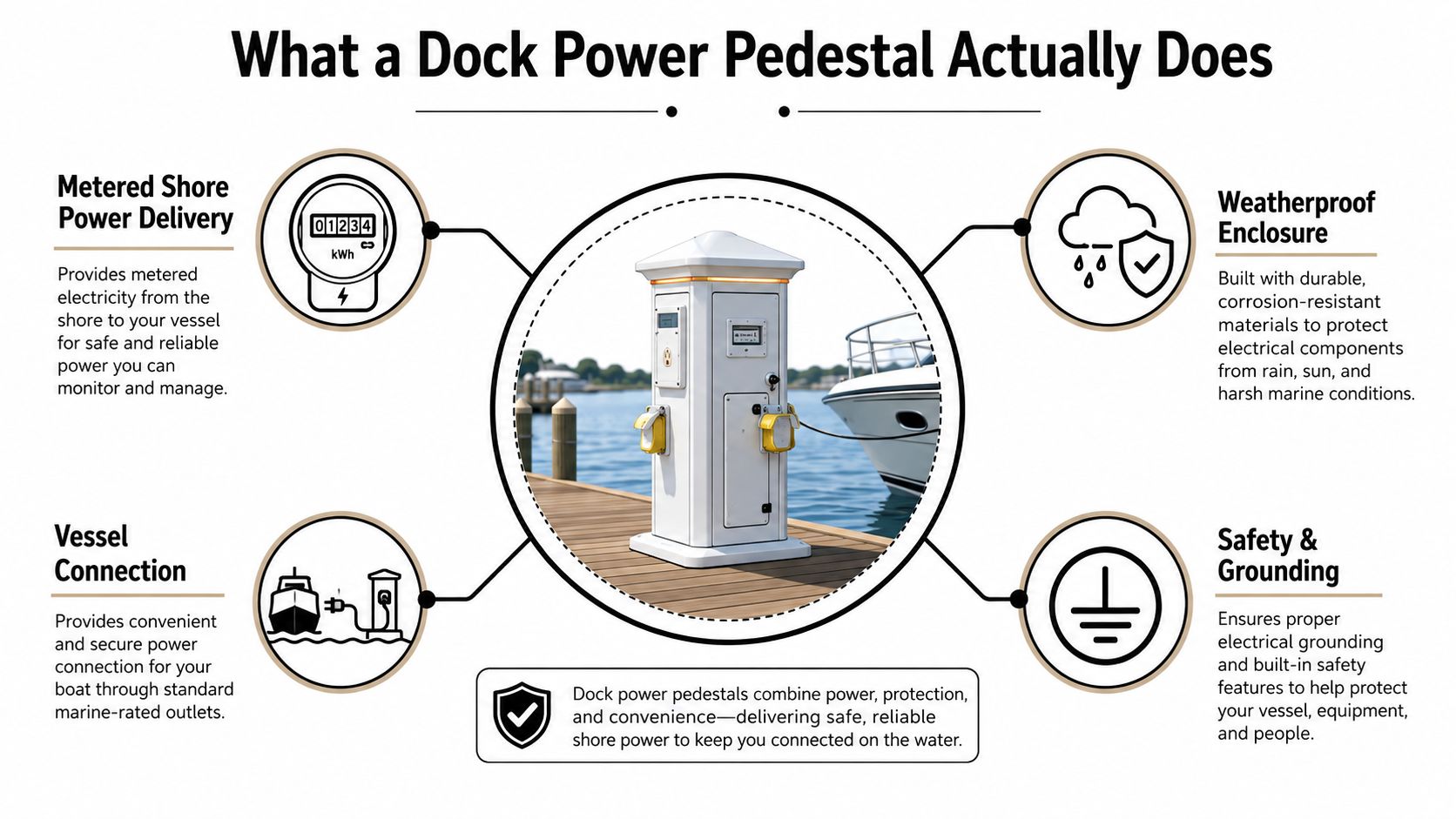
A dock power pedestal is a weatherproof shoreline power enclosure mounted on a dock, pier, or seawall. Its job is to deliver shore power to a vessel through protected receptacles, while keeping the equipment shielded from rain, spray, sun, and corrosion. On many installations it may also house metering, lighting, or other utility functions, but the core purpose is still the same, safe power at the waterline.
The electrical context changes depending on the property. A residential dock usually serves one boat and a limited load profile. A commercial marina can involve multiple slips, changing occupancy, and a stricter inspection environment. Industrial waterfront facilities bring heavier service demands and tighter operational expectations, so the pedestal becomes one element in a larger distribution system rather than a standalone accessory.
A licensed marine electrician, or a contractor experienced with marina systems, is the right trade because dock work isn't just outdoor wiring. The local authority having jurisdiction treats shoreline systems differently from a backyard receptacle because water changes the risk profile. Salt, splash, and continuous exposure create failure points that don't show up in standard residential work.
The pedestal is the visible endpoint. The service entrance, feeder, disconnect, bonding, and branch circuit determine whether it actually belongs there.
That's why it helps to think of the pedestal as the last device in a chain. Power comes from the service entrance or subpanel, passes through the feeder and disconnect, then reaches the pedestal's internal equipment and receptacles. If any part of that chain is weak, the dock can still be unsafe even when the pedestal itself looks perfect.
For a broader view of marina electrical scope and service coordination, the project often needs the same kind of planning found in marina electrical work. And if the dock is also being prepared for communication or accessory wiring, a clean two-way radio setup can be coordinated at the same time so the work doesn't get reopened later.
The Installation Sequence From Mounting to Energization
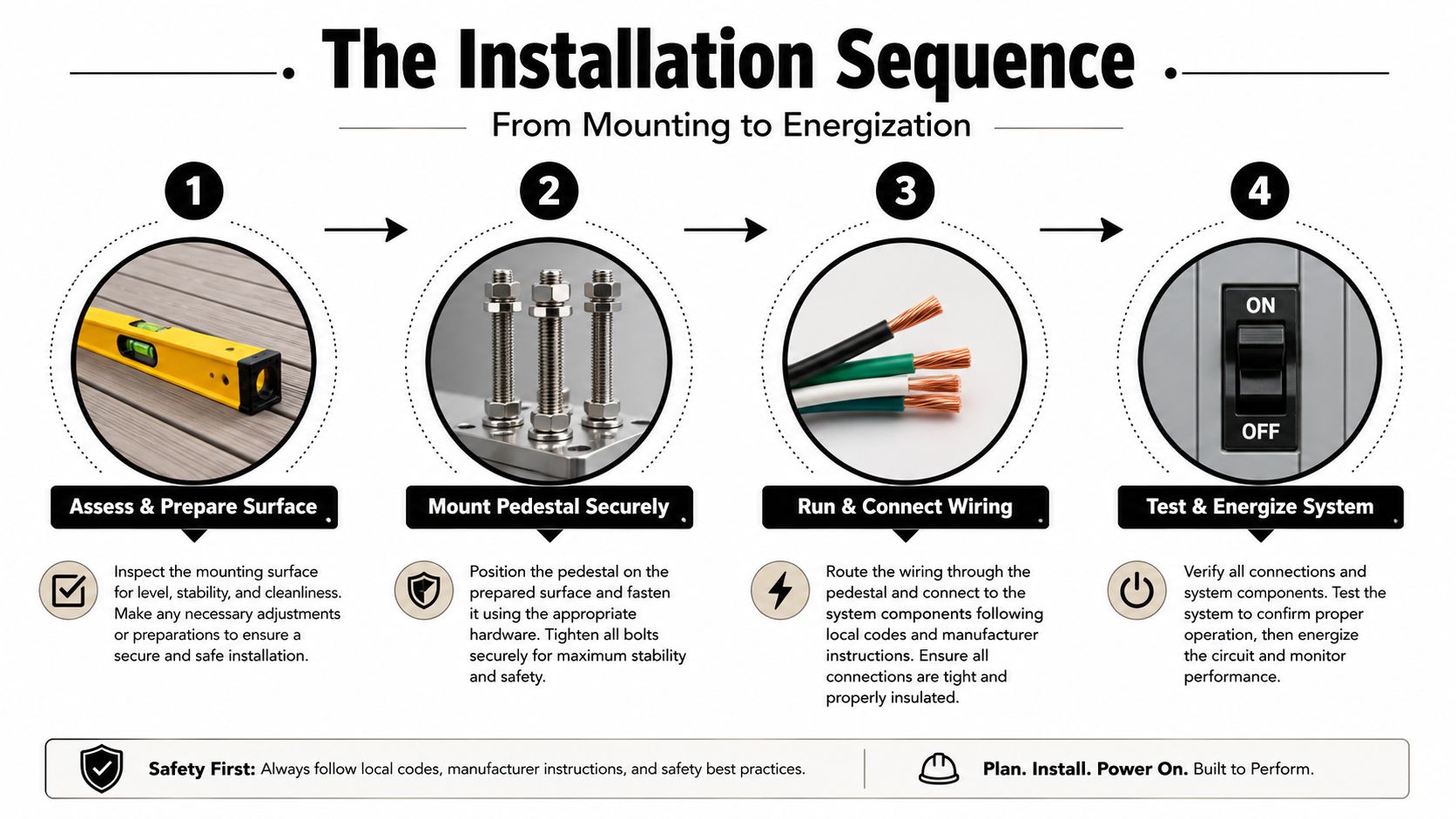
A dock pedestal install starts before the pedestal ever reaches the dock. The mounting surface has to be flat and level, because even a slight tilt throws conduit alignment off, makes the weather seal work harder, and puts constant stress on the terminations inside the enclosure. If the deck or concrete is out of plane, stainless-steel washers are used to shim the base until the unit sits true and the hardware clamps evenly.
Secure the base before you touch the conductors
Manufacturer instructions for marine pedestals call for stainless hardware, washers at the bolt head, and anchor spacing that matches the mounting pattern, so the enclosure stays locked down in a wet, corrosive environment (Eaton installation instructions). Those details sound small until a dock starts moving with tide, traffic, and seasonal use. If the clamp load is uneven or the fasteners are not corrosion resistant, the base works loose and the callback comes later.
Power stays de-energized first, every time. Conductors are routed through the base and terminated before the pedestal is fully closed up, because access gets tighter once the enclosure is locked in place and there is less room to correct a missed connection. Qualified-installation guidance from Lighthouse instructions follows the same order, mount the base, complete the terminations, then reopen the top only as needed for final checks.
If the site sits in a flood-prone area, the storm-cap option deserves a serious look before the job is closed out. It lets the bus bar and top be removed for safer storage during flooding or severe weather, which gives the owner a practical way to reduce damage instead of hoping the enclosure rides out the season. For a broader view of how dock electrical scope gets organized, see installation guidance from Lighthouse Energy Services, where the feeder path, enclosure placement, and final connections are treated as one system. The same planning discipline applies if the dock is also getting a two-way radio setup, because reopening finished work later costs time and creates another point of failure.
A clean finish means the top goes back on only after the base is anchored, the wiring is terminated, and the enclosure has been checked for fit and access. If someone tries to leave the pedestal live-open while the base is still floating, or tightens hardware before the mount is squared, that shortcut usually shows up later as heat, water intrusion, or nuisance trips.
NEC Article 555 and the Code Requirements Most Guides Skip
Most pedestal writeups stop at the enclosure. That's not enough, because the dock wiring system upstream of the pedestal is where many compliance problems start. The U.S. Army Corps guidance on dock electrical systems points to requirements that often drive permits and inspection outcomes, including direct-buried conductors protected by rigid conduit from 24 inches below grade and above the surface, underwater feeders rated for underwater use where applicable, accessible disconnects or breakers, and portable dock power cables rated for extra-hard usage under NEC Article 555 (U.S. Army Corps guidance).
What inspectors care about beyond the pedestal body
The pedestal can be installed correctly and still fail the job if the upstream system isn't built to the same standard. That's why a proposal should spell out whether the existing feeder can support the load, where the disconnect sits, and how the conductors are protected between shore and slip. A dock that lacks an accessible shutoff or proper feeder protection may force a retrofit that goes far beyond the pedestal itself.
Practical insight: ask whether the dock can support the pedestal before you sign the contract, not after the hole is drilled.
GFCI protection and bonding also matter because water changes the fault path and the response time needed to reduce shock risk. If you want a plain-language refresher on how that protection works, the internal guide on what a ground fault circuit interrupter does is a useful companion. In the field, the issue isn't just whether a breaker exists, it's whether the system can clear a fault the way the code intends.
A naming and labeling problem can also create confusion during service and inspection. Clear panel and circuit identification helps the person on site know what disconnect controls the dock, which is why the labeling discipline discussed in the Evright Industrial guide is worth reading when the project includes new disconnects or panel changes. The practical question behind every proposal is simple, can the existing infrastructure support the pedestal without a full feeder and disconnect upgrade? If the answer isn't clear in writing, the dock probably isn't ready.
Cost and Timeline Drivers for a Real Project
The pedestal unit itself is rarely the expensive part. The bigger cost drivers are usually the feeder length, whether the dock is wood, concrete, or aluminum framed, whether the conduit has to be trenched or run overhead, and whether the service gear needs to be upgraded before the pedestal can be energized. Permitting and inspection cycles can add time too, especially when the dock work is reviewed separately from the building-side electrical scope.
A private residential dock can often be handled in a shorter window when the infrastructure is already close to ready. A commercial marina retrofit tends to take longer because the work may need to be staged by slip or by section, with partial closures so the facility can keep operating. If the dock wiring is old, concealed, or undersized, the project can expand quickly from a pedestal swap into a feeder-and-protection upgrade.
Ask bidders to break the quote into parts
- Pedestal equipment: confirm the enclosure type, receptacle configuration, and any metering or accessory package.
- Feeder and conduit: separate the length, routing method, and any trenching or marine-rated protection.
- Disconnect and breaker work: identify whether new upstream equipment is included or only the pedestal replacement.
- Permits and inspections: make sure the proposal states who pulls the permit and who schedules the final inspection.
A quote that only lists “dock power install” usually hides the most important scope decisions.
For practical troubleshooting context after the system is in service, the boat power issue guide from Boat Juice is useful because it highlights the kind of breaker and circuit symptoms owners notice first. The timeline question isn't just how fast the pedestal can be mounted, it's whether the dock can be made compliant without reopening work later. If the upstream feeder or disconnect has to change, that's the part that usually stretches the schedule.
Verifying Long-Term Reliability After the Install
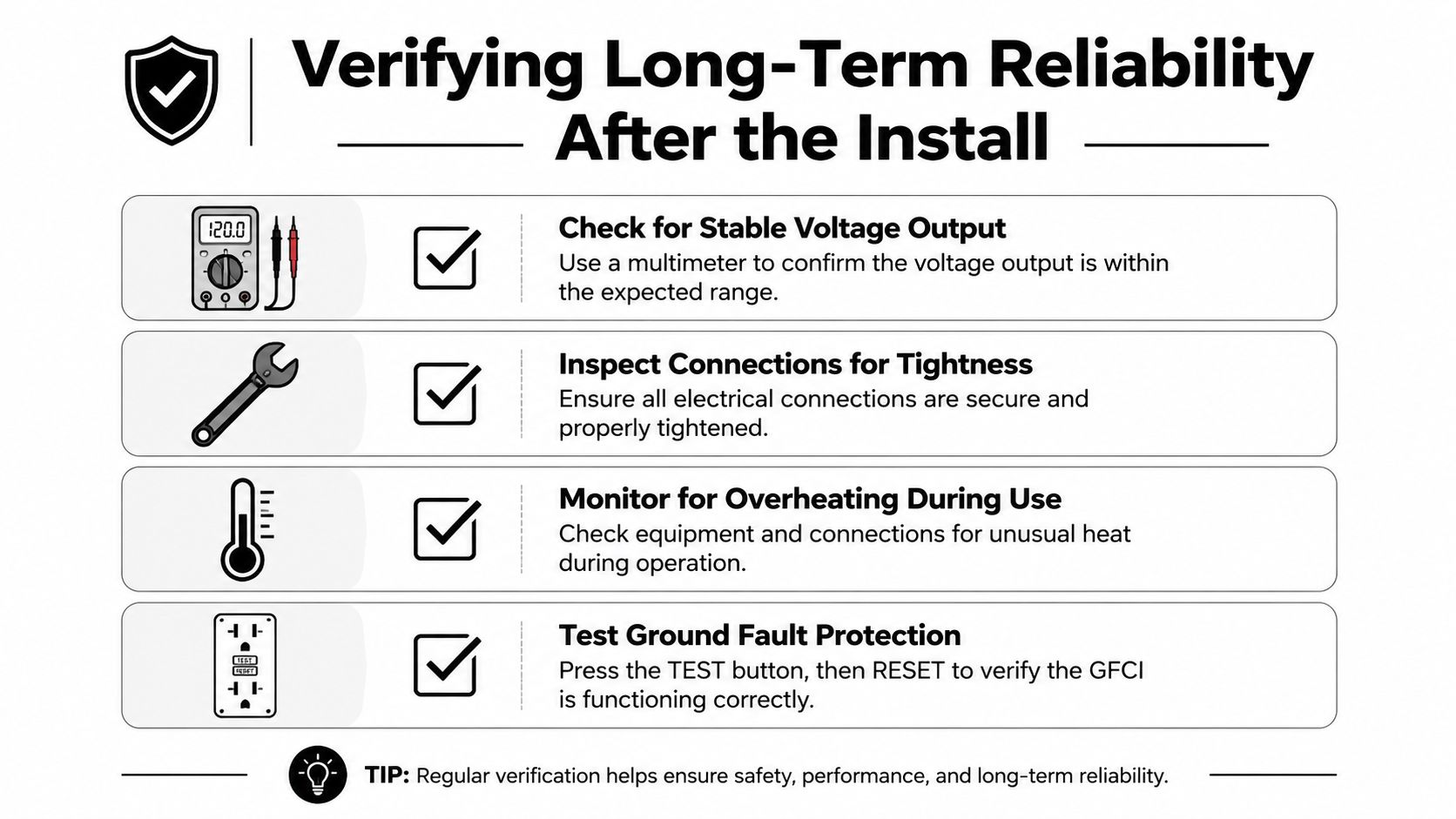
A pedestal can pass inspection on day one and still cause trouble later if the dock environment is harsh or the upstream system was only marginal to begin with. The first thing I look for after energization is whether the output stays stable under load. Voltage that sags, flickers, or behaves differently when multiple circuits are in use usually points away from the pedestal housing and back toward the feeder, termination, or supply side.
What to check after the first season of use
- Check for stable voltage output. Use a meter under real load, not just at idle, because dock problems often show up when the boat is drawing power.
- Inspect connections for tightness. Bus bars, receptacle terminations, and grounding points can loosen from vibration, heat cycling, and corrosion.
- Monitor for overheating during use. Warm junctions, discolored conductors, or a hot faceplate are warning signs, not minor quirks.
- Test ground fault protection. If the protection isn't tripping where it should, or is tripping too often, the issue needs a real diagnosis.
Corrosion is the slow killer on docks. It doesn't always fail as a clean open circuit, it often shows up as intermittent power, nuisance trips, or a breaker that behaves differently from one day to the next. That's why a troubleshooting conversation should separate the pedestal enclosure from the rest of the dock circuit, because the fault may be upstream even when the outlet face is where the symptoms appear.
If a new pedestal still trips, overheats, or delivers unstable voltage, ask for neutral-to-ground testing and breaker verification before replacing the unit again.
That wording helps a contractor narrow the problem faster and keeps the job from turning into a guess-and-replace cycle. Reliable marine electrical work is about repeatable checks, not just a clean-looking final photo. The people who call back least are the ones who verify the connections, the fault path, and the feeder behavior after the dock has been in service.
What to Expect From a Licensed Marine Electrician
A dock pedestal job starts before anyone drills a hole. A proper marine electrician arrives with a permit-ready plan, not just a bag of tools, and the first questions are usually about the feeder, the disconnect, the bond, and whether the dock can carry the load without creating a weak point somewhere upstream. You should expect a licensed and insured contractor to pull the permit in their own name, break the quote into the pedestal, feeder, conduit, disconnect, and inspection pieces, and explain what has to be verified before the new hardware goes in. If the estimator cannot speak plainly about bonding, fault protection, or shoreline disconnects, the project may be outside their comfort zone.
Good signs versus red flags
- Good sign, written scope: the proposal lists the pedestal, feeder, conduit, disconnect, and inspection as separate items.
- Good sign, real communication: the office is answered by qualified staff, not a vague call chain, and the arrival window is clear.
- Good sign, after-hours readiness: dock faults do not wait for business hours, so emergency availability matters.
- Red flag, cash-only quote: that usually means the project is not being handled like permitted electrical work.
- Red flag, no inspection plan: if nobody discusses the AHJ, the job may be incomplete even if it powers up.
- Red flag, no bonding or GFCI discussion: those are not optional details on dock work.
- Good sign, hiring process: a contractor who answers your questions directly and can explain how they work is easier to trust, and a practical checklist like how to find a good electrician helps you separate a clean proposal from a risky one.
A local marine electrician also understands how salt air, storm season, and coastal corrosion change the maintenance burden. In Palm Beach County and similar waterfront markets, that local experience matters because the environment punishes shortcuts fast. If a contractor cannot explain how the installation will hold up after the first wet season, they are selling a one-day fix, not a dock system.
Lighthouse Energy Services handles dock and waterfront electrical work with the same process discipline it brings to other residential and commercial projects, including permits, transparent pricing, and emergency response. If you are planning a dock power pedestal installation or trying to figure out whether your existing dock can support one, ask for a site review before the work starts.
For a dock that powers boats safely, the pedestal has to match the feeder, the disconnect, the bonding, and the inspection plan. Lighthouse Energy Services can help sort out the upstream work, install the pedestal correctly, and verify that the system is ready for real marine use. Schedule a dock electrical assessment and get the project scoped the right way.