
A summer storm rolls in from the Atlantic, and a Jupiter homeowner hears the familiar snap of a breaker. The pool equipment shuts down, the Wi-Fi disappears, and the family moves away from the windows while lightning flashes across the neighborhood. The first search is usually simple: “lightning protection contractors near me.”
The better question is harder: Can this contractor design, install, document, and verify a complete system for this property? A rod on the chimney may look reassuring, but it doesn't automatically protect the roof, wiring, appliances, solar equipment, or people inside. Palm Beach County homes face coastal salt air, dense storm activity, roof-mounted equipment, trees, pool cages, and complex electrical systems. Each condition changes the design.
Lightning protection has developed from Benjamin Franklin's lightning rod in the 1700s to formalized installation standards, including the first U.S. lightning-rod improvement patent in 1839 and the first edition of NFPA 78 in 1904. This documented history of lightning protection standards matters because today's work is not just about attaching copper to a roof. It's about engineered paths, bonding, grounding, surge coordination, inspection, and records.
Table of Contents
- What Lightning Protection Does on a Palm Beach County Home
- NFPA 780, UL 96A, and LPI Credentials Explained Simply
- How to Vet Shortlisted Contractors the Right Way
- Typical Costs and Timelines for Local Lightning Protection Work
- Permits, Inspections, and HOA Considerations in Palm Beach County
- Maintenance, Recertification, and Warranty After the Install
- Putting It All Together and Choosing Your Contractor
What Lightning Protection Does on a Palm Beach County Home
A Palm Beach County home with a broad roof, solar equipment, a pool enclosure, or nearby trees needs more than a rod on the chimney. A properly designed system gives lightning a deliberate route from the highest exposed points of the structure to the earth. Air terminals go on roof ridges, corners, chimneys, cupolas, and other vulnerable points. Conductors then carry electrical energy down the exterior, while a grounding network disperses it into the soil.
The system does not make a house immune to lightning. It reduces the chance that a strike will take an uncontrolled route through roofing materials, framing, wiring, plumbing, or electronic equipment. Bonding equalizes electrical potential between conductive parts of the structure, which limits dangerous side flashes.
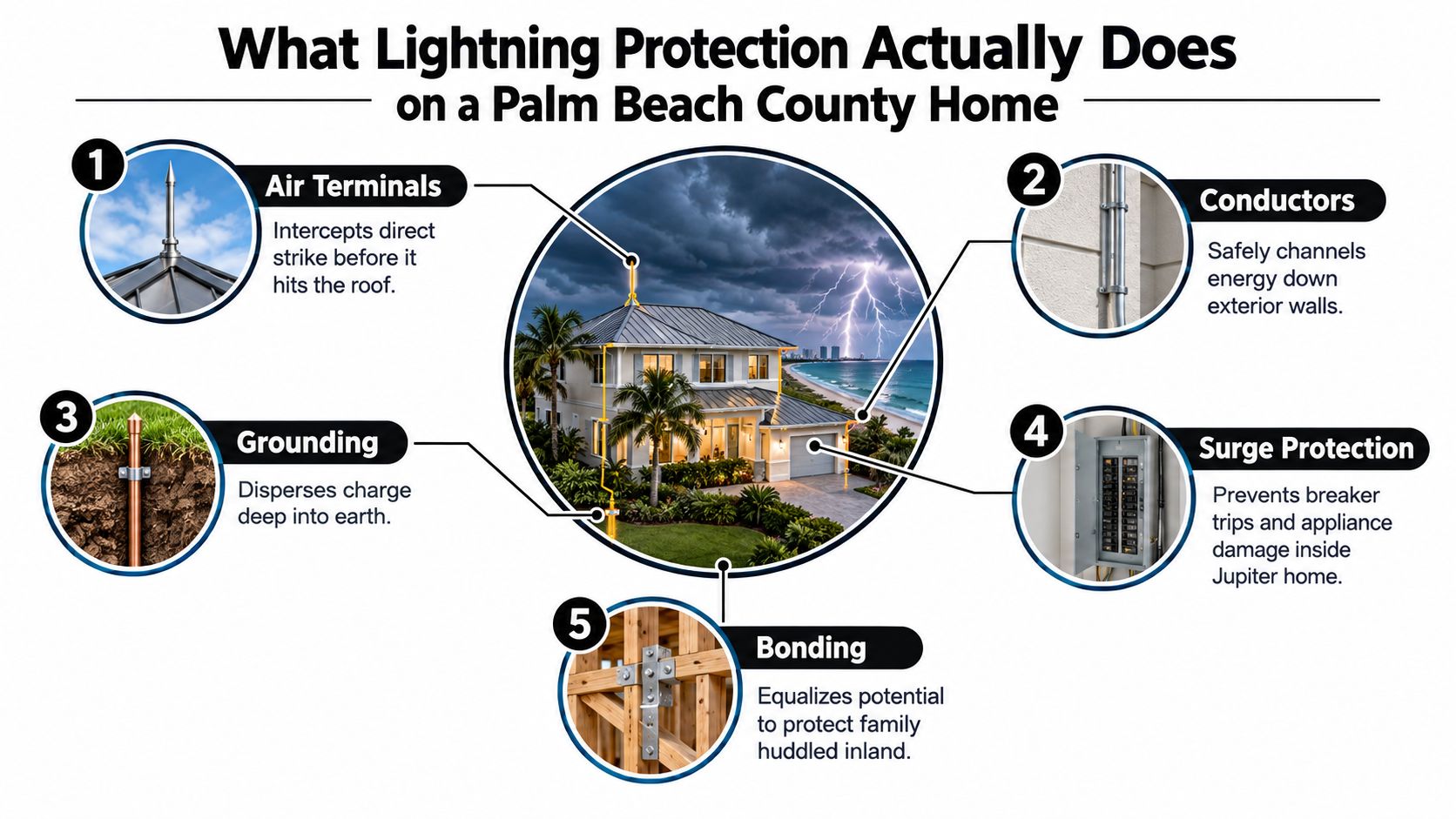
The five parts that must work together
- Air terminals: Rooftop points intercept a direct strike before it reaches exposed roof materials.
- Down conductors: Heavy copper or aluminum conductors provide a controlled path along the structure.
- Grounding electrodes: A planned grounding network disperses energy into the earth.
- Bonding connections: Metallic systems, structural elements, and other conductive components may need bonding so current does not jump unpredictably.
- Surge protective devices: Devices at service equipment and sensitive loads help manage surges entering through electrical, communications, or other connected pathways.
A contractor should inspect the entire structure and its surroundings, not count roof peaks. One chimney rod cannot cover multiple levels, solar arrays, a metal pool enclosure, or tall trees near the home. Exterior protection also needs coordination with interior surge control. This guide to how a whole-home surge protector works explains that electrical side of the system.
Lightning occurs about 20 to 25 million times annually in the United States, more than 300 people are struck each year, and the 30-year average is about 50 lightning deaths annually, according to National Weather Service lightning statistics. The Florida lightning protection history document identifies roofing as 15% of work-related lightning fatalities and construction as 11%. A qualified contractor should discuss worker safety and building risk before discussing decorative copper.
Trees belong in that risk review. A tree may be the tallest object near a home, while its roots, branches, and distance from the roof affect strike exposure and fire risk. This visual resource on lightning tree damage in Atlanta shows why nearby vegetation deserves attention during the site visit.
Choose the contractor who maps the risks, follows recognized installation requirements, coordinates surge protection, and arranges third-party inspection. That is the difference between a complete system and someone who hangs rods.
NFPA 780, UL 96A, and LPI Credentials Explained Simply
Homeowners don't need to become lightning engineers, but they do need to recognize the language on a proposal. Three terms appear repeatedly: NFPA 780, UL 96A, and LPI credentials. They aren't interchangeable, and a contractor who blurs them together isn't helping you compare bids.
NFPA 780 is the installation standard for lightning protection systems. It addresses system design and installation practices, including air terminals, conductors, grounding, bonding, and related protection considerations. Ask the contractor to identify the edition used for the design. The current standards conversation includes the 2026 edition, and the NFPA 780 standard development information is the appropriate place to confirm edition status and development activity.
UL 96A concerns lightning protection installation requirements and listed components. In practical terms, it gives you a way to ask whether the proposed materials and installation methods follow a recognized tested approach. Don't accept “UL compliant” as a vague sales phrase. Ask which components are listed and how the completed installation will be documented.
What LPI credentials add
LPI, the Lightning Protection Institute, is different from a construction standard. LPI certification applies to qualified people, including installers, designers, and inspectors, who have demonstrated technical knowledge through the institute's credentialing process. LPI membership alone doesn't prove that the person designing or installing your system holds a technical certification.
A proposal should identify the actual credentialed individual involved in your project. A company logo or membership badge isn't enough. Ask who will perform the design review, who will supervise installation, and who will handle inspection paperwork.
| Credential | What It Covers | What It Proves |
|---|---|---|
| NFPA 780 | Installation and design requirements for lightning protection systems | The stated design follows a recognized national standard |
| UL 96A | Listed materials and tested installation methods | The specified components and methods align with the applicable UL requirements |
| LPI certification | Individual technical qualifications for installation, design, or inspection | The named professional has demonstrated specialized lightning protection knowledge |
Palm Beach County inspectors may not require these credentials by law, but that isn't a reason to ignore them. It is the opposite. When the law doesn't force the contractor to show specialized credentials, an informed homeowner should request them voluntarily.
Practical rule: Treat NFPA 780 and UL 96A as the technical baseline, then use LPI credentials to judge whether the people applying that baseline know what they're doing.
How to Vet Shortlisted Contractors the Right Way
Start with the license, not the price. A contractor performing electrical work should provide an active Florida Certified Electrical Contractor license, or the appropriate registered Specialty Structure license when the scope falls within limited lightning protection work. Verify the license through the Florida Department of Business and Professional Regulation's online records, and make sure the business name on the proposal matches the license information.
Insurance comes next. Request current certificates for general liability and workers' compensation, then call the carrier to confirm that the policies are active. A certificate can be outdated, incomplete, or issued for a different entity. If the contractor gets defensive about verification, stop the conversation.
Read the proposal like a scope document
The written proposal should do more than list “lightning rods and grounding.” Look for:
- Standard edition: The proposal should name the NFPA 780 edition used for design.
- Component detail: It should identify UL 96A listed materials or explain the applicable listing.
- Roof plan: Air-terminal locations, conductor routes, chimney details, and rooftop equipment should appear in a drawing or clear scope.
- Grounding plan: “Install ground rods” is not a complete grounding design. The proposal should describe the grounding arrangement and bonding approach.
- Surge coordination: The contractor should state whether service-panel and point-of-use surge devices are included, excluded, or coordinated with existing equipment.
- Inspection rights: The contract should allow review by a qualified third party before final payment.
Ask for at least three Palm Beach County references from the past 24 months, then visit one installation if the owner permits it. Look for neat conductor routing, secure attachments, clear labeling, and a homeowner who received drawings and inspection records. For broader due diligence on licensing, insurance, and contractor documentation, this verify contractor credentials guide offers a useful checklist, even though your lightning project still requires specialized questions.
Don't confuse a general electrical referral with lightning expertise. This guide on how to find a good electrician can help with broader electrical hiring, but lightning protection adds standards, geometry, grounding, bonding, and inspection requirements that deserve separate scrutiny.
Finally, check the business through the Palm Beach County Clerk of Courts for liens and review its complaint history with the Better Business Bureau. You aren't trying to find a company with no criticism at all. You're looking for unresolved patterns, abandoned projects, refusal to document work, or a history of disputes over scope and payment.
Typical Costs and Timelines for Local Lightning Protection Work
A Palm Beach County homeowner can receive two very different quotes for the same address. A simple, low-profile roof with accessible conductor routes is a smaller project than an estate with multiple roof elevations, chimneys, cupolas, detached structures, solar equipment, and difficult grounding conditions.
Use price ranges only for early budgeting. A published lightning protection cost guide places typical residential installations at $2,500 to $6,000 for many single-family homes under 4,000 square feet. Larger or architecturally complex homes may reach $8,000 to $15,000, while commercial or estate properties can exceed $25,000. The contractor still needs to design the system and inspect the property before giving you a dependable price.
What changes the number
Roof height and pitch affect access, labor, and conductor routing. Roof geometry and exposed features determine the number of strike termination points. Chimneys, cupolas, decorative parapets, HVAC equipment, solar arrays, and metal pool cages may require added bonding and more detailed routing.
Grounding can change the quote substantially. Soil conditions affect the grounding arrangement, while existing electrical pathways influence how cleanly conductors can be installed. Surge protection adds another cost variable. A properly coordinated design may include the service panel, sensitive equipment, and communications systems rather than stopping at rooftop rods.
| Scope Item | Budget Quote | Mid-Range Quote | Premium Quote |
|---|---|---|---|
| Roof coverage | Basic terminal placement on main roof areas | Detailed coverage for multiple roof elevations | Full architectural treatment for complex roofs and detached structures |
| Down conductors | Limited visible routing | Complete routed paths with documented bonding | Carefully coordinated routing with extensive concealment and finish work |
| Grounding | Basic electrode allowance | Designed grounding network with testing | More involved grounding and bonding for difficult site conditions |
| Surge protection | May include only service equipment | Service equipment plus selected sensitive loads | Coordinated protection throughout the electrical and communications systems |
| Documentation | Basic invoice and warranty | Drawings, scope, and inspection records | Detailed design package, third-party inspection, and maintenance planning |
A low bid often removes value by limiting surge coordination, reducing grounding scope, or excluding third-party inspection. A high bid may include concealed routing or aesthetic work that your property does not require. Compare the design, NFPA 780 and UL 96A compliance, inspection arrangements, surge coordination, and written deliverables before comparing totals.
Contractors in the area commonly report one to two working days for a straightforward home. Larger properties may take up to a week, especially when roof access, grounding, or conductor routing is complicated. Permit scheduling and final inspection can add a week or two, depending on the jurisdiction and workload. Require the proposal to state installation time, inspection assumptions, and any work that depends on permit approval.
Permits, Inspections, and HOA Considerations in Palm Beach County
The permitting authority depends on where the property sits. Homes in unincorporated areas generally go through the Palm Beach County Building Division, while properties inside Boca Raton, West Palm Beach, Delray Beach, and other municipalities follow the city's permitting process. Your contractor should identify the jurisdiction before preparing the proposal, not after the roof work is scheduled.
Lightning protection work generally requires an electrical permit pulled through the local authority. Permit pricing is set by job value, and plan review timelines typically run five to ten business days according to the project brief's verified local guidance. Don't let a contractor tell you that a permit is unnecessary without explaining the basis in writing.
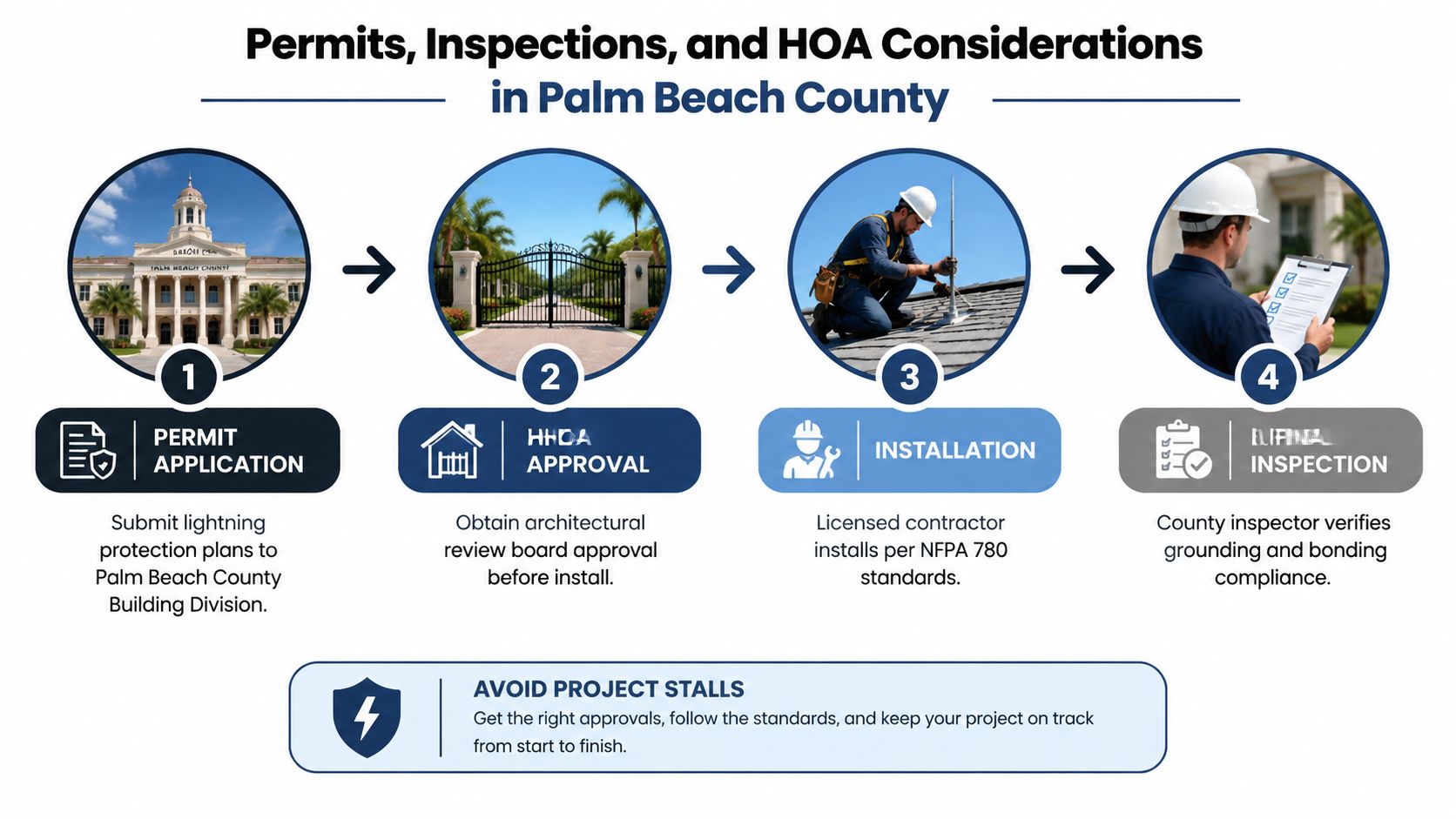
Documents that prevent delays
Before work begins, the file should contain a scope drawing showing:
- Terminal placement: The drawing should identify roof terminals and exposed structural features.
- Conductor routing: It should show the proposed down-conductor paths and attachment approach.
- Grounding details: The grounding network, electrodes, and bonding points should be identified.
- Surge locations: Service-panel and other surge protective devices should appear in the scope.
- Contractor information: The license number, insurance documentation, and responsible company should be clear.
HOA review deserves attention before installation. Many communities require architectural committee approval for roof penetrations, visible copper, attachment hardware, or changes that can be seen from common areas. Give the HOA a materials list, roof attachment detail, conductor-routing drawing, and finish options early. A contractor who says “the HOA won't care” is guessing with your project timeline.
What inspections should cover
A rough inspection may occur before certain conductors or grounding components are concealed. The final inspection follows installation of terminals, conductors, bonds, and surge devices. The inspector checks the permitted scope and applicable installation requirements, including grounding and bonding details.
Municipal inspection is useful, but it isn't the same as specialized third-party review. For a high-value home, request an independent inspection by a qualified LPI inspector or Florida-licensed engineer. It can identify workmanship issues that a general inspection may not examine closely. If the property also needs resilience planning for outages, review the available residential backup power systems separately. Backup power and lightning protection solve different problems, and one doesn't replace the other.
Maintenance, Recertification, and Warranty After the Install
A lightning protection system needs scheduled attention after installation. Palm Beach County's salt air can accelerate corrosion, hurricane winds can loosen attachments, roofers can disconnect conductors, and landscaping work can disturb grounding components. A system that met requirements on installation day may become incomplete after later roof or electrical work.
Schedule maintenance annually or every two years, according to the property's exposure, condition, and insurer requirements. The technician should inspect accessible strike terminals, conductor connections, clamps, bonds, and roof attachments. They should also test grounding performance with suitable earth-testing equipment. Looking at a ground rod is not a test.
What a serious maintenance report includes
- Visual condition: Corrosion, mechanical damage, displaced terminals, and loose conductors.
- Connection checks: Condition and tightness of mechanical bonds and termination points.
- Ground testing: Recorded results for the grounding system.
- Surge device review: Indicator status and visible damage at service and point-of-use devices.
- System changes: Roof work, solar additions, HVAC replacements, trees, or other changes that alter exposure.
- Corrective action: A clear repair list, replacement recommendations, and follow-up dates.
Coastal properties with substantial value may need documentation showing that protection remains compliant. Keep the dated inspection report, updated drawing, and repair records with the home's roof, electrical, and insurance documents. Those records also help a third-party inspector verify that later work did not compromise the design.
Warranty language deserves the same scrutiny as the installation scope. Ask manufacturers for written terms, because copper and aluminum component warranties often run 10 years or more, while surge-device warranties vary and may exclude connected equipment. Review exclusions involving improper installation, electrical modifications, corrosion, and damage to appliances or electronics.
A warranty without a service plan leaves important questions unanswered. Ask who performs follow-up inspections, what testing is included, how defects are documented, and who pays labor when a component fails. Homeowners comparing protection paperwork with broader roof coverage may find this overview of a roof home warranty for California homeowners useful when reviewing coverage terms and maintenance obligations, even though Florida conditions and lightning systems differ.
Budget approximately $300 to $600 every two years for a proper recertification visit, and confirm the local contractor's written scope and fee before scheduling. Treat recertification like a roof inspection, not an optional service call. Require a dated report, test results, identified deficiencies, and confirmation that repairs were completed. That paperwork is especially valuable after reroofing, solar installation, electrical upgrades, or storm damage.
Putting It All Together and Choosing Your Contractor
The right contractor wins on documentation and competence, not on the lowest number at the bottom of a quote. Compare two or three finalists against the same four signals:
- Written NFPA 780 and UL 96A compliance: The proposal identifies the governing standard, edition, components, grounding approach, bonding, and surge scope.
- Verified LPI expertise: The named designer, installer, or inspector holds relevant technical credentials, rather than the company displaying an institute membership.
- Third-party inspection commitment: The contractor welcomes an LPI inspector or Florida-licensed engineer before final payment.
- Surge coordination: The exterior lightning system is coordinated with the home's service equipment and sensitive loads.
A contractor who only talks about rods is selling hardware. A qualified specialist asks about roof geometry, trees, pool cages, solar arrays, metal systems, electrical service, communications pathways, prior strikes, roof age, and future renovations. That conversation tells you more than a polished brochure.
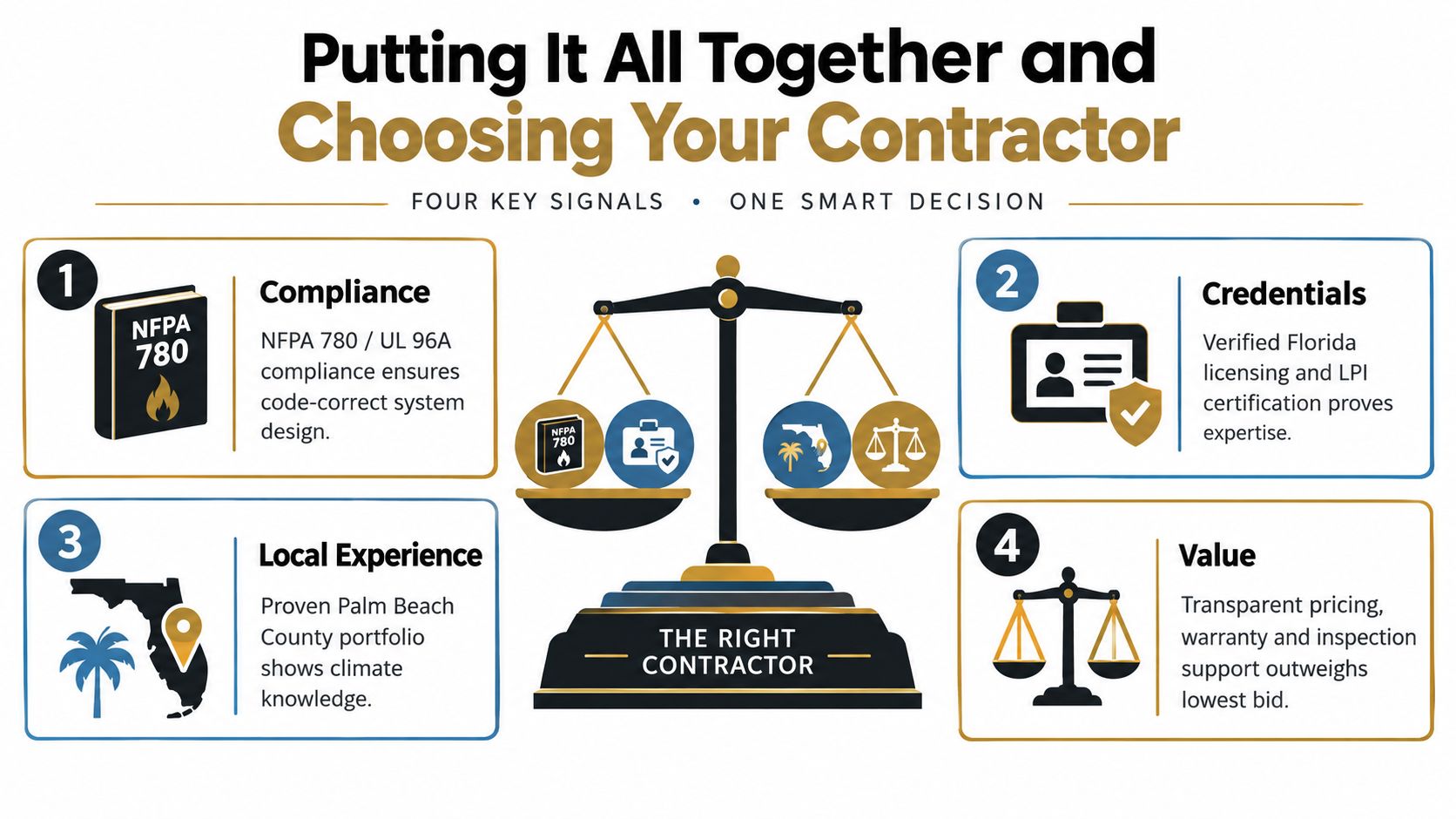
Use the same scorecard for every finalist
Give each proposal the same questions:
| Decision Question | Strong Answer |
|---|---|
| Does the design address the whole property? | It includes roof features, detached structures, metallic systems, trees, solar, and exposed equipment where relevant |
| Is the scope measurable? | Drawings and line items identify terminals, conductors, grounding, bonding, surge devices, and finish details |
| Can someone independent inspect it? | The contract expressly permits third-party inspection before final payment |
| Are future responsibilities clear? | Warranty terms, maintenance timing, recertification, and repair procedures are written down |
| Is the price comparable? | Every finalist quotes the same core deliverables, rather than leaving major items as allowances or exclusions |
For Palm Beach County property managers and HOAs, require records that can transfer to the next manager. For homeowners, keep the as-built drawing, permit, inspection result, warranty, surge-device information, and maintenance reports in one file.
Your next-week action list is straightforward. Pull the permit requirements for your jurisdiction, schedule site walks with two LPI-credentialed firms, request written proposals that reference NFPA 780 and UL 96A, and verify insurance certificates directly with the carriers. Ask each contractor to name the inspection authority before the first downlead is installed.
Lighthouse Energy Services handles residential and commercial electrical work, emergency troubleshooting, and building-related electrical planning in Palm Beach County. If you want a practical review of your property's electrical protection needs, visit Lighthouse Energy Services and request a site conversation focused on documented scope, surge coordination, and qualified installation.