
If you're in Palm Beach County and your AC seems to run all day, the house still feels sticky, and the power bill keeps climbing, you're not imagining it. A lot of Florida homeowners assume the unit is just old or that summer is the problem. In the field, the bigger issue is usually that the system is fighting three battles at once: heat, humidity, and air loss.
That means learning how to improve air conditioner efficiency isn't just about replacing equipment. It's about getting airflow right, controlling moisture, sealing the house so cooled air stays inside, and knowing when a repair or upgrade will be worthwhile. Some fixes are simple and free. Others need a technician. The key is doing the right thing in the right order.
Table of Contents
- Immediate DIY Fixes for Instant AC Efficiency Gains
- Master Your Thermostat and Beat the Florida Humidity
- Seal Your Home to Stop Cooling the Neighborhood
- Next-Level Efficiency with Smart Upgrades
- When to Call Lighthouse Energy Services for Expert Help
- Your Action Plan for a Cooler More Efficient Home
Immediate DIY Fixes for Instant AC Efficiency Gains
A lot of efficiency problems start with neglected basics. Not the kind of basics people repeat without context, but the things that choke airflow, trap heat, and make the system work harder than it should. If you want a same-day improvement in comfort, start with the parts you can reach safely.
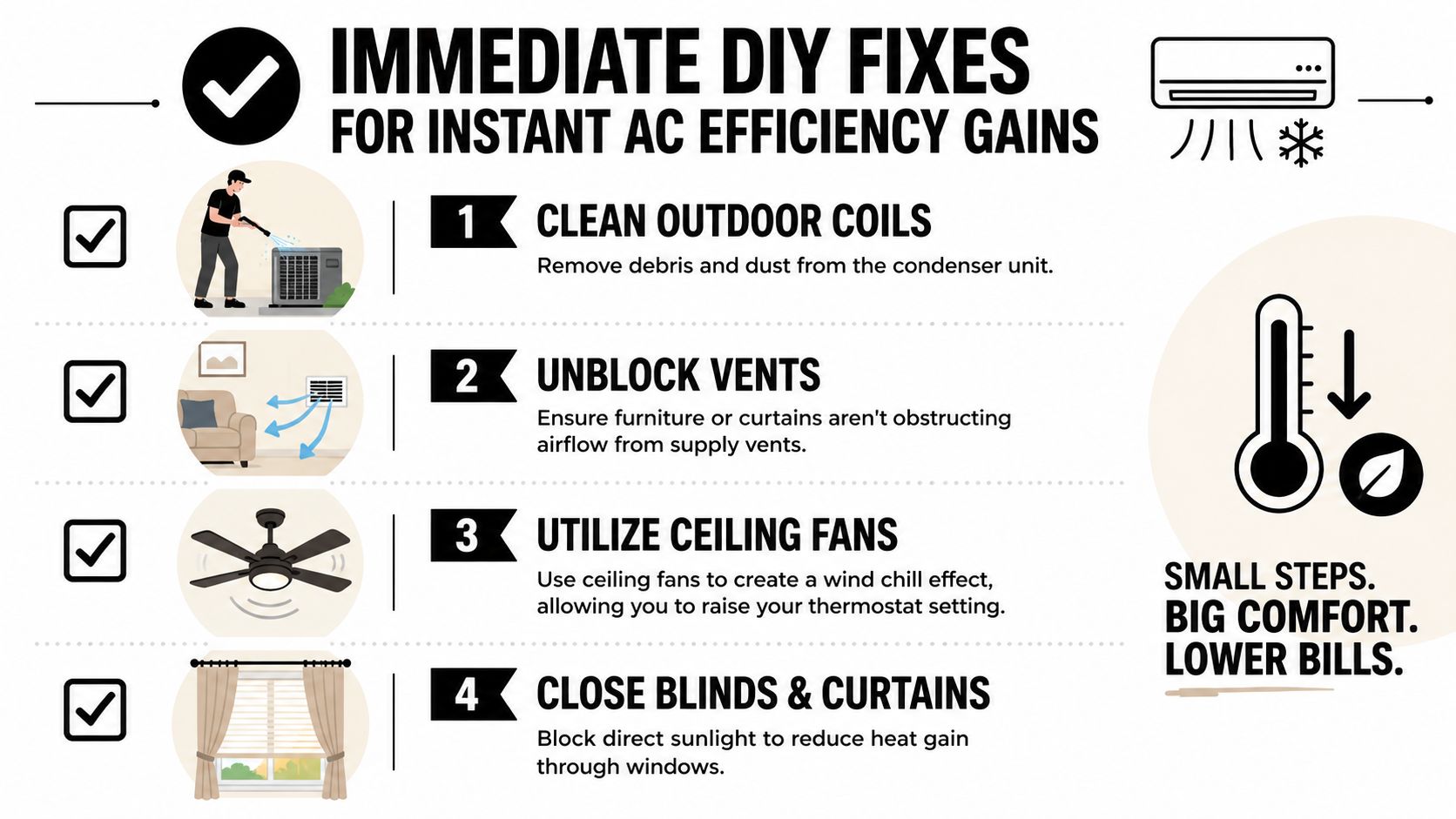
Start outside at the condenser
The outdoor unit has to dump heat. If the coil is packed with dirt, grass clippings, palm debris, or cottonwood-like fluff, it can't shed that heat efficiently.
Do this in order:
- Shut off power first. Use the disconnect at the unit and don't work around moving fan blades.
- Clear the area around the cabinet. Remove leaves, weeds, overgrowth, and anything stored against the unit.
- Take a careful look at the fins. If they're visibly matted with dirt, they need cleaning.
- Rinse with a gentle stream of water. Spray from the inside out if you can access it safely, or from the outside with low pressure. Don't blast the fins with a pressure washer. That bends them and creates a bigger airflow problem.
- Check that the top discharge isn't blocked. Don't stack anything above the unit.
Practical rule: If the outside unit can't get rid of heat, the inside of the house won't cool the way it should, no matter what the thermostat says.
Fix airflow problems indoors
Indoor airflow issues are common, especially in homes where furniture placement slowly changes over time. A blocked supply vent doesn't just make one room uncomfortable. It can throw off how the whole system behaves.
Walk room to room and look for these:
- Covered registers: Move rugs, baskets, dog beds, and furniture off supply and return grilles.
- Curtains pulled over vents: Free up the airflow path.
- Dust-packed grilles: Vacuum the face of the vent and around the opening.
- Closed interior doors: If rooms stay closed for long stretches, pressure imbalances can build up and reduce effective circulation.
Then check the filter. If it's loaded with dust, replace it with the correct size and type. The mistake I see all the time is installing an overly restrictive filter in a system that already struggles for airflow. If the return side is marginal, a super-dense filter can make the unit labor.
A simple comfort booster that helps many Florida homes is using ceiling fans properly. They don't lower air temperature, but they help your body feel cooler so you can tolerate a slightly higher setting. If you need one added in a bedroom, living area, or covered patio, this guide on professional ceiling fan installation is a useful next step.
Use the house better, not just the AC
You can cut the load on the system without touching the equipment.
Try this checklist for the hottest part of the day:
- Close blinds and curtains on sun-facing windows. Direct sun adds heat fast.
- Hold off on heat-producing chores. Ovens, dryers, and long hot showers all add indoor load.
- Run bath fans and kitchen exhaust only as needed. They remove moisture and heat, but they also pull conditioned air out of the home.
- Keep supply vents open in the rooms you're actively cooling. People often shut vents thinking they'll save money. In many homes, that creates static pressure problems instead.
The point of these DIY steps isn't perfection. It's to remove the obvious friction so the equipment can do its job. If you handle the easy airflow and heat-gain issues first, you'll get a much clearer read on whether the remaining problem is humidity, leakage, or equipment performance.
Master Your Thermostat and Beat the Florida Humidity
Florida cooling isn't just about temperature. In Palm Beach County, the house can read reasonably cool and still feel uncomfortable because the air is wet. That's why generic thermostat advice often falls flat here.
Why 78°F isn't the whole story
A lot of homeowners hear one recommendation and stop there: set the thermostat to 78°F and leave it. That can work in some homes. In others, it leads to a clammy house and nonstop runtime.
In humid climates like Palm Beach County, up to 50% of an AC's workload can come from removing moisture, not just lowering the temperature, and systems that prioritize dehumidification can reduce total AC energy use by 15% to 25% without changing the thermostat setting, as noted in this discussion of humidity-focused AC efficiency in humid climates.
What that means in plain terms is this: if your indoor humidity stays high, the system keeps working to pull moisture out of the air. People then drop the thermostat lower because they want to feel comfortable, but the issue isn't always dry-bulb temperature. It's moisture.
Common signs humidity is driving the problem:
- The house feels sticky even when the temperature looks acceptable
- The AC runs for long stretches in the afternoon
- You notice that bedding, towels, or closets feel damp
- You keep lowering the thermostat but comfort doesn't improve much
A dry 76°F usually feels better than a damp 74°F.
Try a precooling schedule that fits Florida
Static settings aren't always the smartest approach. A better strategy in many homes is precooling. The idea is simple. Cool the house earlier, before the worst outdoor heat builds, then let the temperature drift upward later.
According to guidance summarized by Edison on maximizing AC efficiency, cooling a home to 72°F to 74°F before peak heat from 10 AM to 4 PM, then letting it drift to 78°F later, can cut total energy use by 10% to 18% compared to holding a constant 78°F all day.
That sounds backward until you look at how Florida homes behave. Walls, floors, furniture, and framing all store heat. If you lower the indoor temperature before the peak, the house has more thermal buffer when outdoor conditions get rough. The system can then avoid some of the hardest afternoon catching-up work.
A practical schedule might look like this:
| Time of day | What to do |
|---|---|
| Early morning | Let the system cool the house down while outdoor conditions are milder |
| Late morning to afternoon | Allow a gradual increase instead of forcing a hard pull-down during peak heat |
| Evening | Adjust for comfort after solar load drops |
This works best in homes with decent insulation, manageable leakage, and a thermostat that allows scheduled setbacks.
Set the system for comfort, not constant runtime
If you're trying to learn how to improve air conditioner efficiency, thermostat strategy needs to match the house. Don't chase one magic number.
Use these decision points instead:
- If the house feels cold but damp: Focus on humidity control first. Lowering the setpoint may only increase runtime.
- If the house heats up fast after noon: Precooling may help more than a flat daytime setting.
- If upstairs rooms lag badly: The issue may be airflow or duct delivery, not thermostat programming.
- If comfort changes room to room: Check vents, returns, solar gain, and door position before blaming the equipment.
Some homeowners also benefit from upgrading controls. If you're considering smarter scheduling and sensor-based automation, Simply Tech Today's installation guide gives a good homeowner-level overview of what proper smart thermostat setup involves.
The biggest mistake is treating the thermostat like a gas pedal. Turning it way down doesn't make the house cool faster. It just keeps the system running longer. In Florida, comfort comes from balancing temperature, runtime, and moisture removal so the unit isn't fighting the wrong problem all day.
Seal Your Home to Stop Cooling the Neighborhood
I've seen plenty of houses with decent equipment and bad results because the cooled air never had a fair chance to stay indoors. Before spending big on upgrades, make sure the air you're paying to cool isn't escaping through ducts, attic gaps, and frame leaks.
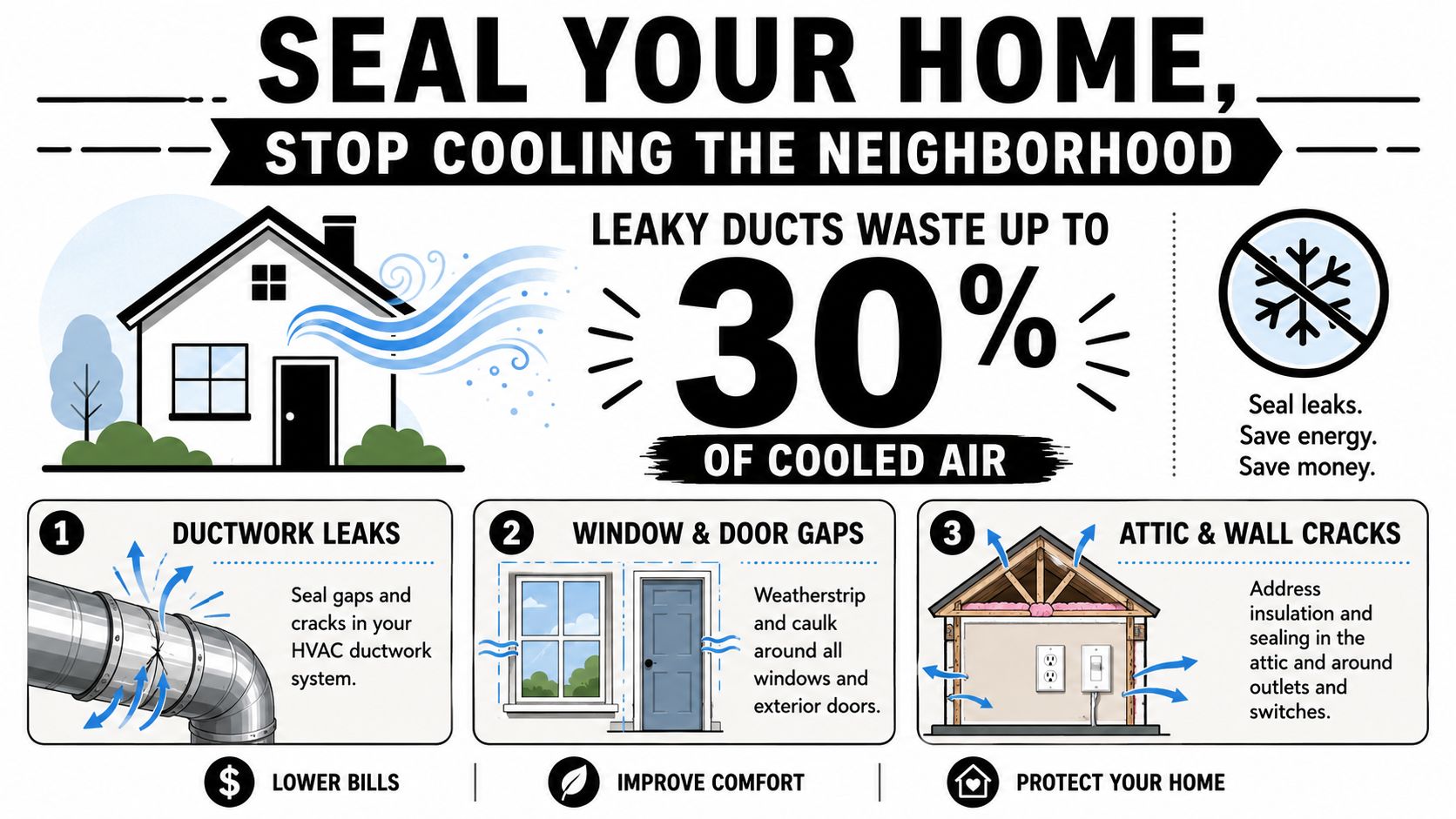
Duct leakage is the first place to look
This is the heavy hitter. The U.S. Department of Energy identifies duct sealing as the most important single step for AC efficiency, and Carrier's summary of AC efficiency improvements notes that unsealed joints can lose up to 30% of conditioned air, while professional sealing can help save a household up to $300 annually.
That number makes sense in real houses. If supply ducts leak into an attic, garage, or crawl area, the equipment still consumes power, but part of the cooling ends up outside the living space. Return-side leaks are just as bad in a different way. They can pull hot, dirty, humid air into the system.
Look for leakage at:
- Plenum connections
- Branch takeoffs
- Boot connections at ceilings or floors
- Flex duct joints
- Air handler cabinet seams
What doesn't work well is the old habit of slapping standard cloth-backed duct tape on everything. In hot attics, it often dries out and fails. Better sealing uses mastics, metal-backed materials, and proper mechanical fastening.
Find the leaks around the envelope
Ducts are only part of the story. The house itself can leak badly enough that the AC never catches up.
Check these areas on a humid afternoon:
- Exterior door edges: Feel for hot air movement at the perimeter and threshold.
- Window frames: Look for failed caulk, loose trim, or obvious light gaps.
- Attic penetrations: Recessed lights, wiring penetrations, and plumbing chases often leak.
- Wall plates and outlet locations on exterior walls: These are common sneaky leak points.
- Pull-down attic stairs and access hatches: These are frequently undersealed.
If you're comparing methods and costs for more thorough duct treatment, a regional pricing breakdown like Utah Aeroseal sealing prices can help you understand how professional duct sealing is commonly scoped and priced, even if your final numbers in Florida differ.
Seal the path first. Then ask the equipment to perform.
One more house-level piece matters in Florida: attic conditions. If the attic runs brutally hot, the ductwork above the ceiling pays the price. Homeowners researching ventilation improvements often also look at attic fan installation cost factors to understand where attic heat control fits into a broader efficiency plan.
Know when sealing needs a pro
A homeowner can handle basic caulking, weatherstripping, and obvious gap sealing. But there are limits.
Call for professional help when:
| Problem | Why DIY often falls short |
|---|---|
| Duct leaks near the air handler | Access is tight and sealing has to hold under vibration and heat |
| Leaks hidden in soffits or chases | You need testing, not guessing |
| Rooms with chronic weak airflow | The issue may be design, balancing, or crushed duct runs |
| Repeated dust and humidity problems | That often points to return-side leakage or deeper envelope issues |
If you only replace equipment and skip leakage, you can end up with a new system doing old work under bad conditions. Sealing isn't glamorous, but it's one of the clearest answers to how to improve air conditioner efficiency in a Florida house.
Next-Level Efficiency with Smart Upgrades
Once the easy fixes and sealing work are handled, the next gains usually come from better control of the equipment you already have or from upgrading the parts that drive the most energy use. Homeowners can then move from basic maintenance to measured improvement.

What better equipment control actually changes
Older systems tend to run in a blunt, all-or-nothing pattern. They start hard, run at a fixed rate, shut off, then repeat. That approach cools, but it isn't always the best way to manage Florida humidity or electrical consumption.
A more refined setup uses staging or variable operation to better match the actual load in the house. That matters because the load changes through the day. Morning, afternoon sun, cooking, guests, and moisture all shift the demand.
According to this technical overview of efficient air-conditioning system upgrades, upgrading to a variable-speed motor can reduce electricity consumption by up to 33% compared to traditional compressors, and it can also cut some maintenance-related downtime and costs by 33%.
That kind of motor upgrade helps in two practical ways:
- Longer, steadier operation at lower intensity: Better for moisture removal and temperature balance
- Less stop-start stress: Easier on components than constant hard cycling
Where the Smartcool ECO3 fits
Not every homeowner is ready for a full HVAC replacement. Sometimes the smarter move is improving how the existing air-conditioning system uses power.
The Smartcool ECO3 is designed to optimize compressor operation so the system runs more efficiently under real conditions. In practical terms, it's a targeted upgrade for homeowners who want lower operating costs without jumping straight to a full equipment swap. For the right system, that kind of add-on makes sense when the equipment is still serviceable, the electrical side is in good shape, and the house has already addressed airflow and leakage problems.
This is also where people often waste money. They buy accessories before solving the underlying restrictions. If the condenser is dirty, the return is starved, or the ducts leak, no control upgrade will deliver its full value.
Smart upgrades work best after the basic mechanical problems are removed.
Pair controls with electrical readiness
AC efficiency isn't just an HVAC conversation. Electrical condition matters more than most homeowners realize. Weak connections, aging disconnects, undersized or worn components, and messy add-on wiring can all undermine reliability.
When homes add smarter controls or related equipment, it's worth reviewing the broader electrical picture. A clean path forward often includes panel capacity review, breaker evaluation, disconnect condition, and safe wiring for any new control hardware. If you're planning broader work around the system, this overview of home electrical upgrades is a practical starting point.
The right upgrade path usually looks like this:
- Correct airflow and leakage issues
- Tune thermostat strategy to the house
- Evaluate whether smart controls or compressor optimization make sense
- Consider motor or system upgrades if the existing equipment is limiting performance
That's the difference between buying hardware and building efficiency. One is a product decision. The other is a house-system decision.
When to Call Lighthouse Energy Services for Expert Help
Some AC problems are clearly beyond homeowner maintenance. Others start small, then push your bill higher for months before anyone takes them seriously. The trick is knowing when the issue is no longer a filter, vent, or thermostat problem.
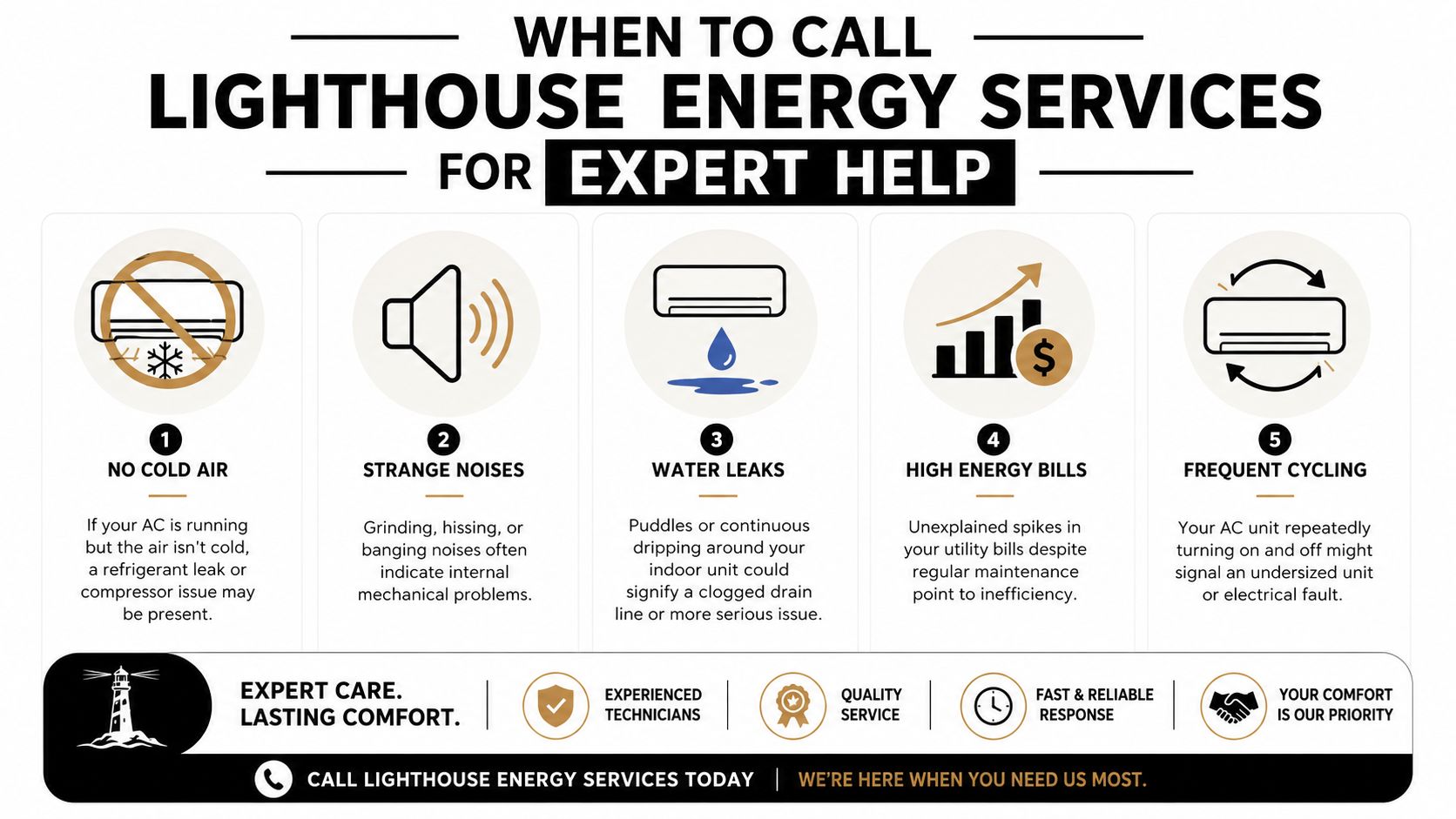
Warning signs that shouldn't wait
Call for expert help if you notice any of these:
- Warm air from the registers: If the system is running but not cooling, the cause could be electrical, mechanical, or refrigerant-related.
- Short cycling: Repeated on-off operation wears components and usually points to a deeper fault.
- Grinding, banging, or hissing sounds: Those noises aren't normal. They signal parts that are loose, damaged, or operating under stress.
- Water where it shouldn't be: Indoor leaks can come from drainage problems, icing events, or other system faults.
- Sudden bill spikes without a lifestyle change: If your usage habits didn't change but the cost did, the system may be losing efficiency fast.
These aren't just comfort issues. They often turn into bigger repairs if ignored through a Florida summer.
Repair or replace is usually a math problem
There comes a point when repair stops being the efficient option. If the system is older, struggles with humidity, needs repeated service, or can't keep up even after basic house fixes, replacement deserves a hard look.
Improvements in equipment efficiency over time are significant. As discussed by Our World in Data on air conditioning efficiency and energy demand, moving from an old SEER 10 unit to a SEER 13 model represents a 30% efficiency increase, and that added cost can be recouped through lower utility bills in as little as three and a half years. The same source notes that newer high-efficiency models can save 20% to 40% on cooling costs.
That doesn't mean everyone should replace right now. It means homeowners should compare the true cost of keeping an inefficient unit alive versus investing in a system that cools better and costs less to run.
A practical way to view this:
| Situation | Smarter move |
|---|---|
| One isolated repair on an otherwise solid system | Repair may make sense |
| Recurring problems plus poor comfort | Start evaluating replacement |
| High humidity, weak airflow, and rising bills together | Look at the full system and house, not just one part |
| Major repair on aging equipment | Run the numbers before approving the work |
What a proper diagnostic should cover
A real diagnostic shouldn't stop at "the unit is old" or "you need more refrigerant." It should connect symptoms to causes.
A solid service call should evaluate things like:
- Airflow across the indoor side
- Condenser condition and heat rejection
- Control operation and cycling behavior
- Electrical connections and component condition
- Visible duct and leakage issues
- Whether the equipment matches the actual needs of the home
That's especially important when the complaint is broad, like "the house never feels comfortable." In Palm Beach County, that can mean poor dehumidification, duct leakage, attic heat, weak blower performance, or multiple smaller issues stacked together.
Good diagnostics save money because they stop homeowners from replacing the wrong thing.
Safety is another reason to bring in a licensed pro. Refrigerant handling, energized electrical components, failed capacitors, and compressor circuit issues aren't weekend experiments. Neither is emergency troubleshooting during an outage or partial system failure.
When you reach the point where the system needs expert evaluation, speed matters. A struggling AC in Florida doesn't get better by waiting, and small inefficiencies have a way of becoming expensive failures when the unit is already working near its limit.
Your Action Plan for a Cooler More Efficient Home
Start with the free and obvious work. Clean the outdoor unit carefully, open up blocked vents, replace a dirty filter, cut solar gain, and use fans to improve comfort. Those steps don't solve every problem, but they remove easy causes of wasted runtime.
Next, get smarter with control. In a Florida house, comfort depends on humidity as much as temperature. If the home feels sticky, don't assume the answer is dropping the thermostat lower. Use a schedule that fits your house, and consider whether precooling gives you a better result than holding one fixed setting all day.
After that, seal the house. If cooled air leaks out through ducts, doors, attic gaps, and wall penetrations, the system never had a fair shot. Then look at upgrades. Smarter controls, compressor optimization, and better motor performance make more sense after the basic losses are under control.
Finally, know when to stop troubleshooting and call for expert help. Warm air, short cycling, strange noises, water leaks, and unexplained bill spikes usually mean it's time for a proper diagnosis. If you're deciding between repair, upgrade, or installing a Smartcool ECO3, the right answer comes from looking at the whole system, not one symptom.
If you're ready to lower cooling costs and get a straight answer on what your home needs, Lighthouse Energy Services serves Palm Beach County with 24/7 expert support, transparent pricing, and practical solutions that range from electrical upgrades to AC efficiency improvements, including Smartcool ECO3 installation. Whether you're dealing with an urgent issue or planning a smarter long-term upgrade, their team can help you get the job done right.