
Why Understanding Attic Fan Installation Cost Matters for Your Home
Attic fan installation cost typically ranges from $369 to $914, with a national average of $625. Here’s a quick breakdown:
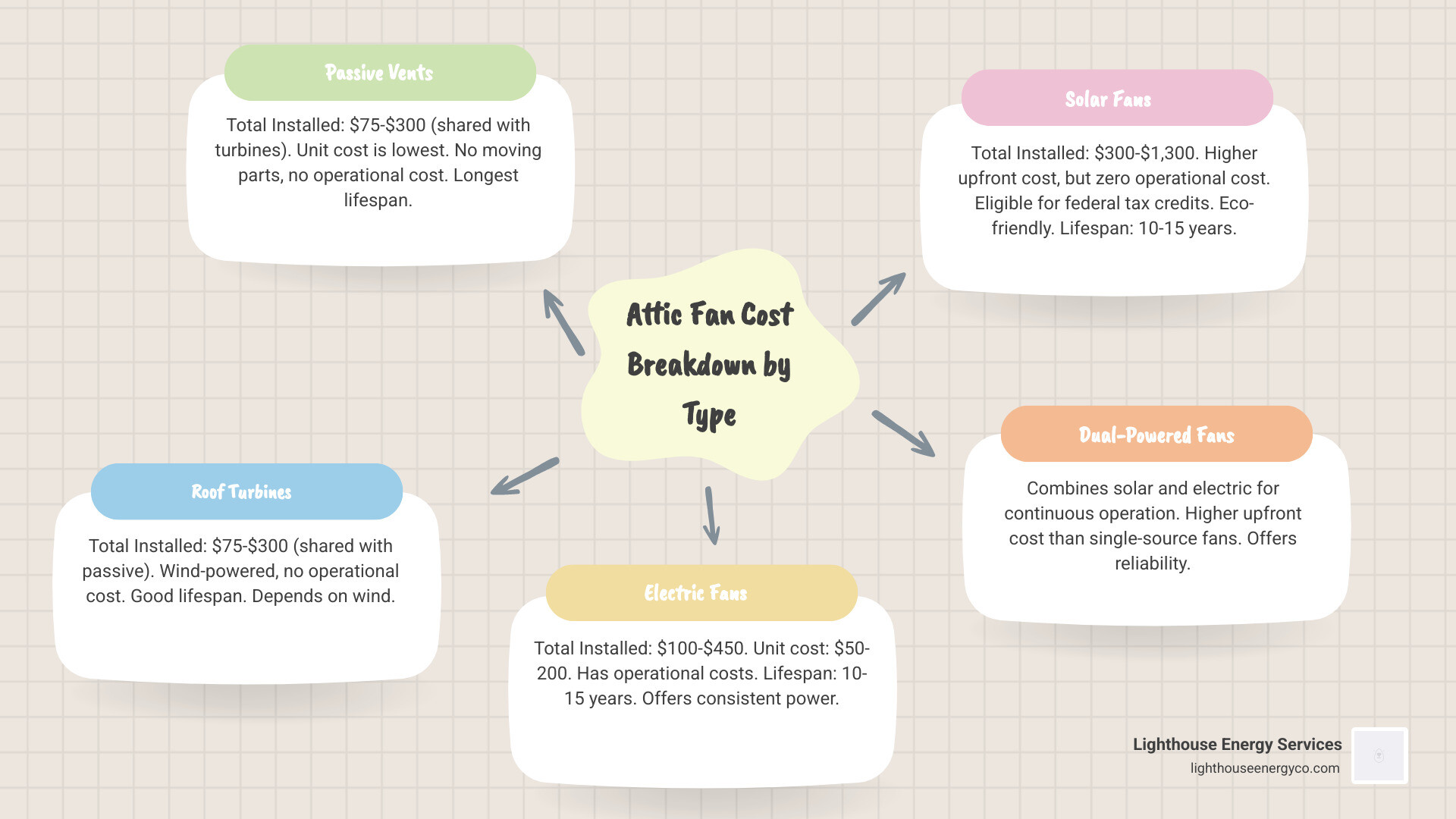
- Passive/Turbine Fans: $75 – $300 installed
- Electric Attic Fans: $100 – $450 installed
- Solar Attic Fans: $300 – $1,300 installed
- Labor Costs: $45 – $100 per hour
- Installation Time: 2 – 5 hours on average
Without proper ventilation, your attic can reach 150°F or more in the summer. This heat radiates into your home, forcing your AC to work harder and increasing energy bills by 20% to 30%. An attic fan can lower attic temperatures by over 20 degrees, protecting your roof structure, extending shingle life, and preventing moisture damage that causes mold.
Before you invest, it’s crucial to understand what drives the cost. The fan type, attic size, installation complexity, and your location all affect the final price. Costs can range from $100 for a simple passive vent to over $1,500 for a high-end solar system. When installed correctly, an attic fan pays for itself through energy savings and prevented damage.
I’m Bruce Kemp, an electrical contractor with years of experience in estimating and installing home ventilation systems. I’ve helped countless homeowners understand attic fan installation cost to make informed decisions that provide the best value without compromising safety or quality.
Attic Fan Types: A Guide to Your Options and Their Costs
Choosing the right attic fan is the first step in understanding your total attic fan installation cost. Each type has unique advantages, disadvantages, and price points. Let’s explore the most common options to find the best fit for your home and budget.
Electric-Powered Attic Fans
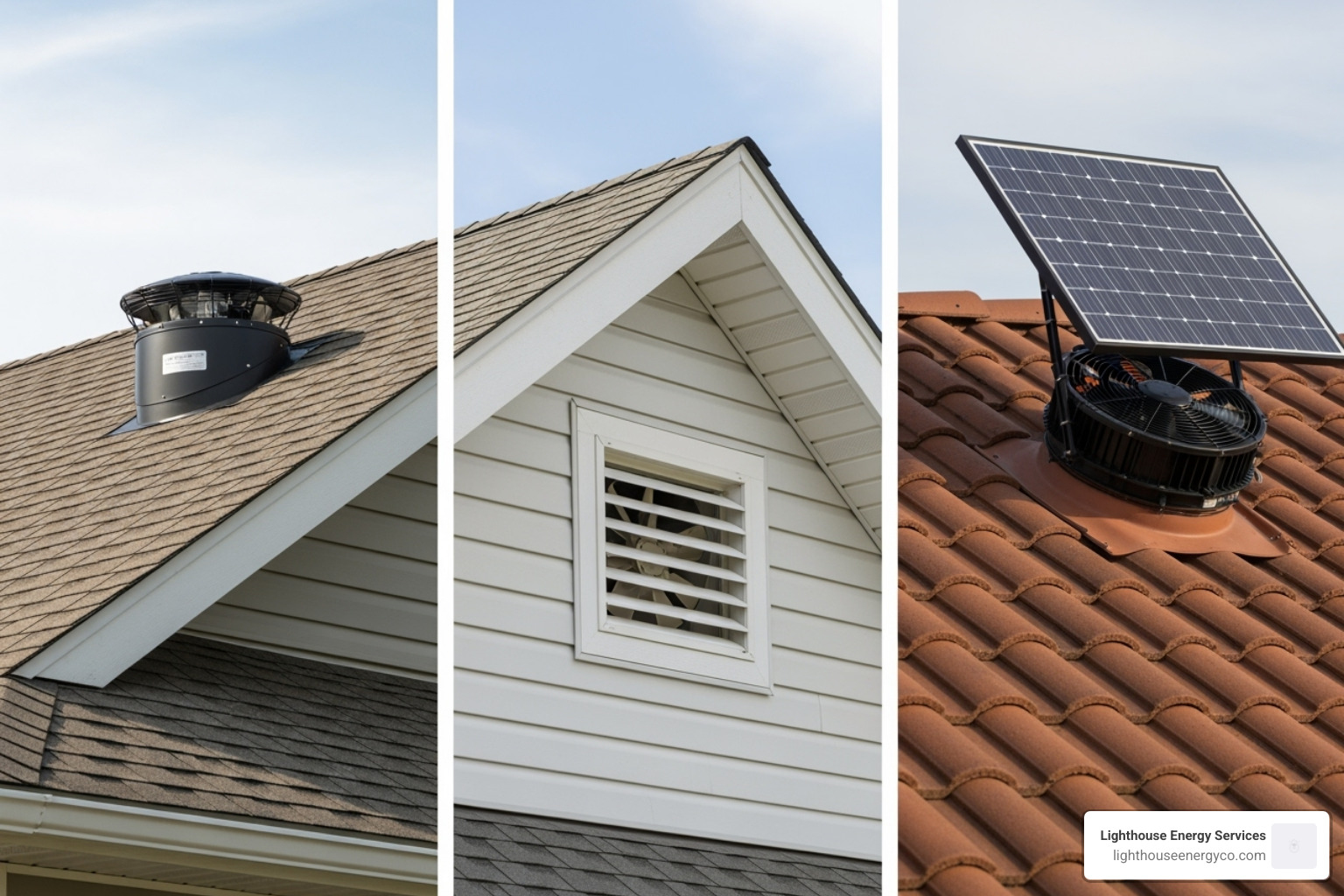
Electric attic fans are a popular choice for reliable ventilation. Installed on your roof or in a gable wall, they connect to your home’s electrical system. The unit typically costs between $100 and $450, with a total attic fan installation cost of around $100 to $1,000. Most installations fall in the $100 to $450 range.
These fans add a small amount to your monthly electricity bill, typically between $0.40 and $7.30, depending on usage and local rates. With proper care, they last 10 to 15 years. The main advantage is thermostat control, often paired with a humidistat, which automatically activates the fan at set temperature or humidity levels.
However, electric fans require a properly sealed attic. If not, the fan can pull conditioned air from your living space, forcing your AC to work harder and increasing energy bills—the opposite of the intended effect.
Solar-Powered Attic Fans
For an eco-friendly option with no operating costs, consider a solar-powered attic fan. These units harness the sun’s energy, meaning they work hardest on the hottest, sunniest days. The upfront cost is higher, with units costing $300 to $1,000. The total attic fan installation cost typically lands between $300 and $1,300.
While more expensive initially, solar fans have zero operational cost and may qualify for federal tax credits covering up to 30% of the purchase and installation cost, significantly offsetting the price. Like electric models, they have a lifespan of 10 to 15 years and reduce your carbon footprint.
If you’re curious about whether a solar solution makes sense for your home, our team can walk you through the options. Learn more about our services here.
Passive Vents & Turbines
Passive vents and roof turbines are the simplest solution, using natural air convection to move hot air out of your attic. This is the lowest cost option. Passive vents cost $20 to $100 for the unit, with installation bringing the total to $75 to $200. Roof turbines, which use wind to pull air out, typically cost $100 to $150 fully installed.
With minimal or no moving parts and no operational cost, these are virtually maintenance-free and can last an incredible 40 to 50 years. Wind-powered turbines are more active but depend on wind conditions and can sometimes allow water seepage in heavy rain. Since they lack thermostat control, their performance is not on-demand. These options are best for budget-conscious homeowners seeking basic ventilation, but they may not provide the same cooling power as powered fans on still, hot days.
[TABLE] Comparing Attic Fan Types
To help you see the differences at a glance, here’s how these fan types stack up against each other:
| Fan Type | Average Unit Cost | Average Installed Cost | Pros | Cons | Lifespan |
|---|---|---|---|---|---|
| Passive Vents | $20 – $100 | $75 – $200 | Lowest upfront cost, no operating cost, longest lifespan, no electricity needed | Relies on natural airflow/convection, less effective in still air, no control (thermostat/humidistat) | 40-50 years |
| Roof Turbines | $20 – $100 | $100 – $150 | Affordable, no operating cost, uses wind power | Performance depends on wind, can be noisy, potential for leaks in heavy rain, no control | 40-50 years |
| Electric-Powered | $100 – $450 | $100 – $1,000 | Consistent performance, thermostat/humidistat control, on-demand ventilation | Uses electricity (small operating cost), shorter lifespan than passive, requires electrical wiring, can increase AC costs if attic is not sealed | 10-15 years |
| Solar-Powered | $300 – $1,000 | $300 – $1,300 | No operating cost, eco-friendly, qualifies for tax credits, independent of home’s electricity | Higher upfront cost, performance depends on sunlight, shorter lifespan than passive | 10-15 years |
| Dual-Powered | $300 – $1,000 | $400 – $1,000 | Combines solar and electric, runs on solar first, switches to electric when needed, reliable performance | Higher upfront cost, some operating cost (when using electric), shorter lifespan than passive | 10-15 years |
A Complete Breakdown of Your Attic Fan Installation Cost
When budgeting for an attic fan, the unit price is just the start. The total attic fan installation cost includes labor, materials, and factors unique to your home. Let’s break down what you’re paying for.
Typical Labor Costs for Installation
Installation often requires a team of skilled tradespeople. Most installations take 2 to 4 hours, but complex jobs can take 8 hours or more.
- Roofers ($45-$75/hr) are needed for roof-mounted fans to cut openings, install the unit, and create a watertight seal.
- Electricians ($50-$100/hr) handle all wiring for electric and solar fans, connecting thermostats and ensuring everything is up to code. A simple hookup takes about an hour, but running new wiring costs $7 to $10 per linear foot.
- Carpenters ($70/hr) may be needed for gable-mounted fans or to build structural supports in the attic.
For more detailed information on labor wages, the Occupational Employment and Wage Statistics offers comprehensive data.
Materials and Supplies
Beyond the fan unit ($20 to $1,000), a professional installation includes several materials. Your quote should include:
- Vents: Proper intake ventilation is crucial. Roof vents cost $30-$50 each, while gable vents are $10-$60.
- Roofing/Siding: Matching shingles ($25-$35 per bundle) or siding (up to $100) are needed to finish the area around the fan.
- Sealant and Caulk ($5-$30): Essential for preventing water leaks.
- Electrical Components: Powered fans require wiring, conduit, and junction boxes. A separate thermostat ($30-$80), humidistat ($50-$80), or combo unit ($50-$90) can add $100 to the labor cost.
- Hardware: Screws, nails, and flashing typically add $15-$50.
How Attic Size and Condition Affect Your Attic Fan Installation Cost
Your attic’s size and condition significantly impact the fan you need and the installation cost. The general rule is to have at least 700 Cubic Feet per Minute (CFM) for every 1,000 square feet of attic space. Larger attics require more powerful, and thus more expensive, fans.
Dark or steep roofs absorb more heat and may require a higher-capacity fan. More importantly, pre-existing damage like roof leaks, mold, or rotted wood must be repaired before installation. These repairs can be costly, with roof repairs alone ranging from $379 to $1,758.
Similarly, if your insulation is old, damaged, or inadequate, it should be upgraded. An attic insulation project typically costs $1,500 to $3,500. Combining proper insulation with ventilation is the key to maximizing energy savings. For technical guidance, the Product and Supplies Data: The HUD PATH Rehab Guide Volume 8: HVAC/Plumbing is a helpful resource.
Other Cost Factors to Consider
Several other variables can affect your final attic fan installation cost:
- Geographic Location: Labor and material costs vary by region. Getting local quotes is essential for an accurate budget.
- Permit Fees: Many municipalities require permits for this work, which can add $50 to $200.
- Roof Accessibility: Steep or hard-to-reach roofs may require more time and special equipment, increasing labor charges.
- Customizations: Features like automatic shutters ($50-$80) or smart home integration will add to the total cost.
Want to see how we’ve tackled various installation challenges? View our past projects to get a sense of the quality work we deliver for homeowners throughout Palm Beach County.
DIY vs. Professional Installation: Weighing the Costs and Risks
To manage your attic fan installation cost, you might consider a DIY approach. However, this project involves cutting into your roof and working with electricity, which carries significant risks that often outweigh the savings on labor.
The True Cost of a DIY Installation
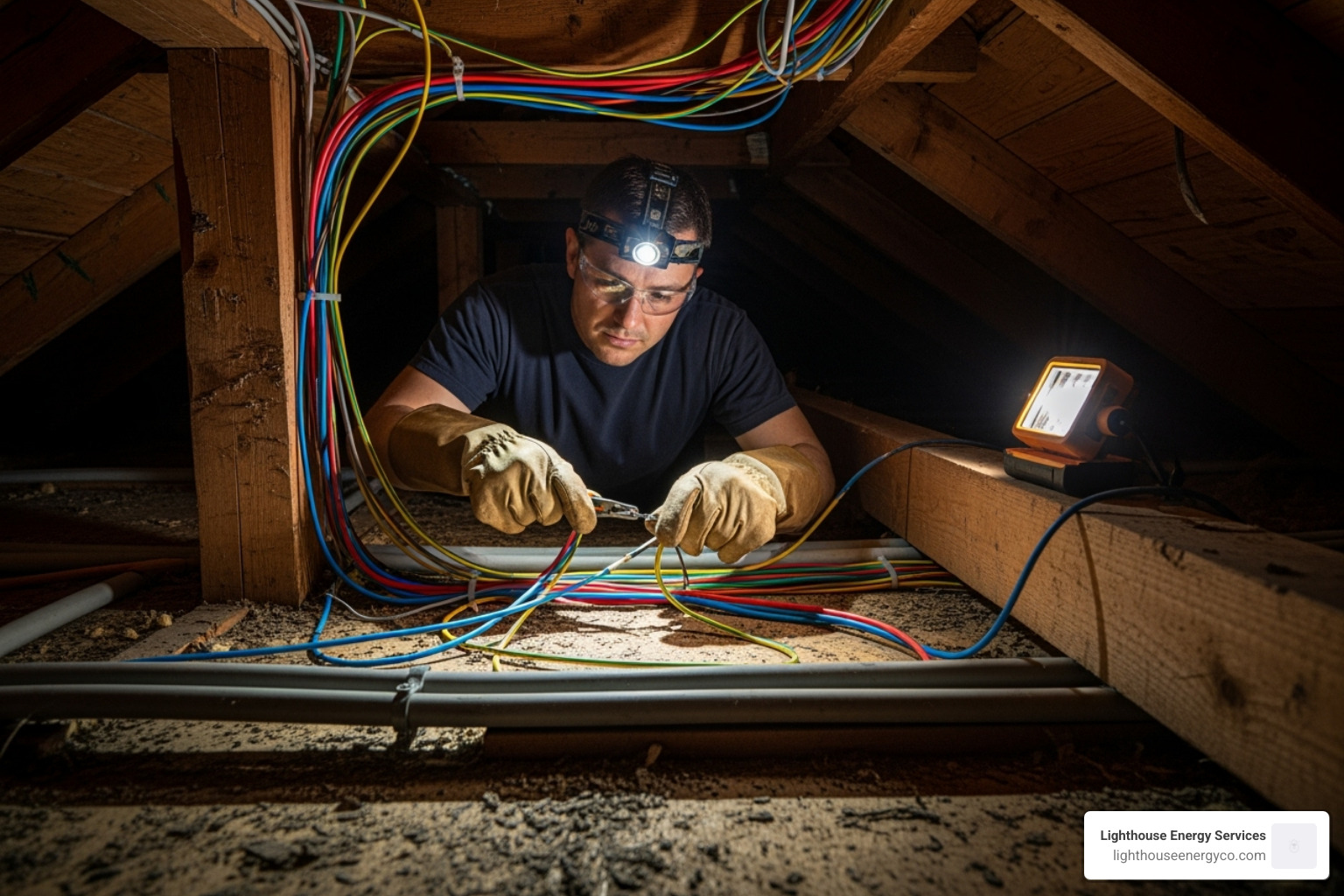
A DIY installation seems cheaper since you only pay for materials ($100-$400). However, the hidden costs can be substantial. You may need to buy or rent specialized tools, and the safety risks are serious. Working on a roof can lead to falls, while improper electrical work can cause shocks or fires. A mistake in sealing the roof can lead to leaks, water damage, and mold—repairs that cost far more than professional installation. Furthermore, a DIY job often voids manufacturer and roofing warranties, leaving you with no recourse if something goes wrong. While a skilled contractor might handle a simple passive vent, powered fans should be left to professionals.
Benefits of Hiring a Professional
Hiring a professional is an investment in safety, expertise, and peace of mind. A pro ensures:
- Correct Sizing and Placement: They calculate the right CFM for your attic and place the fan for optimal airflow.
- Watertight Sealing: Experienced installers use proper techniques to guarantee a leak-proof installation.
- Electrical Safety: Licensed electricians, like our team at Lighthouse Energy Services, wire fans to code, eliminating fire hazards and ensuring reliable operation.
- Time and Convenience: A professional team can complete the job in a few hours, a task that might take a homeowner an entire weekend.
- Warranties and Insurance: Professionals are insured and offer warranties on their work, protecting you from liability and covering any potential issues.
How to Save Money on Your Attic Fan Installation Cost
Even with a professional, you can manage your attic fan installation cost effectively:
- Get Multiple Quotes: Contact at least three reputable local installers. Compare pricing, but also consider experience and reputation.
- Schedule for the Off-Season: Fall and winter are typically slower for roofing and HVAC work, and contractors may offer better pricing.
- Look for Rebates and Tax Credits: Solar attic fans may qualify for a federal tax credit of up to 30%. Check with your local utility company for energy-efficiency rebates.
- Choose the Right Fan: If budget is a primary concern, a passive vent offers basic ventilation at a low cost. Weigh the upfront cost of different fan types against their long-term operational savings.
Frequently Asked Questions about Attic Fan Installation
Homeowners often have questions about attic fan installation cost and long-term performance. Here are answers to some of the most common inquiries.
How long does an attic fan last?
Lifespan depends on the fan type. Passive attic vents and roof turbines are very durable, lasting 40 to 50 years due to having few or no moving parts. Powered attic fans, both electric and solar, have a shorter lifespan of 10 to 15 years because of their motors and electrical components.
Regular maintenance, like keeping vents clear, can extend a fan’s life. If a powered fan over 10 years old needs a major repair (like a motor replacement costing $150 to $650), it’s often more cost-effective to replace the entire unit.
Can you run an attic fan with the AC on?
Yes, an attic fan and your AC can work together effectively to lower cooling costs. The fan removes superheated air (up to 150°F) from the attic, creating a cooler buffer zone above your living space. This reduces the strain on your AC, potentially lowering cooling costs by up to 30%.
However, this only works if your attic is properly sealed from your living area. If there are gaps, a powerful fan can create negative pressure, pulling cool, conditioned air from your home into the attic and outside. This forces your AC to work harder, increasing your bills. Proper attic sealing is essential for an efficient system.
Who installs attic fans?
Attic fan installation often requires a combination of specialists. Roofers are essential for roof-mounted units, as they handle cutting the opening and ensuring a watertight seal. Electricians, like our team at Lighthouse Energy Services, are needed for all powered fans to handle the wiring, connect controls like thermostats, and ensure the system is safe and up to code. Some HVAC contractors also offer this service as part of a whole-home ventilation strategy. For a simple passive vent replacement that doesn’t require new cutting or wiring, a skilled handyman may be sufficient. For most jobs, a roofer and an electrician work together to complete the installation.
Make Your Home More Comfortable and Efficient
An attic fan is a strategic investment in your home’s comfort, efficiency, and longevity. By managing attic temperature, you protect your roof structure, make your living space more pleasant, and can lower energy bills by up to 30%. An attic fan also prevents moisture buildup that leads to mold, mildew, and rot.
While the attic fan installation cost varies—from $75 for a passive vent to over $1,300 for a solar system—the return on investment is clear. You save money on energy bills and avoid costly future repairs. However, the quality of the installation is just as important as the fan itself. A poor installation can lead to leaks and energy waste, which is why professional expertise is crucial, especially for electrical work.
At Lighthouse Energy Services, our certified electricians ensure your attic fan is wired safely, operates efficiently, and meets all local codes. We are available 24/7 because home issues don’t keep business hours, and we are committed to getting the job done right, and done right now—with no hidden fees.
Ready to make your home more comfortable and efficient? Contact us today for a professional consultation and let’s find the best attic fan solution for your home.