You buy the EV, clear a spot in the driveway, and then the first real surprise hits. The garage outlet that seems fine for a phone or a pressure washer is nowhere near the right setup for daily charging, and now the project feels bigger than a wall mount. In Palm Beach Gardens, EV charger installation usually turns into a panel check, a permit, and sometimes an HOA conversation before anyone drills a hole.
That's normal. This market already has a measurable charging footprint, with ChargeHub listing 94 public charging station ports within 15 km of Palm Beach Gardens, including 66 Level 2 ports and 28 Level 3 ports, plus 45 ports offering free charging, while nearby West Palm Beach had 451 total charging stations in the same dataset (ChargeHub Palm Beach Gardens data). In practice, that means local installs aren't happening in a vacuum, they're fitting into an existing network where convenience charging, destination charging, and fast-charging demand all overlap.
Table of Contents
- What a Typical Palm Beach Gardens EV Charger Project Looks Like
- Choosing Between Level 2 and DC Fast Charging
- Assessing Your Electrical Panel and Service Capacity
- Permits, Inspections, and the Palm Beach County AHJ Process
- Typical Costs and Realistic Timelines
- Rebates, Incentives, and Tax Credits Worth Claiming
- HOA, Condo, and Commercial Coordination
What a Typical Palm Beach Gardens EV Charger Project Looks Like
A homeowner usually calls after the car's already in the driveway and the charging routine has become annoying fast. The first walkthrough almost always starts the same way. We look at the garage panel, the parking location, the cable route, and whether the owner is dealing with a single-family home, a condo, or a managed property.
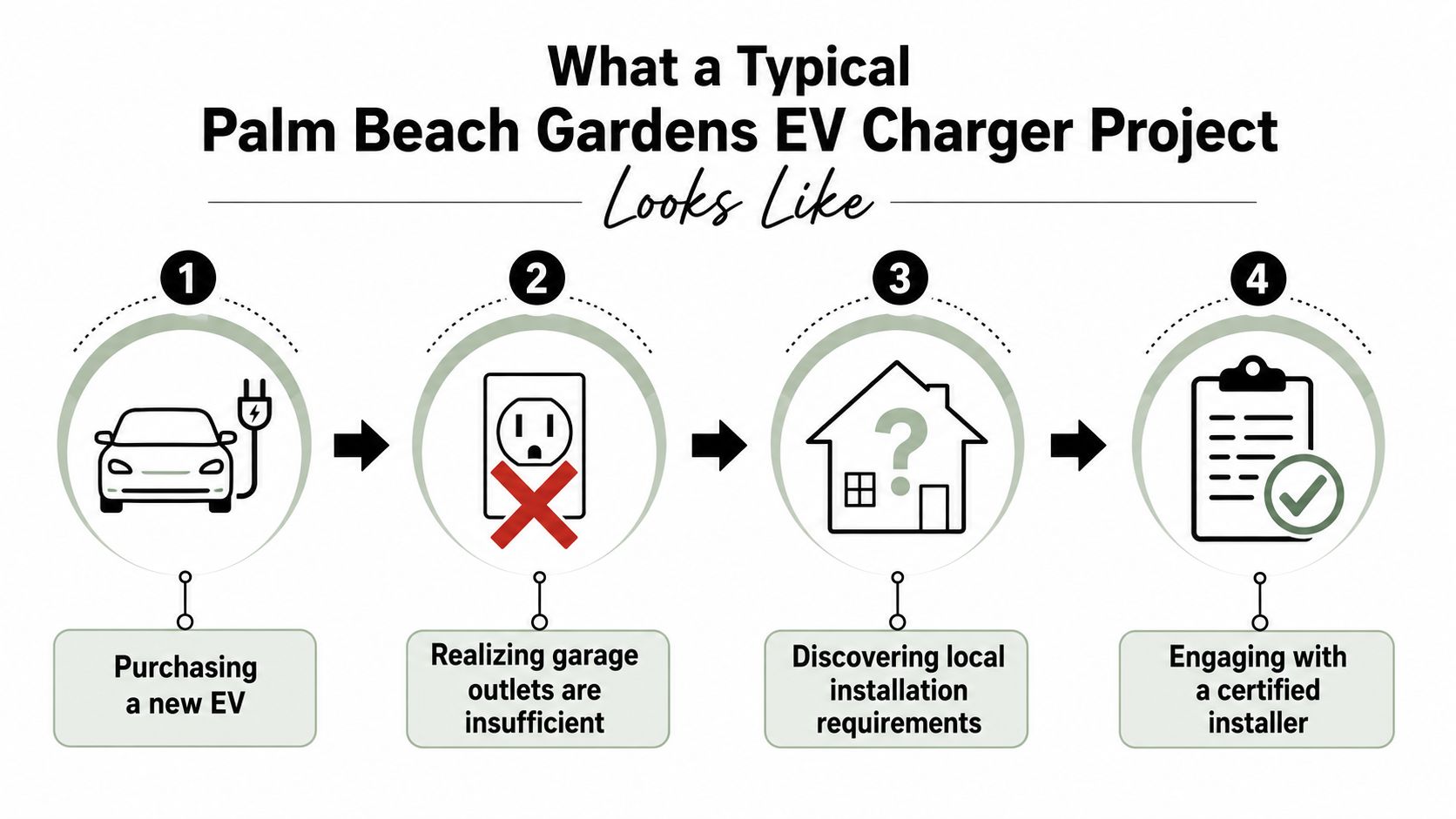
What catches people off guard is that the charger itself is rarely the hardest part. The hidden work is usually making sure the electrical service can support the added load, then getting the permit package right the first time so the job doesn't sit in review. On a straightforward house, that can be a clean path. On a condo or a commercial lot, it can become a coordination project with drawings, approvals, metering, and insurance documents.
Practical rule: if the conversation starts with “can you just install the box,” the real answer is usually “maybe, but not until we check the panel and the paperwork.”
The good news is that the project is manageable when it's broken into stages. A proper install starts with the electrical assessment, moves through permitting, then ends with rough-in, inspection, and final commissioning. That sequence matters because a charger that's mounted before the service plan is settled can create expensive rework.
The other local reality is that Palm Beach Gardens sits inside a mature EV environment, not an emerging one. That changes everything about expectations, especially for property owners who want the install to be invisible to tenants, guests, or neighbors. The job is less about hanging hardware and more about matching the site to the way people charge.
Choosing Between Level 2 and DC Fast Charging
A driveway install in Palm Beach Gardens usually starts with a simple question, and the answer changes once the site is checked. For a house, Level 2 is usually the better fit because it matches overnight charging and longer parking windows. The Florida process framework describes Level 2 EVSE as typically 240V/40A with about 9.6 kW output. That setup works for a car that stays put for hours, not minutes.
For public-facing properties, DC fast charging solves a different problem. It is built for short dwell times and quick turnover, which is why it belongs in retail corridors, fleet yards, and highway-adjacent commercial sites rather than a typical residence. A homeowner usually does not need that amount of throughput, and a business that does need it often has to sort out parking layout, available service, and load management before the equipment is selected.
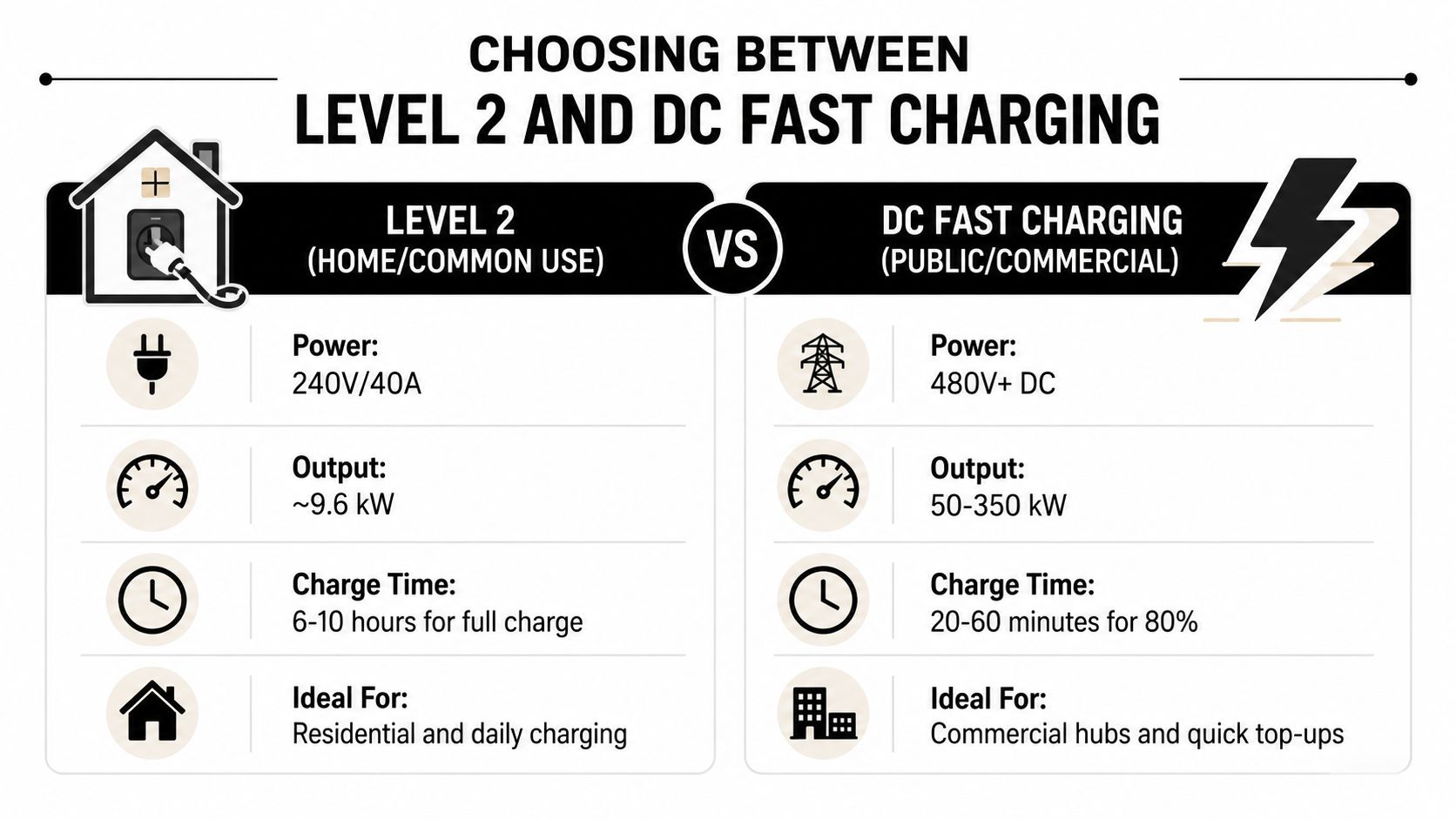
| Specification | Level 2 | DC Fast |
|---|---|---|
| Power | 240V/40A | 480V+ DC |
| Output | About 9.6 kW | 50 to 350 kW |
| Best fit | Residential and daily charging | Commercial hubs and quick top-ups |
| Typical use case | Overnight or extended parking | Short-stop charging with high turnover |
The practical difference is operational. Level 2 fits daily routines because the vehicle can sit long enough for the session to finish without disrupting the property. DC fast charging makes sense when the owner needs cars to move through the space, not occupy it for long stays.
If a site only needs one vehicle to recharge overnight, Level 2 usually makes more sense. If the site depends on turnover, the charging plan has to be built around that from the start.
For Palm Beach Gardens homeowners, the call is usually straightforward. If the vehicle lives at the house, start with Level 2. If the property serves drivers who arrive, plug in, and leave soon after, the charging design should be shaped by turnover, available service, and the approval path that comes with the site.
Assessing Your Electrical Panel and Service Capacity
The panel decides whether the project is easy or disruptive. A proper assessment begins with a load calculation under NEC Article 220, then moves to breaker space, service size, and routing before anyone buys equipment. That's the part many owners skip, and it's usually where the first redesign starts.
The reason is simple. Many Level 2 chargers need a 50A or 60A breaker, and the EPA says the breaker must be sized at least 125% of the charger load (Home Depot EV charger installation guidance). In practical terms, that means the charger doesn't just “fit” if there's an empty slot. The service has to handle the new continuous load safely, with the right conductor size and enough room in the panel for a clean install.
What I check first on site
- Breaker Space: If the bus bars are already crowded, the design may need a subpanel or a service upgrade.
- Service Capacity: A panel that's already near its practical limit can't be treated like it has spare headroom just because the label says there's room.
- Wire Path: Long or awkward runs can turn a simple job into a labor and materials problem fast.
- Future Use: If the owner plans to add a second EV later, the first install should account for that now.
Rule of thumb: if the panel is full, the conversation doesn't end. It just moves to whether a panel upgrade, subpanel, or service-side utility work is the cleaner fix.
An undersized service shows up in the real world as nuisance tripping, overloaded spaces, or panels that already rely on tandem breakers stacked to the limit. That's why a charger quote without a load calculation is incomplete. It might look cheaper at first, then cost more once the actual service conditions are known.
If you're budgeting for a service upgrade, start with an informed estimate rather than a guess. A useful place to review the broader cost factors is this home electrical panel upgrade cost overview, because the panel often drives more of the project than the charger does.
Permits, Inspections, and the Palm Beach County AHJ Process
For an EV charger install in Palm Beach Gardens, the permit path is often what separates a clean project from a messy one. The work should follow a straightforward order, load calculation, equipment selection, permit submission, rough-in, inspection, final mounting and wiring, then closeout. If that sequence gets skipped or scrambled, rework usually follows.
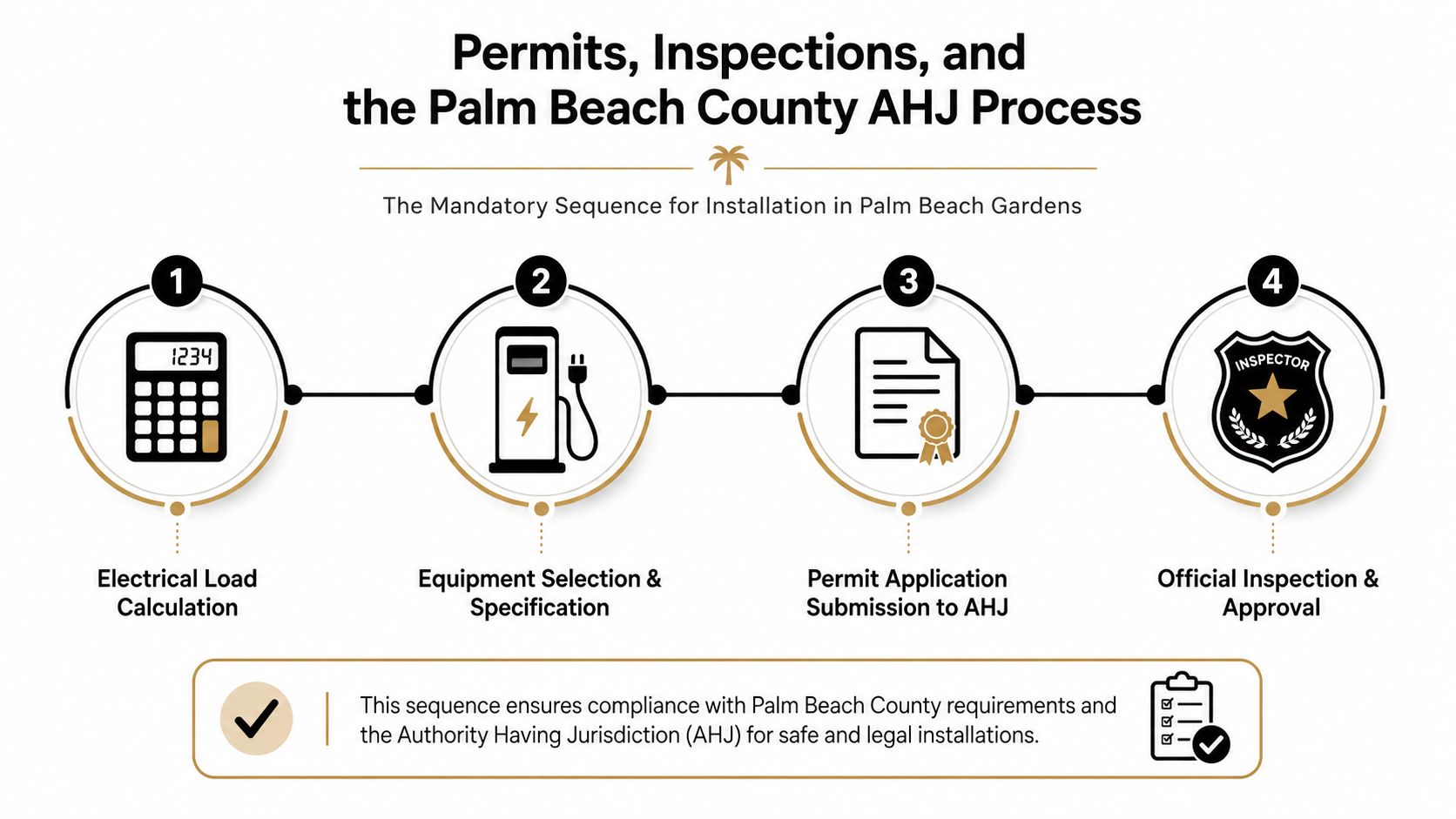
County review can move quickly on a complete submittal, or it can stall when the package is thin and the inspector has to ask for corrections. The practical bottleneck is usually not the charger mount itself. It is the paperwork, the electrical details, and any coordination tied to the utility or property manager. A clean permit set gets attention first, because it shows the reviewer exactly what will be installed and how the circuit is being protected.
The mistakes that trigger red tags
- Missing labeling: The charger, breaker, or disconnect is not identified clearly.
- Wrong breaker sizing: The circuit does not match the load or the installation method.
- Incomplete disconnecting means: The inspector cannot verify the shutdown method.
- Poor documentation: The permit set does not match what was installed.
Those problems are avoidable, but only if the field work matches the permit package from the start. I tell customers to keep the equipment spec on site, confirm the circuit path before the rough-in is closed up, and make the disconnecting method obvious to anyone who opens the panel door. A reviewer or inspector should be able to follow the job without guessing.
The same discipline matters on larger properties, where HOA approval, tenant access, utility service changes, or commercial meter work can slow the project even when the charger itself is simple. A homeowner job may only need a permit and an inspection. A condo, retail site, or office property can add board review, management signoff, or coordination with other electrical work on the premises. That is why the permit plan has to be built around the site, not just the charger.
For a homeowner-level overview of how a permit-backed residential install is usually handled, this at-home EV charger installation guide is a helpful reference. The sequence is familiar, but the approval path gets more layered once the panel, utility, or property structure becomes part of the job.
Typical Costs and Realistic Timelines
A clean residential Level 2 install and a more involved commercial project do not sit in the same budget category, even if both end with a charger on the wall. Cost usually comes down to the hardware, how far the run travels from the panel, whether the panel needs upgrades, and whether trenching or concrete repair enters the scope. Until those pieces are confirmed, any quote is still provisional.
The hidden costs are usually behind the wall or under the slab. A short run to an accessible panel is straightforward. A detached garage, a longer conduit path, or a panel that is already tight on capacity changes labor, material, and inspection scope fast. On commercial sites, the estimate expands again when the design calls for multiple ports, load management, or coordination with other electrical systems on the property.
A real Palm Beach Gardens job also has paperwork and scheduling pressure that many guides leave out. If the site needs HOA review, utility coordination, tenant access, or meter work, the calendar stretches even when the charger itself is simple. I have seen homeowner jobs move on a clean permit and inspection, then watched condo and retail projects wait on board approval, management signoff, or other electrical work that had to happen first.
What changes the timeline
A site visit and load calculation set the project shape. That is where the panel capacity, conduit route, and any likely service issues usually become clear.
Permit submission is the next gate. A complete package moves faster than a submittal that has to be revised after the reviewer spots a mismatch between the drawings and the field plan.
Utility coordination only comes into play when service changes or metering changes are part of the job. That step can add waiting time, especially on properties where the charger is only one part of a larger electrical upgrade.
Inspection and commissioning close the loop. Final approval depends on the installed work matching the approved scope, so the equipment choice, breaker arrangement, and field layout need to line up from the start.
The other timing issue is access. Homeowners have to plan around garage or electrical room access. Property managers need notices, work windows, and sometimes board approval. Commercial owners often have to coordinate around parking flow, tenant operations, and the rest of the site schedule.
Before you commit, it helps to separate installation cost from operating cost. One practical way to do that is to calculate EV charging costs based on your expected charging habits, then compare that number with the scope of the install. The estimate will not replace a site quote, but it does keep the project grounded in both upfront spend and day-to-day charging use.
Rebates, Incentives, and Tax Credits Worth Claiming
The cleanest time to handle incentives is before the permit goes in, while the scope is still being set. Once the work is done, missing invoices, mismatched model numbers, or incomplete commissioning records can turn a simple credit into a back-and-forth paperwork problem.
Residential jobs usually start with the federal EV charger tax credit. Commercial projects take a different track, because eligibility depends on property type, equipment category, and whether the installation fits the incentive rules tied to the charging plan. Utility programs can also matter, especially if the design includes managed charging or load control.
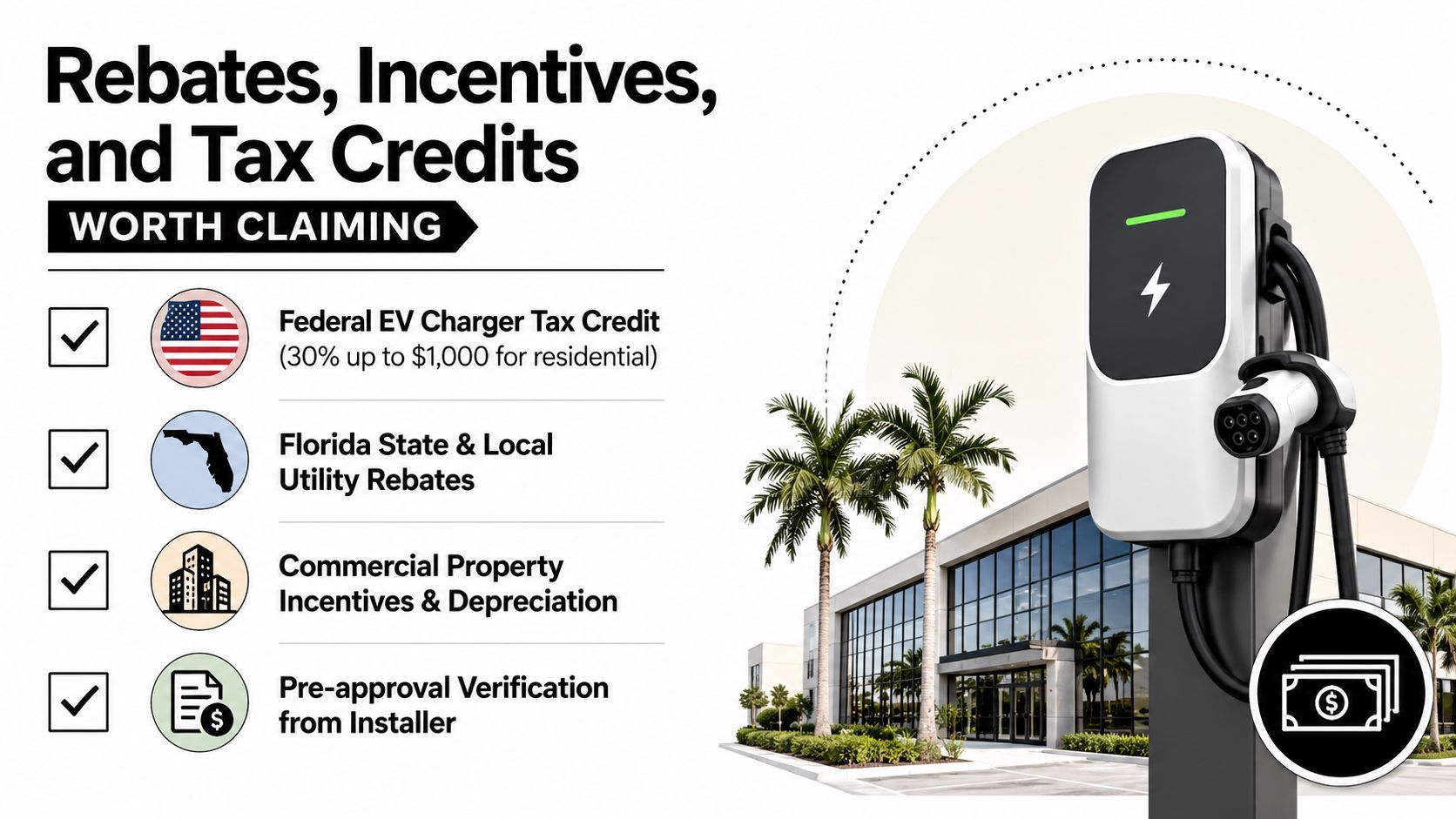
A permit file that is organized from the start makes the incentive side much easier to defend later. I tell clients to keep the paperwork together as the job moves, not after the fact.
- Itemized invoice: Break out equipment, labor, and any panel-related work.
- Equipment certification: Keep the model number and product spec sheet.
- Proof of commissioning: Save record that the charger was installed and energized correctly.
- Installer pre-approval notes: If a program requires screening first, keep the approval in writing.
For homeowners who are pairing charger work with other efficiency upgrades, the South Florida home energy credit guide is a useful reference point. Different programs often have different documentation rules, and mixing them up is a common reason a claim gets delayed.
The practical approach is straightforward. Treat rebates, incentives, and tax credits as part of the project plan, not as a cleanup task after inspection. If the installation is eligible, the paperwork should be lined up with the permit package and the final invoice so nothing has to be reconstructed later.
HOA, Condo, and Commercial Coordination
A Palm Beach Gardens charger job can look simple on paper and still stall for weeks once the HOA, condo board, or property manager gets involved. The hardware is usually the easy part. Shared parking, ownership questions, metering, insurance, and utility coordination are what slow the project down, especially on buildings with limited electrical room space or older service equipment.
Florida condo law gives a unit owner the right to install an EV charger in an assigned limited common element or an exclusively designated parking space, but that right still comes with conditions. The work has to be performed by a licensed electrician, permits and inspection are still required, and the metering and insurance paperwork has to be in place (Palm Beach condo EV charger rights overview). Boards cannot dismiss the request outright, but they can require a complete submittal with the right documentation. If that package is missing, the project sits.
What shared properties need to settle early
- Parking rights: Who controls the space, and whether it is assigned or exclusively designated.
- Metering plan: Separate metering, embedded metering, or another approved billing path.
- Insurance and indemnity: The association or property owner needs paperwork that matches the risk.
- Site circulation: Chargers cannot create a traffic or accessibility problem.
- Utility capacity: The building may need planning help before a new load can be added.
A charger request goes smoother when the owner treats it as part of the building system, not as a private appliance. That matters in condos and commercial sites where one decision affects other owners, tenant access, and the association's future maintenance obligations.
Commercial and multifamily owners should also plan in phases. A property that may add more chargers later is better served by conduit routes, service capacity, and parking layout that account for expansion from the start. That approach helps when load sharing, transformer coordination, and tenant access all have to work at the same time.
For property managers who want a planning framework beyond the electrical scope, the guide from Access Management Group helps because charger rollout often belongs in a larger capital schedule, not in a single maintenance request. For commercial-scale projects, our guide to commercial EV charger installation in West Palm Beach covers load management, multi-port design, and permitting nuances that show up on larger sites.
The contractor selection process matters as much as the approval process. I would verify the Florida electrical license and Palm Beach County registration, confirm the installer pulls the permit, ask for a written load calculation, and check that the company carries the insurance a condo board or commercial owner will expect. A site that needs 24/7 responsiveness, clear pricing, and work that stays on schedule should not be handed to the lowest bid without those checks.
For larger properties, the planning conversation should include a licensed team that can handle residential and commercial scopes. Lighthouse Energy Services provides EV charger installation as part of its electrical work, including dedicated circuits for charging stations, which matters when one contractor needs to coordinate load, permit, and installation details. Ask the same questions of every bidder, because the right answer on paper is the one that still works when the inspector arrives and the board asks for the metering plan in writing.