
If you manage an office building, retail center, mixed-use property, or condo parking area in West Palm Beach, you've probably already seen the pattern. A few tenant requests turn into regular questions. Staff ask whether charging is coming. Customers start parking longer near the entrance. The conversation shifts from “Should we install chargers?” to “How do we do it without creating an electrical headache?”
That's the main issue with commercial EV charger installation in West Palm Beach FL. The charger itself usually isn't the hardest part. The hard part is figuring out whether the site can support it, whether the utility will require changes, how the permit package needs to be built, and how to keep operating costs from creeping up after the ribbon cutting.
A lot of property owners start too late on the planning side and too early on the construction side. They pick hardware first, mark parking spaces, and only then learn that the panel is full, the transformer needs review, the ADA path doesn't work, or the charger layout creates long conduit runs that blow up the budget. Good projects go in the opposite order. They start with capacity, layout, usage pattern, and utility coordination. Then they choose hardware that fits the site.
The Growing Demand for EV Charging in West Palm Beach
A property manager in West Palm Beach doesn't need a market report to notice the shift. You see it in the lot. More electric vehicles show up at offices, multifamily properties, hotels, and retail centers. The practical question becomes whether your property will meet expectations or fall behind nearby sites that already offer charging.
Florida is already well into that transition. Qmerit reports more than 6,800 Level 2 charging stations, more than 9,000 public charging ports, and notes that nearby Boca Raton has over 100 free EV charging stations statewide context included in its Florida market overview on Florida EV and electrification statistics. That matters in Palm Beach County because expectations don't form in isolation. Tenants compare buildings. Customers compare destinations. Employees compare workplace amenities.
Why this is now a property decision
For commercial owners, chargers aren't just electrical equipment. They affect leasing, parking operations, traffic flow, and future capital planning.
A few common scenarios come up fast:
- Office properties: Employees want daytime charging where cars sit for hours.
- Retail centers: Owners want charging without tying up the best parking all day.
- Condos and mixed-use sites: Boards want to support residents without starting disputes over costs and access.
- Fleet or service properties: Managers need predictable charging windows without overloading the building.
Charging has moved out of the “experimental amenity” category. In much of South Florida, people already assume serious commercial properties are planning for it.
What owners usually underestimate
Focus tends to be on the parking stalls and charger model. The bigger decisions happen upstream. Can the service handle the added load? Is the charger type right for the dwell time at the site? Will the utility require upgrades? Can the property add more ports later without rebuilding the job?
Those questions decide whether the project stays manageable or turns into a drawn-out redesign.
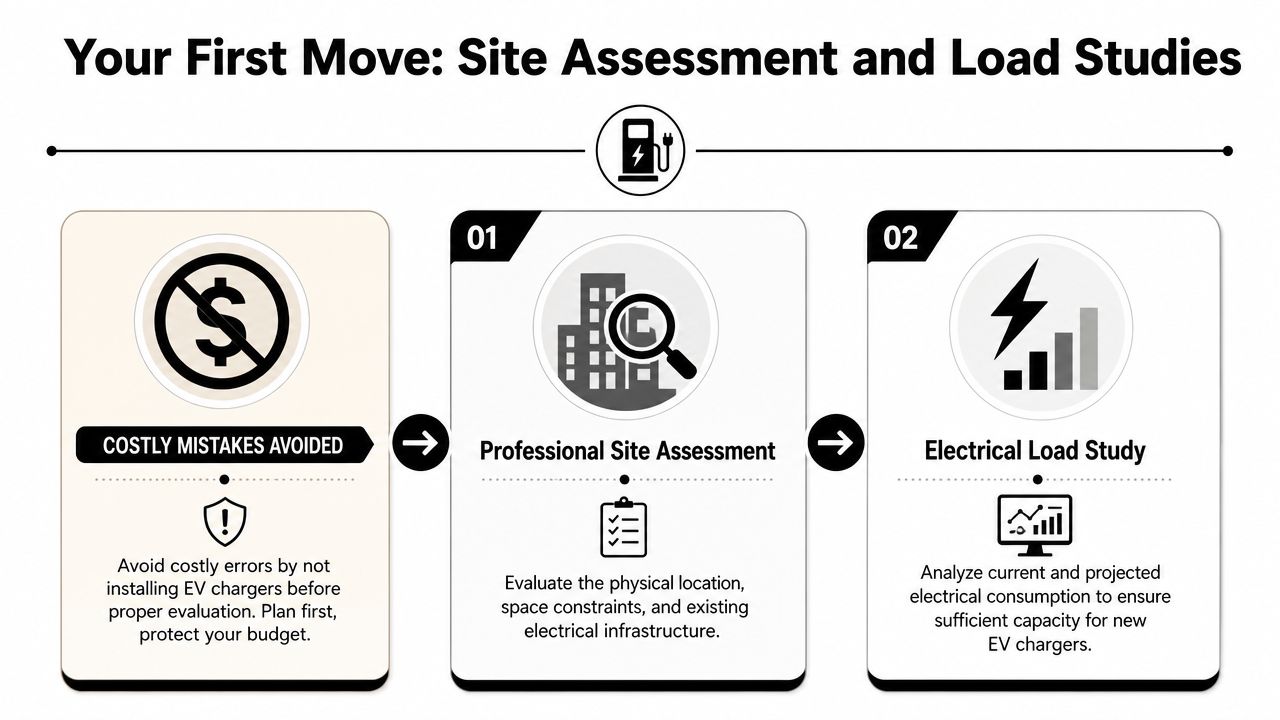
Your First Move Site Assessment and Load Studies
The first real step isn't choosing a charger brand. It's verifying whether the property can support the load you want to add.
In Palm Beach County, the proper process starts with a load-flow and panel or transformer assessment before permit submission, because the county review process requires early confirmation of service capacity to reduce correction cycles across electrical, zoning, and accessibility review, as described in Palm Beach County EV charging guidance from South Florida Engineers.
What a real site assessment includes
A proper assessment goes beyond opening a panel and saying there's “probably room.” On a commercial site, that shortcut causes rework.
The review usually needs to cover:
Existing service capacity
The electrician reviews the service, major distribution equipment, and available capacity at the panel or transformer level.Actual charger locations
Parking layout matters. A charger next to the electrical room is a very different project from one at the far end of the lot.Conduit path and site conditions
Surface-mounted conduit, underground runs, core drilling, trench routing, and concrete or asphalt restoration all affect budget and schedule.Accessibility and circulation
Charger placement has to work with ADA parking, route access, striping, signage, and safe movement through the lot.
What the load study should answer
The load study is where the project gets real. It should answer practical operating questions, not just code questions.
A useful study helps determine:
- How many chargers the site can support today
- Whether the site can use existing gear or needs an upgrade
- Whether a phased rollout makes more sense than building everything at once
- Whether the proposed charger count creates billing risk during peak demand periods
Practical rule: If the first conversation is about charger finish, app features, or pedestal style, the project is out of order. Capacity comes first.
Why this step protects your budget
A lot of commercial owners discover too late that “basic install” pricing doesn't reflect their site. A short run from a healthy panel is one kind of job. A parking-field installation with a constrained service is another.
If the study shows limited capacity, you may need to rethink the design before anyone files permits. That can mean reducing initial port count, using managed charging, relocating equipment, or planning electrical panel upgrades as part of a broader electrical scope instead of treating them as an afterthought.
That's the point of doing the hard analysis early. It's cheaper to revise a plan on paper than in a half-open parking lot.
Choosing Your Chargers Level 2 vs DC Fast Charging
Once the site capacity is understood, charger selection becomes much easier. Most commercial owners are not choosing between “good” and “better.” They're choosing between charger types built for different parking behavior.
How the decision usually works
Level 2 is the workhorse for sites where vehicles stay parked for a meaningful block of time. Think offices, hotels, condos, employee parking, and destination retail where drivers aren't in a rush.
DC fast charging fits sites where turnover speed matters more than stall duration. That can make sense for certain retail corridors, public-facing convenience stops, or fleet operations that need quick returns to service.
The mistake is forcing fast charging onto a site that doesn't need it, or using Level 2 where turnover demands something faster. The electrical consequences are significant, so the use case should drive the selection.
Level 2 vs. DC Fast Charger Comparison for Commercial Properties
| Feature | Level 2 Charger | DC Fast Charger (DCFC) |
|---|---|---|
| Best fit | Offices, condos, hotels, employee parking, destination sites | Fleet yards, rapid-turn retail, sites needing short dwell times |
| Typical parking pattern | Vehicles stay parked for hours | Vehicles need quick turnover |
| Electrical impact | Often easier to fit into existing commercial infrastructure | More likely to push major service and equipment requirements |
| Installation complexity | Usually simpler to deploy across multiple stalls | Typically more complex civil and electrical scope |
| Expansion strategy | Often easier to phase over time | Expansion can require larger upstream planning |
| Operating approach | Good fit for managed charging and shared-capacity strategies | Better for sites with a strong business case for speed |
What works in West Palm Beach
For most commercial EV charger installation in West Palm Beach FL, Level 2 is the practical starting point. It aligns with office dwell time, resident parking, hotel stays, and many customer visits. It also tends to be more forgiving when owners want to phase installation instead of committing to the largest possible electrical buildout on day one.
DC fast charging can be the right choice, but only if the site economics and parking turnover justify it. If you install fast chargers at a site where cars already sit for half a day, you may be paying for capacity you won't use effectively.
A better way to choose
Ask three questions before finalizing equipment:
- How long do vehicles stay parked?
- Is the goal employee and tenant convenience, public access, or fleet readiness?
- What did the load study say about available capacity and upgrade exposure?
The right answer often isn't glamorous. It's the charger type that fits the building, the parking pattern, and the utility reality.
Navigating West Palm Beach Permits and Utility Rules
Commercial EV charging projects slow down when owners assume the permit is just a formality. It isn't. The permit package, utility coordination, and inspection sequence decide whether the project moves cleanly or stalls in revisions.
For commercial EV charging in Florida, electrical permits and final inspections are typically mandatory, and the job isn't complete until the local authority verifies code compliance against the approved plans, as outlined in Florida installation guidance from Simply Wired FL.
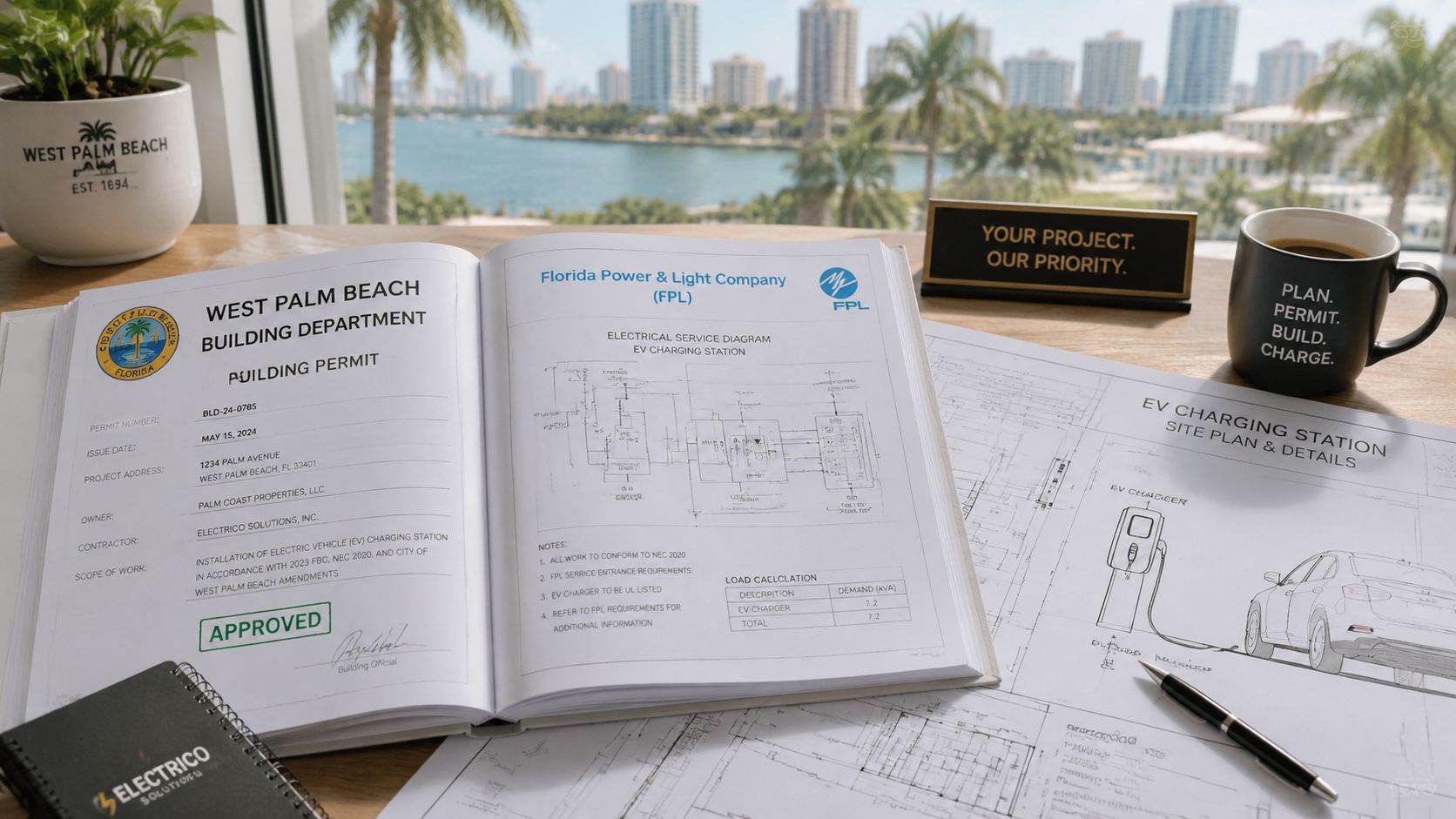
What the permit set needs to show
On a commercial project, permit approval depends on a complete picture of the installation. If the drawings don't match the actual electrical and site conditions, review comments start stacking up.
A strong submittal usually addresses:
- Electrical scope: Dedicated circuits, panel tie-in, breaker sizing, feeder path, disconnects, and equipment specifications
- Site layout: Exact charger location, parking geometry, bollards, striping, signage, and route access
- Accessibility details: ADA space configuration, access aisle relationship, and circulation around the charger
- Structural or civil scope: Pads, mounting details, trenching, restoration, and any relevant wind or flood review items
Why utility coordination can't wait
The city reviews one part of the job. The utility reviews another reality entirely. If the building service is close to its limit, the utility timeline may matter as much as the permit timeline.
Projects often get into trouble. An owner assumes that because the charger install itself is straightforward, the energization path will also be straightforward. That's not always true. If additional service capacity is needed, that discussion has to start early, before construction crews mobilize.
Don't start construction based on hope. Start when the service plan, permit set, and site layout all agree with each other.
Common permit and inspection mistakes
The failures are usually predictable:
- Submitting before the load capacity is resolved
- Showing charger locations that conflict with ADA layout
- Ignoring conduit routing conflicts in active parking areas
- Ordering hardware before approval details are final
- Assuming inspection is a quick sign-off instead of a formal closeout step
Owners who stay ahead of this process ask better questions. Has the service been verified? Does the site plan match field conditions? Is the inspection sequence clear? Those questions save time because they force alignment before the job enters the expensive phase.
Budgeting and Timelines for Your Installation Project
The simplest number in this process is rarely the final number. In West Palm Beach, ProMatcher lists an average of $1,313.03 for a Level 2, 240-volt charging-station installation, with a published range of $1,243.21 to $1,353.99, according to its local pricing page for West Palm Beach electrician costs. That's useful as a baseline, but it's only a starting point for commercial planning.
On commercial property, the difference between a straightforward install and an expensive one usually comes from everything around the charger. Distance from power source. Trenching. Concrete work. Traffic control. Signage. Networking. Panel changes. Utility-related scope. Those are the items that reshape the budget.
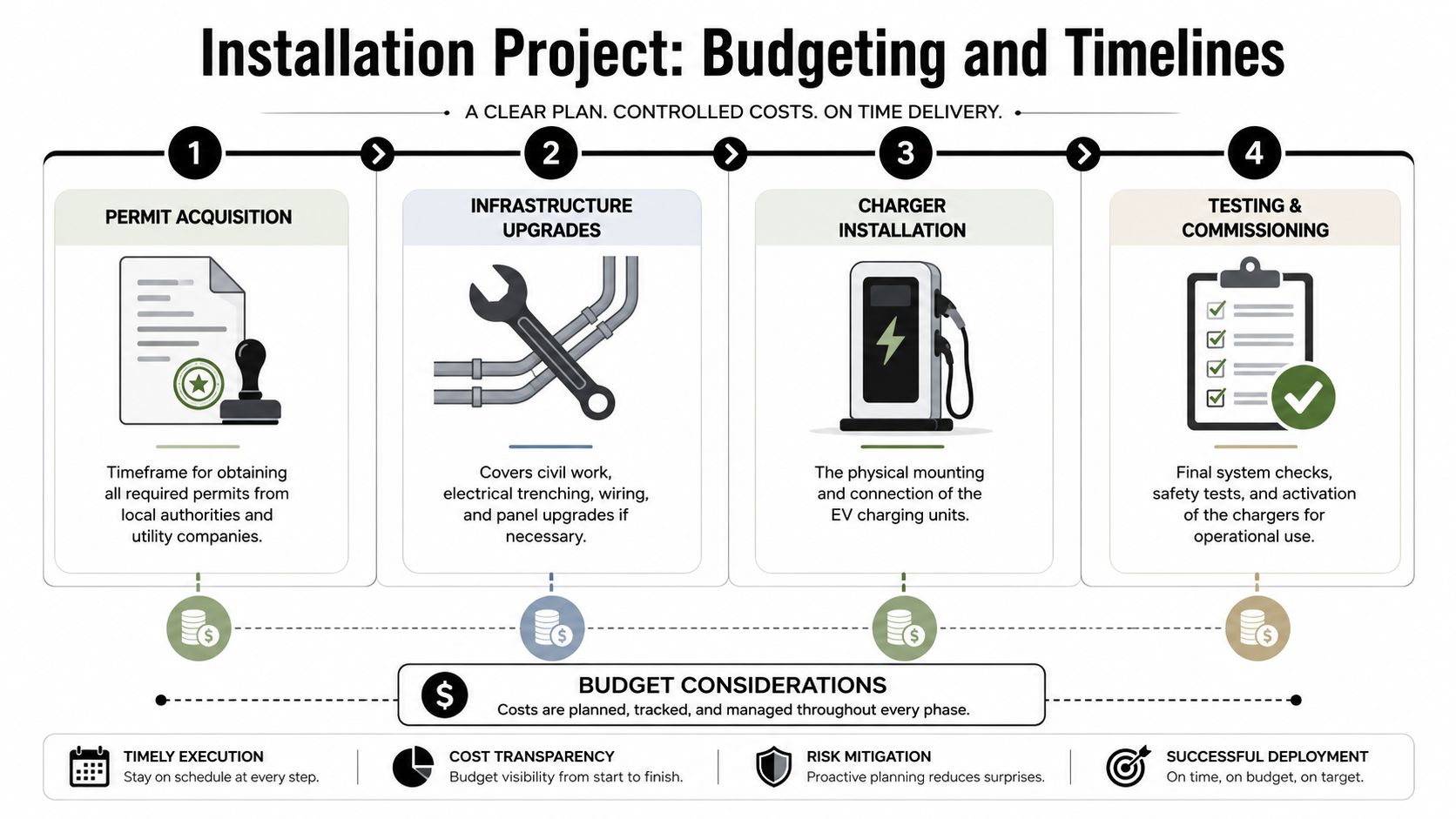
Where commercial budgets actually move
A realistic commercial estimate usually has several layers.
- Base electrical installation: Mounting equipment, dedicated circuit work, wire, breaker, and terminations
- Site construction: Saw cutting, trenching, conduit installation, patching, pads, bollards, and parking lot restoration
- Distribution work: Subpanel additions, breaker changes, feeder extensions, or larger upstream modifications
- Project administration: Permit preparation, inspections, commissioning, labeling, and coordination across trades
- Operational extras: Networking setup, access control, billing platform integration, and signage
If you've ever worked through pricing jobs for contractors, the logic will feel familiar. The visible field labor is only one part of the price. The planning, supervision, mobilization, permit handling, callbacks, and contingencies are what separate rough guesses from reliable budgets.
What affects timeline more than people expect
Owners often ask how long charger installation takes once the permit is issued. The honest answer is that schedule depends less on the charger and more on the site.
Three factors drive most schedule changes:
Civil complexity
Long underground runs and active parking-lot work can be more disruptive than the electrical terminations themselves.Equipment path
If the panel, transformer, or service connection is constrained, work gets slower and more coordinated.Inspection readiness
Jobs finish faster when the as-built installation matches the approved plans and labeling is complete before inspection day.
A budgeting mindset that works
The most reliable way to budget a commercial EV charger project is to separate the job into two buckets: the charger hardware and everything required to make that hardware usable, code-compliant, and maintainable.
Cheap hardware doesn't rescue an expensive site. Site conditions decide far more of the final budget than the charger brochure does.
That's why experienced contractors price the electrical pathway, not just the charger connection point. If the lot is far from the electrical room, if future expansion is likely, or if the property wants multiple ports, those realities should be built into the estimate early.
Smart Operations Load Management and Future-Proofing
A charger project can pass inspection and still perform poorly. That usually happens when the design team thinks only about installation and not about operation.
A major issue for commercial properties is whether the building's existing electrical capacity can support multiple chargers without expensive service upgrades or utility bill spikes from demand charges. As noted in local EV charging guidance from Mr. Electric West Palm, the difference between a workable installation and an underperforming one is often determined by load planning, not the charger brand.
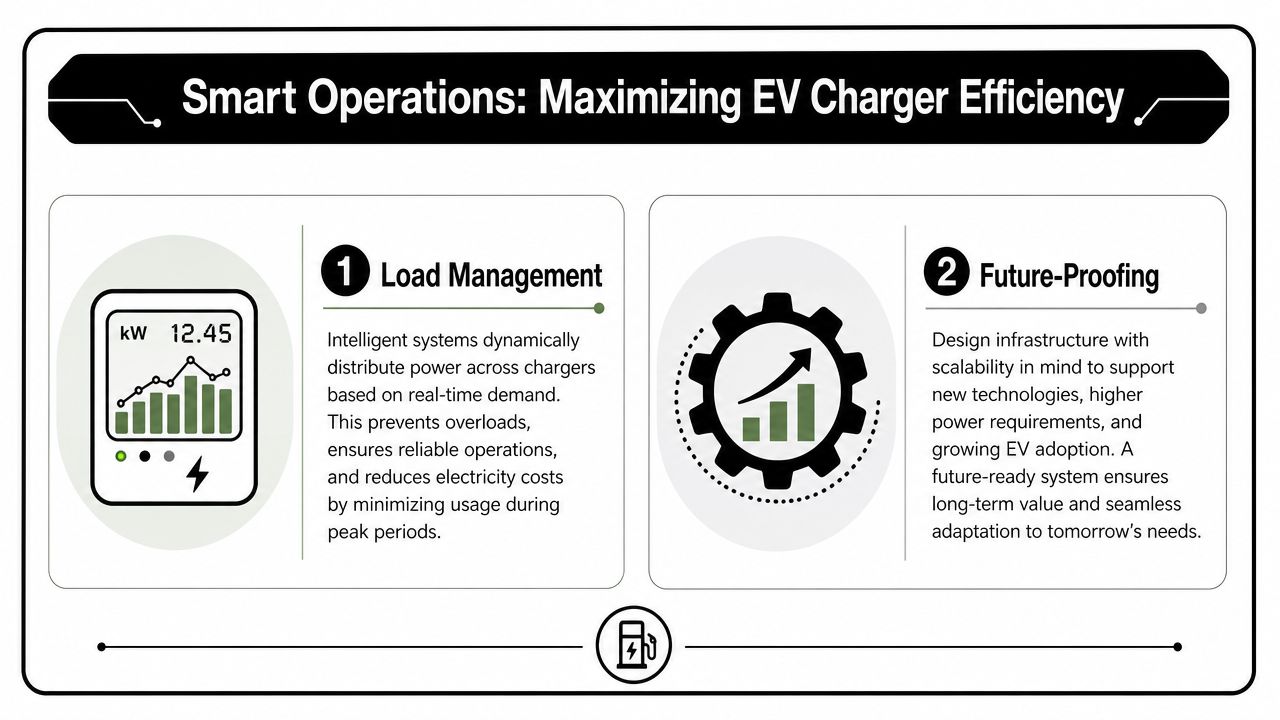
Load management is where good projects separate themselves
If several vehicles plug in at once, the building sees that load whether the owner planned for it or not. Managed charging gives the site a way to control that demand instead of letting every unit pull at full power whenever a driver connects.
That matters most at offices, multifamily sites, and shared parking properties where usage overlaps. Networked chargers can help balance available capacity across ports, reduce overload risk, and support phased deployment when full service expansion doesn't make sense yet.
A few operational benefits stand out:
- Shared capacity across ports: Better use of existing infrastructure
- Peak control: Less risk of sudden load spikes during busy periods
- Easier expansion planning: Additional ports can sometimes be added more intelligently instead of brute-forced with immediate utility upgrades
Future-proofing doesn't mean overspending
Future-proofing is often misunderstood. It doesn't mean buying the biggest charger available. It means building the pathway for sensible growth.
That can include:
- Running extra conduit during the first phase
- Reserving wall or pedestal space for later equipment
- Choosing networked platforms that can manage additional ports
- Coordinating charger plans with broader building power strategy, including items like power factor correction where relevant to overall electrical performance
Build the expansion path while the lot is open. Reopening finished pavement later is where many “phase two” plans become expensive enough to stall.
Operations matter beyond the charger itself
This planning mindset also shows up in fleet and service environments. If a property supports vans, service trucks, or delivery vehicles, charging needs to fit dispatch patterns, parking circulation, and off-hours operations. That's the same reason logistics teams care about tools like routing software for trucks. The charger only helps if it works inside the actual movement of vehicles and staff.
A property owner who thinks this way usually ends up with fewer surprises. The site charges vehicles, the utility bill stays understandable, and future expansion doesn't require tearing up work that was just completed.
Finding the Right Electrical Partner in Palm Beach County
The contractor you hire will shape almost every outcome in this project. A commercial EV charging job touches load calculations, layout, permitting, accessibility, utility coordination, installation sequencing, commissioning, and long-term serviceability. If a contractor is weak in any one of those areas, the owner usually pays for it in delay, redesign, or operating problems later.
What to look for in a contractor
The right partner should be able to do more than mount chargers.
Look for a team that can handle:
- Front-end electrical analysis: Not just a visual check, but real capacity review and system planning
- Commercial permit coordination: Drawings, corrections, inspections, and closeout
- Site-specific design judgment: Parking layout, conduit path, ADA details, and future expansion strategy
- Operational thinking: Load management, shared access, maintenance planning, and realistic rollout phasing
The best sign of a strong partner
The best contractors slow the project down at the right moment. They push for a real assessment before hardware is ordered. They ask how vehicles will use the site. They flag service limitations early. They explain what works, what doesn't, and what will create cost later.
For owners who want one team to handle broader commercial electrical scope alongside EV infrastructure, commercial electrical contractor services in West Palm Beach can be part of that discussion. Lighthouse Energy Services, for example, offers electric car charger installation and commercial electrical work in Palm Beach County, which matters when a charger project also involves panel work, distribution changes, or ongoing maintenance support.
A good commercial EV charger installation in West Palm Beach FL isn't defined by how fast the pedestal goes in. It's defined by whether the property can support the load, pass review cleanly, operate predictably, and expand without starting over.
If you're planning EV charging for a commercial property, condo, office, retail site, or shared parking facility, Lighthouse Energy Services can help evaluate the electrical capacity, permitting path, and installation scope before construction begins. That kind of early planning is what keeps charger projects practical, compliant, and easier to scale.