
You've just bought your first EV, the delivery date is getting close, and you're searching “EV charger electrician near me” from your Palm Beach County home. Maybe you're in Boca Raton, Delray Beach, West Palm Beach, or up near Jupiter, trying to figure out whether a charger can go on the garage wall without turning into a panel replacement project.
That's the right question to ask before you buy equipment or accept the first quote. A home charger isn't just another outlet. The electrician has to confirm your electrical capacity, size the circuit correctly, handle permits, and leave you with an installation that can support the way you'll charge for years.
Table of Contents
- Why Your Search for an EV Charger Electrician Matters Now
- Panel Capacity and Charger Compatibility Before You Call
- How to Vet a Licensed Electrician Near You
- Permits, Inspections, and Code Requirements in Palm Beach County
- Costs, Timelines, and Available Incentives
- Hiring the Right Local Pro for the Job
Why Your Search for an EV Charger Electrician Matters Now
Home EV charging has moved into the mainstream. The International Energy Agency reported that the global stock of public EV charging points exceeded 7 million by the end of 2025, after nearly 1.8 million new public charge points were added during that year. Public charging grew by more than 33% year over year, and China accounted for more than 65% of the global total. Those figures show that charging infrastructure is no longer a niche convenience. It's becoming utility-like infrastructure that supports a growing EV market. IEA global EV charging data
For a Palm Beach homeowner, the practical impact is simple. More EV owners need dependable charging at home, and more properties need electricians who understand dedicated circuits, service capacity, equipment compatibility, and local approvals. A rushed installation can leave you with nuisance tripping, an overloaded panel, an inaccurate quote, or a charger that doesn't deliver the performance you expected.
The right contractor starts with the house, not the charger brochure. They inspect the service panel, review the home's existing connected loads, consider the distance to the garage or driveway, and determine whether your current system can support the equipment safely. That assessment separates a straightforward installation from a larger electrical project.
The practical rule: Don't hire based on the phrase “charger installation” alone. Hire the electrician who can explain exactly how your home will support the charger.
You should also pay attention to how a contractor presents their business online and locally. If you're evaluating an electrical company, this guide to electrician SEO tips 2026 offers useful context on the signals that help customers find and assess local service providers. For your purposes, those signals should lead to a real conversation about licensing, experience, permitting, and the condition of your panel.
The rest of the decision comes down to four things: installability, qualifications, compliance, and a written price. Get those right before your EV arrives, and you'll avoid paying twice for work that should have been planned correctly the first time.
Panel Capacity and Charger Compatibility Before You Call
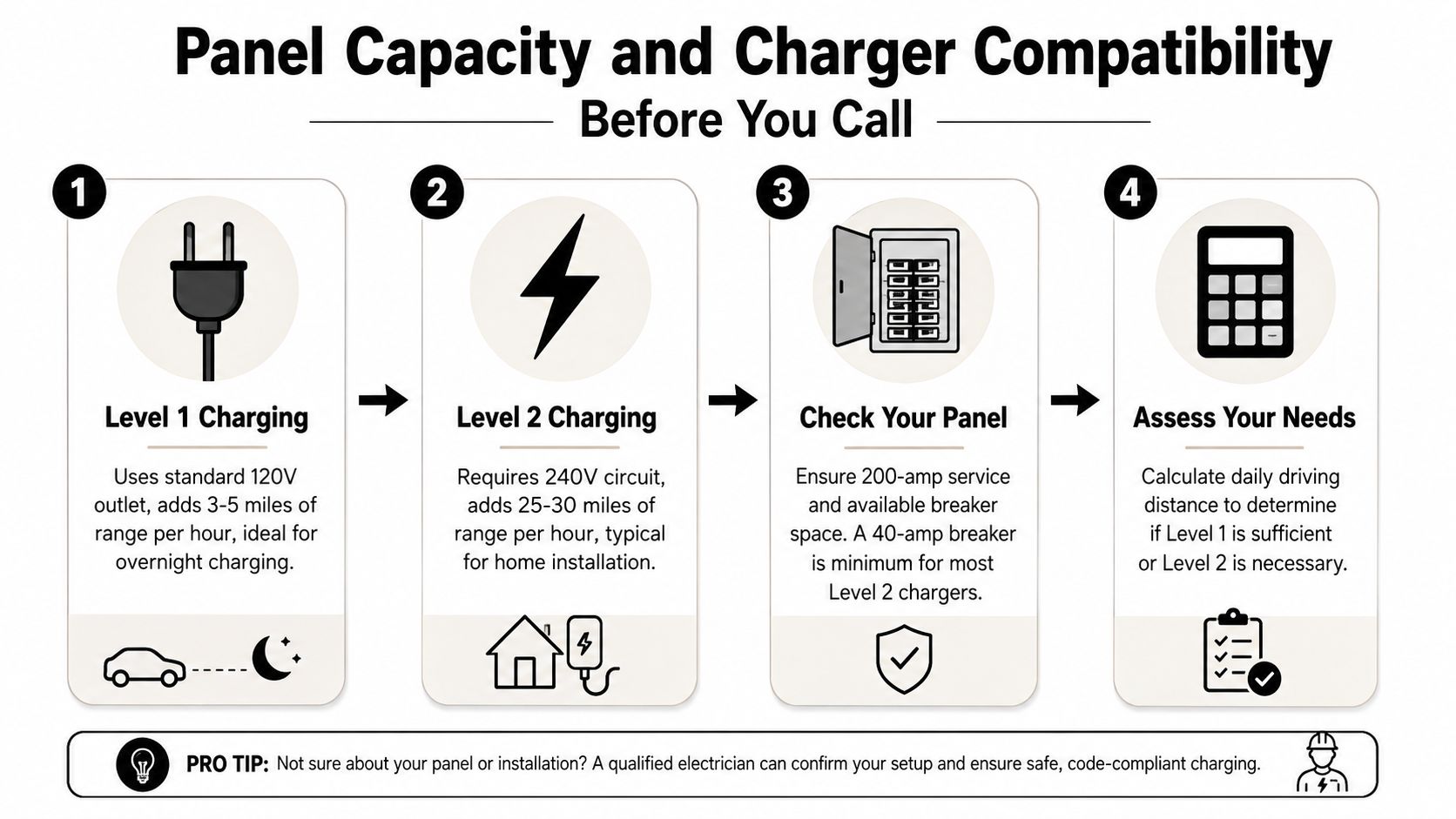
The most important question isn't “Which charger should I buy?” It's “Can my electrical system support the charger I need?”
Level 1 charging uses a standard 120-volt receptacle and can work for drivers with modest daily mileage and plenty of overnight parking time. Level 2 charging uses a 240-volt circuit and is the typical choice when a homeowner wants faster, more consistent home charging. The equipment decision should follow your driving habits and your panel assessment, not the other way around.
Start with the service panel
Ask an electrician to check the service or feeder panel, available breaker space, and the loads already connected to the home. An open breaker slot doesn't automatically mean the service has enough capacity. The electrician needs to calculate the existing load, compare it with the EVSE nameplate current, and determine whether the service rating can handle the addition.
EV charging is treated as a continuous load because the equipment can draw maximum current for 3 hours or more. Conductors and overcurrent protection are therefore sized at 125% of the continuous load, which is why many Level 2 installations require a dedicated branch circuit and formal load calculations. Electrical Magazine guidance on EVSE site assessments
A good pre-call checklist includes:
- Identify the service rating. Find the main breaker rating, but don't assume the number alone answers the question.
- List major existing loads. Air conditioning, electric water heating, pool equipment, cooking appliances, and other large loads affect the calculation.
- Confirm the charger's electrical requirements. The electrician needs the manufacturer's cut sheet or exact model information.
- Measure the circuit route. A garage across the house, an exterior wall, or a detached structure can require more conductor, conduit, trenching, and labor.
- Ask about alternatives. Load-sharing equipment or a sub-panel may solve the capacity problem without immediately replacing the main service.
If you're unsure whether your existing panel can support new equipment, review this practical guide to home electrical panel upgrade cost before requesting quotes. It'll help you understand why two homes with the same charger can receive very different installation recommendations.
Don't confuse capacity with convenience
A plug-in charger may look simpler because it uses a receptacle, while a hardwired unit connects directly to the electrical system. Neither option eliminates the need for proper circuit sizing, suitable equipment, and code-compliant installation. The electrician should recommend the setup that fits your panel, location, charging habits, and future plans.
Tell each contractor the same information. Provide the charger model, panel location, parking location, whether the garage is attached, and any known history of breaker trips or electrical upgrades. The more complete your information, the less likely you are to receive a quote that changes after work begins.
How to Vet a Licensed Electrician Near You
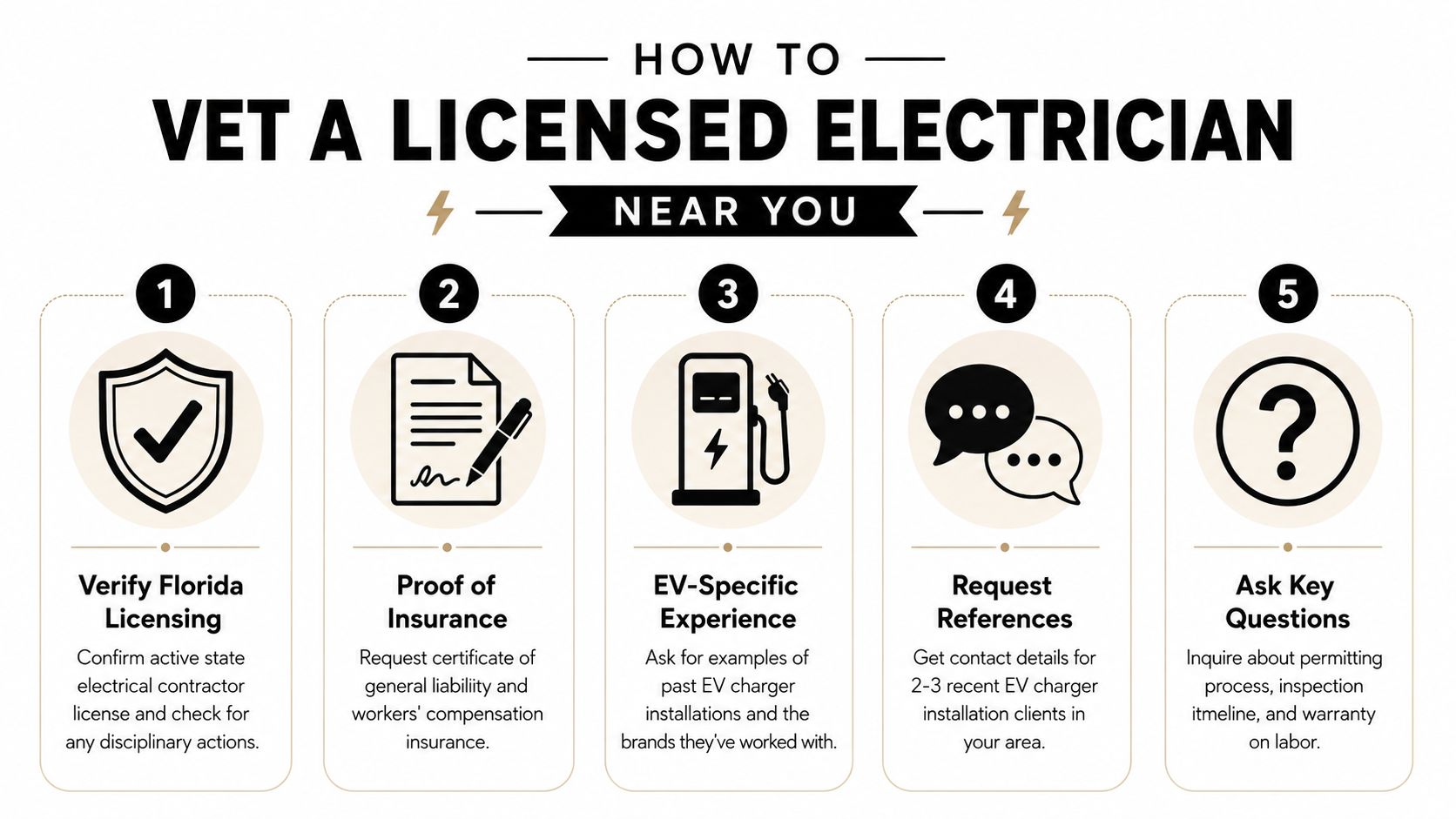
A search result isn't a qualification. Before you schedule the work, reduce your shortlist to electricians who can document that they're licensed, insured, and experienced with EV charging installations.
Verify the contractor first
Confirm that the company holds an active Florida electrical contractor license appropriate for the work. Ask for proof of general liability insurance and workers' compensation coverage. You don't need a complicated sales presentation. You need clear documentation and direct answers.
Then ask how often the electrician performs EV charger work. Experience matters because the job involves continuous-load calculations, equipment-specific requirements, GFCI considerations, conduit or cable routing, and inspection paperwork. A contractor who can describe the assessment process in plain language is more useful than one who promises a fast installation.
Use this question set during every estimate:
- Who pulls the permit? The answer should identify the responsible licensed contractor, not leave the paperwork to you.
- Who schedules the inspection? A serious electrician should explain how inspection coordination works.
- What does the quote include? Ask about the charger connection, breaker, conductors, conduit, disconnects if required, permit fees, inspection coordination, and commissioning.
- What happens if the panel fails the load assessment? You should receive options, not a surprise demand for extra work.
- What warranty covers the labor? Get the terms in writing.
- Can you provide recent EV references? References should involve comparable homes or properties, not only unrelated lighting work.
Read the quote for omissions
The lowest bid often wins by leaving out the difficult parts. A quote may mention the charger but say nothing about the circuit route, wall construction, panel condition, permit, inspection, or testing. Those omissions become change orders once the electrician is already on site.
Transparent contractors explain assumptions before they start. They also tell you whether pricing changes for emergency or after-hours service, even if you're scheduling during normal business hours. You can use this local SEO for contractors resource to understand how local service businesses present themselves, but your final decision should come from documentation and a direct technical conversation.
For additional practical screening questions, see this guide on how to find a good electrician. A qualified professional won't pressure you to skip the assessment, hide the permit path, or commit to a price before seeing the electrical system.
Permits, Inspections, and Code Requirements in Palm Beach County
A Level 2 charger usually adds a new 240-volt circuit or a hardwired connection. That makes the permit and inspection process part of the installation, not an optional administrative detail.
Palm Beach County includes multiple municipalities, and the exact submission process can differ between jurisdictions such as Boca Raton, West Palm Beach, and Jupiter. Your electrician should know which building department has authority for the property, what documents it requires, and how the inspection is scheduled.
What belongs in the permit package
A complete submittal commonly includes the load worksheet, equipment cut sheets, and an installation diagram. Those documents show the authority having jurisdiction what equipment is being installed, how the circuit is sized, and how the charger connects to the existing system.
The load worksheet matters because the inspector needs evidence that the service can support the added continuous load. The cut sheet identifies the EVSE electrical requirements. The diagram clarifies the circuit path, protective devices, and mounting arrangement.
The electrician should also address equipment placement, conductor protection, grounding and bonding, breaker compatibility, and required GFCI protection. The final setup must match both the manufacturer's instructions and the code requirements adopted by the applicable jurisdiction.
Expect a field inspection
After installation, the electrical inspector checks the work against the approved plans and applicable requirements. The electrician should remain responsible for correcting any issue identified during that process. You shouldn't be left trying to interpret an inspection correction for a circuit you didn't design.
Ask this before signing: “Will your company pull the permit, meet the inspector, and correct any installation issue identified during inspection?”
Skipping the permit can create complications when you refinance or sell the property, especially if the installation doesn't appear in the home's records or an inspector questions the new circuit. A reputable contractor handles the approval path and provides documentation when the work is complete. You can also review the process described in this guide to EV charger installation at home before your estimate.
Costs, Timelines, and Available Incentives
Residential EV charger installation costs vary because the electrical work varies. Neutral guidance places typical U.S. installations around $800 to $3,000, while significant electrical work can push the price above $3,000. A panel upgrade may add roughly $1,500 to $3,000, and federal data places the average Level 2 residential installation at about $1,300 per connector before labor and permitting. EnergySage installation cost guidance Alternative Fuels Data Center infrastructure data
The charger itself isn't the whole project. Circuit length, access through finished walls, outdoor routing, panel capacity, trenching, permits, and the need for load management can all change the scope.
EV Charger Installation Cost Scenarios
| Scenario | Typical Cost | Timeline | When It Applies |
|---|---|---|---|
| Straightforward dedicated circuit | Within the typical $800 to $3,000 installation range | Often a short scheduled project, subject to permit and inspection timing | The panel has capacity, the charger is near the panel, and the route is accessible |
| Longer circuit run or sub-panel | May approach or exceed the upper end of the typical range | Requires additional planning for routing, equipment, and approvals | The garage or parking area is distant, access is difficult, or a sub-panel improves the layout |
| Full panel upgrade | Panel work can add roughly $1,500 to $3,000 | Longer than a basic circuit installation because equipment, permitting, and inspection are more involved | The service lacks capacity or the existing panel can't safely support the new load |
These are planning ranges, not promises. A contractor who gives you one fixed number without checking the panel and route is guessing.
Incentives deserve a separate check
Potential federal tax credits, utility programs, and local incentives can change the net cost when you qualify. Eligibility depends on the equipment, property, location, tax situation, and current program rules, so verify the details before treating an incentive as guaranteed. Ask your electrician whether the quote separates eligible hardware and installation components, then confirm the program requirements with the relevant official administrator.
Plan around the vehicle delivery
Don't schedule the electrician for the day before delivery if you can avoid it. The panel assessment, quote, permit submission, installation, and inspection may involve separate steps, and an unexpected capacity issue can extend the schedule.
A sensible approach is to request the assessment as soon as your delivery timing becomes reasonably clear. That gives you time to choose between a dedicated circuit, load-sharing equipment, a sub-panel, or a service upgrade without making the vehicle's arrival your deadline.
Hiring the Right Local Pro for the Job
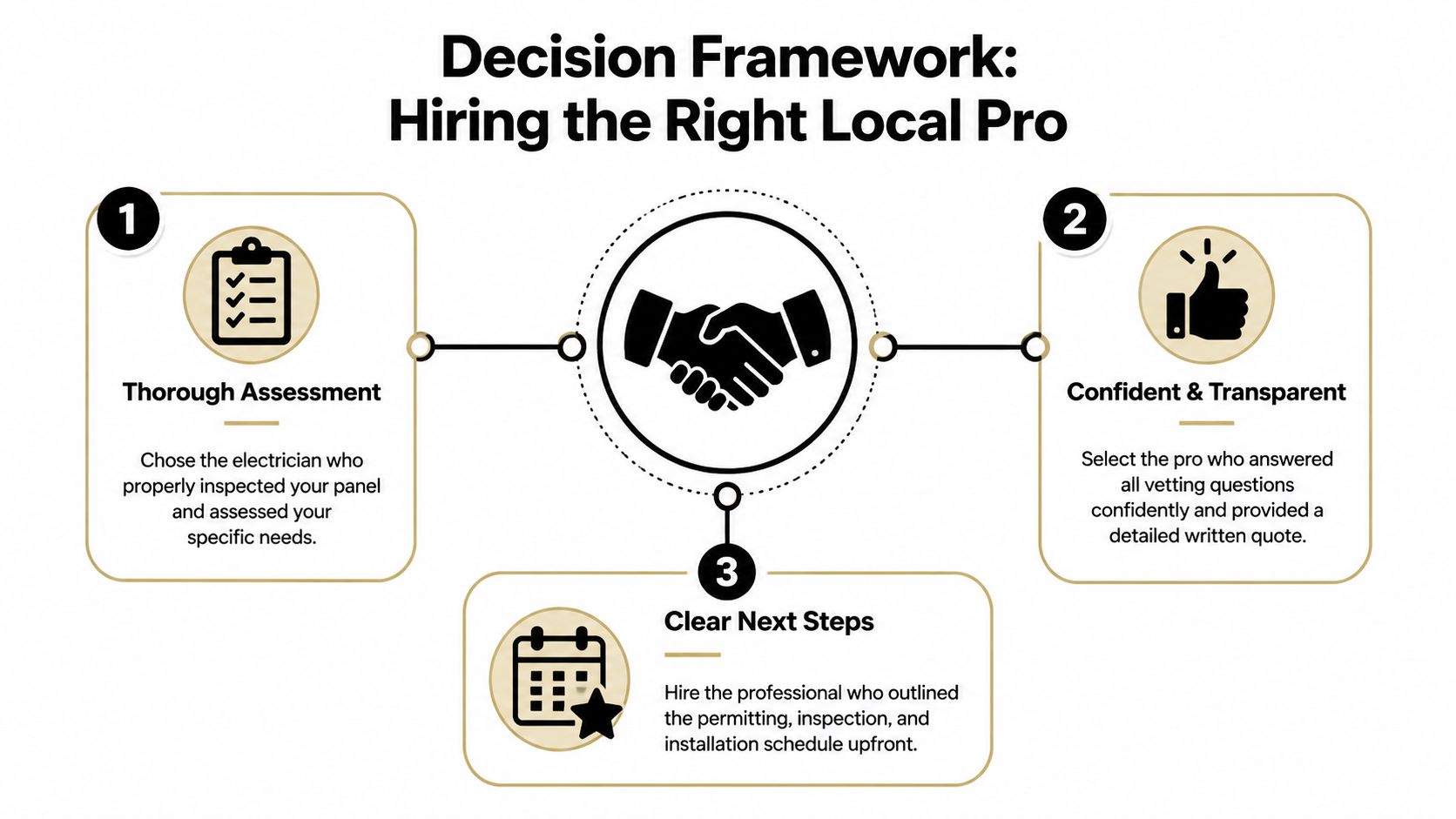
The right electrician isn't necessarily the one with the lowest initial quote. Choose the contractor who inspected the actual panel, calculated the load, explained the circuit route, identified permit responsibilities, and gave you a written scope that accounts for likely complications.
A proper assessment tells you whether your project is small or substantial. A proper quote tells you what the price includes. A proper permit process protects the installation after the electrician leaves.
Use this final decision test
Choose the candidate who can answer these questions without evasive language:
- Was the panel assessed before pricing?
- Were existing connected loads considered?
- Does the quote identify the charger connection method and circuit route?
- Are permit and inspection responsibilities written down?
- Does the contractor explain what happens if additional electrical work is required?
- Are insurance, labor warranty, and payment terms clear?
Avoid any electrician who tells you to use an existing general-purpose circuit without verifying its suitability, promises that a permit isn't necessary, or refuses to explain the load calculation. Don't let a low bid convince you that code compliance and documentation are optional.
Your hiring standard: Pick the professional who proves the installation will work in your home, not the salesperson who promises the fastest price over the phone.
Lighthouse Energy Services serves Palm Beach County from Boca Raton to Jupiter, with residential, commercial, and industrial electrical experience. The company has operated since 2005, has more than 100 years of combined team expertise, offers true 24/7 availability without after-hours charges, and has phones answered by licensed electrical professionals. Its EV charger service includes site assessment, charger selection, dedicated 240-volt circuit installation, mounting, commissioning, and homeowner education.
Schedule the panel assessment before your EV arrives. That's how you find out early whether you need a simple circuit, a managed solution, or a larger upgrade, and how you make sure charging is ready on day one.
Visit Lighthouse Energy Services to schedule a Palm Beach County EV charger assessment with licensed electrical professionals. The team can evaluate your panel, plan the dedicated circuit, manage permitting, and give you a transparent installation path before your vehicle arrives.