
You've just brought home an EV, and the first thing you notice is the unused 240-volt dryer receptacle in the garage. It looks like an easy win: plug in a Level 2 charger, close the garage door, and start charging overnight. Then an electrician opens the panel and finds that the home's service is already carrying a heavy load from air conditioning, cooking equipment, water heating, and laundry.
That situation is common in older and renovated homes throughout Palm Beach County. The central question isn't whether the garage has a 240-volt outlet. It's whether the home can safely support a dedicated, continuous EV load, and whether the installation can manage that demand without overheating conductors, tripping breakers, or exceeding service capacity.
Table of Contents
- Why Your Home Might Need More Than Just an Outlet
- Voltage, Amps, and the Language of Electrical Demand
- Level 1, Level 2, and DC Fast Charging Compared
- Sizing the Circuit, Breaker, and Wire for Your Charger
- Load Calculations and the Panel Capacity Question
- Site Assessment Checklist Before Installation Day
- Permits, Inspections, and NEC Code Changes
- Timeline, Cost, and When to Call a Licensed Electrician
Why Your Home Might Need More Than Just an Outlet
A 240-volt receptacle can look compatible with an EV charger while still being the wrong connection for the job. A dryer circuit, for example, may be sized for a particular appliance and may not be approved for sharing with vehicle charging. An EVSE, or electric vehicle supply equipment, can draw current for hours, so the electrician must evaluate the circuit, conductors, overcurrent protection, and service entrance as one system.
Three constraints control nearly every residential installation:
- Service-entrance capacity: The utility service and main distribution equipment must have enough capacity for the home's existing demand plus the charger.
- Continuous-load sizing: EV charging is treated as a continuous load. The circuit must be sized at 125% of the EVSE's maximum current, as summarized by the EV charger electrical system requirements guide.
- Dedicated branch circuit: The charger generally needs its own branch circuit, unless an approved energy-management system controls the load.
The continuous-load rule is the point that surprises many homeowners. A dryer may cycle on and off as its heating elements regulate temperature. An EV charger can maintain its programmed current for a long charging session. That sustained demand is why the circuit can't be treated as though the charger were just another occasional plug-in appliance.
Practical rule: The outlet is only the last link in the electrical path. The service, panel, breaker, conductors, and charger all have to agree.
A 150-amp service may be perfectly adequate for one household and still have little practical room for a new Level 2 circuit. Conversely, a home with an older service may be able to charge safely at a lower setting if an electrician uses approved load management. The right design starts with capacity, not with the receptacle that happens to be closest to the parking space.
Voltage, Amps, and the Language of Electrical Demand
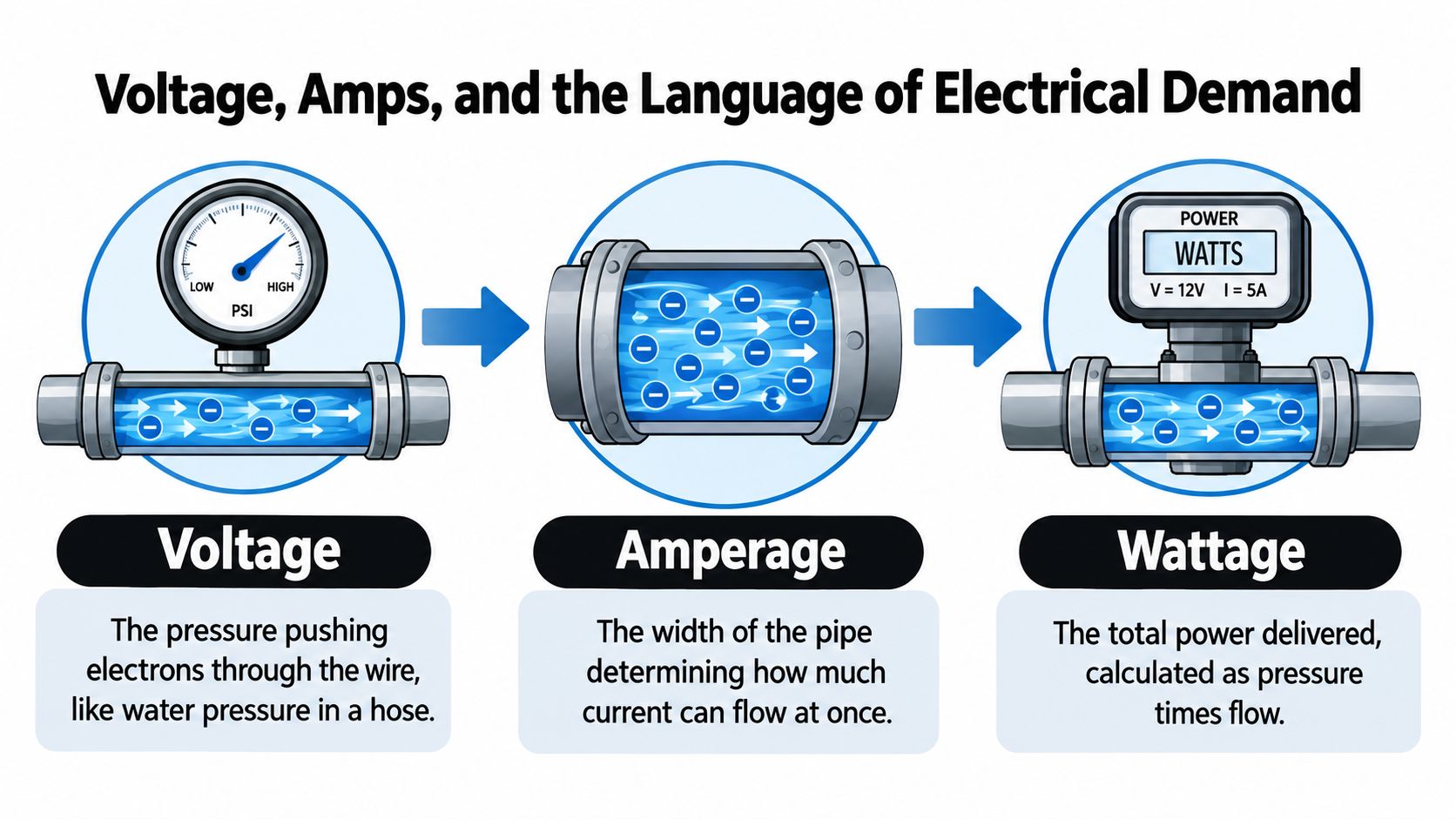
Electrical specifications become easier to understand if you picture water moving through a pipe. Voltage is the pressure pushing electrons, amperage is the amount of current moving through the conductor, and wattage is the total power delivered. In simple terms, power rises when you increase either electrical pressure or current.
A household lamp normally uses 120 volts. A residential Level 2 charger uses the home's 208 to 240 volts, depending on the service arrangement. The higher voltage lets the charger deliver more power without relying on the same current that a lower-voltage circuit would need for an equivalent output.
These are the terms you'll see on a charger label or installation quote:
- Voltage: The electrical pressure available to the equipment.
- Amperage: The current the charger can draw or deliver.
- Wattage: The combined power, calculated from voltage and current.
- Branch circuit: The conductors and protective device running from the panel to the equipment.
- Continuous load: A load expected to operate at its maximum current for an extended period.
A 40-amp charger doesn't go on a 40-amp breaker. Because EV charging is a continuous load, the circuit must be rated at 125% of the charger's maximum current. That means a 40-amp EVSE requires a 50-amp circuit, while a 48-amp EVSE requires a 60-amp circuit, as described in this NEC Article 625 EV charging overview.
At 240 volts, the basic power relationship is easy to estimate. A 16-amp charger is about 3.8 kW, a 32-amp charger is about 7.7 kW, a 40-amp charger is about 9.6 kW, and a 48-amp charger is about 11.5 kW. Those are electrical output estimates, not promises about how quickly a particular vehicle will charge, because the vehicle's onboard charger may accept less power.
The key distinction is that amperage describes the pipe, while wattage describes the useful flow. A larger charger can require a larger breaker and heavier conductors even when the homeowner only cares about charging speed.
Level 1, Level 2, and DC Fast Charging Compared
A homeowner choosing between charging levels is also choosing how much capacity the home's electrical service must provide. Level 1 may be enough when a plug-in hybrid, lightly driven vehicle, or long parking period keeps daily demand modest. Level 2 is the practical home and workplace standard, while DC fast charging belongs mainly to commercial and corridor infrastructure.
The EPA's home EV charging guidance describes the progression from household charging to higher-power AC and DC systems. Charging level affects more than speed. It changes supply voltage, current, branch-circuit design, service demand, equipment location, and the permitting discussion.
| Spec | Level 1 AC | Level 2 AC | DC Fast Level 3 |
|---|---|---|---|
| Typical electrical supply | 120 V AC | 208 to 240 V AC | 200 to 1,000 V DC |
| Common setting | Standard household receptacle | Home, workplace, and public AC charging | Commercial and corridor stations |
| Electrical scale | Low power | Moderate to high AC power | Very high power |
| Installation implication | Usually uses existing receptacle if suitable | Dedicated circuit and capacity review | Heavy service, feeder, and utility planning |
| Best fit | Plug-in hybrids and low-mileage use | Routine home charging | Rapid charging away from home |
Level 1 uses a familiar 120-volt receptacle, but “ordinary outlet” does not mean automatically suitable. Its slower output can fit a low-mileage routine, yet it may not replace the energy used during a longer daily commute.
Level 2 uses 208 to 240 volts AC. Voltage is the electrical pressure, while amperage is the amount of current moving through the conductors. Raising the voltage allows the charger to deliver useful power without relying on the same current at 120 volts. It is like sending the same amount of water through a pipe with greater pressure, but the panel still must have spare service capacity.
A Level 2 unit may be plug-in or hardwired. A plug-in setup is convenient only when the receptacle, branch circuit, and EVSE ratings agree. The EV charging receptacle guidance explains why a 50-amp receptacle can't be installed on a 40-amp branch circuit for EV charging. A suitable receptacle and smart load-management system may let a home with limited spare amperage use Level 2 charging without immediately upgrading the service, subject to code and equipment requirements.
DC fast charging converts AC service to high-power DC for the vehicle. Published system requirements describe equipment reaching up to 350 kW and 500 amps or more, with a three-phase 480-volt service for some commercial installations. That is not a residential circuit extension. It requires feeders, protection, communications, site planning, and utility coordination.
Sizing the Circuit, Breaker, and Wire for Your Charger
A charger can fit the vehicle perfectly and still be too demanding for the circuit behind it. Start with the EVSE's maximum continuous output, then match the circuit, breaker, conductors, and terminations as one system. The connector style alone does not determine the electrical design.
For a continuous load, the circuit is commonly sized at 125% of the charger's maximum current. The practical examples are:
- A 32-amp EVSE requires a 40-amp circuit.
- A 40-amp EVSE requires a 50-amp circuit.
- A 48-amp EVSE requires a 60-amp circuit.
The breaker is not being increased casually. It gives the branch circuit enough rating for sustained operation at the charger's programmed maximum. The service entrance and panel still need enough available capacity, so a larger breaker does not create additional power by itself.
Read the equipment label carefully
The specification sheet should identify maximum input current, supply voltage, connection method, and required protection. It may require hardwiring, a particular receptacle configuration, ground-fault protection, or a stated maximum circuit rating. Treat the label like a recipe. Changing one ingredient, such as the breaker or receptacle, can make the complete installation unsuitable.
Wire size cannot be chosen from breaker size alone. The electrician checks conductor material, insulation rating, terminal limits, ambient conditions, conduit fill, installation method, and the route's length. A long run to a detached garage may also need a voltage-drop review. Attic spaces, exterior walls, underground conduit, and separate structures can each change the wiring method.
| Charger Amps | Breaker Size | Wire Gauge Cu | Receptacle or Termination |
|---|---|---|---|
| 16 A | 20 A | Determined by installation conditions | Approved receptacle or hardwired |
| 32 A | 40 A | Determined by installation conditions | Matching receptacle or hardwired |
| 40 A | 50 A | Determined by installation conditions | Matching receptacle or hardwired |
| 48 A | 60 A | Determined by installation conditions | Typically hardwired |
This table shows the charger-to-circuit relationship, not a universal wire-size prescription. The contractor must verify conductor sizing under the applicable code and actual site conditions. Detached structures add feeder, grounding, disconnect, and GFCI questions that must work together. Homeowners reviewing a separate-building installation can use these shed subpanel and GFCI rules as background, then have the EV circuit designed for the load.
Hardwiring often suits higher-output equipment because it removes a plug-and-receptacle connection from a circuit carrying sustained current. A plug-in unit can also work when the receptacle matches the circuit rating and is installed correctly. Heat, looseness, or discoloration at that connection calls for immediate attention.
Load Calculations and the Panel Capacity Question
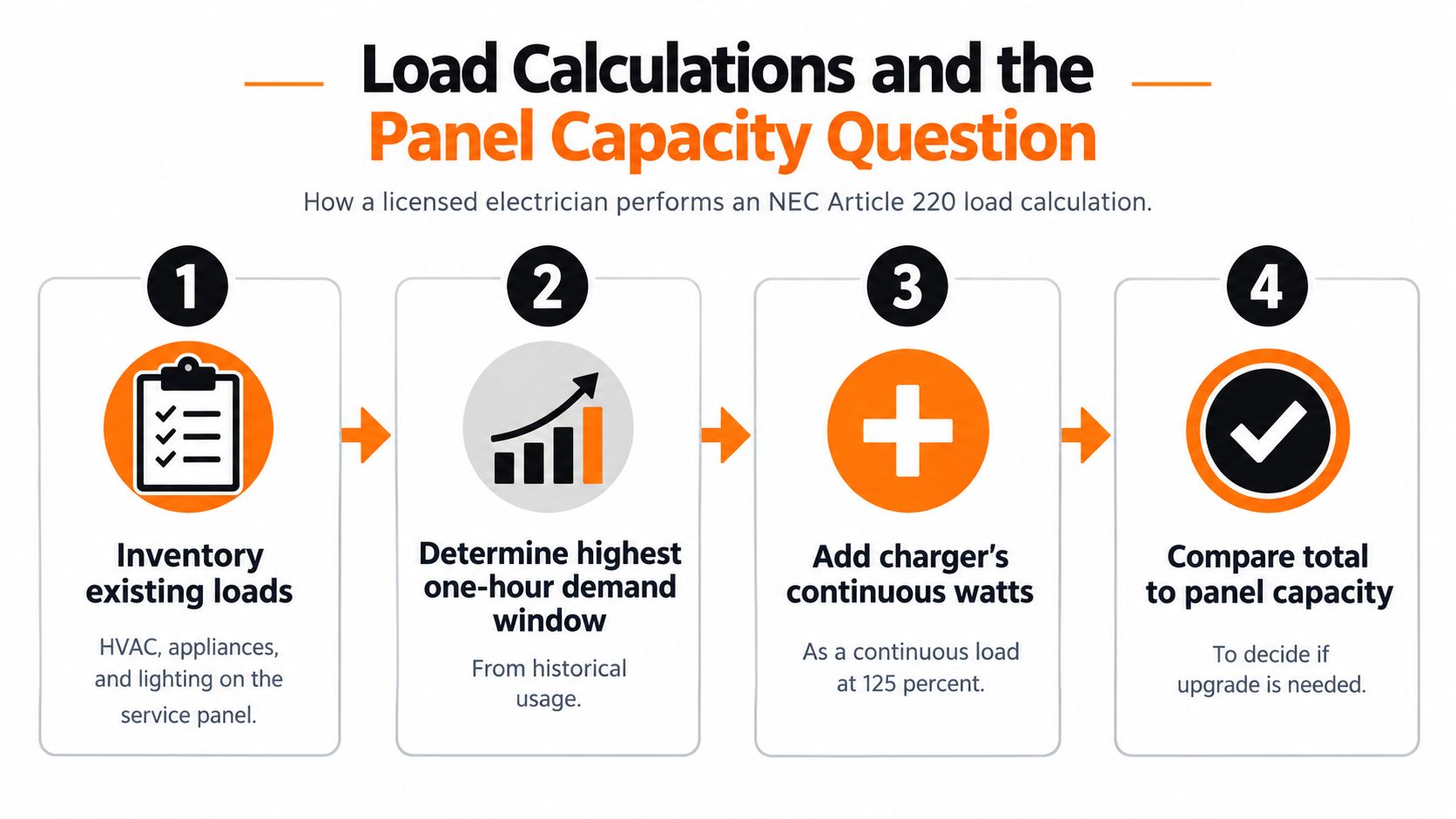
A panel's main rating doesn't tell the whole story. A licensed electrician looks at the service entrance, busbar rating, existing breakers, conductor condition, available spaces, and the household's calculated demand. The panel may have an open space for a breaker and still lack the service capacity for another continuous load.
The electrician typically performs a load calculation under NEC Article 220. The process involves identifying major loads such as air conditioning, cooking equipment, water heating, pumps, and general receptacle loads, then evaluating how those loads affect the service alongside the EVSE. The charger's continuous demand receives the required design treatment rather than being added as a casual appliance.
Why an open breaker space isn't enough
A breaker space answers a physical question. It tells you where a breaker might fit. It doesn't answer whether the service conductors, meter equipment, busbar, or utility connection can support the additional demand.
Older homes can have limited capacity even when the panel appears orderly. A newer home can also need careful analysis if it has electric heating, multiple air-conditioning systems, pool equipment, or other substantial loads. The electrician's calculation determines whether the charger can operate at its selected setting without exceeding the design capacity.
If the service can't support the charger directly, the solution isn't automatically a full panel replacement. Approved options may include:
- Smart load management: The system monitors household demand and reduces or pauses EV charging when other loads are active.
- Load-shedding controls: A relay temporarily disconnects a selected nonessential load while the vehicle charges.
- Energy-management equipment: The EVSE and building controls coordinate available capacity rather than assuming every load runs at full output simultaneously.
- A lower charger setting: A 32-amp or lower-output configuration may fit the home's actual charging needs better than a maximum-output unit.
DOE guidance describes EV-ready spaces using energy management with sizing as low as 2.1 kVA per space, showing why managed charging can change the service-entrance conversation rather than adding nameplate capacity. In a multi-vehicle property, the electrician must also consider whether ports operate together. NEVI-related guidance calls for certain AC ports to provide at least 6 kW per port simultaneously, illustrating why shared charging needs a different design approach than a single-car garage.
A panel upgrade remains appropriate when the equipment is obsolete, damaged, physically inadequate, or unable to support the required load-management arrangement. Homeowners considering that path can review this guide to panel upgrade cost considerations, then request a site-specific calculation rather than accepting a generic recommendation.
Site Assessment Checklist Before Installation Day
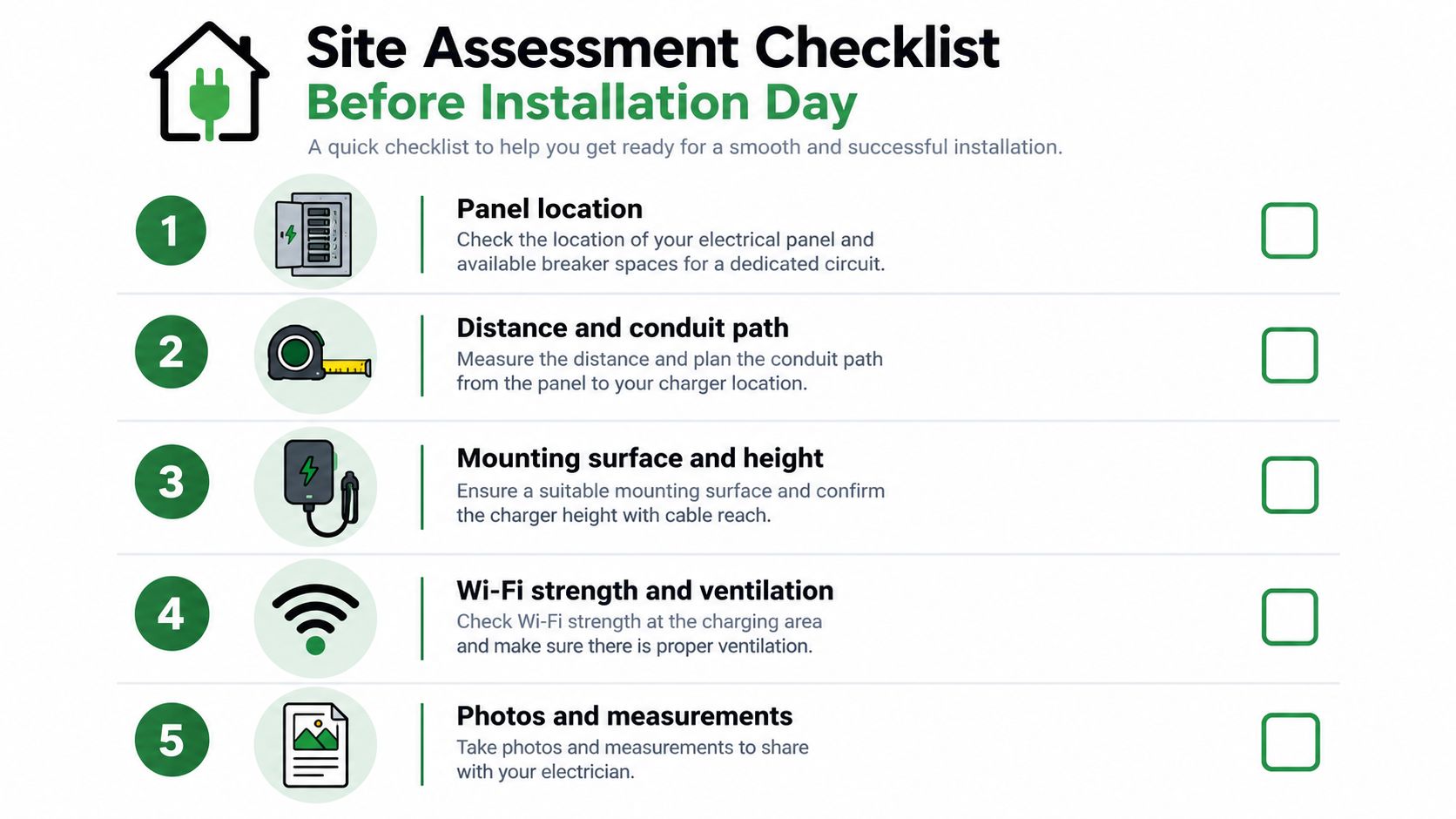
A little preparation makes the electrician's visit more useful. Walk through the route from the service panel to the vehicle, photograph obstacles, and decide where the charger would be convenient without leaving the cable across a walkway.
What you can check yourself
- Panel access: Note the panel location, main rating, visible unused spaces, and any signs of heat, corrosion, damage, or past modifications.
- Parking position: Park where you normally would and check whether the vehicle's charge port can reach the proposed charger location without stretching the cable.
- Mounting surface: Identify a solid wall, post, or pedestal that can support the equipment and keep the cable organized.
- Route conditions: Look for finished walls, attic access, masonry, landscaping, driveways, and other features that may affect conduit or trenching.
- Connectivity: Test Wi-Fi or cellular reception where a connected charger would be installed. The electrical installation can be correct even if the network signal is weak.
- Weather exposure: For an outdoor location, note direct sun, rain, irrigation spray, flooding risk, and physical impact hazards.
Keep the garage and panel area clear before the appointment. The electrician needs working space at the panel and a safe path to inspect, measure, and install equipment. The working-clearance dimensions must be verified for the actual installation under the adopted code, so don't treat furniture placement as a substitute for the electrician's assessment.
The contractor, not the homeowner, should decide whether the wiring belongs in conduit, behind a finished surface, through an attic, or underground. Share photos and measurements, but let the professional confirm conductor routing, protection, weather rating, mounting height, and disconnect access.
Permits, Inspections, and NEC Code Changes
Permitting isn't administrative decoration. It creates a documented review of the electrical design and gives the authority having jurisdiction a chance to verify that the work complies with the locally adopted code. The city or county may enforce an edition different from the newest published NEC, so ask which rules apply before equipment is ordered.
Recent guidance highlights tighter expectations around GFCI protection, permanent labeling, grounding continuity, and energy management. A 2026 code summary states that the 2025 NEC requires Class A GFCI protection for all EVSEs, adds permanent labeling provisions, and calls for grounding-continuity verification. The applicable requirement still depends on local adoption, so the installer must confirm the jurisdiction's current rules rather than applying a national assumption.
What happens on the job
An electrical permit covers the wiring and equipment installation. A building permit may apply if the work changes a structure, creates a pedestal, or involves other construction. HOA approval is separate and may govern exterior placement, shared parking, architectural appearance, or work in a managed community.
A typical inspection process may include:
- Permit filing: The contractor submits the scope, equipment details, and electrical design.
- Rough inspection: The inspector reviews concealed wiring, conduit, box placement, grounding, and protection before finishes hide the work.
- Final installation: The charger is mounted, terminations are completed, labels are installed, and the system is checked.
- Final inspection: The authority verifies accessibility, protection, workmanship, and compliance before the installation is approved.
The electrician should torque terminations to manufacturer specifications, verify grounding continuity, confirm the breaker and conductor relationship, and test protective devices. Labels should identify the EV circuit and the location of the overcurrent protection or disconnect where required.
Code language is also expanding beyond conductors and breakers. Funded public deployments may include communications expectations such as ISO 15118 and OCPP 2.0.1, which shows how managed charging increasingly involves software and control integration. For homeowners, the practical lesson is simple: ask who is pulling the permit, who is arranging inspection, and who is responsible if the inspector identifies a correction. Guidance about home EV charger installation and permitting can help you prepare those questions.
Timeline, Cost, and When to Call a Licensed Electrician
A permitted residential installation usually begins with a site visit. During the first appointment, the electrician reviews the service, identifies the charger location, traces the wiring route, and determines whether the project needs load management, panel work, trenching, or a straightforward branch circuit.
The schedule depends on the authority having jurisdiction, equipment availability, and site complexity. Permit review may take longer in one locality than another, and a detached garage can add excavation or feeder work. The installation itself may be completed in a working day for a simple route, while complex panel or structural work takes longer.
Costs also vary by scope. A short run using available panel capacity is a different project from one requiring a service upgrade, long conduit route, exterior trench, or detached-building connection. A quote should identify equipment, labor, permit fees, inspections, patching, trench restoration, load-management hardware, and commissioning separately.
| Project Type | Cost Range USD | Elapsed Time | Typical Scope |
|---|---|---|---|
| Straightforward installation | Site-specific quote | Site-specific schedule | Existing capacity, short route, standard mounting |
| Longer or more involved circuit | Site-specific quote | Depends on routing and permits | Longer conduit, difficult access, added protection |
| Capacity-constrained installation | Site-specific quote | Depends on design and inspection | Load management, panel work, or service changes |
| Detached garage installation | Site-specific quote | Depends on trenching and feeder work | Separate-structure wiring, grounding, disconnect, and charger |
Homeowners may be able to handle non-electrical preparation, such as clearing the work area or installing an approved mounting surface where local rules allow it. Panel work, breaker installation, conductor termination, testing, permitting, and final energizing should be handled by a licensed electrician.
Before hiring anyone, verify the contractor's state license through the applicable licensing authority, insurance coverage, EV installation experience, and labor warranty. Ask whether the electrician will register the permit under the company's license and whether the quote includes inspection corrections. If you're searching for a qualified provider, this resource for an EV charger electrician near you can help frame the questions to ask.
Lighthouse Energy Services evaluates panel capacity, dedicated-circuit requirements, load management, permitting, and charger placement for residential installations in Palm Beach County. Visit Lighthouse Energy Services to request an assessment and discuss a compliant Level 2 charging plan with an electrical professional.