You've got the car in the driveway, the app is set up, and the first question hits fast: where are you going to charge it every night?
That's the moment most West Palm Beach homeowners reach for generic advice and realize it doesn't quite fit. A new EV isn't hard to live with, but a good home charging setup depends on your panel, your parking layout, your permit path, and sometimes your HOA. If you've just moved, it helps to handle charging the same way you'd handle locks, water shutoffs, and electrical basics on day one. A practical resource like Sunset Shine Home Cleaning's checklist is useful because EV charging works best when it's treated as part of the whole-house setup, not a last-minute add-on.
West Palm Beach already has a visible public charging footprint, with 451 total EV charging stations, and the broader Miami, Fort Lauderdale, and West Palm Beach metro area has 3,878 public charging stations, according to ChargeHub's West Palm Beach charging data. That's good news when you're out running errands or commuting. It doesn't replace the convenience of plugging in at home and waking up ready to go.
Table of Contents
- Your Guide to At-Home EV Charging in West Palm Beach
- Choosing Your Charger Level 1 vs Level 2
- Preparing Your Home for an EV Charger
- Navigating Palm Beach County Permits and Inspections
- Budgeting for Your Installation Costs Timelines and Incentives
- Choosing a Licensed Electrician in West Palm Beach
- Frequently Asked Questions
Your Guide to At-Home EV Charging in West Palm Beach
Most homeowners start in the same place. The car comes with a charger, there's a garage outlet nearby, and it seems like you should be able to just plug in and move on. Sometimes that works. A lot of the time, it's only a temporary solution.
At-home charging in West Palm Beach works best when you match the setup to the way you drive. If the vehicle is used every day, if your commute isn't short, or if you don't want to think about battery level every evening, a proper home charger usually becomes part of the routine fast. The public network is there, but home charging is what removes the planning.
What matters most at the start
A good installation decision usually comes down to four things:
- Your driving pattern: A car used for short local trips has different charging needs than one used daily across Palm Beach County.
- Your electrical capacity: The charger has to fit the house, not just the car.
- Your parking situation: A single-family garage is simpler than a condo garage, shared parking area, or tight carport.
- Your approval path: In some neighborhoods, electrical work moves quickly. In others, HOA review adds another layer before permit approval.
Practical rule: The smoothest jobs are the ones planned from the panel outward, not from the charger box backward.
Homeowners often focus first on charger brand, cable length, or app features. Those details matter, but they aren't what determines whether the job passes inspection cleanly or turns into a delay. In West Palm Beach, the charger itself is usually the easy part. The harder part is getting the wiring path, panel capacity, permit paperwork, and property approvals lined up correctly.
What works and what doesn't
What works is a simple plan. Confirm the charging level you need. Check panel capacity. Identify the mounting location. Pull the permit. Install it cleanly. Schedule inspection. Then test the charger under real use.
What doesn't work is trying to shortcut the process with an overloaded panel, an unpermitted install, or HOA paperwork left until the last minute. That's where projects get expensive, slow, or both.
Choosing Your Charger Level 1 vs Level 2
You get home at 6:30, plug in, and expect the car to be ready by morning. Whether that works depends less on the charger brand and more on choosing the right charging level for your driving habits and your house.
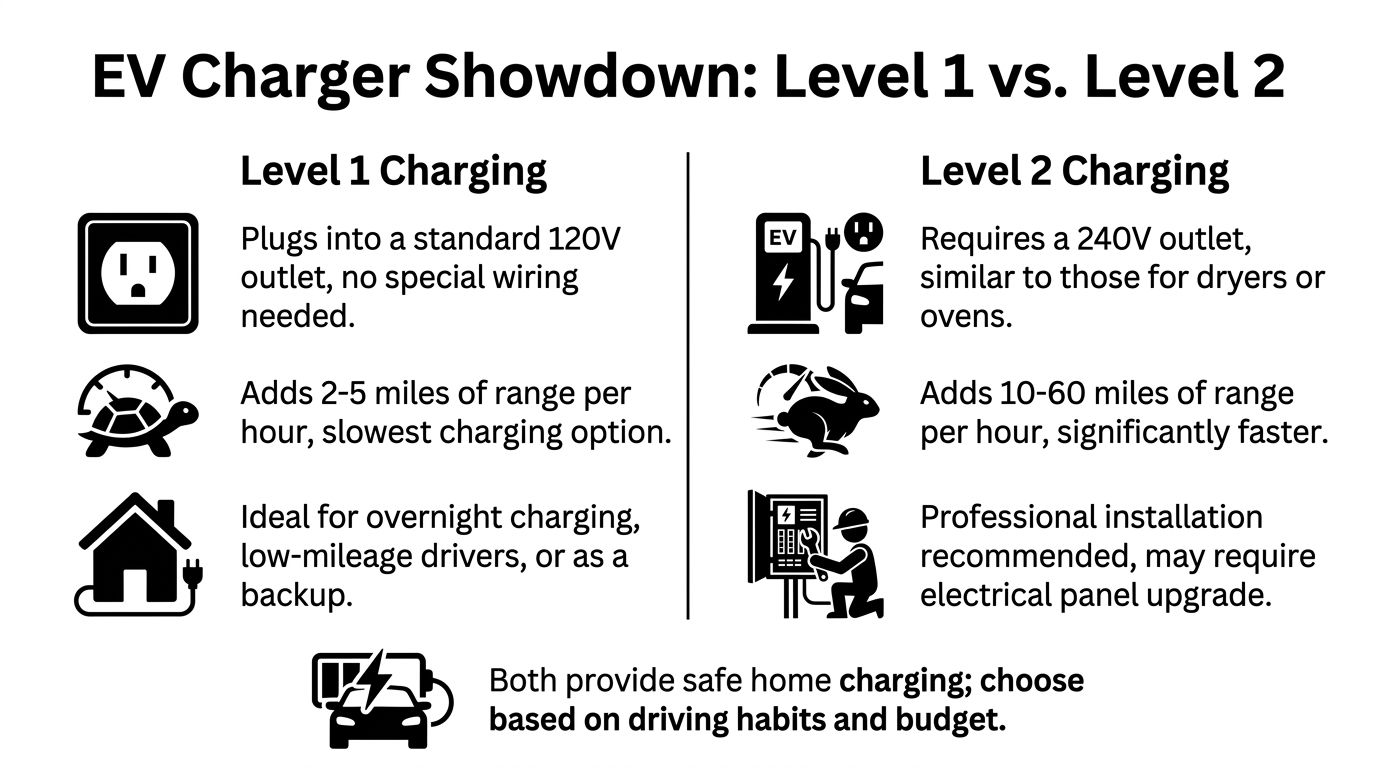
A Level 1 charger plugs into a standard 120-volt outlet. A Level 2 charger runs on a dedicated 240-volt circuit. Both charge the car. The difference is how practical they are once the novelty wears off and the car becomes part of the weekly routine.
What changes in real life
Level 1 works best for lighter use. It makes sense for plug-in hybrids, second vehicles, retirees who stay mostly local, or homeowners waiting on a panel upgrade before committing to a 240-volt circuit. It is also the least disruptive option if you already have a properly located outlet and the car stays parked for long stretches.
Level 2 is what most full EV owners in West Palm Beach end up wanting. Daily driving across Palm Beach County adds up fast, and slow overnight charging can become a nuisance once school runs, work trips, errands, and weekend miles all stack together. A Level 2 setup usually turns charging into a simple overnight habit instead of something you have to plan around.
The catch is electrical capacity. A Level 2 charger may be the better fit for the vehicle, but not every home is ready for it without added work. If your panel is older, full, or already near its limit, the charger decision can tie directly into a home electrical panel upgrade cost estimate.
Level 1 vs. Level 2 Charger Comparison
| Feature | Level 1 Charger | Level 2 Charger |
|---|---|---|
| Power source | Standard 120V outlet | Dedicated 240V circuit |
| Installation | Usually minimal if outlet is suitable | Usually requires electrical work |
| Speed | Slower daily charging | Faster daily charging |
| Best fit | Plug-in hybrids, backup use, low-mileage driving | Full EVs, daily commuting, households that need flexibility |
| Upfront cost | Lower for basic service | Higher if new circuit or panel work is needed |
| Electrical impact | Lighter demand on the home | Requires a dedicated circuit and capacity review |
One local issue homeowners miss is approval friction. In a single-family house, choosing Level 2 is usually a straight electrical decision. In a townhome, condo, or HOA-controlled property, the charger level can affect conduit routing, visible equipment placement, and whether the association asks for drawings or board approval before work starts.
That matters because Level 1 often slips in unobtrusively if an existing outlet can be used, while Level 2 is more likely to trigger questions about exterior conduit, parking assignments, and common-area wiring. In West Palm Beach, I have seen the electrical work itself take less time than the approval emails.
For most full EV households, Level 2 is the practical choice. For lighter driving, Level 1 can still be a reasonable answer. The right call depends on how far you drive, how long the car sits overnight, and whether your property can support the installation without turning a simple charger job into a panel, permit, or HOA project.
Preparing Your Home for an EV Charger
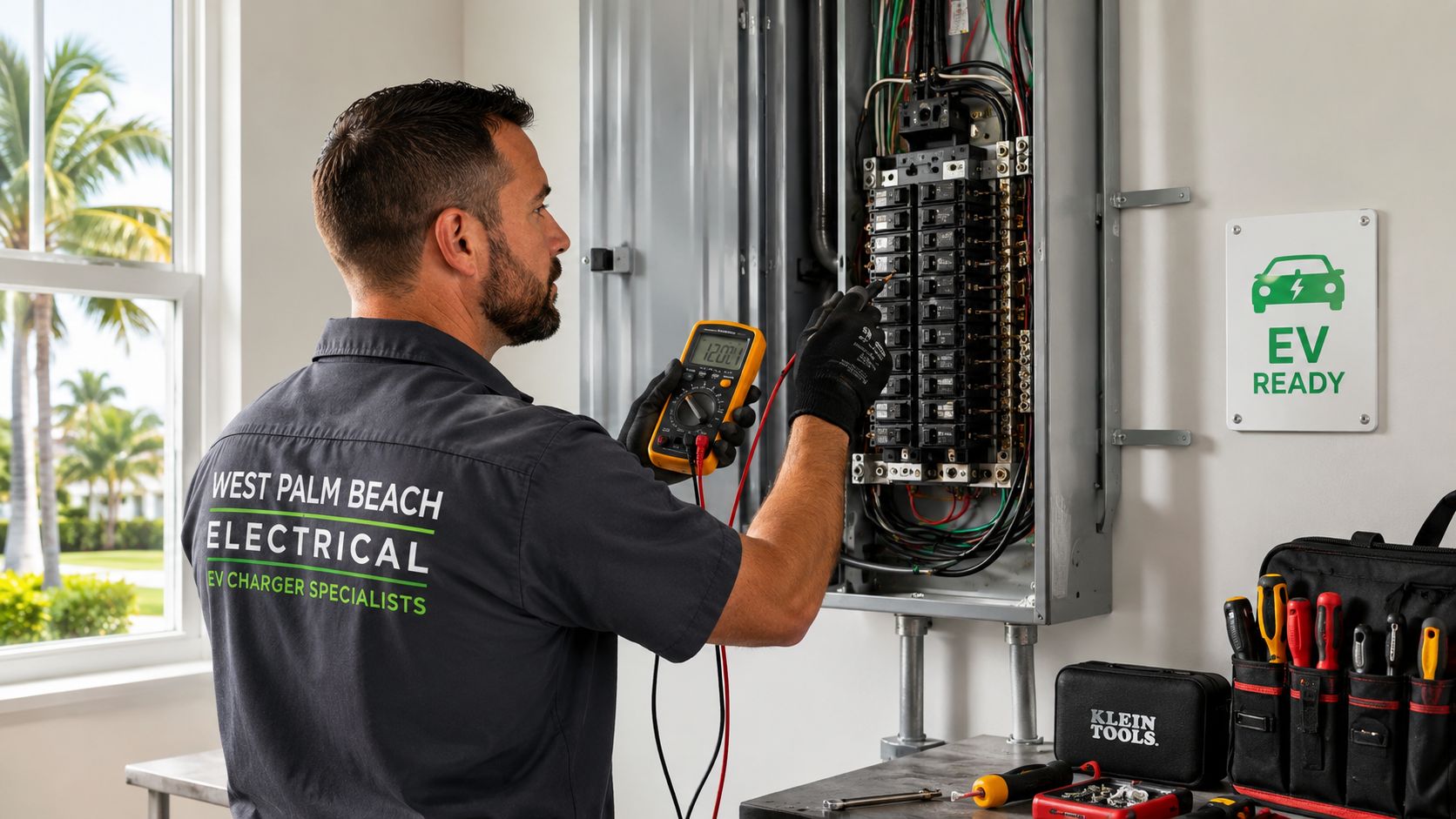
Before anyone mounts a charger on the wall, the electrical system has to be checked properly. That part isn't paperwork. It's safety.
What an electrician checks first
For a Level 2 setup, the charger needs a dedicated circuit breaker sized at least 125% of the charger's continuous load current. A common example is a 40-amp charger requiring a 50-amp double-pole breaker, as outlined in the EPA's home EV charging guidance.
That requirement matters because EV charging is a continuous load. It isn't like plugging in a small appliance for a few minutes. The equipment can draw power for hours at a time, so the circuit has to be designed for that duty.
The next step is the load calculation. A proper load calculation determines whether the existing service can handle the charger along with the rest of the home's electrical demand. In practical terms, that means looking at what's already on the panel, what size service you have, and whether another large continuous load pushes the house beyond a safe limit.
If someone skips the load calculation and just says, “We'll make it fit,” that's a bad sign.
What usually makes a job simple or complicated
A straightforward project usually has these features:
- Panel space is available: There's room for the new breaker without rearranging half the panel.
- The charger location is close: A garage wall near the panel is simpler than a detached parking pad.
- The service can support it: No major upgrade is needed to add the circuit.
- The mounting area is practical: The cable reaches the charge port without stretching across a walkway.
A more involved project can include a long conduit run, outdoor routing, limited breaker space, or a panel that's already near capacity. In those cases, the charger install turns into a broader electrical upgrade. If your electrician says the panel may need work first, it's worth reviewing a realistic home electrical panel upgrade cost guide before you commit.
There's also the question of wire size and environment. For example, outdoor and garage installs often need wiring methods suited to heat, moisture, and physical exposure. Clean conduit routing, proper support, and weather-appropriate materials matter just as much as breaker size.
What homeowners should do before the estimate
Have these answers ready before the site visit:
- Where do you park most nights
- Which side of the vehicle is the charge port on
- Do you want a wall-mounted charger or a receptacle for plug-in equipment
- Has the panel ever had issues with tripping, limited space, or prior upgrades
Those details save time and lead to a quote that reflects the actual job instead of a rough guess.
Navigating Palm Beach County Permits and Inspections
This is the part many homeowners underestimate.
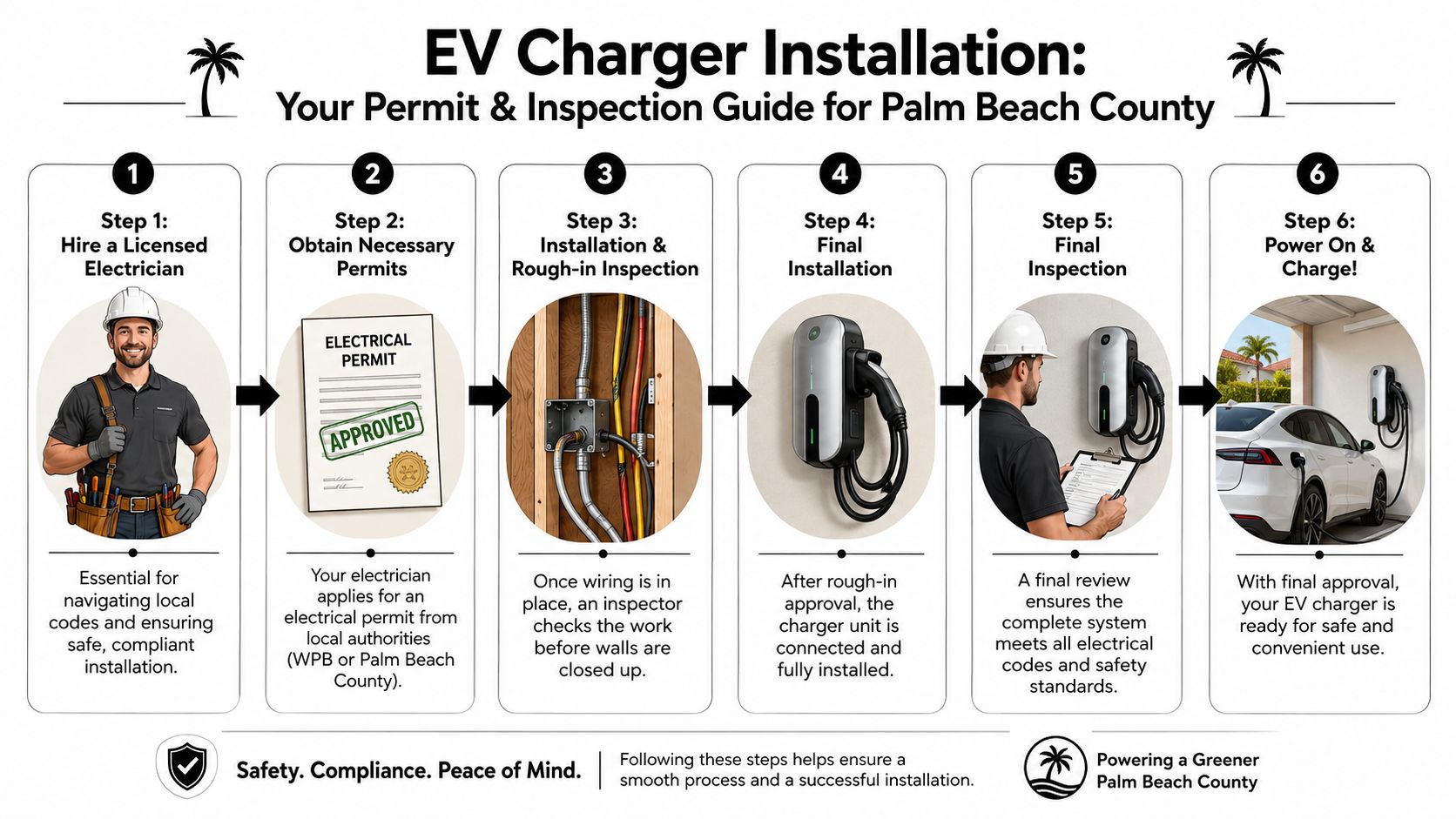
In West Palm Beach and throughout Florida, EV charger installation isn't just a convenience upgrade. It's regulated electrical work. According to Florida installation guidance for EV chargers, these projects require a city-issued electrical permit and a final inspection for compliance with Florida Building Code Chapter 24 and NEC 625. That same source states that failure to obtain permits results in 25% of installations being rejected or delayed during utility interconnection reviews.
What the permit process actually looks like
For a single-family home, the path is usually manageable when the contractor handles it correctly. The permit is pulled, the circuit is installed, the equipment is mounted, and the final inspection confirms code compliance before the project is considered complete. A homeowner who wants a plain-language overview of that process can review this at-home EV charger installation overview.
If the wiring is exposed during the work, the inspector may want to see specific stages before everything is closed up. If the route is simple and accessible, the process is often more straightforward. Either way, the permit record protects the homeowner because the work is documented and inspected.
Where West Palm Beach projects get stuck
The most common delays are rarely about the charger box itself. They usually come from mistakes around the installation details or approval chain.
Common trouble spots include:
- Permit not pulled at all: This creates problems later when inspection, utility coordination, or property sale documentation comes up.
- Conduit installed incorrectly: The same Florida guidance notes problems with improper conduit burial depth under 18 inches for PVC in wet locations.
- Terminations done poorly: That source also flags insufficient wire torque as a contributor to overheating incidents.
- Smart charger setup left unfinished: Initial communication problems can happen when the Wi-Fi setup or charger configuration is handled sloppily.
The cleanest-looking install can still fail if the paperwork is wrong or the electrical details don't match code.
The HOA issue most generic guides miss
In Palm Beach County, HOA and condo approvals can be the primary bottleneck. Standard online articles tend to talk about charger speed and equipment. They rarely deal with shared garages, architectural review committees, assigned parking spaces, or building management requirements.
That gap matters. A local review of West Palm Beach charging projects notes that Florida-specific HOA and multi-family garage approval barriers block roughly 40% of urban EV charger projects, according to this West Palm Beach EV charging article from Lighthouse Energy.
For homeowners in condos or communities with architectural review, the practical move is to treat approval as part of the electrical job from day one. Get the parking-space details, equipment cut sheets, mounting plan, and contractor information ready before filing. If you wait until after the permit conversation starts, the timeline usually stretches.
What works in the field
The projects that move best usually have three things in place:
- A complete scope of work that matches the property conditions.
- A permit application that isn't missing electrical details.
- An HOA package prepared before the board asks for revisions.
That's not glamorous, but it's what keeps Electric Car Charger Installation in West Palm Beach FL from turning into a stop-and-start project.
Budgeting for Your Installation Costs Timelines and Incentives
A charger can be a modest electrical job or a larger service upgrade. The difference usually has little to do with the box on the wall and a lot to do with your house.
In West Palm Beach, the price changes based on four things. How far the charger is from the panel, whether the panel has room and capacity, whether the wiring route stays simple, and whether the work triggers extra coordination with the city, county, or an HOA. Homeowners often focus on the charger price first. The labor and electrical scope usually drive the actual budget.
What changes the install cost
A straightforward Level 2 installation is the lower end of the range. That usually means an available breaker space, a short wire run, and a clean mounting location near the parking area.
Costs rise when the job needs:
- a longer circuit run through attic space, block walls, or finished areas
- load calculations that show the existing panel is already tight
- a subpanel or full panel replacement
- trenching or exterior conduit to reach a driveway or detached garage
- extra paperwork for community approval before work can start
That last item catches many Palm Beach County homeowners off guard. The electrical work may take part of a day. The approval cycle can take much longer.
Budget in phases, not just one number
The cleanest way to budget is to separate the project into three buckets:
- Electrical installation: breaker, wiring, conduit, receptacle or hardwire connection, mounting, and testing
- Property conditions: long distance runs, masonry work, panel limits, or exterior routing
- Project handling: permit filing, inspection scheduling, and document prep for HOA review if your community requires it
That format makes quotes easier to compare. It also exposes the low estimate that leaves out permit handling or assumes a wiring path that does not exist in the field.
If you want a benchmark for what a properly scoped contractor should explain before pricing, this licensed EV charger contractor in West Palm Beach guide covers the items I would expect to see addressed up front.
How long the project really takes
The installation itself is often the shortest part of the job. A standard charger install can usually be completed in one visit once approvals are in place and materials are on site. Jobs with service upgrades, difficult access, or correction work can take longer.
The bigger schedule variable in West Palm Beach is everything around the install. Permit processing, inspection windows, and HOA signoff can stretch the calendar well beyond the electrician's on-site hours. For single-family homes with no approval issues, the process is usually more predictable. Condos, townhome communities, and homes with architectural review tend to move slower.
Incentives and monthly-payment options
Federal tax incentives can reduce your net cost if your home and installation qualify. Tax rules change, and eligibility depends on your situation, so confirm the current requirements with your tax professional before you count on the credit in your budget.
Some homeowners also look at utility or program-based options that spread costs into monthly payments instead of paying everything up front. That can make sense if the program terms fit your property type and charging habits. Read the fine print on equipment ownership, service terms, and what happens if you move.
The charger is only part of the ownership math. For the bigger picture on day-to-day operating expenses, see Punk Ride insights on EV costs.
A low quote can turn into an expensive job if it skips panel review, permit work, or the actual routing needed to reach the car.
Ask for an itemized estimate. In this area, that is the fastest way to see whether you are comparing real scopes of work or just attractive starting numbers.
Choosing a Licensed Electrician in West Palm Beach
The charger matters. The electrician matters more.
A home EV charger is one of those jobs that looks simple from the outside. Mount a unit, run a circuit, plug in the car. But the work sits at the intersection of continuous-load code rules, local permit procedures, and in many neighborhoods, property approval issues. That's why the person doing the installation needs to know more than basic residential wiring.
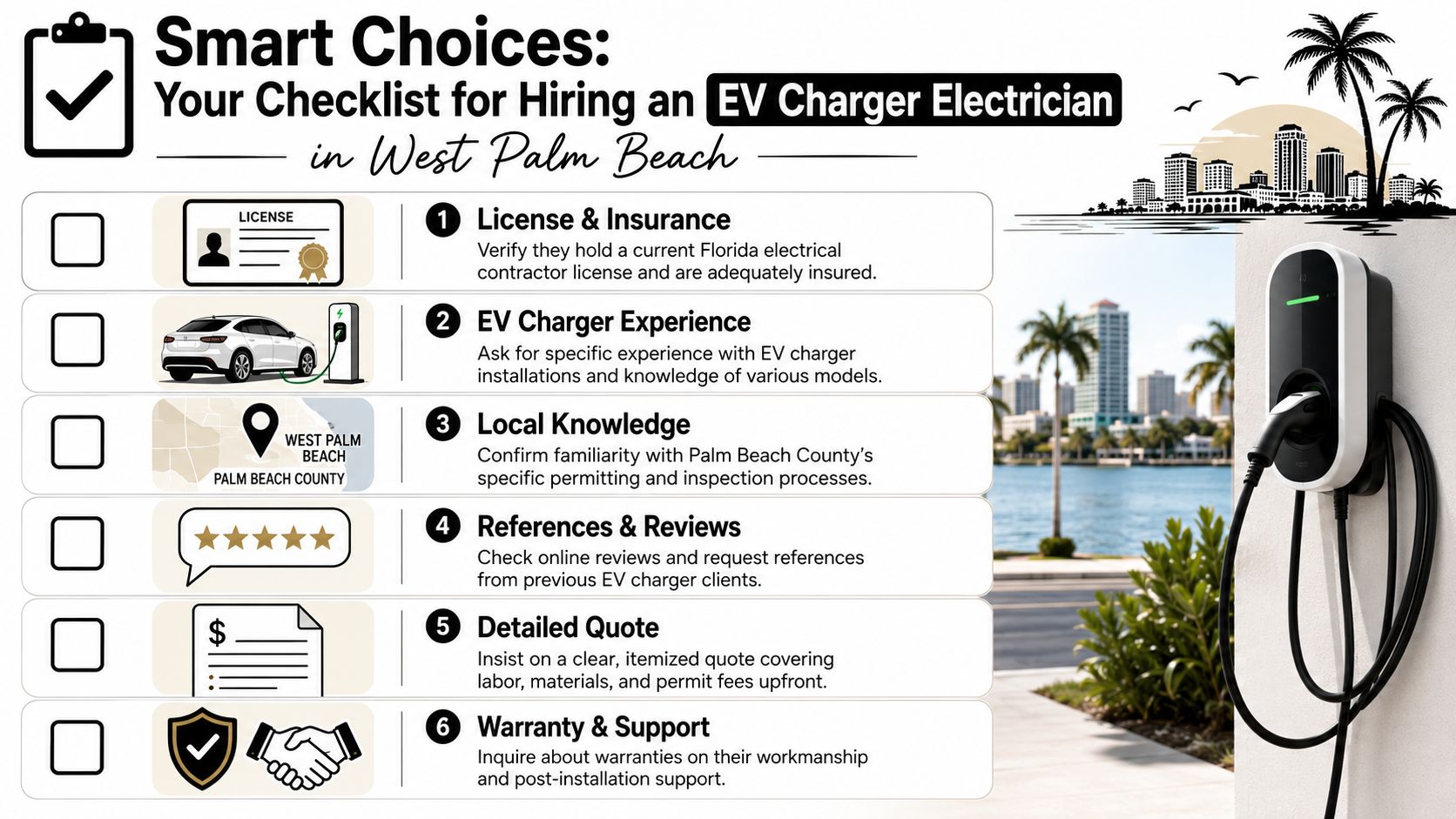
What to ask before you hire anyone
Use a real screening list before you schedule the work.
- License and insurance: Ask for proof that the contractor is properly licensed and insured for this type of electrical work.
- EV charger experience: Ask how they evaluate panel capacity, circuit sizing, and charger placement.
- Permit handling: Confirm who pulls the permit and who schedules inspection.
- HOA experience: This matters more in Palm Beach County than many homeowners expect.
- Itemized quote: You want labor, materials, permit-related work, and any assumptions spelled out.
- Support after installation: Ask who handles troubleshooting if the charger powers up but doesn't charge correctly.
A contractor should be able to answer those questions plainly. If the answers are vague, rushed, or dismissive, that usually shows up again later during the job.
What reliable service looks like on a real project
The local challenge that separates experienced electricians from general installers is the approval process around shared or regulated properties. As noted earlier, HOA and multi-family garage barriers block a large share of urban projects in this market. If a contractor doesn't understand that paperwork trail, the install can stall before the first piece of conduit goes up.
That's why it helps to choose someone with a visible local service focus, such as a licensed EV charger contractor in West Palm Beach, rather than someone treating charger work like a side add-on.
For homeowners also comparing the bigger ownership picture, Punk Ride insights on EV costs can be a useful companion read. It helps frame why many people want home charging done right from the start instead of piecing together a temporary setup.
Good EV charger work is organized before it's fast. The quote should reflect the real property conditions, not the easiest possible version of the job.
If you're evaluating providers locally, Lighthouse Energy Services is one option in Palm Beach County that offers electric car charger installation as a specific service. What matters most is that whichever licensed electrician you hire can handle the load review, permit process, installation details, and approval hurdles without leaving gaps for the homeowner to solve mid-project.
Frequently Asked Questions
Do I need a permit for a home EV charger in West Palm Beach
Yes. If you're adding a Level 2 charger, you're usually adding a new 240-volt circuit, and that requires permit and inspection handling through the local building process.
Can I install the charger first and deal with HOA approval later
That's a bad idea in any community with architectural review or shared parking rules. If your property has HOA or condo oversight, approval should be part of the planning before installation begins.
Is Level 1 enough for a full electric vehicle
Sometimes, but it depends on how you drive. For light use, it may be workable. For many full EV owners, Level 2 is what makes daily charging convenient instead of something you have to manage constantly.
Will every home need a panel upgrade
No. Some homes can support a charger with no major service changes. Others need panel work first. The answer comes from the load calculation, not from guessing based on house size.
How long does the whole process take
The electrical work itself may be fairly quick on a straightforward job, but the total timeline depends on permit processing, inspection scheduling, and whether HOA review is involved.
What's the biggest mistake homeowners make
Waiting too long to verify the panel, permit path, or property approval requirements. The equipment choice usually isn't what causes delays. The project setup is.
If you want a clear answer on what your home can support, the cleanest next step is to have a licensed local electrician review the panel, parking setup, and permit path before you buy equipment. Lighthouse Energy Services handles residential EV charger installations in Palm Beach County and can help you sort out the electrical scope, approval hurdles, and practical options for your property.