
A professionally installed Level 2 EV charger in West Palm Beach typically costs $1,313.03, and more complex or commercial-grade setups can approach $2,400. If you only need a basic Level 1 installation, the average is $237.60, but most property owners calling about daily charging convenience are really asking about a permitted Level 2 setup done right the first time.
If you're reading this, you're probably in one of two situations. You bought an EV and you're tired of slow charging from a standard outlet, or you're managing a condo, rental, or commercial property and need to sort out who can install chargers without creating permit problems, HOA disputes, or electrical hazards.
In West Palm Beach, the charger itself is only part of the job. The hard part is getting the installation, load evaluation, permitting, metering, and inspection process right. Generic online guides usually skip the local friction points. Palm Beach County doesn't. Neither do condo boards. And if the contractor you hire treats EV charging like a simple outlet add-on, you're the one who ends up paying for rework.
Table of Contents
- Choosing the Right EV Charger Before You Hire
- How to Vet a Licensed EV Charger Contractor in Palm Beach County
- Navigating Quotes Permits and HOA Approvals
- Budgeting for Your EV Charger Installation Costs and Incentives
- Installation Day What to Expect
- Frequently Asked Questions About EV Charger Installation
Choosing the Right EV Charger Before You Hire
Most bad EV charger jobs start before the contractor even shows up. The owner asks for “a charger” without deciding how fast they need to charge, where the unit should go, or whether the property can support the load cleanly.
That creates two common problems. The first is overbuying. The second is forcing a contractor to solve planning mistakes in the field, which is where costs climb and code issues start.
Start with how you actually drive
If your vehicle sits in the garage all night and you only need a modest overnight refill, a Level 1 charger may be enough. In West Palm Beach, a basic Level 1 installation averages $237.60, with a range of $181.03 to $294.17, based on local installation cost data for electricians in West Palm Beach.
Most homeowners, though, move quickly to Level 2 because it fits real life better. It runs on 240V, charges faster than Level 1, and is the standard choice for regular home use.
Commercial properties are a different conversation. DC Fast Charging is a public or fleet infrastructure decision, not a typical residential garage upgrade.
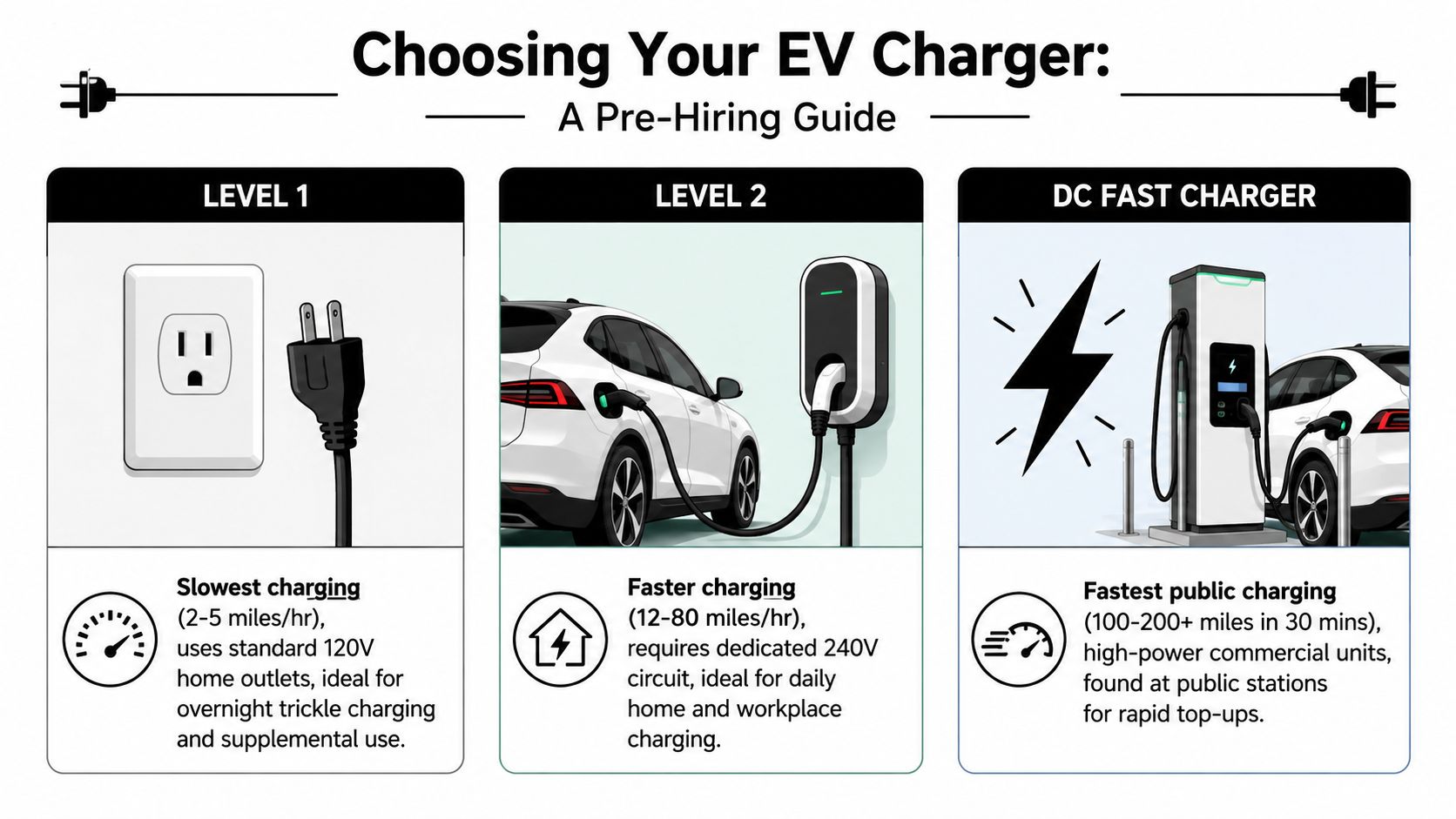
EV Charger Types at a Glance
| Feature | Level 1 Charger | Level 2 Charger | DC Fast Charger |
|---|---|---|---|
| Power source | Standard 120V outlet | Dedicated 240V circuit | High-power commercial service |
| Typical use | Overnight trickle charging | Daily home or workplace charging | Public or fleet rapid charging |
| Installation complexity | Lowest | Moderate to high | High |
| Best fit | Low-mileage drivers | Most homeowners | Commercial sites |
| Contractor involvement | Basic electrical review still matters | Licensed installation is the right path | Specialized commercial work |
Practical rule: Choose the charging speed based on your daily driving and parking habits, not on marketing language.
Location matters more than most owners expect
The charger location affects labor, wiring path, conduit exposure, mounting method, and whether the final installation looks clean or patched together.
A few decisions to settle before you request quotes:
- Garage wall or exterior wall: Exterior installs can work well, but they demand better planning for weather exposure, routing, and physical protection.
- Parking orientation: Back-in parking and front-in parking change cord reach and charger placement.
- Future vehicle changes: A charger mounted in the wrong corner might work for your current car and fail for the next one.
- Panel distance: The farther the run, the more labor and materials the contractor has to account for.
If you're in a condo or shared garage, location becomes even more technical. The charger has to fit your assigned or limited common element space, and the routing has to satisfy the association's rules without creating hazards for neighboring units or common areas.
A smart owner doesn't need to know every code article. You just need to know enough to ask the right first questions. What charger level fits my driving, where should it go, and can my existing electrical system support it safely?
How to Vet a Licensed EV Charger Contractor in Palm Beach County
A lot of people hear “licensed electrician” and stop there. That's not enough for EV charging work in Palm Beach County.
The contractor needs the right Florida credentials, active insurance, and real experience pulling local EVCS permits. The verified local guidance is clear that contractors in Palm Beach County should hold a valid Florida Certified Electrical Contractor license and show local experience handling EV charger permits, not just general electrical work, according to West Palm Beach electrician cost and contractor guidance.
The license matters but local EV permit experience matters too
A proper EV charger installation isn't just mounting hardware and landing wires. It involves permitting, grounding, circuit sizing, inspection coordination, and code compliance under the Florida Building Code and NEC.
If the property is a condominium, the legal standard gets even tighter. Florida Statute 718.113 grants most condominium owners the right to install an EV charger, but only if they use a licensed and insured contractor who meets all safety and permitting rules. With 72% of West Palm Beach's 451 chargers being Level 2, using a verified professional is a statutory and practical necessity, as noted in West Palm Beach charging station data and local charging infrastructure details.
That means the contractor should be comfortable dealing with:
- Board submittals: Charger specs, site sketches, wiring route, and permit plan
- Metering issues: Especially in master-metered or shared electrical environments
- Insurance documentation: Including naming the association when required
- Inspection sequencing: So the job doesn't stall after the rough-in
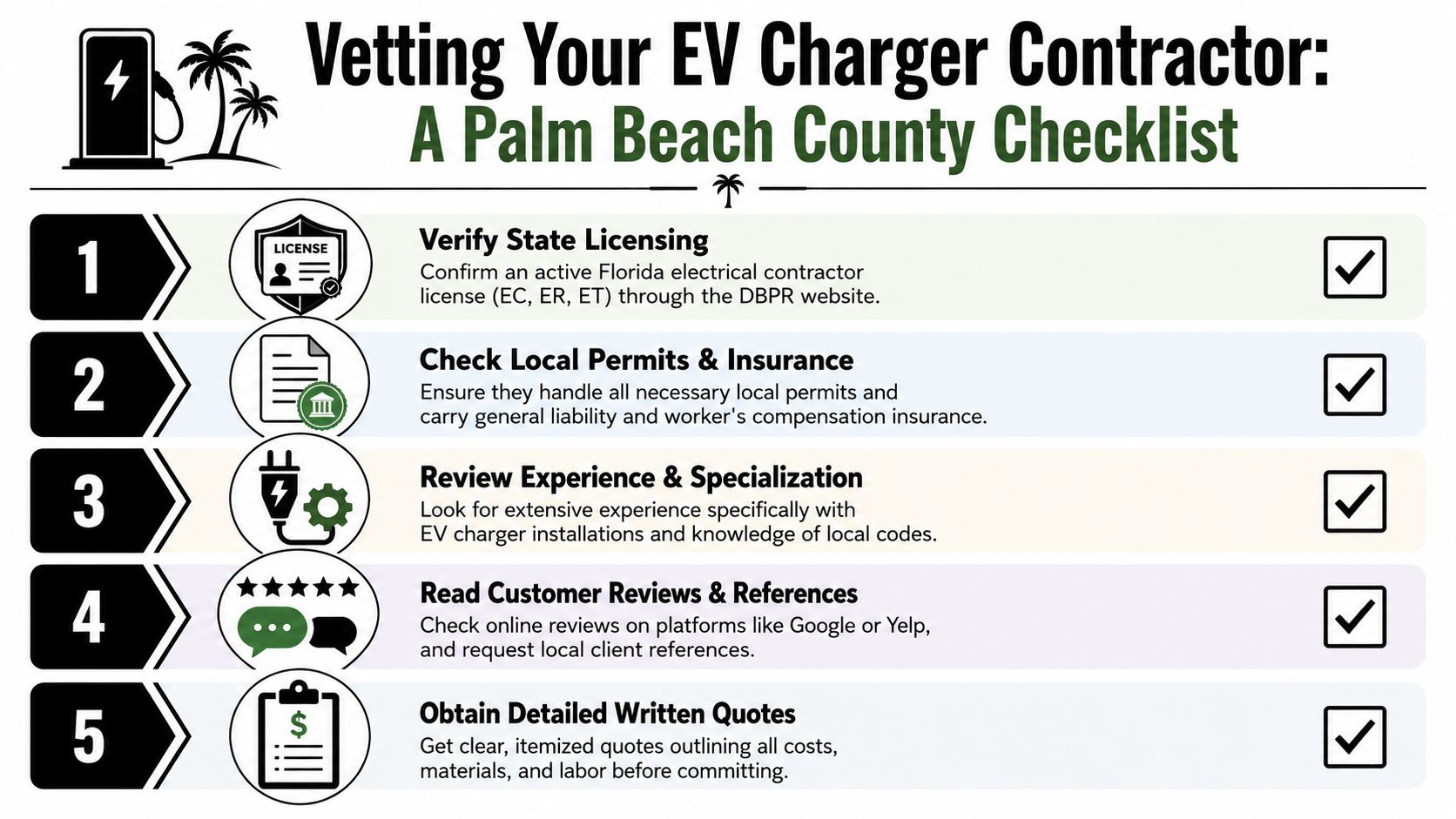
Questions that separate a pro from a shortcut artist
Ask direct questions. A qualified contractor won't get defensive.
- What Florida electrical license do you hold? You want a contractor who can legally contract for this work in Florida.
- Will you pull the permit yourself? If the answer is vague, keep looking.
- Have you handled EV charger permits in Palm Beach County before? Local process knowledge saves time.
- Who handles the load calculation and inspection coordination? It should be part of the job, not an afterthought.
- Have you worked on condo or HOA charger approvals? This matters if your installation involves common elements or board approval.
If a contractor says a permit isn't necessary for a new 240V EV charger circuit, that's a red flag.
One practical way to screen local contractors
Look at how the company presents itself online. Not because marketing proves technical skill, but because a contractor who clearly documents service areas, specialties, and contact information is often easier to verify. For property owners comparing firms, Netco Design's local SEO guide gives a useful framework for spotting whether a contractor has a real local footprint or just a thin lead-generation page.
If you want to compare one licensed option in the area, Lighthouse Energy Services' licensed electrical contractor page outlines the type of credentialed electrical work a properly established contractor should be able to discuss in detail.
The bottom line is simple. Hire the contractor who documents everything, answers cleanly, and doesn't try to talk you out of permits, insurance, or inspections.
Navigating Quotes Permits and HOA Approvals
Often, many projects bog down. The charger choice may be simple, but the paperwork isn't, especially in condos and managed properties.
The strongest quote isn't the cheapest one. It's the one that tells you exactly what the contractor plans to do, what assumptions they're making about your electrical system, and which approvals they will handle.
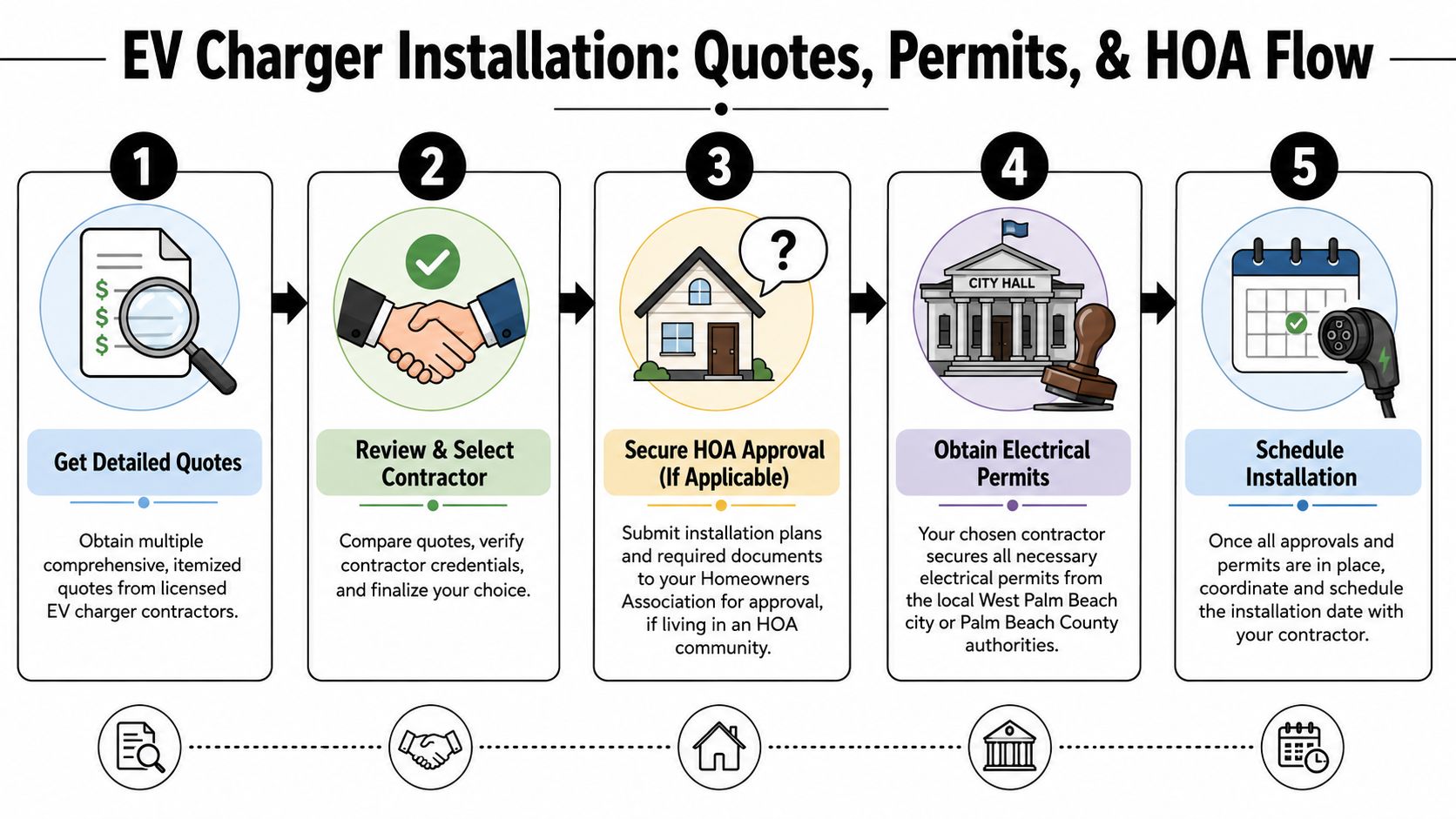
What a real quote should include
A professional EV charger proposal should spell out more than a charger model and labor total. It should identify the circuit requirement, mounting location, conduit path, whether drywall or surface raceway is involved, permit responsibility, and what happens if the panel can't support the new load.
For condo and HOA work, the written package should also align with board review requirements. In Palm Beach County, contractors must perform a professional load calculation, and projects that skip that step face a 25% higher failure rate in final inspections. Failing to include a compliant submetering plan is also a major reason applications get denied, accounting for 30% to 40% of HOA rejections, based on the verified local guidance provided for Palm Beach County installations.
Where condo and HOA jobs usually go sideways
Florida Statute 718.113 gives many condo owners a legal path to install a charger, but the owner still has to meet the conditions. The most common failures aren't dramatic. They're paperwork failures.
Typical problem areas include:
- Incomplete board package: Missing charger spec sheet, wiring route, permit plan, or license information
- Metering gap: No separate meter or submetering plan that satisfies the applicable rule
- Insurance issue: The association isn't named as an additional insured when required
- No load evaluation: The electrical panel is assumed adequate without professional verification
The verified local protocol also notes that 85% of approved installations in Palm Beach County use Level 2 chargers (240V, 40A) and require a minimum 150-amp panel with professional evaluation. When contractors skip that evaluation, they risk panel imbalance or short-circuiting, which leads to 15% of post-installation failures.
Good EV charger work is electrical work first and charger work second.
The cleanest approval path
For a managed property, the smoothest jobs usually follow this order:
- Confirm parking rights for the assigned or limited common element space.
- Gather a complete submittal package with equipment details, routing, licensing, permit plan, and insurance.
- Complete the load calculation before finalizing the installation design.
- Resolve metering early so the board doesn't have to guess how electricity use will be billed.
- Pull the permit and schedule inspection through the licensed contractor.
When the contractor already understands how municipalities and associations want the file organized, approvals move faster and the field work gets easier. For owners reviewing contractors that regularly handle permitted projects, this overview of government-approved electrical contractors shows the kind of compliance-oriented service profile you should expect.
The mistake to avoid is hiring someone who prices the work as if board review, metering, and inspection are side issues. In Palm Beach County, they're part of the job.
Budgeting for Your EV Charger Installation Costs and Incentives
A homeowner gets a low quote for a garage charger, then actual costs become apparent after the work starts. The panel has no spare capacity. The HOA wants a revised plan. The permit requires corrections. That is how a simple EV charger install turns into expensive rework in Palm Beach County.
Budget for the full electrical project, not just the charger on the wall.
Installed cost in West Palm Beach usually depends on distance from the panel, wall construction, available capacity, and whether the property is a single-family home, condo, or mixed-use building. A straightforward install with an open panel and a short wire run costs far less than a job that needs long conduit runs, panel corrections, load-management equipment, or common-area routing.
What changes the price
The charger itself is only part of the total. Labor, electrical capacity, and property restrictions usually decide where the final number lands.
Common cost drivers include:
- Wire run length and access: A charger mounted near the main panel is one scope. A detached garage, finished interior path, or exterior conduit run is another.
- Panel condition and available capacity: If the panel is full, undersized, or has defects that need correction, the charger install gets broader fast. Homeowners comparing quotes should review this electrical panel upgrades guide so they can tell the difference between a standard charger circuit and a larger service upgrade.
- Wall and mounting conditions: Block walls, finished surfaces, weather exposure, and trenching all add labor and material.
- Condo and HOA requirements: In Palm Beach County, the paperwork can affect cost as much as the field work. Florida Statute 718.113 limits how associations can restrict certain installations, but owners still have to follow reasonable approval rules, insurance requirements, and common-element access procedures.
- Metering and billing setup: Shared parking areas often require a clear plan for who pays for electricity before the job is approved.
- Permit corrections: A cheap quote that skips permit detail often gets expensive later.
That last point gets missed in generic pricing guides. In this county, a contractor who prices the job correctly from the start usually includes permit handling, documentation, and a real load review. A lower number on paper can mean the hard parts were left out.
Incentives help, but they should not carry the budget
Build the budget around the installed cost first. Then check whether tax credits, utility programs, or property-specific incentives apply.
Use a simple checklist:
- Confirm the charger and installation method meet current program rules
- Keep the paid invoice, permit record, inspection record, and equipment details
- Make sure the invoice separates equipment from labor if an application requires it
- Verify deadlines before the work starts, not after
Paperwork matters here. If the permit name, charger model, or installation address does not match the incentive application, the savings can disappear.
The practical goal is simple. Get a code-compliant installation approved the first time, with clean documentation and no surprise change orders. That usually costs less than fixing an underpriced job after the county inspector or the association sends it back.
Installation Day What to Expect
On installation day, the best jobs feel organized from the first few minutes. The crew confirms the scope, protects the work area, verifies the mounting point, and checks that the field conditions still match the approved plan.
If the actual site doesn't match the approved route, a professional stops and addresses it before drilling holes or running conduit. That's not a delay. That's how rework gets avoided.
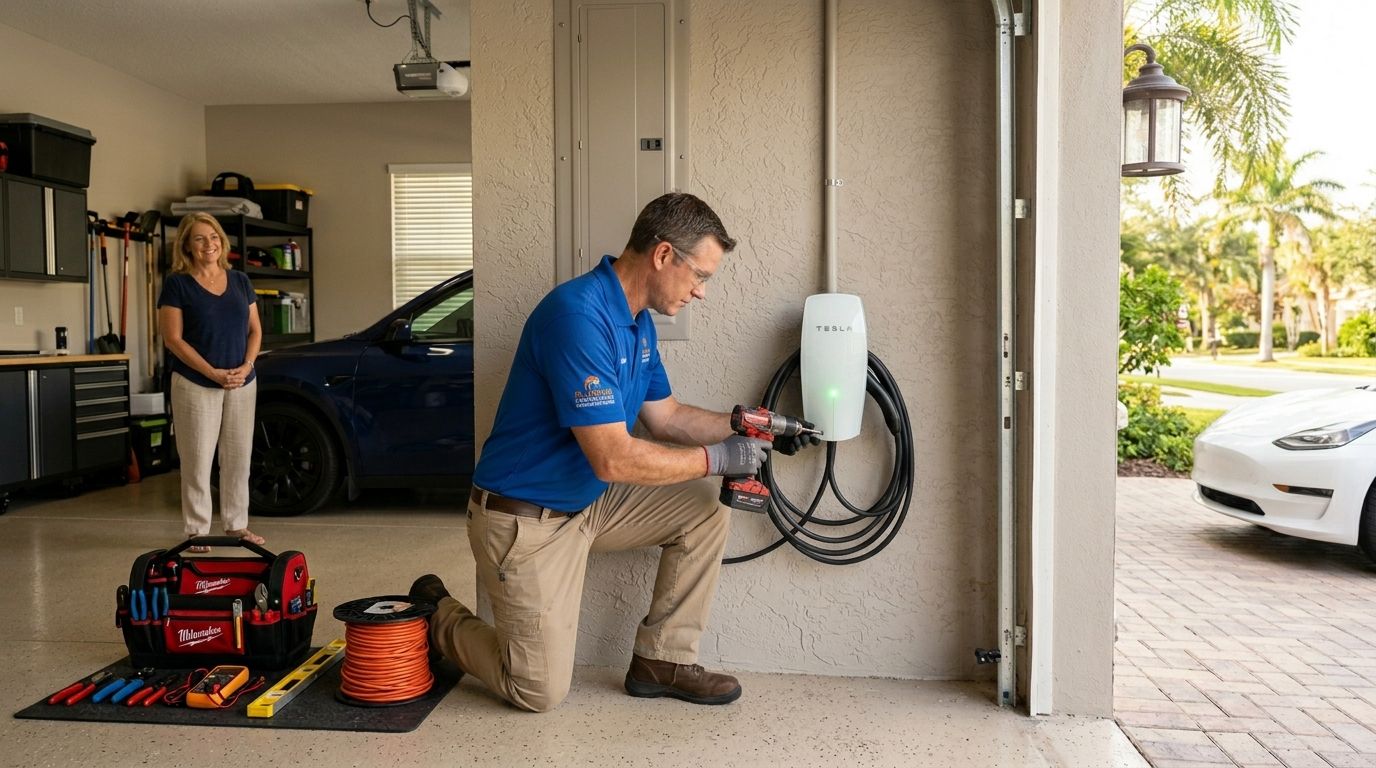
What a professional crew does before tools come out
A proper visit usually starts with a brief walk-through. The electrician confirms panel location, breaker space, wire route, charger height, and whether any HOA or property-management restrictions affect the final placement.
Then the work area gets protected. In a garage, that often means moving stored items clear of the wall, covering nearby surfaces if cutting or drilling is needed, and keeping the path from panel to charger location controlled and tidy.
You should also expect clear communication if the crew finds something unexpected, such as an obstructed wall cavity, prior undocumented wiring, or a panel condition that changes the original installation assumption.
Clean installation work isn't just about appearance. It shows the contractor planned the job instead of improvising it.
What happens after the charger is mounted
Once the electrical work is complete, the job shouldn't end with “you're all set.” The contractor should test charger operation, verify the circuit performs correctly, and walk you through normal use.
That handoff usually includes:
- Basic operation: How to connect, start charging, and recognize normal status lights
- Reset or shutdown process: What to do if the charger faults or loses power
- Inspection and permit closeout: What still needs to happen, if final inspection is pending
- Warranty and records: What paperwork you should keep with the property file
For property managers, this last part matters a lot. Keep the permit record, installation invoice, charger model information, and any HOA approval documents together. If the unit is sold, leased, or reviewed later by the association, you'll want that file complete.
A professional installation day should feel boring in the best possible way. No confusion, no improvising, no mess left behind.
Frequently Asked Questions About EV Charger Installation
Can I install my own EV charger if I'm handy
A portable charger plugged into an existing receptacle is one thing. A new Level 2 circuit or hardwired charger is different. That work brings permit requirements, continuous-load calculations, breaker sizing, wire sizing, grounding, and inspection into play.
In Palm Beach County, a bad DIY install can create more than a failed inspection. It can trigger HOA complaints, insurance issues, and expensive rework after walls have already been opened.
Do condo owners in West Palm Beach have the right to install a charger
In many cases, yes. Florida Statute 718.113 gives condominium owners a path to install a charger in an assigned or limited common element parking space, but the association can still require a proper application, licensed installation, permits, proof of insurance, and a plan for electric metering.
That is where condo projects usually stall. The issue is rarely the charger itself. It is incomplete HOA paperwork, unclear responsibility for power usage, or a contractor who does not understand how the association wants conduit routing, shutdown coordination, and common-area access handled.
Should I install the fastest charger my vehicle can accept
Choose the charger that fits your daily use and your property's electrical system. A higher-output unit can increase labor, require larger conductors, and push the job into panel upgrades or load-management equipment that you may not need.
For many homes, the best setup is the one that restores your daily driving overnight without overbuilding the job.
What if my panel doesn't have enough capacity
Stop and redesign the project before installation starts. That can mean lowering the charger output, adding load management, installing a subpanel, or upgrading service equipment.
What should never happen is forcing an EV charger onto a panel that has not been properly evaluated. That is how overheated breakers, nuisance tripping, failed inspections, and callback costs show up.
How long does the process usually take
At a single-family home, the field work is often the shortest part of the job. In condos and managed properties, approvals usually control the schedule.
If the HOA package is complete, the permit path is clear, and there are no surprises with panel capacity or access, installation can move quickly after approval. If any of those pieces are missing, the job slows down before the first wire is pulled.
Do EV chargers need maintenance
They do not need much routine maintenance, but they should not be ignored. Check the cord, connector, mounting hardware, and enclosure condition from time to time, especially in parking areas exposed to heat, sprinklers, salt air, or impact.
If the charger starts faulting, trips the breaker, shows heat damage, or charges inconsistently, shut it down and have a licensed electrician inspect it before using it again.
If you're looking for a licensed EV charger contractor in West Palm Beach, FL, start with a real site assessment. Make sure the quote covers load evaluation where required, permitting, inspection, and any HOA conditions before work begins. That is how you avoid permit shortcuts, rejected condo applications, and costly changes halfway through the job.
If you want a clean, code-compliant EV charger installation without permit shortcuts or HOA surprises, Lighthouse Energy Services handles residential and commercial electrical work in Palm Beach County, including EV charging projects that need proper planning, permitting, and professional execution.