
A humid Palm Beach evening is when a rooftop obstruction light earns its keep. A telecom crew is securing the last cable on a tall monopole while general aviation traffic moves along the coast. From the ground, a failed beacon may look like a minor electrical issue. From the cockpit, an unmarked structure can become a dangerous visual surprise.
Building owners usually call after a light has failed, a tenant has raised a glare complaint, or a permit reviewer has asked for documentation. By then, the job isn't just replacing a fixture. The installation has to match the structure's geometry, the FAA determination, the approved equipment specification, local electrical requirements, and the maintenance plan that keeps the system operational.
Table of Contents
- Why Towers and Rooftops Need Obstruction Lights
- The FAA and ICAO Rules That Govern Every Installation
- Light Types and Technologies Building Owners Can Choose
- Site Assessment and Where Lights Actually Go
- How a Professional Installation Workflow Runs
- Inspection, Maintenance, and Long-Term Compliance
- Typical Costs and Why a Local Licensed Contractor Matters
Why Towers and Rooftops Need Obstruction Lights
Aircraft obstruction lighting exists to make structures conspicuous to pilots, especially during night operations, reduced visibility, helicopter flights, medical transport, and general aviation. Telecom towers, broadcast antennas, wind turbines, high-rise buildings, cranes, billboards, and bridges can all create hazards when their profiles blend into the surrounding environment.
The first threshold many owners know is more than 200 feet above ground level. Structures at that height must be evaluated through the FAA process. Shorter structures can still require marking or lighting when they penetrate protected airspace surfaces near airports or become hazards through an FAA aeronautical study. That's why a shorter rooftop installation near an airport or heliport may receive more scrutiny than a taller structure in a less sensitive location.
Height alone doesn't decide the answer
The FAA considers the structure's location, elevation, relationship to nearby airports, and effect on navigable airspace. Owners generally begin with FAA Form 7460-1, the notice used for proposed construction or alteration. The resulting determination tells the owner whether marking, lighting, or both are required.
That determination matters more than a contractor's preferred product. A building owner may want a bright white beacon because it's easy to see from the ground, but the approved configuration could require red steady-burning lights, flashing systems, dual-mode equipment, or a specific arrangement at several elevations.
Practical rule: Treat obstruction lighting as a life-safety system, not as rooftop decoration.
A functioning light also needs correct placement. A fixture hidden behind a parapet, antenna array, structural member, or tower component can leave a dead zone even when its power supply and lamp are working. The FAA's guidance connects light layout to pilot visibility from different approach directions, so “the light turns on” isn't enough to prove that the installation performs its intended safety function.
Non-compliance creates more than a repair bill
An owner who ignores a required system can face FAA enforcement, mandated corrective work, and disputes over responsibility after an incident. A lighting failure can also create insurance questions and tort liability if a collision or near miss involves the structure.
The right mindset is simple. If a structure presents an aviation hazard, its lighting belongs in the same risk-management category as emergency power, grounding, and fire protection. You need an approved design, qualified equipment, competent installation, and records that show the system has been maintained.
The FAA and ICAO Rules That Govern Every Installation
The FAA framework has two documents that owners need to understand. AC 70/7460-1 describes standards for marking and lighting structures to promote aviation safety. The FAA currently lists AC 70/7460-1N with an issue date of 2026-08-11, following earlier versions including AC 70/7460-1L, effective 2016-10-08, and AC 70/7460-1M, effective 2020-11-16. That history shows an active regulatory framework, not a one-time rule. The FAA's current obstruction marking and lighting circular should be checked before a new installation or replacement.
AC 150/5345-43 addresses the equipment itself. The FAA issued AC 150/5345-43J on 2019-03-11, defining requirements for obstruction lighting equipment used to improve structure conspicuity for pilots. In plain language, one document helps determine what the structure needs, while the other defines what the lighting equipment must be able to do.
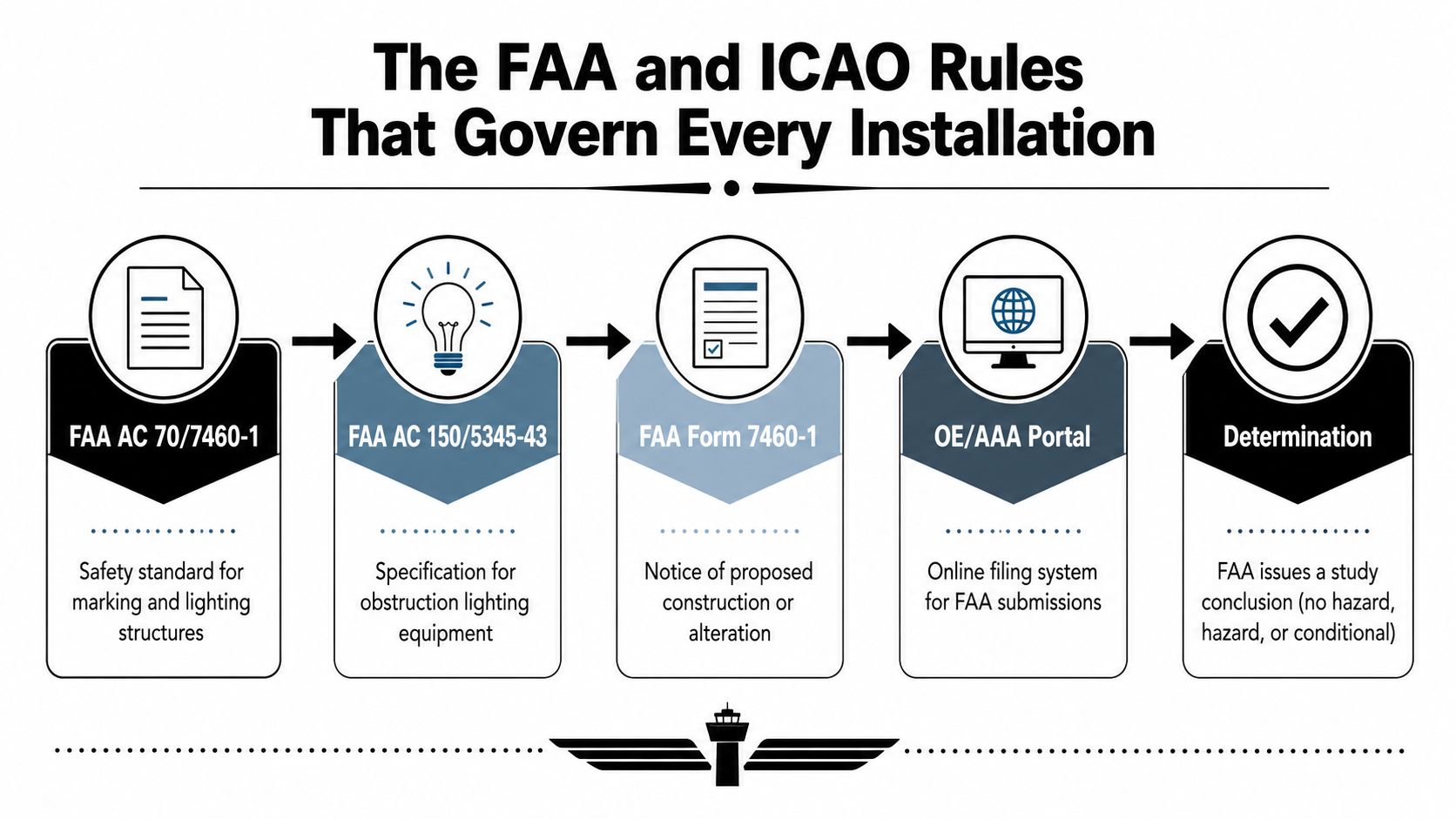
Follow the filing before choosing fixtures
A practical project sequence looks like this:
- Define the proposed structure. Document its location, height, elevation, rooftop features, antennas, cranes, and planned lighting arrangement.
- Submit FAA Form 7460-1. Use the FAA's OE/AAA filing process for the proposed construction or alteration.
- Read the determination carefully. The FAA conclusion may identify a hazard, no hazard, or conditions involving marking and lighting.
- Design from that determination. The letter becomes part of the construction record and should guide the contractor's equipment selection.
- Refile material changes. A change in height, location, structural profile, or lighting plan can require a new review.
Equipment qualification also has a procurement consequence. In AC 150/5345-43H, the FAA stated that equipment qualified under that circular would be the only equipment listed in AC 150/5345-53 after 12 months from the circular's date, creating a one-year transition period for procurement and installation planning. The same specification says its requirements are mandatory for lighting or projects funded under the Airport Improvement Program or Passenger Facility Charges program. The FAA equipment specification explains why legacy inventory shouldn't be accepted without verification.
International projects may also involve ICAO specifications, including Type A, B, and C low-, medium-, and high-intensity classifications. Local building permits, the National Electrical Code for wiring, and communications licensing requirements can add another layer. The takeaway is direct: the FAA determination drives the design, not the installer's preference.
Light Types and Technologies Building Owners Can Choose
Owners make four separate equipment decisions, and confusing them is how projects get mispriced or installed incorrectly. The first is the light source. Modern LED obstruction fixtures generally offer lower electrical demand, longer service life, and better resistance to repeated switching than older incandescent or xenon equipment. That doesn't make every LED fixture acceptable. The unit still has to meet the applicable FAA equipment requirements and match the approved system.
The second decision is the burn pattern. L-810 fixtures provide steady-burning red light for lower-intensity applications. L-864 systems provide medium-intensity flashing red light, while white flashing systems serve different daytime and structure conditions. Dual systems combine red and white operation when the approved design calls for different day and night visibility.
Match the system to the structure
Color isn't a style choice. Red systems are common for many structures, while medium- or high-intensity white systems may be required for specific heights, locations, or visibility conditions. Automatic intensity reduction can help manage nighttime glare, but the controller must preserve the approved operating pattern. In dense Palm Beach neighborhoods, smarter intensity control and correct shielding are usually better answers than installing the brightest available beacon.
Power selection follows the site. A hardwired system suits a building with dependable electrical service and an accessible raceway path. A solar system can serve a remote tower or temporary construction crane, but the battery, charge controller, panel orientation, and Florida storm exposure all need to be engineered together. DC battery-backed equipment can provide resilience where an outage would otherwise darken the structure.
| Structure Type | Typical Fixture | Color | Power |
|---|---|---|---|
| Lower rooftop or monopole | L-810 steady-burning unit | Red | Hardwired or matched solar system |
| Mid-rise rooftop | Dual L-810 and L-864 arrangement | Red, with approved flashing mode | Hardwired with controller |
| Tall broadcast or communications structure | Higher-intensity flashing system | White, red, or dual mode as approved | Hardwired with backup strategy |
| Temporary crane or remote structure | Approved low-intensity or flashing unit | As required by the determination | Solar or battery-backed DC |
Installers should also standardize the equipment family across one structure. Mixing manufacturers can complicate controller compatibility, flash synchronization, replacement parts, and FAA acceptance. For adjacent electrical work, building managers may also need practical, durable CSA-compliant work lights for crews working around rooftop equipment, but those work lights don't replace aviation obstruction fixtures.
The electrical infrastructure deserves the same care as the beacon. A contractor handling related commercial lighting may also need to coordinate parking lot lighting repair and LED upgrades so exterior lighting doesn't interfere with rooftop access or service planning.
Site Assessment and Where Lights Actually Go
Obstruction light placement is geometry-driven. A crew shouldn't arrive with a box of fixtures and decide where they look most convenient. The assessment begins with the structure's height above ground level, its elevation above mean sea level, the highest prominent point, nearby airports and heliports, and any structural feature that can hide the light from an approaching aircraft.
The FAA's guidance states that structures 150 feet AGL or less should have at least two steady-burning red L-810 lights arranged so a pilot has an unobstructed view of one or more lights. The lights need to outline the prominent profile rather than sit together on one convenient bracket. For taller structures, higher-intensity flashing systems and carefully arranged intermediate levels may be required.
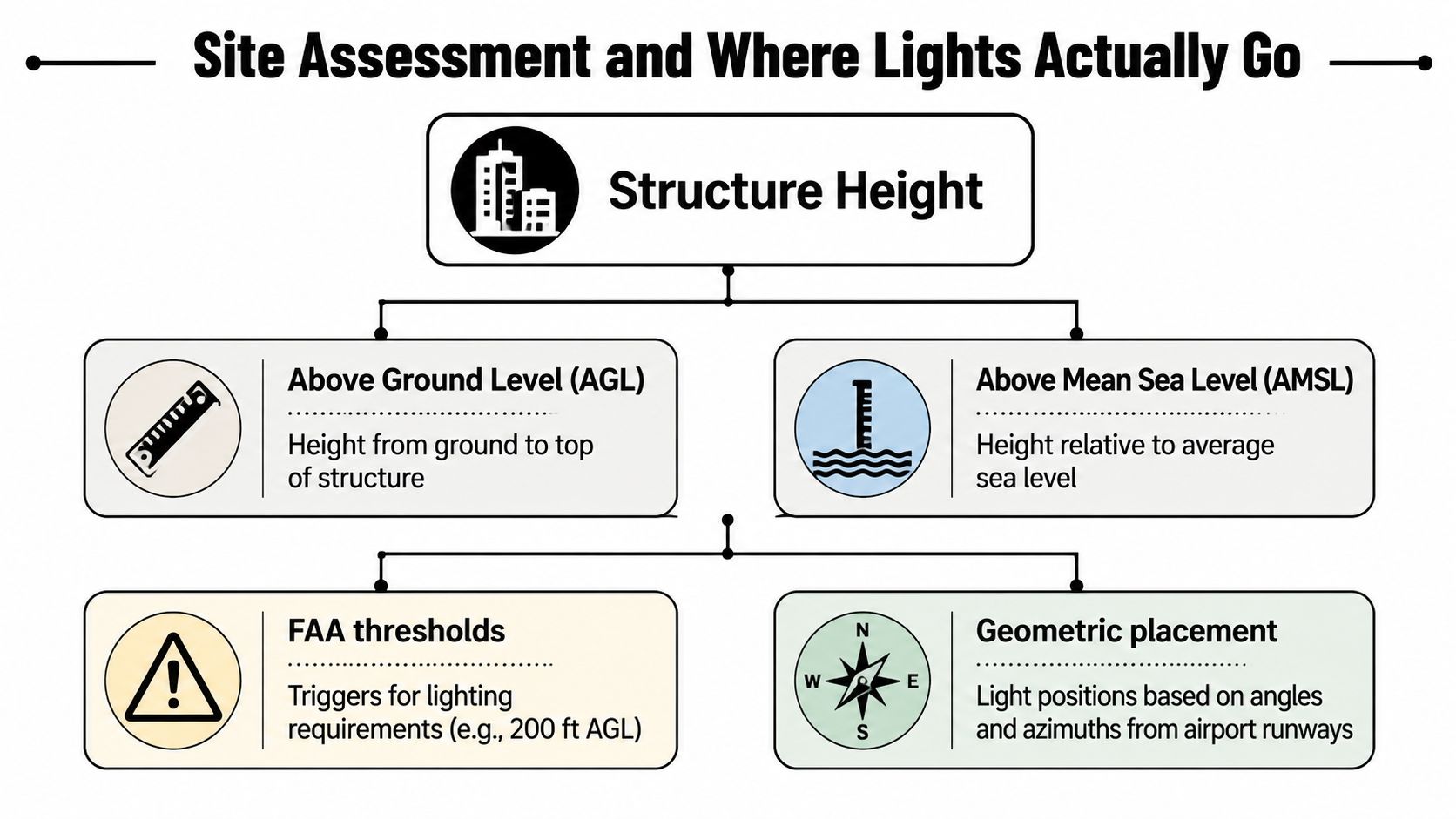
Start with the silhouette
For a low structure, opposing diagonal corners or other approved positions can give pilots a clearer outline than two lights mounted side by side. The exact arrangement depends on the structure profile and the applicable FAA determination. A parapet, mechanical screen, billboard frame, antenna, or rooftop equipment can create a shadow that changes the required mounting location.
For taller structures, the FAA guidance addresses light placement at the highest prominent points or edges and uses the structure's horizontal planes and profile to preserve visibility from different approach angles. The layout must account for flyways, nearby structures, and any part of the tower that blocks the beam.
Inspect the mounting interface
Equipment specifications call for L-810 and L-810(F) units to use either 3/4-inch or 1-inch NPT mechanical interfaces on the light-unit side or bottom. The FAA's obstruction lighting equipment requirements make that interface important in the field. Standard threads help coordinate conduit entry, mounting, sealing, and future replacement without custom fabrication.
A proper site report should include photographs, measurements, equipment locations, cable routes, grounding points, access constraints, corrosion exposure, and the reason each fixture occupies its proposed position. If the plan can't explain why a pilot will see the light from the relevant approach directions, it isn't ready for installation.
How a Professional Installation Workflow Runs
A professional aircraft obstruction light installation starts with paperwork, not a ladder. The crew confirms the FAA determination, applicable permits, and approved geometry before anyone orders equipment or drills a mounting point. That sequence prevents a field failure in which convenient fixtures later prove to be at the wrong height, color, pattern, or level.
Coordinate local permitting and FAA filing before construction. The owner needs a building or electrical permit where required, while the proposed work must follow the FAA submission and determination process. Schedule review time before equipment orders and rooftop access, because changing the design after installation can cost far more than planning it correctly.
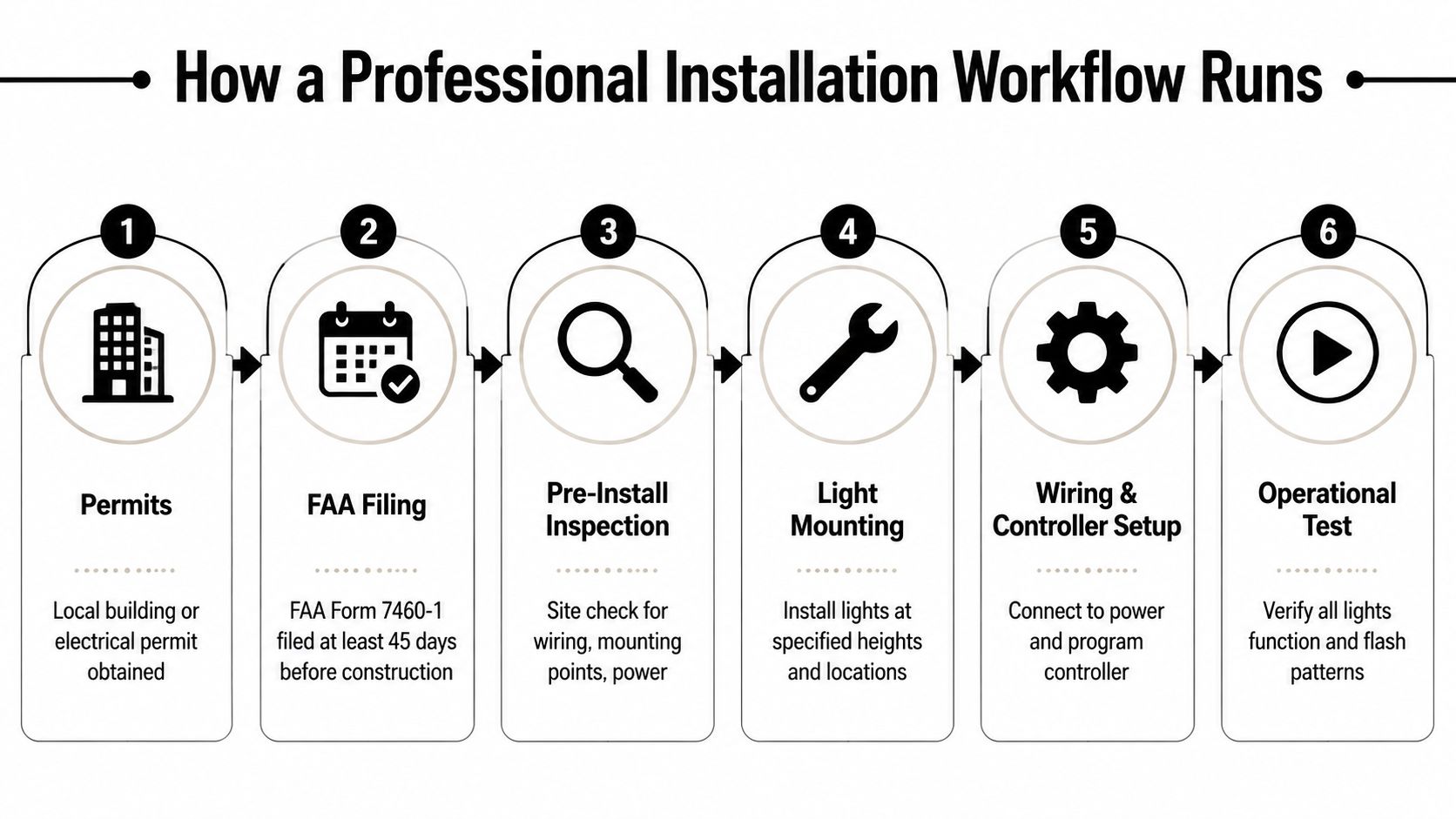
Build the installation around the site
Before climbing, the crew stages fixtures, conduit, connectors, seals, controllers, grounding components, and standardized NPT mounting hardware. Tower work may require a lift, rope access, fall-protection planning, or coordination with a communications tenant. Rooftop work also needs a defined access plan. Wind, heat, wet surfaces, and energized equipment can turn a short task into a serious exposure.
The power system usually includes a dedicated circuit and approved controls. Photoelectric controls manage day and night operation, while monitoring or redundant equipment can identify a failed light or controller. Solar systems require a matched battery, protected enclosures, and enough unobstructed sun for the site conditions.
A fixture is not finished when the bolts are tight. Verify thread engagement, weather sealing, conductor protection, grounding, torque, orientation, and future service access. Label every fixture and controller, then record its location on the as-built drawings. For new circuits, rooftop distribution, controls, or backup power, use a qualified commercial electrical installation provider rather than a general handyman.
Test what pilots need to see
Commissioning must test the operating sequence, not merely confirm voltage. The technician verifies steady-burning operation, flash pattern, synchronization, photocell switching, alarms, controller response, and visibility from relevant ground viewpoints. Night observation matters because glare, nearby lighting, and structural shadows may not appear during daylight.
Owners planning broader exterior safety work can review commercial electrical services that improve commercial property visibility. Keep that work separate from the aviation design. Obstruction lights still require their approved layout and testing record.
Closeout should contain the FAA determination, permits, equipment documentation, as-built drawings, test results, maintenance instructions, and installed fixture locations. Give that package to the building owner or manager. If a future inspector cannot trace what was installed and how it was tested, the project is not properly closed.
Inspection, Maintenance, and Long-Term Compliance
Obstruction lighting isn't a set-it-and-forget-it system. Salt air, wind loading, ultraviolet exposure, insects, bird activity, dirt, water intrusion, and power disturbances all affect performance on Palm Beach County rooftops and towers. A licensed local contractor can spot regional problems early, especially corrosion at fasteners, conduit entries, brackets, enclosures, and grounding connections.
The owner should define who receives failure alarms, who can access the structure, who authorizes emergency work, and who maintains the records. Automated monitoring helps identify failures, but it doesn't eliminate visual inspections. A controller can report electrical status while a dirty lens, loose bracket, blocked beam, or damaged housing remains unnoticed.
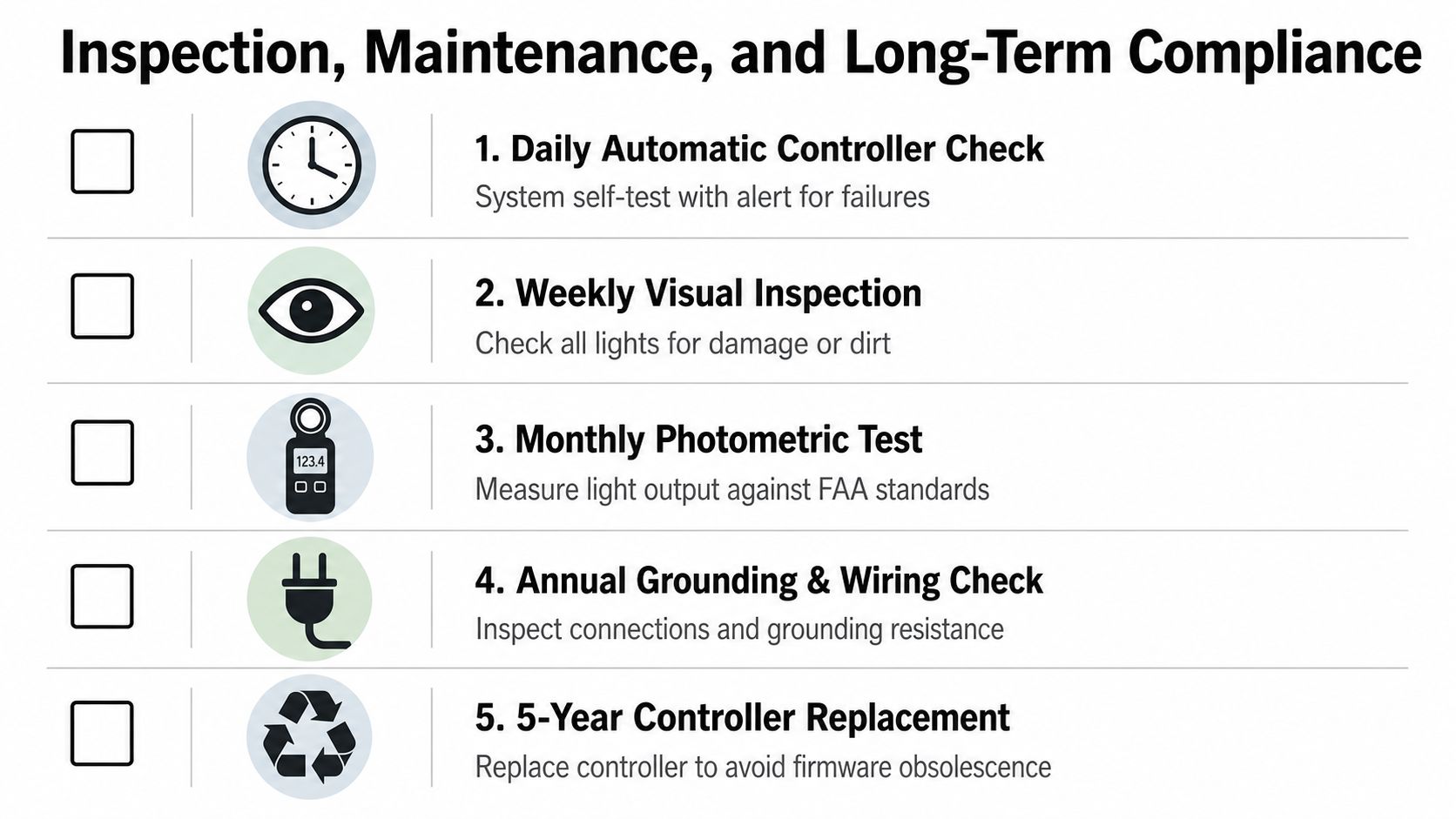
Use layered inspections
A sensible maintenance program combines automated checks with scheduled human review:
- Controller monitoring: Confirm that alarms identify light, power, photocell, and controller failures.
- Routine visual checks: Look for dark fixtures, cracked lenses, contamination, loose hardware, nesting, vegetation, and blocked sightlines.
- Electrical inspections: Check wiring, insulation, grounding, conduit seals, surge protection, and enclosure condition.
- Photometric verification: Confirm that output and operating patterns still match the approved equipment specification.
- Storm response: Inspect the system after major wind events, hurricanes, lightning, or flooding before assuming it remains operational.
Records should identify the date, technician, equipment condition, test results, corrective action, and supporting photographs. Keep the FAA determination and maintenance history for the life of the structure. Records demonstrate that the owner took reasonable steps to keep the aviation warning system functional.
Lighthouse Energy Services includes lighting maintenance support for commercial properties through its lighting maintenance program. Whether you use that provider or another licensed specialist, insist on written inspection results rather than a verbal assurance that the lights appear fine.
Typical Costs and Why a Local Licensed Contractor Matters
The price of an obstruction lighting project depends on height, access, wiring distance, structural work, controller requirements, power source, corrosion exposure, and the FAA-approved configuration. A rooftop retrofit may involve one fixture and a short conduit route. A tower system can require work at height, multiple light levels, specialized access, control equipment, backup power, and detailed testing.
I won't give you a made-up “average” price because the structure determines the work. Ask for an itemized proposal that separates equipment, labor, access, engineering or design support, permitting, testing, and ongoing maintenance. That format makes a low bid easier to evaluate and exposes exclusions before they become change orders.
Compare proposals by risk, not just price
A general handyman may be able to mount a light, but mounting isn't the whole job. The contractor must understand the FAA determination, approved equipment, NPT interfaces, conductor protection, grounding, controller logic, access safety, and final documentation. An unlicensed or inexperienced installer can leave the owner with a fixture that illuminates but doesn't provide the required conspicuity.
| Installation Type | Equipment Cost | Labor Cost | Permit Fee | Total Installed |
|---|---|---|---|---|
| Low-intensity rooftop retrofit | Varies by approved L-810 equipment and fixture count | Driven by roof access, conduit, and circuit work | Confirm with the local jurisdiction | Request an itemized site-specific proposal |
| Medium-intensity tower system | Varies by L-864, white, or dual-mode configuration | Driven by tower height, access method, and number of levels | Confirm with the local jurisdiction | Request a structure-specific proposal |
| Solar or remote installation | Varies by fixture, controller, battery, and panel package | Driven by mounting, battery enclosure, and site access | Confirm with the local jurisdiction | Request a complete power-system proposal |
A Palm Beach County specialist also understands local permitting practices, coastal corrosion, rooftop access, hurricane exposure, and the practical service challenges of structures near active aviation routes. That local knowledge doesn't replace FAA compliance. It helps the approved design survive real weather and real maintenance conditions.
Ask every bidder five questions:
- Who is responsible for the FAA filing and determination review?
- Which exact equipment specification supports each proposed fixture?
- How will the crew confirm visibility from the required approach directions?
- What documents will be included in closeout?
- Who responds when the system fails after hours or after a storm?
The cheapest quote often removes the work you discover only after failure. Pay for licensed electrical labor, safe access, compliant equipment, proper testing, and documentation. That is the cost of reducing aviation, liability, and rework risk.
Lighthouse Energy Services installs, repairs, and maintains aircraft obstruction lighting for Palm Beach County rooftops and towers, with licensed electrical professionals available for project planning, emergency troubleshooting, and ongoing service. Visit Lighthouse Energy Services to request a site-specific assessment and discuss an installation that matches the FAA determination, structure geometry, and local electrical requirements.