
When you hear "lighting maintenance," what comes to mind? For many, it’s just changing a burnt-out bulb. But for a commercial property, a truly comprehensive plan goes so much further. Think of it less like a simple repair service and more like having an expert on your team, dedicated to keeping your facility safe, efficient, and looking its best.
What is Comprehensive Lighting Maintenance?
A flickering hallway or a dark corner of a parking lot isn't just an inconvenience—it's a serious liability. The idea behind incorporating lighting maintenance into your facility's operational plan is to shift your entire approach. Instead of scrambling to fix problems after they happen, you have a partner who prevents them from happening in the first place.
This is about taking control. A good plan means no more surprise outages, no more compliance headaches, and no more inflated energy bills. It's about having a specialist who understands the unique demands of properties here in Palm Beach County and ensures everything just works.
Why Professional Lighting is More Critical Than Ever
The need for reliable, high-quality lighting isn't just a local trend; it's part of a massive global shift. Driven by new construction and pressing mandates for energy efficiency, the lighting fixture market is projected to skyrocket to $156.51 billion by 2030. As The Business Research Company reports, this growth shows just how essential professional lighting has become to modern infrastructure.
A proactive maintenance plan is your best defense against sudden outages. It transforms lighting from a potential problem into a reliable asset, protecting your tenants and your bottom line.
Think of it as a complete wellness plan for your property's lighting system. A solid maintenance strategy bundles several key services together to keep your facility bright, safe, and running smoothly.
- Routine Inspections: A technician regularly walks your property, checking fixtures, wiring, and controls to spot signs of wear and tear before they become real problems.
- Preventative Replacements: Aging bulbs, ballasts, and other components are swapped out on a schedule—long before they have a chance to fail and leave you in the dark.
- Emergency Response: When the unexpected does happen, you have a team on call 24/7 to get things back up and running immediately.
- Compliance Management: This ensures specialized systems, like aircraft obstruction lights on tall buildings, are always operating within strict FAA and local regulations.
By combining these services, you get peace of mind knowing that every part of your property, from the parking garage to the rooftop, is consistently and safely lit.
What Does Professional Lighting Maintenance Actually Involve?
If you think lighting maintenance is just about swapping out a dead bulb, you're missing the bigger picture. That's like saying car maintenance is just putting gas in the tank. True lighting maintenance incorporated into your property management is a comprehensive, forward-thinking strategy designed to keep your facility safe, efficient, and reliable—no exceptions.
It’s about getting ahead of problems before they even start. A real maintenance plan isn't about waiting for a phone call about a dark parking lot. It involves routine inspections to catch worn-out fixtures, scheduled replacements of critical parts like bulbs and ballasts, and even regular cleaning to ensure you're getting the most out of every watt. It’s a system built for consistency.
A Tale of Two Strategies: Planning vs. Panicking
When it comes to lighting, property owners have two choices: be proactive or be reactive. The difference between these approaches couldn't be more stark, and it shows up directly in your budget, your liability, and your late-night stress levels. One is a calm, controlled process; the other is a scramble to fix something that’s already broken.
A professional lighting maintenance plan moves your property from a state of constant reaction to one of proactive control. It’s the difference between calling an emergency electrician at midnight and knowing that call will never be necessary.
This proactive mindset is more than just a convenience; it's a smart financial move. The market for light fixture repair services is on track to hit $4.07 billion by 2030, which tells you just how much businesses are spending on emergency, break-fix repairs. You can learn more about this growing market, but the takeaway is clear: preventing problems is far cheaper than fixing them.
Proactive vs. Reactive Lighting Maintenance
This table breaks down the real-world difference between a planned maintenance strategy and simply waiting for things to fail.
| Aspect | Proactive Maintenance Plan | Reactive (Break-Fix) Approach |
|---|---|---|
| Cost | Predictable, budgeted monthly or quarterly costs. Lower overall lifetime expense. | Unpredictable, high emergency labor rates. Often leads to higher long-term costs. |
| Safety & Liability | Consistently well-lit areas reduce risks of accidents, crime, and liability claims. | Dark spots create immediate safety hazards and increase property liability. |
| Operations | Zero downtime or disruption. Maintenance is scheduled during off-peak hours. | Disruptions to business, potential area closures, and negative customer experiences. |
| Performance | Consistent brightness, color, and efficiency. Lights always perform as intended. | Flickering lights, mismatched colors, and dim areas create a poor impression. |
| Asset Management | Extends the life of fixtures and infrastructure through preventative care. | Components fail prematurely, leading to expensive, unplanned replacement projects. |
As you can see, a proactive plan isn't an expense—it's an investment in stability, safety, and long-term savings.
More Than Just Light: A System for Property Value
Effective lighting maintenance incorporated into your operations creates a ripple effect of benefits that touch on safety, efficiency, and curb appeal. Think of it as a foundation for your property's overall health.
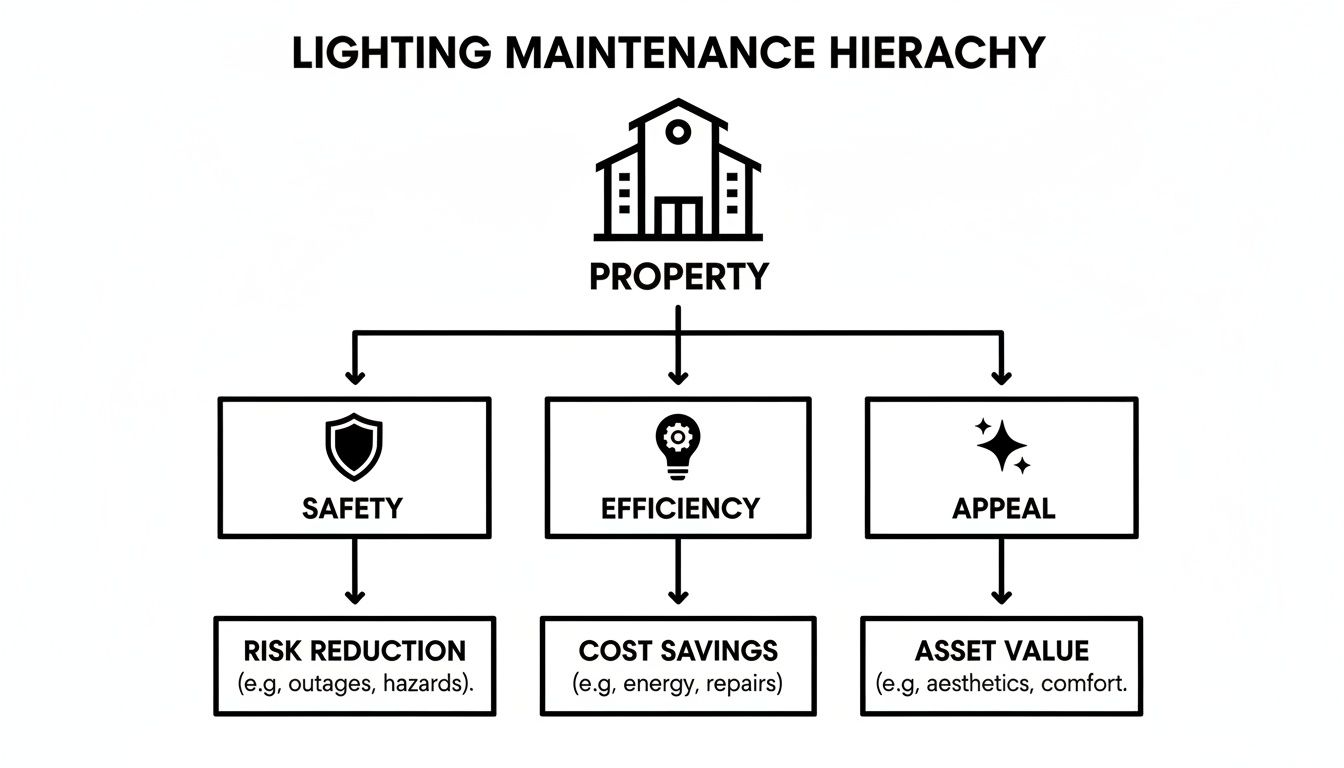
This hierarchy shows that when your lighting is expertly managed, it supports every other goal you have for your property. So, what does this look like in practice? Here are the key tasks that make up a robust maintenance plan:
- Group Re-lamping: Instead of changing bulbs one by one as they burn out, we replace all lights in a specific area at once. This smart move drastically cuts down on labor costs and eliminates the ugly "checkerboard" look of new, bright lights next to old, dimming ones.
- Ballast and Driver Replacement: In fluorescent lights, the ballast regulates power; in LEDs, the driver does the same job. When these components start to fail, you get flickering, buzzing, or a completely dead fixture. Proactively replacing them keeps everything running smoothly.
- Fixture and Lens Cleaning: You'd be shocked at how much light is lost to a simple layer of dust. Dirt and grime can cut a fixture's output by up to 30%. A good cleaning restores full brightness without using a single extra kilowatt.
- Lighting Controls Audits: Timers, motion sensors, and dimming systems are fantastic for saving energy—but only if they're working correctly. Technicians test and recalibrate these controls to make sure they are optimized for maximum efficiency.
Upgrading to LEDs for Financial and Performance Gains
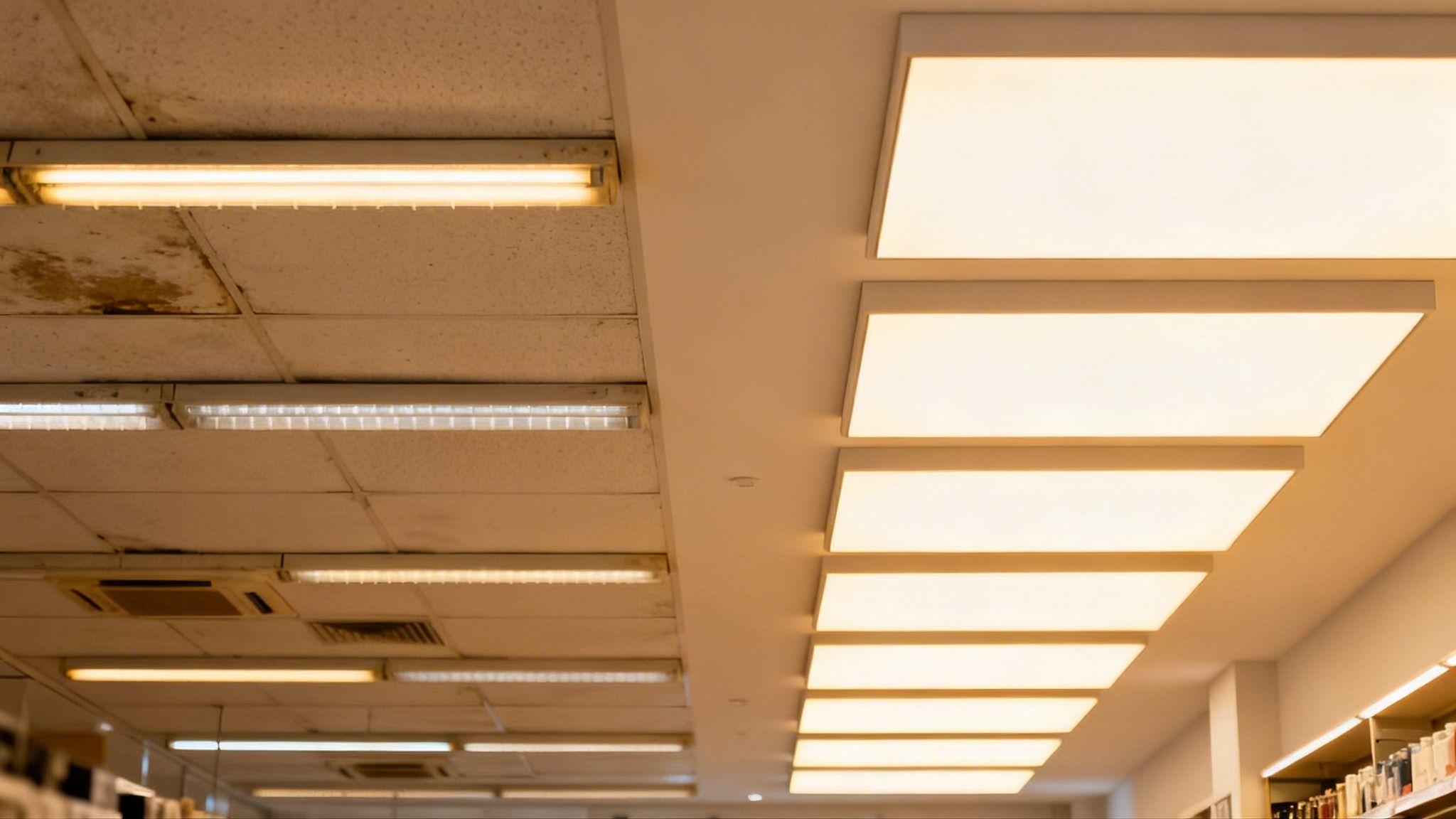
Of all the services a lighting maintenance incorporated plan can include, one of the most impactful is a strategic upgrade to LED technology. It’s far more than just swapping out bulbs. This is a fundamental change in your property's energy profile, and for owners, it brings tangible returns you can see on your very next power bill.
I like to think of older lighting—incandescent, fluorescent, you name it—as a leaky bucket. You're constantly pouring energy and money into it, but a good chunk of it is lost as waste heat before it ever becomes useful light. LEDs, on the other hand, are a sealed, efficient container. Nearly every bit of energy you put in comes out as clean, bright light. This is why a well-planned upgrade can slash your lighting energy use by up to 75%.
This isn't a niche trend; it's a massive global shift. The lighting sector is projected to hit $149.14 billion by 2026 and balloon to $225.56 billion by 2033. The main reason? LEDs now make up nearly 69% of the entire market. The takeaway is clear: LEDs are no longer the future of lighting; they are the standard for any smart, modern property.
Calculating the Rapid Return on Investment
Let’s run the numbers on a real-world example. Say we have a retail center in Palm Beach County with 200 old metal halide fixtures lighting its parking lot and garage. Each one might be burning through 400 watts.
- Old System: 200 fixtures x 400 watts = 80,000 watts (80 kW)
- LED Upgrade: We replace them with new fixtures that use only 100 watts each.
- New System: 200 fixtures x 100 watts = 20,000 watts (20 kW)
That's an immediate 75% reduction in power consumption. Assuming those lights run 12 hours a night, that simple switch saves over 260,000 kilowatt-hours annually. With commercial electricity rates, that translates into tens of thousands of dollars in savings each year. Most projects like this pay for themselves in just 1-3 years. If this kind of modernization sounds appealing, you might be interested in our ultimate guide to electrical upgrades.
More Than Just Savings: The Performance Advantage
The savings are what get everyone's attention, but the operational improvements are just as crucial. A smart lighting maintenance strategy isn't only about cutting costs; it’s about making your facility better, safer, and more reliable.
Upgrading to LEDs isn't an expense—it's an investment that pays you back in lower utility bills, reduced maintenance calls, and a safer, more attractive property.
Here’s what else you gain when you move past the old tech:
- Dramatically Longer Lifespans: An old bulb might give you 2,000 hours if you're lucky. A quality LED fixture, however, can run for 50,000 to 100,000 hours. That means far fewer service calls, less disruption to your business, and a huge drop in long-term labor costs.
- Superior Light Quality: LEDs provide crisp, steady light without the annoying flicker or buzz that plagues aging fluorescent and HID systems. This instantly improves visibility, which is a direct boost to safety for anyone walking or driving through your parking lots and walkways.
- Enhanced Durability: LEDs are solid-state, meaning there are no fragile glass tubes or filaments to break. They stand up to vibrations and impacts much better than their predecessors, making them perfect for high-traffic commercial environments.
Keeping the Skies Safe: Why Aircraft Obstruction Lighting is Non-Negotiable
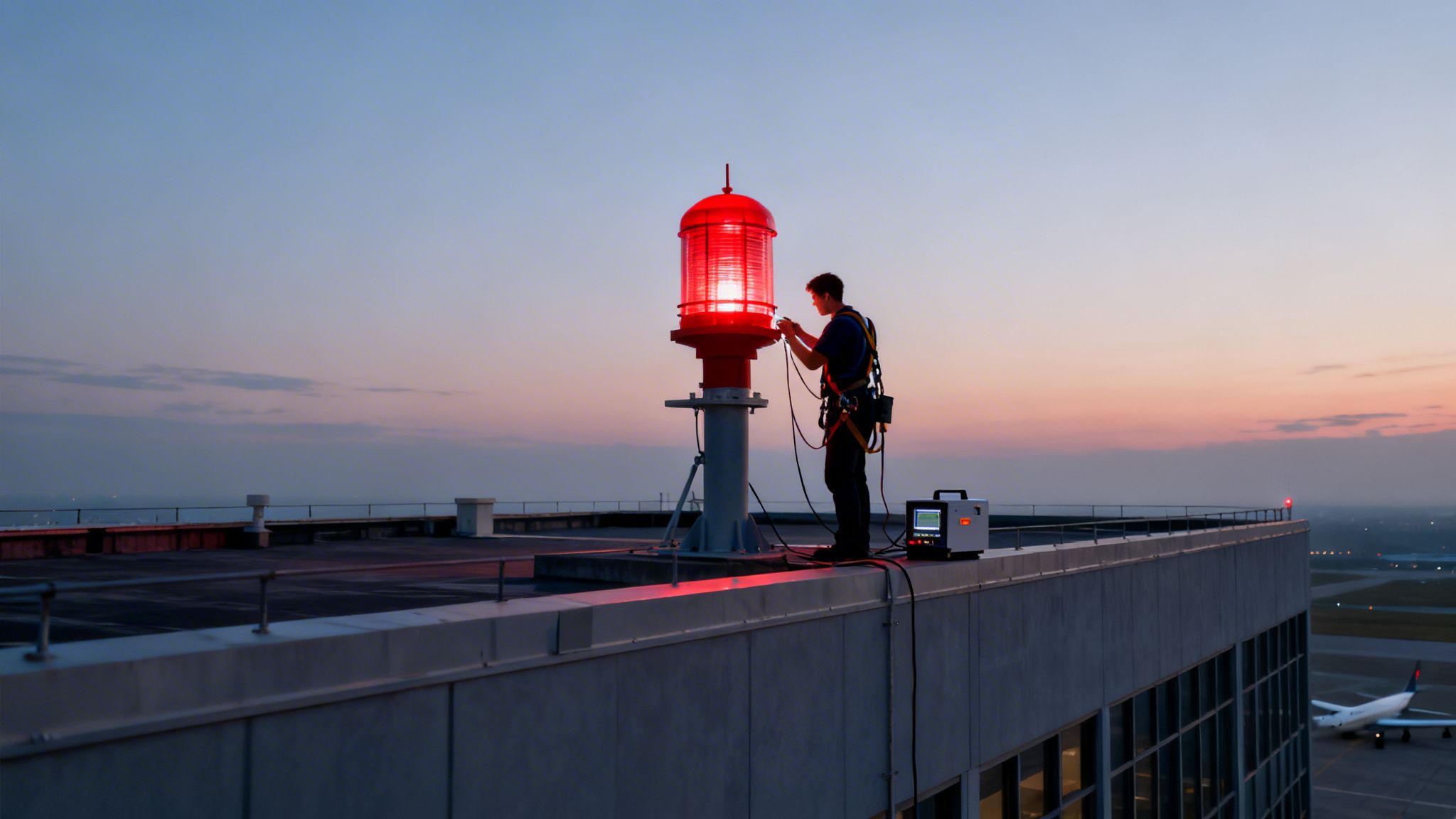
If you own a high-rise, communication tower, or any other tall structure in Palm Beach County, some of your lights have a much bigger job than just illuminating your property. Those steady red glows and flashing white beacons aren't for show—they're a critical, federally mandated safety system.
The Federal Aviation Administration (FAA) requires this aircraft obstruction lighting for one reason: to keep pilots and their passengers safe by making your structure visible from the air. This isn't a suggestion; it's the law.
When a single beacon fails, it punches a dangerous hole in the safety net protecting our airspace. The FAA doesn't take this lightly. A lapse in maintenance can lead to staggering fines, often running into thousands of dollars for every day a light is out of compliance.
It’s Far More Than Just a Light Bulb
Because aviation safety is on the line, maintaining these systems is an incredibly specialized task. It’s an intricate dance between advanced electrical work and a deep understanding of federal regulations. A simple bulb swap just doesn't cut it.
A malfunctioning aircraft beacon is not a maintenance problem—it’s a public safety emergency and a serious legal liability. The FAA demands 100% operational uptime, making expert maintenance a true necessity.
A proper, compliant maintenance inspection goes layers deep to ensure the entire system is flawless. A qualified contractor will need to verify several key functions:
- Photocell Operation: Are the sensors that automatically turn the lights on at dusk and off at dawn functioning properly? They have to be tested to ensure they react correctly to ambient light.
- Flash Timing and Synchronization: For systems with multiple strobes, every light must flash at a precise interval and in perfect sync. Any deviation can confuse pilots.
- Backup Power Systems: What happens if the power goes out? A backup generator or battery system must kick in instantly. This fail-safe is one of the most important components to test regularly.
Given what’s at stake, this is absolutely not a job for a general electrician. You need a contractor with proven, documented experience in FAA lighting standards. If you're responsible for a tall structure, our guide on what to know about aircraft obstruction lights provides a much deeper look into these crucial regulations.
Managing these systems is the ultimate test of a contractor's ability. It proves they can handle complex, mission-critical projects where failure is simply not an option.
Why a 24/7 Emergency Service Is Non-Negotiable
It’s 10 PM on a Saturday, and a main breaker for your parking garage gives out, plunging the entire area into darkness. This is more than just a hassle—it's a massive safety liability and a problem that can’t wait for business hours. Every minute that passes increases the risk of theft, accidents, and frustrated tenants. Waiting until Monday morning simply isn't an option.
This is exactly why having a true 24/7 emergency response team is so critical. It’s not about finding someone who might eventually answer the phone. It's about having a dedicated electrical partner on standby who can get a licensed professional on-site immediately—day or night—to restore safety and get your property back in order.
The Chaos of an Outage vs The Calm of a Plan
An unexpected outage can set off a chain reaction of problems. Tenants feel unsafe, customers will go elsewhere, and your legal liability goes through the roof. The alternative is the peace of mind that comes from having a reliable emergency service baked into your lighting maintenance incorporated strategy.
An electrical emergency doesn't operate on a 9-to-5 schedule, and neither should your support team. True 24/7 service means having an expert on standby, ready to solve your problem right now—not just take a message.
Having that immediate access to an expert is what makes all the difference. Sitting by the phone, waiting for a callback from an answering service while your property is dark, is a stressful and high-stakes gamble. For a closer look at what to expect during these critical moments, you can review our complete guide on emergency electricians.
How Prevention Is Your Best Defense
While a fast emergency response is something you can't go without, the real goal is to stop that emergency from ever happening. A solid preventative maintenance plan is your best defense against sudden, costly failures. By systematically finding and fixing potential weak points, you protect your property, your assets, and your people around the clock.
This proactive approach involves a few key steps:
- Thermal Imaging Scans: Technicians use thermal cameras to see things the naked eye can't, like overloaded circuits or faulty connections. Finding these "hot spots" allows us to fix them before they cause an outage or, even worse, a fire.
- Breaker Panel Audits: We regularly inspect and test your circuit breakers to make sure they'll work properly under pressure and won't trip when they shouldn't—a very common cause of widespread outages.
- Component Testing: We also proactively test the workhorses of your system, like timers, contactors, and relays, to ensure all the automated functions perform without failing unexpectedly.
By making these checks part of a regular maintenance schedule, you turn your electrical system from a potential liability into a dependable, well-managed asset. It's this kind of forward-thinking strategy that truly defines effective and responsible property management.
Choosing the Right Lighting Contractor for Your Property
When it comes to lighting maintenance, the contractor you hire can make or break your budget—and your property's safety. It’s a decision with real consequences. A cheap bid might look good on paper, but shoddy work, surprise costs, and safety risks can quickly turn a "deal" into a costly nightmare.
Finding a great partner isn't about luck; it's about knowing what to look for. You need someone who is more than just a repair person. You need a professional who can safeguard your investment, and that means asking the right questions upfront to weed out the ones who will let you down.
Essential Qualifications to Look For
Think of this as your checklist for hiring a pro. A truly qualified contractor won't hesitate to show you their credentials—in fact, they should expect you to ask. This is your way of verifying they can work safely and legally on your property.
Here are the non-negotiables you should always confirm:
- Proper Licensing and Insurance: At a bare minimum, they must hold a valid electrical contractor license. Just as important, ask for proof of their general liability insurance and workers' compensation. This is what protects you from financial responsibility if an accident happens on your site.
- Genuine 24/7 Availability: A lot of companies claim to be available around the clock, but what you get is an answering service. A true 24/7 partner has a licensed professional answering the phone, ready to dispatch a crew, not just take a message for the morning.
- Transparent Pricing Models: If an estimate feels vague, it probably is. A trustworthy contractor provides detailed, itemized quotes that clearly lay out all the costs. You shouldn't have to worry about hidden fees or surprises on the final bill.
- Proven Local Experience: You want a company with deep roots in Palm Beach County. A contractor with a long local history understands the specific building codes, weather-related challenges, and has a list of completed projects you can actually go see.
The most important quality in a lighting contractor isn’t the price—it’s trust. A reliable partner invests in your property's long-term success by prioritizing safety, quality, and transparent communication above all else.
Using this checklist helps you cut through the sales pitches. It gives you a clear, simple way to find a partner with proven expertise, ensuring any lighting maintenance incorporated into your property’s plan is done right the first time.
Your Lighting Maintenance Questions, Answered
When it comes to putting a professional lighting plan in place, we find property managers often have a few practical questions. It makes sense—you want to know how it all works in the real world. Here are some of the most common things we get asked, with straightforward answers from our experience in the field.
How Often Should I Really Have My Property's Lights Inspected?
As a general rule of thumb, we've found that a thorough lighting inspection twice a year works perfectly for most commercial properties. Think of it like a routine check-up to catch problems before they become expensive headaches.
However, for high-stakes areas—like busy retail centers, parking garages, or any place where security is a top priority—you’ll want to bump that up to quarterly checks. A good contractor will work with you to map out a schedule that fits your property's unique rhythm, ensuring everything stays bright and safe all year long.
Is Upgrading to LED Lighting Actually Worth the Upfront Cost?
This is one of the easiest questions to answer: yes, without a doubt. While there's an initial investment, switching to modern LED technology is one of the smartest moves a property owner can make. We’ve seen it time and time again. You can slash your lighting energy costs by as much as 75%, and the fixtures themselves can last up to 25 times longer than the old bulbs.
That means you're saving big on your monthly utility bills and on the labor costs for future maintenance. For most properties, the entire upgrade pays for itself in just a couple of years.
The real value of an LED upgrade isn't just the energy savings—it's the massive reduction in maintenance headaches. Fewer bulb changes and fewer service calls mean more time and money to focus on other parts of your property.
What Happens If We Have a Lighting Emergency After Hours?
Imagine your main parking lot goes completely dark on a Saturday night. The last thing you want is to be sent to a voicemail or an answering service that just takes a message. A genuine 24/7 electrical contractor understands that.
When you call with an emergency, you should be speaking directly with a licensed professional who can get a crew on the way immediately. That level of response is non-negotiable for protecting your property and keeping your tenants safe. A solid lighting maintenance incorporated plan ensures you have an expert on standby, day or night, and you shouldn't have to pay extra for emergency or after-hours calls.
How Is Aircraft Obstruction Light Maintenance Different?
This is a whole different ballgame. Aircraft obstruction lighting is governed by strict FAA regulations, which makes maintaining it a legal requirement, not just a good idea. The work goes far beyond just swapping a bulb on a tower.
It involves highly specialized testing of photosensors, flash timing, and critical backup power systems to guarantee 100% compliance. If these systems fail, you’re not just looking at major fines—you're dealing with a serious safety hazard. This is a job that demands a contractor with proven expertise in federal aviation standards. The stakes are simply too high for anything less.
Ready to stop reacting to lighting problems and start preventing them? The team at Lighthouse Energy Services is here to help. Our licensed professionals are on call 24/7 to provide reliable maintenance, smart upgrades, and immediate emergency response. Visit our website or call us today to build a plan that protects your property and your peace of mind: https://lighthouseenergyco.com