
Why Adding Can Lights Is One of the Best Lighting Upgrades You Can Make
Adding can lights (also called recessed lighting) is a straightforward home improvement project that can dramatically brighten any room. Here’s a quick overview of how it’s done:
- Plan your layout – Divide ceiling height by 2 for spacing (e.g., 4 ft apart for 8-ft ceilings); place lights 3 ft from walls
- Choose your fixtures – Canless LED wafers or traditional canned housings; IC-rated if insulation is present
- Turn off power – Switch off the breaker and confirm with a voltage tester
- Cut ceiling holes – Use a hole saw matched to your fixture size; check for joists and obstructions first
- Run wiring – Daisy-chain Romex cable from your power source through each fixture location
- Connect and install – Wire each fixture (black to black, white to white, ground to ground), then snap into place
- Test – Restore power and confirm each light works
Can lights sit flush inside the ceiling, so they don’t hang down or clutter a room visually. They work in kitchens, living rooms, hallways, and more. A full DIY install for 8 lights can cost as little as $167 in materials — a significant saving compared to hiring out.
That said, electrical work carries real risks. Whether you’re going DIY or calling a pro, knowing the process helps you do it right and stay safe.
I’m Bruce Kemp, an electrical contractor with hands-on experience in every phase of residential wiring — including planning and adding can lights in kitchens, living rooms, and basements. In this guide, I’ll walk you through everything you need to know to get the job done correctly.
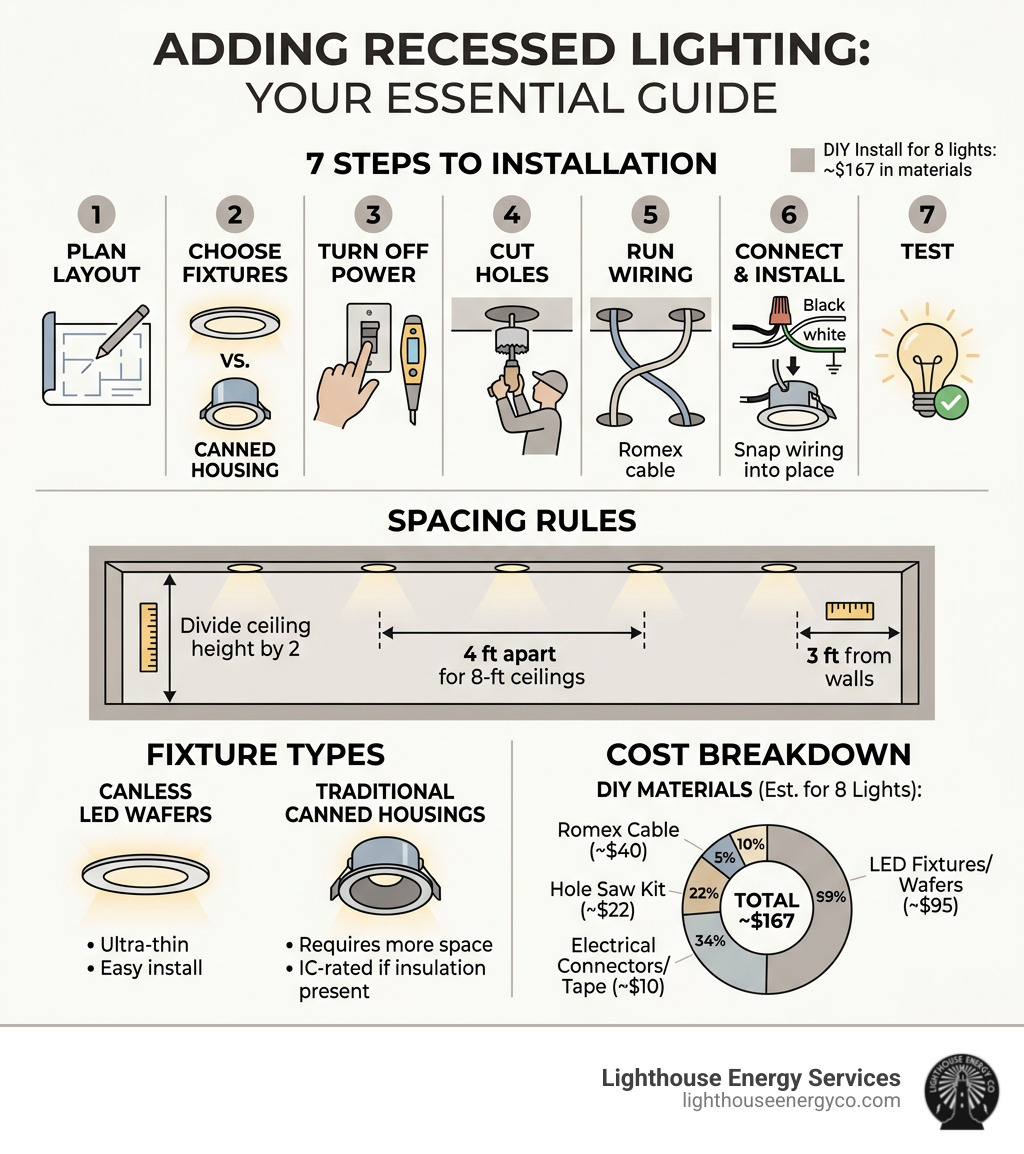
Adding can lights further reading:
Planning Your Layout and Spacing
Before you ever pick up a drill, you need a blueprint. Poorly placed lights can make a room feel like a surgical suite or, worse, leave you chopping vegetables in your own shadow. Proper planning is the difference between a “DIY disaster” and a professional-grade electrical upgrade for your home.
The Golden Rule of Spacing
The standard industry “rule of thumb” is to divide your ceiling height by two. If you have 8-foot ceilings, your lights should be roughly 4 feet apart. For a 10-foot ceiling, 5 feet is the sweet spot. However, in high-utility areas like kitchens, we often recommend tighter spacing—around 30 to 36 inches—to ensure every inch of your countertop is bathed in light.
Avoiding the “Cave” Effect
One of the most common mistakes when adding can lights is placing them too far from the walls. If lights are more than 3 feet away from the wall, the tops of your walls remain dark, making the room feel smaller. Conversely, placing them too close (less than 2 feet) can create “scalloping”—harsh arcs of light that highlight every tiny imperfection in your drywall.
Layout Strategy by Room
- Kitchens: Focus on task lighting. Align your lights with the edge of the countertops (usually 24 inches from the wall) so the light falls directly on your workspace rather than on the back of your head.
- Living Rooms: Aim for ambiance. Avoid placing lights directly over seating areas to prevent uncomfortable shadows on faces. Instead, wash the perimeter with light and use a focal point, like a fireplace or a piece of art, as your starting anchor.

| Ceiling Height | Recommended Spacing | Distance from Wall |
|---|---|---|
| 8 Feet | 4 Feet | 2 – 3 Feet |
| 10 Feet | 5 Feet | 3 Feet |
| 12 Feet | 6 Feet | 3.5 – 4 Feet |
Choosing the Right Fixtures for Adding Can Lights
The world of recessed lighting has changed drastically in the last decade. You no longer have to wrestle with massive “metal cans” that require a gallon of sweat to install.
Canless vs. Traditional Cans
If you are working on an existing ceiling, we almost always recommend canless LED recessed lights. After researching different can lighting options, many homeowners land on these 4″ recessed lights because they are incredibly thin (often less than an inch thick). They don’t require a bulky housing; they simply clip onto the drywall with spring-loaded tension.
Traditional cans are still used in “new construction” where the ceiling is open. These are fastened directly to the joists. If you are retrofitting, look for “remodel” housings which, like the canless versions, are designed to be installed from below.
Understanding Lumens and Kelvin
- Lumens (Brightness): For general room lighting, 700 to 800 lumens per light is standard. In a kitchen, you want a higher total lumen count to ensure safety while using knives and heat.
- Kelvin (Color Temperature): This determines the “mood.” 2700K is warm and yellowish (like old incandescent bulbs), while 5000K is “daylight” (bluish and very bright). Most designers agree that 3000K is the “sweet spot” for residential lighting installation—it’s crisp and clean but still feels welcoming.
Safety Ratings: IC vs. Non-IC
This is non-negotiable. If your ceiling has insulation, you must use IC-rated (Insulation Contact) fixtures. Non-IC fixtures can become a fire hazard if covered in fiberglass or cellulose. Fortunately, most modern LED wafers are IC-rated by default.
Step-by-Step Installation Guide
Ready to get to work? Installing recessed lights is a multi-stage process that requires patience and precision. If at any point you feel overwhelmed, electrician house wiring is what we do best here at Lighthouse Energy.
Preparing for Adding Can Lights
First, gather your tools. You’ll need a ladder, a drill, a stud finder to locate joists, and an adjustable hole saw.
- Map the Ceiling: Use painter’s tape to mark your planned locations. This lets you visualize the layout before making any permanent cuts.
- Check for Obstructions: This is the “pro secret.” Before cutting a large hole, drill a tiny 1/4-inch hole in the center of your mark. Insert a bent coat hanger and spin it around to feel for joists, pipes, or HVAC ducts. It’s much easier to patch a tiny hole than a 6-inch mistake.
- Safety First: Head to your breaker box and shut off the power to the circuit you’re working on. Use a non-contact voltage tester to verify the wires are “dead.”
Wiring and Adding Can Lights
When you’re installing multiple lights, we use a method called “daisy chaining.” This means the power runs from the switch to the first light, then from the first light to the second, and so on.
- Cut the Holes: Using your hole saw (and a dust shield if you have one—a halved basketball works in a pinch!), cut the openings.
- Rough-In the Wiring: Run your NM cable (Romex) between the holes. Leave about 12 to 18 inches of slack hanging out of each hole. This “tail” gives you plenty of room to work.
- Connect the Junction Box: Most modern LED lights come with their own small metal junction box. Open it up, insert the cable through a connector, and strip the wires. Connect black to black (hot), white to white (neutral), and green or bare copper to the ground wire. Use wire nuts or the provided push-in connectors.
- Snap into Place: Tuck the junction box up into the ceiling. Connect the light fixture to the box using the twist-lock connector, then fold back the spring clips and push the light into the hole. The clips will snap down onto the top of the drywall, holding the light flush.
For a deeper dive into the technical side of this, check out our electrician to install light fixture guide.
Design Tips and Common Mistakes to Avoid
Even a perfectly wired system can look “off” if the design isn’t right. Here are a few tips to ensure your new lights enhance your home’s aesthetic.
Use Dimmers
Always, always install a dimmer switch. Recessed lights can be very bright, and being able to drop the light level to 20% for a movie night or a late-night snack completely changes the feel of the room. Just make sure your LED fixtures are labeled as “dimmable.”
Layer Your Lighting
Recessed lights are great for general illumination, but they shouldn’t be your only light source. Designers recommend “layering.” Combine your can lights with:
- Pendants over a kitchen island for style and task focus.
- Floor lamps for warm, eye-level light in seating areas.
- Under-cabinet lighting to eliminate shadows on kitchen counters.
Common Pitfalls
- The “Swiss Cheese” Ceiling: Don’t overdo it. Too many lights can make a ceiling look cluttered. Stick to the spacing rules.
- Wrong Trim: Baffle trims (with ridges) help reduce glare, while eyeball trims allow you to aim the light at a specific wall or feature. Choose based on the room’s purpose.
- Ignoring Symmetry: While function is vital, try to keep your rows straight. If a joist is in the way, it’s often better to shift the entire row by a few inches rather than having one “rogue” light out of alignment.
For more professional advice on planning your project, see our Residential Electrical Contractors Guide 2026.
Frequently Asked Questions about Recessed Lighting
How many recessed lights do I need for a 100-square-foot kitchen?
For a standard 10×10 kitchen, we typically recommend 4 to 6 lights. This provides enough overlap to eliminate shadows on the counters while maintaining a clean look. If you have a large island, you might use 4 can lights for the perimeter and a pair of decorative pendants over the island.
Can I install can lights in a bathroom or shower?
Yes, but you must use “wet-rated” or “vapor-proof” trims. These fixtures have a gasket that prevents moisture from entering the ceiling cavity and the electrical connections. It’s a great way to brighten up a dark shower stall.
Is it cheaper to install canless LED lights or traditional cans?
In almost every remodel scenario, canless LED lights are cheaper. While the fixture itself might cost slightly more than a basic metal housing, you save a fortune on labor and repairs. Because they are so thin, you don’t have to cut massive holes or worry about fitting a 7-inch tall metal box into a tight ceiling space.
Conclusion
Adding can lights is one of the most effective ways to modernize your home, increase its value, and improve its functionality. Whether you are transforming a dark basement into a vibrant game room or making your kitchen a more efficient workspace, the right lighting makes all the difference.
If you’re in Boca Raton, Jupiter, or anywhere in Palm Beach County and the thought of cutting holes in your ceiling makes you nervous, we’re here to help. At Lighthouse Energy, we specialize in high-quality lighting installation and comprehensive electrical repair services.
We offer 24/7 service with no hidden fees, and our qualified electricians ensure every job is “done right, and done right now.” From simple ceiling light repairs to full-home new home electrical wiring, we’ve got South Florida covered.
Ready to brighten your space? Check out our full list of services or give us a call today!