
If the lights have flickered twice this week and the storm season forecast is already on your mind, you're probably in the exact place where a transfer switch stops being an abstract electrical term and starts being a practical decision. The fridge can't wait, the well pump can't wait, and nobody wants to jury-rig a generator cord into a place it was never meant to go.
A proper transfer switch installation gives you a clean handoff between utility power and backup power, so the generator can feed selected circuits without backfeeding the grid. That matters for safety, for code compliance, and for the people who have to work on the lines after an outage. If you're also trying to get your house storm-ready, the storm prep help from AMPM Restoration is a useful checklist to pair with the electrical side of the project.
The first question isn't “manual or automatic.” It's whether the system is being treated as emergency, legally required standby, or optional standby, because that classification drives the wiring path, the separation rules, and the testing expectations. Get that wrong, and the rest of the job gets more expensive and more frustrating than it needs to be.
Table of Contents
- Why a Transfer Switch Matters Before the Storm Hits
- Manual vs Automatic Transfer Switches
- Pre-Installation Planning and Load Calculation
- Step-by-Step Transfer Switch Installation Overview
- Permits, Codes, and Inspection Requirements
- Common Installation Mistakes and How to Avoid Them
- When to Call a Licensed Electrician in Palm Beach County
Why a Transfer Switch Matters Before the Storm Hits
A storm knocks out the utility, the generator comes out of the garage, and suddenly the homeowner is trying to solve three problems at once, power the refrigerator, keep the well pump alive, and avoid sending current back onto the street. That's exactly where a transfer switch earns its keep. Its job is to isolate the building from the utility so a backup source can feed the chosen loads safely.
That isolation is not optional. A generator tied in without proper transfer equipment can create backfeed, which is dangerous for utility crews and hard on the equipment in the house. In plain terms, the switch is the gatekeeper that keeps one source out while the other source is on.
Practical rule: if the backup source and utility source can be connected at the same time, the setup is wrong.
A lot of homeowners compare a transfer switch to an interlock kit, a dryer outlet trick, or a spare subpanel. Those are not the same thing. An interlock can still be legitimate when it's listed and installed correctly, but a generator cord plugged into an outlet that wasn't designed for backfeeding is a bad workaround, not a solution. A dedicated subpanel is useful when you only want critical circuits backed up, but it still needs the right transfer method and the right wiring path.
In homes and small businesses, the stakes go beyond convenience. Improper generator hookups can lead to electrocution hazards, house fires, and insurance problems after a loss if the installation wasn't permitted or code compliant. That's why the code classification question matters from the start. Emergency, legally required standby, and optional standby systems all follow different rules, and the equipment choice has to match the use case, not the wish list.
Manual vs Automatic Transfer Switches
The simplest way to think about the choice is this, manual transfer switches put the homeowner in the loop, while automatic transfer switches remove that step. A manual unit usually means starting the generator, then moving a lever or rotary handle to shift selected loads. An automatic unit senses the loss of utility power, starts the generator, and transfers the load without anyone standing in the rain.
That difference changes the whole experience during an outage. With a manual switch, you're part of the sequence, so there's a little more delay and a little more human judgment involved. With an ATS, the system reacts on its own, which is exactly why it's common in facilities that can't wait for someone to show up and flip a handle.
In storm work, fewer human steps usually means fewer chances to get it wrong.
For homeowners, manual units often make sense when the generator is portable, the backup plan is limited to a few circuits, and the budget matters. Automatic systems make sense when convenience, uptime, and hands-off operation matter more. In commercial or legally required standby settings, the automatic route is often the practical requirement, not just a preference.
The trade-off is maintenance and complexity. A manual switch has fewer control parts to fail. An automatic switch adds sensing, controls, and generator start logic, which means more to test and more to keep in good shape. That's not a knock against ATS equipment, it's just the reality of a system that can start itself.
The internal decision usually comes down to how much of the house you want to support, how fast you need power restored, and who'll be home when the outage starts. A homeowner who wants to keep a few essentials on can often live comfortably with manual operation. A property that needs continuous support for critical loads usually needs automation.
| Feature | Manual Transfer Switch (MTS) | Automatic Transfer Switch (ATS) |
|---|---|---|
| Operating method | Homeowner starts generator and moves the switch | Switch senses outage and transfers automatically |
| Response time | Depends on the person doing the switching | Fast, with no manual intervention |
| Generator requirements | Works with many portable generators | Needs compatible auto-start generator controls |
| Complexity | Simpler control path | More control wiring and logic |
| Maintenance | Fewer control parts | More components to inspect and test |
| Best fit | Essential loads, portable backup, budget-conscious installs | Whole-home backup, critical loads, facilities that need unattended operation |
For a plain-English overview of generator switch types, this transfer switch explanation for homeowners is a helpful reference.
Pre-Installation Planning and Load Calculation
A good installation starts long before anyone opens a panel. The first job is a site survey, because the switch has to live where the panel, generator inlet, conduit, and working space all make sense together. If the location is cramped, blocked, or too far from the main equipment, the install gets harder and the final result usually looks like it.
The second job is the load calculation. Every circuit you expect the switch to feed needs to be listed, then the running load and the largest starting surge need to be understood together. A refrigerator, well pump, and window AC don't all behave the same way when they start, and that surge is where many undersized systems fail in real life.
What to check before you buy equipment
- Panel location and clearance: Find the service equipment, measure the wall space, and make sure the working area stays accessible.
- Circuit list: Decide which circuits are essential, not just which ones you wish would stay on.
- Generator output: Match the generator's output to the calculated demand, with room for the biggest motor start.
- Voltage and controls: Confirm the generator's voltage and the transfer switch control wiring are compatible.
- Neutral strategy: Decide early whether the system needs a switched neutral or can run on a solid neutral arrangement.
The neutral decision matters more than most homeowners expect. Recent code guidance notes that a 120/240V three-pole transfer switch with a switched neutral requires a generator with a bonded neutral and a dedicated grounding connection, while a two-pole solid-neutral system uses a floating neutral and depends on the main service grounding system. If that sounds technical, it is, and that's why this part usually belongs in the hands of a licensed electrician.
In Palm Beach County, the usual residential service layout also shapes the equipment choice. Many homes are on 200A service, and underground or overhead service layout can affect where the switch, inlet, and conduit can land. If you're sizing the backup system for a typical house, the generator sizing guide for home backup helps frame the load conversation before you commit to hardware.
Step-by-Step Transfer Switch Installation Overview
The physical work is methodical, and it should be. The generator should be in standby, the main breaker should be de-energized, and the installer should verify what's live before touching anything inside the panel. From there, the goal is clean routing, correct termination, and no guesswork.
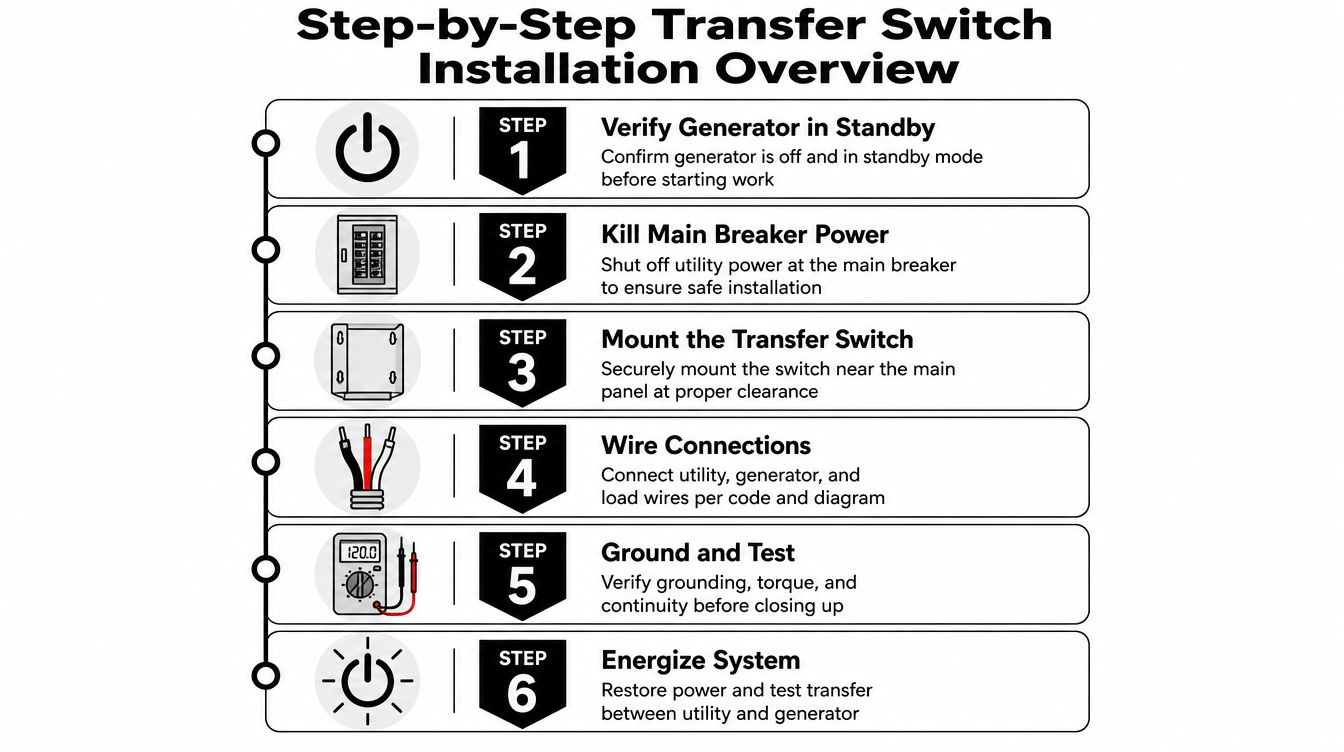
The practical sequence
Start by mounting the switch where it can be serviced and where the run to the panel and generator inlet stays reasonable. In many jobs, that means keeping the unit close to the main panel and within the required working space, because a bad location turns every future service call into a problem.
Then the conductors get run in the right raceway, usually EMT or flex where the application calls for it. The installer lands the line, load, neutral, and ground conductors on the correct lugs, and the neutral bond stays on the service side only. That part matters because neutral and ground belong together only at the correct point in the system.
Good installation work is boring. Straight runs, proper supports, correct terminations, and labels that the next electrician can actually read.
Before the cover goes back on, every termination gets torqued to the manufacturer's value, and if the manufacturer doesn't provide one, the listed tightening values apply. The wiring also needs labeling, because when a transfer switch is installed correctly, the next person should be able to tell at a glance which circuits are backed up.
A live transfer test finishes the job. That means restoring utility power, verifying the generator response, and checking that the load moves the way it should. The sequence is not the same on a small manual kit and a service-rated ATS, so the exact steps vary by equipment. Any work that involves live parts in the panel needs the correct disconnect or lockout procedure, full stop.
Permits, Codes, and Inspection Requirements
Code isn't a bureaucratic afterthought here, it's the framework that keeps the installation safe and legal. Article 700 covers emergency systems, Article 701 covers legally required standby systems, and Article 702 covers optional standby systems. Those categories affect separation, wiring method, labeling, and testing, so the classification has to be settled before the install is drawn.
For generator-backed emergency or standby service, NFPA 110 applies to the generator side of the system. The broader NFPA framework also expects transfer switches to move loads between sources safely, to allow bypass-isolation where permitted, and to support periodic testing with records maintained. That's why code-compliant installation is about more than just getting the wires on the right lugs.
| NEC Article | System Type | Wiring Method | Separation Required | Signage |
|---|---|---|---|---|
| Article 700 | Emergency | Independent wiring path | High separation from other systems | Clear emergency labeling |
| Article 701 | Legally required standby | Dedicated standby wiring | Separation required by system design | Standby identification |
| Article 702 | Optional standby | Flexible, but still listed and compliant | As required by the installation layout | Source and circuit labeling |
Florida projects also have a permitting layer on top of the electrical rules. In Palm Beach County, that usually means a permit, rough inspection, and final inspection, with the Florida Building Code and local portal requirements shaping the submission. Permit fees vary by jurisdiction and job size, so the useful habit is to confirm the fee schedule before work starts and avoid surprises at the end.
Switched neutral and solid neutral installations are also handled carefully by inspectors. In many residential ATS installs, the neutral arrangement now needs to be clearly defined so objectionable current doesn't show up where it shouldn't, especially on multi-wire branch circuits. FPL approval can also matter on load-side disconnect configurations, so a clean single-line diagram and coordinated paperwork save time.
For a broader residential backup-power context, this backup power system overview is a helpful companion reference.
Common Installation Mistakes and How to Avoid Them
The failures that come back on callback tickets usually aren't mysterious. They're the same mistakes repeated with different equipment, starting with the switched neutral omission. When that neutral decision is wrong, GFCI and AFCI breakers can nuisance trip, especially in systems with shared neutral paths.
Undersized conductors are another repeat offender. A transfer switch can be perfectly listed and still be installed with wire that's too small for the load, which is how overheating and voltage drop creep into the system. Long runs make the mistake worse, because the farther the current has to travel, the less forgiving the sizing gets.
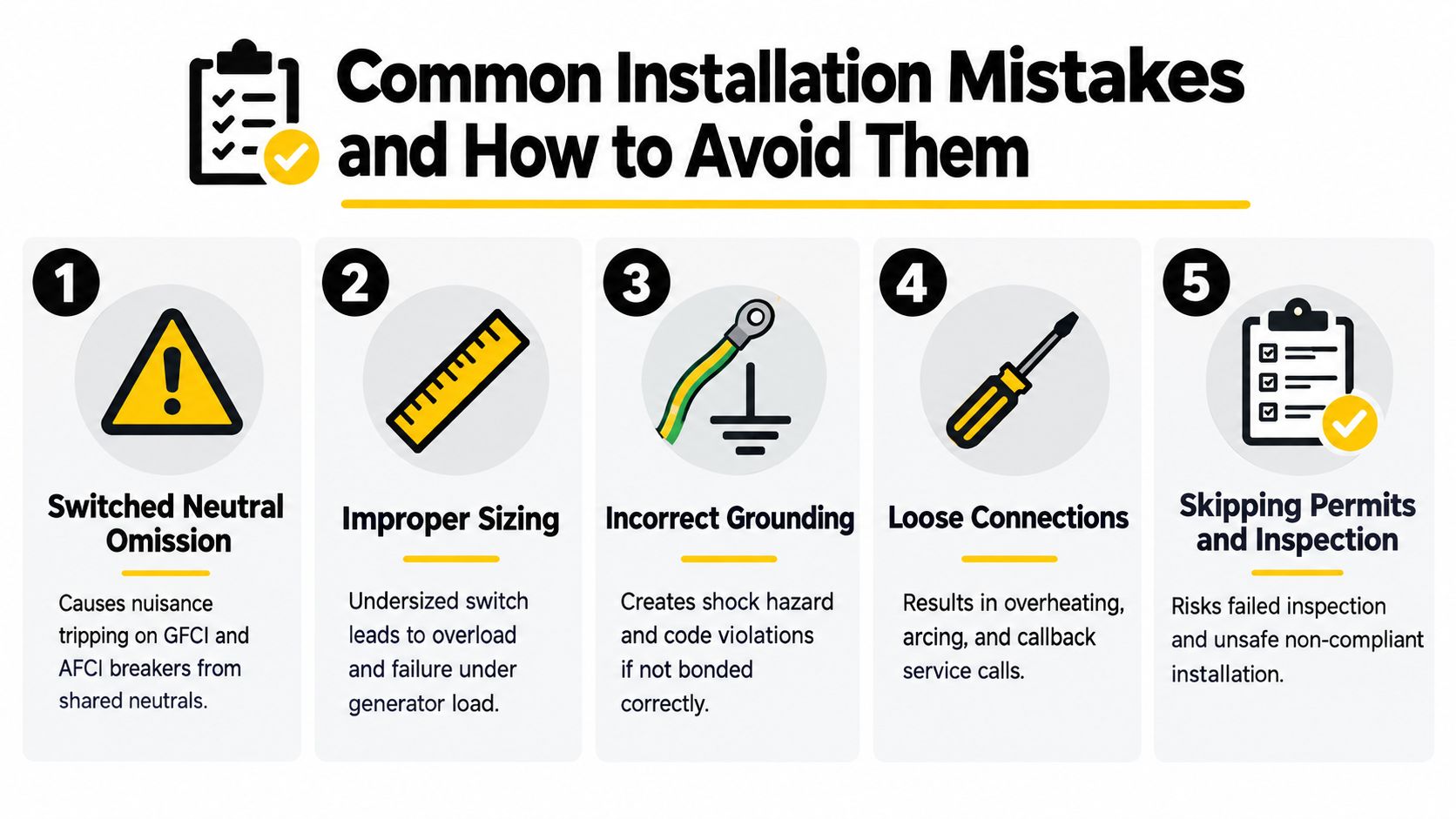
The failures inspectors catch fast
- Incorrect grounding: If the neutral-ground bond ends up in the wrong place, the inspector will catch it and the system may not operate safely.
- Loose terminations: A connection that isn't torqued properly can heat up, arc, and fail under load.
- Missing inlet protection: An outdoor inlet box needs to be listed and rain-tight, not improvised.
- No warning placard: The service disconnect needs clear labeling that a second source is present.
- Poor generator coordination: The generator output breaker has to work with the transfer equipment, or the system can create a dangerous backfeed condition.
The most expensive mistake is usually the one nobody sees until an outage. If the generator and transfer switch aren't coordinated correctly, a dead utility line can still end up energized. That's not a “minor issue,” it's the kind of problem that puts lineworkers at risk.
If an install depends on hope instead of coordination, it isn't finished.
The fix is straightforward in theory, though not always easy in practice. Size the conductors for the actual load, verify the neutral strategy before the first wire is landed, install the proper inlet hardware, and test the whole system before the next storm. That last part matters, because paper compliance doesn't keep the lights on, functional testing does.
When to Call a Licensed Electrician in Palm Beach County
Some jobs are homeowner-friendly on paper but still not wise in the field. In unincorporated Palm Beach County, a homeowner may be able to pull a homeowner's permit for a single-family residence, but that doesn't extend to condos, rentals, or commercial spaces. The moment the work touches service-side disconnects or more complex service equipment, the scope starts pushing into licensed-pro territory.
Panel compatibility is another hard line. Some load centers don't have a listed transfer switch kit that plays nicely with the brand and configuration already in the wall. Add a bonded neutral, service-entrance equipment, or a situation where the inspector needs a very specific diagram, and the job stops being a simple weekend project.
Before hiring, verify the contractor's license through the DBPR and MyFloridaLicense portals, ask for insurance certificates, and make sure the person pulling the permit is the person who's doing the work. If someone refuses to pull the permit, that's not a shortcut, that's a red flag. A real installer should be comfortable with the permit trail because it protects both sides.
Storm season creates another practical issue, which is schedule pressure. Licensed electricians in places like West Palm Beach, Boca Raton, and Jupiter often get booked weeks out once the weather starts turning. Waiting until a hurricane watch is on the screen is the expensive way to plan, so late-spring scheduling usually makes more sense.
Lighthouse Energy Services handles transfer switch installation as part of standby generator work, including load evaluation, transfer-switch installation, permitting coordination, and system testing. If you want the project sized and installed the right way, book the conversation before the next storm forecast turns into a deadline.
If you're ready to stop guessing about backup power, contact Lighthouse Energy Services and ask for help with transfer switch installation, load evaluation, and permit coordination. A licensed electrician can look at your panel, your generator, and your neutral arrangement, then tell you what's safe, what's code compliant, and what needs to be done before storm season closes in.