
A typical residential 200-amp electrical service upgrade costs $2,500 to $4,000, while the broader U.S. range for homeowner projects is $1,800 to $6,000. Complex work involving underground feeds, trenching, or utility coordination can reach $12,000 or more.
A homeowner in Boca Raton recently called after planning two upgrades at once, a central air-conditioning system and an electric vehicle charger. The first estimate looked like a simple panel replacement. The next estimate included a new meter base, larger service conductors, grounding corrections, permits, and utility coordination. That's how an ordinary-looking project becomes a major electrical expense.
The panel itself is often only one part of the bill. In Palm Beach County, access, municipal requirements, overhead versus underground service, and the condition of the existing equipment can change the price substantially. You need a load calculation and a written scope before you can judge whether a quote is fair.
This guide explains what an electrical service upgrade includes, why costs vary, how permits and compliance work affect your budget, and what the installation process looks like. It also uses Palm Beach County scenarios to show how different site conditions affect pricing. By the end, you'll know what to ask an electrician and how to plan a safe, properly sized upgrade.
Table of Contents
- Introduction
- Understanding Electrical Service Upgrades
- Key Factors Affecting Price
- Detailed Cost Breakdowns
- Upgrade Process and Timeline
- Palm Beach County Cost Examples
- Money Saving Tips and Financing Options
- Conclusion and Next Steps
Introduction
The first question most homeowners ask is, “What's the electrical service upgrade cost?” The honest answer depends on whether you're replacing a panel or upgrading the complete service feeding the property. A panel-only replacement can be relatively contained, while a service upgrade may involve the meter, conductors, grounding system, weatherhead, service mast, trenching, utility scheduling, and inspection corrections.
For Palm Beach County homeowners, a 200-amp upgrade commonly falls in the $2,500 to $4,000 range, consistent with the broader U.S. benchmark for a typical 200-amp project, according to current residential electrical service cost benchmarks. That figure is a planning range, not a guaranteed quote. A home with an accessible overhead service may stay near the lower end, while an underground feed or damaged service entrance can move well beyond it.
Why capacity matters
Your electrical service has to support the home's calculated demand, not just the appliances you're using today. Adding an EV charger, heat pump, electric range, pool equipment, workshop circuits, or backup power can expose a capacity problem that was invisible during ordinary use.
Practical rule: Don't approve a larger panel until the electrician shows you the load calculation and identifies every service-entrance item included in the price.
Hidden compliance costs create the biggest surprises. Permit charges, inspection corrections, meter-base changes, grounding work, and utility requirements can add meaningful expense before the electrician completes the installation. The sections ahead give you a practical way to separate those costs and request a transparent estimate.
Understanding Electrical Service Upgrades
An electrical service upgrade increases the amount of power your property can safely receive and distribute. It may include a new main panel, larger service conductors, a replacement meter base, upgraded grounding and bonding, a revised service mast, and utility-side work. A panel replacement alone doesn't necessarily increase the capacity of the utility service.
A service panel distributes electricity to branch circuits throughout your home. A subpanel adds breaker space downstream, but it doesn't automatically increase the total amperage available to the property. If the main service is undersized, installing a subpanel only gives you more spaces, not more capacity.
When an upgrade makes sense
Older homes often have smaller services that were adequate when households used fewer high-demand appliances. Today, homeowners may add central cooling, electric cooking, heat pumps, EV charging, pool equipment, or extensive home-office loads. Those additions can require a formal load review rather than a quick breaker installation.
Common warning signs include:
- Frequent breaker trips: Repeated trips can indicate overloads, damaged equipment, or circuit problems.
- Flickering or dimming lights: Voltage changes under load deserve professional evaluation.
- Limited breaker space: A full panel may require a subpanel or a complete service redesign.
- Heat, buzzing, or corrosion: These conditions can signal loose connections, deterioration, or unsafe equipment.
- Planned high-demand equipment: An EV charger, heat pump, electric range, or major renovation should trigger a load assessment before purchase.
Upgrade versus panel replacement
A simple panel replacement keeps the existing service capacity and usually focuses on the enclosure, breakers, labeling, and related code corrections. A service upgrade changes the capacity or service entrance and may require utility approval.
That distinction affects safety, insurance documentation, future expansion, and resale discussions. Ask the electrician to state in writing whether the proposal is a panel replacement, a service upgrade, or both. If the quote only says “upgrade panel,” it's too vague to approve.
Key Factors Affecting Price
The biggest mistake homeowners make is pricing the box instead of pricing the project. The total bill reflects the work required to deliver safe, code-compliant power from the utility connection to the branch circuits.
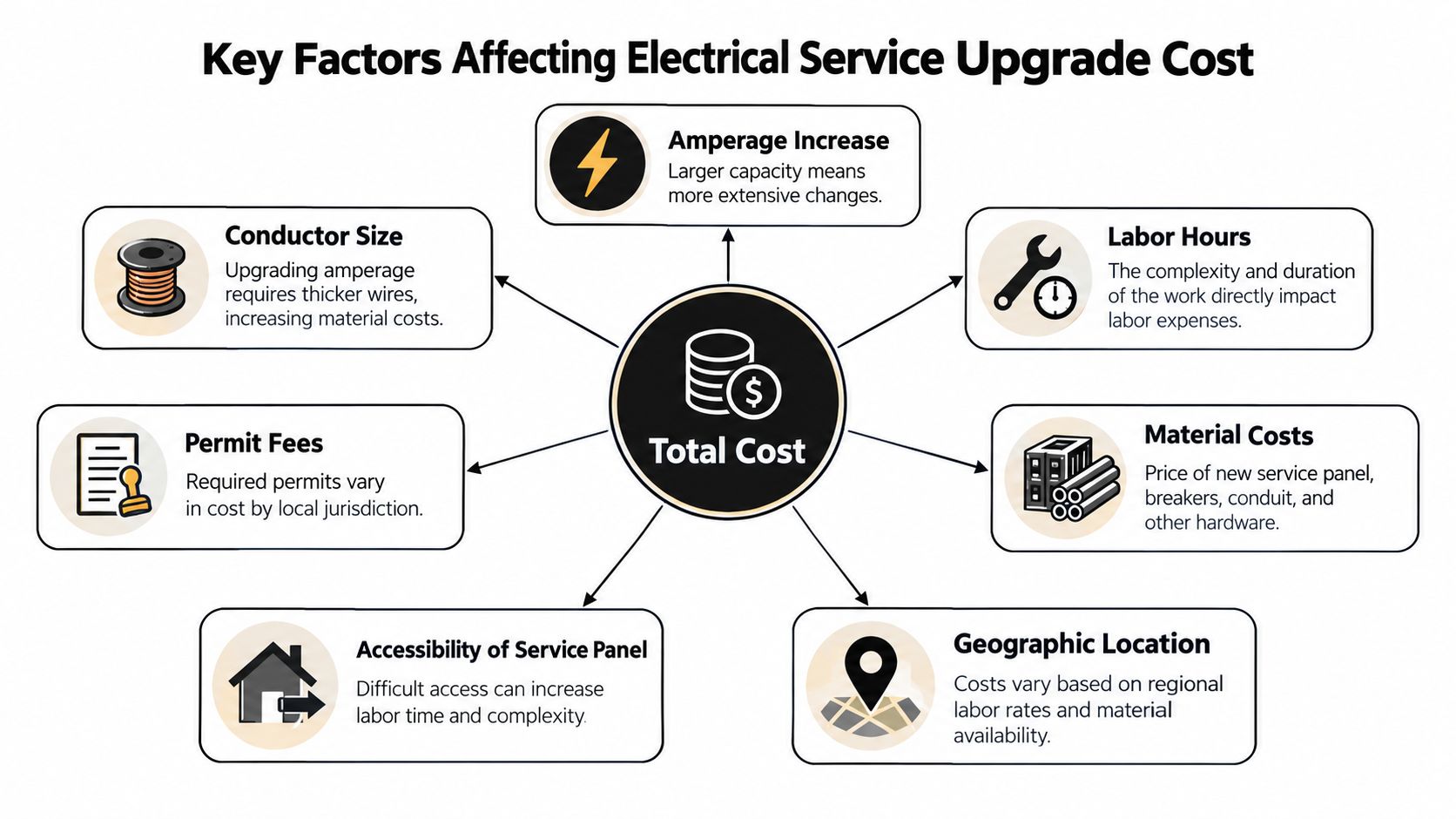
Capacity and conductors
Amperage drives conductor size, service equipment, breaker configuration, and labor. Simple market benchmarks place a 100-amp service upgrade around $800 to $1,500, a 150-amp upgrade around $1,200 to $2,100, a 200-amp upgrade around $1,500 to $2,800, and a 400-amp upgrade around $2,000 to $4,000 in simpler cases, according to service-upgrade pricing benchmarks by amperage.
Those figures can rise sharply when the job includes a meter-base replacement, feeder upsizing, trenching, a longer service path, or code remediation. A 400-amp project and an underground feed can exceed $10,000, because the electrician is replacing infrastructure, not merely installing a larger panel.
Site conditions and equipment
The panel's location matters. A clear, accessible garage wall is easier to work on than a cramped enclosure surrounded by finished surfaces, storage, or landscaping. Conduit routing, conductor length, wall repairs, weather exposure, and the condition of the existing service mast also affect labor.
Panel configuration matters too. A main-breaker panel, main-lug arrangement, meter combination, and available breaker spaces each create different installation requirements. Don't let a contractor reduce these decisions to a catalog price.
If the project supports an EV charger, review the separate planning considerations in this guide to EV charging station installation cost before selecting the charger and service size.
Permits and utility coordination
Permit and inspection charges vary by jurisdiction. Utility coordination may involve disconnect scheduling, meter work, service approval, and requirements for overhead or underground feeds. These items should appear as separate line items in your estimate, not as an unexplained allowance.
Ask for this in writing: panel and breakers, conductors, meter equipment, grounding, labor, permits, inspections, utility coordination, trenching, restoration, and any exclusions.
Detailed Cost Breakdowns
A Palm Beach homeowner should price the service entrance, panel, and related electrical work as separate pieces. Published benchmarks place many residential upgrades in the $1,800 to $6,000 range, while typical 200-amp work often falls around $2,500 to $4,000. Projects ranging from 100 to 400 amps can reach approximately $2,500 to $12,000. Underground feeds and 400-amp installations may exceed $10,000, according to published electrical service upgrade cost ranges.
| Service Amperage | National Cost Range | Local Palm Beach Range |
|---|---|---|
| 100 amps | $800 to $1,500 in simpler service-upgrade cases | Request a site-specific quote |
| 150 amps | $1,200 to $2,100 in simpler service-upgrade cases | Request a site-specific quote |
| 200 amps | $1,500 to $2,800 in simpler cases, with broader projects commonly reaching $2,500 to $4,000 | $2,500 to $4,000 is a practical planning range for a typical project |
| 400 amps | $2,000 to $4,000 in simpler cases, with complex work exceeding $10,000 | Budget for a detailed engineering and utility review |
A single average price gives Palm Beach homeowners the wrong expectation. A nearby meter and accessible panel can keep an overhead 200-amp upgrade relatively straightforward. An underground service may require trenching, restoration, added coordination, and compliance work that changes the budget substantially.
What the written estimate should show
Require a line-item proposal covering:
- Service equipment: Main panel, breakers, meter base, disconnects, and related hardware.
- Conductors and conduit: Wire size, route, assumed length, and exterior protection.
- Grounding and bonding: Grounding electrode work, bonding corrections, and required hardware.
- Permit and inspection charges: Application fees, inspection costs, and responsibility for corrections.
- Utility coordination: The party scheduling the outage, handling utility requirements, and managing reconnection.
- Surface restoration: Trenching, stucco, drywall, paint, concrete, or landscaping exclusions.
Hidden compliance fees deserve special attention. Ask whether the estimate includes required grounding corrections, service-location changes, labeling, equipment clearances, and inspection corrections. If those items are excluded, the initial price is not your project budget.
For broader planning, review this electrical installation cost guidance and compare its categories with the proposal. Then ask the electrician to confirm the service size, scope, exclusions, and Palm Beach County requirements in writing before approving the work.
Upgrade Process and Timeline
A professional upgrade follows a predictable sequence, but the schedule depends on permits, equipment availability, utility requirements, and inspection timing. Homeowners who plan the outage early avoid conflicts with travel, HVAC work, remodeling, and tenant access.
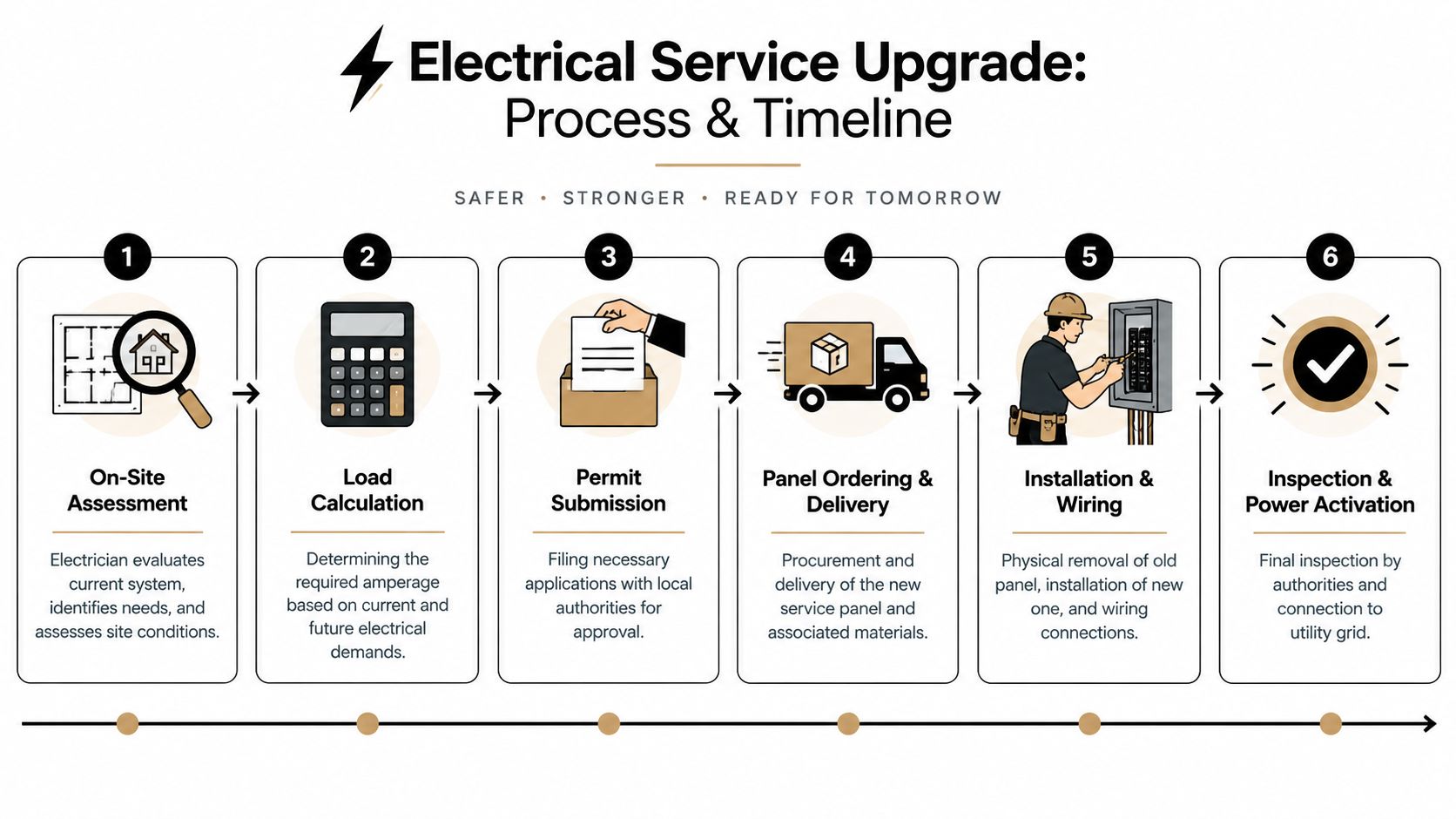
The six working stages
On-site assessment: The electrician reviews the existing service, panel, meter location, conductor route, grounding, and available space. Photos and utility information help define the scope.
Load calculation: The contractor calculates present and planned demand. One technically grounded approach uses 3 VA per square foot for general lighting, 3,000 VA for small-appliance circuits, and 1,500 VA for laundry, then adds major appliance nameplates, demand factors, and motor-load allowances. The resulting volt-amp total is divided by 240 volts to estimate service amperage, as described in this residential load calculation reference.
Permit submission: The electrician files the application and supporting information with the relevant authority. The permit process may identify service-location, grounding, labeling, or equipment requirements before installation.
Panel ordering and delivery: The contractor confirms the panel, breakers, meter equipment, conductors, conduit, and specialty hardware. Delays occur when the approved configuration isn't available.
Installation and wiring: The crew disconnects power, removes or modifies the existing equipment, installs the new service components, completes terminations, and tests circuits. Arrange for power interruption and protect sensitive electronics before work begins.
Inspection and power activation: The authority inspects the work, and the utility completes its portion when required. Power is restored after the necessary approvals and connection steps are complete.
Planning the calendar
Permit processing often takes one to two weeks, equipment lead time may take one week, and installation commonly requires one to two days, according to the project planning benchmarks provided for this guide. Treat those as planning windows, not promises. Underground work, corrections, weather, HOA requirements, and utility scheduling can extend the project.
Choose a contractor who explains who owns each delay. The guide to finding a good electrician can help you evaluate licensing, insurance, service-upgrade experience, communication, and written scope before signing.
Palm Beach County Cost Examples
Local examples should guide a budget, not imitate a completed invoice. Palm Beach County homes differ by municipality, service layout, construction age, HOA rules, and utility requirements. Compare the work included, not the ZIP code alone.
Scenario one, overhead 200-amp service
A Boca Raton home with overhead service, an accessible exterior panel, and no trenching usually has a simpler scope. The electrician still must check the meter base, service mast, grounding, conductor sizing, disconnect, and panel configuration. Plan on $2,500 to $4,000 for a typical 200-amp project, consistent with the residential service-upgrade cost guide.
The budget rises if the mast is damaged, the meter equipment needs replacement, grounding fails inspection, or the utility requires a different arrangement. HOA approval can add application time, exterior-design requirements, and coordinated access.
Scenario two, underground West Palm Beach feed
An underground feed carries more site risk and coordination. The contractor may need to confirm the route, locate existing utilities, install or replace conduit, excavate, protect conductors, and restore soil, paving, or landscaping. Complex residential work can reach $12,000, while underground feeds often exceed $10,000, depending on the scope, according to the service-upgrade cost benchmark.
Ask for a written allowance for excavation and restoration. Those items can shift the final bill more than the panel itself.
Permit differences
Permit charges vary by jurisdiction. One comparison lists panel-upgrade fees from about $43 in Denver to $371.35 in Seattle. A Canadian city lists $290.40 plus 1% of estimated electrical work for a 200-amp permit. These figures show why permit fees must be separated from the electrical estimate, and they do not establish Palm Beach County pricing.
Before approving work, ask the electrician which municipality issues the permit, what the fee covers, and whether revision or inspection charges apply. Use the permit fee schedule example as a reminder to verify the charge with the permitting authority. For a Palm Beach County budget, reserve money for compliance items, especially grounding corrections, revised equipment, and utility coordination.
Money Saving Tips and Financing Options
The safest way to lower an electrical service upgrade cost is to remove uncertainty, not to remove necessary work. Get the load calculation, define the service path, and require the estimate to distinguish permit charges, utility coordination, materials, and labor. A low bid that excludes trench restoration or grounding corrections isn't a saving. It's an unfinished price.
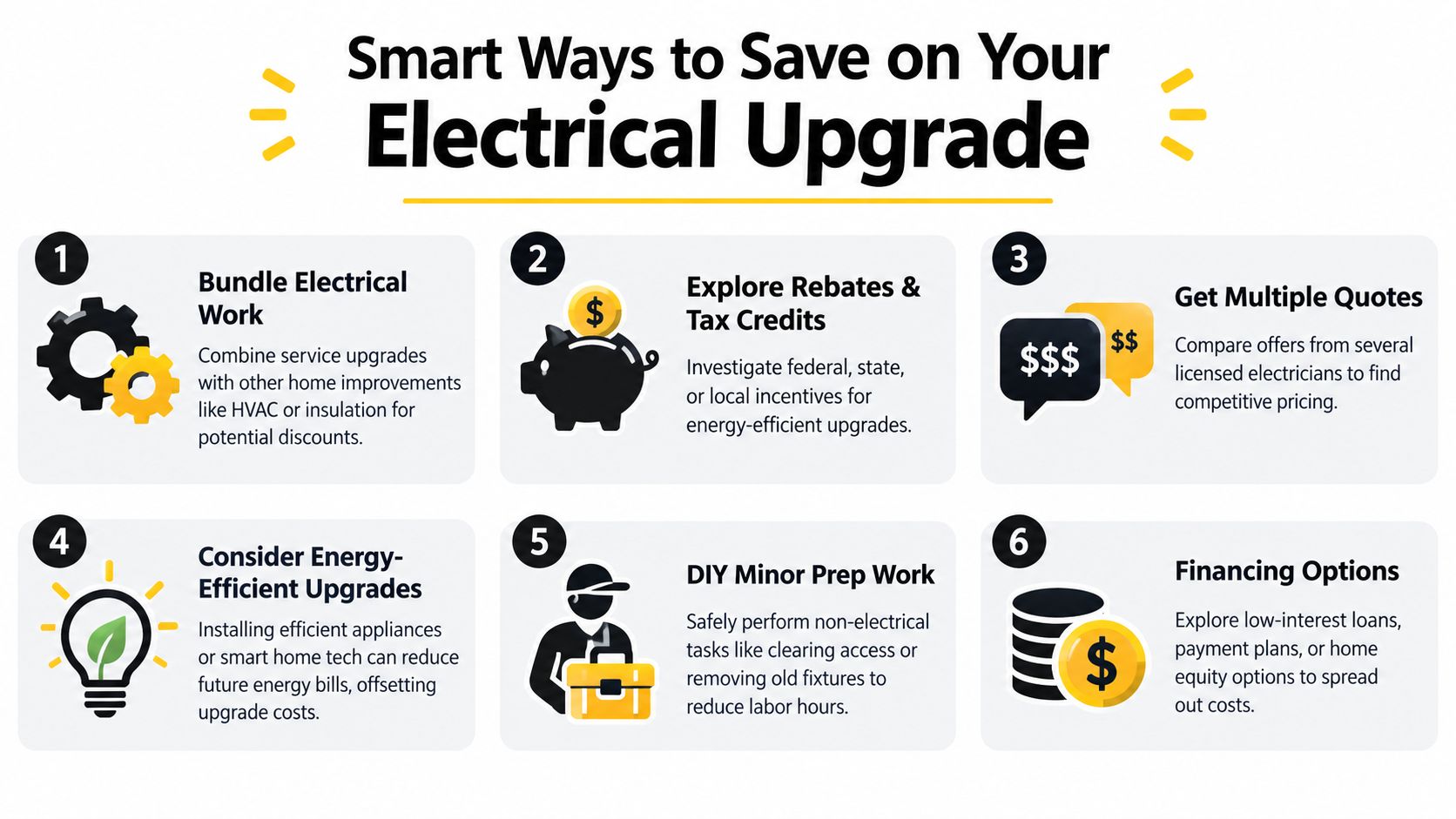
Practical ways to control the bill
- Bundle electrical work: Coordinate the service upgrade with planned HVAC, insulation, or equipment work when the same access and scheduling can reduce duplicated labor.
- Compare qualified quotes: Request multiple written proposals from licensed electricians, then compare scope line by line rather than choosing the smallest headline price.
- Prepare the work area: Clear storage, ensure gate access, protect valuables, and arrange access. Leave electrical disconnection and wiring to licensed professionals.
- Choose capacity deliberately: Don't pay for a larger service without a load calculation. Oversizing can add material and utility complexity, while undersizing creates rework.
- Ask about efficiency planning: Lowering demand through efficient equipment may help your overall electrical design, but it doesn't replace required service work when the calculated load demands an upgrade.
- Check incentives: Confirm eligibility, documentation, and filing requirements before assuming a credit will apply.
ENERGY STAR's referenced guidance states that an eligible electric panel upgrade tax credit covers 30% of project cost up to $600. A qualifying project needs at least $2,000 in eligible spending to reach the maximum credit, according to the industry analysis discussing the ENERGY STAR panel credit. Confirm current eligibility with a qualified tax professional before making the credit part of your budget.
For homeowners financing a larger renovation, New American Funding rehab loans may be a resource to investigate alongside contractor payment plans or home-equity borrowing. Compare the total borrowing cost, fees, repayment terms, and whether the loan is appropriate for your property and project.
Lighthouse Energy Services can also discuss related electrical work and energy-focused installations, including Smartcool ECO3, as part of a broader home-improvement plan. Keep the financing decision separate from the electrical safety decision. Use financing only after you understand the complete installed price.
Conclusion and Next Steps
Electrical service upgrade cost depends on amperage, conductors, service-entry conditions, permits, grounding, access, trenching, and utility coordination. A typical 200-amp project may fit within $2,500 to $4,000, but underground and code-correction work can push the total far higher. Get a load calculation and itemized proposal before authorizing work.
Lighthouse Energy Services serves Palm Beach County with 24/7 electrical availability, licensed professionals, transparent quotes, and on-site service for residential upgrades. A site estimate gives you a defensible budget and a clear installation plan.
Contact Lighthouse Energy Services for a free on-site estimate for your Palm Beach County electrical service upgrade. Ask for the load calculation, permit responsibility, utility coordination scope, and every included service-entrance item before you schedule the work.