
You've got a property that looks unfinished after sunset, or an older system that keeps losing fixtures, tripping circuits, and drawing complaints from neighbors. The first instinct is usually to compare fixture styles and ask for a price. In Palm Beach County, that's backward. You need to qualify the exterior architectural lighting contractor before you discuss the lighting effect.
Salt air, hurricane exposure, airport corridors, local permitting, dark-sky rules, and layered HOA standards can turn a simple-looking installation into a compliance and maintenance problem. The right contractor will address those conditions before proposing a fixture schedule. The wrong one will sell you attractive equipment and leave you with corrosion, glare, failed inspections, or an expensive change order.
Table of Contents
- Why Exterior Architectural Lighting Contractors Are a Different Hire in Palm Beach County
- Designers, Installers, and Full-Scope Contractors
- Credentials, Permits, and Red Flags to Screen For
- Dark-Sky Compliance and FAA Obstruction Lighting
- Realistic Costs and Timelines for 2026 Projects
- Maintenance Plans That Protect the Investment
- Questions That Expose an Unqualified Bid
Why Exterior Architectural Lighting Contractors Are a Different Hire in Palm Beach County
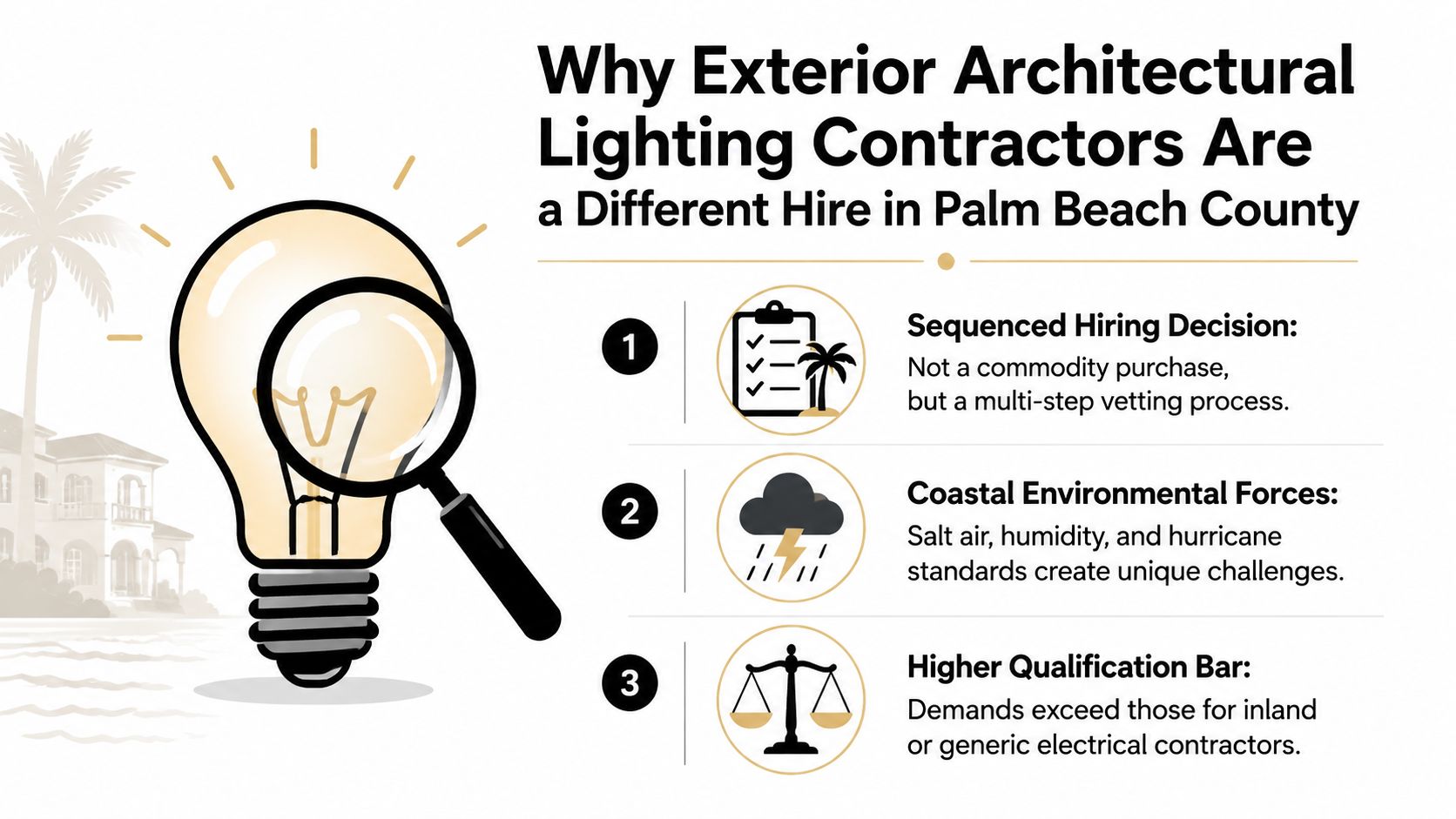
Exterior architectural lighting in Palm Beach County is a sequenced hiring decision, not a commodity purchase. The contractor has to coordinate the fixture, wiring, control gear, surge protection, structural support, permitting, aiming, and final commissioning before the crew starts drilling or trenching. A practical code-and-spec stack commonly includes UL 1598, UL 8750, UL 1449, NFPA 70, ANSI/IES RP-8, ASHRAE/IES 90.1 or IECC, and ASCE 7 or AASHTO LTS-6, depending on the project. This exterior lighting methodology explains why those elements must be coordinated as one package.
Palm Beach County adds conditions that inland contractors may not understand. Salt air and irrigation overspray attack exposed metal, seals, connectors, and drivers. A fixture that looks acceptable in a showroom can deteriorate quickly when it's installed near the Intracoastal, on a beachfront estate, or beside a heavily irrigated area. Ask what corrosion-resistant materials, wet-location listings, mounting hardware, and waterproof connections the bidder is specifying. “Outdoor rated” alone isn't a sufficient answer.
Airport proximity raises another qualification issue. Properties near Palm Beach International Airport, Boca Raton Airport, or relevant flight paths may require aviation review for rooftop equipment, towers, poles, or structures that could affect navigable airspace. A contractor who treats FAA coordination as someone else's problem is not ready to manage the project.
Vet the jurisdiction before approving the design
Your permitting path changes depending on whether the property is in unincorporated Palm Beach County or a municipality such as West Palm Beach, Jupiter, or Delray Beach. HOA rules can add another layer in communities such as Boca West, Lost Tree, and Frenchman's Creek. The contractor should identify the authority having jurisdiction, the applicable review requirements, and the documents needed before finalizing the proposal.
The extra vetting isn't paranoia. It's the actual job specification. Hire someone who can show coastal material knowledge, photometric competence, electrical licensing, structural awareness, and local permitting experience. If the bidder only wants to discuss brightness and fixture appearance, keep looking.
Designers, Installers, and Full-Scope Contractors
Marketing language blurs three different roles. A lighting designer develops the visual and technical concept, usually through photometric layouts, fixture schedules, beam selections, and aiming diagrams. An installer executes a prepared plan, but may not accept responsibility for whether the design achieves the intended appearance. A full-scope contractor takes responsibility for design coordination, electrical execution, permitting, controls, surge protection, and commissioning.
That distinction matters on Palm Beach County properties. Architects and designers may hand a project to a low-voltage installer, but façade lighting, rooftop equipment, tree uplighting tied to a building panel, and other line-voltage work require appropriate electrical oversight. You need to know who holds the electrical permit, who is responsible for the feeder and branch circuits, and who will correct the system if the final result produces glare or fails inspection.
| Role | Delivers | License Held | Owns Final Result |
|---|---|---|---|
| Lighting designer | Concept, photometric layout, fixture schedule, aiming plan | May not hold an electrical contractor license | Owns design intent |
| Installer | Wiring, mounting, fixture placement, field execution | May hold a limited or specialized license | Owns installation workmanship |
| Full-scope contractor | Design coordination, electrical work, permits, controls, testing, closeout | Should hold the required Florida electrical contractor credentials | Owns the complete delivered system |
When a separate designer makes sense
A separate designer can be smart for a custom estate, landmarked property, resort-style campus, or architecturally sensitive renovation. The owner gets a design advocate who can protect the appearance from value-engineering decisions that weaken the result. Before signing, however, assign responsibility in writing for revisions, fixture substitutions, photometric compliance, and field aiming.
For a straightforward residence or a small commercial property, splitting design and installation often creates coordination gaps. The designer blames the installer, the installer blames the fixture supplier, and the owner pays for the confusion. If you're still comparing design approaches, a general resource on how to enhance your home with architectural lighting can help clarify the difference between visual planning and physical installation.
Ownership rule: The person who controls the permit, product schedule, field installation, and commissioning should also own the final result.
Credentials, Permits, and Red Flags to Screen For
Don't start with the lowest bid. Start with documents. Before discussing price, ask each bidder for the Florida Certified Electrical Contractor license information, proof that the registration is active for the relevant Palm Beach County jurisdiction, insurance certificates, and a written description of who will perform the work.
For a legitimate exterior scope, screen for:
- Electrical credentials: Confirm the Florida Certified Electrical Contractor, or EC, license and the permit holder assigned to the project.
- Insurance: Verify general liability coverage suitable for exterior work, including the heights and conditions involved.
- Workers' compensation: Require proof for every crew member who'll work from ladders, lifts, roofs, or elevated structures.
- Product familiarity: Ask for manufacturer documentation and evidence that the proposed fixture lines are appropriate for coastal, wet-location use.
- Permit responsibility: Get the permit names in writing instead of accepting a vague “permit allowance.”
- Design documentation: For commercial or complex properties, request photometric layouts, fixture schedules, control diagrams, and aiming details.
Palm Beach County work may involve building and electrical permits, and exterior installations near sidewalks can require right-of-way coordination. Municipal review, HOA approval, dark-sky requirements, utility coordination, and aviation review may also apply. The contractor should explain which agency handles each item and who pays for revisions if an authority rejects the first submission.
A bid becomes suspect when it omits a license number, combines every permit into one unexplained line, asks for cash or a deposit without a defined schedule, refuses to identify fixture SKUs, or won't provide a photometric plan for a commercial installation. Don't accept “commercial grade” as a product specification. Ask for the exact model, finish, material, listing, warranty, color temperature, beam angle, and BUG rating where applicable.
That image URL contains a mismatch with the supplied asset path, so the required pre-uploaded image must be used exactly as provided:
Use visual planning resources, such as an AI outdoor patio design, only as concept aids. They don't replace electrical plans, site measurements, permits, or commissioning. For a broader screening framework, review this guide on how to find a good electrician.
The question that disqualifies most unqualified bidders is simple: “Who is the licensed electrical contractor responsible for this project, and can I verify the license before signing?” If the answer is evasive, stop the conversation.
Dark-Sky Compliance and FAA Obstruction Lighting
In Palm Beach County, lighting compliance can determine whether a contractor is qualified for the job. Coastal exposure, nearby airports, neighboring properties, and dark-sky expectations all affect fixture selection, aiming, documentation, and long-term maintenance. A contractor must show where light goes, how much escapes the site, what color temperature the equipment produces, and whether the installation creates an aviation concern. DarkSky's luminaire guidance offers a useful reference for directing light only where it is needed and avoiding over-lighting, but the contractor must still apply local requirements to the specific property.
Demand the paperwork before the purchase order
Request a sealed, or otherwise professionally accountable, photometric plan when the project's complexity or jurisdiction requires one. It should identify property boundaries, mounting locations, aiming directions, spill light, light trespass, and the relationship between illuminated areas and neighboring parcels. Ask for fixture cut sheets with BUG ratings, particularly where uplight, glare, or nearby residences create concerns.
Tree-canopy “moonlighting” deserves close review. A fixture can look attractive in a rendering while sending uplight into the sky or across a property line. Imported fixtures with an untempered 4000K output may also conflict with a local standard requiring a lower correlated color temperature. Current ordinance and guidance documents increasingly address fully shielded fixtures, low correlated color temperature, photometric layouts, BUG ratings, and boundary calculations. The paperwork belongs in the design file, not as an afterthought.
Treat aviation review as a separate workstream
A rooftop, tower, pole, or tall architectural feature near an airport may require an FAA determination. Require the contractor to identify whether notification is necessary, who prepares the filing, and which lighting or marking conditions apply. A verbal assurance that “the airport won't care” is not a compliance plan.
For aircraft obstruction lighting, ask for the applicable determination letter and filing record before construction begins. Confirm who will handle inspections, lamp or fixture replacement, monitoring, and any required reporting after installation. Lighthouse Energy's overview of aircraft obstruction lights gives owners a practical starting point when rooftop or tower conditions are part of the scope.
Contract rule: If the bidder calls dark-sky review, photometrics, or FAA coordination “optional,” remove that bidder from consideration.
Realistic Costs and Timelines for 2026 Projects
A low bid often leaves out work the property still needs. Common omissions include coastal-grade hardware, surge protection, trench restoration, permit handling, controls, nighttime aiming, and commissioning. Use the supplied 2026 Palm Beach County project benchmarks for early planning, not as guaranteed quotes.
| Project Type | 2026 Cost Range | Design & Permit | Install Duration |
|---|---|---|---|
| Single-family residential design-build | $4,500 to $12,000 | Design and photometrics commonly take 2 to 4 weeks; permitting may take 3 to 6 weeks in unincorporated Palm Beach County | Rarely less than 2 weeks for a full property |
| High-end estate property | $18,000 to $45,000 | Longer coordination is common because of custom details, coastal materials, HOA review, and surge protection | Typically extends beyond a basic residential installation |
| Commercial façade and landscape lighting | $2.50 to $6.50 per square foot of lit area | Design, photometric sealing, permitting, and jurisdictional review must be scheduled before procurement | Varies with site access, trenching, structure, and controls |
The residential and estate figures are planning ranges from the project brief, not promises of current market pricing. Commercial pricing changes substantially with façade coverage, lighting zones, parking areas, difficult access, trenching, and structural work.
Where change orders usually appear
Directional boring through hardpan or coquina can add labor and restoration that a surface-level estimate misses. A nighttime mockup may also show that the proposed fixtures have inadequate beam spread, excessive glare, or an unsuitable finish, requiring different hardware. Existing electrical service creates another common surprise if it lacks capacity, circuit separation, grounding, or surge protection.
Require a written allowance for each known risk. The proposal should identify who pays for site and surface restoration, what happens if a fixture SKU becomes unavailable, and whether nighttime aiming is included. Ask the contractor to separate allowances from firm pricing so you can see which costs remain uncertain.
A permanent lighting resource from Cultivate House Detailing can provide additional context on how ongoing exterior lighting differs from a one-time seasonal installation.
Price advice: Compare complete scopes, not totals. A $6,000 proposal that excludes controls, permits, surge protection, and commissioning is not cheaper than a $10,000 proposal that includes them. Require both bids to list fixture specifications, wiring, controls, restoration, testing, and closeout documentation before you compare the bottom lines.
Maintenance Plans That Protect the Investment
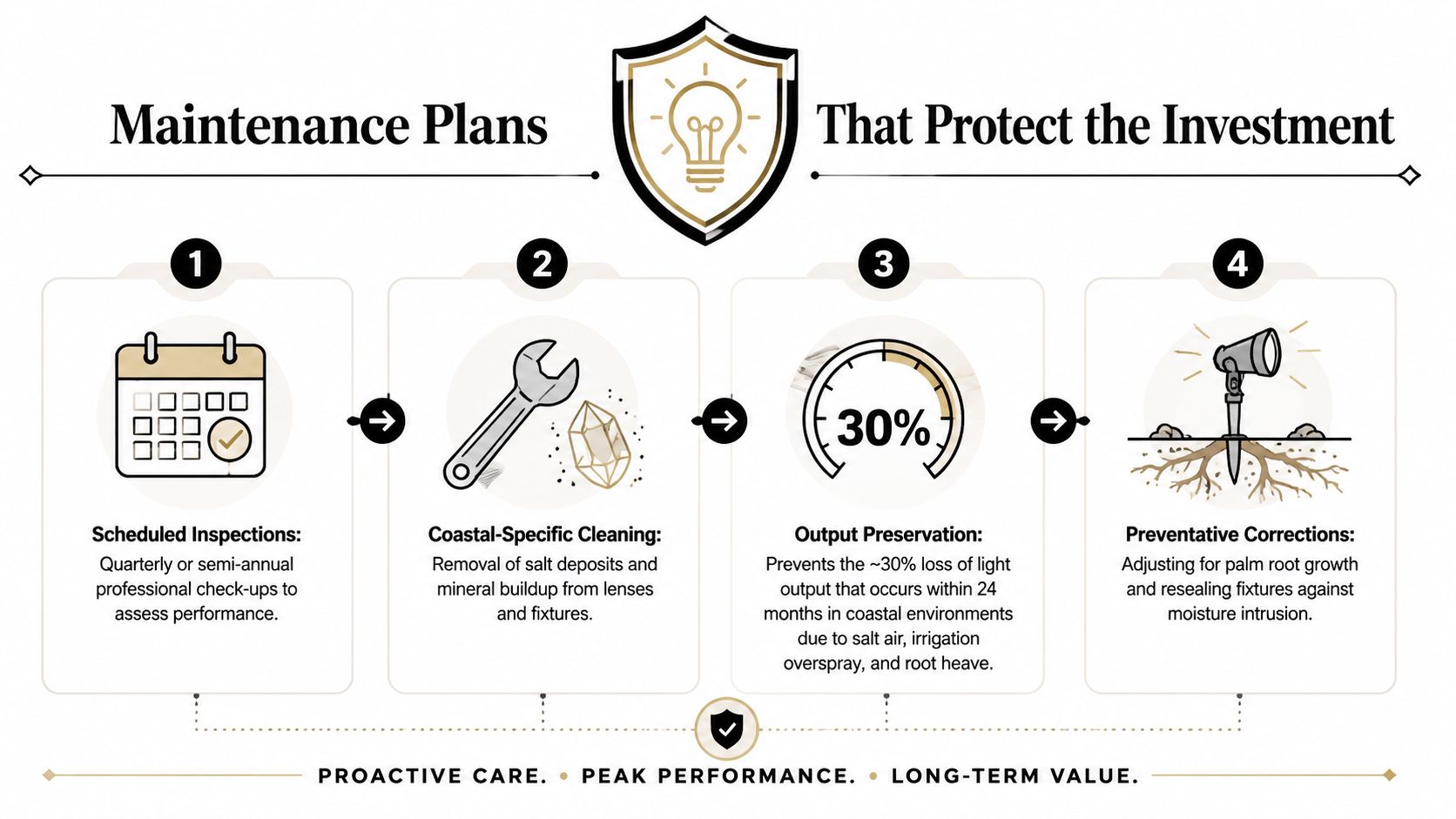
A coastal lighting system can look excellent at turnover and perform poorly later. Salt deposits, irrigation overspray, humidity, storm debris, soil movement, and plant growth affect fixture output, aiming, seals, and connections. Build maintenance into the contract from the start, especially for properties near the coast or exposed to frequent storms.
A service agreement should name every task, inspection interval, response time, and replacement rule. “We'll come back if something breaks” is a repair promise, not a maintenance plan. Use a structured lighting maintenance approach to help define inspection responsibilities and response procedures.
What the agreement should include
- Lens and fixture cleaning: Remove salt film, mineral deposits, dirt, and irrigation residue before they reduce output or distort the beam.
- Post-storm inspection: Re-aim fixtures, inspect seals and connections, test surge protection, and check for impact or water intrusion after significant storms.
- Vegetation management: Adjust aiming as palms, hedges, and canopy growth alter the intended light pattern.
- Electrical testing: Check labeled circuits, controls, transformers, drivers, grounding, and waterproof connections.
- Replacement planning: Record driver and LED module condition, warranty status, and the expected replacement path. The supplied brief identifies year 8 to year 12 as a typical planning window for driver and LED module replacement, although actual life depends on product, heat, loading, and maintenance.
Require written maintenance records. The report should list failed fixtures, corrected aiming, water intrusion, control changes, and parts that may need replacement. Without that record, the next contractor has to rediscover the system at your expense.
Choose the service structure carefully
Property owners generally choose per-visit billing, annual agreements, or HOA-wide master plans. The brief identifies per-visit pricing of $185 to $350 and annual contracts at 8% to 12% of the original installation cost. Compare those options against the property's exposure, access requirements, and storm risk, not just the initial fee.
For HOAs and managed communities, a master agreement can coordinate inspections across multiple lots and common areas. It also keeps dark-sky requirements and aviation-related lighting from being overlooked during routine service. Require a stated response process so a failed fixture is assigned, documented, and corrected instead of remaining unresolved while the owner searches for a qualified contractor.
Questions That Expose an Unqualified Bid
A low bid often looks attractive until an HOA rejects the lighting plan, the city requests revisions, or water reaches an unsealed connection after the first storm. Treat the estimate meeting as a qualification interview. Price comes after accountability, documentation, and a defined scope. Ask who holds the electrical license, who designs the lighting, and who supervises the installation crew or subcontractor.
Require written answers to these questions:
- Who owns the permit? Name the licensed contractor and identify who will communicate with Palm Beach County or the applicable city.
- What exactly is included? List fixtures, transformers, wiring, trenching, boring, controls, surge protection, waterproof connections, grounding, circuit labeling, aiming, testing, and closeout documents.
- Which approvals apply? Confirm building and electrical permits, right-of-way work, HOA review, utility coordination, dark-sky documentation, and any FAA determination.
- How will glare be controlled? The bidder should address shielding, aiming, beam spread, uplight, light trespass, color temperature, and nearby homes.
- What products are specified? Request fixture SKUs, cut sheets, ratings, finish, warranty, driver details, and replacement availability.
- What happens after installation? Get the commissioning process, nighttime aiming schedule, control verification, warranty procedure, and maintenance proposal.
A serious bidder measures the property before final pricing. The site review should identify panel conditions, wiring routes, drainage, hardscape, roots, access limits, mounting surfaces, and restoration work. A contractor who labels every unknown item “custom,” hides the scope in one lump sum, or promises an exact final price without inspecting the property is giving you a reason to stop.
Reject proposals that omit grounding, surge suppression, labeled circuits, written change-order rules, or post-installation aiming and testing. Controls can reduce energy use when the contractor selects the sequence for the property and commissions it properly. Ask the bidder to verify wattage and mounting height, explain scheduling and dimming behavior, then demonstrate nighttime dimming and vacancy recovery before final acceptance. The control guidance and benchmarks can help you compare the proposed control approach against established guidance.
Your closeout package should include approved plans, permit information, product documentation, circuit labels, control settings, test results, warranty contacts, and photographs of concealed work. Without those records, the next service call starts with guesswork.
If the proposal cannot identify one accountable party from design through final approval, do not authorize the work. Lighthouse Energy Services provides exterior lighting installation and retrofits, including parking lot, community, and LED work, along with electrical permitting and troubleshooting for Palm Beach County properties. Visit Lighthouse Energy Services to discuss site conditions, compliance needs, and a complete scope before accepting a bid.