
The most popular advice about commercial electrical maintenance is also the least useful: inspect everything on a fixed calendar and call an electrician when something fails. That checklist can create the appearance of control while leaving a facility exposed to overheating connections, degraded insulation, obsolete equipment, poor records, and emergency outages.
A working program does more than schedule visits. It identifies which assets can interrupt operations, measures their condition, documents the findings, and assigns corrective work before a small defect becomes a safety event or a full-building shutdown. NFPA 70B frames maintenance around equipment condition and criticality, not a calendar alone, and its purpose is to reduce hazards to life and property caused by electrical failure or malfunction (NFPA 70B overview).
Across Palm Beach County, that distinction matters. Salt air, humidity, lightning, storms, aging distribution equipment, and changing loads all punish facilities that rely on vague promises and scattered paperwork. The practical question isn't whether maintenance matters. It's whether your team can prove what was inspected, what changed, what remains unsafe, and who owns the next action.
Table of Contents
- Why Most Facilities Get Electrical Maintenance Wrong
- Core Services Every Commercial Maintenance Program Covers
- Building a Condition-Based Maintenance Schedule
- Understanding Cost Drivers and Measuring ROI
- How to Choose a Licensed Electrical Contractor
- Sample Maintenance Plan and Emergency Response Protocol
- Local Considerations for Palm Beach County Facilities
Why Most Facilities Get Electrical Maintenance Wrong
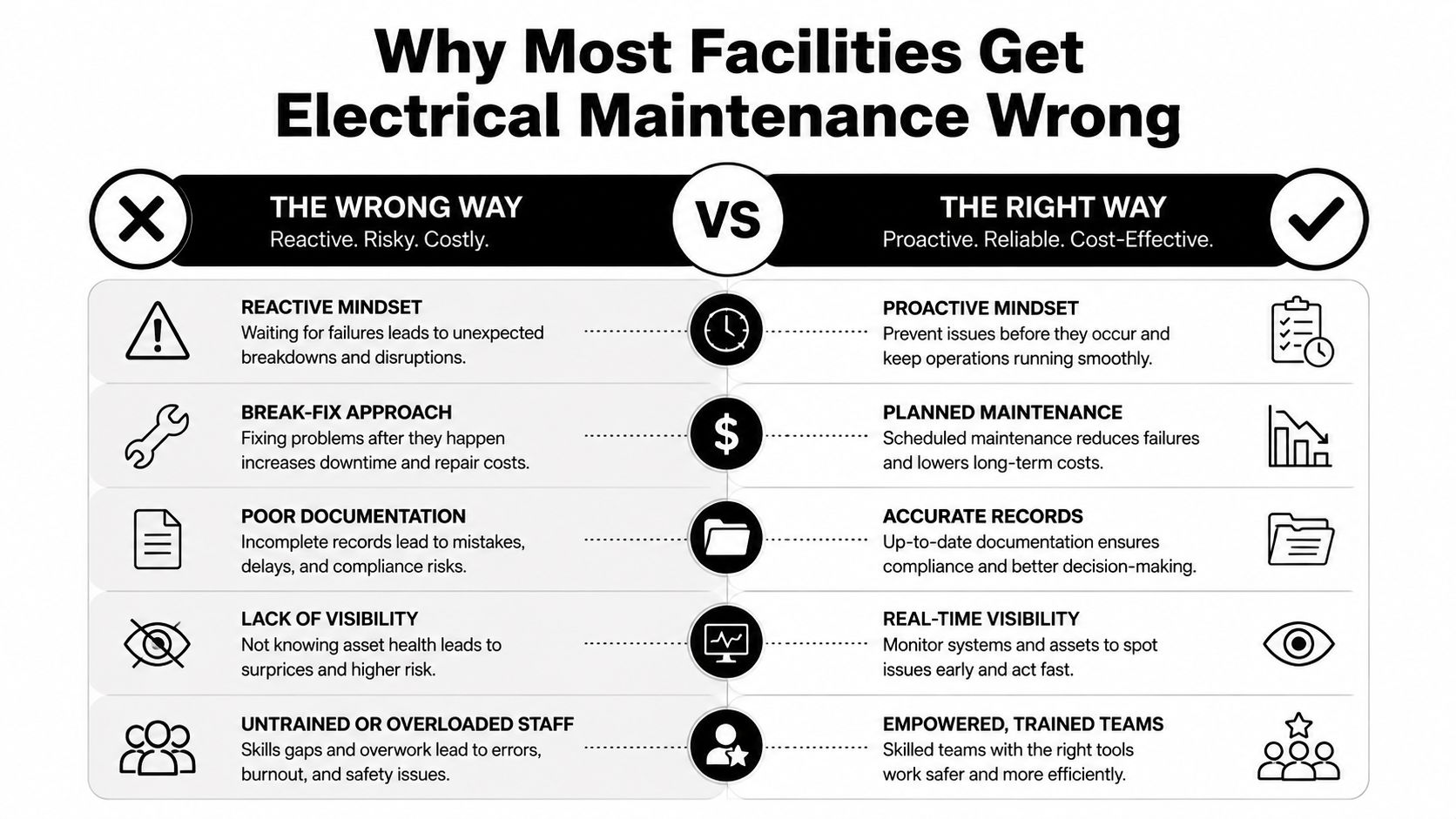
Reactive repairs often look cheaper because the invoice arrives only after the problem appears. That view ignores the operational cost of the failure itself. A tripped breaker may interrupt a tenant's work, spoil temperature-sensitive inventory, stop access systems, disrupt elevators, or force a shutdown at the worst possible time. Emergency labor, expedited parts, temporary power, tenant communication, and investigation can cost more than correcting the defect during planned work.
The deeper problem is that many facilities already understand this. A 2025 maintenance report found that 71% of maintenance leaders consider preventive maintenance core, yet fewer than 35% spend most of their maintenance time on it (State of Industrial Maintenance Report 2025). The gap is execution. Managers approve inspections, but contractors may deliver a brief checklist without baseline readings, defect priorities, photographs, or a closed-loop work order.
The failure starts before the outage
On a service call, a loose termination rarely announces itself as a major failure. It creates resistance, heat, insulation damage, and eventually arcing or equipment malfunction. A neglected transformer can move from an unnoticed maintenance item to a fault that removes power from an entire portion of a building. These events aren't theoretical risks. They're the predictable result of allowing defects to develop without condition data or assigned follow-up.
Calendar-only programs fail for a different reason. A lightly loaded panel in a clean, climate-controlled office doesn't face the same exposure as outdoor switchgear near the coast, equipment serving a high-occupancy retail space, or a distribution system that has gained new loads over time. A mature plan uses intervals as a starting point, then changes attention based on heat, moisture, contamination, loading, age, criticality, and previous findings.
Practical rule: A maintenance record should tell the next electrician what changed, not merely prove that someone visited.
Maintenance enables more than uptime
Electrical maintenance also supports energy management and resilience. Load measurements can reveal distribution problems before they become nuisance trips. Power-quality observations can point to issues affecting sensitive equipment. Lighting controls, backup systems, surge protection, and monitoring devices only deliver their intended value when technicians test and document their operation.
The regulatory history reinforces why documentation matters. Insurers observed electrical fires associated with poor maintenance in the late 1960s. NFPA introduced NFPA 70B as a tentative practice in 1973, followed by its first official edition in 1975. The standard later evolved into a central maintenance framework for equipment such as transformers, breakers, and cables (NFPA 70B history and maintenance guidance).
A facility doesn't need an elaborate software platform to improve. It needs an asset list, a risk ranking, consistent inspection methods, clear defect categories, and a manager who reviews open findings. Paper can work. Disorganized paper cannot.
Core Services Every Commercial Maintenance Program Covers
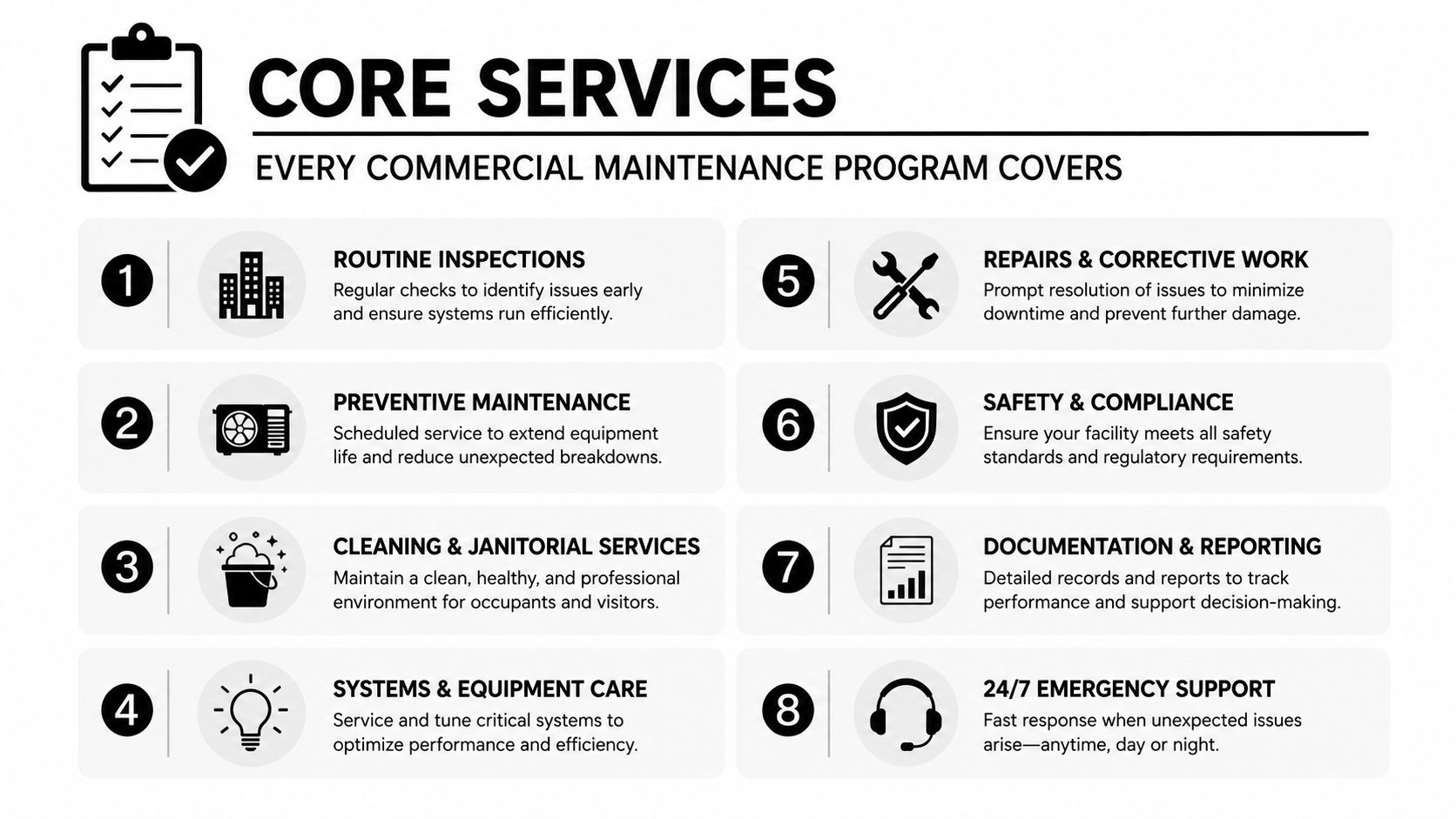
A credible program connects each service to a failure mode. “Panel inspection” isn't enough. The contractor should identify what was examined, what instruments were used, what readings were taken, what defects were found, and whether the issue requires immediate correction, planned repair, or continued monitoring.
Inspections and diagnostics
Infrared thermography is useful for finding abnormal heat at switchgear, panelboards, disconnects, lugs, and other energized equipment. A hot connection may indicate looseness, excessive load, corrosion, or component deterioration. The image matters, but so does the follow-up. A thermal scan without a repair recommendation and a documented recheck is only a snapshot.
Visual inspection catches conditions that thermal imaging can't fully explain, including damaged enclosures, blocked working space, contamination, water intrusion, missing labels, deteriorated insulation, and signs of unauthorized modifications. Technicians should compare findings with prior photographs and readings instead of treating every visit as a blank slate.
Testing and protective equipment
Testing should match the equipment and the hazard. Ground-fault protection verification confirms that protective devices respond as intended. Insulation resistance testing helps assess cable and equipment insulation. Circuit-breaker testing can verify trip performance, while contact resistance measurements may identify high-resistance paths in switching equipment.
The right scope also includes grounding and bonding review, surge protective devices, emergency lighting, transfer equipment, generators, UPS systems, and battery-backed systems where the building depends on them. A contractor who only checks visible panel conditions is not evaluating the entire electrical risk picture.
Lighting, capacity, and modifications
Lighting maintenance includes interior fixtures, controls, exterior areas, exit lighting, and aircraft obstruction lighting on applicable towers and rooftops. A failed obstruction light can create a safety and compliance problem separate from ordinary tenant lighting.
Panel upgrades and load balancing should reflect the building's present use, not the assumptions made when it was constructed. New air-conditioning equipment, kitchen loads, server rooms, EV charging, battery systems, and renewable generation can alter demand and coordination. Maintenance findings should feed capital planning so upgrades happen before the system becomes overloaded.
Response capability
Emergency service isn't a substitute for prevention, but it belongs in the program. The agreement should define who receives the call, how the electrician gains access, how the affected equipment gets isolated, when the facility manager is notified, and whether temporary power is available.
For broader facility upkeep, a cross-trade reference such as the Covenant Aire Solutions checklist can help property teams coordinate electrical work with HVAC maintenance, access requirements, and seasonal planning. The electrical contractor should still produce a dedicated electrical scope, because generic facility checklists rarely capture protection testing or distribution-system condition.
Building a Condition-Based Maintenance Schedule
NFPA 70B provides the right starting principle: maintenance should reflect equipment condition and criticality. A schedule becomes useful when it answers three questions for every asset: what can fail, how would the facility know, and how quickly must someone respond?
Start with an equipment register
List the main switchgear, transformers, panelboards, feeders, breakers, generators, transfer switches, UPS equipment, battery systems, surge protection, lighting controls, and specialized loads. Record location, manufacturer information, age where known, service history, operating environment, and the consequence of failure.
Then assign a criticality rating. A main service disconnect serving a medical tenant, life-safety system, data room, or large retail operation deserves more attention than a lightly loaded branch panel with an alternate feed. Criticality isn't a label for the electrician alone. It determines inspection depth, response priority, spare-parts planning, and acceptable downtime.
Use three levels of observation
Routine inspection covers visible condition, abnormal noise or odor, enclosure condition, labels, access, signs of heat, and basic operating observations. Periodic testing adds measurements such as insulation resistance, contact resistance, grounding performance, and breaker trip behavior when appropriate. Predictive diagnostics can include infrared scanning, power-quality analysis, and trend review.
A practical benchmark in NFPA-related guidance calls for trained professionals to complete key visual-inspection tasks at a 12-month interval, while lubrication may range from 12 to 60 months, depending on equipment condition (NFPA-related maintenance benchmark). Those intervals aren't permission to ignore a high-risk asset between visits. They're reference points that should be adjusted for exposure and findings.
| Equipment Type | Visual Inspection | Infrared Scan | Electrical Testing | Criticality Rating |
|---|---|---|---|---|
| Main switchgear | At least annually, and after significant changes | Condition and risk based | Protection, insulation, and breaker testing as specified | High |
| Transformers | At least annually | Condition and loading based | Insulation, connections, and related tests as appropriate | High |
| Distribution panels | At least annually | Based on load, heat, and history | Connection and protective-device testing as required | Medium to high |
| Emergency systems | Monthly operational observation, with formal review | As equipment and access allow | Generator, transfer, battery, and lighting tests | High |
| Branch circuits | Routine facility observation | Targeted when symptoms or load concerns appear | Fault, grounding, or insulation testing when indicated | Low to medium |
Turn findings into work
Capture a baseline for each critical asset. Record readings in consistent conditions, attach photographs, note ambient or loading context, and define an action threshold. When a reading drifts, create a work order with an owner, due date, safety control, and verification step.
This approach prevents two common wastes. It avoids servicing every component as if it were failing, while also preventing a known defect from disappearing into a folder. The schedule should change when equipment changes, usage changes, or repeated findings reveal a pattern.
Understanding Cost Drivers and Measuring ROI
Electrical maintenance budgets vary because buildings vary. Square footage affects the amount of equipment and distribution to inspect. System complexity adds switchgear, controls, backup power, monitoring, and specialized loads. Age increases the chance of degraded insulation, obsolete components, incomplete drawings, and prior modifications that no longer match the original design.
Service frequency also changes the economics. A facility that operates continuously, houses sensitive tenants, or depends on a single power path has less tolerance for deferred work than a small office with redundant capacity. The right budget isn't the one with the fewest visits. It's the one that buys down the most consequential risks.
Count avoided consequences
A useful ROI conversation includes more than the electrician's invoice. Track:
- Unplanned downtime: Record affected areas, duration, tenant impact, and operational consequences.
- Emergency work: Compare after-hours dispatches, expedited materials, temporary repairs, and repeat visits with planned corrective work.
- Asset life: Document repairs that prevented heat damage, corrosion, insulation deterioration, or premature replacement.
- Energy performance: Review lighting controls, load balance, power quality, and equipment operation during maintenance.
- Risk transfer: Keep inspection records, test results, corrective actions, and approvals available for insurers, auditors, and investigators.
Don't insert unsupported savings into a budget presentation. Use your own outage history, invoices, tenant requirements, and equipment replacement plans. A facility with no downtime log can't credibly demonstrate avoided downtime, so begin recording it before the next failure.
Power factor is one area worth reviewing with a qualified contractor or engineer. For background on the electrical concept and correction options, consult this explanation of power factor correction, then determine whether the facility's measured loads justify action.
| Scenario | Preventive Cost | Reactive Cost | Downtime Hours Saved |
|---|---|---|---|
| Hot connection found during planned scanning | Scheduled diagnostic and corrective work | Emergency repair after arcing or trip event | Based on the avoided outage record |
| Aging breaker identified during testing | Planned testing and replacement | Unplanned failure, procurement, and shutdown | Based on affected equipment and tenant impact |
| Backup system deficiency found before a storm | Planned inspection and repair | Loss of backup power during an outage | Based on the actual interruption |
| Lighting control or load issue identified during review | Targeted adjustment or upgrade | Repeated complaints, trips, and inefficient operation | Based on logged incidents |
The calculation is straightforward: add avoided emergency costs, documented downtime impact, deferred replacement, and energy corrections, then subtract the maintenance program cost. The result won't be perfect, but it gives ownership a defensible operating decision instead of a guess.
How to Choose a Licensed Electrical Contractor
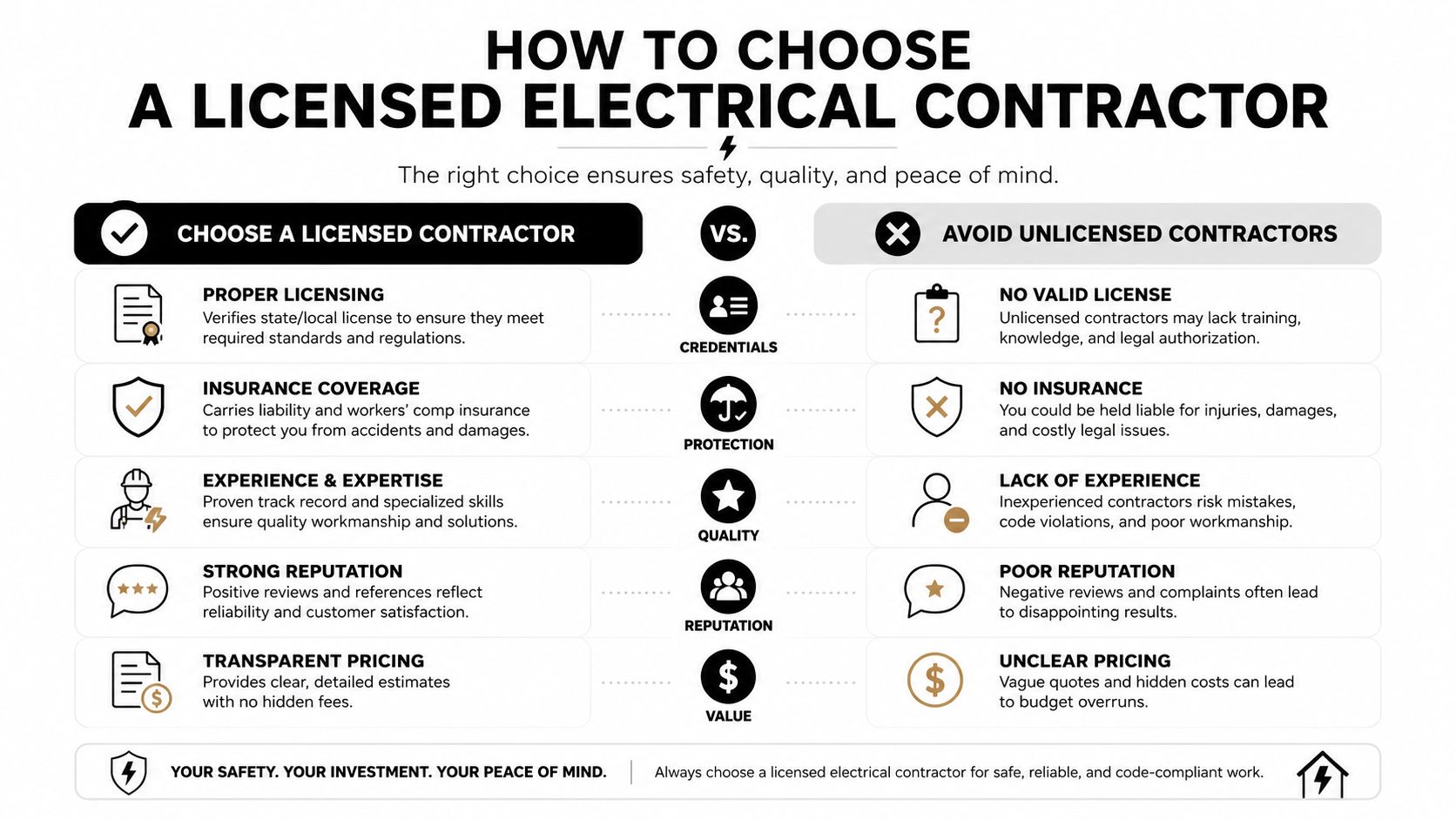
The low bid is only useful when every bidder is offering the same scope, testing depth, reporting standard, safety controls, and response commitment. If one proposal says “inspect electrical system” and another lists thermography, torque verification, protective-device testing, photographs, defect priorities, and closeout reports, the prices aren't comparable.
Compare capability, not just price
Verify the contractor's Florida licensing status through the appropriate state process and confirm that the license classification fits the work. Review general liability, workers' compensation, vehicle coverage, and additional-insured requirements with your risk advisor. Commercial work should also come with a documented safety program covering lockout/tagout, energized work controls, arc-flash boundaries, PPE, and incident reporting.
Ask who provides technical oversight. Complex three-phase distribution, switchgear, generators, and protection systems demand experience beyond ordinary residential troubleshooting. NFPA 70B knowledge and relevant testing credentials can help, but certifications don't replace a clear method statement and qualified supervision.
Read the exclusions
Reject proposals that omit access requirements, outage coordination, reporting, corrective-work authorization, or retesting. Be cautious when the scope has no provision for thermal imaging, no plan for infrared windows where appropriate, and no condition-based recommendations. A contractor who only promises to “check panels” may leave the most important questions unanswered.
Use a simple RFP checklist:
- License and insurance: Verify current documents and proper commercial coverage.
- Testing scope: Ask which instruments, methods, and acceptance criteria will apply.
- Reporting: Require asset-level findings, images, readings, severity, and next actions.
- Response: Define contact paths, arrival expectations, escalation, and temporary power.
- Local execution: Confirm familiarity with Palm Beach County permitting, inspections, and storm conditions.
- Continuity: Determine whether the same team maintains the asset history over time.
Property managers also need reliable call handling after the inspection is complete. A specialized resource on AI answering for electrical contractors may help a contractor organize intake and escalation, but facility leaders should still insist on direct access to licensed electrical professionals for hazardous conditions.
When searching locally, use a specific service request such as commercial electrician near me and compare the resulting providers against the checklist above. A fast response doesn't compensate for weak documentation or unsafe work practices.
Sample Maintenance Plan and Emergency Response Protocol
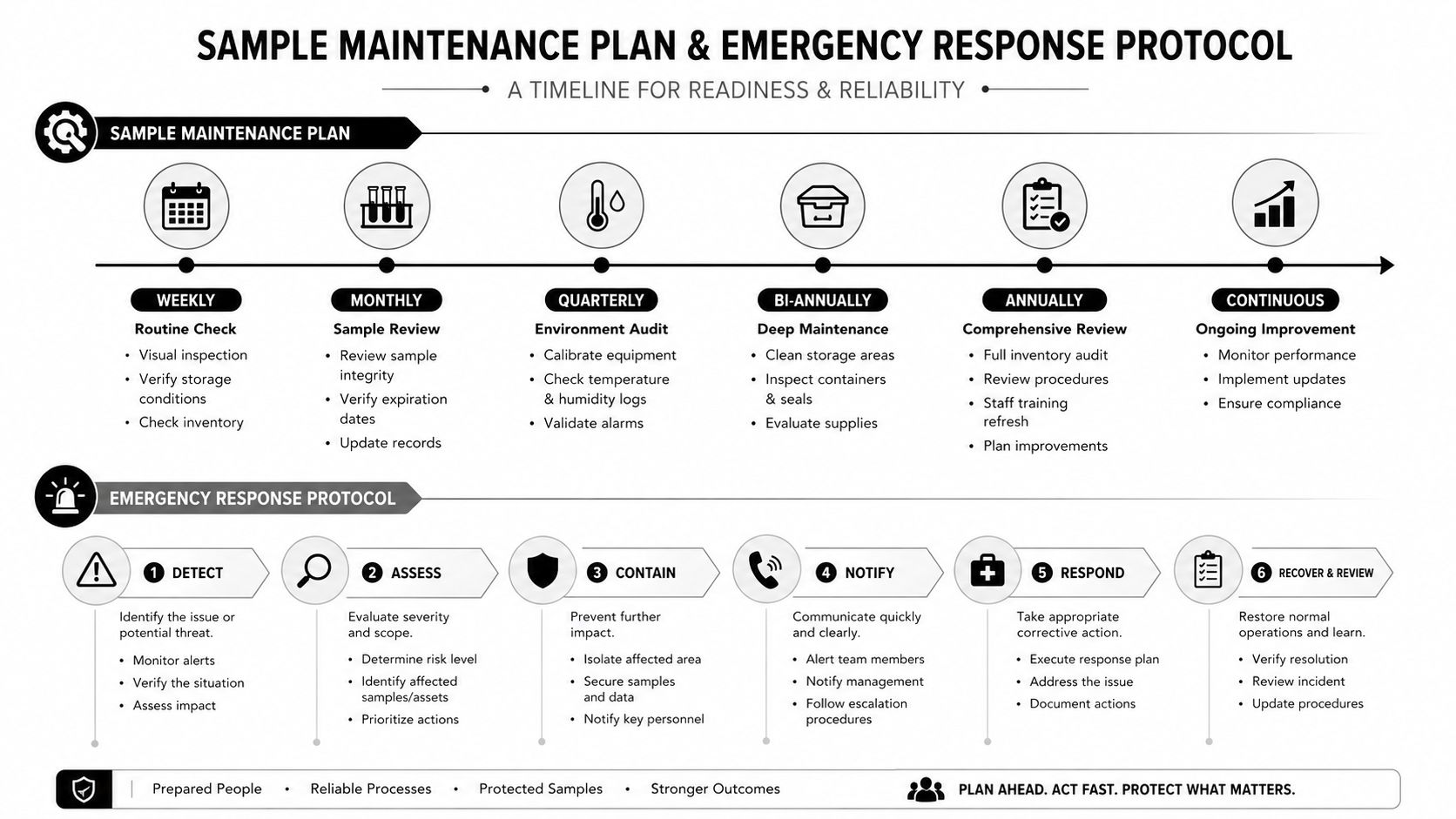
Consider a mixed office and retail facility with approximately 40,000 square feet. It has a main switchboard, transformers, tenant panels, emergency lighting, a generator and transfer switch, rooftop equipment, exterior lighting, and a mix of newer and older distribution equipment. The plan below is a working model, not a substitute for the asset manufacturer's instructions or a site-specific engineering review.
A practical annual rhythm
Monthly, the facility team walks accessible electrical areas, checks for water intrusion, unusual odor, heat, damaged covers, blocked access, nuisance trips, and alarm conditions. Staff don't open energized equipment. They log observations and escalate anything abnormal.
Quarterly, the contractor or qualified in-house team performs targeted preventive work. One visit may focus on switchgear thermography and panel condition. Another can address generator operation, transfer equipment, emergency lighting, and control calibration. A later visit can review panel torque requirements, load observations, surge protection, and outstanding corrective work.
Annually, schedule testing based on the asset register and criticality. Review protection settings, documentation, labels, grounding and bonding, emergency systems, and equipment history. Complete storm preparation before the facility expects severe weather, leaving enough time to correct deficiencies rather than discovering them during an emergency.
What happens during a failure
When the main breaker trips, staff should protect people first, restrict access, identify whether smoke, heat, water, or arcing is present, and call the designated electrical contact. Nobody should repeatedly reset a breaker without identifying the cause. The contractor documents the initial condition, isolates unsafe equipment, tests downstream circuits, and restores power only after the cause is understood.
For partial power loss, the response team maps affected areas and checks whether the issue is upstream, tenant-specific, or related to a transfer system. A ground-fault event requires controlled investigation, not repeated resets. After storm damage, isolate flooded or visibly compromised equipment, coordinate with the utility and building authorities, and deploy temporary power only through qualified personnel.
A tenant notification should state the affected area, safety instruction, expected update time, and contact method. Keep a parallel incident file with call times, photographs, readings, switching decisions, permits, contractor notes, and restoration approval. That record helps the facility manage insurance questions and workplace-safety investigations.
For urgent Palm Beach County failures, a defined vendor path such as emergency electrical repair in Palm Beach County should be established before an outage, not searched for while tenants are standing in a dark lobby.
Local Considerations for Palm Beach County Facilities
Palm Beach County buildings face electrical conditions that generic national checklists often understate. Coastal air can accelerate corrosion on outdoor disconnects, switchgear, panelboards, and hardware. Humidity can contribute to condensation inside enclosures, especially where temperature changes, ventilation problems, or water intrusion affect the equipment environment.
Salt exposure doesn't stop at the shoreline. Air movement, building orientation, rooftop placement, and the condition of enclosure seals all influence how quickly corrosion appears. Technicians should look for discolored terminations, pitted hardware, compromised gasketing, residue, rust trails, and moisture at conduit entries. Cleaning or replacing one visibly damaged part won't solve the problem if the enclosure continues to admit moisture.
Storm readiness belongs in the plan
South Florida facilities also need a deliberate resilience review. Generator starting, transfer operation, fuel arrangements, emergency lighting, surge protection, rooftop equipment disconnects, and critical communications should be tested and documented before severe weather threatens the property. A backup system that starts during a routine test but fails to transfer the intended loads still leaves the building vulnerable.
Lightning and utility disturbances make surge protection and voltage monitoring worth evaluating as part of the broader condition program. The appropriate solution depends on the service arrangement, sensitive equipment, grounding and bonding, existing protection, and the facility's operating profile. Don't treat a plug-in device as a substitute for a coordinated building-level review.
Match attention to exposure
A coastal rooftop disconnect, a generator transfer switch, and a dry interior branch panel shouldn't receive identical treatment. Assign higher inspection priority where moisture, salt, heat, vibration, contamination, high loading, or single-point failure creates greater consequence. Record the environmental reason for the interval so the next manager understands why the schedule differs.
Electrification is adding another layer. Smart lighting, submetering, remote monitoring, UPS equipment, battery storage, renewable generation, EV charging, and integration with HVAC or access control can change load profiles and coordination requirements. Industry coverage identifies these systems as growing areas of commercial electrical service demand, while a market projection places building electrical system maintenance and MRO services at USD 51.88 billion in 2025, rising to USD 75.0 billion by 2035 (commercial electrical services trend coverage). Treat those figures as market projections, not a reason to install technology without a site assessment.
The broader maintenance market reinforces the operational importance of this work. One estimate places global electrical maintenance, repair, and operations spending at approximately USD 714.46 billion in 2025, with a projection of nearly USD 914.57 billion by 2035 at a 2.50% CAGR (electrical maintenance market estimate). Whatever the market size, the facility-level decision remains practical: identify the assets that matter, inspect them under local conditions, document the evidence, and correct defects before weather or demand exposes them.
In Palm Beach County, proactive maintenance isn't paperwork for its own sake. It's how a property team turns climate exposure, changing electrical loads, and storm risk into a manageable operating plan.
Lighthouse Energy Services provides scheduled commercial electrical maintenance, thermal imaging inspections, system upgrades, emergency troubleshooting, and support for generators, switchgear, emergency lighting, and aircraft obstruction lighting across Palm Beach County. Build a condition-based program before the next outage by visiting Lighthouse Energy Services and requesting a facility-focused assessment.